• They Threw Me Out for Loving the Wrong Man. Fifteen Years Later, He Was the Only Reason My Father Was Still Alive.  

    They Threw Me Out for Loving the Wrong Man. Fifteen Years Later, He Was the Only Reason My Father Was Still Alive.  

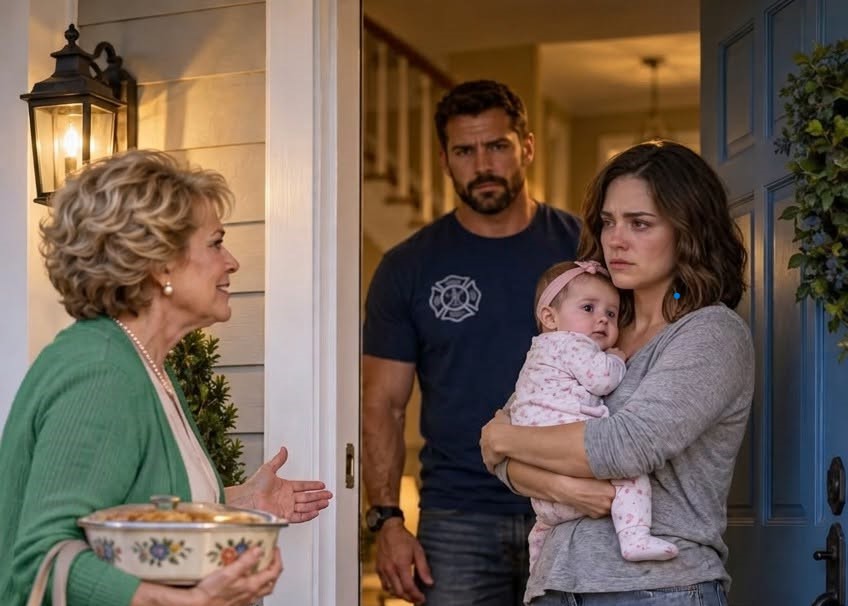
    My mother hadn’t spoken to me in fifteen years, but when she appeared at my front door, she didn’t apologize.

    She smiled.

    Then she opened her arms toward the newborn sleeping against my chest and said, “We’re ready to forgive you.”

    For a moment, I thought I had misheard.

    Behind me, my four-week-old daughter, Ren, made a tiny sleepy sound against my shoulder. Somewhere inside, our dryer hummed. A cartoon played quietly on the television because Silas had forgotten to turn it off before going upstairs.

    Everything about my life was ordinary.

    Safe.

    Mine.

    And on my porch stood the woman who had watched my father throw my suitcase onto a rain-soaked lawn when I was nineteen.

    She carried a casserole dish covered in aluminum foil.

    As if fifteen years of silence could be repaired with baked chicken.

    “Forgive me?” I repeated.

    Mom’s smile wavered.

    “You know what I mean, Colleen. We’ve all made mistakes.”

    I stared at her.

    “No. I don’t think I do.”

    Her eyes dropped to Ren.

    “Oh, look at her.”

    She stepped forward.

    Her hands lifted.

    Instinct moved faster than thought.

    I stepped back.

    Mom froze.

    Something flickered across her face—not hurt.

    Offense.

    As if I had broken some agreement I didn’t know existed.

    “She’s my granddaughter.”

    “You’ve known she existed for four weeks.”

    “That doesn’t change what she is.”

    I almost laughed.

    Then Mom looked past my shoulder toward the brass nameplates Silas had installed beside the blue front door.

    SILAS CALLAHAN.

    COLLEEN CALLAHAN.

    Her lips tightened.

    There it was.

    Fifteen years vanished instantly.

    I was nineteen again, standing in my parents’ foyer as rain hammered the windows.

    My father’s face had been purple with rage.

    “No daughter of mine marries trash.”

    Silas was twenty-one then.

    He drove an old pickup with one working headlight. His father rented half a duplex. They shopped at discount stores and fixed things instead of replacing them.

    Apparently, in my father’s world, poverty was contagious.

    “You want to be a Callahan?” Dad had shouted.

    Then he opened the front door.

    “Go be one.”

    Mom had stood halfway up the stairs in her robe.

    Watching.

    Silent.

    My suitcase landed on the lawn.

    So did a box of nursing-school textbooks.

    By the time I picked them up, rain had soaked through the cardboard.

    I waited.

    I actually waited for my mother to come outside.

    She never did.

    Silas found me twenty minutes later.

    He didn’t ask me to choose between him and my family.

    He simply removed his jacket, wrapped it around me, loaded my ruined things into his truck, and said, “We’ll figure it out.”

    And we did.

    We slept on his father’s foldout couch for eight months.

    We counted my diner tips into a coffee can marked RENT.

    Some weeks, Silas ate peanut-butter sandwiches for dinner and insisted he preferred them because tuition was due.

    I became a nurse.

    Silas entered the fire academy.

    Years passed.

    I became a NICU nurse.

    Silas became a firefighter.

    Then a lieutenant.

    Then a captain.

    We bought a modest white-sided house with a blue door.

    We paid it off early.

    Then, after years of hoping and one miscarriage I had mostly cried through alone, Ren arrived.

    Holding her for the first time taught me something that somehow hurt worse than being thrown out.

    Love for your child wasn’t supposed to have conditions.

    I looked at Ren and knew there was no person she could become that would make me erase her for fifteen years.

    Now my mother stood on my porch pretending those years were a disagreement.

    “I should go,” she said finally.

    “I think you should.”

    Her mouth hardened.

    “Your father is sick, Colleen.”

    That stopped me.

    Not enough to invite her inside.

    But enough.

    “What happened?”

    “His heart.”

    My stomach tightened.

    “How bad?”

    “He collapsed.”

    “When?”

    “A few weeks ago.”

    Before she came here.

    Of course.

    “He’s recovering,” she added. “But experiences like this change people.”

    Apparently not enough to make either of them apologize.

    Mom touched the casserole’s foil covering.

    “He’s been thinking about family.”

    “He had fifteen years.”

    “People get stubborn.”

    “You mean Dad?”

    “I mean everyone.”

    I stared at her.

    She still couldn’t say it.

    They threw me out.

    They cut me off.

    They ignored my graduation, wedding, promotions, birthdays, and pregnancy.

    Yet somehow responsibility remained evenly shared.

    She put the casserole on the porch table.

    “Call me when you’re ready.”

    “I don’t have your number.”

    Mom smiled faintly.

    “Yes, you do.”

    A card sat beneath the casserole.

    Then she walked away.

    That should have ended it.

    Instead, it began a campaign.

    My aunt Deborah called two days later.

    Then Pastor Nylin from my childhood church.

    Then women I hadn’t spoken to since high school began dropping off cards.

    RECONCILIATION HEALS.

    FAMILY IS FOREVER.

    HONOR THY FATHER AND MOTHER.

    No one wrote:

    WE HEARD YOUR PARENTS ABANDONED YOU.

    ARE YOU OKAY?

    Mom had gotten there first.

    She told them Dad had nearly died.

    She told them his only wish was to hold his granddaughter.

    And she told them I refused because I was “still angry about something that happened when I was nineteen.”

    Something.

    As if I had lost a prom dress.

    Then she came to my hospital.

    I was carrying Ren through the main corridor after briefly bringing her to meet several coworkers when I heard Mom’s voice.

    “Colleen.”

    Every face turned.

    My mother walked toward me in a pale pink cardigan, carrying another casserole.

    Of course.

    I had spent nine years in that hospital becoming the calm person.

    The nurse people requested by name.

    The woman who could stand beside terrified parents at three in the morning and explain ventilators without worsening their fear.

    Now my mother was turning my workplace into a stage.

    “There’s my beautiful granddaughter.”

    She reached for Ren.

    I stepped back again.

    Mom stopped.

    A couple of nurses looked away awkwardly.

    “I only want to hold her.”

    “No.”

    Her face immediately crumpled.

    Perfectly.

    “You won’t even let your own mother hold her grandchild?”

    I understood then.

    This wasn’t reconciliation.

    It was pressure.

    Public pressure.

    Mom expected embarrassment to accomplish what guilt hadn’t.

    But she had made one mistake.

    She thought silence meant I was still nineteen.

    I wasn’t.

    That night, after Ren fell asleep, I opened my nightstand’s top drawer and removed an old envelope.

    Nana Ruth’s handwriting covered the front.

    For Colleen.

    My grandmother had been the only Whitfield who contacted me after I was thrown out.

    Never openly.

    Birthday cards arrived without return addresses.

    Cash appeared in Christmas cards.

    When I graduated nursing school, flowers arrived with a note:

    KNEW YOU WOULD.

    Before she died, she mailed one final letter.

    Part of it was carved into my memory.

    “People like that don’t come back for you when they love you. They come back when they’ve lost everything else and need somewhere to put their hands. You don’t owe them the door.”

    I had always assumed she meant emotionally.

    That night, I noticed something new.

    The envelope was thicker near one corner.

    I ran my thumb beneath the paper lining.

    Something small fell into my palm.

    A brass key.

    No label.

    No explanation.

    Just a key.

    I was still staring at it when someone knocked downstairs.

    Silas was working overnight.

    I checked the porch camera.

    My brother Grant stood outside.

    I hadn’t seen him in fifteen years.

    He looked twenty years older.

    When I opened the door, he didn’t hug me.

    He said, “You shouldn’t sign anything Mom gives you.”

    My hand tightened around the doorknob.

    “What?”

    “The agency is collapsing.”

    The Whitfield Insurance Agency had been my family’s pride for forty years.

    Dad talked about it like royalty talked about bloodlines.

    “What does that have to do with me?”

    Grant laughed once, without amusement.

    “A lot more than anyone told you.”

    I let him inside.

    We sat at the kitchen table.

    Grant rubbed both hands over his face.

    “The agency has debt. Serious debt. Dad borrowed against the house. There are liens. The commercial building is collateral.”

    “How much?”

    “Almost nine hundred thousand.”

    My stomach dropped.

    “Why?”

    “He made bad decisions. Then he made more bad decisions trying to fix the first ones.”

    “And Mom came to me because?”

    Grant looked toward the hallway where Ren slept.

    “They need a signature.”

    I stared at him.

    “Whose?”

    “Yours.”

    He reached into his jacket.

    Then placed a thick envelope on my kitchen table.

    The first document bore my name.

    COLLEEN WHITFIELD CALLAHAN.

    Beneath it was an amount.

    $1,240,000.

    My fingers went cold.

    “What is this?”

    “A personal guaranty.”

    “I never signed this.”

    Grant met my eyes.

    “I know.”

    A signature sat at the bottom.

    It looked remarkably like mine.

    But it wasn’t.

    Someone had forged it.

    I heard my heartbeat.

    “What the hell did they do?”

    Grant lowered his voice.

    “Nana left you part of the agency.”

    I stared at him.

    “No.”

    “She did.”

    “How much?”

    “Fifty-one percent.”

    I laughed because sometimes your body chooses the wrong reaction when reality becomes too absurd.

    “That’s impossible.”

    “She changed the trust after Dad threw you out.”

    The room went still.

    According to Grant, Nana Ruth had controlled most of the original Whitfield Agency stock because she and my grandfather founded the business.

    Before dying, she transferred controlling interest into a trust.

    For me.

    Dad had hidden it.

    Years earlier, papers were filed claiming I had voluntarily transferred those shares back to him.

    The signature was forged.

    The recent loan was partly built on that lie.

    And now a bank review had found discrepancies.

    “They need you to ratify everything,” Grant said. “If you sign now, it makes the old transfer look legitimate.”

    “So Mom didn’t come because Dad almost died.”

    Grant looked down.

    “She came because the bank froze the deal four days after he collapsed.”

    I sat silently.

    For fifteen years, my parents had acted as if I were dead.

    Then I became useful.

    And suddenly they believed in family.

    I looked at the brass key beside Nana Ruth’s letter.

    “What does this open?”

    Grant’s face changed.

    “I’ve never seen it.”

    Three mornings later, another piece fell into place.

    Silas was making pancakes.

    Ren slept in a bassinet nearby.

    I had spent half the night searching public records tied to the agency.

    Dad’s collapse happened at his house on Sycamore Street.

    I looked at Silas.

    “Which crew answered the cardiac call on Sycamore?”

    His spatula stopped.

    His shoulders stiffened.

    My skin prickled.

    “Silas.”

    He turned slowly.

    “That was my crew.”

    For a second, I couldn’t breathe.

    “What?”

    He switched off the burner.

    “That was me, Colleen.”

    “You were there?”

    “Yes.”

    “You knew it was him?”

    “Not until I walked into the kitchen.”

    I stared.

    Silas leaned against the counter.

    “He was on the floor. No pulse. Your mom was screaming.”

    “What did you do?”

    His expression barely changed.

    “My job.”

    CPR.

    Defibrillation.

    Medication.

    More CPR.

    Silas had knelt on my parents’ kitchen floor until Dad’s heart started beating again.

    The man my father had called trailer trash had brought him back from the dead.

    “Why didn’t you tell me?”

    “Because you had just given birth. Because you were exhausted. Because I didn’t want his emergency becoming another way your family entered our house.”

    I started crying.

    Not because Dad nearly died.

    Not entirely.

    Because Silas had every reason to hate him.

    And saved him anyway.

    “What did Dad say when he recognized you?”

    Silas was quiet.

    Finally, he said, “He said my name.”

    That hurt more than expected.

    After fifteen years refusing to speak it, my father had looked at Silas from a hospital stretcher and whispered:

    “Callahan.”

    Pastor Nylin arranged a family meeting the following week.

    My parents arrived believing they were walking toward reconciliation.

    Mom brought tears.

    Dad brought his cane.

    Aunt Deborah sat beside them.

    Grant sat near the back.

    Ren stayed with Silas’s father.

    I entered alone.

    Mom began almost immediately.

    “We forgive her for everything, Pastor. We only want our daughter back.”

    I looked at her.

    “For everything?”

    She blinked.

    “What exactly are you forgiving me for?”

    Dad shifted.

    “Colleen—”

    “No.”

    I turned to him.

    “You threw me out at nineteen. I didn’t run away. I didn’t abandon this family. You removed me from it.”

    Nobody spoke.

    Then I asked what I had waited fifteen years to ask.

    “Say his name.”

    Dad frowned.

    “What?”

    “My husband.”

    His jaw tightened.

    “Say his name.”

    Mom whispered, “This is ridiculous.”

    “No. It isn’t.”

    Dad stared at me.

    He couldn’t do it.

    For fifteen years, Silas had been “that man.”

    “That Callahan.”

    “Trash.”

    Anything except himself.

    I leaned forward.

    “His name is Silas Callahan.”

    Dad’s hand tightened around his cane.

    I took a breath.

    “And the night your heart stopped in that kitchen, Silas Callahan was the man who brought you back.”

    Mom stopped crying.

    Aunt Deborah’s mouth fell open.

    Pastor Nylin looked sharply at Dad.

    My father went white.

    “Is that true?” Deborah whispered.

    Dad looked at the floor.

    “Yes.”

    The word barely existed.

    I waited.

    Then Dad finally raised his head.

    “Silas Callahan saved my life.”

    Fifteen years.

    That was all it took.

    One sentence.

    And hearing it somehow didn’t heal me.

    It only proved he had always been capable of saying the name.

    Then I placed the forged guaranty on the table.

    Mom’s face changed before Dad’s.

    That told me everything.

    “What is this?” Pastor Nylin asked.

    “My signature,” I said.

    Then I looked directly at Mom.

    “Except I didn’t sign it.”

    Her lips parted.

    Dad whispered, “Margaret.”

    Interesting.

    Not Colleen.

    Not calm down.

    Margaret.

    I turned to him.

    “You knew?”

    Dad looked older than five minutes earlier.

    “I knew about the shares.”

    “The forged transfer?”

    He didn’t answer.

    “That’s a yes.”

    Mom stood abruptly.

    “This is private family business.”

    “No,” I said. “You made it public when you brought half the church to my hospital.”

    Grant spoke behind us.

    “Tell her why you needed the signature.”

    Mom spun around.

    “Grant, stop.”

    He walked forward.

    “The bank won’t recognize the refinancing unless Colleen ratifies the old transfer.”

    Dad closed his eyes.

    Mom’s face hardened.

    No tears this time.

    “You have no idea what it takes to hold a family together.”

    I laughed.

    “You threw one of your children away.”

    “I was protecting this family.”

    “From Silas?”

    “From instability.”

    I looked around the fellowship hall.

    Then back at her.

    “My husband has never missed a mortgage payment. You forged my name for more than a million dollars.”

    Mom flinched.

    For the first time, I saw shame.

    But then Grant said something strange.

    “Ask her about the payments to Hawthorne Consulting.”

    Mom went completely still.

    Dad looked confused.

    “What payments?”

    And just like that, the room changed again.

    Grant removed another stack of documents.

    Transfers.

    Dozens of them.

    Thousands of dollars each.

    Hawthorne Consulting.

    “What is that?” Dad asked.

    Mom didn’t answer.

    Grant looked at me.

    “I found these after Dad collapsed.”

    Something bothered me.

    Grant sounded nervous.

    Not sad.

    Not angry.

    Nervous.

    I looked at the transfers.

    Then at him.

    “You said the agency was collapsing because Dad made bad decisions.”

    “It is.”

    “But you already knew money was disappearing.”

    “Yes.”

    “How long?”

    Grant hesitated.

    Too long.

    The brass key in my pocket suddenly felt heavy.

    I stood.

    “I’m done.”

    Mom called after me.

    “Colleen!”

    I turned at the door.

    “You wanted me back in the tent.”

    My voice shook, but not from fear.

    “You should’ve made sure there wasn’t a fire inside it first.”

    The next morning, I called the law firm listed on Nana Ruth’s old correspondence.

    When I gave my name, the receptionist went silent.

    Then she transferred me directly to a senior partner.

    “Mrs. Callahan,” he said, “we have been waiting nearly eleven years for you to call.”

    The brass key opened a safe-deposit box.

    Nana Ruth had arranged everything.

    The box contained original trust documents.

    Stock certificates.

    Letters.

    And a small digital recorder wrapped in one of her scarves.

    There was also a note.

    Colleen—

    If you are opening this, then someone finally needed something badly enough to remember you exist.

    My hands trembled.

    I played the recorder.

    Nana Ruth’s voice filled the tiny bank consultation room.

    Older.

    Weaker.

    But unmistakably hers.

    She explained the trust.

    The shares.

    Dad’s anger.

    Then she said something that stopped me cold.

    “Your father thinks I changed the trust because of what he did to you.”

    A pause.

    “I did not.”

    My skin prickled.

    “I changed it because I discovered what was happening inside the agency.”

    She mentioned irregular accounts.

    False vendors.

    Missing premium payments.

    Thousands disappearing.

    Then hundreds of thousands.

    “I confronted your father,” Nana said. “He denied stealing anything. For once, I believed him.”

    My heart thudded.

    If not Dad—

    Then who?

    Nana continued.

    “I became suspicious of Margaret.”

    My mother.

    But another pause followed.

    Longer this time.

    “I was wrong about her too.”

    I stopped breathing.

    “Colleen, if this recording has reached you, do not trust the person who brings you the truth too easily.”

    Grant.

    I replayed the sentence.

    Then again.

    Nana continued.

    “Your brother learned very young that honest people hesitate. Liars arrive prepared.”

    The room seemed to tilt.

    Grant had appeared at my door.

    With documents.

    With answers.

    With exactly enough truth to stop me asking who assembled it.

    I called an attorney.

    Then a forensic accountant.

    Forty-eight hours later, we knew.

    Hawthorne Consulting belonged to Grant.

    Not directly.

    Through two shell companies and an LLC registered under his wife’s maiden name.

    For eleven years, Grant had siphoned money from the family agency.

    Small amounts first.

    Then larger ones.

    When Dad noticed cash-flow problems, Grant blamed market losses and bad investments.

    When the business needed loans, Grant prepared the paperwork.

    When the forged share transfer became an obstacle, Grant forged my signature.

    Mom knew the transfer was questionable.

    Dad knew I had never willingly signed away the shares.

    They were guilty.

    But not of everything Grant claimed.

    They had agreed to let Grant “fix” the documentation rather than contact me.

    Why?

    Pride.

    Fear.

    And because contacting the daughter they disowned meant admitting what they had done.

    Then came the final discovery.

    Dad’s cardiac arrest hadn’t happened randomly.

    He collapsed during an argument with Grant.

    A neighbor’s doorbell camera showed Grant leaving my parents’ house eight minutes before the 911 call.

    Mom found Dad on the kitchen floor minutes later.

    When I confronted Grant, he laughed.

    We were in the agency conference room.

    My attorney sat beside me.

    Silas waited outside.

    “You think Nana made you some kind of hero?” Grant said.

    “No.”

    “You weren’t here, Colleen. You got to leave.”

    I almost couldn’t believe him.

    “Leave?”

    “You escaped all of it. Dad’s expectations. Mom’s control. This business. Everything landed on me.”

    “So you stole from them?”

    “I took what I was owed.”

    “Then why come to me?”

    His smile vanished.

    Because now we had reached the part he hadn’t planned for me to understand.

    The agency wasn’t beyond saving.

    Its property alone was worth more than its debts.

    If I had signed Grant’s ratification documents, the refinancing would have gone through.

    My controlling interest would have been legally surrendered.

    And within thirty days, Grant planned to sell the building and agency book.

    He would pay the bank.

    Pay my parents enough to keep them quiet.

    Then walk away with nearly two million dollars.

    He hadn’t come to rescue me from them.

    He had come to weaponize my anger.

    “You knew Mom would pressure me,” I said.

    Grant smiled without humor.

    “I knew she couldn’t help herself.”

    “And you knew I’d believe the worst.”

    “You had fifteen years of evidence.”

    That was the cruelest part.

    He was right.

    My parents had treated me badly enough that Grant barely needed to lie.

    I looked at my brother.

    “You were the one who told Mom to get me back in the tent.”

    He didn’t answer.

    But his face did.

    Police arrested Grant three weeks later.

    Bank fraud.

    Forgery.

    Embezzlement.

    The investigation uncovered more.

    My parents weren’t innocent.

    Dad had signed false corporate resolutions.

    Mom had knowingly notarized one document she knew I hadn’t signed.

    Their desperation had made them accomplices to their own son.

    But Grant had built the machine.

    My parents had simply been arrogant enough to believe it would never crush them.

    Dad came to my house two months later.

    Alone.

    He stood on the porch where Mom had once held that casserole.

    He looked smaller.

    Older.

    He stared at the blue door.

    “I owe Silas my life.”

    “Yes.”

    “And I owe you…”

    He stopped.

    I waited.

    This time, I didn’t rescue him from the sentence.

    “I owe you an apology.”

    I said nothing.

    “For throwing you out.”

    Still nothing.

    “For what I called him.”

    He swallowed.

    “For making love something you had to earn.”

    That one hurt.

    Because it was the first thing he said that sounded like understanding.

    Dad looked at me.

    “I was wrong about Silas Callahan.”

    The front door opened behind me.

    Silas stepped outside holding Ren.

    Dad stared at him.

    Then at the baby.

    For a second, I saw hope in his face.

    I also saw how easy it was to mistake apology for repair.

    They weren’t the same.

    “You can’t have fifteen years back,” I said.

    Dad nodded.

    “I know.”

    “And you don’t get access to Ren because you said sorry.”

    His eyes lowered.

    “I know.”

    “But maybe someday she’ll know you.”

    He looked up.

    “Maybe?”

    “If you earn it.”

    Dad nodded.

    Then he looked at Silas.

    “Captain Callahan.”

    Silas raised an eyebrow.

    Dad almost smiled.

    “Thank you for saving my life.”

    Silas gently shifted Ren.

    “I didn’t do it for you.”

    Dad blinked.

    Silas looked at me.

    “I did my job because that’s who I am.”

    Dad nodded slowly.

    “I understand.”

    After he left, I leaned against Silas.

    Ren grabbed my necklace.

    “You okay?” he asked.

    “I think so.”

    But there was one final piece.

    Weeks later, after Grant accepted a plea agreement, Nana Ruth’s attorney called.

    “There’s something else in the trust.”

    I almost laughed.

    “Of course there is.”

    We met the next afternoon.

    He opened a sealed envelope.

    Inside was one last letter.

    Colleen—

    If everything has happened the way I feared, then by now you know about the agency.

    You also know it belongs to you.

    That part was true.

    Grant’s conviction voided several transactions.

    The forged transfer had never been valid.

    Legally, I still owned fifty-one percent.

    Dad owned twenty-four.

    Grant’s shares were subject to seizure.

    The rest belonged to a family trust.

    I kept reading.

    I did not leave you this business because I wanted you to run it.

    I did not leave it because Whitfield is your name.

    It isn’t anymore, and that is all right.

    I left it because when your father threw you out, he wanted you to believe he had taken your future with him.

    I wanted you to know he never had that power.

    My eyes blurred.

    Then I reached the final paragraph.

    And discovered Nana Ruth’s last secret.

    Silas’s father had known.

    Years earlier, when Nana first suspected money was disappearing, she needed someone outside the Whitfield family to quietly help verify whether several insured properties and claims were real.

    She contacted someone she trusted.

    A maintenance worker who also volunteered with the local fire department.

    Patrick Callahan.

    Silas’s father.

    The man my father later called trash.

    Patrick had helped Nana uncover the first false vendors Grant created as a teenager working summers at the agency.

    Nana planned to confront Grant.

    Then she became ill.

    Before she could finish, Dad discovered Patrick had been looking through company records.

    He assumed Patrick was trying to expose or blackmail the family.

    That was the real reason Dad hated the Callahans.

    Not poverty.

    Not class.

    Fear.

    When Silas and I started dating, Dad panicked.

    He threw me out because he believed loving Silas might eventually lead me to the truth.

    I sat frozen.

    For fifteen years, I believed I lost my family because they thought the man I loved wasn’t good enough.

    The truth was uglier.

    Silas had always been too close to the truth for them to feel safe.

    I showed him Nana’s letter that night.

    Silas read it twice.

    Then sat quietly on our kitchen floor.

    “My dad knew?”

    “He helped her.”

    Silas laughed softly.

    Then covered his face.

    Patrick Callahan had died seven years earlier without telling his son.

    We went through his old things the next weekend.

    At the bottom of a battered metal toolbox, Silas found an envelope.

    Nana Ruth’s handwriting was on it.

    PATRICK.

    Inside was one note.

    Thank you for protecting my granddaughter before she even knows she needs protecting.

    Silas cried.

    I had seen my husband carry injured children from buildings.

    I had watched him stand beside hospital beds.

    I had watched him remain steady through funerals.

    I had never seen him cry like that.

    Six months later, I sold the Whitfield Insurance Agency.

    I paid every legitimate debt.

    My parents lost the big house on Sycamore, but not because I took it.

    They sold it themselves.

    Dad moved into a small condominium.

    Mom stayed with Aunt Deborah for a while.

    They began therapy.

    Separately.

    I didn’t forgive them because a pastor asked me to.

    I didn’t forgive them because Dad nearly died.

    I didn’t forgive them because people said life was short.

    Forgiveness, I learned, wasn’t a door others were entitled to walk through.

    Sometimes it was simply deciding their choices would no longer own the rooms inside you.

    With part of the agency proceeds, Silas and I created a fund in Patrick Callahan and Ruth Whitfield’s names.

    It helped families with babies in intensive care.

    It also provided emergency assistance to firefighters injured in the line of duty.

    The two people my family had underestimated most ended up sharing a foundation’s name.

    A year after my mother first appeared on my porch, she returned.

    No casserole.

    No audience.

    No tears prepared in advance.

    She stood with her hands at her sides.

    “I drove here three times before I had the courage to knock.”

    I waited.

    “I’m sorry.”

    Two words.

    Fifteen years late.

    But finally the right ones.

    “For what?” I asked.

    Her eyes filled.

    “For standing on those stairs.”

    That nearly broke me.

    Not because it fixed anything.

    Because she finally remembered the exact moment I did.

    “I watched him put you out,” she whispered. “And I chose being his wife over being your mother.”

    I swallowed hard.

    “Yes.”

    “I can’t undo that.”

    “No.”

    She nodded.

    Then turned to leave.

    “Mom.”

    She stopped.

    Ren was toddling behind me now, clutching a stuffed rabbit.

    My mother looked down at her.

    She didn’t reach.

    That mattered.

    “Five minutes,” I said.

    Mom looked at me.

    “On the porch.”

    Her face crumpled.

    She nodded.

    “Five minutes.”

    I sat outside with Ren on my lap.

    Mom sat across from us.

    No one pretended we were healed.

    No one called us whole.

    But something had changed.

    Not because my parents finally chose me.

    Because somewhere between nineteen and thirty-four, between a rain-soaked suitcase and a blue front door, I had learned to choose myself.

    Ren reached for the brass nameplate beside the door.

    CALLAHAN.

    Mom followed her tiny hand.

    I remembered the first time she stood there.

    How her face changed when she saw that name.

    She thought Callahan meant I had chosen the wrong family.

    She was wrong about that too.

    Because the Whitfields gave me blood.

    But Silas gave me shelter when I had nowhere to sleep.

    Patrick helped protect me before I knew I was in danger.

    Nana Ruth reached across silence to leave me a choice.

    And my daughter taught me the simplest truth.

    Family wasn’t the people who demanded you return after hurting you.

    Family was the people who never made love the price of staying.

    Mom looked at Ren.

    “What’s her full name?”

    I smiled.

    It occurred to me then that after everything—the casseroles, the church campaign, the forged documents, the desperate talk about her only granddaughter—my mother had never once asked.

    I kissed Ren’s hair.

    “Ren Ruth Callahan.”

    Mom went completely still.

    “Ruth?”

    “After Nana.”

    Tears slid down her face.

    This time, I believed them.

    Ren wriggled from my arms and toddled toward Silas, who had appeared in the doorway.

    He scooped her up.

    Mom looked at the three of us.

    At Silas.

    At me.

    At Ruth’s namesake.

    At the name beside the door she had once despised.

    And finally she understood what none of them had understood fifteen years earlier.

    My father had thrown my suitcase onto the lawn and told me that if I wanted to be a Callahan, I should go become one.

    He thought he was giving me a punishment.

    He had no idea he was giving me directions home.

  • “Dad… my back hurts so bad I can’t sleep. Mom told me not to tell you.” I had just walked in from a business trip when my eight-year-old daughter quietly shared the secret her mother never wanted me to hear.  

    “Dad… my back hurts so bad I can’t sleep. Mom told me not to tell you.” I had just walked in from a business trip when my eight-year-old daughter quietly shared the secret her mother never wanted me to hear.  

    PART 1

    I hadn’t even been home fifteen minutes.

    My suitcase was still by the door. My jacket sat untouched on the couch. I’d barely stepped inside when I felt it—something was off.

    No tiny footsteps running to greet me. No laughter. No hug.

    Just silence.

    Then her voice came from the bedroom.

    Soft. Weak. On the verge of breaking.

    “Dad… please don’t be mad,” she whispered. “Mom said if I told you, things would get worse. But my back hurts… and I can’t sleep.”

    I froze in the hallway.

    One hand still gripping my suitcase, my heart pounding so loudly it felt like it echoed through my chest.

    This wasn’t a tantrum. This wasn’t a child exaggerating. This was fear.

    I turned toward the room and saw Lily standing partially hidden behind the door, like she expected someone to drag her away at any moment. Her shoulders were stiff. Her eyes stayed locked on the floor. She looked so small—too small.

    “Lily,” I said gently, keeping my voice steady. “Dad’s here. Come here, sweetheart.”

    She didn’t move.

    I set my suitcase down and walked toward her slowly, careful not to startle her. When I knelt in front of her, she flinched—and a cold chill shot through me.

    “Where does it hurt?” I asked softly.

    Her little hands twisted the hem of her pajama shirt until her knuckles turned white.

    “My back,” she murmured. “It hurts all the time. Mom said it was an accident. She told me not to tell you. She said you’d get mad… that something bad would happen.”

    Something inside me shattered.

    I reached out without thinking—but the moment my hand touched her shoulder, she gasped and pulled away.

    “Please… don’t,” she said quietly. “It hurts.”

    I pulled back immediately.

    Panic rose in my throat, but I forced myself to stay calm.

    “Tell me what happened.”

    She glanced toward the hallway, like she was afraid someone might hear.

    Then, after a long pause, she said the words no parent is ever prepared for:

    “Mom got mad. I spilled juice. She said I did it on purpose. She pushed me… and my back hit the door handle. I couldn’t breathe. I thought… I was going to disappear.”

    For a moment, I couldn’t breathe.

    Not because I didn’t understand— but because I understood perfectly.

    Everything in the house suddenly felt different.

    The walls. The silence. The air.

    I had walked in expecting a normal evening.

    Instead, I found my daughter whispering through pain, scared of her own mother, begging me not to make things worse just by knowing the truth.

    And in that moment, I knew—this was only the beginning.

    Because when a child says something like that… the truth doesn’t stay hidden for long.

    I stayed there on my knees, keeping my voice gentle.

    “You did the right thing telling me,” I said.

    She still couldn’t look at me.

    “How long has it been hurting?”

    “Since yesterday.”

    “Did you tell Mom it still hurts?”

    She nodded faintly.

    “What did she say?”

    Lily swallowed. “She said I was overreacting.”

    Those words hit harder than anything else.

    “Can you show me your back?” I asked softly.

    She hesitated… then slowly turned around and lifted her shirt.

    And suddenly, my vision blurred at the edges…

    PART 2

    The bruise was worse than I imagined—deep purple, spreading across her lower back, with a dark center the exact shape of a door handle. Around it were faint yellow marks—older bruises. Healing ones.

    Not one injury. A pattern.

    She quickly pulled her shirt back down, ashamed.

    “Please don’t yell,” she whispered.

    That almost broke me.

    Because what she feared most wasn’t the pain. It was my reaction.

    “I’m not going to yell,” I said carefully. “And I’m not going to let anyone hurt you again.”

    Her lips trembled, and a single tear traced down her pale cheek.

    Before I could say another word, the heavy wooden front door unlocked. The sound of high heels echoed sharply down the hardwood hallway.

    My wife, Sarah, walked in carrying grocery bags, humming a light tune as if it were any ordinary Tuesday evening. She set the bags on the kitchen island, pulled off her coat, and walked toward the hallway.

    When she saw me kneeling outside Lily’s room, her expression flickered—a flash of surprise, quickly replaced by a bright, practiced smile.

    “Mark! You’re back early,” she said smoothly, walking over to kiss my cheek. “Why didn’t you call? I would have made dinner.”

    I didn’t lean into her kiss. I stood up slowly, stepping slightly to place my body between Sarah and Lily.

    “What happened to Lily’s back, Sarah?” I asked. My voice wasn’t raised, but it carried an edge of cold steel that made her pause mid-step.

    Sarah’s smile faltered for a fraction of a second before tightening into a defensive frown. She glanced past me at our daughter, who was shrinking back into the shadows of her doorway.

    “Oh, she told you?” Sarah sighed, rolling her eyes and folding her arms. “She is so dramatic, Mark. She tripped over her own feet yesterday and bumped into the door frame. I told her to put ice on it, but she’s been whining about it ever since.”

    “She didn’t trip, Sarah,” I said, looking her dead in the eye. “There’s a deep purple impact mark in the exact shape of a brass door handle. And there are yellowing bruises all around it.”

    Sarah’s face drained of color. “Are you calling me a liar?”

    “I’m asking you why my daughter is terrified to tell me she’s in pain because you threatened her that things would ‘get worse.’”

    “I didn’t threaten her!” Sarah’s voice spiked into a sharp, shrill register. “I discipline our daughter while you’re off traveling for work! Do you have any idea how hard it is to manage her alone? She spilled juice all over the expensive rug! It was an accident!”

    “Pushing an eight-year-old child so hard her back hits a metal handle isn’t an accident, Sarah,” I snapped, my calm facade cracking. “It’s abuse.”

    “Don’t you dare use that word in my house!” she shrieked, taking a step toward me.

    Behind me, Lily let out a tiny, frightened whimpering sound and covered her ears.

    That sound was the absolute turning point.

    I pulled my phone out of my pocket.

    “What are you doing?” Sarah asked, her eyes widening in sudden panic as her defensive anger crumbled.

    “I’m taking Lily to the emergency room,” I said flatly, keeping my eyes on her. “And I’m calling Child Protective Services and the police from the car.”

    “Mark, stop! You’re ruining our family over a stupid bruise!” Sarah lunged forward, trying to grab my phone, but I caught her wrist firmly in mid-air, holding her back without hurting her.

    “Touch me or touch my daughter again,” I warned, my voice dropping into a dangerous, clinical whisper, “and you’ll be leaving this house in handcuffs tonight instead of tomorrow.”

    I released her wrist. She stumbled back against the hallway wall, breathing heavily, staring at me as if she were looking at a complete stranger.

    I turned around, knelt down, and picked Lily up as gently as humanly possible, cradling her small body against my chest so no pressure touched her lower back. She buried her face into my neck, her tiny arms wrapping tightly around my shoulders.

    “I’ve got you, sweetheart,” I whispered. “Dad’s got you.”

    Without looking back at Sarah, I carried my daughter out the front door, placed her securely in her car seat, and drove straight to the hospital.

    PART 3

    The emergency room at City General was bright, loud, and smelled strongly of antiseptic.

    Because of the nature of Lily’s injuries, the triage nurse immediately flagged us for a private room in the pediatric wing. Within twenty minutes, a pediatrician, Dr. Hayes, accompanied by a hospital social worker named Brenda, performed a full examination.

    I stood in the corner of the room, my hands shoved deep into my pockets, watching with a heavy heart as Dr. Hayes gently documented every mark on Lily’s skin.

    High-resolution photographs were taken. X-rays were ordered to check for hairline spinal fractures. Every single scratch, old bruise, and fresh impact mark was cataloged into an official medical report.

    “The X-rays came back clear of any fractures, which is a miracle,” Dr. Hayes said quietly, stepping out into the hallway with me while Brenda stayed inside to draw pictures with Lily. “However, the tissue damage to her lower lumbar region is severe. And Mr. Miller… the pattern of yellow and green discoloration across her shoulder blades indicates repeated soft-tissue trauma over the last several months.”

    My heart sank into my stomach. “I was traveling three weeks out of every month… I had no idea.”

    “Abusers are very good at hiding it from loving partners,” Brenda said gently, stepping out to join us in the hall. “The hospital has already filed an emergency report with Child Protective Services and the local police department. An officer is on his way to take your statement.”

    An hour later, Officer Davis arrived. I gave a full, detailed statement, detailing the timeline, the conversation I had with Lily, and Sarah’s reaction when I confronted her at the house.

    While Officer Davis was typing up the formal report, my phone began vibrating continuously in my pocket.

    Dozens of missed calls from Sarah.

    Then text messages started flooding in:

    Mark, please don’t do this. I’m sorry. I need help. Let’s talk about this as a family. If you tell the doctors, they will take Lily away from BOTH of us! Where are you?! I’m coming to the hospital!

    I showed the messages directly to Officer Davis.

    “Mr. Miller,” Officer Davis said, his face stern. “An emergency temporary protection order is being granted immediately. I’m sending a unit to your residence right now to detain your wife for questioning.”

    I looked through the glass window of the hospital room. Lily was sitting on the exam bed, swinging her small legs, coloring a picture of a sun with bright yellow crayons. For the first time in months, her shoulders weren’t hunched. She looked safe.

    “Do whatever you have to do, Officer,” I said firmly. “My wife is never getting near my daughter again.”

    FINAL PART

    By the next afternoon, the legal gears had turned with terrifying speed and precision.

    Sarah was arrested at our home that evening and booked on charges of felony child abuse and domestic battery. Because of the documented medical evidence, the official social worker reports, and Lily’s own clear statement, an emergency custody judge granted me exclusive, full temporary custody of Lily, alongside an absolute restraining order against Sarah.

    Two days later, I went back to the house alone while Lily stayed safely at my sister’s home.

    The house was eerily silent. Sarah had been released on bail, but the judge had barred her from coming within five hundred feet of our property.

    I walked into the master bedroom, pulled my heavy travel suitcases out of the closet, and began packing Sarah’s clothes, shoes, and personal belongings into cardboard boxes. I was severing every tie, clearing every trace of the woman who had terrorized my child while I was away.

    While clearing out her nightstand drawer, I found a small leather-bound diary tucked beneath a stack of magazines.

    I opened it.

    Page after page detailed Sarah’s mounting resentment toward our life, toward my career, and toward our innocent daughter. She wrote about her explosive temper, her inability to handle stress, and how she used physical force to “keep Lily quiet” so I wouldn’t suspect anything when I called home from my business trips.

    There was no remorse in those pages. Only anger and self-pity.

    I closed the diary, placed it inside an evidence bag, and called my family law attorney. It was the final piece of evidence needed to ensure Sarah would never receive unsupervised access to Lily ever again.

    Six months later.

    The afternoon sun was warm as it streamed through the tall trees of our new suburban home—a quiet, single-story house I had bought three towns over, far away from the memories of the old place.

    I had resigned from my travel-heavy corporate job, taking a local management position that allowed me to be home every single afternoon by four o’clock.

    I stood on the back porch holding two glasses of cold lemonade.

    Out in the yard, Lily was running across the grass, chasing our new golden retriever puppy. Her laughter filled the clear afternoon air—bright, loud, and completely unrestricted.

    When she saw me standing on the porch, she stopped, waved frantically, and came running over.

    Her back had healed completely. But more importantly, the fearful, guarded look in her eyes had vanished, replaced by the bright, confident spirit of an eight-year-old girl who knew she was cherished and protected.

    “Dad! Watch how fast Buster can run!” she shouted, wiping a golden curl from her forehead.

    I walked down the porch steps, knelt beside her, and handed her the lemonade. She didn’t flinch. She didn’t shrink away. Instead, she threw her small arms around my neck and hugged me tightly.

    “Thanks, Dad,” she whispered against my shoulder.

    I wrapped my arms securely around my daughter, holding her close under the warm afternoon sun.

    The road to healing had been long, filled with court hearings, therapy sessions, and hard conversations. But as I held my daughter safe in my arms, listening to her happy heart beat against mine, I knew that the dark times were finally behind us.

    I had come home from a business trip expecting a normal evening, only to face the darkest nightmare of my life. But I had made a promise to my little girl that night—and I would keep that promise for the rest of my days.

    She would never, ever be afraid again.

  • My Mom Let Herself Into My Apartment With My Sister’s Suitcases and Announced She Was the “New Owner.” They Ordered Me to Pack and Leave—But When I Showed Them the Folder I’d Signed the Night Before, Mom Stopped Smiling.  

    My Mom Let Herself Into My Apartment With My Sister’s Suitcases and Announced She Was the “New Owner.” They Ordered Me to Pack and Leave—But When I Showed Them the Folder I’d Signed the Night Before, Mom Stopped Smiling.  

    My mother didn’t bother knocking.

    She unlocked my apartment, walked through the door as though the place belonged to her, and smiled at me while my younger sister pulled two massive pink suitcases across the hardwood floor I had spent an entire summer refinishing.

    Then Mom opened her arms and said the six words that changed everything.

    “Sweetheart, meet the new owner of your apartment.”

    For a second, I forgot to breathe.

    Behind her, Chloe smiled.

    Not awkwardly. Not apologetically.

    She looked thrilled.

    Like I was some hotel guest who had ignored checkout time.

    My name is Grace Miller. I was twenty-eight years old, and Apartment 4B was the first thing in my life that had ever truly felt like mine.

    Fourth floor.

    Exposed brick.

    Tall windows overlooking a narrow downtown street.

    The coffee shop downstairs opened every morning at six-thirty, and each evening, city lights shimmered beyond my windows like little promises.

    The apartment wasn’t fancy. The elevator rattled. The radiator hissed throughout winter. The kitchen tiles probably remembered the Reagan administration.

    But I adored every inch of it.

    I covered the rent myself.

    Purchased the furniture myself.

    Refinished the floors myself until my hands were sore.

    I painted the yellow walls cream because after growing up surrounded by my family’s constant noise, I wanted somewhere peaceful enough to hear my own thoughts.

    For three years, 4B was my sanctuary.

    Then my family decided the sanctuary looked suspiciously like available property.

    That Tuesday evening, I had just returned home from work. I was curled up on the couch with coffee when I heard my lock turning.

    My stomach tightened.

    I hadn’t invited anybody.

    I had ignored my mother’s previous three texts.

    And the spare key she had was supposedly “for emergencies.”

    Apparently Chloe’s social-media career counted.

    The door swung open.

    Mom walked in wearing her favorite beige coat and that cheerful, determined smile she always wore right before reorganizing somebody else’s life.

    Chloe followed, dragging the suitcases.

    Thud.

    She stopped beneath my exposed-brick wall and glanced around.

    “Oh my God.”

    Her eyes widened.

    “The lighting is even better in person.”

    Mom practically beamed.

    “I told you.”

    I slowly lowered my coffee.

    “Told her what?”

    Chloe rolled her eyes.

    “Please don’t start, Grace.”

    “Start what?”

    Mom sighed.

    That sigh.

    The one suggesting I had already disappointed her simply by asking a question.

    “Your sister needs somewhere downtown.”

    I looked toward Chloe.

    She had already pulled out her phone and started filming the windows.

    “My brand is finally growing,” she said. “My audience engagement is up forty percent. I need an aesthetic space.”

    “And what does that have to do with my apartment?”

    Chloe looked at me as though the answer should have been obvious.

    “This apartment has exactly the look I need.”

    I nearly laughed.

    Mom moved closer.

    “Grace, you’ve been living by yourself too long anyway.”

    There it was.

    The opening argument.

    “You work all day, you come home, you sit around with your books. That’s not a life.”

    My eyes traveled around the room. My bookshelves. My plants.

    A framed street-market print from Boston.

    The cedar-and-vanilla candle glowing on my coffee table.

    The couch I had saved six months to purchase.

    The quiet life I had built with my own hands.

    In my family, peace had always been mistaken for emptiness.

    Mom continued.

    “You can move home for a while. You’ll save money. Eat properly. Spend time with family.”

    Family.

    That word had been used as leverage so many times that I barely remembered what it originally meant anymore.

    When Chloe damaged her car at twenty-two and needed $3,000 immediately: Family helps family.

    When Dad needed rides to physical therapy but Mom was unavailable: Family shows up.

    When Chloe needed college essays reviewed, job applications rewritten, emergency rent money, or someone to support her through another breakup?

    Grace handled it.

    Dependable Grace. Responsible Grace.

    The daughter who supposedly never needed anything.

    The daughter who could always rest later.

    For years, I believed being called responsible meant my parents respected me.

    Eventually, I understood.

    It meant I was the family tool kit.

    Whenever something went wrong, they opened the box and reached for Grace.

    Chloe was protected.

    I was useful.

    And now they had arrived for the only thing I had never shared.

    My home.

    Chloe opened one suitcase.

    Clothes tumbled onto my floor.

    Then makeup.

    A ring light.

    Three pairs of boots.

    A pale-pink blanket still sealed in plastic.

    She glanced down the hallway.

    “Which closet is bigger?”

    I stared at her.

    “You’ve stayed here before.”

    “Yeah, but I wasn’t paying attention.”

    Mom pointed toward my bedroom.

    “She’ll clear it tonight.”

    I stood.

    Very slowly.

    Mom’s smile wavered.

    “Grace.”

    That warning tone had worked on me since childhood.

    One word, and suddenly I was eight years old again, trying des.per.ate.ly not to become the difficult daughter.

    But this time something felt different.

    I didn’t sit back down.

    Mom crossed her arms.

    “You need to understand something. Your lease is expiring.”

    My stomach tightened.

    “I checked,” she added.

    I remembered the renewal notice I had left on my kitchen counter the previous week.

    “You looked through my mail?”

    “Don’t exaggerate. I was watering your plant.”

    “You have never watered my plants.”

    “That isn’t the point.”

    “It’s exactly the point.”

    Chloe groaned.

    “Can you two please not do this? I need to film my moving vlog tonight.”

    Moving vlog.

    She said it so casually.

    As though my apartment had already changed hands.

    Mom stepped closer.

    “Your sister needs this, Grace.”

    Then came the sentence that seemed to summarize my entire childhood.

    “You don’t.”

    I looked straight at her.

    “Who told you I wasn’t renewing?”

    Something almost triumphant appeared in her expression.

    “I spoke with the landlord.”

    My apartment suddenly felt completely silent.

    Even Chloe paused her unpacking.

    “You spoke to Mr. Henderson?”

    “I handled it.”

    “Handled what?”

    “The transition.”

    Mom smiled.

    “I explained that you were moving out and Chloe would take over. He seemed perfectly reasonable.”

    “You told my landlord I was leaving?”

    “Landlords mainly care that the rent gets paid.”

    She looked pleased.

    Actually pleased.

    As though speaking for me was simply part of being a helpful parent.

    Dad wasn’t there, but I could practically hear his voice in my mind.

    Keep the peace, Grace.

    Don’t upset your mother.

    Your sister is sensitive.

    Be the bigger person.

    I had spent twenty-eight years being the bigger person.

    Nobody tells you that if you do that long enough, everyone else eventually expects you to keep making yourself smaller.

    I set my coffee on the table.

    Then glanced toward the front door.

    A small security camera was mounted above the coat hooks.

    Its red light blinked.

    Once.

    Twice.

    Recording.

    Mom followed my eyes.

    Her expression shifted.

    “What’s that?”

    “A camera.”

    “Inside your own apartment?”

    “Yes.”

    “Why?”

    I smiled.

    And that was the first moment she looked uncertain.

    Not because of the camera.

    Because of me.

    I wasn’t crying, shouting or pleading.

    I was calm.

    Chloe returned from my bedroom carrying my denim jacket.

    “This closet is packed.”

    She tossed the jacket toward me.

    It struck my chest and dropped.

    “Where exactly am I supposed to put my coats?”

    Mom didn’t correct her.

    She rarely did.

    Instead, Mom gestured toward the jacket.

    “Pick that up and start packing. We don’t have all night.”

    I looked down at it.

    Then something unexpected happened.

    I remembered Sunday.

    Two days earlier.

    The day everything changed.

    I had arrived at my parents’ house early for dinner.

    Nobody heard me come inside.

    I was still standing in the hallway when I heard Mom speaking in the kitchen.

    “She won’t fight me.”

    Chloe laughed.

    “What if she does?”

    “Grace?”

    Mom sounded amused.

    “Grace will do what I tell her. She always does.”

    Dad’s voice came next.

    Quiet.

    “Linda, it’s her apartment.”

    “She’ll get over it.”

    I remained completely still.

    Chloe said, “That brick wall is going to look insane on camera.”

    Mom laughed.

    Then she said something else.

    Something they probably believed I would never hear.

    “Once Chloe is officially living there, we can use the address for the paperwork.”

    I frowned.

    “What paperwork?” Chloe asked.

    Mom lowered her voice.

    I couldn’t hear everything.

    Only pieces. Application. Income. Grace’s credit. Business.

    I left before dinner.

    I drove home without crying.

    That night, the good daughter inside me finally stopped volunteering to sacrifice everything for everyone else.

    I opened my filing cabinet.

    Read my lease from beginning to end.

    And discovered Clause 22.

    No tenant transfer could happen without my signed, notarized consent.

    At eight the following morning, I walked into Mr. Henderson’s rental office.

    He looked surprised.

    “Grace?”

    “Did my mother call you?”

    His expression shifted immediately.

    “Yes.”

    “What exactly did she tell you?”

    He paused.

    Then rotated his computer toward me.

    On the screen was a scanned document.

    My name appeared at the top. My apartment number beneath it.

    A notice claiming that I planned to leave at the end of the month and transfer the tenancy to Chloe Miller.

    At the bottom was a signature.

    My signature.

    Except I had never written it.

    For a moment, the room seemed unsteady.

    Mr. Henderson lowered his voice.

    “I thought something seemed unusual.”

    “You got this from my mother?”

    “Yesterday morning.”

    I stared at the copied signature.

    Then I remembered those fragments I’d overheard in the kitchen.

    Grace’s credit.

    Business. Paperwork.

    I called Marcus before leaving the building.

    Marcus Reed and I had been friends since college. He now worked for a small law firm focused on contracts and financial misconduct.

    When I showed him the document, his joking expression disappeared.

    “Grace,” he said, “this goes beyond a family disagreement.”

    “How far beyond?”

    He looked at me.

    “We’re going to find out.”

    By lunchtime, I had renewed my lease.

    Mr. Henderson agreed that nobody could change it without appearing personally and providing identification.

    By five, the security camera was installed. By Monday night, Marcus had discovered something else.

    Something that suddenly made the apartment seem like the smallest piece of the problem.

    But Mom and Chloe knew nothing about that.

    So when Chloe tossed my jacket toward me Tuesday night, I calmly picked it up.

    “Are you seriously going to act like you’re calm?” she asked.

    “Yes.”

    Mom’s jaw tightened.

    “Don’t speak to me in that tone.”

    “What tone?”

    “That cold little tone. I am your mother.”

    I nodded.

    “You are.”

    Relief crossed her expression.

    She believed the old button still worked.

    Then I continued.

    “And you’re inside my home without my permission.”

    The relief disappeared.

    “Enough.”

    Mom gestured toward my bedroom.

    “You’re packing a bag. You’re coming home with us. Tomorrow you’ll call Mr. Henderson and confirm that Chloe is taking over.”

    “No.”

    The word came quietly.

    Chloe blinked.

    Mom looked genuinely confused.

    “What?”

    “I said no.”

    For several seconds, nobody moved.

    Then I walked toward the side table.

    A sealed folder rested beneath a magazine.

    Mom spotted it.

    “What are you doing?”

    I picked it up.

    Chloe paused her unpacking.

    Mom narrowed her eyes.

    “Grace, what is that?”

    I set the folder on the coffee table.

    “This is why Chloe shouldn’t unpack.”

    I removed the first document.

    Mr. Henderson’s letterhead.

    Mom’s eyes traveled quickly across the page.

    The color faded from her face.

    “What is this?”

    “My renewed lease.”

    Chloe leaned closer.

    “But Mom said—”

    “I know what Mom said.”

    I pulled out the second paper.

    “This came from Marcus’s law firm.”

    Mom refused to touch it.

    “You involved a lawyer?”

    “You signed my name without my authorization.”

    Her head turned sharply toward me.

    “I did no such thing.”

    “Mr. Henderson has the document.”

    “That was only administrative.”

    “Signing someone else’s name isn’t administrative.”

    “Grace, stop making this into something ridiculous.”

    Then my phone buzzed.

    A message from Mr. Henderson.

    He’s downstairs.

    I stared at the screen.

    Mom noticed.

    “Who?”

    Before I could answer, someone knocked.

    Three times.

    Mom looked toward the door.

    I walked across the room and opened it.

    My father stood outside.

    And Marcus was beside him.

    Dad looked ten years older than he had on Sunday.

    He was carrying a cardboard file box.

    Mom turned pale.

    “Tom?”

    Dad stepped inside.

    Chloe frowned.

    “What’s happening?”

    Dad set the box on my dining table.

    Then he looked directly at Mom.

    “I told you not to do this.”

    Her voice became firm.

    “You stay out of it.”

    “I’ve stayed out of things for thirty-one years.”

    His hands were shaking.

    “Look where that brought us.”

    Mom gave a nervous laugh.

    “This is absurd. Grace is creating a scene over an apartment.”

    Marcus stepped forward.

    “No, Mrs. Miller.”

    He opened his briefcase.

    “The apartment is what led us to everything else.”

    Silence.

    Mom stared at him.

    “What everything else?”

    Marcus glanced toward me.

    I nodded.

    He placed three credit reports on the table.

    One was mine. One belonged to Chloe. One belonged to Dad.

    Chloe picked hers up.

    “What is this?”

    “Look at the second page,” Marcus said.

    Her expression shifted.

    “There’s a business line of credit.”

    “Yes.”

    “I never opened this.”

    “No.”

    Her voice sharpened.

    “It says eighty-four thousand dollars.”

    Mom reacted immediately.

    “Chloe, sweetheart, let me explain.”

    Chloe looked at her.

    It was the first time that evening I saw genuine worry on my sister’s face.

    “You used my name?”

    “I was trying to help your business.”

    “By borrowing eighty-four thousand dollars?”

    “You needed investment!”

    “I didn’t know anything about it!”

    Dad closed his eyes.

    Marcus tapped my report.

    “And there’s a forty-two-thousand-dollar application pending under Grace’s name.”

    I stared at Mom.

    Even though Marcus had already warned me, seeing the number printed on paper made something inside me shift.

    Chloe whispered, “Pending?”

    Marcus nodded.

    “The lender had requested verification of Grace’s downtown residence.”

    And suddenly everything connected.

    The apartment. The unauthorized transfer document. The strange remark about using the address.

    I looked directly at Mom.

    “You didn’t want Chloe living here because of her brand.”

    Mom remained silent.

    “You needed her living here because you were trying to link her business to my address.”

    Still no response.

    Marcus answered for her.

    “Grace has better credit and a steady salary. The application named her as a guarantor.”

    Chloe slowly turned toward Mom.

    “You were planning to put Grace’s name on my debt?”

    “I was going to make everything right!”

    Mom’s voice cracked.

    “It was only temporary.”

    Dad finally spoke.

    “How many times have you said that before?”

    Mom turned sharply toward him.

    “You have no right to judge me.”

    Dad opened the cardboard box.

    Inside were bank statements. Loan paperwork. Tax notices.

    Then he placed one last document on the table.

    I saw the heading.

    Petition for Dissolution of Marriage.

    Chloe gasped.

    “Dad?”

    Mom stared at him.

    “You wouldn’t.”

    “I already did.”

    For the first time that evening, my mother looked genuinely lost.

    Dad’s voice trembled.

    “When Marcus called me Monday, I reviewed our accounts.”

    He swallowed.

    “The house has been refinanced twice.”

    I stared at him.

    “What?”

    Mom whispered, “Tom—”

    “You borrowed one hundred and sixty thousand dollars.”

    Chloe stepped backward.

    “No.”

    Dad continued.

    “You transferred money into Chloe’s business. Paid her cards. Covered sponsorship expenses. Purchased followers. Hired consultants.”

    Chloe looked completely shaken.

    “Bought followers?”

    Mom hurried toward her.

    “Your career needed momentum.”

    “You told me brands were finding me naturally.”

    “They were going to!”

    “You lied to me.”

    Mom reached toward her arm.

    Chloe moved away.

    The movement surprised everyone.

    Chloe had never moved away from Mom before.

    “I thought you believed in me,” she whispered.

    “I do!”

    “No.”

    Tears filled Chloe’s eyes.

    “You believed you could create something through me.”

    That was the moment I saw my sister differently.

    Not blameless.

    She had still entered my apartment expecting me to give it up.

    She had still thrown my jacket.

    Still treated me unfairly.

    But suddenly I noticed something I had never understood before.

    Chloe wasn’t free.

    She had simply been managed inside a prettier cage.

    Mom had used guilt with me.

    She had used praise with Chloe.

    Different methods.

    Same purpose.

    Control.

    Mom turned toward me.

    “This is what you wanted?”

    Her voice shook with anger.

    “You wanted to tear this family apart?”

    Something inside me became completely still.

    “No.”

    I stepped closer.

    “I wanted to keep my apartment.”

    Marcus calmly said, “Mrs. Miller, you signed Grace’s name without authorization and attempted to use her identity on a loan application. The lender has already been informed.”

    Mom’s eyes widened.

    “The lender?”

    “Yes.”

    “You contacted them?”

    “I did.”

    She looked at me.

    “You would report your own mother?”

    I remembered every late-night phone call.

    Every emergency. Every sacrifice I had been expected to make because family helped family.

    Then I met her eyes.

    “Would you use your own daughter’s identity without permission?”

    She had no response.

    My phone rang.

    Mr. Henderson.

    I answered.

    “Grace? Is everything okay upstairs?”

    “Yes.”

    “Do you need me?”

    I looked around the room.

    Dad stood beside the divorce documents.

    Chloe was quietly crying.

    Marcus had positioned himself between Mom and me.

    “No,” I said. “Not yet.”

    Mom grabbed her purse.

    “This family has completely lost its mind.”

    She walked toward the door.

    Then she turned around.

    “And when all of this falls apart, don’t come crying to me.”

    It was such a familiar warning that under different circumstances it might have hurt.

    But that evening, it sounded strangely small.

    Dad spoke from behind her.

    “Linda.”

    She stopped.

    “There’s one more thing.”

    Mom slowly turned back.

    Dad looked toward me.

    “You should tell her.”

    My heart started pounding.

    Chloe wiped her eyes.

    “Tell her what?”

    I reached into the sealed folder again.

    Mom watched my hand.

    Until that moment, she believed she had already seen everything.

    She hadn’t.

    I removed one final document.

    Unlike the others, it didn’t have Marcus’s letterhead.

    It came from Henderson Property Group.

    Mom narrowed her eyes at it.

    “What now?”

    I placed it on the table.

    Across the top were the words:

    RESIDENT PURCHASE AGREEMENT.

    Chloe stopped crying.

    Dad smiled slightly.

    Mom stared at me.

    “I don’t understand.”

    “I know.”

    Three months earlier, Mr. Henderson had privately told me the building was being converted into individually owned condominiums.

    Long-term tenants would receive the first opportunity to purchase their units before outside buyers.

    I had spent three years saving.

    Quietly.

    No vacations. No expensive car. No designer clothing. No social-media lifestyle.

    I had created an emergency fund, invested consistently, and waited.

    I still couldn’t afford the entire market price.

    But Henderson offered existing tenants favorable financing.

    My credit was excellent. My income was steady.

    And because the unit required renovation, the price was lower than I had anticipated.

    When I visited his office Monday morning to stop Mom’s unauthorized transfer, he smiled and slid another folder toward me.

    “You know,” he said, “there’s one way to make sure nobody ever tries taking this apartment away from you again.”

    That was the document I signed without hesitation.

    The lease renewal provided temporary protection while the purchase was finalized.

    The second agreement was permanent.

    I looked at Mom.

    “Closing was originally scheduled for next month.”

    She swallowed.

    “But because someone attempted an unauthorized transfer, Henderson’s attorney accelerated the review.”

    Marcus smiled.

    “Everything was approved this afternoon.”

    My phone buzzed.

    Another message.

    This one included a photograph from Mr. Henderson.

    A recorded deed confirmation.

    I checked the timestamp.

    4:47 p.m.

    Mom had stepped into my apartment at 6:12.

    I turned the phone toward her.

    “You came through that door and announced that Chloe was the new owner.”

    Nobody moved.

    I could hear traffic outside.

    The radiator hissed.

    The small camera above the doorway blinked red.

    Once.

    Twice.

    I smiled.

    “You were almost correct about one thing.”

    Mom stared at me.

    “What?”

    “There actually is a new owner.”

    I lifted the deed.

    “Me.”

    Chloe’s mouth dropped open.

    Dad actually laughed.

    Not loudly.

    Just one quiet, relieved laugh from a man who seemed to have forgotten what relief felt like.

    Mom looked around the apartment.

    At the floors I had refinished.

    The walls I had painted.

    The shelves I had constructed.

    Everything she had considered available simply because it belonged to me.

    Her voice came out barely louder than a whisper.

    “You bought it?”

    “Yes.”

    “How?”

    “I saved.”

    “That much?”

    “I stopped spending my money solving everyone else’s emergencies.”

    That sentence landed harder than I anticipated.

    Mom flinched.

    Then Chloe looked toward me.

    For the first time all evening, there was no arrogance in her expression.

    Only regret.

    “Grace.”

    I waited.

    “I’m sorry.”

    Mom scoffed.

    “Oh, please.”

    Chloe turned toward her.

    “No.”

    Her voice grew stronger.

    “No, Mom. Don’t do that.”

    Mom looked shocked.

    Chloe closed her suitcase.

    She pushed the clothes back inside without folding them.

    Then she pulled the second suitcase upright.

    “I’m not staying here.”

    “I should hope not,” I said.

    She nodded.

    “I know.”

    It wasn’t forgiveness.

    Not yet.

    Maybe not for quite some time.

    But at least it was honest.

    Dad picked up his box.

    “I have a hotel room.”

    Chloe looked toward him.

    “Can I come?”

    Dad nodded.

    Mom stared at them both.

    “You’re leaving me?”

    Dad’s expression softened, but his decision remained unchanged.

    “No, Linda.”

    He opened the door.

    “We’re finally walking away from the situation you created.”

    Mom looked at me one final time.

    I expected anger.

    Instead, I saw something much sadder.

    She looked powerless.

    For my entire life, I had believed my mother was powerful because everybody obeyed her.

    That evening, I finally understood the truth.

    Control only resembles power while other people continue surrendering.

    She walked outside.

    Chloe followed, pulling her pink suitcases.

    Before leaving, she paused.

    “I really am sorry.”

    I nodded.

    “We’ll talk when sorry isn’t the only thing you can offer.”

    She accepted that.

    Dad hugged me.

    For once, he didn’t ask me to keep the peace.

    He whispered, “I should have protected you earlier.”

    I held him for a moment.

    “Then protect yourself now.”

    He nodded.

    Then he left.

    Marcus gathered his documents.

    “If your mother contacts you regarding the loan investigation, send everything to me.”

    “I will.”

    He glanced around.

    “Nice place.”

    I laughed.

    “It better be.”

    After everyone had gone, I locked the door.

    Then I stood alone in the center of Apartment 4B.

    My coffee had gone cold.

    Clothes were scattered over the floor.

    One chair had been pushed sideways.

    The room looked as though a storm had moved through it.

    Maybe one had.

    I walked toward the camera and turned it off.

    The red light vanished.

    Silence settled over the apartment.

    But this time, silence didn’t feel like loneliness.

    It felt like ownership.

    Six months later, Dad’s divorce was finalized.

    Mom avoided criminal prosecution in the identity-related case after agreeing to repay the disputed debts, give up financial control of Chloe’s company, and accept a formal fraud settlement negotiated through Marcus.

    Chloe closed down the artificial version of her brand.

    No purchased followers. No hidden financing. No manufactured success.

    She found a regular marketing job and began rebuilding her business on the side.

    Slowly.

    Honestly.

    Our relationship wasn’t magically repaired.

    Real life rarely works that way.

    But she began calling without asking for money.

    Sometimes we met for coffee. Sometimes we disagreed. Sometimes she apologized again.

    And eventually, I believed her.

    Mom and I didn’t speak for nearly a year.

    Then, one rainy Tuesday, exactly twelve months after she attempted to take Apartment 4B from me, someone knocked.

    Not unlocked. Not entered.

    Knocked.

    I checked the camera.

    Mom was standing outside.

    Alone.

    No suitcases. No instructions. No demands.

    I opened the door but didn’t move aside.

    She looked older.

    “I wanted to see you.”

    “You’re seeing me.”

    Her eyes moved toward the apartment.

    “May I come in?”

    For years, she had stepped into my life without asking.

    My money. My time. My choices. My home.

    Now she stood on the opposite side of the threshold and waited.

    It was such a simple thing.

    And somehow, it meant everything.

    I looked at her for a long moment.

    Then I said:

    “Not today.”

    Pa!n crossed her expression.

    But she nodded.

    “Okay.”

    She turned toward the elevator.

    “Mom.”

    She looked back.

    I held the doorframe.

    “Maybe someday.”

    Her eyes filled.

    She nodded once more.

    Then she walked away.

    I gently closed the door.

    Not angrily. Not triumphantly.

    Simply because I had the right to close my own door.

    That evening, I sat beside the large windows as the city lights flickered alive below.

    The radiator hissed.

    The elevator rattled somewhere down the hallway.

    Downstairs, someone laughed outside the coffee shop.

    Nothing about Apartment 4B was perfect.

    But it belonged to me.

    Completely. Legally. Finally.

    And sometimes I still remember the night Mom walked inside with Chloe’s pink suitcases and announced:

    “Sweetheart, meet the new owner of your apartment.”

    She believed she was introducing me to my replacement.

    She had no idea she was introducing me to the woman I was about to become.

    The woman who stopped mistaking sacrifice for love.

    The woman who learned that boundaries aren’t cruel.

    The woman who understood that being a good daughter never required surrendering her own choices.

    And most importantly, the woman who finally held the key to her own front door, and never again gave a copy to anyone who believed love automatically meant permission.

  • My Mom Let Herself Into My Apartment With My Sister’s Suitcases and Announced She Was the “New Owner.” They Ordered Me to Pack and Leave—But When I Showed Them the Folder I’d Signed the Night Before, Mom Stopped Smiling.  

    My Mom Let Herself Into My Apartment With My Sister’s Suitcases and Announced She Was the “New Owner.” They Ordered Me to Pack and Leave—But When I Showed Them the Folder I’d Signed the Night Before, Mom Stopped Smiling.  

    My mother didn’t bother knocking.

    She unlocked my apartment, walked through the door as though the place belonged to her, and smiled at me while my younger sister pulled two massive pink suitcases across the hardwood floor I had spent an entire summer refinishing.

    Then Mom opened her arms and said the six words that changed everything.

    “Sweetheart, meet the new owner of your apartment.”

    For a second, I forgot to breathe.

    Behind her, Chloe smiled.

    Not awkwardly. Not apologetically.

    She looked thrilled.

    Like I was some hotel guest who had ignored checkout time.

    My name is Grace Miller. I was twenty-eight years old, and Apartment 4B was the first thing in my life that had ever truly felt like mine.

    Fourth floor.

    Exposed brick.

    Tall windows overlooking a narrow downtown street.

    The coffee shop downstairs opened every morning at six-thirty, and each evening, city lights shimmered beyond my windows like little promises.

    The apartment wasn’t fancy. The elevator rattled. The radiator hissed throughout winter. The kitchen tiles probably remembered the Reagan administration.

    But I adored every inch of it.

    I covered the rent myself.

    Purchased the furniture myself.

    Refinished the floors myself until my hands were sore.

    I painted the yellow walls cream because after growing up surrounded by my family’s constant noise, I wanted somewhere peaceful enough to hear my own thoughts.

    For three years, 4B was my sanctuary.

    Then my family decided the sanctuary looked suspiciously like available property.

    That Tuesday evening, I had just returned home from work. I was curled up on the couch with coffee when I heard my lock turning.

    My stomach tightened.

    I hadn’t invited anybody.

    I had ignored my mother’s previous three texts.

    And the spare key she had was supposedly “for emergencies.”

    Apparently Chloe’s social-media career counted.

    The door swung open.

    Mom walked in wearing her favorite beige coat and that cheerful, determined smile she always wore right before reorganizing somebody else’s life.

    Chloe followed, dragging the suitcases.

    Thud.

    She stopped beneath my exposed-brick wall and glanced around.

    “Oh my God.”

    Her eyes widened.

    “The lighting is even better in person.”

    Mom practically beamed.

    “I told you.”

    I slowly lowered my coffee.

    “Told her what?”

    Chloe rolled her eyes.

    “Please don’t start, Grace.”

    “Start what?”

    Mom sighed.

    That sigh.

    The one suggesting I had already disappointed her simply by asking a question.

    “Your sister needs somewhere downtown.”

    I looked toward Chloe.

    She had already pulled out her phone and started filming the windows.

    “My brand is finally growing,” she said. “My audience engagement is up forty percent. I need an aesthetic space.”

    “And what does that have to do with my apartment?”

    Chloe looked at me as though the answer should have been obvious.

    “This apartment has exactly the look I need.”

    I nearly laughed.

    Mom moved closer.

    “Grace, you’ve been living by yourself too long anyway.”

    There it was.

    The opening argument.

    “You work all day, you come home, you sit around with your books. That’s not a life.”

    My eyes traveled around the room. My bookshelves. My plants.

    A framed street-market print from Boston.

    The cedar-and-vanilla candle glowing on my coffee table.

    The couch I had saved six months to purchase.

    The quiet life I had built with my own hands.

    In my family, peace had always been mistaken for emptiness.

    Mom continued.

    “You can move home for a while. You’ll save money. Eat properly. Spend time with family.”

    Family.

    That word had been used as leverage so many times that I barely remembered what it originally meant anymore.

    When Chloe damaged her car at twenty-two and needed $3,000 immediately: Family helps family.

    When Dad needed rides to physical therapy but Mom was unavailable: Family shows up.

    When Chloe needed college essays reviewed, job applications rewritten, emergency rent money, or someone to support her through another breakup?

    Grace handled it.

    Dependable Grace. Responsible Grace.

    The daughter who supposedly never needed anything.

    The daughter who could always rest later.

    For years, I believed being called responsible meant my parents respected me.

    Eventually, I understood.

    It meant I was the family tool kit.

    Whenever something went wrong, they opened the box and reached for Grace.

    Chloe was protected.

    I was useful.

    And now they had arrived for the only thing I had never shared.

    My home.

    Chloe opened one suitcase.

    Clothes tumbled onto my floor.

    Then makeup.

    A ring light.

    Three pairs of boots.

    A pale-pink blanket still sealed in plastic.

    She glanced down the hallway.

    “Which closet is bigger?”

    I stared at her.

    “You’ve stayed here before.”

    “Yeah, but I wasn’t paying attention.”

    Mom pointed toward my bedroom.

    “She’ll clear it tonight.”

    I stood.

    Very slowly.

    Mom’s smile wavered.

    “Grace.”

    That warning tone had worked on me since childhood.

    One word, and suddenly I was eight years old again, trying des.per.ate.ly not to become the difficult daughter.

    But this time something felt different.

    I didn’t sit back down.

    Mom crossed her arms.

    “You need to understand something. Your lease is expiring.”

    My stomach tightened.

    “I checked,” she added.

    I remembered the renewal notice I had left on my kitchen counter the previous week.

    “You looked through my mail?”

    “Don’t exaggerate. I was watering your plant.”

    “You have never watered my plants.”

    “That isn’t the point.”

    “It’s exactly the point.”

    Chloe groaned.

    “Can you two please not do this? I need to film my moving vlog tonight.”

    Moving vlog.

    She said it so casually.

    As though my apartment had already changed hands.

    Mom stepped closer.

    “Your sister needs this, Grace.”

    Then came the sentence that seemed to summarize my entire childhood.

    “You don’t.”

    I looked straight at her.

    “Who told you I wasn’t renewing?”

    Something almost triumphant appeared in her expression.

    “I spoke with the landlord.”

    My apartment suddenly felt completely silent.

    Even Chloe paused her unpacking.

    “You spoke to Mr. Henderson?”

    “I handled it.”

    “Handled what?”

    “The transition.”

    Mom smiled.

    “I explained that you were moving out and Chloe would take over. He seemed perfectly reasonable.”

    “You told my landlord I was leaving?”

    “Landlords mainly care that the rent gets paid.”

    She looked pleased.

    Actually pleased.

    As though speaking for me was simply part of being a helpful parent.

    Dad wasn’t there, but I could practically hear his voice in my mind.

    Keep the peace, Grace.

    Don’t upset your mother.

    Your sister is sensitive.

    Be the bigger person.

    I had spent twenty-eight years being the bigger person.

    Nobody tells you that if you do that long enough, everyone else eventually expects you to keep making yourself smaller.

    I set my coffee on the table.

    Then glanced toward the front door.

    A small security camera was mounted above the coat hooks.

    Its red light blinked.

    Once.

    Twice.

    Recording.

    Mom followed my eyes.

    Her expression shifted.

    “What’s that?”

    “A camera.”

    “Inside your own apartment?”

    “Yes.”

    “Why?”

    I smiled.

    And that was the first moment she looked uncertain.

    Not because of the camera.

    Because of me.

    I wasn’t crying, shouting or pleading.

    I was calm.

    Chloe returned from my bedroom carrying my denim jacket.

    “This closet is packed.”

    She tossed the jacket toward me.

    It struck my chest and dropped.

    “Where exactly am I supposed to put my coats?”

    Mom didn’t correct her.

    She rarely did.

    Instead, Mom gestured toward the jacket.

    “Pick that up and start packing. We don’t have all night.”

    I looked down at it.

    Then something unexpected happened.

    I remembered Sunday.

    Two days earlier.

    The day everything changed.

    I had arrived at my parents’ house early for dinner.

    Nobody heard me come inside.

    I was still standing in the hallway when I heard Mom speaking in the kitchen.

    “She won’t fight me.”

    Chloe laughed.

    “What if she does?”

    “Grace?”

    Mom sounded amused.

    “Grace will do what I tell her. She always does.”

    Dad’s voice came next.

    Quiet.

    “Linda, it’s her apartment.”

    “She’ll get over it.”

    I remained completely still.

    Chloe said, “That brick wall is going to look insane on camera.”

    Mom laughed.

    Then she said something else.

    Something they probably believed I would never hear.

    “Once Chloe is officially living there, we can use the address for the paperwork.”

    I frowned.

    “What paperwork?” Chloe asked.

    Mom lowered her voice.

    I couldn’t hear everything.

    Only pieces. Application. Income. Grace’s credit. Business.

    I left before dinner.

    I drove home without crying.

    That night, the good daughter inside me finally stopped volunteering to sacrifice everything for everyone else.

    I opened my filing cabinet.

    Read my lease from beginning to end.

    And discovered Clause 22.

    No tenant transfer could happen without my signed, notarized consent.

    At eight the following morning, I walked into Mr. Henderson’s rental office.

    He looked surprised.

    “Grace?”

    “Did my mother call you?”

    His expression shifted immediately.

    “Yes.”

    “What exactly did she tell you?”

    He paused.

    Then rotated his computer toward me.

    On the screen was a scanned document.

    My name appeared at the top. My apartment number beneath it.

    A notice claiming that I planned to leave at the end of the month and transfer the tenancy to Chloe Miller.

    At the bottom was a signature.

    My signature.

    Except I had never written it.

    For a moment, the room seemed unsteady.

    Mr. Henderson lowered his voice.

    “I thought something seemed unusual.”

    “You got this from my mother?”

    “Yesterday morning.”

    I stared at the copied signature.

    Then I remembered those fragments I’d overheard in the kitchen.

    Grace’s credit.

    Business. Paperwork.

    I called Marcus before leaving the building.

    Marcus Reed and I had been friends since college. He now worked for a small law firm focused on contracts and financial misconduct.

    When I showed him the document, his joking expression disappeared.

    “Grace,” he said, “this goes beyond a family disagreement.”

    “How far beyond?”

    He looked at me.

    “We’re going to find out.”

    By lunchtime, I had renewed my lease.

    Mr. Henderson agreed that nobody could change it without appearing personally and providing identification.

    By five, the security camera was installed. By Monday night, Marcus had discovered something else.

    Something that suddenly made the apartment seem like the smallest piece of the problem.

    But Mom and Chloe knew nothing about that.

    So when Chloe tossed my jacket toward me Tuesday night, I calmly picked it up.

    “Are you seriously going to act like you’re calm?” she asked.

    “Yes.”

    Mom’s jaw tightened.

    “Don’t speak to me in that tone.”

    “What tone?”

    “That cold little tone. I am your mother.”

    I nodded.

    “You are.”

    Relief crossed her expression.

    She believed the old button still worked.

    Then I continued.

    “And you’re inside my home without my permission.”

    The relief disappeared.

    “Enough.”

    Mom gestured toward my bedroom.

    “You’re packing a bag. You’re coming home with us. Tomorrow you’ll call Mr. Henderson and confirm that Chloe is taking over.”

    “No.”

    The word came quietly.

    Chloe blinked.

    Mom looked genuinely confused.

    “What?”

    “I said no.”

    For several seconds, nobody moved.

    Then I walked toward the side table.

    A sealed folder rested beneath a magazine.

    Mom spotted it.

    “What are you doing?”

    I picked it up.

    Chloe paused her unpacking.

    Mom narrowed her eyes.

    “Grace, what is that?”

    I set the folder on the coffee table.

    “This is why Chloe shouldn’t unpack.”

    I removed the first document.

    Mr. Henderson’s letterhead.

    Mom’s eyes traveled quickly across the page.

    The color faded from her face.

    “What is this?”

    “My renewed lease.”

    Chloe leaned closer.

    “But Mom said—”

    “I know what Mom said.”

    I pulled out the second paper.

    “This came from Marcus’s law firm.”

    Mom refused to touch it.

    “You involved a lawyer?”

    “You signed my name without my authorization.”

    Her head turned sharply toward me.

    “I did no such thing.”

    “Mr. Henderson has the document.”

    “That was only administrative.”

    “Signing someone else’s name isn’t administrative.”

    “Grace, stop making this into something ridiculous.”

    Then my phone buzzed.

    A message from Mr. Henderson.

    He’s downstairs.

    I stared at the screen.

    Mom noticed.

    “Who?”

    Before I could answer, someone knocked.

    Three times.

    Mom looked toward the door.

    I walked across the room and opened it.

    My father stood outside.

    And Marcus was beside him.

    Dad looked ten years older than he had on Sunday.

    He was carrying a cardboard file box.

    Mom turned pale.

    “Tom?”

    Dad stepped inside.

    Chloe frowned.

    “What’s happening?”

    Dad set the box on my dining table.

    Then he looked directly at Mom.

    “I told you not to do this.”

    Her voice became firm.

    “You stay out of it.”

    “I’ve stayed out of things for thirty-one years.”

    His hands were shaking.

    “Look where that brought us.”

    Mom gave a nervous laugh.

    “This is absurd. Grace is creating a scene over an apartment.”

    Marcus stepped forward.

    “No, Mrs. Miller.”

    He opened his briefcase.

    “The apartment is what led us to everything else.”

    Silence.

    Mom stared at him.

    “What everything else?”

    Marcus glanced toward me.

    I nodded.

    He placed three credit reports on the table.

    One was mine. One belonged to Chloe. One belonged to Dad.

    Chloe picked hers up.

    “What is this?”

    “Look at the second page,” Marcus said.

    Her expression shifted.

    “There’s a business line of credit.”

    “Yes.”

    “I never opened this.”

    “No.”

    Her voice sharpened.

    “It says eighty-four thousand dollars.”

    Mom reacted immediately.

    “Chloe, sweetheart, let me explain.”

    Chloe looked at her.

    It was the first time that evening I saw genuine worry on my sister’s face.

    “You used my name?”

    “I was trying to help your business.”

    “By borrowing eighty-four thousand dollars?”

    “You needed investment!”

    “I didn’t know anything about it!”

    Dad closed his eyes.

    Marcus tapped my report.

    “And there’s a forty-two-thousand-dollar application pending under Grace’s name.”

    I stared at Mom.

    Even though Marcus had already warned me, seeing the number printed on paper made something inside me shift.

    Chloe whispered, “Pending?”

    Marcus nodded.

    “The lender had requested verification of Grace’s downtown residence.”

    And suddenly everything connected.

    The apartment. The unauthorized transfer document. The strange remark about using the address.

    I looked directly at Mom.

    “You didn’t want Chloe living here because of her brand.”

    Mom remained silent.

    “You needed her living here because you were trying to link her business to my address.”

    Still no response.

    Marcus answered for her.

    “Grace has better credit and a steady salary. The application named her as a guarantor.”

    Chloe slowly turned toward Mom.

    “You were planning to put Grace’s name on my debt?”

    “I was going to make everything right!”

    Mom’s voice cracked.

    “It was only temporary.”

    Dad finally spoke.

    “How many times have you said that before?”

    Mom turned sharply toward him.

    “You have no right to judge me.”

    Dad opened the cardboard box.

    Inside were bank statements. Loan paperwork. Tax notices.

    Then he placed one last document on the table.

    I saw the heading.

    Petition for Dissolution of Marriage.

    Chloe gasped.

    “Dad?”

    Mom stared at him.

    “You wouldn’t.”

    “I already did.”

    For the first time that evening, my mother looked genuinely lost.

    Dad’s voice trembled.

    “When Marcus called me Monday, I reviewed our accounts.”

    He swallowed.

    “The house has been refinanced twice.”

    I stared at him.

    “What?”

    Mom whispered, “Tom—”

    “You borrowed one hundred and sixty thousand dollars.”

    Chloe stepped backward.

    “No.”

    Dad continued.

    “You transferred money into Chloe’s business. Paid her cards. Covered sponsorship expenses. Purchased followers. Hired consultants.”

    Chloe looked completely shaken.

    “Bought followers?”

    Mom hurried toward her.

    “Your career needed momentum.”

    “You told me brands were finding me naturally.”

    “They were going to!”

    “You lied to me.”

    Mom reached toward her arm.

    Chloe moved away.

    The movement surprised everyone.

    Chloe had never moved away from Mom before.

    “I thought you believed in me,” she whispered.

    “I do!”

    “No.”

    Tears filled Chloe’s eyes.

    “You believed you could create something through me.”

    That was the moment I saw my sister differently.

    Not blameless.

    She had still entered my apartment expecting me to give it up.

    She had still thrown my jacket.

    Still treated me unfairly.

    But suddenly I noticed something I had never understood before.

    Chloe wasn’t free.

    She had simply been managed inside a prettier cage.

    Mom had used guilt with me.

    She had used praise with Chloe.

    Different methods.

    Same purpose.

    Control.

    Mom turned toward me.

    “This is what you wanted?”

    Her voice shook with anger.

    “You wanted to tear this family apart?”

    Something inside me became completely still.

    “No.”

    I stepped closer.

    “I wanted to keep my apartment.”

    Marcus calmly said, “Mrs. Miller, you signed Grace’s name without authorization and attempted to use her identity on a loan application. The lender has already been informed.”

    Mom’s eyes widened.

    “The lender?”

    “Yes.”

    “You contacted them?”

    “I did.”

    She looked at me.

    “You would report your own mother?”

    I remembered every late-night phone call.

    Every emergency. Every sacrifice I had been expected to make because family helped family.

    Then I met her eyes.

    “Would you use your own daughter’s identity without permission?”

    She had no response.

    My phone rang.

    Mr. Henderson.

    I answered.

    “Grace? Is everything okay upstairs?”

    “Yes.”

    “Do you need me?”

    I looked around the room.

    Dad stood beside the divorce documents.

    Chloe was quietly crying.

    Marcus had positioned himself between Mom and me.

    “No,” I said. “Not yet.”

    Mom grabbed her purse.

    “This family has completely lost its mind.”

    She walked toward the door.

    Then she turned around.

    “And when all of this falls apart, don’t come crying to me.”

    It was such a familiar warning that under different circumstances it might have hurt.

    But that evening, it sounded strangely small.

    Dad spoke from behind her.

    “Linda.”

    She stopped.

    “There’s one more thing.”

    Mom slowly turned back.

    Dad looked toward me.

    “You should tell her.”

    My heart started pounding.

    Chloe wiped her eyes.

    “Tell her what?”

    I reached into the sealed folder again.

    Mom watched my hand.

    Until that moment, she believed she had already seen everything.

    She hadn’t.

    I removed one final document.

    Unlike the others, it didn’t have Marcus’s letterhead.

    It came from Henderson Property Group.

    Mom narrowed her eyes at it.

    “What now?”

    I placed it on the table.

    Across the top were the words:

    RESIDENT PURCHASE AGREEMENT.

    Chloe stopped crying.

    Dad smiled slightly.

    Mom stared at me.

    “I don’t understand.”

    “I know.”

    Three months earlier, Mr. Henderson had privately told me the building was being converted into individually owned condominiums.

    Long-term tenants would receive the first opportunity to purchase their units before outside buyers.

    I had spent three years saving.

    Quietly.

    No vacations. No expensive car. No designer clothing. No social-media lifestyle.

    I had created an emergency fund, invested consistently, and waited.

    I still couldn’t afford the entire market price.

    But Henderson offered existing tenants favorable financing.

    My credit was excellent. My income was steady.

    And because the unit required renovation, the price was lower than I had anticipated.

    When I visited his office Monday morning to stop Mom’s unauthorized transfer, he smiled and slid another folder toward me.

    “You know,” he said, “there’s one way to make sure nobody ever tries taking this apartment away from you again.”

    That was the document I signed without hesitation.

    The lease renewal provided temporary protection while the purchase was finalized.

    The second agreement was permanent.

    I looked at Mom.

    “Closing was originally scheduled for next month.”

    She swallowed.

    “But because someone attempted an unauthorized transfer, Henderson’s attorney accelerated the review.”

    Marcus smiled.

    “Everything was approved this afternoon.”

    My phone buzzed.

    Another message.

    This one included a photograph from Mr. Henderson.

    A recorded deed confirmation.

    I checked the timestamp.

    4:47 p.m.

    Mom had stepped into my apartment at 6:12.

    I turned the phone toward her.

    “You came through that door and announced that Chloe was the new owner.”

    Nobody moved.

    I could hear traffic outside.

    The radiator hissed.

    The small camera above the doorway blinked red.

    Once.

    Twice.

    I smiled.

    “You were almost correct about one thing.”

    Mom stared at me.

    “What?”

    “There actually is a new owner.”

    I lifted the deed.

    “Me.”

    Chloe’s mouth dropped open.

    Dad actually laughed.

    Not loudly.

    Just one quiet, relieved laugh from a man who seemed to have forgotten what relief felt like.

    Mom looked around the apartment.

    At the floors I had refinished.

    The walls I had painted.

    The shelves I had constructed.

    Everything she had considered available simply because it belonged to me.

    Her voice came out barely louder than a whisper.

    “You bought it?”

    “Yes.”

    “How?”

    “I saved.”

    “That much?”

    “I stopped spending my money solving everyone else’s emergencies.”

    That sentence landed harder than I anticipated.

    Mom flinched.

    Then Chloe looked toward me.

    For the first time all evening, there was no arrogance in her expression.

    Only regret.

    “Grace.”

    I waited.

    “I’m sorry.”

    Mom scoffed.

    “Oh, please.”

    Chloe turned toward her.

    “No.”

    Her voice grew stronger.

    “No, Mom. Don’t do that.”

    Mom looked shocked.

    Chloe closed her suitcase.

    She pushed the clothes back inside without folding them.

    Then she pulled the second suitcase upright.

    “I’m not staying here.”

    “I should hope not,” I said.

    She nodded.

    “I know.”

    It wasn’t forgiveness.

    Not yet.

    Maybe not for quite some time.

    But at least it was honest.

    Dad picked up his box.

    “I have a hotel room.”

    Chloe looked toward him.

    “Can I come?”

    Dad nodded.

    Mom stared at them both.

    “You’re leaving me?”

    Dad’s expression softened, but his decision remained unchanged.

    “No, Linda.”

    He opened the door.

    “We’re finally walking away from the situation you created.”

    Mom looked at me one final time.

    I expected anger.

    Instead, I saw something much sadder.

    She looked powerless.

    For my entire life, I had believed my mother was powerful because everybody obeyed her.

    That evening, I finally understood the truth.

    Control only resembles power while other people continue surrendering.

    She walked outside.

    Chloe followed, pulling her pink suitcases.

    Before leaving, she paused.

    “I really am sorry.”

    I nodded.

    “We’ll talk when sorry isn’t the only thing you can offer.”

    She accepted that.

    Dad hugged me.

    For once, he didn’t ask me to keep the peace.

    He whispered, “I should have protected you earlier.”

    I held him for a moment.

    “Then protect yourself now.”

    He nodded.

    Then he left.

    Marcus gathered his documents.

    “If your mother contacts you regarding the loan investigation, send everything to me.”

    “I will.”

    He glanced around.

    “Nice place.”

    I laughed.

    “It better be.”

    After everyone had gone, I locked the door.

    Then I stood alone in the center of Apartment 4B.

    My coffee had gone cold.

    Clothes were scattered over the floor.

    One chair had been pushed sideways.

    The room looked as though a storm had moved through it.

    Maybe one had.

    I walked toward the camera and turned it off.

    The red light vanished.

    Silence settled over the apartment.

    But this time, silence didn’t feel like loneliness.

    It felt like ownership.

    Six months later, Dad’s divorce was finalized.

    Mom avoided criminal prosecution in the identity-related case after agreeing to repay the disputed debts, give up financial control of Chloe’s company, and accept a formal fraud settlement negotiated through Marcus.

    Chloe closed down the artificial version of her brand.

    No purchased followers. No hidden financing. No manufactured success.

    She found a regular marketing job and began rebuilding her business on the side.

    Slowly.

    Honestly.

    Our relationship wasn’t magically repaired.

    Real life rarely works that way.

    But she began calling without asking for money.

    Sometimes we met for coffee. Sometimes we disagreed. Sometimes she apologized again.

    And eventually, I believed her.

    Mom and I didn’t speak for nearly a year.

    Then, one rainy Tuesday, exactly twelve months after she attempted to take Apartment 4B from me, someone knocked.

    Not unlocked. Not entered.

    Knocked.

    I checked the camera.

    Mom was standing outside.

    Alone.

    No suitcases. No instructions. No demands.

    I opened the door but didn’t move aside.

    She looked older.

    “I wanted to see you.”

    “You’re seeing me.”

    Her eyes moved toward the apartment.

    “May I come in?”

    For years, she had stepped into my life without asking.

    My money. My time. My choices. My home.

    Now she stood on the opposite side of the threshold and waited.

    It was such a simple thing.

    And somehow, it meant everything.

    I looked at her for a long moment.

    Then I said:

    “Not today.”

    Pa!n crossed her expression.

    But she nodded.

    “Okay.”

    She turned toward the elevator.

    “Mom.”

    She looked back.

    I held the doorframe.

    “Maybe someday.”

    Her eyes filled.

    She nodded once more.

    Then she walked away.

    I gently closed the door.

    Not angrily. Not triumphantly.

    Simply because I had the right to close my own door.

    That evening, I sat beside the large windows as the city lights flickered alive below.

    The radiator hissed.

    The elevator rattled somewhere down the hallway.

    Downstairs, someone laughed outside the coffee shop.

    Nothing about Apartment 4B was perfect.

    But it belonged to me.

    Completely. Legally. Finally.

    And sometimes I still remember the night Mom walked inside with Chloe’s pink suitcases and announced:

    “Sweetheart, meet the new owner of your apartment.”

    She believed she was introducing me to my replacement.

    She had no idea she was introducing me to the woman I was about to become.

    The woman who stopped mistaking sacrifice for love.

    The woman who learned that boundaries aren’t cruel.

    The woman who understood that being a good daughter never required surrendering her own choices.

    And most importantly, the woman who finally held the key to her own front door, and never again gave a copy to anyone who believed love automatically meant permission.

  • My husband filed for divorce, but during the hearing, our six-year-old son suddenly asked the judge, “Your Honor, may I show you something Mom knows nothing about?” The judge agreed—and the moment the video began playing, the entire courtroom fell into stunned silence.  

    My husband filed for divorce, but during the hearing, our six-year-old son suddenly asked the judge, “Your Honor, may I show you something Mom knows nothing about?” The judge agreed—and the moment the video began playing, the entire courtroom fell into stunned silence.  

    Part 1: The Camera Hidden Inside My Son’s Bear

    The morning my husband asked a judge to take my son away from me, he wore the same gray suit he had chosen for our wedding. Across the courtroom, Daniel Mercer smiled as though every piece of my life already belonged to him.

    He wanted our home, our savings, and sole custody of eight-year-old Oliver. His divorce petition described me as reckless, unstable, and incapable of caring for a child without supervision.

    I sat at the defendant’s table in a dark blue dress, hands folded tightly in my lap. It was strange to hear a room full of people discuss a version of me that existed only in Daniel’s carefully rehearsed story.

    Behind him, his mother, Margaret, wore a pale blazer and pressed a tissue to the corner of her eye. “My son only wants what’s best for that little boy,” she said loudly enough for the people nearby to hear.

    What was best for Oliver, according to them, was a home where his father had drained our shared savings two weeks earlier. It was a home where my credit cards had been canceled and where Margaret whispered to my son that his mother was “too confused” to make good decisions.

    Daniel’s executive assistant, Paige, sat beside him pretending to be a worried friend. On her wrist was the gold bracelet I had once found tucked beneath the passenger seat of Daniel’s car.

    Judge Marlowe, a composed woman with silver hair and a voice that carried easily through the room, reviewed the file in front of her. “Mrs. Mercer, I see you are appearing without counsel today.”

    “Yes, Your Honor,” I said. “I’ll be representing myself.”

    Daniel gave a quiet, disbelieving laugh. His attorney did not bother to hide his smile.

    They assumed I was alone because I was helpless. They assumed I had stayed quiet throughout our marriage because I lacked the courage to fight back.

    What Daniel did not understand was that before I became Oliver’s full-time mother, I had worked for eleven years as a forensic accountant. I knew how to follow money after someone had tried very hard to make it disappear.

    For months, I had traced payments from Daniel’s company through false vendor invoices and into accounts that did not appear in any of our financial disclosures. I had copies of the transfers, the tax filings, and the lease payments covering Paige’s luxury apartment.

    But the money was only part of what Daniel had taken. The worst thing he had done was teach our son that the truth was dangerous.

    When Oliver entered the courtroom with the child advocate, my chest tightened. His cardigan was buttoned unevenly, and he held his worn brown teddy bear so closely beneath his arm that I could see his small fingers pressing into its fur.

    He looked at me first. Then he looked toward his father.

    Daniel’s smile faded slightly. He leaned forward and shaped a sentence with his mouth.

    Remember what we practiced.

    Oliver’s hands tightened around the bear. I wanted to cross the room and pull him into my arms, but I stayed where I was so he would know that he did not have to choose between protecting me and making his father angry.

    Daniel’s attorney rose and began describing his client as a reliable provider with a stable home and a strong family network. He called me unemployed, volatile, and incapable of managing money responsibly.

    I listened until the judge turned toward me. “Mrs. Mercer, do you wish to respond?”

    I opened my folder and placed the first stack of certified records on the table. “Yes, Your Honor. I have evidence of forty-two transfers from my husband’s company to accounts he concealed from both this court and our marriage.”

    Daniel’s expression changed. It was only a flicker, but I saw it.

    Before his attorney could speak, a small voice rose from beside the child advocate.

    “Your Honor?”

    Every person in the courtroom turned. Oliver stood slowly, reached into the hidden pocket on the back of his teddy bear, and pulled out a tiny digital camera.

    “Can I show you something?” he asked, his voice trembling. “Something Dad told me to erase?”

    Part 2: What My Son Refused to Delete

    Daniel rose so quickly that his chair scraped across the courtroom floor. “Your Honor, he is eight years old. My wife has clearly coached him to create a scene.”

    Judge Marlowe did not look at Daniel. She looked at Oliver, who stood beside the child advocate with his teddy bear pressed to his chest and the small camera resting in his open palm.

    “Oliver,” she said gently, “did your mother tell you to record anything?”

    He shook his head. “No, ma’am. Dad said I had to delete it, but I didn’t want to.”

    Daniel’s attorney stepped forward. “Your Honor, this is not a proper method of introducing evidence. A child’s recording could be edited, misunderstood, or taken without consent.”

    “Then we will determine that by reviewing it,” Judge Marlowe replied. “Bailiff, please connect the device to the evidence monitor.”

    Daniel’s face lost its color. Paige stared at the table, and Margaret’s fingers clenched so tightly around her handbag that her knuckles turned white.

    While the bailiff worked, Judge Marlowe turned back to me. “Mrs. Mercer, you were about to present financial records.”

    “Yes, Your Honor.” I opened the folder I had prepared in the weeks before Daniel filed for divorce. “These documents trace forty-two transfers over eighteen months from Mercer Holdings to an account in the Caribbean held through two shell companies.”

    Daniel’s attorney tried to interrupt. “Those are unsupported accusations.”

    “They are certified account ledgers, corporate filings, and tax documents,” I said. “They also show marital funds paying for Paige Warren’s apartment, personal expenses, and travel.”

    The bailiff handed the first set of pages to the judge. For several long seconds, she reviewed them without speaking.

    Then she looked directly at Daniel. “Did you authorize these transfers?”

    Daniel swallowed. “They were business expenses.”

    “Your company paid $6,800 per month for Ms. Warren’s apartment,” the judge said. “Is that part of your business?”

    Paige’s head snapped up. Daniel did not answer.

    The large monitor above the judge’s bench flickered to life. A date appeared in the corner of the footage: three months earlier.

    The video was filmed from the upstairs landing of our house. The image shook slightly, but the kitchen below was clear enough for every person in the courtroom to see.

    Daniel stood near the counter, facing me. His shoulders were stiff, and one hand held a folder I recognized immediately—the trust documents from my grandmother’s estate.

    “Sign it,” Daniel’s voice boomed through the courtroom speakers. “Sign the waiver, or I’ll make sure you never see Oliver again.”

    My husband filed for divorce, but during the hearing, our six-year-old son suddenly asked the judge, “Your Honor, may I show you something Mom knows nothing about?” The judge agreed—and the moment the video began playing, the entire courtroom fell into stunned silence.

    Part 2 of 3

    In the recording, I stood several feet away with both hands raised, trying to keep my voice low. “I’m not signing away our son’s inheritance, Daniel.”

    Margaret appeared beside the refrigerator holding a pen. “Stop making this difficult,” she said on the video. “If you cared about Oliver, you would do what his father asks.”

    A sound escaped me before I could stop it. I had remembered that night in pieces—the locked bedroom door, Daniel’s rage, Oliver crying upstairs—but hearing it again in front of strangers made every detail return at once.

    Then Paige entered the kitchen carrying Daniel’s overnight bag. She glanced toward the stairs and laughed softly.

    “Just tell the court she threw something at you,” Paige said. “You already have the police report ready.”

    The courtroom went completely still.

    On the screen, Daniel’s hand reached for a stack of plates on the counter.

    Part 3: The Lie Played Before the Judge

    On the courtroom screen, Daniel swept the stack of dinner plates from the counter with one sharp movement. They shattered across the kitchen floor, and then he turned toward the stairs and raised his voice.

    “Oliver!” he shouted in the recording. “Look what your mother did again!”

    The video ended a few seconds later. No one in the courtroom moved.

    Paige slowly pulled her hand away from Daniel’s. Margaret stared at the floor, her face drained of every trace of the concern she had performed so carefully that morning.

    Daniel remained standing beside his chair, his mouth open but silent. The confident man who had entered the courtroom in his wedding suit looked as though he had suddenly forgotten how to breathe.

    Judge Marlowe removed her glasses and set them on the bench. “Mr. Mercer, you testified under oath that your wife destroyed those dishes during an episode of uncontrolled anger.”

    Daniel’s attorney rose halfway from his seat. “Your Honor, we should be allowed to review this footage before drawing conclusions.”

    “You will sit down,” Judge Marlowe said. Her voice was calm, but it cut through the room. “I have watched a child produce a recording that directly contradicts your client’s sworn statement.”

    Daniel’s attorney sat.

    The judge looked again at the monitor, then at the financial records spread across her bench. “Mrs. Mercer, was this recording made on the same day your husband demanded that you sign the trust waiver?”

    “Yes, Your Honor.” My throat tightened as I spoke. “He wanted me to waive Oliver’s interest in the education trust my grandmother established. When I refused, he told me he would make the court believe I was dangerous.”

    Margaret finally looked up. “Daniel was under terrible stress,” she said. “He was trying to protect his family.”

    “By threatening his wife in front of his son?” Judge Marlowe asked. “By helping create a false account of domestic behavior?”

    Margaret’s lips pressed together. She did not answer.

    The judge turned to Daniel. “And Ms. Warren’s statement on the recording suggests the false police report was planned in advance.”

    Paige’s eyes widened. “I didn’t write it,” she blurted out. “Daniel handled all of that.”

    Daniel spun toward her. “Don’t say another word.”

    But it was too late. The courtroom had already heard enough.

    Judge Marlowe nodded toward the bailiff. “Please take Oliver to the child advocate’s office. He has done more than any child should ever have been asked to do today.”

    Oliver looked at me before he left. I gave him a small smile, even though tears were burning behind my eyes.

    When the doors closed behind him, Judge Marlowe lifted her gavel. “The court finds immediate cause to question the credibility and safety of the petitioner, as well as the integrity of the financial disclosures before this court.”

    Daniel stepped forward. “Your Honor, Evelyn set me up. She used Oliver—”

    “No,” I said before I could stop myself. “Oliver protected himself because you taught him he had to.”

    Judge Marlowe held up one hand, silencing us both. “Mr. Mercer, no further contact with the child will occur outside court-supervised channels until this matter has been fully investigated.”

    Daniel’s face twisted. “You can’t do that.”

    “I can,” the judge replied. “And I am.”

    She reviewed the transfers one final time, then addressed the clerk. “Issue an emergency freeze on all personal and business accounts connected to Daniel Mercer and Mercer Holdings. Refer the financial evidence and the apparent false report to the appropriate investigative authorities.”

    The color disappeared from Daniel’s face. “You’re freezing my company?”

    “I am preserving assets that may belong to your wife and child,” Judge Marlowe said. “And I am preventing further harm while the facts are examined.”

    Then she looked directly at me.

    “Mrs. Mercer, this court will now consider where Oliver will be safe tonight.”

    Part 4: The Orders He Never Expected

    Judge Marlowe asked the child advocate to summarize Oliver’s immediate safety needs. The advocate explained that he had shown clear anxiety around his father, that he had been coached to repeat false statements, and that he had hidden the camera because he was afraid Daniel would find it.

    Daniel’s attorney tried one last time to recover control of the hearing. “Your Honor, these are serious conclusions based on a single incident and a child who may be influenced by his mother.”

    Judge Marlowe’s expression did not change. “A single incident does not create forty-two unexplained transfers, a false police report, a recorded threat, and an eight-year-old child who believes he must hide evidence in a toy.”

    Daniel looked toward me as if he expected me to rescue him from the moment he had created. For years, I had softened difficult conversations, protected his reputation, and accepted blame just to keep the peace.

    Not anymore.

    The judge issued temporary orders from the bench. Oliver would remain in my sole physical care, Daniel’s contact with him would be suspended pending a full evaluation, and Margaret would not be permitted unsupervised access to him.

    Daniel stood again. “You can’t take my son away because of one mistake.”

    Judge Marlowe looked directly at him. “This is not punishment, Mr. Mercer. It is protection.”

    She also ordered a forensic review of Mercer Holdings and every related account. The home would remain available to Oliver and me, and none of the marital assets could be sold, moved, or borrowed against while the court examined the evidence.

    Paige began to cry quietly beside Daniel. The bracelet on her wrist suddenly looked less like a prize and more like proof.

    Daniel’s voice broke as he turned toward me. “Please. Tell her I’m a good father.”

    I held his gaze. “A good father does not make his child afraid to tell the truth.”

    For a long moment, the courtroom was silent. Then Judge Marlowe struck her gavel and announced that the hearing was adjourned pending emergency investigation.

    When I reached the hallway outside the courtroom, Oliver ran toward me with his teddy bear tucked under one arm. I knelt and held him so tightly that I could feel his heartbeat racing against mine.

    “Am I in trouble?” he asked.

    “No, sweetheart,” I whispered. “You were brave.”

    His face crumpled against my shoulder. “Dad said nobody would believe me.”

    I brushed his hair back from his forehead. “He was wrong. The truth matters, even when someone powerful tells you it doesn’t.”

    We left the courthouse through the side entrance, avoiding the reporters gathering near the front steps. I thought the hardest part of the day was over until we reached the curb and I heard Daniel call my name.

    He was standing several yards away with his tie loosened and his perfect gray suit rumpled. Margaret hovered behind him, suddenly quiet without a courtroom audience to perform for.

    “Please don’t send those records anywhere else,” Daniel said. “You can have the house. You can have the money. Just don’t ruin my life.”

    I looked at the man who had threatened to destroy mine. “I didn’t ruin your life, Daniel.”

    Then I opened the car door for Oliver and helped him climb inside.

    “You spent years creating the evidence,” I said. “My son only made sure it could be seen.”

    Daniel’s face changed as the words settled in. Before I could get into the car, Judge Marlowe’s clerk hurried out of the building and called after me.

    “Mrs. Mercer,” she said, holding a sealed envelope. “The judge asked that this be delivered to you immediately.”

    Inside was a notice from the financial investigator.

    It listed one account Daniel had never mentioned—and the name attached to it was not his.

    Part 5: The Truth My Son Set Free

    The account named in the investigator’s notice belonged to Margaret. For nearly two years, Daniel had routed money through a company in her name before moving it offshore, using parts of Oliver’s education trust as temporary cover whenever he needed cash.

    That was the final piece the investigators needed. It also explained why Margaret had been so determined to make me sign the waiver Daniel shoved across the kitchen counter.

    The next six months were filled with interviews, document requests, and meetings with lawyers. I no longer faced any of it alone; the court appointed counsel for Oliver, and I hired an attorney who understood both divorce law and financial fraud.

    Daniel eventually agreed to a settlement that gave me full custody, the family home, and control of Oliver’s trust. His company was audited, Paige returned the gifts and money she had accepted, and Margaret sold her lake cottage to help repay what had been taken.

    Daniel did not go to prison for the rest of his life, and I did not need him to. He faced criminal consequences for the fraud, lost control of his business, and was ordered to repay the money he had hidden.

    More importantly, he no longer had the power to frighten our son into silence. Any future contact with Oliver had to happen under conditions set by the court, and only after Daniel completed the counseling and accountability requirements he had once mocked.

    The divorce became final on a clear spring morning. I walked out of the courthouse holding Oliver’s hand, while he carried the same brown teddy bear that had held the camera.

    “Are we going home now?” he asked.

    I looked at him and smiled. “Yes, sweetheart. We’re going home.”

    We stayed in the house for another year while I rebuilt my forensic accounting practice. I worked from the small office Daniel had once used to hide his paperwork, and every time I opened a new client file, I remembered that numbers could tell the truth when people refused to.

    Oliver started sleeping through the night again. He joined a science club, learned to ride his bike without training wheels, and slowly stopped looking over his shoulder whenever an adult raised their voice.

    One afternoon, I found him sitting at the kitchen table with his teddy bear beside him. The tiny camera had been removed from its hidden pocket and placed in a wooden box on the bookshelf.

    “Do you miss it in there?” I asked.

    Oliver shook his head. “No. I don’t need it anymore.”

    I sat beside him, trying not to cry. “Why not?”

    He looked up at me with the quiet certainty that had carried him through the courtroom. “Because now I can just tell you things.”

    For years, I had believed that keeping quiet was the only way to keep our family together. But peace built on fear is not peace at all.

    My son did not save me because he had a camera. He saved us because, when he was afraid, he still chose the truth.

    And once the truth was seen, we were finally free to build a home where neither of us had to hide it again.


  • My parents told me there “wasn’t enough space” for me at the annual family gala I had paid nearly $75,000 to create. Then I saw the guest list: eighty-eight names—my six siblings, their spouses, cousins, friends, and even a stranger—but no seat for me. I did not argue or beg for a chair. I simply made a few calls. Hours later, my mother was screaming…  

    My parents told me there “wasn’t enough space” for me at the annual family gala I had paid nearly $75,000 to create. Then I saw the guest list: eighty-eight names—my six siblings, their spouses, cousins, friends, and even a stranger—but no seat for me. I did not argue or beg for a chair. I simply made a few calls. Hours later, my mother was screaming…  

    Part 1: The Seat They Never Saved for Me

    My mother called while I was reviewing a wedding schedule with my assistant.

    “The florist is being impossible,” she said without greeting me. “He wants his deposit today.”

    I looked at the calendar. The annual Whitaker Family Gala was the next evening, and I had already spent weeks coordinating nearly every detail. “Of course he does, Mom. The event is tomorrow. How much?”

    “Six thousand dollars. And your father forgot about the lighting invoice. Could you put that on your card too? We’ll reimburse you when the family investments pay out.”

    They never reimbursed me. For five years, my parents had used vague promises about dividends and delayed transfers to turn my business into their private account.

    I owned an event-planning company in Boston. I organized corporate launches, charity dinners, and private celebrations for clients who understood contracts, invoices, and basic gratitude. Yet when my parents called, I still became the eldest daughter who solved problems before anyone else had to notice them.

    “I’ll handle it,” I said.

    My mother’s voice brightened immediately. “You always save us, darling. Oh, and about tomorrow night…”

    I glanced at the navy silk gown hanging near my office window. I had bought it because, for once, I wanted to attend the Gala as a daughter—not the planner monitoring staff from behind a service door.

    “I’m looking forward to it,” I said. “I even found a dress.”

    The silence on the line lasted too long.

    “Sarah,” my mother finally said, “we have a slight issue with seating. The ballroom has a strict limit, and your sister invited several guests who could be useful for her work. Your father also has business friends coming.”

    I sat straighter. “The venue seats one hundred people. I know because I booked it.”

    “Yes, but we had to make choices. There are eighty-eight confirmed guests, and we simply don’t have room for everyone at dinner.”

    The coldness that moved through me was almost physical. “Are you saying there is no seat for me?”

    “Please don’t be dramatic. You can come for cocktails, of course. Or you can stay near the catering team in case something needs attention.”

    I could not speak for a moment.

    My parents had asked me to pay for the flowers, lighting, wine, entertainment, and catering. The final cost was close to seventy-five thousand dollars. Now they were telling me that I could supervise the service staff at the event I had funded, while everyone else sat down to eat.

    My mother added, “It’s just logistics. Don’t make this about your feelings.”

    Then she ended the call.

    Five minutes later, my sister Jessica posted a photograph of the printed seating chart on Instagram. I enlarged the image until the names blurred.

    There were eighty-eight of them.

    My parents. My six siblings. Their spouses. Cousins I barely knew. Friends of friends. My father’s golfing partner had brought someone listed only as Guest.

    There was a chair for a stranger.

    There was no chair for me.

    For years, I had convinced myself that my parents loved me in their own difficult way. But looking at that seating chart, I finally understood what I was to them.

    Not a daughter. Not even a guest.

    I was the person who paid when their plans became expensive.

    I picked up my office phone and called Marco, the owner of the catering company.

    “Sarah,” he said warmly. “We’re preparing the wagyu now. Your mother changed the dessert order again, but I told her I would need your approval.”

    “Marco,” I said, “cancel the catering.”

    There was a long pause.

    “Tomorrow’s Gala?” he asked.

    “Yes.”

    “Are you certain?”

    I looked once more at the empty space where my name should have been.

    “I’m completely certain.”

    Part 2: The Gala They Had to Explain

    Marco was quiet for several seconds before he said, “Sarah, your mother has been calling every hour about menu changes. She will be furious.”

    “She can place a new order if she wants to,” I said. “But it will need to be under her name, on her card, and paid in full.”

    He understood immediately. We had worked together for years, and he knew which person had approved every invoice. “I’ll stop the order and send you the cancellation terms.”

    “Please do.”

    The next call was to the florist. Then the lighting company, wine supplier, string quartet, and rental coordinator. I explained the same thing every time: I would honor the cancellation charges, but nothing was to be delivered to the Whitaker Gala the following evening.

    I did not cancel the ballroom. My parents had signed for that cost themselves, and I had no intention of rescuing them from every consequence. But the food, flowers, music, lighting, and service staff belonged to contracts I had paid for.

    By seven that evening, I had spent almost eighteen thousand dollars in cancellation fees. It was not a small amount of money, but it was less than the seventy-five thousand I would have spent financing an event where I had been told to stand in the back.

    Then I wrote my mother one email.

    You said there was no seat for me at the Gala. I have therefore cancelled the services I was personally funding. The ballroom remains available to you. Everything else is your responsibility now.

    I sent it and blocked every family number on my phone.

    For the rest of the evening, I did nothing dramatic. I ordered pasta from my favorite neighborhood restaurant, opened a bottle of wine, and watched an old movie without checking a schedule, solving a crisis, or listening to anyone tell me that I owed them more because we shared a last name.

    The next morning, the calls began reaching my office line.

    My mother left the first message at 8:12 a.m. Her voice was confused. “Sarah, the caterer says you cancelled. There has to be some mistake. Call me immediately.”

    By the fifth message, confusion had turned to anger. “The florist is refusing delivery. The lighting company says they have no contract. What are you doing to us?”

    By the twelfth, she was pleading.

    “The guests arrive in six hours. We have no wine, no food, no music. Sarah, please. Don’t punish the whole family because you’re upset.”

    I listened to every voicemail while drinking coffee at my desk. Then I deleted them.

    At two in the afternoon, my assistant knocked gently on my office door. “Your mother is in the lobby.”

    “Did she make an appointment?”

    “No. She says it is an emergency.”

    I looked through the glass wall toward the reception area. My mother stood near the front desk in a cream coat, talking sharply with the receptionist while several clients tried not to stare.

    “It is not an emergency,” I said. “It is a bill she assumed I would keep paying.”

    My assistant hesitated. “Should I ask security to escort her out?”

    “Yes, please. Politely.”

    Ten minutes later, my mother was gone.

    Around four, a new number appeared on my screen. I nearly ignored it, but the message was from my youngest brother, Daniel.

    Sarah, please answer. I’m not calling to defend them.

    I called him back.

    “Are you all right?” he asked.

    “I am. How is the Gala?”

    He let out a breath that sounded almost like a laugh. “The guests are arriving, and there is nothing here except an empty ballroom and a seating chart.”

    I leaned back in my chair.

    “What did Mom tell them?”

    “She said there was a vendor problem. Then Senator Collins asked why every vendor had cancelled at once.”

    I waited.

    Daniel’s voice dropped. “I told him the truth.”

    Part 3: The Truth in the Empty Ballroom

    Daniel was quiet for a moment after admitting that he had told Senator Collins the truth.

    “What exactly did you say?” I asked.

    “That you had paid for the Gala every year,” he replied. “That Mom asked you to cover the vendors this time, then told you there was no place for you at dinner. I also told him she suggested you work in the back instead.”

    I could hear voices behind him and guessed he had stepped outside the ballroom. “How did he react?”

    “He looked at the seating chart first. Jessica had posted it publicly, so people already knew there were eighty-eight guests. Then he said he did not attend events built by treating family like staff.”

    “And he left?”

    “He did. A few others left after him.”

    I imagined the ballroom as Daniel described it: white linens on tables, bare walls without flowers, no warm lights, no musicians, no wine being poured. Eighty-eight guests had arrived expecting an elegant evening and found only the shell of one.

    My mother would have hated that most of all. Not the lost money or the inconvenience, but the fact that people could see behind the image she had worked so hard to maintain.

    “Mom is telling everyone there was a vendor emergency,” Daniel continued. “She says you sabotaged the event because you were jealous of Jessica.”

    I almost laughed. “Did she explain why every vendor used my name on the contracts?”

    “She tried not to.”

    A woman’s voice called Daniel’s name in the background. He lowered his voice. “Sarah, I should have said something years ago. We all knew you were paying for these things. We just liked having them.”

    That honesty hurt, but it was cleaner than another excuse.

    “Thank you for saying it,” I told him.

    When we ended the call, I sat in silence for a long time. I did not feel triumphant. I felt tired, and then unexpectedly lighter, as if I had finally set down a burden I had mistaken for love.

    My father reached me an hour later through a number I did not recognize.

    “Sarah, we need to talk,” he said.

    “I don’t think we do.”

    “You humiliated your mother.”

    “I cancelled services that I was paying for.”

    “The Senator left. Our friends are talking.”

    “People are talking because you invited eighty-eight people to a dinner that excluded your daughter. That was your decision.”

    His voice tightened. “It was a seating issue.”

    “No, Dad. It was a priority issue. You had a chair for a stranger and no chair for me.”

    He said nothing.

    For years, I had waited for him to challenge my mother, to tell her that I deserved better, or simply to notice what was happening. But on that call, I understood that his silence had been its own choice.

    “We could have worked this out,” he said finally.

    “You could have included me. You could have thanked me. You could have treated me like family instead of an invoice that paid itself.”

    “What about next year’s Gala?”

    The question was so predictable that I almost felt sorry for him.

    “There will not be another Gala that I fund,” I said. “If you want one, plan it yourselves.”

    “Sarah, be reasonable.”

    “I am being reasonable. You want an expensive event, then you pay for it. You want my support, then treat me with basic respect.”

    I ended the call before he could answer.

    That night, Jessica posted a statement blaming an “unforeseen vendor failure” for the ruined event. She expected sympathy, but someone replied with a screenshot of the seating chart.

    Then another person commented beneath it.

    Why was the woman paying for the Gala not given a seat?

    Part 4: The Question No One Could Answer

    By Monday morning, the Gala had become the only thing my family’s social circle wanted to discuss.

    The event had been announced for months as my parents’ grand annual tradition. Instead, guests had arrived to an empty ballroom, bare tables, and a host who could not explain why every vendor had cancelled at once.

    My mother called it sabotage. My father called it a misunderstanding. Jessica posted several defensive messages about “family conflict being taken out of context.”

    But the seating chart remained online.

    People could see the eighty-eight names. They could see spouses, cousins, friends, and anonymous plus-ones. They could also see that the woman who had paid for the event did not appear anywhere on it.

    My parents tried to explain that the ballroom had a strict capacity limit. That claim lasted until someone contacted the venue directly and confirmed that it seated one hundred guests comfortably.

    After that, the story changed. My mother said I had refused to attend. Then she said I was too busy. Then she said I had offered to work with the caterers because I preferred being useful.

    The changing versions were almost worse than the original insult.

    I’m sorry, she wrote. I saw the seating plan two weeks ago. I asked why you weren’t on it, and your mom said you were handling the event and wouldn’t care.

    I read the message twice before replying.

    Thank you for telling me.

    The truth was that I did care. I cared because no one had asked me whether I was willing to be excluded. They had simply decided that my money mattered more than my presence.

    Daniel called again that weekend. “Mom wants to meet you.”

    “I’m not ready.”

    “She says she wants to apologize.”

    “Does she understand what she did?”

    He hesitated. “She understands that people are angry.”

    “That is not the same thing.”

    My parents had always measured harm by how uncomfortable the consequences made them. They could understand cancelled vendors, departing guests, and damaged reputations. Understanding why their daughter had finally stopped accepting disrespect required something deeper.

    The following Monday, my mother appeared at my office again. This time she did not shout in the lobby.

    She stood near the front desk holding a small gift bag, looking older than she had the week before. When my assistant asked whether I wanted to see her, I almost said no.

    Then I told her to send my mother in for ten minutes.

    Celeste entered my office carefully. “You look well,” she said.

    “I am well.”

    She placed the gift bag on my desk. Inside was the navy silk gown I had mentioned on the phone. She had sent someone to retrieve it from my apartment building after I left it in the dry-cleaning pickup area.

    “I thought you could wear it next year,” she said. “We can fix this.”

    I looked at the dress, then back at her.

    “Fix what?”

    “The Gala. The family.”

    “No, Mom. You want to fix the embarrassment.”

    Her eyes filled with tears. “I did not realize how much you were doing for us.”

    “You knew exactly how much. You just did not care as long as I kept doing it.”

    She opened her mouth, but nothing came out.

    I pushed the gift bag gently back toward her. “There is one question I need you to answer before we discuss any relationship.”

    “What question?”

    “Why did eighty-eight people have seats, and I did not?”

    My mother looked down at the gown between us.

    For the first time in my life, she had no answer.

    Part 5: The Space I Finally Made for Myself

    My mother never answered the question.

    She sat across from me in my office, staring at the navy gown between us. For several seconds, I thought she might finally say something honest—something that explained why a stranger had been offered a chair while I had been assigned a role behind the scenes.

    Instead, she whispered, “Jessica needed to impress people.”

    I nodded slowly. “And I did not matter?”

    “That is not what I meant.”

    “It is what you did.”

    She began to cry, but I no longer felt responsible for making her feel better. I had spent years responding to every crisis, paying every invoice, and accepting every excuse because I believed that being useful would eventually make me valued.

    It never did.

    “I hope you understand one day that I wanted the best for this family,” she said.

    “The best for the family cannot always mean the worst for me.”

    When she left, she took the gown with her. I did not want it anymore. It had become part of a night I had nearly spent proving I belonged at a table where no one had bothered to save me a seat.

    The months after the Gala changed more than our family’s calendar.

    My parents did not host another lavish event. Without my contracts, my vendor relationships, and my payments, they could not afford one. They tried a smaller gathering the following year, but the guest list was short, the meal was simple, and the responsibility for planning it fell on the people who had once expected me to do it quietly.

    Some of my siblings complained. A few said I had overreacted, that family should forgive and move on. But Daniel did not.

    “We all benefited from what you gave,” he told me over lunch one afternoon. “And we let Mom treat you like you were there to serve us. I’m sorry.”

    His apology did not erase the past, but it mattered because he did not ask me for anything in return.

    Over time, Daniel and I became closer. We met for dinner without our parents. We talked honestly about our childhood, the habits we had accepted, and the ways silence had protected the wrong people.

    My relationship with my parents became polite and limited. They sent messages on holidays, and I answered when I wanted to. There were no more requests for vendor deposits, emergency loans, or “temporary” expenses that had a way of becoming permanent.

    One year after the empty ballroom, I hosted a dinner of my own.

    There were no senators, no influencers, and no guests chosen to make someone else look important. I invited Daniel, Melanie, a few close friends, and the employees who had helped build my company.

    I rented a beautiful private room at a restaurant overlooking the river. Every person had a name card at the table, and every person had been invited because I wanted them there.

    At the end of the night, Daniel lifted his glass.

    “To Sarah,” he said. “For finally knowing what she deserves.”

    I smiled and looked around the table.

    For years, I had believed family was supposed to be the place where you worked hardest to earn your place. But family should not require you to disappear, pay the bill, and be grateful for the invitation you never received.

    My parents had taught me that there was not enough space for me at their table.

    So I stopped begging for a chair.

    I built a better table instead.

    On Wednesday, I received a message from my sister-in-law, Melanie. She was married to my older brother and had rarely spoken against my mother.

  • My parents told me there “wasn’t enough space” for me at the annual family gala I had paid nearly $75,000 to create. Then I saw the guest list: eighty-eight names—my six siblings, their spouses, cousins, friends, and even a stranger—but no seat for me. I did not argue or beg for a chair. I simply made a few calls. Hours later, my mother was screaming…  

    My parents told me there “wasn’t enough space” for me at the annual family gala I had paid nearly $75,000 to create. Then I saw the guest list: eighty-eight names—my six siblings, their spouses, cousins, friends, and even a stranger—but no seat for me. I did not argue or beg for a chair. I simply made a few calls. Hours later, my mother was screaming…  

    Part 1: The Seat They Never Saved for Me

    My mother called while I was reviewing a wedding schedule with my assistant.

    “The florist is being impossible,” she said without greeting me. “He wants his deposit today.”

    I looked at the calendar. The annual Whitaker Family Gala was the next evening, and I had already spent weeks coordinating nearly every detail. “Of course he does, Mom. The event is tomorrow. How much?”

    “Six thousand dollars. And your father forgot about the lighting invoice. Could you put that on your card too? We’ll reimburse you when the family investments pay out.”

    They never reimbursed me. For five years, my parents had used vague promises about dividends and delayed transfers to turn my business into their private account.

    I owned an event-planning company in Boston. I organized corporate launches, charity dinners, and private celebrations for clients who understood contracts, invoices, and basic gratitude. Yet when my parents called, I still became the eldest daughter who solved problems before anyone else had to notice them.

    “I’ll handle it,” I said.

    My mother’s voice brightened immediately. “You always save us, darling. Oh, and about tomorrow night…”

    I glanced at the navy silk gown hanging near my office window. I had bought it because, for once, I wanted to attend the Gala as a daughter—not the planner monitoring staff from behind a service door.

    “I’m looking forward to it,” I said. “I even found a dress.”

    The silence on the line lasted too long.

    “Sarah,” my mother finally said, “we have a slight issue with seating. The ballroom has a strict limit, and your sister invited several guests who could be useful for her work. Your father also has business friends coming.”

    I sat straighter. “The venue seats one hundred people. I know because I booked it.”

    “Yes, but we had to make choices. There are eighty-eight confirmed guests, and we simply don’t have room for everyone at dinner.”

    The coldness that moved through me was almost physical. “Are you saying there is no seat for me?”

    “Please don’t be dramatic. You can come for cocktails, of course. Or you can stay near the catering team in case something needs attention.”

    I could not speak for a moment.

    My parents had asked me to pay for the flowers, lighting, wine, entertainment, and catering. The final cost was close to seventy-five thousand dollars. Now they were telling me that I could supervise the service staff at the event I had funded, while everyone else sat down to eat.

    My mother added, “It’s just logistics. Don’t make this about your feelings.”

    Then she ended the call.

    Five minutes later, my sister Jessica posted a photograph of the printed seating chart on Instagram. I enlarged the image until the names blurred.

    There were eighty-eight of them.

    My parents. My six siblings. Their spouses. Cousins I barely knew. Friends of friends. My father’s golfing partner had brought someone listed only as Guest.

    There was a chair for a stranger.

    There was no chair for me.

    For years, I had convinced myself that my parents loved me in their own difficult way. But looking at that seating chart, I finally understood what I was to them.

    Not a daughter. Not even a guest.

    I was the person who paid when their plans became expensive.

    I picked up my office phone and called Marco, the owner of the catering company.

    “Sarah,” he said warmly. “We’re preparing the wagyu now. Your mother changed the dessert order again, but I told her I would need your approval.”

    “Marco,” I said, “cancel the catering.”

    There was a long pause.

    “Tomorrow’s Gala?” he asked.

    “Yes.”

    “Are you certain?”

    I looked once more at the empty space where my name should have been.

    “I’m completely certain.”

    Part 2: The Gala They Had to Explain

    Marco was quiet for several seconds before he said, “Sarah, your mother has been calling every hour about menu changes. She will be furious.”

    “She can place a new order if she wants to,” I said. “But it will need to be under her name, on her card, and paid in full.”

    He understood immediately. We had worked together for years, and he knew which person had approved every invoice. “I’ll stop the order and send you the cancellation terms.”

    “Please do.”

    The next call was to the florist. Then the lighting company, wine supplier, string quartet, and rental coordinator. I explained the same thing every time: I would honor the cancellation charges, but nothing was to be delivered to the Whitaker Gala the following evening.

    I did not cancel the ballroom. My parents had signed for that cost themselves, and I had no intention of rescuing them from every consequence. But the food, flowers, music, lighting, and service staff belonged to contracts I had paid for.

    By seven that evening, I had spent almost eighteen thousand dollars in cancellation fees. It was not a small amount of money, but it was less than the seventy-five thousand I would have spent financing an event where I had been told to stand in the back.

    Then I wrote my mother one email.

    You said there was no seat for me at the Gala. I have therefore cancelled the services I was personally funding. The ballroom remains available to you. Everything else is your responsibility now.

    I sent it and blocked every family number on my phone.

    For the rest of the evening, I did nothing dramatic. I ordered pasta from my favorite neighborhood restaurant, opened a bottle of wine, and watched an old movie without checking a schedule, solving a crisis, or listening to anyone tell me that I owed them more because we shared a last name.

    The next morning, the calls began reaching my office line.

    My mother left the first message at 8:12 a.m. Her voice was confused. “Sarah, the caterer says you cancelled. There has to be some mistake. Call me immediately.”

    By the fifth message, confusion had turned to anger. “The florist is refusing delivery. The lighting company says they have no contract. What are you doing to us?”

    By the twelfth, she was pleading.

    “The guests arrive in six hours. We have no wine, no food, no music. Sarah, please. Don’t punish the whole family because you’re upset.”

    I listened to every voicemail while drinking coffee at my desk. Then I deleted them.

    At two in the afternoon, my assistant knocked gently on my office door. “Your mother is in the lobby.”

    “Did she make an appointment?”

    “No. She says it is an emergency.”

    I looked through the glass wall toward the reception area. My mother stood near the front desk in a cream coat, talking sharply with the receptionist while several clients tried not to stare.

    “It is not an emergency,” I said. “It is a bill she assumed I would keep paying.”

    My assistant hesitated. “Should I ask security to escort her out?”

    “Yes, please. Politely.”

    Ten minutes later, my mother was gone.

    Around four, a new number appeared on my screen. I nearly ignored it, but the message was from my youngest brother, Daniel.

    Sarah, please answer. I’m not calling to defend them.

    I called him back.

    “Are you all right?” he asked.

    “I am. How is the Gala?”

    He let out a breath that sounded almost like a laugh. “The guests are arriving, and there is nothing here except an empty ballroom and a seating chart.”

    I leaned back in my chair.

    “What did Mom tell them?”

    “She said there was a vendor problem. Then Senator Collins asked why every vendor had cancelled at once.”

    I waited.

    Daniel’s voice dropped. “I told him the truth.”

    Part 3: The Truth in the Empty Ballroom

    Daniel was quiet for a moment after admitting that he had told Senator Collins the truth.

    “What exactly did you say?” I asked.

    “That you had paid for the Gala every year,” he replied. “That Mom asked you to cover the vendors this time, then told you there was no place for you at dinner. I also told him she suggested you work in the back instead.”

    I could hear voices behind him and guessed he had stepped outside the ballroom. “How did he react?”

    “He looked at the seating chart first. Jessica had posted it publicly, so people already knew there were eighty-eight guests. Then he said he did not attend events built by treating family like staff.”

    “And he left?”

    “He did. A few others left after him.”

    I imagined the ballroom as Daniel described it: white linens on tables, bare walls without flowers, no warm lights, no musicians, no wine being poured. Eighty-eight guests had arrived expecting an elegant evening and found only the shell of one.

    My mother would have hated that most of all. Not the lost money or the inconvenience, but the fact that people could see behind the image she had worked so hard to maintain.

    “Mom is telling everyone there was a vendor emergency,” Daniel continued. “She says you sabotaged the event because you were jealous of Jessica.”

    I almost laughed. “Did she explain why every vendor used my name on the contracts?”

    “She tried not to.”

    A woman’s voice called Daniel’s name in the background. He lowered his voice. “Sarah, I should have said something years ago. We all knew you were paying for these things. We just liked having them.”

    That honesty hurt, but it was cleaner than another excuse.

    “Thank you for saying it,” I told him.

    When we ended the call, I sat in silence for a long time. I did not feel triumphant. I felt tired, and then unexpectedly lighter, as if I had finally set down a burden I had mistaken for love.

    My father reached me an hour later through a number I did not recognize.

    “Sarah, we need to talk,” he said.

    “I don’t think we do.”

    “You humiliated your mother.”

    “I cancelled services that I was paying for.”

    “The Senator left. Our friends are talking.”

    “People are talking because you invited eighty-eight people to a dinner that excluded your daughter. That was your decision.”

    His voice tightened. “It was a seating issue.”

    “No, Dad. It was a priority issue. You had a chair for a stranger and no chair for me.”

    He said nothing.

    For years, I had waited for him to challenge my mother, to tell her that I deserved better, or simply to notice what was happening. But on that call, I understood that his silence had been its own choice.

    “We could have worked this out,” he said finally.

    “You could have included me. You could have thanked me. You could have treated me like family instead of an invoice that paid itself.”

    “What about next year’s Gala?”

    The question was so predictable that I almost felt sorry for him.

    “There will not be another Gala that I fund,” I said. “If you want one, plan it yourselves.”

    “Sarah, be reasonable.”

    “I am being reasonable. You want an expensive event, then you pay for it. You want my support, then treat me with basic respect.”

    I ended the call before he could answer.

    That night, Jessica posted a statement blaming an “unforeseen vendor failure” for the ruined event. She expected sympathy, but someone replied with a screenshot of the seating chart.

    Then another person commented beneath it.

    Why was the woman paying for the Gala not given a seat?

    Part 4: The Question No One Could Answer

    By Monday morning, the Gala had become the only thing my family’s social circle wanted to discuss.

    The event had been announced for months as my parents’ grand annual tradition. Instead, guests had arrived to an empty ballroom, bare tables, and a host who could not explain why every vendor had cancelled at once.

    My mother called it sabotage. My father called it a misunderstanding. Jessica posted several defensive messages about “family conflict being taken out of context.”

    But the seating chart remained online.

    People could see the eighty-eight names. They could see spouses, cousins, friends, and anonymous plus-ones. They could also see that the woman who had paid for the event did not appear anywhere on it.

    My parents tried to explain that the ballroom had a strict capacity limit. That claim lasted until someone contacted the venue directly and confirmed that it seated one hundred guests comfortably.

    After that, the story changed. My mother said I had refused to attend. Then she said I was too busy. Then she said I had offered to work with the caterers because I preferred being useful.

    The changing versions were almost worse than the original insult.

    I’m sorry, she wrote. I saw the seating plan two weeks ago. I asked why you weren’t on it, and your mom said you were handling the event and wouldn’t care.

    I read the message twice before replying.

    Thank you for telling me.

    The truth was that I did care. I cared because no one had asked me whether I was willing to be excluded. They had simply decided that my money mattered more than my presence.

    Daniel called again that weekend. “Mom wants to meet you.”

    “I’m not ready.”

    “She says she wants to apologize.”

    “Does she understand what she did?”

    He hesitated. “She understands that people are angry.”

    “That is not the same thing.”

    My parents had always measured harm by how uncomfortable the consequences made them. They could understand cancelled vendors, departing guests, and damaged reputations. Understanding why their daughter had finally stopped accepting disrespect required something deeper.

    The following Monday, my mother appeared at my office again. This time she did not shout in the lobby.

    She stood near the front desk holding a small gift bag, looking older than she had the week before. When my assistant asked whether I wanted to see her, I almost said no.

    Then I told her to send my mother in for ten minutes.

    Celeste entered my office carefully. “You look well,” she said.

    “I am well.”

    She placed the gift bag on my desk. Inside was the navy silk gown I had mentioned on the phone. She had sent someone to retrieve it from my apartment building after I left it in the dry-cleaning pickup area.

    “I thought you could wear it next year,” she said. “We can fix this.”

    I looked at the dress, then back at her.

    “Fix what?”

    “The Gala. The family.”

    “No, Mom. You want to fix the embarrassment.”

    Her eyes filled with tears. “I did not realize how much you were doing for us.”

    “You knew exactly how much. You just did not care as long as I kept doing it.”

    She opened her mouth, but nothing came out.

    I pushed the gift bag gently back toward her. “There is one question I need you to answer before we discuss any relationship.”

    “What question?”

    “Why did eighty-eight people have seats, and I did not?”

    My mother looked down at the gown between us.

    For the first time in my life, she had no answer.

    Part 5: The Space I Finally Made for Myself

    My mother never answered the question.

    She sat across from me in my office, staring at the navy gown between us. For several seconds, I thought she might finally say something honest—something that explained why a stranger had been offered a chair while I had been assigned a role behind the scenes.

    Instead, she whispered, “Jessica needed to impress people.”

    I nodded slowly. “And I did not matter?”

    “That is not what I meant.”

    “It is what you did.”

    She began to cry, but I no longer felt responsible for making her feel better. I had spent years responding to every crisis, paying every invoice, and accepting every excuse because I believed that being useful would eventually make me valued.

    It never did.

    “I hope you understand one day that I wanted the best for this family,” she said.

    “The best for the family cannot always mean the worst for me.”

    When she left, she took the gown with her. I did not want it anymore. It had become part of a night I had nearly spent proving I belonged at a table where no one had bothered to save me a seat.

    The months after the Gala changed more than our family’s calendar.

    My parents did not host another lavish event. Without my contracts, my vendor relationships, and my payments, they could not afford one. They tried a smaller gathering the following year, but the guest list was short, the meal was simple, and the responsibility for planning it fell on the people who had once expected me to do it quietly.

    Some of my siblings complained. A few said I had overreacted, that family should forgive and move on. But Daniel did not.

    “We all benefited from what you gave,” he told me over lunch one afternoon. “And we let Mom treat you like you were there to serve us. I’m sorry.”

    His apology did not erase the past, but it mattered because he did not ask me for anything in return.

    Over time, Daniel and I became closer. We met for dinner without our parents. We talked honestly about our childhood, the habits we had accepted, and the ways silence had protected the wrong people.

    My relationship with my parents became polite and limited. They sent messages on holidays, and I answered when I wanted to. There were no more requests for vendor deposits, emergency loans, or “temporary” expenses that had a way of becoming permanent.

    One year after the empty ballroom, I hosted a dinner of my own.

    There were no senators, no influencers, and no guests chosen to make someone else look important. I invited Daniel, Melanie, a few close friends, and the employees who had helped build my company.

    I rented a beautiful private room at a restaurant overlooking the river. Every person had a name card at the table, and every person had been invited because I wanted them there.

    At the end of the night, Daniel lifted his glass.

    “To Sarah,” he said. “For finally knowing what she deserves.”

    I smiled and looked around the table.

    For years, I had believed family was supposed to be the place where you worked hardest to earn your place. But family should not require you to disappear, pay the bill, and be grateful for the invitation you never received.

    My parents had taught me that there was not enough space for me at their table.

    So I stopped begging for a chair.

    I built a better table instead.

    On Wednesday, I received a message from my sister-in-law, Melanie. She was married to my older brother and had rarely spoken against my mother.

  • My husband came to divorce court with three lawyers, his girlfriend, and a prenup he called airtight—ready to take our company and our eight-year-old twins. For twelve years, he told everyone I was only his homemaker wife. Then the judge opened the original incorporation papers and asked why my first name appeared beside 72% of the shares. My husband went silent, but that was only the first document I had saved.  

    My husband came to divorce court with three lawyers, his girlfriend, and a prenup he called airtight—ready to take our company and our eight-year-old twins. For twelve years, he told everyone I was only his homemaker wife. Then the judge opened the original incorporation papers and asked why my first name appeared beside 72% of the shares. My husband went silent, but that was only the first document I had saved.  

    Part 1: The Name on the First Ownership Record

    My husband entered divorce court with three attorneys, a prenup he called airtight, and the woman he had been seeing seated beside him.

    He expected to leave with our company, our fortune, and primary custody of our eight-year-old twin sons. Then the judge opened the original incorporation papers and asked why my maiden name appeared as the majority owner.

    By that rainy Thursday morning, our divorce had become local gossip in Fairfax County. Adrian Hollis was the admired CEO of Hollis Transit Systems, a transportation company people praised as one of the region’s great business success stories.

    The public knew almost nothing about me.

    For twelve years, I stood beside Adrian at fundraisers, business dinners, and company events while reporters called me his homemaker wife. After Samuel and Owen were born, I stepped out of view completely, and my silence gave everyone else permission to tell the story for me.

    According to Adrian’s version, he had built an empire alone while I enjoyed the life he financed. Now, he claimed, I was trying to take what I had not earned.

    Adrian looked relaxed at the counsel table in a navy suit and an expensive watch. His lead attorney had a thick binder full of arguments about my supposed dependence, while Paige Ellison—Adrian’s communications director and his girlfriend—sat close enough to whisper in his ear.

    When Judge Calder entered, he looked toward my empty chair.

    “Where is Mrs. Lane?”

    Adrian checked his watch and smiled. “She has never respected anyone else’s time.”

    Paige laughed softly.

    His attorney had barely started asking for primary custody when the courtroom doors opened. I walked in holding Samuel’s and Owen’s hands, both boys wearing matching gray jackets and expressions far too worried for children their age.

    Paige murmured, “She brought them?”

    Judge Calder looked directly at her. “One more interruption, Ms. Ellison, and you will be removed.”

    Her smile vanished.

    “I apologize for arriving late, Your Honor,” I said. “The boys asked to come.”

    “Children usually should not attend a hearing like this.”

    “I agree. But their father has already told them I abandoned our home and that they will soon live with him and Ms. Ellison. I wanted them to hear the truth in a place where it cannot be rewritten.”

    Adrian’s posture stiffened.

    “That is inappropriate,” he said.

    I did not look at him.

    A court officer seated the boys nearby, and Adrian’s attorney continued. For nearly half an hour, he described the company, our old home, private school tuition, and investment accounts. He painted me as a woman with no income, no experience, and no ability to care for our children without Adrian’s wealth.

    When he finished, Judge Calder turned to me.

    “Mrs. Lane, who is representing you?”

    “Myself.”

    Adrian leaned back, satisfied.

    The judge removed his glasses. “You understand the seriousness of the claims against you?”

    “Yes, Your Honor.”

    “Then you may respond.”

    I opened my handbag and placed a sealed envelope on the table.

    Inside were the original incorporation documents for Hollis Transit Systems.

    Judge Calder read the first page, then stopped. His expression shifted as he turned to the ownership section.

    “Mr. Hollis,” he said quietly, “why is Elena Lane listed here as the company’s original majority shareholder?”

    Adrian did not move.

    Paige turned sharply toward him. His attorneys began whispering to one another, but Adrian stared at the document as if he had never seen it.

    “That is impossible,” he said.

    Judge Calder held up the paper.

    “It is an original state filing. Elena Lane is listed as owning seventy-two percent of the company at incorporation.”

    A murmur passed through the courtroom.

    I had waited twelve years to hear someone say it aloud.

    Adrian found his voice again. “She signed paperwork as a formality. The company had no value then.”

    The judge studied him. “So you acknowledge the document is authentic?”

    Color drained from Adrian’s face.

    Across the aisle, Samuel sat perfectly still. Owen looked at me with wide, uncertain eyes.

    I gave him the smallest nod.

    Then Adrian’s attorney stood quickly. “Your Honor, we request a brief recess.”

    Judge Calder closed the file.

    “You may have ten minutes,” he said. “Use them wisely.”

    The gavel struck.

    And as we stepped into the hallway, Adrian turned toward me with a look I had never seen before.

    Not anger.

    Fear.

    “What have you done?” he asked.

    I met his eyes.

    “I stopped letting you erase me.”

    Part 2: The Signature He Expected Me to Forget

    The judge did not decide the entire case that morning. But after reviewing the original incorporation records, she denied Adrian’s request to portray me as financially dependent on him.

    His attorney tried to dismiss the documents as outdated.

    “Mrs. Lane’s role was administrative,” he argued. “Mr. Hollis built the business into what it is today.”

    I looked at Adrian. For years, he had used that same sentence in interviews, at charity dinners, and whenever someone praised Hollis Transit Systems.

    He built it.

    As though the company had appeared from nothing but his ambition.

    “My role was not administrative,” I said. “I supplied the startup capital from my inheritance. I guaranteed the first equipment lease, handled the compliance filings, and used the proceeds from selling my mother’s property to keep the company alive during its first year.”

    The courtroom became still again.

    Adrian’s lawyer opened his mouth, but Judge Mercer raised a hand. “Was Mrs. Lane compensated for those contributions?”

    “No,” I answered. “I deferred payment because we were married and because I believed we were building a future together.”

    I handed my attorney a second folder. Inside was an email Adrian had sent six months after the company’s launch.

    I need you to trust me. Once we’re stable, we’ll put everything back in both our names.

    He had never done it.

    Instead, years later, he had placed a share-transfer agreement in front of me while I was grieving my mother. He told me it was routine planning paperwork. The document listed my ownership stake as worth one dollar.

    I had not signed it.

    “You knew she never signed this?” the judge asked Adrian.

    His face had gone pale beneath his tan.

    “It was a draft,” he said.

    “It was a plan,” I corrected. “A plan to make me disappear from the company I helped create.”

    Paige Ellison shifted in her chair behind him. Until then, she had sat with the careful confidence of someone who believed she was watching another woman lose everything. Now she was staring at Adrian as though she had begun to understand that he had not told her the whole story either.

    The judge granted me a temporary custody arrangement. Samuel and Owen would remain with me during the school week, while Adrian would have alternating weekends. She also ordered financial disclosures from both sides before the next hearing.

    When we left the courthouse, Adrian caught my arm near the elevator.

    “You’re making a mistake,” he said quietly.

    I pulled away. “No. I spent too many years making that mistake.”

    “You don’t understand what this will do to the company.”

    “I understand exactly what you were willing to do to protect it.”

    His expression hardened. “You think those old papers give you power?”

    “No,” I said. “I think the truth does.”

    That evening, the twins fell asleep early in the furnished townhouse I had rented near their school. Samuel had asked whether his father was angry with him. Owen wanted to know if Paige was going to choose the color of their bedrooms.

    I told them neither question was theirs to carry.

    After I tucked them in, I found an envelope taped to the front door.

    There was no return address.

    Inside was a photocopy of an old company memo, dated nine years earlier. At the bottom was a signature that looked like mine, but the handwriting was wrong. Below it, someone had written a single message in black ink.

    Ask Adrian why your father called him the night before the accident.

    My breath caught.

    Eleven years earlier, my father had died on a rain-slicked road outside Richmond.

    And Adrian had always sworn he had not spoken to him that week.

    Part 3: The Call My Father Made Before He Died

    I read the note three times before I called my attorney.

    Maya arrived at the townhouse the next morning with a document examiner’s contact information and a look that told me she already understood this was no longer only a divorce case. We spread the memo, the ownership papers, and every old company file I had kept across my dining table while Samuel and Owen ate cereal in the next room.

    The signature on the memo was not mine.

    It had been placed beneath a proposal authorizing Hollis Transit to replace a group of older service vans through a vendor I had never heard of. The deal had been approved without my knowledge, despite the fact that my original ownership stake required my consent for major financing decisions.

    “There’s more,” Maya said, turning to the final page.

    Attached to the memo was an email chain between Adrian and the vendor. My father’s name appeared in the subject line.

    Daniel Lane had been a mechanic before he retired. When Adrian and I were first building the company, Dad had volunteered at the depot on weekends, helping inspect vehicles and teaching our young drivers how to spot problems before they became disasters.

    The night before he died, he had called me twice.

    I had been in a meeting and missed both calls.

    At the time, Adrian told me Dad had probably wanted to talk about a family dinner. Then came the accident on a wet road outside Richmond, and grief swallowed every question I should have asked.

    But the email was dated less than an hour before Dad’s crash.

    Daniel is asking questions he has no business asking, Adrian had written.

    The vendor replied, Then deal with him before he costs us the contract.

    My hands began to shake.

    “This doesn’t prove Adrian caused the accident,” Maya said carefully. “But it gives us a reason to obtain records—business records, phone logs, vehicle maintenance reports, everything.”

    I nodded, unable to speak.

    By afternoon, Adrian was calling again. He left three voicemails, each one more controlled than the last.

    The first accused me of stealing company documents. The second offered to “resolve the ownership disagreement privately.” By the third, his voice had changed.

    “Elena,” he said, “do not involve anyone else. You have no idea what you’re reopening.”

    That night, I received another call from a number I did not recognize.

    “Is this Elena Lane?” a woman asked.

    “Yes.”

    “My name is Paige Ellison.”

    For a moment, I said nothing.

    “I know you don’t want to hear from me,” she continued, her voice unsteady. “But Adrian lied to me too. About the company. About you. About your father.”

    I closed my eyes.

    “What do you know?”

    “There’s a storage unit in his name,” Paige said. “He goes there whenever he thinks no one is watching. Last week, I saw him carrying boxes marked with old Hollis Transit files.”

    My stomach tightened.

    “Why are you telling me this?”

    “Because he was angry after court,” she said. “He said if you kept digging, he would make sure you regretted it the way your father did.”

    The line went silent.

    Then Paige whispered, “Elena, I think he knows exactly what happened the night your father died.”

    Part 4: The Evidence He Could Not Explain

    Maya advised me not to go near Adrian’s storage unit or confront him about Paige’s call. Instead, she contacted the police and submitted the memo, the suspicious signature, and the email chain for review.

    Within two days, a detective from the county’s financial-crimes unit requested an interview.

    Detective Harris was calm, methodical, and unwilling to make promises he could not keep. He explained that the old business records raised questions about forgery, concealed ownership, and possible fraud, but my father’s accident would require a separate investigation.

    “I can’t tell you what happened to your father,” he said. “Not yet. But I can I can tell you this: your husband’s records do not match his story.”

    That was enough to make the room feel colder.

    The court-appointed forensic examiner confirmed what I already knew. The approval signature on the nine-year-old memo had been copied from an older document, then altered to make it appear as though I had authorized the van contract.

    The vendor behind the deal had been dissolved years ago.

    Its former owner, however, had not disappeared.

    He had been paid through a chain of consulting companies that led back to Adrian.

    When the second custody hearing began, Adrian arrived alone. Paige was gone, and the polished confidence he had worn at the first hearing had been replaced by something tighter and more brittle.

    His attorney argued that the company dispute had nothing to do with the twins.

    My attorney stood and handed the judge a list of payments made from Hollis Transit accounts, including the money Adrian had used for a private investigator who had followed me after I filed for divorce. He had been searching for evidence that I was unstable, irresponsible, or unfaithful.

    He had found nothing.

    “What he did find,” Maya said, “was that Mrs. Lane attended client meetings, picked up her sons from school, and spent every evening at home with them.”

    Adrian stared at the table.

    The judge did not hide her displeasure. She expanded my temporary custody arrangement and ordered that all communication about the boys occur through a parenting app. Adrian was also prohibited from discussing the case, Paige, or company finances with Samuel and Owen.

    Afterward, he cornered me in the courthouse parking garage.

    “You think you’ve won?” he asked.

    “I think you need to stop treating people like problems you can bury.”

    His eyes flashed. “Your father made his own choices.”

    The words struck harder than he intended them to.

    I stepped closer. “What does that mean?”

    For one second, Adrian looked frightened.

    Then he smiled without warmth. “It means accidents happen, Elena.”

    He walked away before I could answer.

    That evening, Detective Harris called.

    “We executed a warrant on the storage unit,” he said. “You should come in tomorrow morning.”

    The evidence room smelled like cardboard and old paper. On a metal table lay boxes of company ledgers, duplicate contracts, and a damaged black laptop that investigators had already sent for recovery.

    Then Detective Harris opened a sealed evidence bag.

    Inside was my father’s old workshop notebook.

    I recognized the grease-stained cover immediately. Dad had carried it everywhere, writing down repair notes, parts numbers, and reminders for himself. The final page was marked with a strip of blue tape.

    There were only two lines written there.

    Adrian said the brakes would be handled.
    If anything happens to me, Elena must see the files.

    Part 5: The Life He Could No Longer Rewrite

    The investigation did not turn my father’s death into a simple answer.

    The police found that the brakes on his truck had been deliberately compromised, but too much time had passed to establish every person involved beyond doubt. What the evidence did prove was that Adrian had known about the defective vehicles, concealed the financing scheme, forged my signature, and destroyed records after my father began asking questions.

    The former vendor agreed to cooperate.

    He admitted that Adrian had pressured him to keep quiet about the brake repairs, fearing Dad would expose the fraudulent contracts and the unsafe fleet. Adrian had not been charged with causing the accident, but he was charged with financial fraud, forgery, and obstruction related to the cover-up.

    For the first time since I had known him, he could not talk his way around the facts.

    At the final divorce hearing, Adrian looked smaller than I remembered. He no longer wore expensive suits or the confident expression that had made so many people believe him. His lawyers sat beside him, but there was nothing left for them to reshape into a better story.

    The court recognized my ownership interest in Hollis Transit Systems and appointed an independent manager while the financial review continued. My attorney and I reached an agreement that separated my stake from Adrian’s control, protected the company’s employees, and ensured that the money he had hidden could not be used against the boys.

    Adrian was granted limited parenting time, supervised at first.

    Samuel asked whether that meant his father was a bad person.

    I took a breath before answering. “It means your father made serious choices, and adults have to take responsibility for the choices they make.”

    Owen looked down at the floor. “Did he stop loving us?”

    “No,” I said, pulling both boys close. “But love is not enough if someone keeps choosing to hurt the people who trust them.”

    Paige testified about the storage unit and the things Adrian had said after the first hearing. She did not ask me to forgive her, and I did not pretend that what she had done had not mattered. But I understood that Adrian had lied to both of us in different ways, counting on women around him to carry the weight of his decisions.

    Months later, the company board voted to rename the employee safety program after my father.

    Daniel Lane had never cared about titles or recognition. He cared about people coming home safely at the end of the day. At the first training session, I stood in the back of the depot while a new group of drivers listened to the rules he had spent his life teaching others.

    Samuel and Owen stood beside me.

    “Grandpa would have liked this,” Samuel said.

    I smiled through tears. “He would have loved that you’re here.”

    Our townhouse was temporary, but it became peaceful in ways our old house never had been. There were school projects on the dining table, shoes by the door, and weekend pancakes that turned into flour-covered disasters whenever Owen insisted on helping.

    One evening, I opened the old file box that had started everything. The incorporation papers rested on top, my maiden name clear beneath the number Adrian had tried to erase.

    Seventy-two percent.

    For years, I had thought those pages represented what I had lost.

    Now they represented something else.

    They were proof that I had been there from the beginning. Proof that my father had tried to protect me. Proof that the truth could survive even when someone spent years trying to bury it.

    I closed the box and joined my sons in the kitchen.

    This time, I was not rebuilding a life Adrian could control.

    I was building one he could never take from us again.


  • Five days after my C-section, my husband handed me $12 and told me to take a city bus home with our newborn while he drove my SUV to lunch with his mother. “The fare costs less than that,” he said when I begged for help. I watched him leave me on the hospital sidewalk, then called my father. By the next stop, black sedans were waiting—and someone was already standing beside my SUV with documents my husband had never read.  

    Five days after my C-section, my husband handed me $12 and told me to take a city bus home with our newborn while he drove my SUV to lunch with his mother. “The fare costs less than that,” he said when I begged for help. I watched him leave me on the hospital sidewalk, then called my father. By the next stop, black sedans were waiting—and someone was already standing beside my SUV with documents my husband had never read.  

    Part 1: The Twelve Dollars He Left Me With

    Five days after my C-section, my husband put twelve dollars in my hand and told me to take the bus home with our newborn son.

    Behind him, my black SUV waited at the curb outside St. Vincent’s Hospital. Dominic had the keys, his mother was climbing into the passenger seat, and every movement I made pulled painfully at the incision beneath my dress.

    “Please tell me you are joking,” I said.

    Dominic checked his watch instead of looking at me. “My mother has a reservation for lunch, Audrey. The bus will get you home.”

    Victoria Hale appeared beside him in oversized sunglasses and an expression of practiced impatience. “Dominic, we are already late.”

    He opened the SUV door for her.

    During my entire pregnancy, he had never opened a door for me.

    I adjusted Leo against my shoulder and looked down at the small stack of bills in my palm. “I need the diaper bag.”

    Dominic took it from the back seat and dropped it near my feet. When I tried to bend down, pain tore through my abdomen so sharply that the world blurred for a second.

    A nurse rushed out of the hospital doors. “Mrs. Hale, please do not bend like that. You are still recovering from surgery.”

    Dominic gave an irritated sigh. “Can we stop making this sound so serious?”

    The nurse stared at him. I did too.

    Then Dominic got into my SUV. Victoria settled comfortably beside him, while his father and sister filled the back seat. A moment later, they drove away laughing, leaving me on the sidewalk with a five-day-old baby, a hospital bracelet, and twelve dollars.

    A city bus arrived just as I began to cry.

    The driver saw Leo in my arms and lowered the steps. An elderly woman gave up her seat before I could even ask. Her kindness hurt in a way I could not explain, because strangers had shown me more care in thirty seconds than my husband had shown me in months.

    As the bus moved through Manhattan, I watched the city blur past the window and finally stopped defending Dominic in my own mind.

    I had spent years explaining him away. His temper was stress. His demands were work pressure. His mother’s cruelty was just her personality. His disregard during my pregnancy was temporary.

    But there was nothing temporary about leaving a woman recovering from major surgery to ride home alone with a newborn so you could take your mother to lunch.

    Dominic thought he knew everything about me. He knew I was Audrey Brooks, that I came from money, and that my father had worked for the government before retiring.

    What he did not know was that my father had not been an ordinary government employee.

    General Charles Brooks had spent his career in command positions most people only read about. He was a four-star Army general, and I had deliberately hidden the full truth because I wanted Dominic to love me without calculating what my family could do for him.

    My father had warned me once, “Let people show you who they are before they learn who stands behind you.”

    I understood that warning now.

    I called the private number he had given me years earlier. He answered after the first ring.

    “Audrey?”

    My voice broke. “Dad, I need help.”

    His tone changed immediately. “Where are you?”

    “On a city bus with Leo.”

    There was a silence so deep I could hear only the hum of the road beneath us. Then I told him everything: the surgery, the twelve dollars, Dominic driving away in my vehicle, and the fact that I could no longer imagine returning to my own apartment.

    When I finished, Dad asked only one question.

    “Do you want to go back?”

    I looked down at Leo, asleep against my chest.

    “No,” I said. “I want to leave him.”

    “Then you have left him.”

    At the next stop, two black sedans were waiting at the curb. A woman in a dark suit helped me into a car equipped with a newborn seat, blankets, water, and medication.

    My phone began to vibrate.

    Dominic had sent a message.

    Mom needs the SUV again tomorrow. Do not make plans.

    I looked at the screen, then typed only one reply.

    You should check the parking lot first.

    Because by then, someone was already waiting beside my SUV with the ownership documents Dominic had never bothered to read.

    Part 2: The Car He Thought Was His

    Dominic was still inside the restaurant when Aaron Wells arrived in the parking lot. My attorney wore a charcoal suit and carried a leather folder, and he stood beside my SUV with the quiet confidence of someone who did not need to raise his voice to be taken seriously.

    When Dominic, Victoria, and the rest of his family came outside, Victoria noticed Aaron first.

    “Dominic,” she said, adjusting her sunglasses, “who is that?”

    Dominic barely glanced at him. “Probably valet.”

    Then Aaron stepped forward. “Mr. Hale?”

    Dominic stopped. “Yes?”

    “My name is Aaron Wells. I represent Audrey Brooks.”

    Dominic laughed as though my name alone made the situation ridiculous. “My wife?”

    “Yes,” Aaron said. “This vehicle is registered solely to Mrs. Brooks. She has revoked your permission to drive or possess it.”

    For a moment, Dominic only stared at him.

    Victoria moved closer. “He is her husband.”

    “That does not make him the owner,” Aaron replied.

    Dominic took the document from him and scanned the first page. The confidence in his face disappeared as he reached the registration details, the purchase information, and my name printed exactly where it had always been.

    “This is a stunt,” he said.

    “It is a formal notice.”

    “I have the keys.”

    “And Mrs. Brooks has requested their return.”

    Victoria crossed her arms. “Do you know who my son is?”

    Aaron looked at her with polite disinterest. “No, ma’am.”

    The answer landed harder than anyone’s raised voice could have. Dominic’s sister looked away, and even his father seemed embarrassed.

    Dominic held the keys tightly. “My belongings are in the car.”

    “You may remove your personal property,” Aaron said. “Then the vehicle will be collected.”

    “Mom has plans tomorrow,” Victoria snapped.

    “Not with Mrs. Brooks’s SUV.”

    By then, several people had slowed down to watch. Dominic noticed them, and I knew that was the part he hated most. Not the loss of the car. Not the fact that he had abandoned me outside a hospital.

    The humiliation.

    He finally dropped the keys into Aaron’s open hand.

    My phone began ringing almost immediately. Dominic called once, twice, then again and again, but I was sitting in my father’s sedan with Leo asleep in a properly secured car seat. For the first time since leaving the hospital, I was surrounded by people who had thought about what I needed without being asked.

    Dad sat across from me in a white shirt and dark trousers, looking less like the general people saw in photographs and more like the father who had once waited outside my college dorm to make sure I got home safely.

    “You are shaking,” he said.

    “I’m fine.”

    “No,” he replied. “You are not.”

    That single sentence broke through everything I had been holding together. I looked down at my hands and began to cry, quietly at first, then hard enough that I could barely speak.

    “I thought he loved me,” I said.

    Dad did not rush to defend me or insult Dominic. He only leaned forward and said, “You deserved better than having to question that five days after giving birth.”

    We arrived at a townhouse my father kept through a family trust. A postpartum nurse was waiting with medication, food, clean clothes, and a bassinet already prepared for Leo.

    Everything Dominic had failed to consider had been handled within an hour.

    My phone rang again. This time, I answered.

    “Where are you?” Dominic demanded.

    “Somewhere safe.”

    “What does that mean?”

    “It means Leo and I will not be coming home tonight.”

    He laughed without humor. “You are making a scene over a bus ride.”

    “No,” I said. “The bus ride made me see the whole marriage clearly.”

    His voice sharpened. “You had money. What was the problem?”

    “Twelve dollars, Dominic.”

    “The fare costs less than that.”

    I closed my eyes. There it was—the answer I needed. Not concern about my recovery. Not regret for leaving his newborn son in my arms outside a hospital.

    Only arithmetic.

    “My attorney will contact you tomorrow,” I said.

    “For what?”

    “Our separation.”

    The silence that followed was long enough for Victoria’s voice to carry through the phone.

    “Ask her when we get the SUV back.”

    I looked at Leo sleeping beside me.

    “The car was never yours,” I said. “And neither was my life.”

    Before Dominic could respond, I ended the call.

    Ten seconds later, my father looked up from his tablet. “Did he just say you were overreacting?”

    I nodded.

    Dad’s expression became very still.

    Then his phone rang.

    He listened for less than a minute before handing it to me. The caller was my new attorney.

    “Mrs. Brooks,” she said, “there is something you need to see. Your husband may have been using your private assets to support his business claims.”

    Part 3: The Money He Claimed as His Own

    My attorney’s name was Caroline Mercer. She arrived at the townhouse the next morning with a slim laptop, a stack of financial statements, and the kind of calm voice that made every word feel more serious.

    “Dominic’s company has been presenting itself as financially secure,” she said. “Several investor materials refer to substantial household assets and family-backed liquidity.”

    I looked down at the pages in front of me.

    They contained numbers from accounts Dominic had never been authorized to use. My brokerage portfolio. Property held in trusts my father had created years before I met Dominic. Funds that had never belonged to our marriage.

    “He showed investors my assets?” I asked.

    “He did not explicitly claim they were his,” Caroline said carefully. “But he created the impression that he could rely on them.”

    My father sat near the window, silent but alert.

    “Can he do that?” I asked.

    “Not without consequences,” Caroline replied. “We are sending formal notice to his company and anyone who received those representations. We are not accusing him of anything before the review is complete. We are making the truth clear.”

    That was all I wanted.

    Not revenge. Not favors from my father. Just the truth, finally written down where Dominic could not talk his way around it.

    Over the next two days, his messages changed by the hour. First, he was angry.

    Stop behaving like this.

    Then he became demanding.

    We have obligations. You cannot leave without discussing it.

    Then came the familiar manipulation.

    My mother is devastated. Leo needs his father.

    I read every message and replied to none of them.

    The first message that made me cry was the simplest.

    I love you.

    Three days earlier, that would have been enough to pull me back. I would have convinced myself that the hospital was one bad afternoon and that Dominic could still become the husband I kept hoping to find.

    But now I could see that he loved what my life made possible for him. The SUV. The apartment. The image. The access to a financial world he had quietly borrowed from me.

    Then he discovered who my father really was.

    A photograph from a defense conference appeared online. My father stood at a podium in dress uniform, four stars visible on his shoulders beneath the headline: General Charles Brooks Addresses National Security Leaders.

    Dominic called within minutes.

    I did not answer, but his messages arrived one after another.

    Is that your father?

    Why did you never tell me?

    Audrey, call me.

    I stared at the final question until the answer became clear.

    He was not asking why I had stopped trusting him. He was not asking why I had been left on a bus five days after surgery.

    He was asking why I had not told him something that could have made me more useful.

    Victoria called next.

    “Audrey, sweetheart,” she said, using a name she had never once called me during seven years of marriage.

    “Victoria.”

    “There has clearly been a misunderstanding.”

    “No,” I said. “There has been a long pattern.”

    She paused. “Dominic feels terrible.”

    “He should.”

    Her voice grew quieter. “Your father is really General Brooks?”

    “Yes.”

    “Why did you keep that from us?”

    “Because I wanted to know how you would treat me when you believed my family had nothing to offer you.”

    Silence filled the line.

    “So thank you,” I said.

    “For what?”

    “For answering that question.”

    The next morning, Dominic appeared outside the townhouse holding a large bouquet of flowers. He wore the navy suit I used to love and the expensive watch he had bought after one of his investor dinners.

    From the security camera, he looked like a man rehearsing remorse.

    The guard refused to let him inside.

    “I am her husband,” Dominic said.

    “The child and his mother are safe,” the guard replied.

    “You cannot keep me from my family.”

    That was when my father stepped outside.

    Dominic saw him and went still.

    “General Brooks,” he said.

    Dad stopped several feet away. “Mr. Hale.”

    “I think Audrey misunderstood what happened.”

    “No,” Dad replied. “She understood it exactly.”

    Dominic’s face tightened. “We had an argument.”

    “My daughter was recovering from surgery and carrying your newborn son. You drove away in her vehicle to take your mother to lunch.”

    “I did not force her onto the bus.”

    My father’s expression did not change.

    “That is the defense you chose?”

    Dominic opened his mouth, but no words came out.

    Dad spoke quietly. “Audrey’s legal matters will be handled by her attorney. You will not contact her except through counsel. You will not use my name to excuse the consequences of your own choices.”

    Dominic nodded quickly.

    Then my father added, “And you will stop telling people I destroyed your business.”

    Dominic turned pale.

    “Your company’s investors are asking questions because your wife’s attorney corrected false assumptions about her assets,” Dad said. “That is not destruction. That is accountability.”

    Dominic looked toward the townhouse windows as if he hoped I might come outside and save him.

    I did not.

    Later that night, my phone rang again. I answered only because I wanted to hear him explain.

    “What did you do?” he demanded.

    “I told the truth.”

    “You ruined Hale Capital.”

    “No, Dominic. You built it on things that were never yours.”

    Then he said the one sentence that finally erased every doubt I had left.

    “You would have nothing without me.”

    I took a breath.

    “Exactly what did you think I had because of you?”

    He went silent.

    And for the first time, he had no answer.

    Part 4: The Business Built on My Name

    Caroline’s investigation did not reveal a single dramatic theft. It revealed something more calculated: Dominic had spent years turning my existence into a financial asset.

    His investor presentations described Hale Capital as supported by “substantial family resources.” He never wrote that I had guaranteed his company, because he knew I had not. Instead, he let people believe that my accounts, property, and inherited assets stood behind him.

    “They invested based on an impression he created,” Caroline explained. “Once we correct that impression, they will decide how they want to proceed.”

    I sat with Leo asleep against my chest and felt a strange kind of clarity settle over me. Dominic had not just taken my SUV for granted. He had taken my silence, my privacy, and my desire to keep peace, then used all of it to make himself look important.

    My father did not offer to call anyone. He did not threaten Dominic’s investors or use his position to interfere.

    “This is your decision,” he said. “Your lawyer. Your case.”

    But he looked at Caroline and added, “Make sure the truth is complete.”

    Within forty-eight hours, formal letters were sent to Hale Capital and its investors. They stated only the facts: I had not given Dominic permission to use my assets in any business representation, I had never guaranteed his company’s obligations, and my property remained separate.

    The reaction was immediate.

    One investor postponed a transfer. Another requested amended financial disclosures. Then the company’s board asked Dominic questions he could not answer without admitting exactly how much he had exaggerated.

    He called me late that night.

    “You contacted my investors,” he shouted.

    “No. My attorney corrected statements about my assets.”

    “You knew this would hurt my business.”

    “I did not know you were using my life to sell yours.”

    “It was not like that.”

    “Then explain it.”

    Dominic went silent.

    For years, silence had been his favorite weapon. He used it whenever I asked where money had gone, why he needed my car, or why his mother treated our home like a hotel.

    Now it was simply proof that he had no defense.

    “We are married,” he finally said. “Everything we have is shared.”

    “Not everything.”

    “You are hiding behind your father and expensive lawyers.”

    I looked down at Leo’s small hand curled against my shirt. “No, Dominic. I am protecting myself because you taught me I had to.”

    The next message came from Victoria.

    You are destroying the family.

    I almost replied, but I stopped. I had spent too much of my marriage trying to explain basic decency to people who treated my pain as an inconvenience.

    So I put my phone facedown and fed my son.

    Three weeks later, Dominic and I sat across from each other at formal mediation. He brought two attorneys, a stack of folders, and the tired expression of a man who had finally realized charm would not solve a legal problem.

    I brought Caroline.

    My father did not attend. That was important to me. Dominic had begun telling people that General Brooks was using military influence to punish him, and I wanted the process to show exactly what it was.

    A mother protecting herself and her newborn through ordinary legal channels.

    Caroline placed a proposed custody schedule, a financial disclosure request, and a temporary separation agreement on the table. Dominic read the first page, then looked at me.

    “You are really doing this,” he said.

    “Yes.”

    “Over one mistake?”

    I felt my anger rise, but my voice stayed even. “This is not about one afternoon outside a hospital. It is about every time you made me smaller so you could feel bigger.”

    During the break, Dominic followed me into the hallway.

    “Did you ever love me?” he asked.

    The question hurt because the answer was still true.

    “Yes.”

    His face softened with hope. “Then how can you do this?”

    I looked at him for a long moment.

    “Because loving you never required me to disappear.”

    Before he could answer, Caroline stepped into the hallway with her phone pressed to her ear. Her expression told me something had changed.

    She ended the call and looked directly at Dominic.

    “There is an urgent development,” she said. “One of Hale Capital’s investors has provided documents showing that Dominic may have used Audrey’s signature on a financing agreement.”

    Dominic’s face went white.

    Part 5: The Life He Could No Longer Borrow

    Caroline did not accuse Dominic of forgery in the hallway. She simply took the documents, asked for a forensic review, and told him that any response would need to come through his attorneys.

    But Dominic knew what he had done.

    The financing agreement contained a signature that looked enough like mine to convince someone who had never seen me sign anything in person. The review later showed I had never been sent the document, never approved it, and had been recovering from childbirth when it was supposedly executed.

    Once that evidence surfaced, Dominic’s business problems stopped being something he could blame on me.

    Hale Capital lost investors because its own records could not support the image Dominic had sold. The company’s board removed him from daily control while the matter was reviewed, and the financial questions continued through the appropriate legal channels.

    I did not celebrate.

    I had loved the man who built that company. I had sat beside him at dinners, smiled at people who praised his ambition, and believed him when he said everything he did was for our future.

    The truth was that he had been building a future around my resources while making me feel as though I should be grateful to stand beside him.

    Our divorce took months. The custody process was difficult, but Dominic’s early behavior mattered: abandoning me after surgery, the threatening messages, the financial misrepresentations, and the way he treated Leo as an argument rather than a child.

    The court created a structured parenting plan. Dominic was given a chance to be Leo’s father, but access came with responsibility, consistency, and respect for boundaries he had spent years ignoring.

    Victoria tried calling twice after the mediation.

    The first time, she left a message saying she missed Leo. The second time, she said the family had been “punished enough.”

    I did not return either call.

    Missing a child and respecting a child’s mother were not the same thing. Neither was regret and accountability.

    My father never asked me to forgive Dominic. He never told me what choice to make, even when he saw how exhausted I was from sleepless nights, legal meetings, and caring for a newborn.

    Instead, he came to the townhouse one morning with coffee and held Leo while I took a shower without listening for someone to criticize how long I had been gone.

    That was what support looked like.

    Six months after I left the hospital, I took Leo to the park for the first time on a warm spring morning. He sat in his stroller wearing a tiny blue hat, watching pigeons move across the path with the complete seriousness only babies can manage.

    I thought about the woman I had been outside St. Vincent’s Hospital.

    She had been in pain, carrying a newborn, and still wondering whether she was asking too much by wanting her husband to care.

    I wished I could stand beside her for one moment and tell her the truth.

    You are not difficult for needing help.

    You are not dramatic for expecting kindness.

    You are not selfish for protecting the life you built.

    That afternoon, Dominic sent a message through our parenting app.

    I am sorry for what I did. I should have treated you better.

    I read it once, then set the phone down.

    An apology was not a door back into my life. It was only an acknowledgment that the door had closed for a reason.

    Leo stirred in his stroller, and I lifted him into my arms. He pressed his cheek against my shoulder, warm and safe, while sunlight moved through the trees above us.

    For the first time in years, I was not trying to become smaller so someone else could feel important.

    I was simply Audrey.

    And that was more than enough.

  • My Husband Ignored My First 30 Calls While His Mother Was Dying. On Call #31, His Mistress Answered: “We’re in Maui. Stop harassing us.”. My Mother-in-Law Heard Every Word.  

    My Husband Ignored My First 30 Calls While His Mother Was Dying. On Call #31, His Mistress Answered: “We’re in Maui. Stop harassing us.”. My Mother-in-Law Heard Every Word.  

    Before She Died, She Pressed a Silver Key Into My Hand. The Next Morning, Her Lawyer Saw the Key, Locked the Door, and Pulled Out a Box He’d Been Waiting Years to Open.

    PART 1

    On my thirty-first call from the hospice room, a young woman’s voice answered my husband’s phone.

    “Julian is in the shower,” she purred, her tone dripping with annoyance over the sound of ocean waves. “We’re in Maui. Stop harassing us.”

    Then she let out a soft, mocking laugh and hung up.

    I set the phone on the bedside table and looked down at Nora, my mother-in-law, lying in the hospital bed with an oxygen cannula fitted beneath her nose.

    She had heard every single word.

    Julian had told me two days ago that he was in Dallas closing a high-stakes commercial deal for his family’s transportation firm. His mother had been emergency-admitted to the medical center in downtown Chicago two days ago.

    And my husband was in Hawaii with another woman.

    For twenty years, I had been the person who accompanied Nora to every specialist appointment, organized her daily medications, cooked her meals, and slept on her sofa whenever her heart condition flared up.

    Julian always had an ironclad excuse.

    Meetings.

    Business trips.

    Client dinners.

    Exhaustion.

    Earlier that evening, the attending physician had quietly pulled me into the hallway and told me Nora likely wouldn’t survive until morning. That was why I had called thirty-one times. I was naive enough to believe that any son, knowing his mother was breathing her last, would race across the country to say goodbye.

    I was dead wrong.

    I leaned over the bed rails, swallowing the lump in my throat. “I’m so sorry, Nora. He isn’t coming.”

    Nora didn’t cry. She didn’t even look surprised.

    With painful slowness, she shifted her hand under her pillow and pulled out a small, vintage silver key. She pressed it into my palm and folded my fingers around it with a desperate, surprising burst of strength.

    “Don’t… give it… to Julian,” she rasped.

    Those were nearly her final words. Twenty minutes later, the cardiac monitor flatlined into a continuous tone. Nora passed away holding tightly to my wrist.

    I sat in the dim room until a nurse gently asked if she should notify the next of kin.

    I looked at my phone screen. 31 Missed Calls. 0 Answers.

    “No,” I whispered. “He already knows where we are.”

    At nine o’clock the following morning, I walked directly into the law offices of Arthur Vance—the senior estate attorney who had managed Nora’s legal and personal affairs for over twenty-five years.

    The second Arthur saw the silver key resting on my palm, his face went stone-cold. He stepped over to his office door, locked it, and pulled the blinds.

    “Then the time has finally come,” Arthur said softly.

    He brought out a dark mahogany box from a floor safe. The silver key slid smoothly into the lock and clicked.

    Inside lay certified bank statements, property deeds, tax filings, insurance policies, and a heavy manila folder with my name printed on the front in bold block letters: EVELYN.

    A cold shiver ran down my spine. Arthur opened a handwritten letter from Nora resting on top.

    Evelyn,

    If you are reading this, it means my son was not by my side when I needed him most, and that you were. Do not allow him to use your loyalty as a weapon against you ever again.

    Beneath the letter were dozens of corporate loan guarantees, refinance agreements, and personal indemnity bonds bearing signatures identical to mine.

    There was only one problem: I had never signed a single one of those documents.

    Over three million dollars in corporate liabilities, lines of credit, and defaulted commercial debts had been fraudulently forged into my name.

    I looked up at Arthur, my hands shaking. “What is this?”

    Arthur leaned his palms against the desk. “Your husband’s exit strategy. He built a paper wall of debt to crush you financially the moment he walked away.”

    My phone vibrated violently against the wood. 37 Missed Calls from Julian.

    Now he wanted to talk.

    Arthur slid a secondary file toward me. “Evelyn, that isn’t even the worst of it.”

    Inside were wire transfer ledgers spanning the past five years, directing millions from the family firm into an offshore holding entity named Pacific Crest Investments.

    The registered owner of the shell company was Chloe Sinclair—the exact same woman who had answered my husband’s phone from a luxury resort in Maui.

    Among the assets listed under Chloe’s name was a four-million-dollar oceanfront estate in Kapalua.

    For the past six months, Julian had sworn to me that Vance Freight Systems didn’t have enough liquid capital to hire a night nurse for his dying mother. I had paid for her hospice care out of my own modest personal savings. Meanwhile, he had quietly funneled millions to his mistress.

    Something inside me severed completely. It wasn’t my heart breaking; it was the very last excuse I was ever willing to invent for him.

    Arthur looked into my eyes. “How far are you willing to take this, Evelyn?”

    I stared at the silver key lying on the desk. “All the way to the end.”

    Arthur unlocked his desk drawer and produced a second, larger brass key stamped with a three-digit number: 317.

    “Nora instructed me to hand this to you only if you chose to uncover the truth about Julian,” Arthur said quietly. “And Evelyn… Nora wasn’t just investigating the money.”

    PART 2

    Key 317 opened a private safety deposit box at a commercial bank in downtown Chicago.

    Inside, we found high-resolution surveillance photographs of Julian entering luxury hotels with Chloe, handing thick envelopes to unknown men, and meeting privately with Dr. Maurice Salgado—the cardiologist who had managed Nora’s care until six months ago, when Julian had suddenly fired him, claiming the doctor was “incompetent.”

    Beneath the photos lay a notarized letter written by Nora:

    If my health declines unexpectedly, do not allow my body to be released or cremated without an independent forensic autopsy.

    My blood ran cold.

    Three days before Julian’s flight to Hawaii, Nora was still sitting up in her armchair, talking about returning home. Then she suffered a sudden, catastrophic neurological and cardiac decline.

    Arthur pulled out his phone and immediately placed a call to the county coroner’s office.

    While he spoke, my phone rang again. It was Julian.

    I answered and put it on speaker.

    “Where the hell have you been?!” Julian yelled, his voice laced with frantic panic. “Why didn’t you tell me my mother died?!”

    I waited two full seconds before responding. “I called you thirty-one times.”

    “I was working!”

    “In Maui?”

    Silence hung over the line.

    “Chloe answered your phone,” I added flatly.

    I could hear his heavy, ragged breathing through the speaker. “Evelyn… listen to me, I can explain—”

    “His mother heard her, too, Julian.”

    The tone of the silence shifted instantly. He no longer sounded defensive or ashamed. He sounded terrified.

    “What did my mother give you before she died?” he demanded.

    I looked over at Arthur. “A key.”

    Julian took far too long to reply. “Listen to me carefully, Evelyn. Do not open anything. My mother was senile. She was out of her mind on morphine.”

    “Funny,” I replied. “That’s the exact same line you used every time I asked to look at the corporate accounts.”

    “You have no idea what you’re messing with!” he hissed.

    “Then you’d better hurry back.” I hung up.

    Ten minutes later, Arthur received a frantic call from an accounting clerk at Vance Freight Systems named Sarah. Julian had just remoted into the corporate server from the airport and ordered the immediate deletion of six years of financial ledgers.

    What Julian didn’t know was that Sarah had already archived a complete mirror drive. Nora had quietly paid her months ago to backup every file.

    We met Sarah in an underground parking garage downtown. She handed Arthur a encrypted red flash drive.

    “Here are the offshore wires, the pension fund diversions, and the off-the-books payments,” Sarah whispered nervously.

    “Payments to whom?” I asked.

    Sarah looked at me with deep sympathy. “To Dr. Salgado.”

    The ground felt like it was shifting beneath my feet.

    Before I could ask another question, a black SUV pulled into the parking deck, its high beams cutting through the gloom. Two men in suits stepped out.

    Sarah went pale. “Those are Julian’s private security guys.”

    Arthur grabbed my arm, guiding us quickly up the emergency exit stairwell and back to his office building.

    We loaded the flash drive onto an air-gapped laptop. The drive contained payroll records, foreign accounts, and wire confirmations to Chloe.

    And a hidden directory titled PROJECT EMBER.

    Inside was a single wire confirmation for $250,000 sent to Dr. Salgado’s offshore account just four days before Nora’s sudden physical collapse.

    While it didn’t prove medical murder on its own, the next file made Arthur stop breathing entirely.

    It was a strategic exit plan dated six months prior:

    Asset Liquidation. Pension Fund Transfer. Foreign Residency in St. Kitts. Divorce.

    All defaulted debts and fraudulent personal guarantees were structured to fall onto my name. Julian would walk away completely clean with Chloe.

    At the very bottom of the document was a single typed sentence:

    Resolve Issue N prior to final departure.

    My phone buzzed with an incoming text from Julian, showing a photo of a flight departure board:

    Landing in Chicago at 9:00 PM. Don’t do anything you’re going to regret.

    A second text followed immediately after:

    Before you trust Arthur Vance, ask him what really happened to my father.

    I looked up at the estate attorney. Arthur’s face had drained of all color.

    “What does that mean, Arthur?” I asked softly.

    Arthur slowly removed his glasses, rubbing his eyes. “It means Nora left one final ghost in the closet.”

    For twenty years, Julian had told everyone that his father, Richard Vance, had stolen millions from the family firm and abandoned them when Julian was a teenager. Nora had never publicly denied the story.

    Until she hired Arthur to find him.

    “His father didn’t abandon them, Evelyn,” Arthur whispered, pulling an old black-and-white photograph from a locked desk drawer.

    The photo showed a young Nora, an eighteen-year-old Julian, and a tall, dignified man whose face had been aggressively scribbled over with black ink.

    “Richard Vance is alive,” Arthur said. “And he’s living less than an hour from here.”

    PART 3

    His real name was Richard Vance, and he lived in a modest home near Elgin, Illinois.

    For thirty years, Julian had built his public reputation on the tragic narrative of a devoted son rebuilding a business destroyed by a runaway father. Nora had stayed silent to protect the company’s standing—until her final months, when she uncovered the truth.

    Arthur drove us out to Elgin while Sarah remained secured in a safe house, turning over duplicate financial drives to federal prosecutors and the State Attorney General’s office.

    Richard Vance opened his front door. He was seventy-two years old, with tired eyes and hands worn by years of physical labor.

    The moment I introduced myself as Julian’s wife, he closed his eyes and let out a long, heavy sigh. “So Nora finally gave you the key.”

    He set an old metal document box on his kitchen table.

    Thirty years ago, when Julian was nineteen, he began forging purchase orders within the family transportation business. It started small, then spiraled into hundreds of thousands of dollars. When his father discovered the embezzlement and threatened to turn Julian over to the police, Julian retaliated by framing his father. He had spent months planting forged records in his father’s office.

    “Why didn’t you fight him in court?” I asked, stunned.

    Richard pulled a faded letter from the box. “Because he threatened his mother. He told me that if I went to the authorities, he would burn the firm to the ground, expose our family to public ruin, and leave Nora penniless. Nora begged me to step away until we could fix it quietly. But the lie took on a life of its own.”

    Richard had spent thirty years living under an assumed name, working as a shop mechanic, while his son built an empire on his destroyed reputation.

    In her final years, Nora had gathered the financial evidence proving her husband’s innocence. She had systematically restructured her estate, established independent trusts, and placed legal roadblocks across Julian’s corporate holdings so he could never seize total control upon her death.

    My phone vibrated again. Julian’s plane had landed at O’Hare.

    Arthur stood up. “We need to get back downtown.”

    When we arrived at Arthur’s law office at 10:00 PM, Julian was waiting in the lobby.

    He was still wearing the linen shirt from his flight, his eyes bloodshot, his jaw tight with rage. He marched toward me the second the elevator doors opened.

    “Evelyn, come with me right now,” Julian demanded. “We can fix this.”

    “Like you fixed Maui?” I asked coldly.

    His jaw flexed. “Chloe was a mistake!”

    “Was transferring three million dollars to her shell company a mistake, too?”

    He went dead silent.

    “You have no idea how corporate finance works, Evelyn!”

    I pulled a certified copy of a fraudulent debt agreement from my tote bag and held it up. “I know how forgery works. And this signature isn’t mine.”

    Real, unadulterated fear flashed in his eyes for the very first time.

    Then, the elevator doors opened behind us, and Richard Vance stepped into the lobby alongside Arthur.

    Julian turned around and froze. The color completely evaporated from his face.

    “No…” Julian whispered, taking a step backward. “No…”

    Richard looked at his son with quiet, tragic dignity. “Hello, Julian.”

    “You’re dead,” Julian stammered, his voice cracking. “You’ve been dead for thirty years!”

    “You certainly found that narrative convenient,” Richard replied softly.

    Julian whirled back toward me, looking frantic. “Evelyn, listen to me! My mother was manipulating you! He’s manipulating you! They’re trying to steal everything I built!”

    “Everything you built?” I asked, looking at the man I had spent twenty years loving. “You said the exact same thing to your father when you were nineteen.”

    Julian pulled out his phone, his hands shaking so violently he dropped it onto the carpet. “I’m leaving. This is absurd.”

    Arthur stepped forward. “You can leave, Julian. But the forensic financial files, the forged indemnity bonds, and the emergency toxicology reports regarding your mother have already been delivered to the U.S. Attorney’s Office and the Cook County State’s Attorney.”

    Julian turned back to me, his eyes wide with desperate rage. “What did you do, Evelyn?!”

    “I did what your mother was too afraid to do for thirty years,” I said, my voice steady and deadly calm. “I stopped protecting you.”

    There was no cinematic confrontation. Life rarely offers clean, dramatic movie climaxes.

    What followed was a swift, crushing wave of legal reality.

    Federal agents executed search warrants at Vance Freight Systems the following morning, freezing accounts tied to Pacific Crest Investments. Chloe Sinclair was detained at O’Hare Airport attempting to board a flight to Switzerland; she immediately hired a criminal defense lawyer and offered full testimony against Julian in exchange for a plea deal.

    Dr. Maurice Salgado was stripped of his medical license pending a formal criminal investigation into illegal prescription distribution and corporate bribes.

    The state court officially invalidated every single forged personal guarantee bearing my name, stripping Julian of his ability to dump his corporate liabilities onto me.

    Three weeks later, I walked into Nora’s empty suburban home for the last time.

    The house was quiet, filled with the soft scent of lavender and old paper. I sat on the edge of her bed, pulling the small silver key from my purse.

    For days, I had assumed Nora had given me the key to hand me money or real estate. I was wrong.

    Her greatest legacy wasn’t an inheritance or a corporate portfolio. It was the truth—and the absolute freedom to decide what to do with it.

    Arthur finalized the probate proceedings two months later. Nora’s remaining assets were placed into a protected trust, with a significant portion allocated to reimburse employees whose pension funds Julian had compromised.

    I received voting control over the remaining family shares—just enough to ensure Julian could never unilaterally control the firm again.

    Julian called me from a federal detention facility while awaiting trial on charges of corporate fraud, grand larceny, and forgery.

    I picked up on the first ring.

    “Give me back my company, Evelyn,” he demanded, his voice hollow and broken.

    “It was never yours, Julian.”

    “My mother would never have done this to me!”

    I looked down at the silver key resting in my palm. “Your mother spent five years preparing for this exact day.”

    Silence stretched over the line.

    “Julian,” I added softly, “your mother died waiting for you to answer her calls while you were lying on a beach in Hawaii.”

    I hung up the phone and blocked the number permanently.

    A month later, I accompanied Richard Vance as he visited Nora’s grave for the first time in thirty years. He laid a fresh bouquet of white hydrangeas beside her headstone, resting his hand on the cold granite.

    “We took too long,” Richard whispered.

    I understood what he meant. Nora had spent decades trying to silently fix the monster she felt responsible for creating, while I had spent twenty years mistaking patience for love, silence for peace, and sacrifice for loyalty.

    I had protected Julian from the consequences of his own cruelty because I wanted desperately to preserve our marriage. Every excuse I made for him had simply become another shadow for him to hide in.

    My husband needed thirty-one unanswered calls to show me who he truly was.

    His mother needed a single silver key to show me who I needed to become.

    I slipped the key into my coat pocket, took a deep breath of the crisp autumn air, and looked out over the quiet horizon.

    I was no longer the woman who waited by the phone. I was no longer the woman who asked for permission to live. I was finally, unassailably free.