Category: News

  • My 13-year-old son secretly took a job washing dishes, and I had no idea why. Then his boss called me and said, “Do you know what he does with every paycheck?! Everything that boy has told you about the money is a lie.”

    My 13-year-old son secretly took a job washing dishes, and I had no idea why. Then his boss called me and said, “Do you know what he does with every paycheck?! Everything that boy has told you about the money is a lie.”

    Part 1 of 3


    PART 1: THE BIKE THAT NEVER CAME

    My thirteen-year-old son, Evan, had been dreaming about the same bicycle for months. Every time we drove past the sporting goods store on Route 9, he would glance toward the window at the matte black frame with orange lettering, yet he never once asked me to buy it for him.

    That was simply who Evan had become after losing his father three years earlier. Marcus had died suddenly, leaving me with a ten-year-old boy who seemed to grow up almost overnight.

    Evan started noticing things children were not supposed to notice. He saw the bills stacked on the kitchen table, the nights I was too tired to cook, and the months when I quietly moved money from one payment to another just to keep everything running.

    Somewhere along the way, he decided that his job was to make my life easier rather than add another burden to it. He stopped asking for expensive gifts, handled chores without reminders, and rarely complained when money was tight.

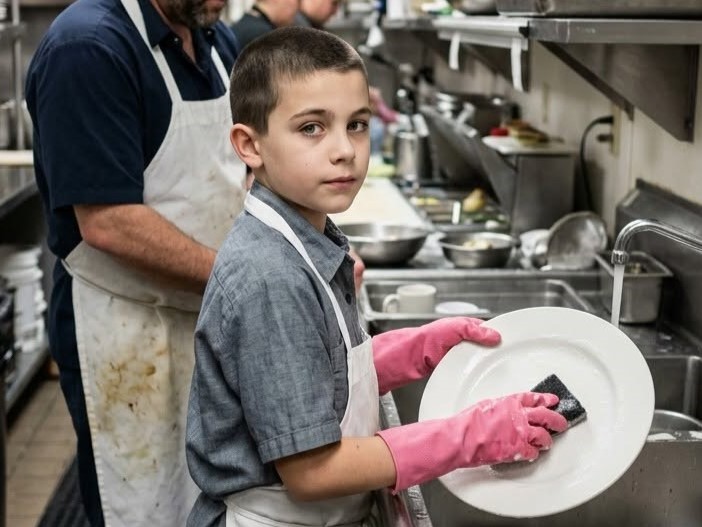
    So when he came to me one evening and announced that he had found a Saturday job washing dishes at a diner on Cherry Street, I was surprised but not shocked. He stood unusually straight while explaining that the owner, a man named Sal, had agreed to pay him cash each week.

    “I want to buy the bike myself. I don’t want you paying for it.”

    I told him we could find another way, but Evan shook his head.

    “No. I want to earn it.”

    I agreed on one condition: school came first, and if the job became too much, he had to stop. Evan grinned, hugged me tightly, and promised he could handle it.

    Every Saturday after that, he left early wearing old jeans and worn sneakers. He returned in the evening smelling of dish soap and fryer grease, his hands increasingly red from hours in hot water.

    Whenever I asked how close he was to affording the bike, he always gave me the same answer.

    “Almost there.”

    At first, I thought nothing of it. One month became two, and I assumed Evan was being careful with his savings or wanted extra money beyond the exact price.

    Then three months passed. Then four. By the fifth month, the bike was still sitting in the store window.

    I started doing the math quietly. Evan had told me Sal paid around sixty dollars every Saturday, which meant he should have saved well over a thousand dollars by then, while the bike cost only about six hundred.

    I tried not to worry because thirteen-year-old boys were allowed to have secrets. Maybe he had changed his mind, found something else he wanted, or was planning some kind of surprise.

    Then one night, I walked past his bedroom and saw him sitting on the floor counting a thick stack of cash. There was far more money than I expected, and the moment Evan noticed me in the doorway, his expression changed from concentration to unmistakable fear.

    He gathered the bills quickly and shoved them into his backpack.

    “What’s all that money?”

    “It’s just the bike money. Sal pays me in small bills, so it looks like more than it is.”

    His explanation sounded reasonable, but his voice did not. I stood there for another moment, feeling that something was wrong without knowing exactly what it was.

    A few weeks later, Evan came home almost two hours late from work. His shoes were covered in mud, his jacket was torn at the shoulder, and there was a fresh scrape along the side of his face.

    He claimed he had slipped near the creek while walking home, but the damage to his clothes looked less like a fall and more like a struggle. When I asked about that week’s paycheck, Evan lowered his eyes and became strangely quiet.

    “I put it somewhere safe.”

    That night, I lay awake staring at the ceiling. The missing bike, the hidden cash, the torn clothes, and the frightened look on my son’s face no longer felt like separate mysteries.

    For the first time, I began wondering whether the Saturday dishwashing job was hiding something much bigger.

    And I was terrified of what I might eventually discover.


    PART 2: THE PHONE CALL FROM SAL

    After Evan came home muddy and scraped, my mind began filling in the blanks with possibilities I hated. I wondered whether older kids were pressuring him, whether someone had gotten him involved in something illegal, or whether the dishwashing job had never been as simple as he claimed.

    I decided I would sit him down and demand the truth, no matter how uncomfortable the conversation became. Before I had the chance, however, my phone rang while I was at work two days later.

    “Is this Evan’s mother?”

    The voice belonged to an older man who introduced himself as Sal, the owner of the diner on Cherry Street. The moment he said Evan’s name, every fear I had been trying to control came rushing back at once.

    “Did he do something wrong?”

    Sal hesitated for several seconds before answering. When he finally spoke, he sounded less angry than genuinely uncertain about how to explain what had been happening.

    “I honestly don’t know how to answer that.”

    My stomach tightened.

    “What do you mean?”

    Another pause followed.

    “Do you know what your son does with every paycheck?”

    I told him Evan had been saving for a bicycle and that washing dishes was supposed to be how he earned the money himself. Sal released a slow breath before saying the words that immediately made my hands go cold.

    “Ma’am, you should sit down. Everything that boy has told you about the money is a lie.”

    For a moment, I could barely process what he had said. The missing bike, the cash in Evan’s bedroom, the muddy clothes, and the months of hearing “almost there” suddenly seemed to confirm every terrible suspicion I had tried to dismiss.

    “What is he doing with it, Sal? Please, just tell me.”

    Before he could answer, shouting erupted somewhere behind him. Through the phone, I suddenly heard Evan’s voice, frightened and much younger than the calm, responsible boy he always tried to be around me.

    “Please, Sal! Don’t tell my mom!”

    Another man shouted something I could not understand, followed by a loud crash and the sound of dishes striking the floor. I jumped to my feet so quickly that several coworkers turned toward me.

    “Evan? What’s happening? Sal, where is my son?”

    Sal returned to the phone breathing heavily, as though he had been trying to separate people.

    “You need to come down here right now. Your son tried to do it again, and this time things got out of hand.”

    The call ended before I could ask what “it” meant.

    I left work without my coat and drove toward the diner with every possible nightmare competing inside my head. I wondered whether Evan had been stealing, fighting, or handing money to someone who had manipulated him, and the torn jacket from a few weeks earlier suddenly felt connected to something much darker.

    By the time I reached Cherry Street, I had convinced myself that my son might be in serious trouble. I rushed through the diner door expecting police, blood, or evidence that the boy I thought I knew had become involved in something dangerous.

    Instead, I found Evan standing in the middle of the restaurant with tears streaming down his face. He was holding a fistful of cash toward a woman sitting in a booth, while Sal stood between them and a broken tray of dishes lay scattered across the floor.

    On the table beside the woman were prescription bottles, official-looking papers, and a child’s drawing. Nothing about the scene made sense, but Evan’s face crumpled the moment he saw me.

    “Mom, I’m sorry. I didn’t want you to find out.”

    I stepped closer, terrified but completely confused.

    “Find out what?”

    Sal rested a hand gently on Evan’s shoulder and looked at me with tears in his own eyes. His next words changed everything I thought I knew about the past six months.

    “Your son hasn’t been doing anything wrong. Every Saturday I pay him sixty dollars, and the second I put that money in his hand, he gives it away.”


    PART 3: WHERE EVERY PAYCHECK WENT

    For several seconds, I could only stare at Sal because his answer made less sense than every terrible explanation I had imagined on the drive over. Evan had spent six months lying about saving for a bicycle, but the truth was not that he was stealing money or getting involved with the wrong people.

    He was giving every paycheck away.

    The woman sitting in the booth was named Carla, and she had two young children, a six-year-old boy and a four-year-old girl. Her husband had left, she had lost her job, and she had fallen behind on rent while also struggling to afford medication for her son’s asthma.

    Sal had quietly been helping whenever he could by giving the children food and letting the family stay inside the warm diner without expecting them to order much. Evan had noticed them almost immediately because he recognized the same expressions he had seen on my face after Marcus died.

    One Saturday, after Sal handed Evan his sixty-dollar paycheck, Evan walked directly to Carla’s booth and placed every dollar on the table.

    “This is for your kids.”

    Carla tried to refuse, but Evan would not take the money back. The following Saturday, he did the same thing, and then repeated it week after week for almost six months.

    Suddenly, every strange detail made sense.

    The money I had seen scattered across Evan’s bedroom floor had not been secret savings for himself. He had been counting it carefully to make sure there was enough for Carla’s children, sometimes adding money from his own allowance when her son needed another inhaler.

    Then I remembered the night he had come home with mud covering his shoes, a torn jacket, and a scrape across his face. When I asked what had happened that night, Evan wiped his cheeks and finally told me the truth.

    “There were some older kids near the creek. They saw me give Carla money once, so they figured I always carried cash.”

    The boys had waited for him after work and tried to take that week’s paycheck. Evan ran rather than give it up, slipped while climbing the muddy creek bank, tore his jacket, and managed to escape with the money still in his possession.

    “I told you I put it somewhere safe. I did. I gave it to Carla the next week.”

    My stomach twisted as I realized how much danger he had hidden from me. He had been chased, frightened, and injured while protecting money that was not even meant for himself, yet he had come home and lied because he knew I would make him stop if I discovered what was happening.

    I looked at my thirteen-year-old son standing there with cracked hands from months of dishwashing and tears still running down his face. Pride and fear collided inside me so hard that I could barely speak.

    “Why, Evan? Why didn’t you tell me any of this?”

    He lowered his eyes before answering. When he finally spoke, six months of secrets seemed to come out with every word.

    “Because I knew you’d tell me we couldn’t afford to give money away. And you would’ve been right, Mom.”

    He gestured toward Carla and the prescription bottles on the table.

    “But they had less than we did.”

    Evan told me he still remembered the months after his father died, including the nights he heard me crying when I thought he was asleep. He remembered almost losing our electricity, neighbors bringing us food, and a woman from church quietly paying our heating bill when I had nowhere else to turn.

    “People helped us when we were drowning. When I saw Carla and her kids, I knew what that looked like.”

    By then, I was crying too.

    “I had money I could give them. I wanted to be the person for them that other people were for us.”

    Then Evan looked directly at me, and what he said next broke through the last piece of composure I had left.

    “Dad would’ve done it.”

    PART 4: THE REASON HE KEPT IT SECRET

    Evan wiped his face with the sleeve of his torn jacket and tried to explain why Marcus had been on his mind every time he handed Carla his paycheck. He remembered me telling him that his father had always been the kind of man who would help a stranger without waiting to be asked.

    “Dad would’ve done it. You always said he’d give someone the coat off his back.”

    His voice broke as he looked at me.

    “If I can’t have him here anymore, I thought maybe I could at least be like him.”

    That was the moment I stopped trying to hold myself together. I crossed the diner, wrapped my arms around my son, and held him tighter than I had since the day we buried his father.

    “I’m not angry with you. I’m proud of you, Evan. I have never been more proud of anyone in my life.”

    Carla began crying again from the booth, and when she finally joined us, she explained that she had tried repeatedly to refuse Evan’s money. Every Saturday, she told him to keep his paycheck and save for the bicycle he supposedly wanted, but Evan would leave the cash on the table and hurry back to the kitchen before she could return it.

    The money had kept her electricity on and helped pay for her son’s asthma medication. On more nights than she could count, it had also meant the difference between her children eating dinner and going to bed hungry.

    Sal had known what Evan was doing for months. He admitted that he struggled with whether to contact me because Evan had begged him not to interfere, but the incident with the older boys convinced him that the secret had become too dangerous.

    That afternoon had finally forced Sal to make the call. Carla had learned that Evan had been chased over the money and refused to accept another paycheck, while Evan insisted she take it anyway.

    Their disagreement became emotional enough that a tray of dishes was accidentally knocked onto the floor. That was the crash I had heard through the phone, and Sal had been trying to calm everyone down when he told me to come immediately.

    “In forty years of running this diner, I’ve never seen anything like what your son has done.”

    Sal looked at Evan before turning back to me.

    “I figured his mother deserved to know what kind of boy she raised.”

    His words made me think again about the sentence that had terrified me over the phone. Sal had told me that everything Evan said about the money was a lie, and I had immediately imagined the worst possible version of my son.

    The bike had indeed been a lie, but not for the reason I feared. Evan had invented that story because he knew I would try to protect him by telling him to stop giving away money we could barely afford to spare.

    Over the following weeks, I realized that Evan should never have been carrying Carla’s entire problem on his thirteen-year-old shoulders. His compassion was extraordinary, but what Carla needed was not a child sacrificing every Saturday paycheck forever.

    She needed a way back onto solid ground.

    I had spent three difficult years rebuilding my own life after Marcus died, and during that time people had helped me navigate jobs, bills, benefits, and emergencies I did not understand. Now I realized it was my turn to do the same thing for someone else.

    I started making phone calls.

    Through a friend, I helped Carla find steady work and showed her how to apply for assistance programs she had never known were available. Within a few months, she was current on her rent, and buying her son’s inhaler no longer meant deciding what her children would have to go without.

    Carla finally refused to accept another dollar from Evan.

    For the first time in six months, my son was allowed to keep his own paycheck.

    But knowing Evan, I should have realized that did not mean he was finished helping people.


    PART 5: THE BOY ON THE BLACK BIKE

    Once Carla was back on her feet, she refused to accept any more money from Evan. Sal gave him a small raise and told him that generosity was admirable, but carrying every problem alone was not.

    “Big hearts still need backup. If someone comes after you again, you tell an adult. You don’t have to handle everything yourself.”

    Evan promised he would, and for once, I believed he understood that asking for help did not make him weak. What surprised me was that keeping his paycheck did not suddenly turn him into a different child.

    A few weeks later, he found a shelter downtown that needed volunteers on Sundays. He started helping there whenever he could and still gave away part of what he earned, only now he did it openly, with me knowing where the money went and sometimes helping him decide how much he could reasonably afford to give.

    Watching him taught me something I had not understood before. Evan’s kindness was not a temporary reaction to Carla’s situation; it had become part of how he moved through the world after losing his father.

    A couple of months later, Evan’s birthday arrived. I drove to the sporting goods store on Route 9 and bought the matte black bicycle with orange lettering that had started the entire story.

    When he saw it waiting for him, he stood completely still. Then his eyes filled with tears.

    “Mom, you didn’t have to do this.”

    “I know.”

    I smiled at him.

    “That’s the point. Your dad understood that too. You don’t help someone because you have to. You help because you can.”

    Evan hugged me so tightly that for a moment I could almost feel Marcus standing there with us. The bike had once represented something Evan thought he needed to earn entirely by himself, but by then it meant something different to both of us.

    He rides that bicycle to the shelter almost every Sunday now. Sometimes I watch him leave with a backpack over his shoulders and think about how terrified I was during those months when I did not know where his money was going.

    I had built an entire dark story in my head about my son. I imagined older boys pulling him into trouble, stolen money, dangerous secrets, and every nightmare a widowed mother can create when her child starts acting differently.

    I had been wrong about almost everything.

    The one thing I understood correctly was that Marcus’s death had changed Evan. What I failed to see was that the loss had not pulled him toward something darker; it had made him more sensitive to other people who were struggling.

    He knew what fear looked like because he had watched it on my face after his father died. He knew what it felt like when bills piled up, when strangers quietly helped, and when someone stepped into your life at exactly the moment you thought you were alone.

    That experience became a kind of radar in him.

    When Evan looked at Carla and her children, he did not see strangers. He recognized the version of us that had once needed help.

    I spent years trying to teach my son how to survive losing his father. Without realizing it, he had taken that loss and turned it into compassion.

    Sometimes I think about Marcus and hope, wherever he is, he can see the boy we raised. I hope he sees Evan riding that black bicycle across town, using his cracked hands and his own money to help people he could easily ignore.

    Evan once told me he was only trying to become like his dad.

    The truth is, I think he already has.

  • I came home three hours early and found my sick mother cooking over a hot stove while trying to care for my two-year-old twins. One child was shaking in her arms. The other was clinging to her leg. In the living room, my husband and his mother sat comfortably, treating her like a servant. I was ready to leave quietly with my children. Then I saw the bruises on my mother’s face and arms. That was when I opened the gates to the mansion across the street—the one they never knew I owned.

    I came home three hours early and found my sick mother cooking over a hot stove while trying to care for my two-year-old twins. One child was shaking in her arms. The other was clinging to her leg. In the living room, my husband and his mother sat comfortably, treating her like a servant. I was ready to leave quietly with my children. Then I saw the bruises on my mother’s face and arms. That was when I opened the gates to the mansion across the street—the one they never knew I owned.

    Part 1 of 3

    I came home three hours early and found my sick mother cooking over a hot stove while trying to care for my two-year-old twins. One child was shaking in her arms. The other was clinging to her leg. In the living room, my husband and his mother sat comfortably, treating her like a servant. I was ready to leave quietly with my children. Then I saw the bruises on my mother’s face and arms. That was when I opened the gates to the mansion across the street—the one they never knew I owned.

    Part 1: The House Across the Street

    Inside the mansion, the silence felt unreal. No television. No shouting. No Ryan demanding service.
    Oliver looked up at me. “Mommy, are we staying here?” “Yes,” I whispered. “For as long as we need.”
    Margaret sank onto a bench, gray with pain and fear. I settled the twins with cartoons, then returned to her. “Mom, I need the truth.” She tried to protect my marriage, but I stopped her.
    “Ryan is their father,” she whispered. “And you are my mother.”
    Finally, she rolled up her sleeve. Finger-shaped bruises circled her wrist, and older yellow marks spread above them. Vivian had grabbed her after Emma spilled juice. Ryan saw it and later told Margaret not to tell me, warning that if she upset me during my trip, he would make sure she never saw the twins again.
    Then I asked if Ryan had ever touched her himself. She answered too quickly: “No.” “Mom. Look at me.” She touched her cheek. “He pushed me once.”
    The words hollowed me out. Two nights earlier, after Vivian complained dinner was late, Margaret told Ryan she was not his servant. He told her to stop disrespecting his mother, grabbed her shoulder, and she stumbled into a cabinet. My husband had put his hands on my mother.
    My phone rang. Ryan. I declined.
    Messages followed: Open the gate. We need to talk. You can’t take my children. Stop being dramatic. Then came the message that made my hand shake: You’ll regret this.
    At the gate camera, Ryan stood with Vivian, shouting for entry. I told them the children were safe. Vivian screamed that the mansion was theirs.
    “No,” I said. “It was bought through a private trust created before my marriage.”
    Ryan’s expression changed instantly. “You never told me you had a trust. How much money is in it?”
    Not: Are the children okay? Not: Is Margaret hurt? Only money.
    I shut off the intercom.

    My flight from New York landed early, so I decided to surprise my twins, Oliver and Emma, and my mother, Margaret.

    Instead, I walked into a nightmare.

    “Your mother came here to work, not to rest,” my mother-in-law, Vivian, shouted from the living room. “She can sit after dinner is done.”

    I froze in the doorway.

    Vivian was stretched across the sofa, pointing toward the kitchen like my mother was hired help. My husband, Ryan, sat beside her watching television, beer in hand, phone in the other.

    Then I heard Emma crying.

    I rushed into the kitchen.

    My mother stood over a steaming pot, holding Emma against her chest while stirring with her other hand. Oliver clung to her leg, frightened and exhausted. Margaret’s face was pale. Sweat had soaked through her blouse. Her swollen fingers could barely hold the spoon.

    She had severe rheumatoid arthritis. Some mornings, she could hardly walk without help.

    “Mom, what are you doing?”

    Margaret looked down. “Vivian wanted roast beef. She also asked me to change the sheets, wash Ryan’s trousers, and iron his shirts.”

    I reached for Emma, but my mother flinched.

    That was when I saw the bruise on her cheek.

    More marks covered her wrist and forearm.

    “Who did this to you?” I asked, my voice shaking.

    Margaret pulled down her sleeve. “I fell.”

    But she would not meet my eyes.

    From the living room, Vivian yelled, “Tell her not to burn the meat again!”

    Ryan laughed. “And she still hasn’t finished my laundry.”

    Something inside me went cold.

    For seven years, I had paid the mortgage, bought the cars, funded vacations, and covered Vivian’s medical bills. Ryan lived like a wealthy man because I allowed him to.

    And while I was away, they had humiliated the woman who sold her land to put me through college.

    I picked up my mother’s suitcase, lifted Oliver into my arms, and took Emma from her.

    “We’re leaving.”

    Vivian stormed in. “She isn’t finished.”

    Ryan blocked the door. “Apologize to my mother and get back in that kitchen.”

    I opened the home-control app.

    Electricity: disabled.

    Water supply: locked.

    Cards: revoked.

    The television died. The lights went out. Ryan’s phone buzzed with cancellation alerts.

    “What did you do?” he shouted.

    “I gave you back the life you can afford.”

    Then I walked out with my mother and children, crossed the street, and stopped before the largest mansion in the neighborhood.

    I pressed my thumb to the scanner.

    The gates opened.

    Ryan ran after us barefoot. “How do you have access to that house?”

    I turned as the gates closed between us.

    “Because I bought it three years ago. It’s fully paid off. And your name isn’t on one document.”

    Part 2: The Bruises

    Inside the mansion, the silence felt unreal. No television. No shouting. No Ryan demanding service.

    Oliver looked up at me. “Mommy, are we staying here?” “Yes,” I whispered. “For as long as we need.”

    Margaret sank onto a bench, gray with pain and fear. I settled the twins with cartoons, then returned to her. “Mom, I need the truth.” She tried to protect my marriage, but I stopped her.

    “Ryan is their father,” she whispered. “And you are my mother.”

    Finally, she rolled up her sleeve. Finger-shaped bruises circled her wrist, and older yellow marks spread above them. Vivian had grabbed her after Emma spilled juice. Ryan saw it and later told Margaret not to tell me, warning that if she upset me during my trip, he would make sure she never saw the twins again.

    Then I asked if Ryan had ever touched her himself. She answered too quickly: “No.” “Mom. Look at me.” She touched her cheek. “He pushed me once.”

    The words hollowed me out. Two nights earlier, after Vivian complained dinner was late, Margaret told Ryan she was not his servant. He told her to stop disrespecting his mother, grabbed her shoulder, and she stumbled into a cabinet. My husband had put his hands on my mother.

    My phone rang. Ryan. I declined.

    Messages followed: Open the gate. We need to talk. You can’t take my children. Stop being dramatic. Then came the message that made my hand shake: You’ll regret this.

    At the gate camera, Ryan stood with Vivian, shouting for entry. I told them the children were safe. Vivian screamed that the mansion was theirs.

    “No,” I said. “It was bought through a private trust created before my marriage.”

    Ryan’s expression changed instantly. “You never told me you had a trust. How much money is in it?”

    Not: Are the children okay? Not: Is Margaret hurt? Only money.

    I shut off the intercom.


    Part 3: The Letter My Father Left

    I led Margaret to a guest suite and told her she could stay as long as she wanted. She said she did not want to be a burden.

    “You sold your farmland so I could attend college,” I reminded her. “You worked two jobs. You wore the same winter coat for nine years because tuition was due.”

    She smiled faintly.

    “You remember too much.”

    “I remember everything.”

    Then she said, “So do I.”

    Before I could ask what she meant, the mansion alarm sounded.

    Someone had entered with an authorized access code.

    Only three people had private access: me, the property manager, and my late father’s attorney.

    At the front door stood Thomas Hale, my father’s lawyer for more than twenty-five years.

    The moment he saw Margaret’s bruises, his face changed.

    “Oh, Margaret.”

    “You knew?” she whispered.

    “I knew this day might come,” he said.

    He opened his briefcase and removed sealed folders. One old envelope had my name written in my father’s handwriting.

    Beneath it were six words:

    If Margaret is ever hurt, open this.

    Thomas said my father had not created the trust only to protect my inheritance.

    He created it to protect my mother.

    Then he showed me a property transfer dated twenty-eight years earlier.

    The name at the top was Vivian Bennett.

    My mother-in-law.

    A faded photograph was attached. It showed my father, my mother, a younger Vivian, and a man named Samuel Bennett—Vivian’s first husband.

    On the back, my father had written:

    Margaret must never be left alone with them again.

    Then I learned the truth: Margaret had known Vivian before I married Ryan. Vivian had pretended not to recognize her.

    Samuel once worked for my father.

    He disappeared after money vanished from the company.

    And Vivian had been connected to it.

    Part 4: The Vault Beneath the Mansion

    Thomas revealed that Ryan had not met me by accident. Years earlier, Vivian had referred him to the consulting firm where I worked.

    Every memory of our marriage rearranged itself.

    The “chance” meeting.

    The charming smile.

    The fast romance.

    The questions about my father’s money.

    Then Ryan texted a photo from our old house.

    He was inside my study, beside the safe where I had once kept financial documents.

    You should have told me what your father left you.

    Another message followed.

    Mom says it belongs to us.

    I opened my father’s letter again and saw one underlined sentence:

    Vivian was never interested in our money. She was looking for what Samuel hid.

    At that moment, the mansion alarm screamed.

    BASEMENT VAULT: ACCESS ATTEMPT.

    No one knew there was a basement vault.

    No one except my father.

    And apparently Vivian.

    Then the screen changed.

    Access code accepted.

    A lock opened somewhere beneath the house.

    Margaret whispered, “There’s something about this mansion your father never told you.”

    The vault cameras went dark. Security arrived, and we went downstairs.

    The vault door stood open.

    Someone had escaped through an old service tunnel.

    Inside the vault was a wooden box, a photograph of Samuel with my father, and a message on the back:

    Samuel knows where Vivian put it.

    Then Ryan sent a photo of Vivian holding a black metal case.

    You should have opened the vault sooner.

    Ask your mother what Samuel stole.

    Margaret finally told the truth.

    Samuel did not steal from my father.

    Vivian did.

    She framed Samuel using hidden transfers and forged authorizations. Samuel discovered it and planned to expose her.

    But one original document disappeared.

    The case Vivian now held might contain it.

    Part 5: The Recording

    Inside the wooden box were old cassette tapes. One was labeled:

    Vivian — Night Samuel Disappeared.

    We found a cassette player and listened.

    My father’s voice filled the room, followed by Samuel’s.

    Samuel told my father to protect Margaret.

    Then Vivian’s younger voice erupted. She accused Samuel of trying to take documents that belonged to Ryan’s future.

    Samuel called them stolen.

    My mother’s younger voice appeared too.

    I had been there that night.

    I was three years old.

    Then Vivian said something that made the room stop.

    “If you walk out with those papers, I’ll tell everyone who Ryan’s real father is.”

    I stared at my mother.

    The recording cut off.

    The rest had been erased.

    Margaret finally confessed that years before I was born, during a brief separation, my father had made one terrible mistake with Vivian. Vivian later claimed Ryan was his child and insisted he owed Ryan part of the Whitmore fortune.

    But later genetic testing proved Ryan was Samuel’s biological son.

    Vivian had lied for years.

    She had used the possibility as leverage. She believed Ryan had a claim on my father’s company, and when Samuel tried to expose her fraud, he vanished.

    Then Ryan sent a location pin.

    Come alone if you want the truth about Samuel.

    It was an abandoned Whitmore Construction warehouse.

    I knew it was probably a trap.

    But I also needed to know whether Ryan was part of Vivian’s scheme—or another person she had manipulated.

    Part 6: The Man Who Vanished

    Security followed at a distance as I drove to the warehouse.

    Ryan waited inside, exhausted and shaken.

    The black case sat on a table.

    Inside were the genetic report and Samuel’s signed statement.

    Ryan had just learned the truth: Vivian had built his childhood around a lie. She told him my father abandoned him. She told him Samuel was not his father.

    “She lied,” I said.

    He pushed another document toward me.

    Samuel’s statement described Vivian’s hidden accounts, forged transfers, and plan to claim my father had promised ownership to Ryan.

    Then came the final paragraph.

    If anything happens to me, Vivian should not be blamed. I am leaving voluntarily.

    Samuel had not died.

    He had disappeared on purpose because his signatures were on transactions Vivian manipulated. He abandoned his car, changed his name, and started over.

    Then a voice came from the dark.

    “I am.”

    An older man stepped beneath the warehouse light.

    Silver beard.

    Gray eyes identical to Ryan’s.

    Ryan whispered, “Dad.”

    Samuel admitted he had left out of fear, then built another life with a wife, daughters, and grandchildren. Vivian had found him six months earlier and wanted the original statement.

    When he refused, she went after Margaret because she believed Margaret knew where my father stored copies.

    Vivian had not only been cruel to my mother.

    She had been using her to search the house.

    Samuel handed over a flash drive with copies of everything. Investigators arrived, and Vivian eventually entered a plea for financial crimes. The harm to Margaret was documented separately.

    Ryan cooperated.

    He did not protect his mother.

    That mattered.

    But it did not erase what he had done.

    Part 7: The Mother I Never Knew

    Weeks later, Thomas uncovered another secret in my father’s trust.

    He had quietly repurchased the farmland Margaret sold for my college tuition and left it to her. The land had grown valuable, with part of it leased to a renewable-energy company.

    Margaret cried when she saw the deed.

    “I thought I lost this forever.”

    “You gave it away for me,” I said.

    “I’d do it again.”

    Life began to settle.

    Ryan started therapy, found work, repaid what he could, and showed up consistently for the twins. He apologized to Margaret without asking her to comfort him. The divorce papers remained unsigned, not because I had chosen reconciliation, but because I refused to decide under pressure.

    Then Samuel sent a photograph.

    It showed the old farmhouse, my father, Margaret, Samuel, Vivian—and another young woman holding a baby.

    On the back, Samuel had written:

    Ask Margaret who Miriam is.

    Margaret finally told me.

    Miriam was her sister.

    And the baby was me.

    Margaret had not given birth to me.

    Miriam had.

    She was nineteen, frightened, and alone. My father legally adopted me when I was two, and Margaret raised me as her own.

    Miriam was still alive in California.

    I did not speak to Margaret for two days.

    Not because I hated her.

    Because love and betrayal were colliding inside me.

    On the third day, she left an address outside my room.

    I flew to Santa Barbara and met Miriam.

    She cried when she saw me.

    “You look like your father.”

    My biological father, Jonathan Hale, had never known about me until recently. He lived thirty minutes away.

    I met him too.

    He did not reach for me. He simply said, “I’m sorry I didn’t know.”

    I believed him.

    That mattered.

    Part 8: The House That Became a Home

    One year after I came home early from my business trip, we gathered again at the old house where everything had begun.

    But it was different now.

    The living room where Vivian once ordered Margaret around had warm white walls, children’s drawings, and quiet sunlight. Margaret had turned one room into a reading space for neighborhood children. The kitchen had lower counters and easy-grip handles for her arthritis.

    She was cooking because she wanted to.

    Not because anyone demanded it.

    Ryan arrived with groceries and put them away without being asked. Change had not come through promises. It came through repetition: therapy, accountability, patience, and apologies without expectation.

    I eventually signed the divorce papers.

    The old marriage needed to end before anything new could begin.

    Six months later, Ryan and I began dating slowly.

    Coffee.

    Walks with the twins.

    Separate homes.

    Clear boundaries.

    He never asked when I would take him back.

    That was part of why I kept choosing to see him.

    On Margaret’s birthday, the complicated family gathered at the restored farmhouse. Samuel came. Miriam came. Jonathan came. Thomas came without any envelopes, which I appreciated.

    Ryan handed me a small silver pendant with four stones around a tiny tree.

    “One for you. One for Margaret. One for Oliver. One for Emma.”

    “And you?” I asked.

    He smiled.

    “I’m not asking to be included automatically.”

    For once, he understood.

    Later, Thomas gave me one final letter from my father.

    Family is not defined by who owns you, who gave birth to you, or whose name is beside yours. Family is whoever protects your heart without demanding possession of it.

    I looked across the field.

    Margaret was laughing with Miriam. Jonathan was teaching Oliver to fly a kite. Emma slept against Margaret’s shoulder. Ryan stood nearby, not asking for anything he had not earned.

    For years, secrets had shattered us.

    But truth had made room for a larger family.

    The mansion was only property.

    The money was only money.

    The real inheritance was this:

    Nobody is entitled to another person’s love, labor, silence, forgiveness, or future.

    Love must be chosen.

    Respect must be practiced.

    And home must be a place where nobody is afraid of the people inside it.

  • My Wealthy Sister Gave Mom $20 for Her 70th Birthday and Said, ‘At Her Age, She Doesn’t Need Much’ – Then I Got an Idea for Her Gift  

    My Wealthy Sister Gave Mom $20 for Her 70th Birthday and Said, ‘At Her Age, She Doesn’t Need Much’ – Then I Got an Idea for Her Gift  

    My sister showed up to Mom’s 70th birthday carrying a designer handbag that probably cost more than several months of my car payments.

    Melissa had always been the successful one in the family.

    Big house.

    Luxury vacations.

    A husband who owned several dental clinics.

    So naturally, I expected her to make a big production out of Mom’s birthday gift.

    Instead, she opened her expensive purse, pulled out a twenty-dollar bill, slipped it into a birthday card, and handed it across the table.

    Then she laughed.

    “At her age, she doesn’t really need much.”

    Mom smiled politely.

    “Thank you, sweetheart.”

    But I noticed what she did next.

    She folded the card quickly and slid it beneath her plate.

    Something about that small movement bothered me.

    Not because twenty dollars wasn’t enough.

    It wasn’t about the amount.

    It was about everything Mom had done for Melissa over the years.

    Mom had babysat Melissa’s children without ever accepting payment.

    She had cooked dinners when Melissa worked late.

    She had helped whenever the family needed something.

    And years earlier, when Melissa and her husband were trying to buy their first home, Mom had even dipped into her retirement savings to help them.

    So hearing Melissa joke that a seventy-year-old woman “didn’t need much” made my blood boil.

    I almost confronted her right there at the table.

    Then I remembered something.

    A wooden box in Mom’s bedroom.

    Months earlier, while helping her clean out a closet, I had seen what was inside.

    Old report cards.

    Childhood drawings.

    Photographs.

    Hospital bracelets.

    Mother’s Day cards.

    And two small notebooks filled with dates and numbers I hadn’t understood.

    Suddenly, I had an idea.

    “Mom,” I said, “I actually forgot your real present at home. Can we do gifts again tomorrow?”

    Melissa laughed.

    “You forgot her birthday present?”

    I ignored her.

    The following afternoon, everyone came back for leftover cake.

    This time, I placed a large wrapped box in front of Mom.

    Melissa leaned back with an amused expression.

    Mom opened it.

    Inside was a scrapbook I had made using copies of the things she had saved from our childhood.

    Old photographs.

    Little handwritten notes.

    Mother’s Day cards.

    Drawings.

    Memories from decades ago.

    Mom covered her mouth.

    “Oh, Amanda…”

    She slowly turned the pages.

    Then she reached the final section.

    Her smile vanished.

    I hadn’t intentionally placed anything shocking there.

    I had simply copied one page from the old notebook because I thought it was part of our family history.

    Melissa suddenly stood.

    “Where did you get that?”

    I looked at her.

    “Mom’s box. Why?”

    She grabbed the scrapbook and flipped through the pages.

    Then she froze.

    Her eyes locked onto one handwritten date.

    Mom’s face went pale.

    Without saying anything, she pushed back her chair and walked toward her bedroom.

    Seconds later, she returned holding a small brass key.

    Melissa immediately stood.

    “Mom, don’t.”

    Mom ignored her.

    She walked into the bedroom and knelt beside the locked bottom drawer of her dresser.

    Melissa rushed forward.

    “Don’t open that!”

    I caught her by the arm.

    “What is wrong with you?”

    “Nothing. Amanda, stay out of this.”

    “You just tried to stop Mom from opening her own drawer.”

    “I wasn’t going to hurt anyone.”

    Then Mom looked up.

    “Melissa.”

    There was something in her voice that made both of us stop.

    She unlocked the drawer.

    Inside were old folders, envelopes, bank statements, and a checkbook.

    Nothing looked particularly dramatic.

    Mom pulled out one folder.

    “Here.”

    I opened it.

    The first document showed a bank transfer from fourteen years earlier.

    The amount immediately caught my attention.

    $35,000.

    I looked at Mom.

    “Was this for Melissa’s house?”

    Mom nodded.

    I already knew she had helped Melissa and her husband with their down payment.

    I just hadn’t realized how much.

    Then I noticed something else.

    Beside the transfer was a handwritten date.

    It matched the date from Mom’s notebook.

    And beside that was another date almost three years later.

    “What’s this?”

    Melissa answered before Mom could.

    “That was when I was supposed to repay her.”

    I stared at her.

    “You borrowed thirty-five thousand dollars?”

    “It wasn’t exactly like that.”

    “There’s an amount and a repayment date. That sounds pretty much like a loan.”

    Mom touched my shoulder.

    “Amanda.”

    But I had already pulled out another document.

    $18,000.

    Different year.

    Different repayment date.

    “What was this?”

    Melissa crossed her arms.

    “We were struggling then.”

    “Your husband owned a dental clinic.”

    “One clinic. And it was barely surviving.”

    Then I found another transfer.

    $12,500.

    Then another.

    $27,000.

    I grabbed Mom’s notebook again.

    Suddenly, all those strange columns of numbers made sense.

    Every figure corresponded to money Mom had given Melissa.

    I sat on the edge of the bed and started matching the dates.

    “Stop,” Melissa said.

    I kept going.

    One transfer happened around the time her second child was born.

    Another appeared shortly before her husband opened his second clinic.

    I remembered that year.

    Melissa had spent months talking about how stressful the expansion was.

    Mom, meanwhile, had decided her twelve-year-old car could somehow last “a few more years.”

    Another payment came during the year Mom canceled a vacation with friends because she said traveling was too expensive.

    I looked at her.

    “Mom, how much money did you give Melissa?”

    She hesitated.

    “I’d have to calculate it.”

    “I won’t.”

    I opened the calculator on my phone.

    Melissa stepped toward me.

    “Amanda, don’t.”

    That only made me more determined.

    I added every amount.

    Then checked the total.

    Twice.

    Three times.

    Finally, I looked up.

    “One hundred thirty-seven thousand five hundred dollars.”

    Nobody spoke.

    My eyes went to Melissa.

    Her designer purse was downstairs on Mom’s dining table.

    The same purse she had spent ten minutes bragging about the day before.

    And inside Mom’s birthday card was twenty dollars.

    “You owe Mom $137,500?”

    “No.”

    I actually laughed.

    “No?”

    “That’s not what this is.”

    “There are repayment dates beside every single amount.”

    “Mom never expected me to repay everything.”

    “How convenient.”

    “It’s true.”

    I turned toward Mom.

    “Is she telling the truth?”

    Mom sat beside me.

    “Yes.”

    That answer stopped me cold.

    “What?”

    “I never really expected Melissa to pay all of it back.”

    I stared at the documents.

    “Then why write everything down?”

    Mom took the notebook from my hands.

    “Because I needed to remember how much she had already received.”

    “For what?”

    She looked at me.

    “For you.”

    I couldn’t speak.

    Mom turned several pages.

    There was my name.

    And beneath it?

    Almost nothing.

    “I don’t understand.”

    Mom sighed.

    “Melissa needed help sooner than you did. You didn’t. But that doesn’t mean one daughter should eventually receive more than the other.”

    Melissa slowly sat beside the window.

    Mom continued.

    “Some of these began as loans. Melissa always told me she would pay me back once they were doing better.”

    “But you never made her.”

    “No.”

    “Why?”

    Mom looked genuinely confused by my question.

    “Because eventually I didn’t need her to.”

    “That’s not the point.”

    “It is to me.”

    She closed the folder.

    “I have two daughters. Whatever I leave someday will ultimately be divided between both of you anyway. Melissa needed part of hers earlier, so I gave it to her earlier.”

    I looked down at the notebook.

    “Then why keep records?”

    “So that when the time comes, what Melissa has already received can be taken into account. You would receive an equivalent amount first. Whatever remains after that gets divided between you.”

    For several seconds, the only sound in the room was the hallway clock.

    I had opened that drawer expecting proof that Melissa had taken advantage of Mom.

    Instead, I had discovered that Mom had quietly been planning for both daughters all along.

    “I don’t want $137,500,” I said.

    Mom smiled gently.

    “I know.”

    “That isn’t why I’m angry.”

    “I know that too.”

    Then I looked at Melissa.

    “Did you know?”

    “Know what?”

    “That Mom considers all this part of what you would eventually inherit?”

    Melissa didn’t answer.

    “Melissa.”

    “Yes.”

    My anger returned instantly.

    “You knew?”

    “Mom told me.”

    “So you knew she had already given you more than a hundred thousand dollars. And yesterday, for her seventieth birthday, you handed her twenty dollars and joked that she didn’t need much?”

    “Amanda, this isn’t about twenty dollars.”

    “You’re right. It isn’t.”

    Mom stood.

    “Enough.”

    “No, Mom.”

    I turned toward her.

    “How many times have you told me something was too expensive?”

    “I never said I couldn’t afford anything.”

    “You said it wasn’t worth spending the money.”

    “Sometimes it wasn’t.”

    “Your old car was falling apart before you finally replaced it.”

    “It still ran.”

    “You canceled the trip with your friends.”

    “I didn’t care that much about going.”

    “You always say that.”

    Mom’s face changed.

    She didn’t look angry.

    She looked sad.

    “Amanda, I chose what to do with my money.”

    That silenced me.

    “I wasn’t tricked,” she continued. “Melissa didn’t steal from me. I helped my daughter because I wanted to.”

    Melissa looked up.

    Mom continued.

    “I was proud when they bought their first house. I was proud when the clinics became successful. I loved watching my grandchildren while Melissa worked. Don’t turn things I was happy to give into something ugly simply because you’re angry.”

    I sat down.

    She was right.

    I wanted Mom to be angry because I was angry.

    But those were two different things.

    Still, there was one question I couldn’t let go.

    I looked toward the scrapbook lying on the dresser.

    “Then why did you hide Melissa’s birthday card under your plate yesterday?”

    Mom froze.

    Melissa turned toward her.

    “Mom?”

    Mom started putting documents back into the folder.

    “It was nothing.”

    “No,” I said gently. “That’s what you always say.”

    She gave me a warning look.

    I lowered my voice.

    “Did what Melissa said hurt you?”

    Mom didn’t answer.

    Melissa stood.

    “Mom, I was joking.”

    “I know.”

    “I didn’t mean anything by it.”

    “I know that too.”

    Mom closed the drawer.

    Then she looked directly at Melissa.

    “It wasn’t about the twenty dollars.”

    Melissa visibly relaxed.

    Mom noticed.

    “Don’t look relieved.”

    Melissa’s expression disappeared.

    “You could have given me nothing,” Mom continued. “You could have written ‘Happy Birthday’ on a scrap of notebook paper and I would have loved it.”

    “Then what did I do?”

    Mom’s voice became quiet.

    “You said, ‘At her age, she doesn’t need much.’”

    Melissa stared at her.

    “I was joking.”

    “I know.”

    “Then why are you upset?”

    Mom took a long breath.

    “Because I’m seventy, Melissa.”

    She paused.

    “I’m not finished.”

    Nobody moved.

    “I still like things. I still want to travel. I still get excited about plans. I still want people to think about me sometimes.”

    Melissa’s eyes filled with tears.

    Mom continued.

    “I spent years telling both of you not to worry about me. Maybe I did that too well.”

    Melissa wiped beneath one eye.

    “I didn’t mean you weren’t worth anything.”

    “I know you didn’t.”

    Mom’s voice trembled slightly.

    “But for one moment yesterday, that’s how it felt.”

    Melissa sat down.

    And for the first time since Mom opened the drawer, she stopped defending herself.

    Her eyes drifted toward the scrapbook.

    She picked it up.

    Several pages had bent when she grabbed it earlier.

    She carefully flattened one with her palm.

    It contained a Mother’s Day card Melissa had made when she was seven.

    The handwriting was crooked.

    She had drawn Mom with purple hair because apparently we had owned only a handful of crayons.

    Melissa laughed through her tears.

    “You kept this?”

    “Of course.”

    She turned another page.

    A paper flower.

    A photograph of the three of us wearing matching pajamas.

    A note I had written apologizing for breaking a lamp after blaming the cat.

    Then she found a tiny folded card she had made as a teenager.

    There was nothing expensive in the scrapbook.

    Most of it was paper.

    Some of it was barely recognizable anymore.

    Mom had saved every piece.

    Melissa looked at the pages for a long time.

    Then her eyes moved toward the twenty-dollar bill still sticking out of yesterday’s birthday card.

    “I understand.”

    Mom sat beside her.

    Melissa shook her head.

    “No. I really understand.”

    Then she looked at me.

    “I didn’t want you finding those financial records because I knew what you would think.”

    “What?”

    “That everything I have happened because Mom paid for it.”

    “I don’t think that.”

    “I thought you would.”

    Her voice became quieter.

    “Every time Mom helped us, I told myself it was temporary. Then our situation improved and she kept telling me to forget about paying her back.”

    She paused.

    “After a while…”

    “After a while what?”

    Melissa looked at Mom.

    “I stopped thinking about what helping us cost her.”

    Mom reached for her hand.

    Melissa started crying.

    “That’s horrible.”

    “It’s honest,” Mom said.

    Melissa shook her head.

    “You made receiving help so easy.”

    Mom gave a sad smile.

    “Maybe that was my mistake.”

    “No.”

    Melissa squeezed her hand.

    “It was mine.”

    She looked around Mom’s bedroom.

    The older furniture.

    The curtains Mom had repaired rather than replace because they were “still perfectly good.”

    “I kept hearing you tell us you didn’t need anything,” Melissa said. “Eventually, I started believing you.”

    She swallowed.

    “Not just about money. About everything.”

    Mom squeezed her hand.

    “I’m sorry,” Melissa said.

    “Not because I gave you twenty dollars.”

    She wiped her face.

    “I’m sorry because I started believing that since you never asked me for anything, there was nothing you needed from me.”

    Mom pulled her into a hug.

    I turned away for a moment because suddenly I was crying too.

    When I looked back, Melissa had opened the scrapbook again.

    Near the beginning was an old photograph of Mom beside a lake.

    She looked maybe twenty-five.

    Her shoes were in one hand.

    Her jeans were rolled above her ankles.

    She was laughing.

    Melissa touched the photograph.

    “Where was this?”

    Mom smiled.

    “Lake Briar.”

    “You used to talk about that place.”

    “I still do.”

    “I thought you hadn’t been there since we were little.”

    “I haven’t.”

    Melissa studied her.

    “Do you still want to go?”

    Mom blinked.

    “What?”

    “To the lake. Do you still want to go back?”

    A slow smile spread across Mom’s face.

    “Of course I do.”

    Melissa nodded.

    “Then let’s go.”

    Mom laughed.

    “All of us?”

    Melissa looked at me.

    “If Amanda can tolerate me for a weekend.”

    “I’ll think about it.”

    She rolled her eyes.

    And somehow, for the first time that afternoon, everything felt normal again.

    Later, just before we left, I watched Mom return all the financial documents to the drawer.

    Then she locked it.

    “You’re still keeping records?” I asked.

    “Absolutely.”

    I smiled.

    “You really plan to make everything equal?”

    She slipped the brass key into her pocket.

    “As equal as I possibly can.”

    I hugged her.

    For years, I had assumed Mom lived modestly because she simply didn’t want much.

    Melissa had apparently believed the same thing.

    We were both wrong.

    Mom wanted plenty.

    She wanted trips.

    Memories.

    Attention.

    Things to look forward to.

    She had simply spent decades putting her daughters’ needs ahead of her own.

    And somewhere along the way, Melissa had mistaken Mom’s generosity for proof that Mom needed nothing in return.

    In the end, the twenty-dollar bill was never the real problem.

    It was the sentence Melissa used to explain it.

    “At her age, she doesn’t need much.”

    Because turning seventy didn’t mean Mom needed less love.

    Less thought.

    Less joy.

    Or fewer reasons to look forward to tomorrow.

  • “There are no maids in this house,” I told my mother-in-law after a week of criticizing my cooking, moving my things, and teaching me how I should take care of her son.  

    “There are no maids in this house,” I told my mother-in-law after a week of criticizing my cooking, moving my things, and teaching me how I should take care of her son.  

    “I didn’t come here to ask permission every time I touch something, Chloe. Justin is my son. I know exactly how he likes to live.”

    My mother-in-law, Virginia, said that only four days after moving into our house.

    But what bothered me most was not her tone.

    It was my husband.

    Justin sat at the kitchen table staring into his coffee as though keeping his eyes down would somehow make the argument disappear.

    The whole situation had actually started innocently.

    Virginia and my father-in-law, Walter, lived several hours away in Bakersfield.

    Virginia had been waiting months for a series of medical appointments in Sacramento.

    When the appointments were finally scheduled across several weeks, Justin suggested that his parents stay with us.

    “We have an empty guest room,” he said. “Why should they spend thousands on hotels?”

    I agreed immediately.

    It seemed completely reasonable.

    I wanted them to feel welcome.

    Before they arrived, I washed fresh sheets, cleared space in the closet, stocked the bathroom with new towels, and even baked an apple pie.

    I truly wanted the visit to go well.

    Virginia entered our home that first afternoon and immediately began inspecting everything.

    She stopped beside the living room window.

    “Did you choose these curtains?”

    “Yes.”

    She touched the fabric.

    “They make the room terribly dark. I would have picked something lighter.”

    I smiled.

    Then she tried the pie.

    She chewed slowly.

    “It’s decent.”

    I waited.

    “But it could use more spice.”

    Walter immediately asked for a second slice.

    That helped.

    Before the evening ended, I decided to set one simple boundary.

    “I really want you both to feel comfortable here,” I said. “Please use the kitchen, make yourselves at home. I only ask that we respect each other’s routines while you’re staying.”

    Virginia raised one eyebrow.

    “Of course. We’re guests. We didn’t come here to run your household.”

    I smiled.

    “Perfect.”

    Justin said nothing.

    By the next morning, the salt shaker had moved.

    So had my kitchen towels.

    And several knives.

    Two days later, I found my expensive nonstick skillet covered in deep scratches.

    “Virginia, did you clean this earlier?”

    “Yes. It was filthy.”

    “You used the metal scrubber?”

    “Obviously.”

    I took a breath.

    “You really can’t use that on nonstick cookware. It damages the coating.”

    She laughed.

    “My goodness, Chloe. Apparently washing a pan requires advanced training in this house.”

    I set the ruined skillet aside without responding.

    Then came dinner.

    Every evening became a performance.

    I cooked grilled chicken, vegetables, fish, potatoes, pasta salads.

    Virginia always found something wrong.

    One night, she looked at Justin’s plate and sighed.

    “My poor son. You look so thin.”

    Justin glanced down at himself.

    “Mom, I’ve actually gained weight.”

    “That’s probably bloating from all these vegetables.”

    I slowly placed my fork on the table.

    “Virginia, if you prefer something else, you’re welcome to cook anything you like.”

    Her expression changed instantly.

    “We’re guests. I’m certainly not going to invade your kitchen.”

    “Cooking isn’t invading my kitchen.”

    She stared at me.

    “But criticizing every meal I make is starting to feel like invading my home.”

    Later that night, Justin followed me into the bedroom.

    “Can you please try to ignore some of it?”

    I turned toward him.

    “Why?”

    “She’s my mother. She’s always been like this.”

    “That doesn’t make it okay.”

    “I just want everyone to get along.”

    “So do I.”

    I folded my arms.

    “That’s why I’m setting boundaries now instead of exploding later.”

    Justin sighed.

    For two days, Virginia stopped criticizing my cooking.

    I actually thought she might have understood.

    Then Thursday afternoon, I passed the guest room and heard her on the phone.

    “You absolutely have to come Saturday, Brenda.”

    I stopped walking.

    “You need to see how these young people live.”

    There was a pause.

    Then Virginia lowered her voice.

    “No, don’t bring food. I want you to taste what Chloe serves.”

    I stood motionless in the hallway.

    That was when I realized this was no longer about preferences.

    Virginia wanted an audience.

    Saturday morning, I woke early.

    If she wanted to put me on display, fine.

    I went to the market and bought pork loin, fresh herbs, tomatoes, bread, cheese, and salmon.

    I marinated the meat with garlic, rosemary, black pepper, and orange.

    I prepared appetizers and salad.

    Nothing extravagant.

    Just a good meal.

    Virginia’s sister Brenda arrived with her husband Frank around two.

    Brenda could not have been more different from Virginia.

    She hugged me the second she walked inside.

    “This house is beautiful! And whatever you’re cooking smells incredible.”

    Virginia sat on the couch with her mouth pressed into a thin line.

    Justin entered the kitchen while I checked the roast.

    “Everything smells amazing.”

    “It’s pork, not a miracle.”

    He laughed.

    “My mother has been staring at this kitchen like you’re taking an exam.”

    “That sounds accurate.”

    During appetizers, Brenda praised the presentation.

    “These look like something from a restaurant.”

    Virginia said nothing.

    When I brought out the pork roast, Justin inhaled dramatically.

    “That should be illegal.”

    I noticed Virginia’s jaw tighten.

    And suddenly I understood.

    This had never been about my food.

    She didn’t like watching Justin praise me.

    She didn’t like Brenda admiring me.

    She didn’t like that this was my home.

    My kitchen.

    My routines.

    My marriage.

    She wanted to feel like the woman in charge of Justin’s life.

    We sat down.

    Virginia cut off a tiny piece of pork.

    She chewed slowly.

    Once.

    Twice.

    Three times.

    Then she dropped her fork.

    “This is extremely tough.”

    Nobody answered.

    She continued.

    “It’s like chewing shoe leather. My mother knew how to cook meat properly. She used to let it cook for hours until it fell apart.”

    I felt the insult immediately.

    Not because I doubted the food.

    Because I knew exactly what she was doing.

    Then Virginia looked toward Justin.

    “Of course, when you’re a guest in someone else’s home, you simply eat whatever they give you.”

    That was enough.

    Something inside me became completely calm.

    I stood up.

    Walked around the table.

    Picked up Virginia’s plate.

    Her eyes widened.

    “What are you doing?”

    “One moment.”

    I carried the plate into the kitchen.

    Set it on the counter.

    Then returned to my chair.

    Virginia stared at the empty space in front of her.

    “You took away my dinner?”

    “Yes.”

    “Are you serious?”

    “You just said it tastes like shoe leather. I’d hate for you to suffer through it.”

    Her face reddened.

    “You’re punishing me in front of my son.”

    “No.”

    I looked directly at her.

    “I’m taking you seriously.”

    Justin’s knee bumped mine nervously under the table.

    I continued.

    “I respect you because you’re Justin’s mother and a guest in this house. But I’m not going to sit at my own table while you deliberately humiliate me.”

    “I was telling the truth!”

    Before I could answer, Brenda cut a large piece of pork and ate it.

    She chewed.

    Then looked at Virginia.

    “Mine is perfectly tender.”

    Frank nodded.

    “So is mine.”

    Justin took another bite.

    “Mom, it’s cooked really well.”

    Virginia went pale.

    Then Brenda placed down her fork.

    “And since we’re being honest, Virginia, you told me yesterday that you invited me because Chloe needed someone to teach her how to run a home.”

    The room went silent.

    Justin slowly turned toward his mother.

    Virginia glared at Brenda.

    “That was a private conversation.”

    “Then maybe you shouldn’t have invited me here to participate in some ridiculous setup.”

    Virginia slammed her hand against the table.

    “Justin!”

    He looked up.

    “Are you really going to sit there while your wife and my own sister attack me?”

    Everyone looked at him.

    Virginia clearly expected him to defend her.

    I said nothing.

    Because for the first time, Justin could not hide behind coffee cups, sighs, or silence.

    He had to choose what kind of husband he wanted to be.

    For several seconds, nobody spoke.

    Then Justin looked at his mother.

    “Mom, Chloe isn’t disrespecting you.”

    Virginia blinked.

    “Excuse me?”

    “You heard me.”

    “So I’m the problem now?”

    “I’m saying what happened.”

    His voice remained calm.

    “You intentionally insulted Chloe in front of everyone.”

    “The meat was tough.”

    Brenda glanced at her empty plate.

    “Then apparently my teeth are unusually powerful.”

    Frank tried not to laugh.

    Justin continued.

    “Since you arrived, Chloe has done everything she can to make you comfortable. She prepared your room, rearranged her schedule, cooks after working all day, and every day you find something wrong.”

    Virginia stared at him like he had betrayed her.

    “I raised you.”

    “I know.”

    His voice softened.

    “And I love you.”

    Then he added,

    “But raising me doesn’t give you permission to come into our home and treat my wife like she has to pass some test.”

    I felt something inside me finally release.

    Virginia leaned back dramatically.

    “Well, clearly I’m not wanted here.”

    There it was.

    The familiar move.

    Turn a boundary into rejection.

    “No one said you’re unwanted,” I said.

    She looked at me.

    “You are welcome to stay here.”

    I paused.

    “As long as you respect that it is our home.”

    “You have quite a difficult personality.”

    “In my own home, I stand up for myself.”

    Brenda laughed.

    “Oh, Virginia, stop pretending this is new. You did the same thing with Mom.”

    “Stay out of this.”

    “You invited me into it.”

    Then Walter finally spoke.

    “That’s enough, Virginia.”

    The entire table turned toward him.

    Walter rarely raised his voice.

    He didn’t need to.

    Virginia looked hurt.

    “You too?”

    “I’m not against you.”

    He looked at her steadily.

    “But you’ve been looking for arguments since we arrived.”

    Virginia stood.

    Said nothing.

    Walked straight to the guest room.

    The door closed behind her.

    Silence.

    Then Brenda pointed toward the platter.

    “So… can I have another piece before this officially turns into a funeral?”

    Everyone laughed.

    Even Justin.

    Later, Brenda helped me clear the dishes.

    “Don’t feel guilty.”

    “I don’t.”

    “Good.”

    She lowered her voice.

    “My sister has always done this when she thinks another woman is taking over a role she believes belongs to her.”

    That sentence explained everything.

    The curtains.

    The salt.

    The pan.

    The food.

    It was territory.

    Virginia was struggling with the fact that her son had built a life that no longer revolved around her.

    After Brenda and Frank left, Justin brought some glasses into the kitchen.

    He hesitated.

    “Taking her plate away might have been a little intense.”

    I looked at him.

    “What should I have done instead?”

    “I don’t know.”

    “I ignored her for a week.”

    He looked down.

    “I didn’t scream. I didn’t insult her. I removed food she claimed was disgusting.”

    “I know.”

    “And please don’t tell me anymore that ‘she’s just like that.’”

    Justin looked up.

    “Why?”

    “Because when you say that, what you’re actually asking is for me to tolerate her behavior so you don’t have to deal with it.”

    That landed.

    He went quiet.

    “I love you,” I said. “I don’t want your mother to become something we resent each other over.”

    “Neither do I.”

    “Then don’t make me defend myself alone.”

    Justin rubbed his face.

    Then nodded.

    “You’re right.”

    He looked genuinely ashamed.

    “I should have spoken up days ago.”

    Virginia didn’t come out for dinner that night.

    The next morning, I expected icy silence.

    Instead, she entered the kitchen wearing her robe and quietly sat down.

    “Good morning.”

    “Morning.”

    I poured her coffee.

    She accepted it.

    No criticism.

    She ate breakfast.

    No comments about salt.

    No inspection of the sink.

    It was the most peaceful morning we had shared since she arrived.

    Over the next two weeks, something changed.

    Virginia focused on her medical appointments.

    She stopped rearranging the kitchen.

    She left the salt exactly where I kept it.

    One evening, after an exhausting day at work, I opened the front door and smelled onions, garlic, and chicken.

    I walked into the kitchen.

    Virginia was wearing my apron.

    “I made breaded chicken cutlets and mashed potatoes.”

    I stared at her.

    “I asked Justin before using the meat.”

    I smiled.

    “Thank you. I’m exhausted.”

    She glanced over.

    “Just promise you won’t confiscate my plate if you don’t like them.”

    I burst out laughing.

    “That depends entirely on how much salt you used.”

    She laughed too.

    Dinner was excellent.

    “These are really good.”

    Virginia looked pleased.

    “Just an old family recipe.”

    Justin looked between us.

    “I can’t believe we survived.”

    We did not suddenly become best friends.

    That would have been unrealistic.

    Virginia was still opinionated.

    So was I.

    But now there was respect.

    She asked before changing things.

    I stopped automatically assuming every suggestion was criticism.

    When the time came for Virginia and Walter to return to Bakersfield, Justin took their luggage downstairs.

    Virginia and I stood alone in the living room.

    “Thank you for letting us stay here.”

    “You’re welcome.”

    She looked around the room.

    Then at me.

    “You are a very strong woman.”

    “I’ve heard that.”

    “When I first arrived, I thought you were too sensitive.”

    I smiled.

    “And I thought you came here planning to reorganize my entire life.”

    She sighed.

    “Maybe I did.”

    I laughed.

    Virginia looked toward the hallway.

    “It’s hard.”

    “What is?”

    “Realizing your son has another home.”

    Her voice softened.

    “For years, I decided things for Justin. What he ate. What he wore. How things were done. Somewhere along the way, I forgot that he grew up.”

    I nodded.

    “I can understand that transition being difficult.”

    She smiled faintly.

    “When you took my plate away, I was furious.”

    “I noticed.”

    “Walter told me later that if I kept treating people like that, eventually no one would want us around.”

    “Walter is wise.”

    Virginia chuckled.

    “After forty years, he finally learned when to speak.”

    Justin came back for the last bags.

    Before Virginia walked out, she touched my arm.

    “Take care of this home.”

    “I will.”

    “And take care of my son.”

    I smiled.

    “We take care of each other.”

    She studied me.

    Then nodded.

    “That’s the right answer.”

    After they left, I closed the front door and felt like I could finally breathe again.

    Justin returned upstairs a few minutes later.

    “My mom said something before she got into the car.”

    “What?”

    He put his arms around me.

    “She told me I’m lucky I married you.”

    I smiled.

    “And what did you say?”

    “That I already knew.”

    He kissed my cheek.

    “Even if I occasionally act like an idiot.”

    I looked around the living room.

    The dark curtains were still there.

    The salt shaker was in the right place.

    The scratched skillet sat unused in the cabinet.

    Nothing dramatic had changed.

    And yet everything had.

    I had spent years believing boundaries damaged relationships.

    What I learned was the opposite.

    Healthy boundaries reveal whether a relationship is capable of respect.

    Several months later, Virginia called before another medical appointment in Sacramento.

    This time, she asked,

    “Chloe, would it be all right if Walter and I stayed with you again?”

    Not assumed.

    Asked.

    I smiled.

    “We’d be happy to have you.”

    And I meant it.

    Because this time, everyone understood something that should have been clear from the beginning.

    Love does not require surrendering your dignity.

    Family does not mean unlimited access to someone else’s home.

    And respect works only when everyone at the table understands where the lines are.

  • My parents left my injured son alone after a car crash because they were desperate to keep my sister from taking the blame.  

    My parents left my injured son alone after a car crash because they were desperate to keep my sister from taking the blame.  

    The call came at 9:17 on a rainy Friday night.

    My father, Richard, said there had been an accident outside Springfield, Missouri. His voice sounded strangely calm.

    “Evan’s hurt,” he told me. “But don’t panic.”

    Evan was my sixteen-year-old son.

    I was already grabbing my keys.

    “What happened?”

    There was a pause.

    Then my father said, “Your sister was driving.”

    My stomach dropped.

    My younger sister, Melissa, had lost her license six months earlier after a DUI. She wasn’t supposed to be driving.

    I headed toward County Road 14 while calling 911. Dispatch said no crash had been reported.

    That made no sense.

    When I arrived twenty minutes later, my parents’ SUV sat crooked beside a drainage ditch. The front passenger side was destroyed.

    Evan lay on the wet grass.

    Blood covered one side of his face.

    He was barely conscious.

    “Dad,” he whispered when he saw me.

    I dropped beside him.

    His breathing sounded wrong.

    My mother, Diane, stood near the SUV with Melissa.

    Neither was helping him.

    “What the hell are you doing?” I shouted.

    Mom folded her arms.

    “Lower your voice.”

    “Why didn’t you call an ambulance?”

    Melissa started crying.

    Dad approached me. “We needed time to figure this out.”

    I stared at him.

    “Figure what out?”

    Mom answered.

    “If the police come now, Melissa goes to jail.”

    I looked at my son bleeding in the rain.

    Then at her.

    “And that matters more than Evan?”

    Mom gave a short, bitter laugh.

    “Let him bleed. One less problem for this family.”

    For several seconds, nobody moved.

    Even Melissa stopped crying.

    My mother seemed to realize what she had said, but she didn’t apologize.

    I called 911 again and put the phone on speaker.

    Dad’s face went pale when the dispatcher said officers were already coming.

    A passing truck driver had seen the wreck from the highway and reported it.

    Melissa suddenly grabbed my arm.

    “Daniel, please. Tell them Dad was driving.”

    I pulled away.

    “No.”

    Mom stepped closer.

    “You don’t understand what this will do to your sister.”

    I looked down at Evan.

    His eyes were closing.

    Then I noticed something beside the crushed passenger door.

    A phone.

    Evan’s phone.

    The screen was cracked, but it was still recording.

    A red timer kept counting.

    My mother followed my gaze.

    Her expression changed instantly.

    She understood.

    Everything she had just said was recorded.

    And through the rain, blue lights appeared in the distance.

    The first ambulance arrived less than three minutes later.

    Two paramedics rushed to Evan while a sheriff’s deputy ordered everyone else away from the SUV.

    I stayed beside my son until a paramedic gently pushed me back.

    “We need room, sir.”

    Evan had a fractured collarbone, two broken ribs, a deep cut above his ear, and signs of internal bleeding. The paramedics stabilized his neck and loaded him onto a stretcher.

    I rode with him in the ambulance.

    Behind us, I saw Melissa talking to Deputy Harris with my father close beside her.

    Mom stared at Evan’s phone in my hand.

    She looked terrified.

    At the hospital, doctors rushed Evan into surgery.

    A trauma surgeon told me his spleen had ruptured.

    Another thirty minutes without treatment, he said, could have changed everything.

    I sat alone in the waiting room, covered in my son’s blood.

    At 11:06 p.m., Deputy Harris arrived.

    He asked to speak privately.

    I handed him Evan’s phone.

    “There’s a recording on there.”

    He listened silently.

    The video had started moments before the crash because Evan was filming himself complaining about Melissa’s driving.

    Her voice was clear.

    “You’re such a baby. I’m barely over the limit.”

    Then Evan said, “You don’t even have a license.”

    Melissa replied, “Mom said nobody cares.”

    Seconds later, the car swerved.

    Screaming.

    Impact.

    The camera went dark.

    But it kept recording.

    For the next twenty-seven minutes, it captured every conversation near the wreck.

    My father telling Melissa to move away from the driver’s side.

    My mother telling Dad to wipe the steering wheel.

    Melissa asking if Evan was going to die.

    Dad saying, “He’ll be fine. We need to protect you first.”

    And finally, Mom.

    “Let him bleed. One less problem for this family.”

    Deputy Harris stopped the video.

    His expression had changed.

    “Did you know they were trying to stage the scene?”

    “No.”

    He nodded slowly.

    “Your father told the first responding officer he was driving.”

    I laughed once, though nothing was funny.

    The lie lasted less than an hour.

    The truck driver who reported the crash had a dashboard camera.

    His footage showed Melissa climbing from the driver’s door.

    By 1:30 a.m., Melissa was arrested on suspicion of driving while revoked, reckless driving causing serious bodily injury, and leaving an injured person without reasonable assistance.

    My father was questioned for making a false statement.

    Mom refused to speak without a lawyer.

    At 3:12 a.m., the surgeon finally came out.

    Evan had survived.

    He would recover.

    But the doctor warned that emotional recovery might take much longer.

    When I entered his room the next morning, Evan looked smaller than I had ever seen him.

    He opened his eyes.

    “Did Grandma really say that?”

    My chest tightened.

    He had heard everything.

    He had lain conscious on the ground while they discussed whether protecting Melissa mattered more than saving him.

    “Yes,” I said.

    Evan looked toward the window.

    After a long silence, he whispered, “I don’t want to see them again.”

    “You don’t have to.”

    That afternoon, Mom called seventeen times.

    I ignored every call.

    Then she texted.

    You’re destroying this family over one mistake.

    I stared at the words.

    One mistake.

    Melissa driving illegally.

    The crash.

    The delay.

    The lies.

    Staging the scene.

    Leaving Evan bleeding.

    Mom laughing while he lay there.

    That wasn’t one mistake.

    It was a series of choices.

    And for the first time, I decided my parents would live with the consequences of theirs.

    Evan spent nine days in the hospital.

    During those nine days, my parents went from frightened to convinced they were the victims.

    Mom started with long texts.

    She said I was “letting anger cloud my judgment.”

    She said Melissa had always been fragile.

    She reminded me that my sister had struggled after her divorce, lost her job, drank too much, and had already suffered enough after her DUI.

    Not once did she ask how Evan was doing.

    Not once.

    Dad tried another approach.

    He called from a number I didn’t recognize.

    When I answered, he immediately said, “Before you hang up, listen.”

    I nearly hung up anyway.

    “Daniel, your mother said something horrible. Nobody is defending that.”

    “You both left Evan on the ground.”

    “We were in shock.”

    “You weren’t in shock when you wiped down the steering wheel.”

    Silence.

    It was the first time I directly confronted him about the recording.

    Dad sighed.

    “I made a bad decision.”

    “You made several.”

    “I was trying to keep Melissa out of prison.”

    “And if Evan died?”

    “He didn’t.”

    Those two words changed something in me.

    He didn’t.

    As if that erased what they had done.

    As if survival turned cruelty into a misunderstanding.

    I hung up.

    A week later, investigators told me they had more evidence.

    Melissa’s phone records showed messages with Mom less than an hour before the crash.

    Melissa: I’m taking Dad’s SUV. Don’t tell Daniel.

    Mom: Just be careful.

    Melissa: If I get stopped I’m screwed.

    Mom: You won’t.

    That destroyed Mom’s claim that she hadn’t known Melissa was driving.

    She knew.

    Worse, she encouraged her not to worry.

    There were also photos from after the crash.

    The truck driver who stopped was Aaron Bell. He had parked about sixty yards away because the shoulder was too narrow.

    Before approaching the wreck, he took pictures with his phone.

    One showed Dad leaning into the driver’s side of the SUV.

    Another showed Melissa standing with Mom several yards away.

    A third showed Evan alone on the ground.

    The timestamps mattered.

    They were taken eleven minutes before I arrived.

    Eleven minutes.

    Eleven minutes while my son was badly injured and, as surgeons later told me, every delay increased the chance that his internal bleeding could become fatal.

    Aaron eventually contacted me.

    He didn’t apologize because he had nothing to apologize for.

    Instead, he said, “I wish I’d gotten there faster.”

    I told him the truth.

    “You’re the reason police came.”

    He had seen the wrecked SUV from the highway and called emergency services before pulling over.

    My parents hadn’t known.

    That call probably saved Evan’s life.

    Three weeks after the crash, Evan came home.

    He moved slowly.

    He needed help showering.

    He slept downstairs because climbing the stairs hurt too much.

    At night, he sometimes woke breathing hard.

    He rarely discussed the crash.

    But one evening at dinner, he asked me something.

    “Why does Grandma hate me?”

    I put down my fork.

    “She doesn’t get to decide what you’re worth.”

    “That’s not what I asked.”

    He was right.

    He deserved an answer, not a speech.

    “I don’t think this started with you,” I said.

    Evan watched me carefully.

    I continued.

    “Your grandmother has spent years protecting Melissa from consequences. She protected her when she skipped school. When she stole money from Grandpa. When she got arrested for shoplifting. When she got her DUI. Eventually, protecting Melissa became more important than being fair to anyone else.”

    “Even me?”

    “Yes.”

    It hurt to say.

    But lying would hurt more.

    Evan nodded.

    “Okay.”

    That conversation forced me to face something I had avoided for years.

    Melissa had always been the center of our family.

    As children, I was expected to be responsible because Melissa was “sensitive.”

    If she broke something, I should have watched her.

    If she insulted someone, she was upset.

    If she borrowed money and never returned it, she was struggling.

    When I married my wife, Rachel, Mom complained I was abandoning the family.

    When Evan was born, my parents loved being grandparents, but even that somehow revolved around Melissa.

    If Melissa needed help moving, Evan’s birthday dinner could wait.

    If Melissa needed money, my parents suddenly couldn’t afford Christmas gifts.

    I accepted it for years because keeping the peace seemed easier.

    Rachel saw it more clearly.

    She died from breast cancer when Evan was twelve.

    A few months before she died, she said something I never forgot.

    “Your parents don’t keep peace, Daniel. They keep Melissa comfortable.”

    At the time, I thought Rachel was being harsh.

    Four years later, standing beside my injured son, I finally understood exactly what she meant.

    The criminal case moved slowly.

    Melissa’s lawyer initially argued that the crash caused panic and confusion.

    Then prosecutors introduced Evan’s recording.

    The defense changed strategy.

    Melissa eventually accepted a plea agreement.

    She pleaded guilty to felony driving while revoked resulting in serious injury and reckless operation.

    Additional charges for failing to render timely assistance were reduced under the agreement.

    At sentencing, Melissa cried.

    She told the judge she loved Evan.

    She said she had made “the worst mistake of my life.”

    Evan chose not to attend.

    I did.

    Mom sat behind Melissa.

    Dad sat beside her.

    Neither looked at me.

    The prosecutor played part of the recording.

    Not Mom’s comment.

    The judge had already reviewed all the evidence.

    Instead, the prosecutor played Melissa saying, “Don’t call anyone yet. Please.”

    Then Dad saying, “We need a story.”

    The courtroom went silent.

    Melissa received a prison sentence followed by supervised release.

    It wasn’t the maximum.

    It wasn’t the minimum either.

    When deputies led her away, Mom started sobbing.

    She turned to me for the first time.

    “Are you happy now?”

    I didn’t answer.

    No answer mattered.

    Outside the courthouse, Dad approached me.

    He looked ten years older.

    “Your mother wants to see Evan.”

    “No.”

    “Daniel.”

    “No.”

    “She’s still his grandmother.”

    “That doesn’t give her access to him.”

    Dad lowered his voice.

    “She regrets what she said.”

    “She regrets that it was recorded.”

    He flinched.

    Maybe that was unfair.

    Maybe not.

    Either way, I no longer cared to debate intention.

    Evan was the one lying in the rain.

    Evan was the one listening while adults debated whether his life was inconvenient.

    Evan had earned the right to decide who entered his life afterward.

    Several months passed.

    His ribs healed.

    His collarbone healed.

    The scar near his ear faded from angry red to pale pink.

    The emotional wounds healed more slowly.

    He started therapy.

    At first, he hated it.

    Then one afternoon he came home and said, “I think I understand something.”

    “What?”

    “I kept thinking Grandma said that because I did something wrong.”

    My throat tightened.

    “And now?”

    “Now I think she said it because something is wrong with how she thinks about family.”

    I nodded.

    “That sounds possible.”

    He looked at me.

    “I still don’t want to forgive her.”

    “You don’t have to decide anything right now.”

    That became our rule.

    No forced forgiveness.

    No forced reconciliation.

    No pretending.

    Almost ten months after the crash, Mom came to our house.

    She didn’t call first.

    I saw her through the living room window.

    She stood on the porch holding a large envelope.

    Evan was upstairs.

    I stepped outside and shut the door behind me.

    “You need to leave.”

    “I brought something for him.”

    “What?”

    She handed me the envelope.

    Inside was a letter.

    Eight pages.

    I didn’t read it.

    “I’ll tell him you brought it.”

    Her eyes filled.

    “Daniel, I know what I said.”

    “Yes.”

    “I hear it in my head every night.”

    I said nothing.

    She looked toward the house.

    “I didn’t mean it.”

    “You said it.”

    “I was angry.”

    “At a bleeding sixteen-year-old?”

    She looked down.

    “No.”

    “Then who were you angry at?”

    She waited several seconds.

    “You.”

    That surprised me.

    “Why?”

    “Because you were going to call the police. Because I knew you wouldn’t protect Melissa.”

    There it was.

    Not confusion.

    Not shock.

    Not panic.

    A belief.

    Protecting Melissa was a duty.

    I had broken that duty by choosing my son.

    Mom wiped her eyes.

    “I realize how insane that sounds now.”

    I studied her.

    For the first time, she wasn’t defending herself.

    But regret didn’t restore trust automatically.

    “I hope you mean that.”

    “Can I see Evan?”

    “No.”

    Her face tightened.

    “Not even for five minutes?”

    “No.”

    “When?”

    “That’s his decision.”

    She nodded slowly.

    Then left.

    That night, I told Evan she had come.

    I gave him the unopened letter.

    He stared at it.

    “You didn’t read it?”

    “No.”

    “Why?”

    “Because it’s addressed to you.”

    He turned the envelope over.

    Then put it in a drawer.

    Weeks passed.

    He didn’t open it.

    Months passed.

    Still unopened.

    On the crash’s anniversary, Evan asked to visit the site.

    I didn’t understand why, but agreed.

    County Road 14 looked ordinary in daylight.

    No wrecked SUV.

    No police tape.

    No blood.

    Just grass, asphalt, and a shallow drainage ditch.

    Evan stood near where he had lain.

    He was seventeen now.

    Taller.

    Stronger.

    He stared at the ground.

    “I remember hearing Grandma.”

    I waited.

    “I remember thinking you weren’t coming.”

    “I was coming.”

    “I know.”

    He looked toward the highway.

    Then smiled faintly.

    “That truck driver came.”

    “Yes.”

    “And you came.”

    “Yes.”

    He exhaled.

    “That’s enough.”

    Three months later, he opened Mom’s letter.

    He read it alone.

    Then came downstairs and handed it to me.

    “You can read it now.”

    I did.

    Mom apologized.

    Not perfectly.

    She still explained too much in places.

    She wrote about fearing for Melissa.

    About panic.

    But halfway through, she finally wrote something I had never heard her admit.

    I chose Melissa over you.

    There is no excuse for that.

    Evan told me he wasn’t ready to see her.

    He might never be.

    But he wanted to reply.

    His response was only four sentences.

    Grandma,

    I survived.

    I remember what you said.

    I’m building a life where I don’t have to prove I deserve to be protected.

    If I ever want contact again, I’ll be the one to decide.

    He mailed it himself.

    My parents stopped visiting after that.

    Dad occasionally sent birthday cards.

    Mom sent nothing.

    Melissa remained in prison.

    Relatives told me she blamed me for “turning everyone against her.”

    I didn’t respond.

    There was nothing left to argue about.

    Evan graduated high school the following spring.

    At the ceremony, he crossed the stage while I stood in the crowd clapping until my hands hurt.

    Rachel should have been there.

    I thought about her.

    About that rainy road.

    About how close I had come to losing the last person in the world who carried part of her with him.

    After the ceremony, Evan found me outside the stadium.

    He still wore his graduation gown.

    He hugged me.

    “Dad?”

    “Yeah?”

    “You know what I remember most about that night?”

    I expected him to mention my mother.

    Instead, he said, “You showed up.”

    For a second, I couldn’t speak.

    He smiled.

    “That’s what matters now.”

    We walked toward the parking lot together.

    Behind us, families took pictures, laughed, and called names across the crowd.

    Life hadn’t returned to what it was before the crash.

    It never would.

    But maybe that wasn’t the goal.

    The goal was to build something better than before.

    Something where love wasn’t measured by who could be protected from consequences.

    Something where being family didn’t mean accepting betrayal.

    Something where Evan never again had to wonder whether his life mattered.

    And that began the night everyone else chose silence—

    and I chose my son.

  • The moment I paid off my $100,000 house debt, Mom called: “Your sister earned her PhD. Give her the house as a graduation gift.” Dad added coldly: “She’s the hope of this family.  

    The moment I paid off my $100,000 house debt, Mom called: “Your sister earned her PhD. Give her the house as a graduation gift.” Dad added coldly: “She’s the hope of this family.  

    After ten brutal years of double shifts, sore feet, and saying no to almost everything I wanted, I finally paid off the mortgage on my little house. I cried when I saw the zero balance. For exactly forty-two seconds.

    Then my mother called.

    “Your sister Chloe just earned her PhD,” Eleanor announced, sounding less like a proud mother and more like someone issuing a legal order. “Since your house is finally paid off, your father and I have decided you’ll transfer it to her as a graduation gift.”

    For a moment, I honestly thought I had misunderstood.

    “What?”

    “She needs a proper home,” Mom continued. “Somewhere respectable where she can entertain colleagues.”

    I stared around the kitchen.

    The same kitchen where I had clipped coupons.

    The same table where I had fallen asleep after late shifts.

    The same house I had spent ten years fighting to keep.

    “You want me to give Chloe my house?”

    “Don’t make this difficult.”

    “I worked two jobs for a decade to pay for this place. Where exactly are Nora and I supposed to live?”

    That was when my father grabbed the phone.

    “Stop being selfish,” he snapped. “Chloe is a doctor. She is the future of this family. You’re a waitress.”

    My chest tightened.

    He wasn’t finished.

    “She’s the one we’re proud of. You’ve always been the disappointment.”

    I closed my eyes.

    Some insults hurt even when you’ve heard versions of them your entire life.

    “We’ll be there tomorrow morning at ten,” Dad continued. “We’ll bring the transfer papers. You’ll sign the deed, hand over the keys, and stop making a scene.”

    Then he hung up.

    I stood there staring at my phone.

    Ten years.

    Ten years of working until my legs ached.

    Ten years of missing weekends.

    Ten years of scraping together mortgage payments.

    And my parents had just decided the reward belonged to Chloe.

    A small hand covered mine.

    My eleven-year-old daughter Nora stood beside me.

    Unlike me, she didn’t look shocked.

    She looked almost calm.

    Too calm.

    “Let them come, Mom.”

    I looked at her.

    “Nora—”

    “Seriously. Let them come.”

    Something in her expression made me pause.

    Then she added,

    “The timing is actually perfect.”

    The next morning, my parents arrived exactly when they said they would.

    Chloe came with them.

    Dad walked into my kitchen and slapped a thick legal folder onto the counter.

    “Sign.”

    I looked down at the quitclaim deed.

    He had already filled in most of the paperwork.

    “You actually prepared this.”

    “Enough drama, Evelyn.”

    Chloe leaned against the counter scrolling through her phone, barely bothering to look at me.

    Mom stood beside her like a proud bodyguard.

    Dad tapped the signature line.

    “Sign the house over to your sister.”

    Then Nora spoke from the living room.

    “No one is signing anything.”

    Everyone turned.

    My eleven-year-old daughter stood straight beside the television.

    Dad frowned.

    “This is an adult conversation.”

    Nora ignored him.

    “If Aunt Chloe is going to receive a house as a reward for graduating, shouldn’t she have actually graduated first?”

    Chloe’s head snapped up.

    Mom blinked.

    Dad stared at Nora.

    “What are you talking about?”

    Nora picked up a remote.

    “I’m talking about the fact that Aunt Chloe hasn’t been enrolled at her university for over three years.”

    For the first time since walking into my home, Chloe stopped looking smug.

    Her fingers froze around her phone.

    Dad took a step forward.

    “What did you just say?”

    Nora looked directly at her aunt.

    “I think there are a few files everyone should see.”

    Chloe’s face changed.

    Not confusion.

    Fear.

    Pure fear.

    Dad saw it too.

    “What kind of nonsense are you making up?” he demanded.

    Nora remained completely calm.

    “Aunt Chloe, last week you told Grandma and Grandpa that you spent Tuesday defending your doctoral thesis in molecular biology.”

    Chloe immediately snapped,

    “Because I did.”

    “You also told them you spent the previous four nights working in the research archive.”

    “Yes.”

    Nora tapped a button.

    An image appeared on the television.

    At first, I didn’t understand what I was looking at.

    Then I saw Chloe.

    She was on the deck of a luxury yacht.

    Bright swimwear.

    A drink in her hand.

    Ocean behind her.

    The image had been captured in the background of a public social-media post.

    A date and location appeared beside it.

    Tuesday.

    Dubai.

    The exact day Chloe claimed she had been inside a university auditorium defending her thesis.

    Mom went pale.

    Chloe exploded.

    “That’s fake!”

    Nora didn’t react.

    “The timestamp isn’t fake.”

    “You edited it!”

    “The geolocation data agrees with the timestamp.”

    Chloe took an angry step forward.

    Nora simply moved behind the coffee table and pressed another button.

    A new screen appeared.

    This time it showed university records.

    Chloe’s full name.

    Student ID.

    Former graduate program.

    Then, at the top, in unmistakable lettering:

    ACADEMIC STATUS: PERMANENTLY EXPELLED.

    Mom made a sound like she had forgotten how to breathe.

    Dad moved closer to the screen.

    Underneath were the details.

    Reason:

    Repeated unexcused absences.

    Failure to meet academic requirements.

    Effective date:

    Three years earlier.

    The room became completely silent.

    Mom clutched the pearls around her neck.

    “Chloe.”

    My sister didn’t answer.

    “Tell me this is wrong.”

    Chloe’s eyes filled with tears.

    For three years, she had been pretending to be a doctoral student.

    During those same three years, my parents had been giving her money.

    A lot of money.

    Tuition.

    Laboratory fees.

    Research expenses.

    Travel.

    Special academic programs.

    Every time Chloe asked, they paid.

    They had dipped into their retirement savings because they believed they were investing in the brilliant daughter who was going to make the family proud.

    There had been no tuition.

    No research.

    No thesis.

    Much of the money had gone toward luxury trips, designer clothes, expensive hotels, and the lifestyle Chloe displayed online.

    She had created fake report cards.

    Fake university letters.

    Fake progress updates.

    Mom’s face crumpled.

    Dad stared at Chloe like he no longer recognized her.

    Then Nora said,

    “There’s more.”

    Chloe looked at her.

    “Stop.”

    Nora clicked again.

    A series of financial transfers appeared.

    For the previous eighteen months, Chloe had been moving large amounts of my parents’ money into a company connected to her ex-husband, Julian Vance.

    At first, Mom seemed confused.

    Dad was the one who understood.

    “Our retirement accounts.”

    His voice came out as a whisper.

    Nora nodded.

    The transfers were designed to move money into accounts controlled by Julian before Chloe’s lies collapsed.

    Dad sank into a chair.

    “How much?”

    Nora looked at me.

    Enough.

    More than enough.

    Then the doorbell rang.

    Nobody moved.

    Except Nora.

    She walked to the front door and opened it.

    A man in a dark suit stood outside with two uniformed officers.

    Arthur Vance.

    Julian’s uncle.

    He had also been my late husband’s uncle and had stayed in touch with Nora and me after my husband passed away.

    Arthur was a corporate attorney.

    And unlike the rest of the Vance family, he had never trusted Julian.

    “Good morning,” he said.

    Then he stepped inside.

    “I’m representing Evelyn in this matter.”

    Chloe’s face drained of color.

    Arthur continued.

    “The university has also submitted documentation regarding fraudulent academic credentials. The financial evidence has been forwarded to investigators.”

    One of the officers moved closer.

    Arthur looked at Chloe.

    “You are under investigation for financial fraud, theft, forged records, and the attempted transfer of assets through accounts connected to Julian.”

    Chloe screamed.

    Then everything happened very quickly.

    The officers approached her.

    She started yelling at Mom and Dad.

    “Help me!”

    Neither moved.

    Then Chloe said something that turned every head in the room.

    “It was Julian’s idea!”

    Arthur’s expression hardened.

    Chloe kept talking.

    “He said we needed more money. He said Evelyn’s house would solve everything!”

    I stared at her.

    My house.

    So that was why my parents had suddenly decided Chloe “needed” it.

    She had not merely accepted their favoritism.

    She had been planning to use it.

    Mom turned toward me.

    Her eyes were red.

    “Evelyn, please.”

    I stepped back before she could touch me.

    “She’s your sister.”

    I looked at the deed still sitting on my kitchen counter.

    Then I picked it up.

    Dad watched.

    Mom watched.

    Chloe watched.

    I tore it in half.

    Then again.

    And let the pieces fall onto the floor.

    “You called me a failure.”

    Dad lowered his eyes.

    “You told me Chloe was the pride of this family because she had a title you never even bothered to verify.”

    No one spoke.

    “I spent ten years earning this house honestly. I worked until my feet hurt. I missed weekends with my daughter. I did everything without asking you for anything.”

    Mom started crying.

    “You were willing to take the one thing I built and hand it to someone who had been stealing from you for years.”

    “Evelyn—”

    “No.”

    I looked at both of them.

    “You came into my home with legal papers and ordered me to leave.”

    Dad looked suddenly much older.

    “We didn’t know.”

    “You didn’t want to know.”

    That hurt him.

    Good.

    “You knew one daughter worked two jobs for ten years. You knew the other constantly needed money. You simply decided Chloe’s story mattered more because you liked the way it sounded.”

    Arthur stepped beside me.

    I pointed toward the door.

    “Get out.”

    Dad swallowed.

    “Evelyn, please.”

    “Leave my house before Arthur starts discussing whether your attempt to force this transfer qualifies as extortion.”

    That did it.

    They left.

    For the first time in my life, neither of my parents got the last word.

    Six months later, I sat on my porch with Arthur drinking coffee.

    He handed me a folder.

    “The final court orders.”

    I opened it.

    Chloe had pleaded guilty to the major fraud and theft charges.

    She received a five-year prison sentence and was ordered to repay what she could.

    Investigators had recovered a large portion of my parents’ money from accounts connected to Julian.

    Julian was facing separate federal charges related to the laundering scheme.

    “And my parents?”

    Arthur sighed.

    “They sold their large house.”

    I looked at him.

    “They had to downsize after the legal fees and financial losses.”

    I felt no satisfaction.

    But I didn’t feel guilty either.

    “They tried to contact Nora again,” Arthur added.

    My expression hardened.

    “I handled it. The protective order is now permanent.”

    I looked across the yard.

    Nora was sitting beneath the large oak tree reading a science book that looked far too advanced for an eleven-year-old.

    She seemed peaceful.

    Safe.

    For years, my parents had convinced me that Chloe was the successful daughter.

    The brilliant one.

    The child worth investing in.

    And I was the waitress.

    The disappointment.

    The one who should sacrifice.

    It took me far too long to understand something simple.

    I had paid off a house while raising a child alone.

    I had worked double shifts for ten years.

    I had built a stable life without family money, titles, or applause.

    There had never been anything shameful about that.

    My parents arrived that morning expecting the same daughter they had spent decades training to obey them.

    What they failed to understand was that I had changed.

    And they had underestimated Nora completely.

    I walked across the grass and sat beside my daughter.

    “Thanks, kiddo.”

    Nora smiled.

    “For what?”

    “You know exactly what.”

    She closed her book.

    “I told you.”

    “Told me what?”

    “Nobody takes our house.”

    I wrapped my arm around her.

    Months later, the final financial cases were settled.

    Arthur confirmed that every legitimate claim against my property had been dismissed.

    The deed remained entirely in my name.

    Chloe began serving her sentence.

    Julian continued fighting his federal case.

    My parents moved into a much smaller apartment.

    For a while, Mom kept calling Arthur’s office asking him to arrange a meeting with me.

    She told his staff she wanted the family to “start over.”

    I declined every request.

    Eventually, the calls stopped.

    What surprised me most was how little satisfaction I felt about their downfall.

    I had imagined for years that if my parents ever understood how badly they had treated me, I would feel vindicated.

    Instead, I felt peaceful.

    Their approval simply stopped mattering.

    One afternoon, Arthur came by with the final property records.

    “Everything is clean,” he told me. “Your house is yours. No liens. No outstanding claims. Nothing anyone can use against it.”

    I smiled.

    “Good.”

    After he left, I walked into the yard.

    Nora sat at a table with her laptop open beside several coding books.

    She looked up.

    “Everything done?”

    “Everything.”

    “The house?”

    “Ours.”

    “Forever?”

    I sat beside her.

    “As close to forever as paperwork can make it.”

    Nora leaned her head against my shoulder.

    “Good.”

    Then she repeated the same words she had said months earlier.

    “Nobody touches our home.”

    I kissed the top of her head.

    Ten years of double shifts had given me more than a paid-off mortgage.

    I had built a place where my daughter never had to wonder whether she belonged.

    A place nobody could demand from us because they believed somebody else deserved it more.

    For most of my life, I had mistaken obedience for love.

    I thought belonging meant sacrificing whatever my family demanded.

    Chloe’s success was celebrated.

    My survival was dismissed.

    But when my parents walked into my home expecting me to surrender everything, the truth finally became impossible to ignore.

    I was never the failure.

    And my home was never theirs to give away.

    The long years of being treated like the expendable daughter were over.

    The house was ours.

    The life inside it was ours.

    And for the first time, so was my peace.

  • Right before my brain surgery, my husband confessed, “I’ve had a daughter with your friend for nine years.” He thought I might lose my memory after the surgery—and forget everything he’d done.  

    Right before my brain surgery, my husband confessed, “I’ve had a daughter with your friend for nine years.” He thought I might lose my memory after the surgery—and forget everything he’d done.  

    I didn’t scream. I quietly canceled his cards and handed our financial records to a lawyer. The next day, he realized my memory wasn’t the only thing he should have worried about.

    PART 1

    “Sign the divorce papers before they open up your skull. If you don’t wake up, at least Claudia and I can get married without any red tape.”

    Those were my husband’s exact words to me, two hours before I was scheduled for brain tumor surgery.

    My name is Camila Vance. I’m forty-five years old, and for fifteen years, I believed I was married to an imperfect but decent man. That morning, in a private hospital room in Chicago, I was waiting for Alejandro to walk in, take my hand, and tell me everything was going to be okay.

    Instead, he walked in wearing a brand-new tailored suit, wearing expensive cologne, and holding a leather portfolio.

    “Why are you dressed like that?” I asked, my voice raspy.

    “I have an important business lunch,” he said smoothly.

    He pulled several pages from the folder and laid them directly onto my hospital sheet.

    “Claudia and I want to start our life together. Her baby just turned one. My son. I’ve waited long enough.”

    The heart monitor beside my bed began to beep faster.

    Claudia wasn’t a stranger. She had been my best friend since high school. When I was diagnosed with the tumor six months earlier, she was the first person to hug me, promising she would help take care of Alejandro while I was undergoing treatment.

    Now I understood what kind of “help” she had been providing.

    Alejandro kept talking with a serene composure that terrified me far more than his words.

    “Look, Camila, I don’t want to be cruel, but you could never give me children. Now you’re sick. Claudia is young, healthy, and she gave me a boy. I deserve a real family, too.”

    “How long have you two been together?”

    “That doesn’t matter anymore.”

    “And the child?”

    He smiled proudly. “He’s mine. And as your best friend, Claudia thinks you should be happy for us.”

    Then he leaned down over my bed.

    “Besides, let’s be realistic. If something goes wrong during the surgery, I don’t want to be stuck dealing with probate, inheritance disputes, and hospital bureaucracy. Just sign.”

    Fifteen years of marriage, reduced to a legal signature right before I was wheeled into an operating room.

    I looked at him, and suddenly, my terror vanished, replaced by an icy, absolute clarity.

    “Okay.”

    Alejandro blinked, caught off guard. “What?”

    “I’ll sign.”

    I took the pen with my trembling hand, the IV line still taped to my wrist, and pressed my signature onto the bottom line.

    He snatched the documents back with a triumphant grin. “I knew you’d understand in the end. Good luck with the operation.”

    He walked out without kissing me, without touching my shoulder, and without looking back.

    I didn’t shed a single tear.

    Because Alejandro was completely oblivious to a fundamental truth.

    The high-rise condo in downtown Chicago where he planned to live with Claudia hadn’t been paid for by him.

    The platinum credit cards he used to buy his designer suits, watches, and dinners weren’t sustained by his modest salary.

    And the monthly wire transfers sent to his parents’ struggling carpentry workshop in Indiana didn’t come from his “investments.”

    Every single cent came from me.

    My late father had built a commercial real estate empire over forty years. When he passed away, I inherited properties, commercial holdings, and an independent trust that I kept entirely separate from my marital assets. I never bragged about it to Alejandro because I wanted to protect his fragile male pride.

    That had been my greatest mistake.

    When the surgical team entered to prep me for the operating room, I closed my eyes and whispered a single vow to myself:

    If I wake up, the lie is over.

    The surgery lasted seven hours.

    When I opened my eyes in recovery, my neurosurgeon was smiling down at me. “Camila, it went brilliantly. We successfully resected the tumor without complications.”

    I hadn’t just survived. I had made it back in time to watch Alejandro discover who had actually paid for the lavish life he loved to brag about.

    PART 2

    A week after the surgery, as soon as I was steady enough to walk down the hospital corridor, I called Richard Vance—my family’s estate attorney who had managed our holdings since long before I met Alejandro.

    I laid out every detail.

    There was a long, heavy silence on the line.

    “Camila, I need your formal authorization for three immediate actions,” Richard said crisply. “We freeze the voluntary monthly allowances to your in-laws, remove Alejandro as an authorized user on all your primary credit accounts, and separate the joint operational funds immediately.”

    “Do it today.”

    “And the downtown condo?”

    “Protect my assets,” I replied. “I don’t want an illegal lock-out. We do everything strictly by the book.”

    At nine o’clock the following morning, Alejandro discovered his platinum card couldn’t even buy him a cup of coffee.

    He called my cell phone, practically screaming into the receiver. “What did you do to my accounts?!”

    “Your accounts, Alejandro?”

    “Don’t play dumb with me! I’m at a dealership right now trying to buy a new SUV for Claudia, and the card was declined!”

    “Perhaps you should try paying for it with your own salary,” I said softly.

    He hurled a string of insults at me and slammed the phone down.

    Two hours later, Claudia walked into my hospital room. She was wearing a hot-pink designer dress, carrying a luxury handbag, and held no flowers.

    “Well, look at you—you actually survived,” she said, her voice dripping with artificial sweetness. “How awkward.”

    She sat down in the armchair as if she owned the room.

    “Alejandro told me you signed the papers. Thank you, Camila. We can finally be a real family.”

    She pulled out her phone and held it in front of my face. It showed a photograph of her, Alejandro, and a toddler at a luxury resort in Miami. Alejandro was wearing the expensive gold watch I had bought him for our ten-year anniversary.

    “Look at him,” she gloated. “He was never truly happy with you. You were a burden. Now he has a real woman and a son.”

    I let her speak, keeping my expression entirely blank.

    Then she made the fatal mistake of bragging too much.

    “Alejandro makes an incredible income. He told me he’s being promoted to vice president next month. We’re already planning our permanent move into your… well, his downtown condo.”

    I almost smiled.

    Before turning to leave, Claudia added one final jab: “By the way, this weekend Alejandro and I are taking the baby to visit your parents’ memorial plot. He wants to introduce us as his new family at their headstone.”

    That touched a nerve. My late parents were sacred to me, and the thought of them being used for a cheap victory flex made my blood run cold.

    The moment Claudia left, I called Father Thomas, a longtime family friend who oversaw the parish adjacent to the cemetery where my parents rested. I explained the situation, and he assured me that no one would be permitted to desecrate my parents’ memory for a cheap spectacle.

    That afternoon, Alejandro called me via video.

    Behind him, I could see my downtown living room looking like a war zone. My clothes were being stuffed into black trash bags. My antique book collection was piled haphazardly on the floor. Claudia was standing in front of the mirror, trying on one of my tailored cashmere coats.

    And standing beside them were my in-laws.

    “We’re finally clearing out your junk,” Alejandro sneered into the camera. “This place needs a younger, vibrant woman.”

    My mother-in-law stepped up to the camera. “Camila, you aren’t family anymore. Claudia actually gave us a grandson.”

    Then Alejandro reached down and lifted a wooden keepsake box. Inside were my parents’ photo albums and my late father’s vintage pocket watch.

    “This junk is going straight to the dumpster,” Alejandro laughed.

    “Don’t you dare touch those,” I said quietly.

    All four of them burst into laughter, and the line went dark.

    I was shaking when Richard Vance walked into my hospital room ten minutes later, carrying a thick grey folder.

    “We have several developments, Camila,” Richard said. “Alejandro attempted to present himself as the sole owner of one of your commercial office buildings this morning to secure an unauthorized private business loan. His firm’s corporate compliance department has already opened an internal investigation into his conduct.”

    “How could he be so stupid?”

    “Because he’s spent fifteen years convincing himself that everything he touched was his own,” Richard replied.

    He laid the file flat on my lap. “But that isn’t the most significant discovery.”

    He pulled out a certified legal document.

    “I ran a comprehensive legal check on Claudia since she’s now involved in the contested asset dispute. We uncovered an active paternity and child-support proceeding filed in cook county eight months ago. There is a certified DNA report in the court record.”

    A chill ran down my spine. “For the baby?”

    Richard nodded. “Yes.”

    “And Alejandro?”

    Richard looked at me with absolute deadpan gravity. “Alejandro is not the biological father.”

    PART 3

    Two days later, my physician granted me medical clearance for a four-hour leave from the step-down unit. He protested initially, but agreed once I assured him I would not be engaging in physical exertion—only attending a critical legal disclosure.

    At nine o’clock that morning, a private car dropped me off outside a glass skyscraper in downtown Chicago.

    The commercial tower housed the corporate headquarters where Alejandro worked. What Alejandro had never bothered to check was that the building was owned by a real estate holding company controlled by my family’s foundation.

    For years, Alejandro had bragged to his friends that his firm occupied prime real estate because of his executive stature. In reality, the CEO of his firm, Stephen Miller, was a close associate of my late father, and our family trust maintained a major investment stake in the firm.

    When I stepped into the marble lobby, I heard Alejandro’s booming voice before I even saw him.

    He had brought Claudia, the baby, and his parents into the office lobby to show off.

    “I want everyone to meet my real family!” Alejandro was boasting to a group of bewildered mid-level managers. “I finally cut ties with a sick, helpless wife who was living off my hard work.”

    Claudia beamed beside him, holding her designer bag. My in-laws stood nearby, though they looked visibly panicked rather than celebratory.

    “Alejandro,” his mother pleaded, her voice trembling. “The bank just froze our workshop line of credit in Indiana! They said the monthly subsidy wire was canceled! You promised us the money was secure!”

    Alejandro brushed her off with a wave of his hand. “Calm down, Mom. I’ll handle it. Camila just locked the secondary accounts because she’s bitter. I’ll have my lawyers sort it out.”

    “We owe over one hundred thousand dollars on new industrial saws!” his father groaned. “We took out those equipment loans because you swore those monthly transfers were your personal executive bonuses!”

    Alejandro glanced around nervously, lowering his voice. “Once my promotion to VP goes through this week, that debt will be pocket change!”

    At that exact second, the executive elevator doors slid open behind them.

    Stephen Miller, Richard Vance, and I stepped out onto the marble floor.

    The entire lobby went dead quiet.

    Alejandro turned, spotted me in my silk blouse and tailored trousers, and let out a condescending laugh. “Did you seriously follow me to my office to beg me to come back, Camila?”

    I didn’t utter a single word.

    “Look at you,” Alejandro smirked, taking a step toward me. “It’s over, Camila. Even if you got on your knees right now, I’m not leaving Claudia. Now stop acting childish and unlock my credit cards. You’re playing with money that isn’t yours.”

    Stephen Miller stepped directly between us, his posture imposing. “Mr. Vance, stop speaking immediately.”

    Alejandro laughed, looking around at his colleagues. “Stephen, with all due respect, this is a private domestic matter between my wife and me.”

    “No, Alejandro, it became a corporate matter the second you submitted forged ownership documents regarding this building to secure an unauthorized credit line,” Stephen replied icily.

    Alejandro’s smirk faltered. “What are you talking about?”

    Stephen gestured to the soaring glass ceiling above us. “This skyscraper is owned by Sterling Real Estate Holdings—a firm managed exclusively by the family trust of Mrs. Camila Vance.”

    Alejandro let out a sharp, nervous chuckle. “That’s impossible. She doesn’t own buildings.”

    “Furthermore,” Stephen continued coldly, “the Vance Family Trust is one of our primary institutional investors. The woman you just referred to as a ‘helpless parasite’ is not only our landlord, but her family’s capital literally funded the expansion of this firm.”

    A collective gasp echoed across the lobby.

    Alejandro stared at me as if I had suddenly transformed into an absolute stranger. “You… you don’t have that kind of money…”

    Richard Vance stepped forward, opening his leather portfolio.

    “Here are the certified deeds, corporate charters, and financial ledgers,” Richard stated clearly for the entire lobby to hear. “The downtown condo was purchased entirely with pre-marital inheritance assets and is fully protected under a sole-proprietorship trust. The platinum credit cards you used were secondary authorized cards paid directly from Mrs. Vance’s estate. And the monthly wire transfers sent to your parents’ workshop in Indiana were voluntary personal gifts extended by Camila out of her private funds.”

    Alejandro’s mother covered her mouth in sheer horror, turning to me. “You… you paid off our equipment mortgage five years ago?!”

    “Yes,” I said quietly.

    “And the three thousand dollars sent every month?” his father stammered.

    “Also me.”

    My father-in-law collapsed onto a plush lobby bench, burying his face in his hands.

    I remembered a family dinner in Indiana three years ago, where my mother-in-law had pointed her fork at me and told the table that I was a useless, unemployed wife who couldn’t even give her son an heir. Alejandro had laughed along with her, claiming, “Mom’s right. Without my salary, Camila wouldn’t even know how to pay a electric bill.”

    I had stayed silent back then, watching quietly as the money keeping his father’s shop afloat was wired directly from my private account the next morning.

    “The monthly wire transfers have been permanently terminated,” I announced, looking directly at my in-laws. “Not out of malice, but because you made it abundantly clear that I am not family. I will no longer fund people who treat my generosity as weakness.”

    My mother-in-law took a desperate step toward me. “Camila, sweetie, we were just upset! You know how stress gets to us!”

    “I know exactly who you are now,” I replied softly.

    Alejandro was sweating profusely through his new suit. “Okay, look—I made some mistakes! But we’re still legally married, Camila! Half of that trust is marital property!”

    Richard Vance shook his head with a razor-thin smile. “Incorrect, Mr. Vance. You prematurely filed an expedited dissolution petition containing your explicit waiver of spousal support and asset claims, which you signed and handed to my client in her hospital room. The court has already accepted the filing. Furthermore, pre-marital trust inheritances are legally excluded under state law.”

    Alejandro’s face contorted in pure, unadulterated panic. “She tricked me! She let me believe I was paying for everything!”

    “No,” I said, stepping forward. “I allowed you to keep your pride, Alejandro. You chose to turn that pride into arrogance and cruelty.”

    Claudia, who had stood frozen in the corner for ten minutes, suddenly grabbed Alejandro’s arm, her voice shrill. “You told me you were a multi-millionaire! You said you owned the condo!”

    “I am! I mean… I thought—!”

    “They just proved you don’t own a single thing!” she shrieked.

    I looked at her calmly. “And you haven’t been entirely honest either, Claudia.”

    Richard Vance pulled out the grey folder. Alejandro snapped his head toward him. “What are you talking about?”

    Richard explained that during the routine legal background check conducted for the divorce proceedings, his team had uncovered an active child-support and paternity lawsuit filed in Cook County eight months ago by Claudia against another man. Attached to the file was an official, court-certified DNA report.

    Claudia went deathly pale. “That’s private record!”

    “It is a matter of public court record,” Richard corrected smoothly. “And the certified genetic analysis confirms that Alejandro Vance has zero biological relation to the child.”

    The silence in the lobby was deafening.

    Alejandro stared at the toddler in Claudia’s arms, then whipped around to face her. “Tell me he’s lying!”

    Claudia remained silent, avoiding his gaze.

    “Tell me!” Alejandro roared.

    “Lower your voice!” she spat back defensively. “You’re making a scene!”

    “A year! I spent an entire year bragging to everyone that he was my son!”

    Claudia crossed her arms, her tone turning icy. “Because you were desperate to believe it! You wanted an heir so badly to spite your wife that you swallowed everything I said without asking a single question!”

    Before Alejandro could respond, a man accompanied by two private investigators walked through the front glass doors of the lobby. His name was Marcus Vance—a nightclub owner from North Chicago whose name appeared as the respondent on Claudia’s original child-support filing.

    Claudia closed her eyes in defeat.

    Marcus wasn’t there to pick a fight. His attorney handed a formal legal notice to Richard Vance, explaining that Claudia had maintained a relationship with Marcus, filed for support when his club business was thriving, and then vanished when his enterprise faced a temporary state audit. Months later, she resurfaced on social media posing with Alejandro, claiming he was the real father because she believed Alejandro was wealthy.

    The entire grotesque puzzle clicked into place.

    Claudia had never fallen in love with Alejandro. She had fallen in love with the illusion he projected. For years, Alejandro had bragged at high school reunions that he was a self-made tycoon, that he owned a luxury condo, and that he was on the verge of buying out his firm. Claudia knew our life from the outside—the vacations, the fine dining, the watches. She assumed I was a frail, sick heiress sitting on a fortune that my husband controlled, and she decided to replace me.

    “You told me you had millions!” Claudia screamed at Alejandro, entirely unbothered by the crowd of employees watching. “You told me Camila was a penniless leech!”

    “I believed it was my money!” Alejandro screamed back.

    “Then you’re even dumber than I thought!” she sneered.

    Stephen Miller cut through the chaos with absolute authority. “Mr. Vance, we have one final matter to address.”

    Stephen handed Alejandro a formal termination letter.

    “You are hereby terminated for cause, effective immediately. Our internal audit uncovered unauthorized expense claims, altered corporate invoices, and an illegal attempt to use corporate assets to secure personal lines of credit. The firm has already turned the evidence over to the State’s Attorney.”

    Alejandro went ghastly white. His knees visibly buckled. The internal investigation hadn’t been triggered by my divorce—it had been running for weeks. His arrogant attempt to use my building as collateral had simply handed them the final piece of evidence they needed to ruin him.

    “Camila…” Alejandro whimpered, taking a step toward me, his eyes wide with desperate terror.

    It was the very first time he had spoken my name without contempt since walking into my hospital room a week earlier.

    “Please… tell Stephen to drop the corporate charges,” he begged, falling to his knees right there on the lobby floor. “We can fix this! Claudia means nothing to me! The baby isn’t even mine! We were together for fifteen years, Camila! Please!”

    I looked down at him from my wheelchair.

    “Three days ago, you stood over my hospital bed and demanded I sign divorce papers because you thought I was going to die on the operating table,” I said, my voice steady and unyielding.

    “I was confused! I was stressed!”

    “You called me defective.”

    “I didn’t mean it!”

    “You threatened to throw my late parents’ photo albums into a dumpster.”

    Alejandro lowered his head, sobbing uncontrollably against the polished floor. “Forgive me… please…”

    “No,” I said softly. “Forgiveness does not mean handing you back the keys to my life.”

    My former in-laws began pleading as well, weeping beside the lobby benches. “Camila, think of us! We’re old! We’ll lose the workshop!”

    “I was never your daughter when you called me barren, unemployed, and a burden,” I told them. “I wish you no physical harm, but your debts are your own responsibility.”

    Claudia was already backing away toward the street, holding the child, trying to slip away unnoticed. But her troubles were far from over; Marcus’s legal team served her with fraud and custody papers right on the sidewalk outside. The two conspirators who had planned a perfect, stolen life ended up turning on each other in open court over the following months.

    Minutes later, two plainclothes detectives from the financial crimes unit arrived with a warrant for Alejandro’s arrest regarding the corporate fraud scheme. As they pulled his arms behind his back and clicked the steel handcuffs around his wrists, Alejandro went into full-blown panic.

    “Camila! I’m your husband! Do something!”

    Richard Vance stepped forward, closing his briefcase. “You were in a tremendous hurry to stop being her husband, Mr. Vance. Enjoy the consequences.”

    Alejandro was led out through the revolving glass doors in full view of his former colleagues. There was nothing left of the arrogant, suit-wearing man who had walked into my hospital room a week earlier to demand a pre-surgery divorce. All that remained was a broken coward who had finally realized that the money wasn’t his, the home wasn’t his, the heir wasn’t his, and the power he had flaunted was an illusion provided entirely by the woman he had tried to destroy.

    EPILOGUE

    Six months later.

    The summer sun shone brightly over the quiet, manicured grounds of the memorial park on the north side of the city.

    I stood alone in front of a polished granite headstone engraved with two names: Arthur and Eleanor Vance.

    I laid a fresh bouquet of white lilies at the base of the stone, sitting quietly on the stone bench nearby.

    Father Thomas walked down the gravel path, offering a warm, compassionate smile. “He never came back, Camila. After that Saturday when we turned them away at the gate, neither Alejandro nor that woman ever tried to step foot on these grounds again.”

    “Thank you, Father,” I whispered. “For protecting their peace.”

    “They would be so very proud of you, my dear,” Father Thomas said gently, pressing my hand before walking back toward the chapel.

    I sat alone in the quiet garden for a long time, listening to the gentle rustle of the wind through the oak trees. For the first time since my diagnosis, I allowed myself to cry—not out of grief for Alejandro, but for the woman I had been for fifteen years.

    I wept for the woman who had confused love with constantly protecting a man’s fragile ego; the woman who had quietly paid off debts, swallowed insults from in-laws, and tolerated subtle disrespect because she foolishly believed that boundless generosity could preserve a home.

    My father used to tell me: “Camila, helping someone you love is a virtue. But handing them the keys to your dignity is a tragedy.”

    It had taken a brain tumor and a heartless betrayal for me to finally understand his wisdom.

    Alejandro had mistaken my quiet nature for helplessness. Claudia had mistaken my illness for an opportunity. My in-laws had mistaken my patience for an obligation. They had all made the fatal error of confusing kindness with weakness.

    And I had been guilty of allowing them to make that mistake for far too long.

    I reached up and touched the thin, fading surgical scar hidden beneath my hair near my hairline.

    It no longer brought a feeling of shame or trauma. It was my badge of honor—proof that I had survived two major operations. One had successfully removed a physical tumor from my brain; the other had cleanly excised a toxic, parasitical life built entirely on lies.

    I stood up from the bench, pulled my coat tight against the light breeze, and walked down the path toward my car.

    Losing a fake family didn’t leave me broken or alone. It simply freed up the space required for me to finally rediscover the one person I had abandoned for fifteen years just to keep everyone else happy:

    Myself.

  • I Tried To Introduce Myself To My Fiancé’s CEO Parents. His Father Stopped Me Cold: “You’re Not Important Enough To Talk To Us.” The Room Fell Completely Silent. I Stayed Calm—Then He Mentioned The $600 Million Acquisition Sitting On My Desk For Review.  

    I Tried To Introduce Myself To My Fiancé’s CEO Parents. His Father Stopped Me Cold: “You’re Not Important Enough To Talk To Us.” The Room Fell Completely Silent. I Stayed Calm—Then He Mentioned The $600 Million Acquisition Sitting On My Desk For Review.  

    “You’re not important enough to speak with me.”

    There was a brief silence on the other end of the line.
    Then a familiar voice answered.
    “Colonel Hart? Is something wrong?”
    I kept my eyes on Grant through the glass doors.
    “Project Aegis,” I said calmly. “Freeze the final approval. Effective immediately.”
    The voice on the phone changed instantly.
    “Understood. Do you want a formal compliance review?”
    “Yes. Supplier declarations, cost projections, testing records—everything. No signatures until I personally clear it.”
    Behind me, the terrace door flew open.
    “Evelyn!”
    Cole rushed outside, his face pale.
    “What are you doing?”
    Before I could answer, Grant appeared behind him.
    The smug expression he had worn all evening was gone.
    “What did you just say about Aegis?”
    I slipped the phone into my jacket.
    “I said the acquisition is being placed on hold.”
    Grant stared at me for half a second.
    Then he laughed.
    Not because it was funny.
    Because he still thought I was nobody.
    “You?” he said. “You think you can stop a six-hundred-million-dollar federal contract?”
    I met his eyes.
    “No, Grant.”
    His smile returned.
    Then I finished the sentence.
    “But the person responsible for final acquisition oversight can.”
    The color drained from his face.
    Cole slowly turned toward me.
    Elaine stood frozen in the doorway.
    And then Grant’s phone began ringing.
    He looked at the screen.
    Whatever name appeared there made his hand tremble.
    He answered.
    Within seconds, his expression collapsed.
    “What do you mean the contract has been suspended?”
    I said nothing.
    Because the most important part hadn’t happened yet.
    And when Grant finally discovered exactly what I had found inside Project Aegis, losing the contract would become the least of his problems.

    Grant Whitmore said it so casually that, for half a moment, I wondered whether I had heard him incorrectly.

    I hadn’t.

    My hand remained extended across the marble dining table while he raised his whiskey, examined the amber drink instead of looking at me, and took a measured sip.

    He didn’t stand. He didn’t shake my hand.

    And all around us, the private dining room became completely quiet.

    I lowered my hand.

    Next to me, my fiancé, Cole Whitmore, stared down at the embroidered white tablecloth.

    “Dad,” he said softly. “Evelyn came because I wanted you to meet her.”

    Grant laughed once.

    “Then you should have asked if I wanted to meet her before wasting my evening.”

    That was how I first met the man who expected to become my father-in-law.

    Ten minutes earlier, I had entered Washington’s Capital Meridian Club expecting an awkward family dinner.

    I had prepared myself for questions about my upbringing, my career, whether Cole and I wanted children, and perhaps several passive-aggressive remarks about my dress.

    Instead, I was being treated like an unwelcome mark on Grant Whitmore’s carpet.

    The private room smelled of polished mahogany, costly wine, and cigar smoke drifting inside from the terrace.

    Beyond the enormous windows, Washington sparkled beneath a cold February sky.

    Grant’s wife, Elaine, sat beside him wearing a black evening dress, diamonds resting along her throat.

    She offered me a small, apologetic smile.

    “Please sit, Evelyn.”

    Grant’s eyes narrowed as I pulled out my chair.

    I think he expected me to leave.

    He didn’t know me particularly well.

    Yet.

    I had spent sixteen years around officers, attorneys, contractors, senior government officials, and executives who believed confidence could replace competence.

    A wealthy man with a forceful voice wasn’t going to intimidate me.

    But Cole’s silence hurt.

    For eighteen months, he had warned me that his father was difficult.

    Controlling. Domineering.

    “Eventually I’ll stand up to him,” Cole had promised me more than once.

    I had trusted him.

    Now, sitting beside him while his father dismissed me, I realized I might be watching that promise disappear.

    Being underestimated wasn’t unfamiliar territory.

    I grew up outside Dayton, Ohio, in a narrow two-story home where my older brother Daniel seemed to consume all the emotional oxygen.

    When I was eleven, I earned first place in a statewide mathematics competition.

    I came home holding the certificate inside a blue folder.

    My father studied it for three seconds.

    Then he asked my mother whether Daniel’s baseball practice had been changed to Saturday.

    That night, I folded my certificate into quarters and tucked it inside a kitchen drawer.

    It taught me something.

    Sometimes people don’t overlook you because you haven’t accomplished enough. They overlook you because they decided long ago whose accomplishments matter.

    My mother noticed.

    She always did.

    Sometimes, after my father had gone to sleep, she would sit beside me at the kitchen table.

    “I’m proud of you, Evie,” she would whisper.

    Always whisper.

    As though caring about both of her children equally needed secrecy.

    At seventeen, after another science competition received another distracted “That’s nice,” from my father, I stopped asking to be noticed.

    I enlisted after graduation.

    Later, I earned my commission.

    Eventually, I entered defense acquisition and logistics.

    It wasn’t glamorous work.

    There were no movie-style confrontations or dramatic medals.

    There were spreadsheets.

    Testing reports. Supplier certifications. Cost analyses.

    Thousands of pages of regulations intended to answer one straightforward question:

    If taxpayers paid for something that soldiers relied upon, would it actually work?

    Cole knew that much.

    But he had never appeared especially interested in details.

    Whenever people asked what I did, he called it “a government job.”

    For a long time, I persuaded myself that was healthy.

    Maybe he loved Evelyn Mercer instead of Lieutenant Colonel Mercer.

    Maybe titles truly didn’t matter to him.

    But that night, while Grant ignored me and Cole stared at his plate, I started wondering whether I had mistaken indifference for acceptance.

    Dinner became worse.

    Grant complained about the wine.

    He criticized our nervous server for “still carrying plates at thirty.”

    Then he spent twenty minutes discussing Whitmore Defense Systems.

    He talked about overseas expansion.

    Government partnerships. New production facilities. Quarterly projections.

    Nobody interrupted him.

    Apparently, conversation in the Whitmore family meant waiting patiently until Grant finished speaking.

    Then he leaned backward.

    “By Friday,” he said, “Project Aegis closes.”

    My fork stopped.

    Grant smiled.

    “Six hundred million dollars.”

    The room suddenly felt smaller.

    “Eleven years of positioning, testing, development, and lobbying,” he continued. “That contract will set this family up for three generations.”

    I slowly lowered my fork.

    Project Aegis.

    Three inches of procurement documents carrying that name had been sitting on my secure desk only hours earlier.

    Supplier declarations. Testing reports. Cost projections. Engineering certifications. And discrepancies.

    Plenty of them.

    Nothing yet established fraud.

    But several numbers did not match.

    Multiple suppliers appeared to share addresses.

    Testing dates conflicted with manufacturing schedules.

    One subcontractor had certified components before records indicated those components had even been produced.

    That afternoon, I had submitted a recommendation for additional review.

    Grant Whitmore had no idea.

    He lifted his glass.

    “The government needs equipment. We manufacture it. Everyone pretends the process is more complicated than it is.”

    He chuckled.

    “Let ordinary people enlist and sweat and get sent wherever Washington needs them. Companies like mine understand where the real money is.”

    My pulse slowed.

    That happened whenever I became angry enough to turn calm.

    Grant looked toward Cole.

    “And once Aegis closes, this nonsense ends.”

    His gaze moved toward me.

    “You marry somebody whose family belongs at this table. Not someone who wandered in from a government office.”

    Cole finally raised his eyes.

    For one foolish moment, hope rose inside my chest.

    I thought he would finally defend me.

    Instead, he swallowed.

    Then said,

    “Yes, sir.”

    Something inside me didn’t break.

    It simply became finished.

    I stood.

    “Evelyn,” Cole whispered.

    I pushed my chair beneath the table.

    Grant took another sip.

    He looked satisfied.

    In his mind, the inconvenient woman had finally recognized her place.

    I walked out onto the terrace.

    The February air cut through my dress.

    Behind the glass doors, Grant had already started talking again.

    I reached inside my jacket and removed my government-issued phone.

    I called my division chief.

    Colonel Sarah Hart answered after the second ring.

    “Mercer?”

    “Ma’am. I need to report a possible procurement conflict involving Project Aegis.”

    Silence.

    Then her voice became sharper.

    “Go ahead.”

    I explained where I was.

    Whose table I had been sitting at.

    Who Cole’s father was.

    And what Grant had just said.

    Hart listened.

    When I finished, she asked the question that mattered most.

    “Were your concerns documented before tonight?”

    “Yes. Secure system. Fourteen forty-two today. Preliminary recommendation for expanded review.”

    “Good.”

    I exhaled.

    “Ma’am, given the undisclosed personal connection—”

    “I know.”

    Another pause.

    “We’re placing an administrative hold on final approval. Effective immediately. You’re removed from further decision-making until conflict counsel reviews everything.”

    That was precisely what should have happened.

    No retaliation. No personal command. No dramatic misuse of authority.

    Only procedure.

    I looked through the glass toward Grant.

    “Understood.”

    The terrace door opened.

    Cole walked outside.

    “What did you do?”

    Before I could respond, Grant appeared behind him.

    “What did you say about Aegis?”

    His confidence had vanished.

    “My office is placing final approval on administrative hold.”

    Grant stared directly at me.

    Then he laughed.

    “You?”

    “No.”

    His smile grew wider.

    I finished calmly.

    “The people responsible for determining whether your company supplied truthful information.”

    Grant’s phone rang.

    He looked at the screen.

    Something shifted across his face.

    He answered.

    “Whitmore.”

    Silence.

    “What?”

    Another silence.

    “What do you mean suspended?”

    His eyes moved toward mine.

    For the first time that evening, Grant Whitmore looked uncertain.

    I walked past him.

    Cole followed me down the hallway.

    “Evelyn, wait.”

    I continued walking.

    “Please.”

    I stopped beside the elevators.

    “What exactly do you want me to wait for?”

    “I can explain.”

    “You had dinner to explain.”

    His jaw tightened.

    “You don’t understand my father.”

    “No, Cole. I understand him perfectly.”

    The elevator doors opened.

    I stepped inside.

    He caught the door using one hand.

    “I love you.”

    That hurt more than Grant’s insult.

    I looked directly at him.

    “Then you should have remembered that before you said ‘yes, sir.’”

    I took off my engagement ring.

    Cole went pale.

    “Evelyn—”

    I placed it into his hand.

    “I spent my childhood begging people to decide I mattered. I’m not spending my adulthood doing it again.”

    The doors closed between us.

    At 6:12 the following morning, I was sitting inside Colonel Hart’s office.

    My Aegis access had been suspended.

    Not as punishment.

    As protection.

    Hart pushed a coffee toward me.

    “You did the right thing by reporting immediately.”

    “It doesn’t feel like it.”

    “It rarely does.”

    Legal counsel had already confirmed my electronic notes.

    The concerns regarding Aegis had been documented hours before dinner.

    Some had existed for weeks.

    That mattered.

    But the fact remained that I had become engaged to the son of a principal executive connected with a company under review.

    Although I hadn’t known Aegis was Whitmore’s project until dinner, the appearance problem was obvious.

    “I should have asked more questions about Cole’s family,” I said.

    Hart leaned backward.

    “He told you his father owned Whitmore Defense?”

    “No. He said his family had holdings in manufacturing and commercial property. I knew the name Whitmore, obviously, but it isn’t exactly rare.”

    Hart’s expression shifted slightly.

    “What?”

    “I said something wrong?”

    “No.”

    She turned back toward her computer.

    Then she asked, “How interested was Cole in your assignments?”

    “Not very.”

    “Did he know you’d been transferred into advanced systems procurement?”

    “Yes.”

    “When?”

    I thought carefully.

    “Last summer.”

    “And when were you assigned Aegis?”

    “Six months ago.”

    Hart wrote something down.

    A cold sensation moved through me.

    “What are you thinking?”

    “I’m thinking we let the Inspector General do the thinking for us.”

    Three hours later, federal investigators were examining the file.

    By noon, Whitmore Defense had hired one of Washington’s most expensive law firms.

    By three, Grant Whitmore’s attorneys had submitted an accusation claiming the administrative hold resulted from “a personal dispute involving a government employee romantically involved with the CEO’s son.”

    Exactly as Hart had anticipated.

    The press didn’t have the story.

    Not yet.

    But Grant’s attorneys were preparing to make certain they would.

    “He’s trying to make you the scandal,” Hart said.

    I studied the complaint.

    “He moves fast.”

    “He’s worried.”

    That evening, a message arrived from an unknown number.

    PLEASE DON’T DELETE THIS. I NEED TO TALK TO YOU. ELAINE WHITMORE.

    I stared at it for ten seconds.

    Then I forwarded it to the investigators.

    Two hours later, with authorization, I met Elaine at a hotel café.

    She arrived wearing sunglasses even though it was already dark outside.

    Without Grant beside her, she seemed smaller.

    Exhausted.

    “Thank you for coming.”

    “I’m no longer part of the investigation.”

    “I know.”

    “Then anything you know should be given directly to investigators.”

    She nodded.

    “I already contacted them.”

    That surprised me.

    Elaine wrapped both hands around her untouched cup of tea.

    Then she whispered, “There’s something you need to know about Cole.”

    My chest tightened.

    “What?”

    She glanced around.

    “Grant knew who you were before last night.”

    I stared at her.

    “How?”

    “He knew months ago.”

    “Cole told him?”

    “No.”

    Elaine’s eyes filled with something I couldn’t immediately recognize.

    Fear.

    Or shame.

    “Grant has people research everyone who becomes important to this family.”

    “That’s unsettling. It isn’t necessarily criminal.”

    “No.”

    Her fingers tightened around the cup.

    “But what he did with that information might be.”

    She leaned closer.

    “Look into Larkspur Dynamics.”

    I recognized the name immediately.

    One of the subcontractors I had flagged.

    “Why?”

    “Just look.”

    “I can’t.”

    “Then tell the investigators.”

    I did.

    The following day, they looked.

    And everything in my life changed.

    Larkspur Dynamics was registered through three separate layers of holding companies.

    The final beneficial owner was identified as Daniel Mercer.

    My brother.

    I read the name twice.

    Then once more.

    It remained the same.

    Daniel.

    The golden child.

    My father’s pride.

    My brother, who had spent the previous decade moving between sales jobs, unsuccessful businesses, and ambitious ventures my parents continued calling “promising.”

    Daniel owned a company receiving millions from Whitmore Defense.

    A company whose documents had helped initiate the Aegis review.

    When Hart told me, I struggled to breathe.

    “That’s impossible.”

    “It appears entirely possible.”

    “He would’ve told me.”

    Hart remained silent.

    That silence hurt.

    I called Daniel from a secure conference room while investigators were present.

    He answered cheerfully.

    “Evie! Mom said you and Cole finally met his parents—”

    “Do you own Larkspur Dynamics?”

    Nothing.

    “Daniel?”

    His breathing shifted.

    “Where did you hear that?”

    My stomach dropped.

    “Oh my God.”

    “Evelyn, listen—”

    “You own it.”

    “It’s not what you think.”

    “Then explain it.”

    He began speaking too quickly.

    A consulting opportunity. A private investment. A friend of a friend.

    Documents he had signed.

    Payments he had received for “business development.”

    “How much?”

    Silence.

    “Daniel. How much?”

    “About one hundred twenty thousand.”

    My hand shook.

    “For what?”

    “I told you. Consulting.”

    “You don’t know anything about defense electronics.”

    “I know business.”

    Despite everything, I nearly laughed.

    “That isn’t an answer.”

    Then Daniel said something that made everything around me disappear.

    “Dad knew.”

    I closed my eyes.

    “Dad knew what?”

    “He met Grant.”

    My father.

    The man who barely understood what I did for a living.

    Had met Grant Whitmore.

    “Why?”

    “He said it was useful networking.”

    “When?”

    Daniel hesitated.

    “Last year.”

    Before I had been assigned Aegis.

    Before Cole proposed.

    Before the dinner.

    I ended the call.

    Then I walked into the bathroom and became physically ill.

    My father called seventeen times that evening.

    I ignored sixteen.

    On the seventeenth, I answered.

    “What?”

    “Your brother made a mistake.”

    There it was.

    Not What happened?

    Not Are you okay?

    Your brother made a mistake.

    “He accepted money from a defense contractor through a shell company.”

    “He didn’t understand.”

    “He’s forty-one.”

    “He trusted the wrong people.”

    “And now my career is being reviewed because those people somehow selected my brother.”

    My father sighed.

    “Evelyn, don’t make this about you.”

    That sentence did something unexpected.

    It freed me.

    I had spent thirty-eight years hoping that someday he might recognize how differently he treated us.

    Suddenly, I didn’t need him anymore.

    I laughed.

    Quietly.

    “What’s funny?”

    “Nothing.”

    “Daniel could face serious legal consequences.”

    “Yes.”

    “You work for the government. Surely you can help.”

    I stared at the wall.

    There it was.

    My usefulness.

    Finally.

    Not my medals. Not my commission. Not my career. Not all those years of work.

    He noticed me only when Daniel needed something.

    “I can’t help him.”

    “You mean you won’t.”

    “No. I mean I can’t. And even if I could, I wouldn’t interfere with an investigation.”

    My father’s voice became firm.

    “Family is supposed to protect family.”

    I swallowed.

    “Interesting time to remember that.”

    Then I ended the call.

    My mother called ten minutes later.

    She was crying.

    “I’m sorry.”

    “For what?”

    “For allowing him to make you feel invisible.”

    I couldn’t speak.

    “I thought keeping the peace meant protecting you,” she whispered. “I was wrong.”

    Tears burned behind my eyes.

    “Mom—”

    “There’s something else.”

    My heart sank.

    “What?”

    “Your father met Grant Whitmore twice.”

    I tightened my grip on the phone.

    “How do you know?”

    “I found the emails.”

    “What emails?”

    “Grant’s assistant contacted your father after Daniel signed those documents.”

    “Why?”

    My mother inhaled unsteadily.

    “Because they were asking questions about you.”

    The investigation expanded immediately.

    Daniel’s company hadn’t been chosen randomly.

    Neither had my family.

    Grant’s team had deliberately searched for relatives connected to acquisition personnel.

    They had discovered Daniel through public business filings.

    Daniel needed money.

    My father wanted connections with influential people.

    Whitmore offered both.

    But investigators still couldn’t establish exactly why.

    Until Grant made his next move.

    His attorneys leaked the story.

    Within forty-eight hours, headlines began appearing online.

    DEFENSE CONTRACT DELAYED AFTER OFFICIAL’S FAMILY LINK DISCOVERED.

    QUESTIONS SURROUND $600 MILLION AEGIS PROCUREMENT.

    ENGAGEMENT CONNECTS GOVERNMENT OFFICIAL TO WHITMORE FAMILY.

    The facts were framed just carefully enough to appear damaging.

    My name wasn’t printed at first.

    It didn’t matter.

    People figured it out.

    By Friday morning, strangers were emailing my office.

    Some accused me of misconduct.

    Others claimed I had tried to undermine Whitmore because Grant rejected me.

    I was placed on temporary administrative leave while the conflict review continued.

    Grant appeared on a financial news program.

    He spoke calmly.

    “We respect the procurement process,” he said. “But no company should be punished because of one official’s personal feelings.”

    I watched from my apartment.

    He almost sounded convincing.

    Then he added,

    “We trust facts will prevail.”

    I switched off the television.

    That afternoon, Cole came to my door.

    I almost didn’t answer.

    When I finally did, he looked exhausted.

    He hadn’t shaved.

    “Leave.”

    “Please.”

    “You have two minutes.”

    He stepped inside.

    His gaze moved toward the empty place on my finger.

    “I’m sorry.”

    “For which part?”

    He flinched.

    “Everything.”

    “Did you know about Daniel?”

    “No.”

    “Did you know your father had investigated me?”

    Cole didn’t respond quickly enough.

    My stomach tightened.

    “How much did you know?”

    “Evelyn—”

    “How much?”

    His eyes filled.

    “More than I ever told you.”

    I stepped backward.

    The room suddenly felt uncomfortable.

    “Get out.”

    “Please listen.”

    “You lied to me.”

    “I couldn’t tell you.”

    “You could have decided not to marry me.”

    “That part wasn’t a lie.”

    I laughed bitterly.

    “You expect me to believe that?”

    “Yes.”

    “Why?”

    “Because I loved you before any of this started.”

    Before I could answer, Cole glanced toward the window.

    Then at his watch.

    He looked terrified.

    “I need you to trust one thing.”

    “What?”

    “Your notes. The ones you wrote before dinner. Don’t let anyone convince you they aren’t enough.”

    I stared at him.

    “How do you know about my notes?”

    Cole froze.

    He realized his mistake.

    I moved closer.

    “How do you know?”

    Someone knocked at the door.

    Three deliberate knocks.

    Cole closed his eyes.

    Then said softly,

    “Because this has been happening much longer than you realize.”

    I opened the door.

    Two federal investigators were standing outside.

    One looked toward Cole.

    “It’s time.”

    My blood turned cold.

    Cole slowly reached inside his coat.

    For one alarming second, I thought he was about to be taken into custody.

    Instead, he handed the investigator a small black recording device.

    I stared at him.

    “What is that?”

    Cole looked directly at me.

    And the man I believed I knew seemed to disappear.

    “Evidence.”

    The truth emerged five days later.

    Not inside a courtroom. Not yet.

    It came inside a secure conference room filled with investigators, agency attorneys, auditors, and two representatives from the Justice Department.

    I sat at the opposite end of the table.

    Cole entered through another doorway.

    He didn’t sit beside me.

    An investigator pressed play.

    Grant’s voice filled the room.

    “Is she assigned to Aegis?”

    Cole answered.

    “Yes.”

    My heart stopped.

    The recording was dated five months earlier.

    Grant laughed.

    “That’s useful.”

    “How?”

    “Because Mercer’s brother already signed for Larkspur.”

    Silence.

    Then Cole said, “What are you talking about?”

    Grant explained.

    They had brought Daniel in months earlier.

    Not because they needed him.

    Because they needed me.

    If Aegis survived review, Whitmore received six hundred million dollars. If I discovered the discrepancies, Grant intended to expose Daniel’s financial connection.

    That would make me appear compromised.

    My audit could be questioned. My decisions could be portrayed as conflicted.

    The contract could be delayed, reassigned, or pushed through under another official before the fiscal deadline.

    Then Grant’s voice said something I would remember for the rest of my life.

    “People trust scandals more than spreadsheets. Give them a woman sleeping with the CEO’s son and a brother taking contractor money, and nobody will care what she found in the testing reports.”

    Nobody around the conference table moved.

    The recording continued.

    Cole sounded furious.

    “You used Daniel to frame her.”

    “I created leverage.”

    “You’re destroying her career.”

    Grant chuckled.

    “Careers recover.”

    Then:

    “And if she becomes inconvenient, make sure she gets emotional. Hum!liate her. Let her retaliate. People love a woman who proves the stereotype they already believe.”

    My hands became cold.

    The dinner. The insult. The hostility.

    It had all been intentional.

    Grant had wanted me to react.

    He wanted me to make an angry phone call.

    He wanted to argue that the administrative hold was retaliation.

    I thought I had entered a family dinner.

    I had walked into a carefully planned setup.

    Then the recording changed everything once again.

    Cole spoke.

    “You’re asking me to use my relationship.”

    Grant replied,

    “I’m asking you to remember who made you.”

    The audio stopped.

    I looked toward Cole.

    “How long?”

    He didn’t pretend he misunderstood.

    “Nine months.”

    “Nine months what?”

    “I’ve been cooperating with investigators.”

    Silence filled the room.

    Cole’s eyes were wet.

    “I discovered irregular payments last spring. I confronted my father. He told me to stay out of it.”

    “So you went to the government?”

    “Yes.”

    “And you couldn’t tell me.”

    “No.”

    “Why?”

    “Because once I became a cooperating witness, everything I said mattered. My father had people watching me. When you were assigned Aegis, my handlers told me that if I warned you, it could compromise both investigations.”

    I stood.

    “You proposed to me while all this was happening.”

    “Yes.”

    “Was that part of the operation?”

    His answer came immediately.

    “No.”

    “How am I supposed to know?”

    “You’re not.”

    That stopped me.

    Cole swallowed.

    “I don’t get to ask you to believe me.”

    For the first time since that dinner, he wasn’t trying to defend himself.

    “I loved you before I knew Aegis would reach your desk,” he said. “I loved you while I was cooperating. And I hated every second I had to pretend not to understand what you did.”

    “The ‘government job.’”

    His expression crumpled.

    “I knew exactly what you did.”

    Somehow, that hurt even more.

    “All those times I thought you didn’t care.”

    “I was terrified that asking the wrong question would make it look like I was fishing for information.”

    I turned away.

    “And the dinner?”

    He closed his eyes.

    “My handler knew Grant was planning something. I was instructed to stay in character and keep recording.”

    My voice broke.

    “So when he said I wasn’t good enough…”

    “I wanted to confront him.”

    “But you said yes, sir.”

    Cole nodded.

    Tears moved down his face.

    “Because there was a microphone inside my cuff link.”

    Nobody spoke.

    He reached into his pocket.

    Placed the cuff link on the table.

    Tiny. Silver. Ordinary.

    The same cuff link I had noticed him nervously touching throughout dinner.

    I had assumed he was embarrassed.

    He had actually been checking whether the recording device remained active.

    I remembered Grant dismissing me.

    Cole staring downward.

    Elaine remaining silent.

    My own hand trembling beneath the table.

    And suddenly the entire evening appeared different.

    Not less pa!nful.

    Simply different.

    The investigator played one final recording.

    It had been captured after I walked out of the dining room.

    Grant’s voice:

    “She took the bait.”

    Cole replied quietly, “You think so?”

    “She called someone the second she walked outside.”

    “And if her concerns were documented before dinner?”

    A pause.

    Then Grant laughed.

    “That’s why we have her brother.”

    The recording ended.

    That was enough.

    But the investigators weren’t finished.

    Testing records indicated that Whitmore Defense had knowingly concealed failures involving Aegis field components.

    During high-temperature trials, critical sensor units had stopped functioning.

    Engineers had recommended redesigns.

    Executives had overruled them.

    Reports had been altered.

    Subcontractor documents had been falsified.

    Invoices had been inflated.

    Larkspur Dynamics and six similar companies had been used to transfer money and obscure responsibility.

    Aegis wasn’t simply overpriced.

    Parts of it didn’t function properly.

    Equipment soldiers could eventually rely upon had been approved on paper despite failing during actual testing.

    That was the part that erased whatever sympathy I might have still felt for Grant.

    This wasn’t simply about wealthy people playing financial games.

    People could have been placed at serious risk.

    Two mornings later, federal agents executed search warrants at Whitmore Defense Systems.

    Grant was escorted from headquarters in front of employees.

    Cameras recorded him crossing the sidewalk.

    For once, he had nothing to say.

    Daniel faced separate charges.

    He cooperated.

    His attorney argued that he hadn’t understood the broader scheme.

    That was partly true.

    He had been careless, motivated by money, and flattered by influential people.

    But he had signed documents without fully understanding them because the money was attractive.

    He eventually pleaded guilty to a lesser financial offense.

    My father blamed me.

    Of course he did.

    “You could have helped him.”

    “No,” I said.

    “I could have protected him.”

    “What’s the difference?”

    I thought about that blue certificate folded inside the kitchen drawer.

    Everything became clear.

    “One teaches him consequences.”

    I paused.

    “The other is what you’ve done his entire life.”

    Then I ended the call.

    My mother left my father three months afterward.

    She rented a modest apartment near Dayton.

    The first time I visited her, I noticed something hanging above the kitchen table.

    My mathematics certificate.

    The one I’d received when I was eleven.

    Flattened.

    Framed.

    Still marked by four creases.

    “I kept it,” she said.

    That almost broke me.

    “Why?”

    “Because I knew someday you might need proof that someone noticed.”

    I held her for a long time.

    The Aegis contract was officially canceled.

    Not because I demanded it. Not because Grant had insulted me.

    Because the evidence demonstrated that Whitmore Defense could not be trusted with it.

    The company’s board removed Grant.

    Several executives faced charges.

    An independent team restarted the procurement process from the beginning.

    My conflict review cleared me of any wrongdoing.

    The report specifically stated that my concerns regarding Aegis existed before the dinner, the public controversy, and my discovery of Daniel’s involvement.

    I returned to work four months later.

    There was no ceremony.

    No applause.

    Only a new stack of files waiting on my desk.

    That suited me.

    But there was still Cole.

    He never pressured me.

    He sent a single letter.

    Not an email.

    Not a text message.

    A handwritten letter.

    I left it unopened for two weeks.

    Eventually, I read it.

    He didn’t ask me to forgive him.

    He didn’t describe what he had done as heroic.

    He wrote that loving someone while concealing something enormous had taught him that good intentions could still create terrible pain.

    At the bottom, he wrote:

    I told myself silence was protecting you. I understand now that it also took away your ability to choose. Whatever happens between us, I am sorry for that.

    I folded the letter.

    Then put it away.

    Six months after the dinner, Grant Whitmore pleaded guilty to conspiracy, procurement fraud, obstruction, and falsification charges.

    I attended the hearing.

    Not because I wanted revenge.

    Because I wanted to watch the story reach its conclusion.

    Grant seemed smaller.

    He noticed me across the courtroom.

    For a moment, his familiar arrogance returned.

    Then his gaze shifted.

    Someone had entered behind me.

    Elaine.

    She walked past Grant without acknowledging him.

    She sat beside me.

    When the hearing finished, we walked outside together.

    “He always believed power meant making everyone afraid to leave,” she said.

    “Why didn’t you leave sooner?”

    She offered me a tired smile.

    “Same reason people remain in many unhealthy situations. Fear. Habit. Hope.”

    We stood quietly.

    Then she reached inside her purse.

    “There’s something you don’t know.”

    I nearly laughed.

    “I’m starting to dislike that sentence.”

    “You’ll want to hear this one.”

    She handed me a copy of an old email.

    The date was nearly one year before Project Aegis reached my desk.

    The recipient was the Defense Department Inspector General’s anonymous disclosure portal.

    The message described concerns involving Whitmore Defense.

    Testing discrepancies.

    Shell subcontractors.

    Internal pressure.

    Enough information to start asking questions.

    At the bottom was a handwritten note from the investigation file.

    Original whistleblower identity verified under seal.

    I looked at Elaine.

    “You?”

    She nodded.

    My mouth fell open.

    “You started the investigation?”

    “I started one investigation.”

    “But Cole said—”

    “Cole didn’t know about mine.”

    I stared at her.

    “Why?”

    Elaine looked back toward the courthouse.

    “Because Grant had been doing things like this for years. Aegis was simply the first time I found documents I could verify.”

    “Why anonymously?”

    “I was still married to him.”

    That answer required no explanation.

    Then Elaine smiled faintly.

    “But that isn’t the surprising part.”

    I waited.

    “When investigators first responded, they asked if I knew anyone inside acquisition who was impossible to intimidate.”

    My heartbeat changed.

    Elaine continued.

    “I didn’t know you personally.”

    “Then why—”

    “Cole had talked about you.”

    I stared at her.

    “Long before Grant understood your job mattered, Cole told me about the woman he was dating. The Army officer from Ohio who had spent half her childhood being overlooked and somehow transformed that into a refusal to overlook details.”

    My throat tightened.

    Elaine’s smile turned sad.

    “He was incredibly proud of you.”

    I looked down at the email.

    “You gave investigators my name?”

    “No.”

    She shook her head.

    “I told them I knew someone with integrity. They explained assignments don’t work that way, and they were right.”

    She paused.

    “Months later, when Aegis happened to land in your division, I thought fate had an unusual sense of humor.”

    I almost smiled.

    But Elaine still wasn’t finished.

    “The real surprise came afterward.”

    She pulled out another page.

    A printed corporate ownership chart.

    Whitmore Defense.

    Grant’s shares.

    Trust holdings.

    Voting control.

    I frowned.

    “What am I looking at?”

    “When Grant established Whitmore Defense, my father financed the first factory.”

    I knew Elaine came from wealth.

    I hadn’t known the details.

    “In exchange, my family trust received voting rights Grant could exercise only while he remained an officer in good standing.”

    She tapped the document.

    “When he was removed for cause, those rights reverted.”

    “To you?”

    “Yes.”

    I stared at her.

    “How much?”

    “Fifty-two percent.”

    I looked toward the courthouse.

    Then back at Elaine.

    Grant had spent decades behaving as though Whitmore Defense were his personal kingdom.

    But legally—

    “It was yours?”

    “Not exactly.”

    Her eyes brightened for the first time.

    “Until yesterday.”

    “What happened yesterday?”

    “I sold my controlling interest.”

    “To whom?”

    Elaine handed me one final document.

    I read the heading.

    Then read it once again.

    WHITMORE DEFENSE SYSTEMS EMPLOYEE OWNERSHIP TRUST.

    I looked up.

    Elaine smiled.

    “The engineers. The technicians. The factory workers. The people Grant treated like furniture.”

    My mouth opened.

    She continued.

    “The company is being reorganized under independent management. Employees will hold the controlling stake.”

    I started laughing.

    I couldn’t stop myself.

    Grant had spent that dinner lecturing me about class.

    About family dynasties.

    About how Project Aegis would make the Whitmores wealthy for three generations.

    Now he was facing the consequences of his actions.

    His contract was gone.

    His board had removed him.

    His wife had left him.

    And the company he believed existed to preserve his family’s influence now belonged to the people he had spent decades looking down upon.

    Elaine laughed too.

    “That,” she said, “was the only part I enjoyed.”

    We walked down the courthouse steps.

    Cole was standing across the street.

    He didn’t approach me.

    He simply noticed me.

    Waited.

    And allowed me to decide.

    That mattered.

    I crossed the street.

    His expression shifted.

    “Hi.”

    “Hi.”

    For several seconds, neither of us knew what to say.

    Finally, he asked, “How are you?”

    “Better.”

    He nodded.

    “I’m glad.”

    I looked at him.

    There were still things between us that couldn’t be repaired by one secret recording or one honorable explanation.

    Love did not erase deception.

    Sacrifice did not automatically rebuild trust.

    But people were more complicated than heroes and villains.

    Sometimes someone could hurt you while genuinely believing they were protecting you.

    Sometimes forgiveness didn’t mean immediately returning to what had existed before.

    Sometimes it meant allowing the possibility that something different could exist later.

    “I read your letter,” I said.

    Cole swallowed.

    “Okay.”

    “You were right about something.”

    “What?”

    “You took away my ability to choose.”

    His face fell.

    “I know.”

    “So I’m choosing now.”

    He waited.

    I extended my hand.

    Not for a ring.

    Simply my hand.

    Cole stared at it.

    Then carefully took it.

    No promises.

    No engagement.

    No immediate happy ending.

    Just a beginning built on honesty.

    We started walking.

    Behind us stood the courthouse where Grant Whitmore had finally confronted the lesson he had tried to teach me at dinner.

    He believed importance came from money.

    From family names.

    From exclusive clubs.

    From being the loudest person at the table.

    He was wrong.

    Importance comes from what you do when nobody expects you to matter.

    I had learned that at eleven years old, standing inside a kitchen with a folded mathematics certificate.

    My mother had learned it while quietly telling me she was proud of me.

    Elaine had learned it while secretly collecting documents inside a marriage shaped by fear.

    Cole had learned it with a microphone concealed inside a cuff link.

    And Grant?

    Grant learned it much too late.

    Because the woman he told was “not important enough to speak to him” had never needed to bring him down.

    She only needed to notice what he believed nobody else would.

    And in the end, the six-hundred-million-dollar contract wasn’t what truly brought Grant Whitmore down.

    The details did.

  • _Breaking : White House Physician Releases Trump Health Update…  

    _Breaking : White House Physician Releases Trump Health Update…  

    President Donald Trump remains in “excellent health” and is “fully fit” to carry out the duties of commander in chief, according to a medical report released Friday following a comprehensive examination at Walter Reed National Military Medical Center. The report, authored by Dr. Sean Barbabella, said Trump underwent an extensive series of evaluations during his visit, including a CT scan, advanced cardiac imaging, cancer screenings, and numerous preventative health assessments conducted by a team of 22 medical specialists. The physician’s report concluded that Trump remains in strong physical condition and capable of fully performing the responsibilities of the presidency, according to multiple reports. According to the report, Trump weighed 238 pounds during the examination, an increase of 14 pounds from his April 2025 physical. Physicians provided recommendations regarding diet, physical activity, and weight management, but emphasized that the president remains in strong overall health. The report stated that Trump’s “cognitive and physical performance are excellent” and that he remains fully capable of carrying out the demands of the office. At 6 feet, 3 inches tall, Trump’s body mass index was measured at 29.7. Medical guidelines generally classify a BMI of 30 or higher as obese, placing Trump just below that threshold.

    The report also documented bruising on Trump’s hands, explained as “minor soft

    tissue irritation related to frequent handshaking,” and said it was “a common and benign effect of aspirin therapy.” Among the recommendations was a switch to low-dose aspirin, Barbabella’s report said. The White House disclosed last year that Trump had been diagnosed with chronic venous insufficiency, a common age-related condition that can cause blood to pool in the legs and lead to swelling. According to the latest medical report, Trump still exhibited slight lower-leg swelling during this year’s examination, but his physician noted that the condition has improved since last year.

    Trump Shows Strong Physical Performance Barbabella said the president demonstrated strong cardiac, pulmonary, neurological, and overall physical health, with no abnormal findings identified during the comprehensive evaluation. “His demanding daily schedule, including multiple high-level meetings, public engagements, and regular physical activity, continues to support his overall well-being,” Barbabella wrote. Trump also underwent the Montreal Cognitive Assessment, a widely used screening tool for cognitive impairment and dementia. According to his physicians, he scored a perfect 30 out of 30 – matching the results reported during examinations in 2025 and 2018.

    INBOX: Memo from POTUS physician

    “Cognitive and physical performance are excellent. He is fully fit to carry out all duties of the Commander-in-Chief and Head of State.”

    He takes three medications, two for his cholesterol and Aspirin. @townhallcom pic.twitter.com/k9wt7fdCFT

    — Cameron Arcand (@cameron_arcand) May 30, 2026

    “Cognitive and physical performance are excellent. He is fully fit to carry out all duties of the Commander-in-Chief and Head of State.” He takes three medications, two for his cholesterol and Aspirin. @townhallcom pic.twitter.com/k9wt7fdCFT – Cameron Arcand (@cameron_arcand) May 30, 2026 “Cognitive and physical performance are excellent. He is fully fit to carry out all duties of the Commander-in-Chief and Head of State.” He takes three medications, two for his cholesterol and Aspirin. @townhallcom pic.twitter.com/k9wt7fdCFT – Cameron Arcand (@cameron_arcand) May 30, 2026 The report also highlighted significant improvements in Trump’s cholesterol levels. His total cholesterol measured 143, down dramatically from 223 in 2018. Doctors attributed the improvement in part to medications including rosuvastatin, which helps lower LDL (“bad”) cholesterol while increasing HDL (“good”) cholesterol, and ezetimibe, which further reduces LDL levels.

    Health Disclosure During Election Cycle The examination, which Trump described as a comprehensive physical, marked the fourth publicly disclosed medical evaluation since returning to office for his second term. The release comes as the administration seeks to demonstrate the president’s health and fitness heading into a critical midterm election cycle. Presidential health disclosures have long been a matter of public interest, though there is no legal requirement that presidents release complete medical records. Trump, who turns 80 next month, was the oldest person ever elected president at the time of his election.

    His predecessor, President Joe Biden, left office at age 82 after ending his 2024 reelection campaign amid widespread concerns about his age and fitness for another term. Biden failed miserably in his lone debate against Trump in June 2024, showing what many said were obvious signs of mental cognitive decline. He dropped out of his reelection bid not long afterward and endorsed his vice president, Kamala Harris, much to the chagrin of many in the Democrat Party who preferred to have a primary.

  • My neighbor tore up my lawn with his motorcycle and acted like it was nothing — the next morning, a little “surprise” was waiting for him.  

    My neighbor tore up my lawn with his motorcycle and acted like it was nothing — the next morning, a little “surprise” was waiting for him.  

    My husband created the garden during the summer of 1997. He never asked whether I wanted one.

    One Saturday morning, Roy simply pulled into the driveway with the back of his truck loaded with fresh soil, trays of red and yellow flowers, gardening tools, and—judging by the certainty with which he moved—a plan he had clearly been thinking about for quite some time.

    I stood on the porch and watched him.

    Roy was fifty-three that summer.

    He still looked very much like the man I had married when I was twenty-six, although age had changed the way he moved. There was less wasted motion now. Every step seemed deliberate, as though he had learned exactly how much energy each task required and refused to spend more than necessary.

    He worked almost the entire day.

    By six that evening, he finally climbed the porch steps and stood beside me.

    Together, we looked at what he had created.

    The garden appeared almost effortless from the street.

    Red and yellow flowers curved naturally through one another, but from where I stood slightly above them, I could tell the pattern was carefully planned.

    When the late afternoon sunlight touched the petals, the entire flower bed seemed to glow.

    “Roy,” I said.

    He looked at me.

    “Do you like it?”

    “Why red and yellow?”

    He smiled.

    “Because those are the flowers I always bring you.”

    He said it as though the answer should have been obvious.

    That was Roy.

    He had a way of explaining obvious things with a quiet smile that suggested he found it amusing that I needed them explained at all.

    It was the same smile I had noticed the first time we met at a church social in 1968.

    Every anniversary, Roy brought me red and yellow flowers.

    Every single year.

    For forty-one years.

    I looked at the garden again.

    “This might be the most beautiful thing anyone has ever made for me.”

    Roy shrugged.

    “It’s just a garden.”

    “No,” I said. “It isn’t.”

    And despite what he said, I knew he understood.

    Roy died in March of 2011.

    He was sixty-seven.

    That still feels far too young.

    Of course, I suppose any age would have felt too young to me.

    If he had been seventy-five, I would have wanted eighty.

    If he had been eighty, I would have wanted ninety.

    There would never have been an age when losing him would have felt reasonable.

    He was still completely Roy when he died.

    Still making Saturday plans.

    Still noticing things that needed fixing.

    Still wearing that slow-arriving smile.

    He had a heart attack while working in the garden.

    Saturday morning.

    Exactly where he had spent so many Saturday mornings before.

    The doctors told me it happened quickly.

    I decided a long time ago that I would believe them.

    After Roy died, I kept the garden exactly as he had designed it.

    Or at least as exactly as anyone can keep a garden.

    Gardens change.

    Flowers die.

    Winters come.

    Soil needs replacing.

    Plants have to be moved or replanted.

    But every spring, I restored the same pattern.

    Red flowers.

    Yellow flowers.

    The same sweeping curve Roy had created in 1997.

    Every year, I spent one afternoon kneeling in the dirt, planting everything in the places I remembered.

    And every year, when I finally stood, wiped the soil from my jeans, and looked down at the finished garden, I felt Roy nearby.

    Not literally.

    I knew better than that.

    But there are certain things you do long enough with someone you love that, after they’re gone, performing those same rituals seems to bring some part of them back into the room.

    Or the yard.

    The garden wasn’t valuable in a financial sense.

    The flowers cost perhaps forty or fifty dollars every spring.

    Some fresh soil.

    A little fertilizer.

    Nothing extravagant.

    But what the garden cost in love, memory, and time could never be calculated.

    Neither could what it gave back to me.

    My name is Eleanor Marsh.

    Most people in the neighborhood call me Ellie.

    Roy started calling me that decades ago, and like many things Roy began, the name outlived him.

    I was seventy-one and had lived in that house for twenty-nine years.

    I knew nearly everyone on the street.

    I knew which families had lived there longer than we had.

    I knew which houses had changed owners three times.

    I knew the morning walkers, the dogs they walked, and the children whose growth I had watched from bicycles to driver’s licenses.

    And I knew the Hauser family.

    Dennis Hauser lived three houses down.

    He had been there about twelve years.

    Dennis had done well for himself.

    Commercial property.

    Restaurant supply.

    A few other businesses I never completely understood.

    Whatever he did, it had made him wealthy.

    He drove an expensive silver sedan and carried himself with the relaxed confidence of a man who had been financially comfortable for so many years that he no longer had to think about it.

    Dennis was not a terrible neighbor.

    His lawn was always maintained.

    His home was quiet.

    He waved when we passed one another.

    Once, after a storm sent a large tree branch crashing into my yard, he sent his groundskeeper over to remove it without my asking.

    Then his son Kyle returned home from college.

    Kyle was twenty-two.

    Within two weeks, I understood something about the young man.

    Dennis had made a mistake raising him.

    Not because he had given Kyle too much.

    Giving your children opportunities is not wrong.

    The mistake was that somewhere along the way, providing things had replaced teaching responsibility.

    Kyle had grown up with everything he needed and most things he wanted.

    Worse, he knew it.

    And he seemed to have built much of his personality around the belief that consequences belonged to other people.

    He was loud because no one had ever required him to lower his voice.

    He was careless because someone else had always been available to fix whatever he damaged.

    And he owned a motorcycle.

    A very expensive motorcycle.

    He rode it with the confidence of someone who had far less experience than he wanted people to believe.

    All summer, the neighborhood tolerated him.

    Not because anyone enjoyed it.

    Because neighborhoods are complicated little social systems.

    Sometimes people decide that confronting a problem will create more trouble than simply enduring it.

    Dennis was wealthy, connected, and protective of his son.

    Mrs. Patterson, who lived on the corner, once knocked on Dennis’s door after Kyle blocked her driveway late at night.

    Dennis apologized politely.

    Kyle did it again.

    The Nguyen family watched him cut across the edge of their carefully maintained lawn more than once.

    Eventually, they stopped saying anything.

    I watched.

    I remembered.

    And I wrote things down.

    Roy used to joke that I had the mind of an auditor.

    He meant it affectionately.

    I always observe before I act.

    I collect information.

    I wait until individual incidents begin forming a pattern.

    By the end of summer, Kyle’s pattern was obvious.

    Eventually, he was going to damage something important to someone.

    And when it happened, he would shrug.

    I simply didn’t know the important thing would belong to me.

    It happened on a Saturday afternoon near the end of September.

    The garden was still beautiful.

    Autumn had begun changing the light, but the first frost hadn’t arrived yet.

    The red and yellow flowers were in their final bright weeks.

    I was making tea when I heard Kyle’s motorcycle.

    The engine grew louder.

    Too loud.

    He was accelerating when he should have been slowing down.

    By the time I reached the window, I already knew something was wrong.

    Kyle came around the corner too quickly.

    Instead of completing the turn properly, he cut across my front lawn.

    The rear tire went directly through Roy’s garden.

    It happened in perhaps two seconds.

    But I remember every part of it.

    The tire cutting through the flowers.

    Dark soil spraying behind it.

    Several plants flattening beneath the wheel.

    The curve Roy had designed nearly three decades earlier suddenly broken by a muddy track.

    I put down my tea.

    Then I walked outside.

    Kyle had stopped in his own driveway.

    He was removing his helmet.

    I walked across the damaged edge of my lawn until I reached the boundary between our properties.

    “Those flowers were for my husband,” I told him. “He passed away.”

    Kyle looked toward the garden.

    He saw the tire mark.

    He saw the flowers lying crushed against the soil.

    Then he shrugged.

    “It’s just grass and flowers. They’ll grow back.”

    There was no anger in his voice.

    No deliberate cruelty.

    That almost made it worse.

    Cruelty at least requires a person to recognize that something matters before deciding to hurt it.

    Kyle simply did not understand that anything important had happened.

    He could see flowers.

    He couldn’t see the garden.

    Not the real one.

    He couldn’t see Roy spending an entire Saturday in 1997 moving dirt.

    He couldn’t see forty-one anniversaries.

    He couldn’t see the Saturday morning in 2011 when my husband never came back inside.

    He saw flowers.

    Replaceable flowers.

    Across the street, my neighbor Janet stood on her porch.

    She had witnessed everything.

    Our eyes met briefly.

    Then she quietly went inside.

    Kyle checked his phone.

    When he realized I was still standing there, he gave me a small smile that felt more like dismissal than friendliness.

    Then he walked into his house.

    I didn’t shout.

    I didn’t threaten him.

    I went back inside and closed my door.

    For several minutes, I stood quietly in the kitchen.

    I wasn’t shaking.

    I wasn’t fighting tears.

    I was thinking.

    The tire had cut approximately three feet through the flower bed.

    Seven or eight plants were either crushed or completely uprooted.

    The pattern Roy had created was damaged along the southern side.

    Kyle had acknowledged causing the damage.

    He had not apologized.

    He had offered nothing.

    He had simply informed me that the flowers would grow back.

    I walked to the small writing desk near the living room.

    Then I opened a drawer.

    Inside was a folder I had been maintaining since June.

    Because, as I said, I notice things.

    And Kyle had given me plenty to notice.

    Dates.

    Times.

    Photographs.

    Descriptions.

    I had been documenting his behavior for four months.

    Not because I was waiting for revenge.

    Because by August, I had become fairly certain something would eventually happen that required more than a conversation across a driveway.

    I picked up my phone and called Patricia Delgado.

    Patricia was an attorney and junior partner at a local firm specializing in property and neighborhood disputes.

    A friend of mine had recommended her.

    According to Agnes, Patricia had a particular talent for making people realize—usually halfway through a meeting—that they had entered a situation considerably less prepared than they believed.

    I had retained Patricia in August.

    Not to sue Kyle.

    Not yet.

    I simply wanted someone available who understood the law if the pattern I had been observing became something more serious.

    Patricia answered quickly.

    “Mrs. Marsh. Has something happened?”

    “Yes.”

    I told her about the motorcycle.

    The lawn.

    The garden.

    Kyle’s response.

    She listened without interrupting.

    Then she asked, “Documentation?”

    “I have photographs from August showing the garden intact. I’ll take pictures of today’s damage.”

    “Do it immediately,” she said. “Before rain, wind, or anyone else changes the scene.”

    “I will.”

    “Witnesses?”

    “Janet Kowalski. Across the street. She saw everything.”

    Patricia paused.

    Then she said, “I want to separate two things here.”

    I listened.

    “The physical damage to the flower bed is straightforward. Replacement plants, repair to the soil and lawn. Financially, it probably won’t amount to very much.”

    “I understand.”

    “But the pattern you’ve been documenting may matter far more.”

    That was exactly what I had expected her to say.

    She asked me to review everything I had collected since June and identify any incidents with clear dates, times, descriptions, or photographs.

    “I’ve already done that,” I said.

    Patricia laughed softly.

    “Of course you have.”

    Then her tone changed.

    “There may also be another approach.”

    “What kind?”

    “Not every effective response is a lawsuit.”

    She explained that people like Kyle often depended on the silence surrounding them.

    One neighbor decided complaining wasn’t worth the trouble.

    Then another.

    Then another.

    Eventually, disruptive behavior became normal because everyone individually concluded that speaking up would cost too much.

    “But if several people speak at once,” Patricia said, “the equation changes.”

    She had a colleague involved in community mediation.

    That colleague knew people at the local newspaper and the city council office.

    There were ways, Patricia explained, to turn a private nuisance into a documented community issue.

    Dennis Hauser was a businessman.

    He sat on local boards.

    His reputation mattered.

    A property damage claim for a few flowers would mean almost nothing to him.

    A public record showing repeated neighborhood complaints could mean significantly more.

    “I understand,” I said.

    “Let me make some calls.”

    I thanked her.

    Before hanging up, Patricia paused.

    “Mrs. Marsh?”

    “Yes?”

    “The flowers. I’m sorry.”

    She understood what they meant.

    “Thank you, Patricia.”

    Then I went outside with my camera.

    I photographed everything.

    Wide shots.

    Close-ups.

    The tire track.

    The crushed plants.

    The broken curve in the flower arrangement.

    Then I compared them with photographs I had taken earlier in the summer.

    Afterward, I added everything to the folder on my computer.

    June 15.

    Kyle’s motorcycle on the edge of the Nguyens’ lawn.

    June 22.

    Motorcycle blocking Mrs. Patterson’s driveway close to eleven at night.

    July 8.

    Kyle revving the engine in the street shortly before midnight.

    There were more.

    July.

    August.

    September.

    Times.

    Dates.

    Descriptions.

    Photographs whenever possible.

    The file was extensive.

    Roy would have called it excessive.

    Then he would have smiled because he would have known perfectly well why I had done it.

    Patricia called the following morning at eight.

    She had already spoken with several people.

    “There are city ordinances regarding excessive residential noise and property interference,” she told me. “Your documentation appears to show repeated violations.”

    The city council member’s office was willing to receive a formal complaint.

    The local newspaper’s community section had also been looking into neighborhood quality-of-life issues.

    My street could provide a useful local example.

    “It doesn’t have to become a story specifically about Kyle,” Patricia explained. “The larger pattern may be more important.”

    Then she mentioned Dennis.

    “He sits on the chamber of commerce board. He has business relationships around the city. Public records have a way of getting people’s attention.”

    There was something else.

    Patricia had looked into Kyle’s motorcycle permit.

    Apparently, an incident when he was eighteen had resulted in specific conditions connected to his riding privileges.

    Certain behavior in residential neighborhoods might violate those conditions.

    “That part belongs to the traffic division,” she said.

    Then, after a pause:

    “I know someone there.”

    “Patricia.”

    “Yes?”

    “You’ve been busy.”

    “You paid me a retainer, Mrs. Marsh. I prefer my clients to receive something for their money.”

    I almost smiled.

    “What do you need from me?”

    She needed my signature on the formal complaint.

    She also wanted to send a notice to my property.

    Nothing threatening.

    Nothing dramatic.

    Simply a legal notice stating that recent incidents involving the property were being formally documented and that any future damage would be added to the existing record.

    “In other words,” she said, “something Kyle will see when he walks outside.”

    “I understand.”

    The notice arrived shortly after nine.

    A young employee from Patricia’s office placed it beside my front walkway.

    The wording was simple.

    The property was under active legal review because of recent incidents.

    Additional damage to landscaping or other property would be documented and could result in formal claims.

    Legal counsel had been retained.

    Everything on the sign was true.

    I returned to the kitchen and made tea.

    At 10:15, Kyle came outside.

    He was wearing his motorcycle jacket.

    He walked toward the driveway while looking at his phone.

    Then he stopped.

    He had seen the sign.

    He read it.

    Then he read it again.

    Finally, he looked directly toward my house.

    His expression was not remorse.

    Not yet.

    It was surprise.

    The face of someone who had expected an event to disappear the moment it was over and had suddenly discovered that it hadn’t.

    Kyle had expected silence.

    He had received it from the neighborhood all summer.

    But this time, the silence had broken.

    I sat at my kitchen table where he couldn’t see me.

    I watched him go back inside.

    Twenty minutes later, Dennis came outside.

    He read the notice too.

    He stared toward my house longer than Kyle had.

    Then he disappeared inside.

    Forty minutes later, he knocked on my door.

    “Mrs. Marsh.”

    “Dennis.”

    “I’d like to talk about the notice.”

    “Of course.”

    He stood carefully, hands visible at his sides.

    The posture of someone trying very hard not to appear confrontational.

    “I understand there was an incident yesterday.”

    “Yes.”

    “Kyle told me this morning.”

    “Did he?”

    Dennis nodded.

    “He understands that what he did was inappropriate.”

    I noticed the wording.

    Not wrong.

    Not disrespectful.

    Inappropriate.

    Carefully chosen language from a man accustomed to solving problems without admitting more than necessary.

    “I’d like to make it right,” he continued.

    “The flowers. Whatever they cost, I’ll pay for them.”

    “Yes,” I said.

    “You will.”

    Dennis blinked.

    “I just said I would.”

    “I know.”

    I waited.

    “Dennis, the flowers are the smallest part of what needs addressing.”

    His expression changed slightly.

    “I don’t understand.”

    “Have you heard from the city council member’s office yet?”

    That caught him.

    “No.”

    “You probably will.”

    I told him about the formal complaint.

    Then I told him that Patricia was contacting the traffic division regarding Kyle’s existing permit conditions.

    Dennis became very still.

    “There are permit conditions?”

    “There was an incident when he was eighteen. You should probably discuss the details with your lawyer.”

    “Mrs. Marsh, I’m sure we can resolve this without involving—”

    “I know you believe that.”

    Then I told him what I had watched all summer.

    Mrs. Patterson’s driveway.

    The Nguyens’ lawn.

    The late-night engine noise.

    The other incidents.

    “I have photographs,” I said.

    Dennis looked at me.

    “Photographs?”

    “Since June.”

    For the first time since arriving, he had nothing to say.

    “The garden was planted by my husband,” I continued.

    “I heard that. I’m sorry for your loss.”

    “He planted it in 1997. I’ve maintained it since he died.”

    Dennis listened.

    “Yesterday, your son rode a motorcycle through it and told me the flowers would grow back.”

    I paused.

    “And he’s right.”

    Dennis looked confused.

    “They will grow back,” I said. “I’ll plant new ones next spring.”

    “But the complaints will continue.”

    “The city will review the ordinance violations.”

    “The traffic division will review the permit conditions.”

    “The council member will walk through the neighborhood.”

    “And the newspaper reporter will write whatever article she decides to write.”

    I watched his face.

    “Those things are no longer dependent on this conversation.”

    Dennis finally asked the question I had been waiting for.

    “What do you want?”

    “Kyle.”

    His eyebrows lifted.

    “I want Kyle to come to my door.”

    “I’ll send him over.”

    “No.”

    Dennis frowned.

    “Then when?”

    “When he’s ready to mean it.”

    He looked at me as though I had made an unreasonable request.

    “You have a lawyer, the city council, possibly a newspaper involved, and what you really want is an apology?”

    “A genuine one.”

    “Not something you make him say.”

    Dennis was quiet.

    “What makes you think he’ll ever give you one?”

    “I don’t know if he will.”

    That was the truth.

    “But nothing you can offer me matters as much as him understanding what he did.”

    Dennis glanced toward the damaged garden.

    “And the flowers?”

    “I’ll plant them again.”

    “It won’t be exactly the same.”

    “No.”

    I looked toward the yard.

    “But it will still be the garden.”

    “And Kyle?”

    “That part belongs to him.”

    Dennis stood quietly for several seconds.

    Then something in his expression softened.

    “Mrs. Marsh, I owe you an apology too.”

    This time his voice sounded different.

    Less rehearsed.

    “I knew about the noise,” he said.

    “And the blocked driveways.”

    “I kept telling myself he was home for the summer and that he’d settle down eventually.”

    He looked uncomfortable.

    “That was easier than dealing with him.”

    Then he said, “I’m sorry.”

    I nodded.

    “Thank you.”

    Dennis returned home.

    Three days later, the city council member arrived with someone from her staff.

    They walked through the neighborhood.

    At first, it was only me.

    Then Janet came outside.

    Then the Nguyens.

    Then Mrs. Patterson.

    Soon seven more neighbors were standing along the street.

    One after another, they told the same story.

    Noise.

    Blocked driveways.

    Damaged lawn edges.

    Motorcycles where motorcycles shouldn’t be.

    But underneath all of those complaints was something else.

    They had all been silent because each person believed speaking alone would create more trouble than it solved.

    The council member listened.

    She asked questions.

    Then she reviewed my records.

    “This is extremely thorough.”

    “I started in June.”

    “Why June?”

    “Because that was when I realized a pattern was forming.”

    “And you waited?”

    “I waited until something happened that shouldn’t simply be absorbed.”

    Her eyes went toward my flower bed.

    “The garden.”

    “Yes.”

    Two weeks later, the newspaper story appeared.

    It wasn’t a scandal piece.

    Kyle wasn’t named.

    Neither was Dennis.

    Instead, the reporter wrote about neighborhood quality of life.

    About how repeated small acts from one household could slowly change an entire block.

    About why residents often remained silent.

    About how documentation and civic involvement could sometimes accomplish what isolated complaints couldn’t.

    My name appeared.

    So did the garden.

    And so did Roy.

    That mattered to me more than anything else in the article.

    Dennis called after reading it.

    “I saw the piece.”

    “Yes.”

    “It was accurate.”

    “Yes.”

    He paused.

    “Kyle wants to speak with you.”

    I said nothing.

    “I didn’t tell him to,” Dennis continued. “He came to me after reading the article.”

    “When?”

    “Whenever you’re willing.”

    “Saturday morning.”

    Kyle arrived that Saturday.

    No motorcycle jacket.

    No helmet tucked beneath his arm.

    Just jeans and an ordinary shirt.

    Without all the things he usually used to announce himself, he looked younger than twenty-two.

    “Mrs. Marsh.”

    “Kyle.”

    “Can I come inside?”

    “Yes.”

    We sat at the kitchen table.

    He looked uncomfortable.

    Good apologies usually begin that way.

    “I read the newspaper article.”

    “I know.”

    “I didn’t understand…”

    He stopped.

    Then tried again.

    “I didn’t understand everything.”

    I waited.

    “I read about your husband.”

    His eyes moved toward the front window.

    “And the garden.”

    “And what I said.”

    “Yes.”

    He swallowed.

    “I came to apologize.”

    Then he quickly added:

    “Not because my dad told me to.”

    I believed him.

    “I said something stupid.”

    He stared at his hands.

    “I didn’t look.”

    I waited.

    “I mean, I looked at the garden. But I didn’t actually look at what it was.”

    He lifted his eyes.

    “I saw flowers and grass.”

    “And you saw something else.”

    “Yes.”

    He nodded slowly.

    “I keep thinking about what it would feel like if somebody destroyed something that mattered to my dad and then treated it like it was nothing.”

    His voice was quieter now.

    “And I think I’ve been doing that a lot.”

    “With the garden?”

    “With everything.”

    He looked down again.

    “I’ve treated things like they don’t matter because they don’t matter to me.”

    He took a breath.

    “And nothing I did ever really had consequences.”

    “Until now.”

    “Yes.”

    That was the first moment I believed he might actually have learned something.

    I asked him a question.

    “Why did you come here?”

    “Because of what the article said.”

    “About Roy?”

    He nodded.

    “And because of what I said afterward.”

    His face tightened slightly.

    “I told you the flowers would grow back.”

    “Yes.”

    “And now I keep thinking about what that really meant.”

    He searched for the words.

    “Like if something can be replaced, then it doesn’t matter.”

    “Like I only have to care about what something costs instead of what it means.”

    He paused.

    “And I think maybe I’ve done that with people too.”

    Not just gardens.

    I looked at him.

    There was nothing polished about the apology.

    No speech Dennis had written.

    No lawyer’s language.

    Kyle had arrived at the thought by himself.

    “Yes,” I said.

    “I think you have.”

    He nodded.

    Then he told me he would pay to have the damaged lawn professionally repaired.

    Not his father.

    Him.

    A landscaper would restore the soil properly before winter.

    Then he hesitated.

    “And next spring…”

    “Yes?”

    “When you plant the flowers again…”

    He rubbed his hands together.

    “If you’d let me help, I’d like to.”

    I studied him.

    Two weeks earlier, this young man had driven through Roy’s garden and shrugged.

    Now he sat at my kitchen table asking permission to help rebuild it.

    “Yes,” I said.

    “You can help.”

    He nodded.

    “Thank you.”

    Neither of us spoke for several seconds.

    Then Kyle surprised me.

    “Mrs. Marsh?”

    “Yes?”

    “What was your husband like?”

    I hadn’t expected that question.

    I thought for a moment.

    “Roy was the kind of man who would come home one Saturday with an entire truckload of topsoil without warning me what he was planning.”

    Kyle almost smiled.

    “He didn’t tell you about the garden?”

    “No.”

    “Why?”

    “He wanted me to see it after he finished.”

    Kyle thought about that.

    “That sounds like someone who knew what mattered.”

    “Yes.”

    “He knew what mattered to you.”

    “Yes.”

    Another silence.

    Then Kyle said something I still remember.

    “I’d like to become someone who knows what matters to other people.”

    He gave a small, embarrassed laugh.

    “I don’t think I’m that person yet.”

    “You’re twenty-two.”

    “That sounds like an excuse.”

    “It isn’t.”

    I shook my head.

    “It’s simply a fact.”

    “You have time.”

    “What you do with that time is your responsibility.”

    He nodded.

    Eventually, he stood.

    “Next spring?”

    “Saturday morning.”

    He smiled slightly.

    “I’ll be here.”

    “Bring gloves.”

    “Yes, ma’am.”

    Then he left.

    I remained at the kitchen table after the door closed.

    Outside, the garden had already entered its winter state.

    The flowers were gone.

    The soil was dark and still.

    Waiting.

    Roy planted that garden in the summer of 1997.

    He spent an entire Saturday making sure everything was exactly where he wanted it.

    He chose red and yellow because those were the colors he had brought me on every anniversary.

    He never asked whether I wanted a garden.

    He simply knew.

    I maintained it for twenty-nine years.

    And I intended to keep maintaining it for however many years I had left.

    The following spring, a twenty-two-year-old young man would kneel beside me in borrowed gardening gloves.

    Together, we would place red and yellow flowers into the pattern Roy had created decades earlier.

    Kyle would not understand everything the garden meant.

    Not completely.

    Perhaps nobody besides me ever could.

    But he would understand more than he had before.

    And perhaps that was enough.

    Understanding rarely arrives all at once.

    We gather pieces of it over the years.

    We plant things.

    We care for them.

    We watch them grow.

    Sometimes they are damaged.

    Sometimes we have to begin again.

    And eventually, if we pay attention, their meaning becomes clearer.

    Roy had understood that long before I did.

    Maybe that was why he planted the garden in the first place.

    The garden Kyle said would grow back.

    The garden that did grow back.

    The garden that, in every way that mattered, had never really left.