Author: Ordinary

  • My Sister Said There Was No Room for My Son. Three Empty Seats Exposed a Family Secret That Changed Everything.  

    My Sister Said There Was No Room for My Son. Three Empty Seats Exposed a Family Secret That Changed Everything.  

    The moment my sister’s gas card was declined, my phone started ringing so aggressively that for a second I thought someone had been h3rt.

    Lauren was sitting at a gas station in her silver minivan with an almost empty tank, three children, and our mother beside her. She had no money to fill the van, and the card she had relied on for nearly two years suddenly didn’t work.

    That card was mine.

    For twenty-two months, I had been spending close to $600 every month helping keep Lauren’s minivan on the road. Yet just a few hours earlier, she had looked directly at my nine-year-old son and told him there was no space for him in that same vehicle.

    There had been three empty seats.

    Now Lauren was stranded at a gas pump leaving furious voicemails while my son was forty minutes away laughing his way down a waterslide.

    At the time, I thought canceling the card was simply the moment I finally stopped letting my sister take advantage of me. I had no idea the real reason my mother was panicking had almost nothing to do with gasoline—or that Lauren’s silver minivan was connected to a secret that would completely change what I believed about my family.

    My name is Natalie Mercer. I was thirty-six, a single mother living outside Columbus, Ohio, and working full-time at a grocery store. My son, Evan, was nine years old. He was the kind of kid who apologized when someone bumped into him, saved the biggest cookie for me, and still believed adults usually meant what they promised.

    I loved that innocence about him, but it also frightened me because I knew how easily kind people could be taken advantage of—especially by family.

    My older sister, Lauren, had three children: Chloe, fifteen; Ben, twelve; and Noah, seven. Lauren had always been the louder sister, the more charming sister, and the one who somehow managed to cry before anyone could hold her responsible for whatever had happened. I was the reliable one. If Lauren needed a babysitter, Mom called me. If she couldn’t afford a bill, Mom called me. If her kids needed school supplies, birthday presents, or transportation, there was always some explanation for why I should step in.

    Because I loved my nieces and nephews, I usually did.

    Our family loved saying, “We have to take care of each other.”

    What that usually meant was that I had to take care of Lauren.

    My father, Robert, had been different. He worked as a mechanic for thirty-eight years, wore the same old baseball cap until it practically fell apart, and believed that when you gave someone your word, you kept it. He died three years before all of this happened. After his funeral, Mom told Lauren and me that Dad had left her the house and that most of his remaining savings had disappeared into medical expenses.

    I never questioned it. Dad had worked hard his whole life, and if anything remained, I assumed Mom needed it. I wasn’t expecting an inheritance anyway. I had my job, my apartment, and Evan. I thought that was enough.

    Everything began the Sunday before the water-park trip.

    We were eating dinner at Mom’s house when Lauren announced that she was taking her children to Harbor Falls Water Park the following Saturday. Evan’s face immediately lit up.

    “Can I come?”

    Lauren smiled across the table. “Of course you can, buddy. We’ll pick you up at Grandma’s Saturday morning.”

    Evan looked at me as if Christmas had suddenly been moved forward several months. “Really, Mom?”

    I laughed. “Looks like you’ve got yourself a water-park day.”

    For the next six days, he talked about almost nothing else. He watched videos of the Cyclone Drop, memorized the park map, and repeatedly asked whether he was tall enough for the biggest ride. Friday night, he carefully laid out his swimming clothes. By seven Saturday morning, he was already dressed in navy swim trunks, rubber sandals, and his bright green shark T-shirt. He had put so much sunscreen across his nose that he looked as though someone had dusted him with flour.

    I packed his backpack with a towel, extra clothes, snacks, water shoes, a waterproof phone pouch, and twenty dollars. We arrived at Mom’s shortly after eight, and Evan spent the next few minutes looking through the blinds waiting for Lauren.

    Then the silver minivan came around the corner.

    “They’re here!”

    He grabbed his backpack so quickly he almost knocked over Grandma’s umbrella stand.

    I smiled.

    Later, I would wish I could return to that exact moment and warn both of us.

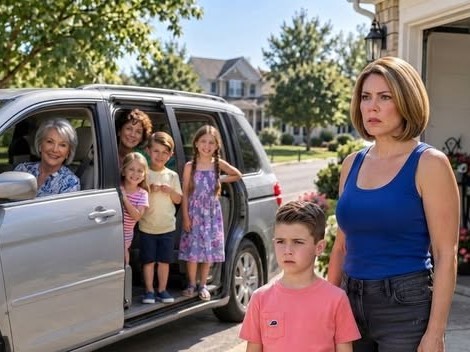
    Lauren’s van had eight seats. Lauren drove. Mom climbed into the front passenger seat. Chloe and Ben sat in the middle row, and Noah sat by himself in the back.

    Three seats were empty.

    Evan immediately pointed toward Noah. “I’ll sit next to him!”

    Lauren got out and opened the rear hatch. Inside were a cooler, two tote bags, towels, a folding chair, and a ridiculous half-inflated crocodile float.

    “Aunt Lauren, should I put my backpack back there?” Evan asked.

    She barely looked at him.

    “Actually, honey, you can’t come with us. There isn’t enough room.”

    Evan stopped moving.

    I stared at my sister. “What?”

    “We need the extra space for our things.”

    I looked through the open sliding door at the three clearly empty seats. “Lauren, there are three empty seats.”

    She sighed. “Natalie, please don’t start.”

    “Start what? You invited Evan.”

    “And I just told you there’s no room.”

    “For what?”

    She gestured toward the hatch. “The cooler. Towels. The bags. The float.”

    I looked at the inflatable crocodile. “You’re telling me that thing gets space in the van, but my son doesn’t?”

    “Stop twisting what I’m saying.”

    “Then put the luggage in the back.”

    “The trunk is full.”

    It wasn’t. There was easily enough space left for several backpacks and probably another cooler.

    Before I could argue further, Evan lightly touched my arm.

    “It’s okay, Mom.”

    Those four words hurt more than anything Lauren said.

    He wasn’t okay. He was trying to make himself smaller so the adults around him wouldn’t have to feel uncomfortable about hurting him.

    Mom walked out wearing sunglasses and a large straw hat. “What’s all this noise?”

    “Lauren says there isn’t room for Evan.”

    Mom looked inside the van. I watched her eyes move across one empty seat, then another, then the third.

    She knew.

    But instead of defending her grandson, she placed a hand on his shoulder.

    “Oh, sweetheart. Maybe next time.”

    My throat tightened. “Mom, Lauren invited him.”

    “Well, plans change, Natalie.”

    Lauren shut the hatch. Chloe leaned toward the open sliding door.

    “Mom, Evan can sit next to me!”

    “No, honey. Buckle your seat belt.”

    “But—”

    “Chloe. Now.”

    The sliding door shut. Mom got into the passenger seat, Lauren started the engine, and my nine-year-old son stood in his grandmother’s driveway clutching the backpack he had packed so carefully.

    As they drove away, Mom rolled down her window.

    “Next time!”

    Evan gave her a tiny, polite wave.

    Then he walked back toward the house.

    He stood at the front window until the minivan disappeared around the corner. For several seconds, neither of us spoke.

    Then I picked up my purse.

    “Grab your backpack, buddy.”

    He turned around. “Why?”

    “Because we’re going to Harbor Falls.”

    His eyes widened. “Really?”

    “Really.”

    “But Aunt Lauren already left.”

    “I know.”

    “What about Grandma?”

    I opened the front door.

    “What about her?”

    For the first time that morning, he smiled.

    Harbor Falls was about forty minutes away. During the drive, Evan repeatedly asked if we were really going. I think part of him expected my phone to ring and for me to suddenly turn around because Grandma had convinced me we needed to understand Lauren’s situation.

    That was normally how our family operated.

    Lauren created a problem.

    Everyone else adjusted.

    Not that day.

    When we reached the park, the regular parking lot was already packed. I checked the ticket options on my phone and saw that two VIP passes would cost $450.

    Four hundred and fifty dollars.

    I was the kind of woman who compared grocery prices and brought lunch from home instead of buying it. Spending $450 in one afternoon made my stomach tighten.

    I could practically hear Lauren mocking me.

    Must be nice to have money to waste.

    Then I remembered all the extra shifts I had worked, all the vacation days I never used, and the way Evan had stood at Grandma’s window trying to pretend he wasn’t hurt.

    I bought the passes.

    “Mom,” he whispered when he saw the confirmation, “are those the special tickets?”

    “Yep.”

    “The ones where you get to skip some of the lines?”

    “Those are the ones.”

    He wrapped both arms around me so tightly that for a second I couldn’t breathe. Not because of the hug, but because I suddenly realized how rarely I spent money simply to create happiness for my own child.

    I was always preparing for the next emergency.

    And somehow Lauren was always the emergency.

    We entered through the VIP gate. Evan stared at his wristband as though it were gold. We rode the Cyclone Drop three times. He screamed through the first ride, laughed uncontrollably through the second, and raised both hands on the third. We shared nachos covered in suspiciously orange cheese, drifted around the lazy river, and relaxed in a shaded cabana where Evan announced that the lounge chairs were “basically furniture for kings.”

    For the first time in months, I stopped thinking about my family.

    Then my phone buzzed.

    Lauren.

    “Where are you? Mom said you left.”

    I took a picture of Evan smiling beside the Cyclone Drop and sent it.

    Her answer came instantly.

    “YOU’RE AT HARBOR FALLS?”

    Then:

    “Why didn’t you tell us?”

    And finally:

    “The kids would’ve loved VIP passes!”

    I stared at the screen.

    Not one apology.

    Not one question about Evan.

    Her only concern was that her children hadn’t received something special too.

    I placed the phone facedown.

    Then my banking app sent me a notification.

    Someone had attempted to use the fuel card connected to the account I used for Lauren’s gasoline.

    I opened the app.

    For almost two years, I had been paying her fuel expenses. She first asked for help after her hours at work were supposedly reduced.

    “Just until I’m back on my feet,” she promised.

    Initially, I sent money directly. Then Mom suggested that I add Lauren as an authorized user on a separate gas card.

    “It’ll make everything easier,” she said.

    So I did.

    The first month cost $280.

    The second was nearly $400.

    Eventually, the total regularly approached $600 a month.

    Whenever I questioned the amount, Lauren reminded me that she had three children.

    “School, groceries, appointments. You know how expensive driving is.”

    Mom always defended her.

    “It’s for the children, Natalie.”

    I looked across the cabana at Evan, who was arranging French fries from shortest to longest.

    Then I opened the card controls.

    Lauren’s card.

    Deactivate.

    I pressed the button.

    For the first time in twenty-two months, my sister would have to pay for her own gasoline.

    Three hours later, my phone started ringing.

    Lauren.

    I ignored it.

    She called again.

    Then Mom called.

    Then Lauren sent a message.

    “NATALIE! I’M AT THE GAS STATION! THE TANK IS EMPTY AND THE CARD KEEPS GETTING DECLINED! WHAT DID YOU DO?!”

    I looked at Evan. He was eating ice cream while watching kids race down another slide.

    I typed five words.

    “Ask your three empty seats.”

    Then I put my phone away.

    I expected Lauren to be furious.

    I expected Mom to accuse me of being selfish.

    I expected the usual speech about family helping family.

    What I didn’t expect was Mom’s next voicemail.

    Her voice wasn’t angry.

    She sounded terrified.

    “Natalie, call me immediately. You don’t understand what you’ve done.”

    I stepped away from the cabana and called.

    She answered instantly.

    “Turn the card back on.”

    “No.”

    “Natalie, listen to me.”

    “I’ve been listening to you for years, Mom.”

    “Lauren doesn’t have enough money to fill the tank.”

    “Then maybe she should use whatever money she saved by refusing to buy Evan a ticket.”

    “This isn’t funny!”

    “I’m not laughing.”

    There was a long silence.

    Then Mom said something that made my stomach tighten.

    “If Lauren calls the police, don’t tell them anything about that van.”

    I stopped walking.

    “What?”

    “Just reactivate the card. Please.”

    “Why would Lauren call the police?”

    “She’s upset.”

    “Over gasoline?”

    “Natalie—”

    “What aren’t you telling me?”

    I heard Lauren yelling in the background.

    Mom lowered her voice.

    “Your father wanted this family to stay together.”

    Hearing Dad’s name suddenly made my chest tighten.

    “What does Dad have to do with a gas card?”

    “Nothing. Forget I said anything.”

    She hung up.

    I stood beside a row of vending machines while the distant roar of waterslides filled the air.

    Something was wrong.

    Mom had spent my entire childhood rearranging everyone’s lives whenever Lauren got angry. She had never sounded frightened of her.

    So why was she terrified now?

    And why had she brought up Dad?

    When I returned to the cabana, Evan was sitting beside Chloe, Lauren’s fifteen-year-old daughter.

    “Aunt Natalie!”

    I looked around. “Where’s your mom?”

    “At the gas station, I think.”

    “How did you get here?”

    “We were already in the park. Mom and Grandma left to get food and gas. They told us to stay near the wave pool.”

    My pulse quickened. “They left all three of you here?”

    “Ben’s twelve. We were okay.”

    That was another conversation for later.

    Chloe looked down at Evan, then at me.

    “Can I talk to you?”

    We moved a few steps away.

    “I wanted Evan to come this morning,” she said.

    “I know.”

    “No, I really did. I told Mom there was plenty of room.”

    “I heard you.”

    Chloe swallowed.

    “She said you’d probably bring him yourself because you always have money.”

    A bitter laugh slipped out of me. “Did she?”

    Chloe nodded. “Grandma said you probably wouldn’t spend the money because you’re too careful.”

    So my mother had known exactly how hurt Evan would be.

    And she had still watched that van leave.

    “Did your mom ever say why she didn’t want Evan there?”

    Chloe hesitated.

    “She said something about Grandpa.”

    A cold feeling spread through my chest.

    “What about Grandpa?”

    “I don’t know everything. Mom and Grandma were arguing last night.”

    “What did you hear?”

    Chloe looked at the ground.

    “Mom said she was tired of pretending everything belonged to Evan.”

    I went completely still.

    “Everything?”

    “That’s what she said.”

    Before I could ask more, Chloe received a text from Grandma telling them to meet at the front gate. But before she left, she turned around.

    “Aunt Natalie?”

    “Yeah?”

    “I don’t think Grandpa forgot about Evan.”

    Then she hurried away.

    Dad had adored my son. Every Sunday, he took Evan to a little playground. He taught him to skip stones, whistle through his fingers, and recognize birds. When Evan was six, Dad built him a small wooden toolbox. Inside was a handwritten message:

    For my favorite apprentice. Build something wonderful.

    Evan kept it beneath his bed.

    But I hadn’t thought about Dad’s finances since his death because Mom repeatedly told us there had been almost nothing left after the medical bills.

    Why, then, would Chloe think Dad had left something specifically for Evan?

    I called Mom.

    No answer.

    Then I called Lauren.

    She answered immediately.

    “Finally!”

    “Where’s Mom?”

    “Right here.”

    “Put her on.”

    “No. Turn my card back on first.”

    I took a breath.

    “Lauren, what did Dad leave Evan?”

    Silence.

    Then: “What are you talking about?”

    “Chloe heard you arguing with Mom.”

    “That girl needs to stay out of adult conversations.”

    “What belongs to Evan?”

    “Nothing!”

    The answer came too quickly.

    “Lauren.”

    “Your son isn’t entitled to everything just because he’s your only child.”

    My heartbeat became louder in my ears.

    “What are you talking about?”

    Lauren’s voice sharpened.

    “You always act like you’re better than me. You don’t know what it’s like raising three children.”

    “I’m raising Evan alone.”

    “And somehow you always have money!”

    “Because I work!”

    “Oh, here we go.”

    “No. You’re answering me.”

    She hung up.

    Seconds later, Mom texted:

    “Come to my house tonight. Alone. We need to talk.”

    I replied:

    “If this involves my son, I’m not discussing it behind his back.”

    Her response came almost immediately.

    “Please don’t make this harder.”

    Lauren eventually found another way to pay for gas and arrived back at the water park near closing time. I was drying Evan’s hair when I heard her shouting my name.

    She marched toward us with Mom several steps behind.

    “You humiliated me!”

    I continued folding Evan’s towel.

    “Did I?”

    “Do you know how embarrassing it is to have your card declined with people standing behind you?”

    I looked at Evan, then back at her.

    “Do you know how embarrassing it is for a child to be told there’s no room for him while three seats are empty?”

    Lauren rolled her eyes.

    “Are you seriously still talking about that?”

    “Yes.”

    “He came anyway!”

    Evan lowered his head.

    I stepped between them.

    “Don’t talk about him as though he isn’t standing right here.”

    She gave a bitter laugh. “You spent $450 just to make me look bad.”

    “No, Lauren. I spent $450 because my son deserved one good day.”

    Mom grabbed my arm.

    “Enough.”

    I pulled away.

    “Why did you mention Dad?”

    Mom’s expression changed immediately.

    Lauren looked toward her.

    “Not here,” Mom said.

    “Why?”

    “This is a family matter.”

    I looked around the crowded parking lot.

    “Interesting. I thought Evan was family this morning.”

    Lauren grabbed Mom’s arm.

    “We’re leaving.”

    As they turned, Evan spoke.

    “Grandma?”

    Mom stopped.

    His voice became very small.

    “Did I do something wrong?”

    Mom opened her mouth.

    Nothing came out.

    Lauren sighed.

    “Nobody said you did anything.”

    “Then why couldn’t I come?”

    Lauren looked away.

    For once, she had no answer.

    That evening, after Evan went to bed, I downloaded twenty-two months of fuel-card statements.

    The total was $12,846.

    Nearly thirteen thousand dollars.

    That money could have gone toward Evan’s education. A better apartment. A real vacation. Instead, I had been pouring it into Lauren’s gas tank.

    Then I noticed something stranger.

    Recent charges came from stations scattered around Columbus. Some occurred less than an hour apart, twenty miles away from one another.

    I looked through older statements.

    The pattern repeated.

    So I called Lauren’s ex-husband, Scott.

    We had remained civil after their divorce because of the children.

    “Does Lauren still have that landscaping job?” I asked.

    “What landscaping job?”

    “The one where she delivers equipment between sites.”

    Scott went quiet.

    “Natalie, she hasn’t worked there in more than a year.”

    My stomach dropped.

    Then his voice changed.

    “Is this about your gas card?”

    “How do you know about the card?”

    “Lauren told me you paid for her gas. She said you didn’t care because you made more money than she did.”

    “I work at a grocery store, Scott.”

    “I know.”

    After another silence, he said, “You should probably ask who else has been using the card.”

    “Who?”

    “I can’t prove anything, but I’ve seen Derek carrying it.”

    Derek was Lauren’s boyfriend.

    He owned a landscaping business.

    Three trucks.

    A trailer.

    And apparently access to my gas account.

    The next morning, Mom came to my apartment carrying homemade muffins.

    Food first.

    Guilt second.

    That had always been her method.

    “Lauren cried all night,” she said.

    “Did she apologize to Evan?”

    Mom sighed. “She’s under a lot of pressure.”

    “So am I.”

    “She has three children.”

    “And I have one.”

    “Exactly. You don’t understand how expensive three children are.”

    I turned toward her.

    “I spent almost thirteen thousand dollars paying for Lauren’s gas.”

    Mom looked genuinely surprised.

    “That can’t be right.”

    “I checked.”

    “Well, I’m sure she needed it.”

    “Her boyfriend has been using my card.”

    Mom looked away.

    That tiny movement told me everything.

    “You knew.”

    “Natalie—”

    “How long have you known?”

    “Lauren said Derek sometimes needed help when business was slow.”

    “And you decided I should finance his business too?”

    “He’s part of her life.”

    “So is Evan.”

    Mom hardened.

    “You’re turning one small mistake into something enormous.”

    “Leaving a nine-year-old behind isn’t a small mistake.”

    She grabbed the muffin container.

    “Your father would be ashamed of how you’re treating your sister.”

    Normally, that sentence would have filled me with guilt.

    This time, it made me angry.

    “Do not use Dad to manipulate me.”

    Mom froze.

    “And since you brought him up—what did he leave Evan?”

    Her fingers tightened around the container.

    “Nothing.”

    “Chloe heard otherwise.”

    “She’s a child. She doesn’t understand adult conversations.”

    “Then explain it to me.”

    Mom walked toward the door.

    “I won’t stand here and be interrogated.”

    I followed her.

    “Did Dad leave money for Evan?”

    She stopped with her hand on the doorknob.

    After several seconds, she whispered:

    “Some things are better left alone.”

    Then she walked out.

    By Monday, I contacted the attorney who had handled Dad’s estate.

    Mr. Harrison remembered me immediately.

    After hearing why I was calling, he became quiet.

    “Ms. Mercer, your father created a separate custodial account before he died.”

    My hands went cold.

    “For who?”

    “Your son.”

    I closed my eyes.

    “How much?”

    “I can’t disclose account details over the phone until the proper documents are verified. But the account wasn’t part of probate.”

    “Who controlled it?”

    Another pause.

    “Your mother was named custodian.”

    Every conversation after Dad’s death rushed back to me.

    Mom saying there was nothing.

    Lauren complaining I never helped enough.

    Every extra shift.

    Every bill I covered.

    “What was that money intended for?”

    “For Evan’s benefit.”

    That afternoon, I went to Mr. Harrison’s office.

    Dad had opened the account when Evan was six. Mom was named custodian because Dad knew his health was deteriorating and wanted someone to manage the money until Evan became older.

    The original contribution was $52,000.

    I couldn’t speak.

    Dad had worked on cars his entire life. He wore patched jackets and saved anything that might still be useful.

    And quietly, he had saved fifty-two thousand dollars for his grandson.

    Mr. Harrison slid a photocopied letter across his desk.

    Dad’s handwriting.

    The first sentence read:

    “Evan, I hope this helps you build the kind of life you dream about.”

    My eyes filled with tears.

    “What happened to the money?”

    “That’s what we need to determine.”

    He explained that we could formally request an accounting. If the money had been used improperly, legal options existed to protect Evan’s interests.

    That evening, Chloe called.

    “Aunt Natalie, can you come get me?”

    “Are you okay?”

    “I’m at Grandma’s. I found something.”

    When Evan and I arrived, Chloe was sitting on the porch holding a blue folder.

    “I found this in Grandma’s filing cabinet.”

    “You shouldn’t take her things, Chloe.”

    “I know. But Grandma told Mom to destroy it. I heard them.”

    The label on the front read:

    EVAN MERCER — CUSTODIAL ACCOUNT.

    Inside were bank statements, dealership documents, and handwritten notes.

    The account originally contained $52,000.

    Then there was a withdrawal.

    $34,800.

    Paid directly to a vehicle dealership.

    I recognized the dealership immediately.

    It was where Lauren bought her silver minivan.

    There were more withdrawals.

    Insurance.

    Registration.

    Transfers directly into Lauren’s account.

    A handwritten note in Mom’s handwriting was attached to one invoice:

    Vehicle necessary for family transportation. Funds used for beneficiary’s benefit.

    I read those words three times.

    My mother had used Evan’s inheritance to buy Lauren a minivan.

    The exact same minivan that had pulled away from him with three empty seats.

    I didn’t confront anyone.

    I photographed every document and called the attorney.

    Soon, I was sitting across from another lawyer, Ms. Bennett, explaining everything: the water park, the gas card, the custodial account, the minivan.

    She reviewed the documents carefully.

    “These records raise serious questions about whether the funds were actually used for Evan’s benefit.”

    “Can we recover the money?”

    “We’ll need complete records first. Then we can determine our legal options.”

    Three days later, Lauren arrived at my apartment.

    “Chloe told me you got a lawyer.”

    “Yes.”

    “You’re actually going to drag Mom through court?”

    “Where did Evan’s money go?”

    Lauren sat on my couch.

    “Mom said Dad wanted all of us taken care of.”

    “Then why was the money specifically placed in Evan’s account?”

    “He wanted all his grandchildren to have reliable transportation.”

    “All his grandchildren?”

    “Yes.”

    I stared at her.

    “Then why couldn’t Evan ride in the vehicle his money purchased?”

    Lauren flinched.

    Her eyes filled with tears.

    “You’re making me sound horrible.”

    “I asked you a question.”

    She looked away.

    “Because I was tired of everything being about him.”

    “What?”

    “Dad always took Evan places. He talked about how smart he was. He bought him things.”

    “He loved all his grandchildren.”

    “Not the same way.”

    I remembered Dad attending Chloe’s school events, building Noah a toy chest, helping Ben repair his bicycle, teaching Chloe how to drive.

    “You resented a nine-year-old because Grandpa left him money?”

    “You don’t understand. You always had everything together. A job, savings, an apartment. I was struggling.”

    “So you took my son’s inheritance?”

    “Mom said we could use it!”

    “And you believed that?”

    Lauren stared down at the floor.

    Then she whispered:

    “I thought you’d never find out.”

    That sentence removed every possible excuse.

    It wasn’t a misunderstanding.

    She knew.

    Over the following weeks, Mom called repeatedly. Sometimes she cried. Sometimes she accused me of tearing apart the family. Sometimes she insisted Dad would have approved because the money supposedly helped all the grandchildren.

    But she could never explain why she hid the account from me.

    Or why the van belonged exclusively to Lauren.

    Or why thousands had gone directly into Lauren’s personal bank account.

    My attorney requested the complete accounting, and the records confirmed substantial withdrawals. We began the process of recovering what belonged to Evan.

    I also refused to reactivate Lauren’s gas card.

    When she told relatives that I had “stranded her children at a gas station,” I sent one final response.

    “I did not strand your children. I stopped paying for your gasoline. Those are not the same thing.”

    Then I stopped arguing.

    One evening, Evan found me sitting at the kitchen table reading Grandpa’s letter.

    “Is that from Grandpa?”

    I nodded.

    “Can I see?”

    He slowly read it, following the lines with his finger. When he reached the sentence about building the life he dreamed of, he smiled.

    “Grandpa always said I’d be an engineer.”

    “He did.”

    “Do you think he knew how much I’d miss him?”

    My throat tightened.

    “I think he knew exactly how much he loved you.”

    Then Evan asked something harder.

    “Are Grandma and Aunt Lauren angry because of me?”

    “No, sweetheart.”

    “But they don’t come here anymore.”

    “Sometimes adults make choices that hurt people, and then they don’t want to admit they were wrong.”

    He thought about it.

    “Like when Aunt Lauren left me?”

    “Yes.”

    “Do you think she’ll apologize?”

    “I don’t know.”

    After a moment, he leaned against me.

    “I don’t really want to go anywhere with her anymore.”

    I kissed the top of his head.

    “Then you don’t have to.”

    That was when I understood that protecting Evan meant more than making sure nobody abandoned him in a driveway.

    It meant teaching him that love should never require him to beg for a place.

    Two months after the water-park trip, Lauren finally agreed to begin discussing repayment through our attorneys. Mom acknowledged authorizing the withdrawal from Evan’s account. Lauren admitted knowing where the money came from.

    The minivan became part of the repayment proposal.

    Lauren had to give it up.

    I expected watching that silver van disappear to be satisfying.

    Instead, the biggest discovery was still coming.

    The day Lauren was cleaning out the vehicle, Chloe called.

    “Aunt Natalie, you need to come here.”

    “What happened?”

    “Mom found something in the van.”

    When I arrived, Lauren stood beside the open sliding door. Mom sat on the porch without looking at me. Chloe held a small dusty metal box.

    Across its lid was faded masking tape.

    I recognized Dad’s handwriting immediately.

    FOR EVAN — WHEN HE’S OLD ENOUGH TO UNDERSTAND.

    “Where did you find that?”

    “Behind a storage panel,” Chloe said. “Mom put it there when they cleaned out Grandpa’s garage. She forgot about it.”

    Inside were photographs, a brass key, and a sealed envelope addressed to me.

    The letter was dated six months before Dad died.

    He wrote that he had been saving money for Evan because he wanted his grandson to have opportunities he never had.

    Then I reached a paragraph that made my hands begin to shake.

    Dad had been worried about Mom’s financial decisions.

    Apparently, she had repeatedly pressured him to give Lauren money that had been intended for the grandchildren.

    Then came the sentence that made me sit down.

    “Natalie, if you are reading this, I need you to know that I tried to name you as custodian of Evan’s account.”

    I looked toward Mom.

    Her face had turned white.

    Dad explained that Mom had convinced him I was already overwhelmed as a single mother and that she should manage the money instead. He reluctantly agreed.

    But the letter wasn’t finished.

    Dad had left something for me too.

    A separate savings account.

    $15,000.

    It was supposed to help me replace my aging Honda, take Evan on a vacation, or eventually put money toward a home.

    Mom had told me there was nothing left.

    According to Dad, she had been instructed to give me that money after his death.

    I looked up.

    “Where’s my money?”

    Mom started crying.

    Lauren moved toward her.

    “Mom, don’t.”

    But I kept reading.

    Dad’s last paragraph said:

    “I know your mother may tell you to save it or use it to help Lauren. But this money belongs to you, Natalie. You’ve spent your entire life putting everyone else first. I want you to do something for yourself and Evan.”

    I couldn’t speak.

    For years, I worked overtime.

    I skipped vacations.

    I stretched every paycheck.

    I paid almost thirteen thousand dollars to keep Lauren’s van running.

    And meanwhile, Mom had hidden money Dad had specifically left to me.

    “I was going to tell you,” Mom cried.

    “When?”

    She covered her face.

    “Lauren needed help after the divorce.”

    I looked directly at her.

    “Where did my money go?”

    She couldn’t answer.

    Then Lauren whispered:

    “Mom used it for the down payment on my house.”

    For a moment, the world seemed to shift.

    My son’s inheritance had bought Lauren’s van.

    My inheritance had helped buy Lauren’s house.

    And I had spent the next two years paying to keep the van fueled.

    I didn’t scream.

    I didn’t throw anything.

    I simply took Dad’s letter, walked to my car, and went home.

    That night, I called my attorney.

    The legal process took months. There were records to verify, financial trails to reconstruct, and questions Mom and Lauren desperately didn’t want to answer.

    But something in me had changed.

    I no longer feared those difficult conversations.

    Lauren agreed to a repayment plan using money from the van and other funds. Mom agreed to address the inheritance she had withheld from me. My attorney continued working to restore as much as possible to Evan’s account.

    Not everything returned immediately.

    But for the first time in my adult life, my family’s financial problems stopped automatically becoming mine.

    I stopped paying Lauren’s expenses.

    I stopped apologizing for boundaries.

    And I stopped allowing Mom to use my father’s memory against me.

    Six months after that first Saturday, Evan and I returned to Harbor Falls.

    This time, we planned everything together.

    He saved allowance money for a souvenir.

    I packed sunscreen and sandwiches.

    And we bought ordinary admission tickets because Evan announced that waiting in line wasn’t bad when you were standing beside someone you actually wanted to be with.

    We spent the morning racing down waterslides. At lunch, we found a shaded picnic table.

    “Mom?”

    “Yeah?”

    “Remember when Aunt Lauren said there wasn’t room for me?”

    My chest tightened.

    “I remember.”

    He took another bite of his sandwich.

    “I’m kind of glad.”

    I stared at him.

    “Why?”

    “Because if she had let me go with them, we wouldn’t have had our special day.”

    I reached across the table and squeezed his hand.

    He grinned.

    “And maybe we never would’ve found Grandpa’s letter.”

    I smiled through tears.

    “No. Maybe we wouldn’t have.”

    Then Evan reached into his backpack and pulled out the wooden toolbox Grandpa had made him.

    Inside was a small wooden boat Evan had been working on. It was crooked, the edges weren’t even, and a tiny paper sail leaned slightly to one side.

    “I made this for you.”

    I held it carefully.

    “It’s beautiful.”

    Evan smiled proudly.

    “Grandpa told us to build something wonderful.”

    I nodded.

    “He did.”

    He placed the little boat in my hands.

    “We’re doing that, right?”

    I pulled him into my arms.

    “Yes, sweetheart. We are.”

    That evening, after Evan fell asleep, I sat outside with Dad’s letter.

    For years, I had believed the greatest thing I could give my son was a family that stayed together.

    So I tolerated disrespect.

    I paid bills that weren’t mine.

    I swallowed anger.

    I let people convince me that keeping everyone together was worth any price.

    But I finally understood something.

    Family isn’t defined by how many people sit around the same table.

    It’s defined by who makes room for you when you need them.

    And people who truly love you don’t make you earn your seat.

    The next morning, Evan and I had an appointment to look at a house.

    Nothing enormous.

    Just three bedrooms, a small backyard, and a garage with enough room for him to build things.

    For the first time, the money I earned was going toward the life my son and I deserved.

    And whenever I thought back to that Saturday, I stopped picturing Lauren’s silver minivan driving away.

    Instead, I pictured Evan at the top of the Cyclone Drop with both hands raised toward the sky, laughing so hard he could barely breathe.

    Because the day my family decided there wasn’t room for my son was the day I finally learned something important.

    Evan never needed a seat in Lauren’s van.

    He needed a mother who would stop allowing other people to decide how much space he deserved in this world.

    And that was something I would never let anyone take away from him again.
  • My biological father bought me a car for my seventeenth birthday, then looked straight at my stepdad and said, “Now he knows who his real father is.”  

    My biological father bought me a car for my seventeenth birthday, then looked straight at my stepdad and said, “Now he knows who his real father is.”  

    PART 1

    For a second, I wanted to embarrass him in front of everyone.

    I wanted to say something sharp enough to wipe that smile off his face.

    But then I thought of something better.

    Something my entire family would remember.

    My biological father left when I was three years old.

    For the next fourteen years, it was mostly just Mom and me.

    Money was always tight.

    We talked about it constantly without ever really talking about it.

    Which bills could wait.

    What we didn’t need this month.

    Whether the car could survive another repair.

    Mom met Julian when I was sixteen.

    He already had two children of his own—Leo, eleven, and Elena, nine—who stayed with us every other weekend.

    Suddenly, our little household got bigger.

    Five people trying to stretch money that had already been stretched too far.

    Life didn’t become easier when Julian came along.

    In some ways, it became more expensive.

    But not once did he make me feel like I was the extra person making everything harder.

    He came to every one of my games.

    Even during the season when I barely left the bench.

    He sat across from me at the kitchen table trying to help with chemistry homework he clearly understood no better than I did.

    One night, close to eleven, I shoved the book away.

    “I’m done. I’m dropping the class.”

    Julian pushed the book back toward me.

    “Read the question again.”

    I groaned.

    “Julian—”

    “Again.”

    He pointed at the page.

    “We’re not quitting tonight.”

    That fall, he and Mom quietly opened a college savings account for me.

    They put in whatever they had left at the end of each month.

    Sometimes it was a little.

    Sometimes there was nothing left at all.

    Julian was also paying child support for Leo and Elena.

    He never mentioned the account to me.

    Mom was the one who eventually told me.

    Around that time, nearly everyone at school seemed to be getting a car.

    Most were old.

    A few were barely running.

    But they were cars.

    I knew there was no way Mom and Ray could afford one for me.

    And strangely, I wasn’t upset about it.

    When you grow up understanding exactly what things cost, you learn not to want every single thing you see.

    Then my seventeenth birthday arrived.

    And so did my biological father, Arthur.

    After fourteen years.

    He had never remarried.

    Never had any other children.

    He walked up as though he had only been gone for a weekend.

    Then he placed a hand on my shoulder like that gesture automatically made up for everything.

    “Come outside.”

    I followed him toward the driveway.

    And there it was.

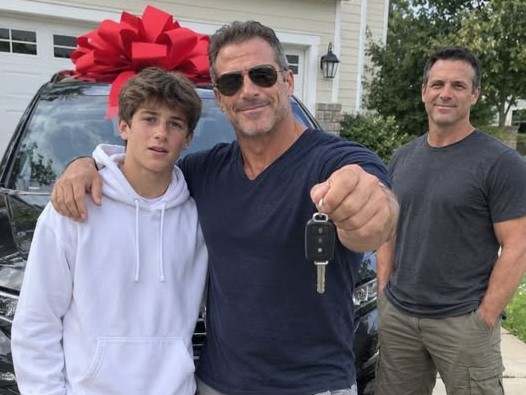
    A brand-new car.

    I just stared at it.

    He grinned.

    “Happy birthday, son.”

    Mom said nothing.

    Julian stood near the porch with both hands tucked into his pockets.

    Arthur was smiling at me when he held out the keys.

    But the next thing he said wasn’t really meant for me.

    He turned slightly toward Julian.

    “Now he knows who his real father is.”

    Julian lowered his eyes.

    Arthur extended his hand, the keys resting proudly in his palm, clearly waiting for the thank-you he believed he had earned.

    I had fourteen years’ worth of things I could have said.

    I could have humiliated him right there.

    I could have reminded everyone who had actually been present.

    Who had sat in the bleachers.

    Who had stayed awake over chemistry homework.

    Who had quietly saved for my future even when there was barely anything left to save.

    Every word was sitting on the tip of my tongue.

    But I didn’t say any of it.

    Instead, I turned toward the porch.

    “Julian.”

    He looked up.

    “Come here for a second.”

    PART 2

    Ray looked up, a faint smile touching his face as he wiped his hands on his jeans. He stepped off the porch and walked over, his eyes moving between me, my biological father, and the sparkling red sedan sitting in the driveway.

    Arthur’s smile broadened, his chest puffing out as he held the key fob higher. He assumed I was calling Ray over to show him what a “real father” looks like, expecting me to rub his wealth in the face of the man who had been struggling to pay for my groceries.

    “Julian,” I said, looking straight at my stepdad, ignoring Arthur’s outstretched hand entirely. “Do you remember last month when we spent four hours trying to fix the radiator on Mom’s old station wagon?”

    Julian blinked, surprised. “Yeah, kid. I remember.”

    “You didn’t give up, even when your hands were covered in grease and you had to work an early shift the next morning,” I said. “And I remember who sat at the kitchen table with me every single night until eleven PM so I wouldn’t fail chemistry, even when you were exhausted.”

    Arthur’s smile faltered, his arm slowly sinking a few inches. “Son, what are you talking about? The car is right here—”

    “Don’t call me son,” I said, turning my head to look Arthur dead in the eye for the first time since he had arrived. My voice was calm, but every word felt like a deliberate blow. “You don’t get to show up after fourteen years with a piece of metal on wheels and claim a title you never earned.”

    Arthur’s jaw dropped. He opened his mouth to speak, but no sound came out.

    “You want to know who my real father is?” I asked, reaching out my hand—not toward Arthur’s key fob, but toward Julian. “It’s the man who showed up to every single one of my bench-warming basketball games. It’s the man who quietly opened a college fund for me when he didn’t even have enough money for his own tools. It’s Julian.”

    Arthur’s face flushed a deep, embarrassed crimson. He looked around at my mother, who was standing on the porch with a soft, proud smile, and then at Julian, whose eyes were shining with unshed tears.

    I looked down at the shiny key fob still resting in Arthur’s trembling palm.

    “Keep the car,” I said quietly. “I’d rather walk than drive a reminder of your regret.”

    Without waiting for another word, I turned my back on my biological father, wrapped my arm around Julian’s broad shoulders, and walked back up the porch steps toward our home.

    PART 3

    Behind us, a car door slammed sharply, followed by the roar of an engine as Arthur sped down the driveway, leaving behind nothing but a cloud of dust and an awkward, heavy silence.

    Julian stood on the porch, his hands still jammed into his pockets, staring down at the wooden deck boards. His shoulders were trembling slightly.

    “You didn’t have to do that, kid,” Julian whispered, his voice thick with emotion. “That was a brand-new car. You deserved a good ride.”

    “A car is just metal, Julian,” I replied, looking him in the eye. “You can buy a car with money. You can’t buy fourteen years of showing up.”

    Mom walked over, wrapping her arms around both of us, resting her head against Julian’s chest. For the first time in years, the heavy weight of financial stress and unspoken sacrifices felt lighter. We didn’t have a new car, and things were still going to be tight, but we had something Arthur’s money could never buy: respect and a real family.

    Two weeks later, Julian called me out to the garage after dinner.

    Sitting in the driveway was an old, beat-up 2008 blue pickup truck with a rusted rear fender and a cracked side mirror. It was far from shiny, and the engine let out a raspy cough as it idled, but it was sitting right there in front of our house.

    Julian tossed me a heavy, scratched metal key.

    “It took a little extra weekend work down at the shop, and a favor from old man Miller,” Julian said, rubbing the back of his neck, almost looking sheepish. “She’s not a sports car, and the radio only picks up AM stations… but the engine is solid. She’s yours.”

    I held the warm, worn key in my palm. It didn’t come with a speech or a grand gesture. It came from early mornings, greasy hands, and a man who worked overtime just to make sure his stepson didn’t feel left behind.

    “It’s perfect,” I said, my chest swelling.

    FINAL PART

    Five years later.

    The afternoon sun streamed through the glass windows of the university auditorium. Hundreds of students in black caps and gowns sat in neat rows, waiting for the commencement ceremony to begin.

    I sat near the front, my heart beating with pride as I looked down at my degree in Chemical Engineering—the very subject I had almost given up on in high school.

    When it was my turn to walk across the stage, the presenter read my name over the loudspeakers: “Leo Vance—Magna Cum Laude.”

    As I shook the dean’s hand and accepted my diploma, a loud, booming roar echoed from the top bleachers of the auditorium.

    “THAT’S MY SON!”

    I looked up into the crowd and smiled. Standing right at the front of the balcony section was Julian, wearing his best button-down shirt, waving his arms wildly, his eyes wet with tears of pure joy. Beside him stood Mom, Leo, and Elena, all cheering at the top of their lungs.

    After the ceremony, we met outside on the lawn under the shade of the oak trees.

    Julian walked up to me, his hands shaking slightly as he pulled me into a bear hug that nearly knocked the wind out of me.

    “You did it, kid,” Julian said, stepping back and gripping my shoulders tightly. “You really did it.”

    I pulled my diploma from its leather casing and handed it to him.

    Julian blinked, looking down at the heavy paper. Written in gold foil at the bottom of the degree was a custom inscription I had requested months before graduation:

    To Julian Vance:

    Thank you for never letting me quit.

    Everything I am, I owe to your quiet strength.

    Julian stared at the words, his tough, stoic posture completely melting away. He wiped a tear from his cheek with the back of his rough hand and pulled me into another hug.

    Out in the parking lot, parked right beside a row of brand-new luxury sedans, stood my old 2008 blue pickup truck. It was still rusted, still faded, and still raspy—but it had brought me all the way across the state, through five years of college, and into a bright future.

    Arthur had thought a father was someone who bought a car.

    Julian taught me that a father is someone who builds a foundation strong enough for you to stand on for the rest of your life. And as we walked toward the truck together, surrounded by the people who truly mattered, I knew I was the luckiest son in the world.

    EPILOGUE

    Ten years after my graduation, the morning sun broke over the driveway of our new home in suburban Illinois.

    Parked side-by-side in the garage were two vehicles. The first was a sleek, electric SUV I had bought after accepting a senior director position at a bio-chemical firm in Chicago. The second was the old 2008 blue pickup truck—restored, re-painted, its engine purring as smoothly as the day it rolled off the assembly line twenty-two years ago.

    I sat on the porch steps, drinking a fresh cup of coffee, watching seven-year-old Toby kick a soccer ball across the green grass.

    A silver sedan pulled into the driveway, and Julian stepped out, wearing his favorite flannel shirt and a baseball cap. His hair was almost entirely silver now, and his step was a little slower, but the warmth in his eyes hadn’t faded a bit.

    “Grandpa!” Toby yelled, dropping the soccer ball and sprinting across the lawn.

    Julian’s face lit up with a brilliant smile. He bent down, effortlessly catching Toby in his arms and swinging him around before setting him back down on his feet.

    “Hey there, buddy,” Julian laughed, ruffling Toby’s hair. “Did you practice those kick-drills I showed you last weekend?”

    “Every single day!” Toby cheered, grabbing Julian’s hand and dragging him toward the grass. “Come watch!”

    I walked down the porch steps, handing Julian a second cup of coffee. He took it with a nod of thanks, his eyes following my son as he dribbled the ball around plastic cones set up in the yard.

    “He’s getting fast, Leo,” Julian said quietly, taking a sip. “A lot faster than you were at his age.”

    “That’s because he didn’t spend three seasons warming the bench,” I chuckled, leaning against the wooden porch railing beside him.

    Julian let out a soft laugh, resting his arm on my shoulder. “Bench or no bench, you always stayed until the final buzzer. That’s what counted.”

    As we watched Toby, a delivery van pulled up to the curb. The driver stepped out, holding a large, flat package wrapped in brown paper, checking the address on his clipboard before walking up the driveway.

    “Leo Vance?” the driver asked.

    “That’s me,” I replied.

    I signed the digital pad, took the package, and set it on the patio table. Julian walked over, curious, as I pulled the tape away and unwrapped the thick paper.

    Inside was a heavy, framed piece of dark mahogany wood. Mounted on the front was an official plaque from the state university’s engineering department, alongside a letter bearing an official university seal.

    Julian adjusted his reading glasses, leaning in closer. “What’s this, kid?”

    I picked up the plaque and handed it directly to him.

    Julian read the gold-embossed lettering out loud, his voice wavering slightly with every word:

    THE JULIAN VANCE SCHOLARSHIP FOR FIRST-GENERATION ENGINEERS

    Established by Leo Vance, Class of 2026

    To honor the man who taught me that showing up every day is the greatest gift a father can give.

    Julian stopped reading. He stared at the plaque for a long moment, his thumb tracing the smooth gold lettering of his own name.

    “Leo…” he whispered, his throat tight, looking up at me with tears brimming in his eyes. “You… you didn’t need to do this. This must have cost…”

    “It covers full tuition for two students every single year, Julian,” I said softly, stepping closer and placing my hand firmly on his shoulder. “Kids who come from families where money is tight. Kids who think they have to drop out because they can’t afford the books or the fees. Kids who just need someone to tell them, ‘We’re not quitting tonight.’”

    Julian let out a long, trembling breath. He set the plaque down on the table, wiped a tear from his cheek with his rough knuckle, and pulled me into a tight, fierce hug.

    For thirty years, Julian had never asked for a single thank-you. He had worked eighty-hour weeks in the grease of an auto shop, paid child support, helped with chemistry homework he barely understood, and put every spare dollar into a college fund for a boy who wasn’t biologically his. He had given up his weekends, his back, and his youth—never expecting his name to be carved into anything.

    And now, his name would stand at the entrance of the university engineering hall forever.

    “I’m so proud of you, Leo,” Julian choked out against my shoulder. “So proud.”

    “I learned it from you, Dad,” I whispered.

    It was the first time in twenty years I had called him Dad out loud.

    Julian pulled back, looking into my eyes, a tear slipping down his weathered cheek. He didn’t say a word, but the quiet, overwhelming joy on his face said everything that fourteen years of silence had ever tried to express.

    Toby came running over, breathlessly kicking the soccer ball right to Julian’s feet. “Grandpa! You promised you’d play goalie!”

    Julian wiped his eyes, threw his head back with a bright, clear laugh, and kicked off his boots right there on the grass.

    “Alright, buddy!” Julian called out, stepping between two wooden chairs to form a makeshift goal post. “Let’s see what you’ve got!”

    I sat back down on the porch steps, holding my warm coffee cup, watching my father bend his knees, get into position, and cheer for my son as the soccer ball flew across the grass.

    A long time ago, a man had driven a brand-new car into a driveway, believing that fatherhood could be bought with a single gesture. He had thought that a shiny piece of metal made a parent.

    He was wrong.

    Fatherhood wasn’t a transaction. It was the early mornings. It was the greasy hands. It was the quiet sacrifices made when nobody was watching. It was the man standing in the yard right now, laughing with my son, showing up—just like he always had, and just like he always would.

  • My mother-in-law arranged a dinner at an exclusive restaurant, but when I arrived there was no seat reserved for me; she smirked: “Maybe a budget place suits you better!”  

    My mother-in-law arranged a dinner at an exclusive restaurant, but when I arrived there was no seat reserved for me; she smirked: “Maybe a budget place suits you better!”  

    My mother-in-law arranged a dinner at an exclusive restaurant, but when I arrived there was no seat reserved for me; she smirked: “Maybe a budget place suits you better!” I burst out laughing and asked the owner for a seat, because the owner was…

    He barely looked at it.

    “Mom probably ran out of room.”

    “There’s a 2-in margin, Daniel.”

    He kissed my forehead before leaving.

    “She didn’t mean it like that.”

    That sentence had become a loadbearing wall in our marriage.

    Diane didn’t mean it when she cropped me out of the family Christmas photo.

    She didn’t mean it when she introduced me to her garden club as Daniel’s little helper at the office.

    She didn’t mean it when she told the caterer at our anniversary party I could eat in the kitchen because I’d feel more comfortable there.

    Daniel had a gift for repackaging cruelty as carelessness.

    And for six years, I let him.

    Not because I believed him.

    Because I was busy running the company that paid for all of it—the foil invitations, the Savannah stationary, the client happy hours.

    Nobody at that dinner table knew that yet.

    And the word guest was about to cost the Marshes more than they could afford.

    I started washing dishes at a seafood shack called Mullers the summer I turned 16.

    Minimum wage.

    No air conditioning.

    Grease burns covered both forearms by August.

    The head cook was Sal Pcelli, 60 years old, with a voice like a blown speaker and hands capable of breaking down a halibet in 45 seconds.

    He watched me clear tables for 3 weeks without speaking to me.

    Then one night after closing, he placed an 8 in chef’s knife on the prep counter and slid it toward me.

    “You don’t flinch,” he said. “That’s half the job.”

    The knife came inside a canvas roll held shut by a rubber band.

    Chipped rosewood handle.

    A blade sharpened so often its spine had become thinner than a butter knife.

    I still own it.

    I carried it through culinary school, my first sue chef job at 21, and years managing kitchens in three cities.

    Along the way, I learned everything cooking shows ignored—vendor contracts, leases, labor compliance, health inspections, insurance claims.

    At 25, I filed the paperwork for Keystone Hospitality Group, an LLC with my name on the operating agreement and my savings in the capital account.

    Keystone didn’t build restaurants.

    We developed them.

    Concept.

    Financing.

    Buildout.

    Staffing.

    Launch.

    I took failing locations, rebuilt menus, renegotiated leases, recruited talent, and returned profitable kitchens to operators within 14 months.

    I specialized in invisible work.

    The work keeping the lights on while somebody else accepted the praise.

    That habit would eventually cost me.

    At the time, it simply felt like the right way to build.

    The Marshes lived inside a frame they had constructed around a picture that no longer existed.

    25 years earlier, Gerald Marsh, Daniel’s father, ran a development company that bet everything on a resort project outside Hilton Head.

    It collapsed publicly.

    The kind of failure covered by the local business journal.

    The kind where neighbors know before the children do.

    Gerald drank himself into a quiet disappearance afterward.

    He died before Daniel turned 20.

    Diane was left with two children, a last name that used to open doors, and enough anger to rebuild its reputation.

    She rebuilt it through performance.

    The right country club.

    The right lunchon circuit.

    The right vocabulary.

    Intimate instead of small.

    Curated instead of cheap.

    She taught Daniel and Whitney that looking wealthy could last longer than actual wealth.

    For years, she was right.

    Everyone still believed the Marshes were the Marshes.

    Nobody checked.

    Diane’s problem wasn’t that she was simply mean.

    Mean people are predictable.

    Diane was strategic.

    Every insult was calculated.

    Every exclusion deniable.

    She never screamed.

    She just rearranged the room until you were outside it, then acted surprised to find you there.

    She decided what I was the first night Daniel brought me home.

    I was 28, still carrying fryer oil beneath my perfume, discussing food cost ratios instead of vacation homes.

    To Diane, I wasn’t a threat to Daniel.

    I threatened the story.

    A daughter-in-law who started as a dishwasher didn’t fit the frame.

    And Diane would rather break me than resize it.

    Daniel was charming the way a hotel lobby is charming—polished, climate-controlled, designed to welcome you without ever letting you behind the desk.

    He had his mother’s jaw and his father’s talent for speaking confidently about things he barely understood.

    When we met, he managed a bar three months from shutting down.

    Over one weekend, I restructured its lease, replaced the supplier, and rebuilt the cocktail program.

    Daniel watched me with dazzled admiration.

    I mistook admiration for respect.

    We married when I was 28.

    By then, Keystone was producing real revenue, and I needed someone who could serve as its public face.

    Someone for investor dinners and ribbon cuttings.

    Daniel fit perfectly.

    Diane had trained him for performance.

    I made him Keystone’s managing partner on salary and gave him a 10% equity stake from my own holdings.

    Harrove Capital Partners already held 20% from a growth round I had pitched in Charlotte the year before our marriage.

    That left me with 70% as majority member.

    My attorney, Francis Doyle, insisted the agreement include a managing partner removal clause.

    “Insurance,” she called it.

    I told her she was being dramatic.

    The arrangement worked because I let myself remain invisible.

    Daniel attended conferences.

    Daniel took meetings.

    Daniel’s name appeared on business cards my capital paid to print.

    Everyone assumed he had built Keystone.

    I never corrected them.

    That was my weakness.

    Not naivity.

    Not people pleasing.

    I was isolated inside my own competence.

    I believed good work should speak for itself.

    I carried everything because asking for recognition felt too much like asking permission.

    But the work never spoke.

    It simply kept working.

    And my silence allowed a false story to harden until everyone accepted it as truth.

    The Marshes held Sunday dinners at Dian’s house.

    Cream tablecloth.

    Matching napkins.

    Seasonal centerpiece.

    Everyone had an assigned seat.

    Daniel sat on Diane’s right.

    Whitney and her husband Brad sat across from him.

    Gerald’s chair remained empty at the head of the table, a monument to grief Diane had never processed.

    My seat was at the short end, beyond the good flatear and wine glasses, where the kitchen draft hit my neck whenever someone opened the door.

    I never complained.

    I brought dessert.

    Cleared dishes.

    Asked about Whitney’s Pilates and Diane’s Garden Club.

    For 6 years, I played the perfect daughter-in-law in every way except the one that counted.

    They never treated me as family.

    The worst moment came at Diane’s 62nd birthday in front of 11 people.

    A photographer arrived for a family portrait.

    Diane, Daniel, Whitney, Brad.

    They gathered before the fireplace.

    I stood to join them.

    Diane raised one hand, smiled toward the camera, and said the sentence that stayed with me for the next 14 months.

    “You’re staff, dear, not family.”

    Nobody reacted.

    Daniel coughed.

    Whitney adjusted an earring.

    The photographer took six pictures.

    I returned to the kitchen and wrapped leftovers in foil.

    Later that night, Daniel insisted she was joking.

    “You know Mom. She’s got a dry sense of humor.”

    I understood dry humor.

    I grew up in kitchens where line cooks roasted one another professionally.

    Diane wasn’t joking.

    She was filing me into the category she needed so her frame wouldn’t crack.

    3 weeks before the dinner at Salen, I secured the largest letter of intent Keystone had ever received.

    Signed, pending final contract.

    Howerin Hotel Group wanted a flagship restaurant inside its new downtown property.

    200 seats.

    A rooftop bar.

    A tasting room.

    More than $4 million for buildout alone.

    I had pursued them for 11 months.

    Twice, I flew to their Atlanta headquarters.

    I built the pitch deck, proforma, staffing model, and sourced the architect.

    When the LOI arrived, it was addressed to Keystone Hospitality Group LLC.

    Attention: Athena Exley, managing member.

    Daniel’s contribution had been a handshake during the first meeting and a follow-up email sent from his phone while watching golf.

    Yet Dian’s invitation read, “Celebrating Daniel’s landmark partnership with Howerin Hotel Group.”

    His partnership.

    His landmark.

    The morning it arrived, Daniel called Diane to thank her.

    I heard him from the hallway.

    “Mom, it means a lot. Really. This is the one that changes everything for us.”

    Us meant the Marshes.

    Not Athena.

    The invitation named Sen, a restaurant with a threemonth waiting list and a prefix beginning at $240 ahead.

    Exactly the kind of room where Diane could perform status before an audience willing to believe her.

    What she didn’t know was how Sen’s owner had started.

    Or who had given him his first kitchen.

    Some questions answer themselves when you pay attention.

    The Marshes rarely paid attention to anything that didn’t already carry their name.

    The morning of the dinner, I drove to Francis Doyle’s office on King Street.

    Francis wore reading glasses on a beaded chain and dismantled liability clauses like a surgeon removing splinters—quietly, precisely, without drama.

    I hired her 9 years earlier to draft Keystone’s operating agreement.

    She had insisted on protections I thought I’d never use.

    A managing partner removal clause triggered by majority member vote.

    A 12-month non-compete cooling period.

    Annual capital account reconciliations requiring every member’s signature.

    Daniel had signed them every year.

    He had never read them.

    I handed Francis the Navy folder.

    Soft leather.

    Midnight blue.

    Keystone’s logo embossed in one corner.

    Inside were the operating agreement, Daniel’s signed acknowledgements, the capital contribution ledger, and the Howerin LOI.

    “You want me to have this notorized today?” Francis said.

    “Not a question. I want originals certified and a duplicate set locked in your office.”

    She looked over her glasses.

    “You’re sure about the timeline?”

    “Monday,” I said. “After the dinner.”

    “After,” she repeated.

    For a moment, I thought she might ask why.

    Instead, she opened a drawer, removed her notary stamp, and started working.

    I sat across from her with the folder on my lap.

    It weighed almost nothing.

    A few papers.

    Some signatures.

    Several numbers.

    The entire structure of the life the Marshes believed they controlled fit inside my tote bag.

    When Francis finished, I zipped it closed and drove home.

    Whitney called that afternoon.

    “Just confirming the headcount for tonight,” she said with the particular brightness that meant she was managing something. “Diane wants to keep it intimate. Close family only.”

    “I’m close family,” I said.

    “Of course you are. I just mean it’s a small table. We had to be selective.”

    Selective.

    I pictured her rehearsing the word before dialing.

    “Is there a seat for me, Whitney?”

    Silence.

    3 seconds.

    Long enough to hear her swallow.

    “I’m sure Daniel can figure something out. He’s so good at that.”

    She disconnected before I answered.

    I stood alone in the kitchen holding the phone.

    Something in my chest became completely still.

    Not anger.

    Not sadness.

    Recognition.

    I had stood here before.

    Outside the frame.

    Beyond the good flatear.

    Beyond the photographer’s lens.

    The Marshes had a system.

    For 6 years, I had cooperated because carrying the weight seemed easier than setting it down and seeing what collapsed.

    Whitney’s call didn’t surprise me.

    It confirmed everything.

    Close family.

    I would remember those words.

    I texted Daniel: Whitney says, “The table is full. Is there a seat for me?”

    Three dots appeared.

    Vanished.

    Appeared again.

    20 minutes later:

    I’ll talk to mom.

    He wouldn’t.

    I knew it the way I knew a kitchen was failing before tickets started backing up.

    The rhythm changes.

    Everything gets strangely quiet.

    And suddenly you realize nobody is running the pass.

    Daniel wasn’t running anything.

    He was waiting for somebody else to fix it.

    As always.

    Sen had dominated the city’s food scene for four years.

    Visionary.

    Unmissable.

    Transcendent roasted carrots.

    Its chef-owner, Declan Hail, was 39, Irish American, built like a middleweight, with a pairing-knife tattoo on his left wrist and a James Beard nomination on the wall.

    Every profile told the same origin story.

    Declan Hail, self-taught prodigy who opened his first restaurant at 27 through grit and vision.

    I had read those profiles.

    I never corrected them.

    The missing part—one Declan also left out because I asked him to—was that he wasn’t self-taught.

    At 22, he had been my line cook.

    He burned stocks and overcooked rado in a kitchen I managed when I was barely older than him.

    I taught him proteins.

    I taught him mislass.

    When he was ready to open his own place, I co-signed his first commercial lease because no bank would finance a 27year-old without collateral.

    That lease became a restaurant.

    The restaurant became a reputation.

    The reputation became Sen.

    When Daniel casually said over breakfast, “Mom booked Sen. Can you believe it?” something flickered behind my sternum.

    Not nostalgia.

    Not concern.

    Recognition.

    Like a forgotten card suddenly turning face-up.

    “Nice,” I said, pouring coffee.

    Two days before dinner, I tried once more.

    Daniel stood in our bedroom choosing between ties.

    Navy silk.

    Diane’s taste.

    I sat on the bed holding the invitation.

    “Can you call your mother and ask her to add a seat for me?”

    He never looked up.

    “It’s handled.”

    “How is it handled?”

    “I mentioned it. She said the table’s already set.”

    “Then I’ll call the restaurant myself and add a chair.”

    He turned around.

    For a second, I thought he might finally say something honest.

    Then he straightened the tie against his chest and chose cowardice instead.

    “Athena, don’t make it weird. It’s one dinner. Mom’s been planning it for weeks. I don’t want to rock the boat.”

    The boat.

    I had built it.

    Waterproofed its hull.

    Replaced the engine.

    Charted the course.

    And my husband, wearing a tie his mother chose, was asking me not to rock it.

    “I won’t make it weird,” I said.

    Relief spread across his face.

    “That’s my girl.”

    He kissed the top of my head and left.

    I remained on the bed.

    Not crying.

    Not even planning.

    Just feeling the specific weight of being somebody’s girl instead of somebody’s partner.

    My phone buzzed.

    A calendar reminder.

    Francis, notary appointment, 9:00 a.m. Friday.

    I turned the phone face down.

    I wasn’t going to make anything weird.

    I was going to make it permanent.

    Whitney preferred operating in the margins.

    Whispered comments.

    Brunch invitations sent to everyone except the person being discussed.

    She was Dian’s logistics officer, and she had spent the month quietly campaigning.

    I learned about it sideways.

    That’s how you learn most things in families built on omission.

    Brad, Whitney’s husband, had begun appearing at Keystone events.

    This was a man whose primary professional achievement was being fired from a commercial real-estate firm during a market when those firms were practically begging for staff.

    He showed up at team lunches.

    A Howerin sitewalk.

    Coffee with our project architect.

    I asked Daniel why.

    “Whitney thought Brad could use some exposure. He’s been down lately.”

    “Exposure to what exactly?”

    “The business. Get a feel for things. Maybe take on a role eventually.”

    “A role?”

    “Something operational. Whitney thinks he’s got potential.”

    I poured water and drank slowly so I wouldn’t say Brad had roughly the potential of a screen door on a submarine.

    Instead:

    “Whose idea was this?”

    “It came up at mom’s. Whitney mentioned it, and mom thought it made sense.”

    Of course she did.

    It made perfect sense if they were quietly positioning Brad to replace the person Diane never wanted inside the family to begin with.

    The woman whose name wasn’t on the invitation.

    The former dishwasher who had somehow washed up into the Marsh family.

    They weren’t merely excluding me from dinner.

    They were rehearsing my replacement.

    The night before dinner, I couldn’t sleep.

    Daniel was already out.

    He slept like a man with no conscience, which, to be fair, requires having one in the first place.

    I went downstairs for water.

    His phone lay face-up and unlocked on the kitchen counter.

    I didn’t intend to look.

    I walked toward the sink.

    Then the screen lit up.

    A notification from Marsh family.

    Three words appeared in the preview from Diane.

    She’s staff staff.

    Then the message cut off.

    My hand stopped over the faucet.

    The kitchen was dark except for the phone’s blue glow.

    I wasn’t someone who searched her husband’s phone.

    I tracked invoices, contracts, and compliance reports.

    I read documents professionally.

    And documents had taught me something.

    Information doesn’t care how you discover it.

    It only matters whether it’s true.

    I picked up the phone.

    43 messages from the previous 2 weeks.

    I read them standing barefoot on cold tile with the focus I reserved for contracts containing hidden clauses.

    The first thread covered Sen’s seating chart.

    Every name was listed.

    Daniel.

    Whitney.

    Brad.

    The Callaway cousins.

    Two Garden Club friends.

    A Howerin Hotel Group representative, so they can see the whole family behind Daniel’s success.

    No Athena.

    Whitney replied: Perfect. Keep it tight.

    12 messages later came the thread that hardened my jaw.

    Diane: We need to talk about the company. Daniel should be the sole face going forward. Athena can step back. She’s operational. She doesn’t need a title.

    Whitney: Brad can handle the operational side. He’s motivated.

    Diane: Exactly. Daniel runs the client relationships. Brad handles operations. And Athena can consult quietly.

    Whitney: Does Daniel know?

    Diane: Daniel will do what makes sense for the family. He always does.

    Earlier, Whitney had asked, “Doesn’t Athena have some kind of stake in the company?”

    Dian’s reply: Daniel says it’s mostly his. She helps with the dayto-day.

    Daniel had told them that.

    Or at minimum, he had allowed them to believe it.

    His mother had designed a takeover around a lie he found too convenient to correct.

    Then came Daniel’s contribution to the conversation.

    One thumbs-up emoji.

    No objection.

    No reminder that I founded Keystone.

    No suggestion that perhaps they should speak to me before deciding my future.

    Just a yellow thumbs-up floating beneath a plan to remove his wife from the company she created.

    Farther down, Diane discussed the dinner.

    No seat for her. If she shows up, she’ll get the message. If she doesn’t, even better.

    Then came the line that settled everything.

    She’s staff. Staff doesn’t sit at the family table.

    There it was.

    Not humor.

    Not misunderstanding.

    Strategy.

    Typed in complete sentences and coordinated by three Marshes—including the man sleeping upstairs—who agreed that I was something to manage, rearrange, and eventually remove.

    I returned the phone exactly where I found it.

    Face down.

    My hands stayed steady.

    So did my pulse.

    Upstairs, I opened my laptop and sent Francis a twoline email.

    Proceed with the notary on Friday and bring a second set of the Howerin Li.

    Then I shut the laptop and lay beside the husband who had responded to my erasure with a thumbs-up.

    Friday morning, Francis notarized the documents.

    The Navy folder lay open between us.

    Operating agreement.

    Capital ledger.

    Daniel’s annual acknowledgements.

    Howerin Li.

    I had read those documents a hundred times.

    That morning, they looked different.

    Article 3, membership interest.

    Athena Kxley, 70%.

    Daniel R. Marsh, 10%.

    Harrove Capital Partners, 20%.

    That 20% belonged to the institutional investor that had backed me—not Daniel—after a Charlotte pitch the year before our marriage.

    Article seven covered removal of the managing partner.

    A majority member could initiate removal with 30 days written notice for cause or 60 days without cause.

    Cause included material breach, failure of duty, or conduct harmful to the company.

    Francis slid the notarized copies across her desk.

    “The removal notice is drafted,” she said. “You just need to sign.”

    “Monday.”

    “Monday works.” She paused. “You know, they’ll claim it’s retaliatory.”

    “They can claim whatever they want. I’ve got 9 years of signed acknowledgements proving he knew the terms.”

    She nodded.

    “What about tonight?”

    “I’m going to the dinner.”

    “Even without a seat?”

    “Especially without a seat.”

    I zipped the folder and placed it in my bag.

    The leather felt almost weightless.

    The documents weren’t heavy.

    The weight came from six years spent pretending they didn’t matter.

    Francis walked me out.

    “Athena.”

    I turned.

    “Don’t lose your temper tonight. Whatever happens, you have the paperwork. That’s enough.”

    I drove home in silence with the folder on the passenger seat.

    That afternoon, I called Keystone’s project coordinator.

    “The Howerin rep?” I said.

    “Patricia Engel. She’s attending.”

    “Confirmed?”

    “She RSVPd through Dian’s office.”

    “Good.”

    Patricia Engel was Howerin Hotel Group’s vice president of development.

    She had sat across from me twice in Atlanta.

    She knew my name.

    My pitch deck.

    My square-footage projections.

    My revenue model.

    My staffing timeline.

    Because I had built every piece.

    What she didn’t know was that the man introduced three months earlier as the company’s founder was actually a salaried managing partner holding 10% equity and wearing a tie chosen by his mother.

    Tonight, she would discover that.

    Not because I planned to make a speech.

    Not because I intended to create a scene.

    Truth is quiet.

    When you stop covering for a lie, truth tends to walk into the room by itself.

    At the kitchen counter, I reviewed the evening the way I prepared restaurant openings.

    Logistics.

    Timing.

    Exits.

    I wasn’t angry.

    I was clear.

    Clarity is what arrives when you finally stop translating someone else’s cruelty into language you can tolerate.

    If you’ve ever sat at a table that pretended you weren’t there, you already know the silence I carried that week. I didn’t argue. I didn’t beg. I just kept reading the one document none of them thought to ask about.

    Stay with me. The dinner is where everything turns.

    And if quiet women winning is your kind of story, subscribe so the next one finds you.

    At 6, I dressed.

    Black sheath dress.

    Low heels.

    Small earrings.

    Nothing designed to announce itself.

    My tote bag sat on the bed with the Navy folder beside my keys and lipstick I would probably forget to reapply.

    Across the room, my old knife roll sat on the shelf above my desk.

    Still wrapped in its rubber band.

    S’s knife.

    Chipped rosewood.

    Blade worn thinner than a credit card by years of sharpening.

    It had followed me through every kitchen, every buildout, every late-night soft opening.

    Probably the most honest thing I owned.

    For one strange moment, I considered taking it.

    Not as a weapon.

    As a talisman.

    Something solid to hold if the room shifted beneath me.

    I left it there.

    Tonight, I didn’t need a knife.

    The tool I needed was already inside my bag.

    And it was sharper than anything S ever put on a wet stone.

    Daniel had already left for Sen.

    He went early to help mom with the setup, which likely meant standing in the foyer drinking procco while Diane ordered staff around like a four-star general.

    The house was silent.

    I checked myself in the hallway mirror.

    Calm.

    Steady.

    A woman who had washed dishes since 16 and built companies since 25, about to enter a room where everyone believed she was nobody.

    I picked up my bag.

    The folder settled against the lining like a heartbeat.

    Don’t fight for a chair, I told the mirror. You own the building.

    Then I locked the house and drove to Sen.

    Sen occupied the ground floor of a converted cotton warehouse on East Bay Street.

    Exposed brick.

    Iron beams.

    Candle light turning everything amber.

    The bread course alone probably cost more than my first week at Mullers.

    I gave the hostess my name.

    She checked the list twice.

    “I’m sorry, I don’t see a reservation under Exley.”

    “Try Marsh.”

    Recognition brightened her face.

    “Of course. The Marsh party. Right this way.”

    She led me to a long table beneath a rod iron chandelier.

    14 seats.

    14 place cards.

    Copper ink on heavy creamtock.

    I counted as she checked her chart.

    Diana at the head.

    Daniel on her right.

    Whitney and Brad opposite.

    The Callaway cousins.

    Garden Club women.

    A man I recognized as Howerin’s regional director.

    Not Patricia Engel.

    The bigger gun was arriving later.

    Three unfamiliar names completed the table.

    14 cards.

    14 chairs.

    I walked the entire length.

    My name wasn’t there.

    The hostess waited behind me.

    Everyone else was already seated.

    Daniel looked up from his wine.

    Whitney adjusted her napkin.

    Brad studied the bread basket.

    Diane sat at the head with both hands folded over her place card.

    Then she smiled at me.

    The smile of a woman admiring a room arranged exactly according to plan.

    My chair wasn’t accidentally missing.

    The missing chair was the message.

    I was supposed to absorb it.

    Then leave.

    The space where chair 15 should have stood was louder than anything anyone could say.

    I remained at the end of the table.

    14 faces turned toward me like a jury.

    The chandelier hummed.

    A plate clattered somewhere behind the kitchen doors.

    Diane tilted her head and finally delivered the sentence she’d been rehearsing for six years.

    “Maybe a budget place suits you better.”

    The table laughed.

    Not everyone.

    Daniel didn’t.

    He stared at his fork.

    Brad coughed into one fist.

    The Garden Club women laughed openly.

    So did the Callaway cousin at the opposite end.

    Whitney made a small bright sound she disguised as clearing her throat.

    Diane’s smile never moved.

    Everything had been choreographed.

    The seating chart.

    The missing card.

    The line.

    She wanted me standing.

    Wanted witnesses.

    Wanted me to understand publicly that the table, the family, the company, and the life had no room for the former dishwasher.

    I looked at Diane.

    Then at the empty space where the 15th card belonged.

    Then Daniel, rotating his wine glass and saying nothing.

    And I laughed.

    Not politely.

    Not nervously.

    A genuine belly laugh that came because it had nowhere else to go.

    Diane’s smile flickered.

    “Something funny?” she said.

    I placed my bag on the floor, smoothed my dress, and addressed the nearest server.

    “Could you ask the owner to come out, please?”

    He hesitated.

    Looked at the table.

    Then me.

    Then the kitchen.

    “The owner?”

    “Declan Hail. Tell him Athena is here.”

    His posture changed instantly.

    Recognition.

    He nodded and disappeared toward the kitchen.

    Silence replaced the laughter.

    Dian’s smile remained, but the structure behind it had started shifting.

    Whitney whispered to Brad.

    Daniel put down his wine and finally looked directly at me.

    Confusion.

    Perhaps the beginning of dread.

    I waited without explaining.

    Without fidgeting.

    Hands folded in front of me the way S taught me to stand during service.

    Still.

    Grounded.

    Ready.

    The kitchen door swung open.

    Declan Hail emerged in his chef’s coat, wiping his hands on a towel.

    The moment he saw me, his face changed.

    His eyes crinkled.

    His shoulders relaxed.

    Four strides carried him across the room.

    He wrapped me in a hug smelling of brown butter and thyme.

    “Chef,” he said.

    Not Athena.

    Chef.

    That word hit the room like a stone dropped into still water.

    The Garden Club women stopped talking.

    The Callaway cousin lowered his bread.

    Patricia Engel, who had apparently arrived sometime during the last 5 minutes and was standing by the bar with her coat still on, turned toward us.

    Declan stepped back.

    “We saved your seat,” he said. “We always save your seat.”

    Then he turned toward the hostess.

    “Chef’s table. Set it now.”

    His chef’s table was a six-seat counter facing the open kitchen.

    Best seats in the building.

    $400 ahead.

    A waiting list longer than the regular dining room.

    Declan personally pulled out a chair.

    Then he placed a fresh card on the counter.

    Copper ink.

    Creamtock.

    Athena Xlay.

    I sat.

    Inside the kitchen, threeline cooks, a pastry chef, and a Sue who looked barely 24 glanced up.

    One said, “Chef.”

    Another lifted a ladle.

    They knew me.

    They had always known.

    Because Declan told every cook who entered his kitchen the same story.

    I got my first shot from a 23-year-old woman who ran a kitchen like a surgeon runs an O. She signed a lease for me when no bank would. Everything I built started in her kitchen.

    After Sen received its first major review, he told me over drinks that he shared that story.

    I asked him to stop.

    He looked at me like I’d asked him to stop breathing.

    “I’ll stop when it stops being true.”

    He never stopped.

    The dining room began recalibrating.

    You could feel it like a temperature change.

    One degree at a time.

    The Garden Club women leaned together.

    The Callaway cousin typed on his phone.

    And at the Marsh table, Diane stared at me with an expression I’d never seen before.

    The frame she spent 25 years building had cracked.

    She hadn’t heard the sound yet.

    Declan personally brought my first course.

    Seared scallops with saffron burblanc.

    The dish that helped earn his James Beard nomination.

    He [snorts] set the plate in front of me and leaned against the counter.

    “Still got the knife S gave you?” he asked.

    I smiled.

    “On the shelf at home.”

    “That knife taught me more than culinary school. You holding it over a cutting board at 7 a.m. That’s the first thing I think about when I build a menu.”

    He spoke loudly enough for the dining room to hear.

    Not for performance.

    Declan simply didn’t know how to whisper about things that mattered.

    The long table watched.

    All 14.

    Daniel had turned pale.

    Whitney gripped her napkin.

    Brad looked like a man realizing the job promised to him never existed.

    Diane’s mouth was open.

    No words came.

    I tasted the scallop.

    Perfect.

    Then placed my fork down.

    “He learned to cook in my kitchen.”

    Nothing more.

    No explanation.

    Just a sentence that landed like a deed because, in a way, it was.

    Declan nodded once.

    A man acknowledging a truth he had carried for 12 years.

    Then returned to his kitchen.

    Silence filled the room, broken only by somebody setting down a glass too hard.

    Diane’s fingers curled into fists on the tablecloth.

    The frame was no longer merely cracked.

    It was hanging by one nail.

    Patricia Angle crossed the room.

    She moved with the deliberate calm of someone who had negotiated hotel deals across four continents and recognized a power shift instantly.

    She stopped at my counter.

    “Athena Xley,” she said.

    Not a question.

    “You pitched the Howerin flagship in Atlanta last March, the rooftop concept with the vertical garden.”

    I shook her hand.

    “And again in June.”

    “And again in June.” She smiled. “You run Keystone.”

    Every person heard it.

    I didn’t turn toward the Marsh table.

    I didn’t need to.

    I could feel Daniel shift.

    Whitney stop whispering.

    Diane tighten.

    Patricia took the stool beside me.

    “I’ve been looking forward to meeting the rest of the team tonight,” she said. “But the pitch, the proforma, the staffing model, the build schedule, that was all your work.”

    “It was.”

    “I thought so.”

    She leaned closer.

    “Between us, the gentleman at the cocktail reception in January, Daniel, he’s charming, but he couldn’t answer a single question about the revenue model.”

    I remained silent.

    She nodded as though I had confirmed something.

    “I’ll have my office send a revised LOI on Monday, addressed correctly this time.”

    She didn’t need to say to you.

    She tapped the counter, stood, and returned toward the bar.

    14 people sat absolutely silent.

    I could hear candle wicks hiss.

    Daniel turned toward me.

    I looked back.

    No anger.

    No triumph.

    Only the deep calm of a woman who had stopped protecting a lie.

    Whitney moved first.

    She grabbed Daniel’s arm.

    “What is she talking about?” she hissed. “Who runs the company?”

    Daniel opened his mouth.

    Closed it.

    Opened it again.

    He looked like a fish dropped on a countertop.

    Diane remained still.

    Her fists relaxed.

    Perhaps she had realized gripping the table wouldn’t stop the ground from moving.

    The Garden Club women traded quick calculating looks.

    Monday brunch was already writing itself.

    Brad reached for water and missed the glass.

    Howerin’s regional director cleared his throat and pretended to study the menu.

    And I sat at the chef’s counter with perfect scallops and my own place card, watching the room that excluded me reorganize itself around a truth that had been sitting inside my Navy folder all along.

    Nobody asked me to explain.

    Nobody called me a liar.

    The silence confirmed everything.

    And I still hadn’t opened the folder.

    I removed it from my bag and placed it on the counter.

    Soft Navy leather beneath my fingers.

    Keystone’s logo catching the candle light.

    I unzipped it slowly.

    Not for drama.

    For precision.

    The same precision I brought to everything I built.

    “Daniel,” I said.

    My voice remained level.

    “I’m going to read something and I’d like you to listen.”

    He didn’t answer.

    I wasn’t asking permission.

    I opened the operating agreement to article 3.

    Keystone Hospitality Group LLC membership interest: Athena Kxley 70%, Daniel R. Marsh 10%, Harrove Capital Partners 20%.

    I looked up.

    Every face stared back.

    Patricia Angel watched from the bar with crossed arms.

    Declan leaned against the kitchen pass.

    “You signed this 9 years ago, Daniel. You signed the acknowledgement every year since. Your 10% stake entitles you to a salary and a distribution schedule. It does not entitle you to the company.”

    Diane shot to her feet.

    Her chair cracked against the hardwood like a gunshot.

    “This is absurd. Daniel built that company from nothing.”

    “Diane.”

    I faced her.

    “You’re welcome to read the document yourself. Page four, paragraph 2. The founding member is listed by name. It isn’t Daniel.”

    I laid the agreement flat where everyone could see.

    9 years of signatures.

    9 years of capital contributions.

    Mine.

    Nine years of Daniel signing documents he never bothered reading—documents clearly stating that his wife owned the company he allowed everyone to believe belonged to him.

    The room was so quiet I heard ice melt.

    Diane’s lower lip trembled.

    Not from grief.

    From fury trying to disguise itself as pain.

    I looked across the room at her.

    Across the long table.

    Across the missing chair.

    “Funny,” I said. “The staff owns the place.”

    Diane erupted.

    Not like someone facing an uncomfortable truth.

    Like someone watching a false ceiling she spent 25 years constructing collapse.

    “After everything this family gave you,” she said, and her voice cracked on the word family, like a windshield hitting a rock. “We took you in, we gave you a name, we introduced you to people you never would have met on your own, and this is how you repay us?”

    I said nothing.

    “You were nobody, Athena. Nobody. A girl who smelled like a kitchen. Daniel gave you a life.”

    “Daniel gave me a business card,” I said. “I gave him the business.”

    Her hands shook.

    She turned toward Daniel.

    Waiting for him to defend her.

    Waiting for the son she trained to perform to perform one more time.

    Whitney was already crying.

    Not for me.

    Not Daniel.

    She was mourning the operational job promised to Brad, the income she had counted on, the chair that had just disappeared beneath them.

    “This isn’t legal,” Whitney said. “You can’t just—you can’t take it.”

    “I’m not taking anything. I’m keeping what’s mine.”

    Brad stared at the tablecloth.

    The Garden Club women looked horrified and delighted in equal measure.

    Enough material for 6 months of brunch.

    Howerin’s regional director was already on his phone.

    Diane continued.

    Louder.

    Faster.

    Her performance collapsing in real time.

    Ungrateful.

    Cold.

    Someone who would never understand family.

    Through all of it, I remained at the chef’s counter with folded hands and a level voice.

    I never raised it.

    There was no reason to.

    The documents were open.

    The truth was sitting in the room.

    And the woman who had called me staff was standing inside a restaurant owned by a man I trained, screaming at the woman who owned the company supporting the lifestyle she treasured.

    Eventually, the noise faded.

    It always does.

    Like a kitchen fire when you cut the gas.

    Then I spoke.

    “Here’s what happens on Monday,” I said. “Francis Doyle, my attorney, will file the managing partner removal notice under article 7 of the operating agreement. Daniel’s role as managing partner terminates with 60 days written notice. The agreement allows removal by majority member vote without cause.”

    I looked at my husband.

    “I don’t even need a reason. But if anyone asks, six years of misrepresenting his authority to clients and investors, a capital account he never funded, and telling his own family he owned a company that was never his, are all on the record.”

    Daniel made a sound.

    Not quite a word.

    “The salary stops,” I continued. “The distribution stops. The title stops. Brad will not be offered a position because there is no position to offer. The company isn’t hiring family members who can’t explain a food cost ratio.”

    Whitney flinched.

    “Howerin will be notified that all future correspondents should be directed to me. Patricia has already indicated her office will reissue the LOI under the correct contact.”

    Then I looked directly at Daniel.

    “And I’m filing for divorce. My attorney will handle the asset separation. The operating agreement is clear on what belongs to the company and what belongs to the marriage. You’ll find they don’t overlap much.”

    Nobody spoke.

    Diane sank into her chair.

    Face blotchy.

    Hands gripping the armrests.

    Whitney typed furiously on her phone.

    Probably calling an attorney.

    Or searching, “Can my sister-in-law fire my husband?”

    Brad pushed his chair away from the table like a man preparing to evacuate a burning building.

    The 14 copper place cards remained exactly where Diane had arranged them.

    And the 15th—mine—sat beneath the kitchen lights at the chef’s counter.

    Exactly where it belonged.

    Daniel stood.

    His chair scraped the floor.

    For one brief, honest moment, he looked at me the way he had when we first met.

    Back when I was saving his failing bar.

    Back when he looked at me as if I were the most capable person he had ever known.

    “Mom,” he said.

    His voice sounded rough.

    “She built all of it.”

    The room froze.

    Diane looked at him with something I had never seen before.

    Not rage.

    Not manipulation.

    Fear.

    Real fear.

    The fear that comes when the performance ends and nothing exists behind the curtain.

    Daniel opened his mouth again.

    I saw the fork in the road.

    The exact second when he could have finally chosen honesty.

    He could have turned to me.

    Could have admitted he knew.

    Could have admitted he was afraid.

    Instead, he faced Diane.

    “I’m sorry, Mom. I should have managed this better.”

    Managed.

    Not told the truth.

    Not defended my wife.

    Managed.

    The word lingered like smoke.

    He reached for Diane’s hand.

    She took it.

    Her chin trembling.

    Already creating the version she would tell at Garden Club.

    Athena the villain.

    Daniel the victim.

    The Marshes as a loving family ambushed by an ungrateful wife.

    I watched my husband choose her.

    Choose the frame instead of the picture.

    Performance instead of the person.

    The mother who taught him that love was staged for an audience.

    Something inside me finally released.

    Not a crack.

    A click.

    A lock opening.

    “I’m not leaving the table,” I said. “I’m leaving the marriage.”

    I picked up my bag.

    Then the Navy folder.

    And walked out of Sen the same way I had entered kitchens since 16.

    Upright.

    Steady.

    Ready for whatever came next.

    Outside, the May air in the Low Country was cool.

    Jasmine bloomed nearby, making the night smell almost sweet enough to forget that 20 minutes earlier I had detonated the central lie of my six-year marriage before 14 witnesses and a James Beard nominee.

    Declan caught me beside my car.

    He had removed his chef’s coat.

    Plain white T-shirt.

    Arms folded.

    The steady look of a man who might have known this was coming before I did.

    “You good?”

    “I’m good.”

    “You need anything?”

    “A decent night’s sleep and a real estate attorney.”

    He almost smiled.

    “I’ll have the scallops boxed up for you.”

    “Keep them. Feed the staff.”

    He nodded.

    Then Declan did something he almost never did publicly.

    He hugged me again.

    And didn’t immediately let go.

    “Chef,” he said quietly into my shoulder. “Thank you for all of it.”

    I drove home with the windows open and radio off.

    The Navy folder rested on the passenger seat.

    The house was dark.

    Daniel wasn’t home.

    I hadn’t expected him.

    I changed into sweats, made tea, and sat at the same kitchen counter where I had read the Marsh family chat 24 hours earlier.

    The phone screen remained dark.

    The counter was clean.

    Jasmine drifted through the open window.

    I didn’t cry.

    I wasn’t sad.

    I felt the strange calm that comes after carrying something so long that setting it down feels like floating.

    Monday unfolded exactly as Mondays do when you spend the weekend preparing.

    Francis filed Daniel’s removal notice at 9:00 a.m.

    By noon, Keystone had suspended his access to company accounts, email, and project systems.

    By 300 p.m., his corporate card stopped working.

    He called me twice.

    I didn’t answer.

    Brad received a formal letter rescending the informal offer that technically had never existed because Diane’s brunch promises couldn’t survive contact with an operating agreement.

    Patricia Engel’s office issued a revised LOI for the Howerin flagship.

    Athena K. Exley, managing member, Keystone Hospitality Group.

    Project budget: $4.2 2 million.

    My name appeared on every page.

    The divorce filing went through Wednesday.

    Asset separation was straightforward.

    Francis had intentionally structured the operating agreement to distinguish company assets from marital property.

    Daniel kept the house and car.

    His 10% equity stake remained frozen pending an independent appraisal Francis estimated would take four to six months.

    I kept Keystone.

    The Howerin contract.

    The nine years of sweat.

    The silent 6:00 a.m. sitewalks.

    The midnight spreadsheets.

    Everything the Marshes had convinced themselves belonged to them.

    Diane never called.

    A mutual acquaintance later told me she informed her Garden Club that I had suffered a breakdown at dinner.

    The Garden Club women, who had witnessed the entire evening, politely changed the subject.

    Two months later, I walked through Keystone’s new flagship space.

    Construction had just started.

    Bare concrete.

    Exposed wires.

    Sawdust.

    Possibility.

    On the future host stand, Declan had left one place card.

    Copper ink on creamtock.

    A Xlay owner.

    A chair only has power if you believe the room must grant you permission to sit.

    I stopped asking permission the night I realized the table had been arranged against me long before I arrived.

    That’s my story.

    One missing chair.

    One smirk.

    And a company they never bothered reading the paperwork on.

    If this reminded you that what you built should carry your name, go check whose name is really on the things you made. Do it this week.

    Share this with someone who needs the nudge. Drop a comment, hit subscribe, and I’ll see you in the next.

  • My Daughter Came Home Like a Completely Different Person from a Class Trip to Los Angeles – Until Her Teacher Asked, ‘She Didn’t Tell You What Really Happened?’  

    My Daughter Came Home Like a Completely Different Person from a Class Trip to Los Angeles – Until Her Teacher Asked, ‘She Didn’t Tell You What Really Happened?’  

    My cheerful fifteen-year-old daughter came home from what was supposed to be the trip of her dreams completely changed.

    She was quiet.

    Angry.

    And frightened.

    At first, I assumed something terrible had happened in Los Angeles.

    Then her teacher called me and asked one question that made my stomach drop.

    “How is Lily doing after what happened?”

    I had raised Lily alone for fifteen years, which meant I had become very good at worrying.

    Whenever panic started taking over, I repeated the same sentence to myself.

    Deal with what you know.

    What I knew was simple.

    Lily’s father had left when he learned I was pregnant.

    That was the version I had always told her.

    It was true.

    But it wasn’t the whole story.

    The truth was that I had loved him deeply.

    I had imagined marriage.

    A small house.

    A family.

    And even after he walked away, I spent months hoping he would change his mind.

    Lily never knew that part.

    She had never seen a picture of him.

    She didn’t know how long I had waited.

    Whenever she asked for details, I usually found something to clean or straighten so I wouldn’t have to look her in the eyes.

    I told myself I was protecting her.

    Really, I was protecting myself.

    Still, I sometimes wondered whether growing up without a father had left a space inside Lily that I couldn’t fill.

    That was one reason I was terrified when her school announced a class trip to Los Angeles.

    It was two thousand miles away.

    A hotel.

    Eighteen teenagers.

    Two teachers.

    Everything about it made the anxious part of my brain scream.

    Lily begged.

    “There’ll be teachers with us the whole time. Room checks at ten. I’ll call every night.”

    I said no.

    She kept asking.

    Then she finished the school year with straight A’s.

    Eventually, I gave in.

    “You call me every evening.”

    “I will.”

    “No wandering off.”

    “I promise.”

    “No changing plans without telling me.”

    “I promise.”

    She hugged me so tightly I almost laughed.

    At the time, I thought trusting her was part of learning to let her grow up.

    I had no idea that trip would make her question everything I had ever told her.

    At first, everything went perfectly.

    Every day, Lily sent pictures.

    Palm trees.

    Souvenir shops.

    Her friends making ridiculous faces.

    She called every evening and talked so fast I could barely respond.

    Then came the final day.

    She stopped answering.

    Hours passed.

    Finally, one message appeared.

    I’m coming home.

    That was it.

    No heart.

    No emoji.

    No picture.

    Nothing.

    Before Los Angeles, Lily told me everything.

    She would come through the front door after school, throw down her backpack, and follow me into the kitchen while telling me every detail of her day.

    Even when she had done something wrong, guilt usually brought her into my bedroom before midnight.

    “Promise you won’t get mad?”

    “I promise I’ll listen.”

    And then the whole story would pour out.

    Lily had never been good at hiding things from me.

    So I told myself she was tired.

    Jet lag.

    Teenage moodiness.

    Anything.

    Then she came home.

    And I knew immediately that something was wrong.

    Normally, after even one night away, she would run into my arms.

    This time she walked straight past me.

    No hug.

    No smile.

    She dragged her suitcase upstairs.

    Then locked her bedroom door.

    She had almost never done that.

    I knocked.

    “What happened?”

    “Nothing.”

    “Lily.”

    “Can you please just leave me alone?”

    Over the next week, things got worse.

    She barely ate.

    She kept her phone facedown.

    But every time it buzzed, she flinched.

    If a car slowed outside our house, she rushed to the window and watched until it drove away.

    Whenever I mentioned Los Angeles, she became furious.

    “Stop asking me about that place!”

    At first, I assumed she had fought with a friend.

    Maybe been embarrassed by a boy.

    But none of that explained the fear.

    And none of it explained why she kept looking at me like I had betrayed her.

    I finally decided to call one of the teachers.

    Before I could, she called me.

    “How is Lily doing after everything?”

    I froze.

    “After what?”

    The teacher went silent.

    “She won’t tell me anything,” I said. “She came home furious. I was actually about to call you.”

    Another pause.

    Then the teacher said,

    “Wait. The principal told us your family had already been notified.”

    My hand went weak.

    The plate I was washing slipped into the sink.

    “Notified about what?”

    Her voice changed.

    “So Lily really didn’t tell you?”

    “No.”

    “I was afraid of that.”

    I gripped the counter.

    “Tell me what happened.”

    She explained that on the last day of the trip, the class had returned to a studio lot.

    At some point during the tour, Lily disappeared from the group.

    My heart stopped.

    “For how long?”

    “Almost thirty minutes.”

    They searched everywhere.

    Eventually, security contacted them.

    Lily had been found outside a restricted soundstage.

    She had repeatedly tried to get past a barrier.

    “Was she hurt?”

    “No.”

    “Then why was she trying to get inside?”

    The teacher hesitated.

    “That’s where Max was filming.”

    “Who?”

    She seemed surprised I didn’t know.

    “Max. The actor.”

    The name meant nothing to me.

    Apparently, Lily had tried multiple times to get into the restricted area.

    Security warned her that if she returned, they would involve police.

    She refused to explain herself.

    The school filed an incident report.

    But because of an administrative mix-up, everyone assumed someone else had contacted me.

    The teacher had called because she couldn’t stop thinking about Lily.

    When we hung up, I stood beside the sink in shock.

    My daughter had disappeared from her group in an unfamiliar city.

    She had tried to enter a restricted film set.

    And then she had hidden the entire thing from me.

    I marched upstairs.

    I knocked hard.

    “Lily.”

    Silence.

    “Who is Max?”

    The door opened.

    Lily stepped out holding her phone.

    Her face was pale.

    But she looked determined.

    Without speaking, she held the screen in front of me.

    There was a photograph of a man.

    Dark hair.

    Green eyes.

    A crooked smile.

    And for one disorienting second, I felt something twist in my stomach.

    He looked like Lily.

    Not vaguely.

    Enough that I immediately understood what she was thinking.

    “Look at us,” she said.

    “People can look alike.”

    She swiped to another screen.

    “He filmed a movie in our county sixteen years ago.”

    I stared at her.

    “That would’ve been when I was conceived.”

    My stomach dropped.

    “You think this man is your father?”

    “I know he is.”

    “Lily, I have never met him.”

    She laughed bitterly.

    “You expect me to believe this is coincidence?”

    She held the phone closer.

    Same eyes.

    Same smile.

    Same slight tilt of the head.

    I reached over and straightened a crooked picture frame.

    Lily immediately noticed.

    “There.”

    “What?”

    “That’s what you do.”

    “What are you talking about?”

    “You clean things whenever I ask about Dad.”

    I stopped moving.

    “That’s how I know you’re hiding something.”

    “I’m not hiding Max.”

    “You told me my father abandoned us.”

    “He did.”

    “No. You hid him because he was famous.”

    “That isn’t what happened.”

    Her voice broke.

    “You let me spend fifteen years thinking my father didn’t want me when maybe he never even knew I existed.”

    “Lily—”

    “You took my father away from me.”

    “No.”

    “I’ll never forgive you.”

    I tried explaining that resemblance was not proof.

    That Max had filmed in our area, but so had many other people.

    That I had never met him.

    She refused to believe me.

    Finally, I told her everything I had avoided for years.

    How I called her real father until he changed his number.

    How I mailed letters that came back unopened.

    How I waited.

    How I kept hoping.

    How much it had hurt.

    “I didn’t tell you because those memories still hurt me,” I admitted. “Not because Max is your father.”

    Lily didn’t believe a word.

    After that, the distance between us settled into the house.

    She stopped coming into the kitchen while I cooked.

    She carried dinner upstairs.

    Whenever I passed her room, I heard Max’s interviews playing through the door.

    Once, I knocked.

    “Want to watch one together?”

    “No.”

    “Maybe it would help if—”

    “You’ll just sit there telling me what isn’t true.”

    That hurt more than the yelling.

    At night, I would check the locks and pause outside her bedroom.

    She was only a few feet away.

    But Los Angeles felt like it was still between us.

    And then something happened that frightened me even more.

    Against my better judgment, I started studying Max too.

    I knew he couldn’t be Lily’s father.

    I knew that.

    But the resemblance was unsettling.

    Lily even had some of his expressions.

    Her biological father had rarely spoken about his relatives.

    Could Max somehow be related to him?

    A distant cousin?

    An uncle?

    Something?

    I didn’t know.

    But I refused to tell Lily any of that without evidence.

    Then one evening, I walked into her room and saw a payment page open on her phone.

    She quickly pulled it against her chest.

    “What are you doing?”

    “Nothing.”

    I took the phone.

    She was about to send three hundred dollars.

    Almost everything she had saved.

    “To who?”

    She looked away.

    Someone online had contacted her after she left comments under Max’s photos.

    The person claimed to work for him.

    He said Max remembered me.

    He said Max suspected Lily might be his daughter.

    And if she wanted a private DNA test, she first had to pay a confidentiality fee.

    My blood went cold.

    “Lily, this is a scam.”

    “You don’t know that.”

    “The account was created four days ago.”

    Silence.

    “His name is spelled wrong.”

    She looked down.

    “And he told you not to tell an adult.”

    Her face crumpled.

    I canceled the payment.

    For one second, I thought that would finally end the fantasy.

    Then she whispered,

    “That doesn’t mean the real Max isn’t my father.”

    That was the moment I became truly afraid.

    Someone had almost taken her savings.

    The next person might ask her to meet somewhere.

    That night, I found Max’s official agency website.

    I stared at the contact email for almost an hour.

    Then I wrote.

    My name is Anna, and I desperately need your help with my fifteen-year-old daughter.

    I explained everything.

    That I was a single mother.

    That I had saved for months for Lily’s class trip.

    That she had seen Max and become convinced he was her father.

    That she had left her school group trying to reach him.

    That studio security had intervened.

    That she no longer believed anything I said.

    And that someone had already tried to scam her.

    I wrote:

    I am not asking for money, publicity, or even a DNA test. I only need Max to confirm that we have never met.

    I read the message six times.

    Then I sent it.

    The next afternoon, Max’s agent, Angela, replied.

    She was polite.

    But cautious.

    She explained that celebrities regularly received false claims involving paternity, money, and attention.

    Before she could approach Max, she needed to verify me.

    I sent identification with unnecessary information covered.

    I sent the school incident report.

    With my permission, she contacted the principal.

    I also confirmed in writing that I had never contacted the press and had no intention of doing so.

    Two days later, Angela wrote again.

    She told me she was a mother too.

    She understood how desperately teenagers sometimes cling to an explanation they emotionally need.

    Then she said she would see what she could do.

    I read those words over and over.

    Then a week passed.

    Then two.

    By the end of the month, I had heard nothing more.

    Lily’s anger slowly faded.

    What replaced it was worse.

    Silence.

    She moved around the house like a guest.

    Every morning, I checked my email before getting out of bed.

    Every evening, we sat across from each other eating dinner with almost nothing to say.

    Then one afternoon, a black SUV stopped outside our house.

    I watched from the window.

    A woman stepped out first.

    Angela.

    Then a tall man emerged from the other side.

    He wore sunglasses.

    When he took them off, I forgot how to breathe.

    Max.

    And in person, the resemblance was even stronger.

    The same green eyes.

    The same crooked smile.

    The same small tilt of the head.

    For one completely irrational second, I wondered whether I had somehow been wrong.

    Angela approached first.

    “I’m sorry we couldn’t warn you. We needed to keep this private.”

    Max explained that he was traveling to a nearby city for an event.

    Angela had shown him my email.

    And he agreed to make a short detour.

    “My father disappeared when I was young,” he said. “I know what unanswered questions can do to a kid.”

    Then he looked toward the house.

    “Would you call Lily?”

    I walked upstairs.

    I could barely speak.

    “Someone is here to see you.”

    Lily followed me downstairs.

    The moment she saw Max, her entire face lit up.

    She ran outside.

    “Dad!”

    Max immediately raised one hand before she could reach him.

    “Lily.”

    She stopped.

    “I need you to listen to me.”

    Her smile disappeared.

    He spoke gently.

    “I have never met your mother.”

    Lily stared at him.

    “And because of a medical condition I was diagnosed with before you were born, I cannot be your biological father.”

    The color drained from her face.

    “But we look exactly alike.”

    “I know.”

    Max’s voice remained kind.

    “But resemblance doesn’t change the facts.”

    Then he added something else.

    “You also need to understand that leaving your group was dangerous.”

    Lily looked down.

    “Those security guards weren’t trying to keep you away from your father. They were doing their jobs.”

    Her face reddened.

    “You can’t ignore boundaries just because you believe something strongly.”

    Lily said nothing.

    For the first time since Los Angeles, she looked embarrassed instead of angry.

    Max studied her.

    Then smiled slightly.

    “For what it’s worth, though, the resemblance really is incredible.”

    Lily touched her cheek.

    “You think so?”

    “I do.”

    Then Max glanced at me.

    “And that actually gives me an idea.”

    Lily looked up.

    He explained that the neighboring city was holding a celebrity-lookalike contest the following month.

    Max was scheduled to make a guest appearance.

    “There’s a junior category.”

    Lily’s eyes widened.

    “You want me to enter?”

    “Only if your mother agrees.”

    She immediately turned toward me.

    “Mom?”

    “Let him finish.”

    I was trying not to smile.

    Max explained that the winner received professional headshots, admission to an acting workshop, and a small screen test.

    “A real screen test?”

    “A real one.”

    Then his expression became more serious.

    “But this is not a promise of fame.”

    Lily nodded.

    “Acting requires discipline. Patience. And respect for boundaries.”

    Her cheeks turned pink again.

    “Yes.”

    “This is not a reward for sneaking away from your class.”

    “I understand.”

    “It’s an opportunity to do something the right way.”

    Angela stepped closer.

    “If your mother approves, I’ll send her the official information.”

    Then Lily reached for my hand.

    For weeks, she had demanded answers from me.

    Accused me.

    Pushed me away.

    This time, she didn’t demand anything.

    She simply asked,

    “Can we talk about it?”

    I squeezed her hand.

    “Yes.”

    And for the first time since she came home from Los Angeles, hope appeared on my daughter’s face without replacing me.

    It included me.

    And that mattered more than anything.

  • I Asked My Neighbor Three Times to Stop Tossing Tea Bags Onto My Balcony, but He Didn’t Laugh for Long  

    I Asked My Neighbor Three Times to Stop Tossing Tea Bags Onto My Balcony, but He Didn’t Laugh for Long  

    Let me tell you what eleven years in the same apartment building teaches you.

    Eleven years is enough time to learn which stair creaks in cold weather, which neighbors argue every Sunday morning, who gets groceries delivered on Thursdays, and which resident practices an instrument badly enough that you can track their complete lack of improvement.

    It is long enough to become part of the building itself.

    The person people trust with spare keys.

    The neighbor who signs for packages.

    The one who knows where maintenance forms are kept because she has actually read them.

    That person was me.

    Margaret Collier.

    Apartment 3B.

    Eleven years.

    In all that time, I had never caused a complaint, started a feud, or given management any reason to remember my name except when rent was due.

    I had watched neighbors’ pets.

    Accepted packages.

    Helped new tenants find the recycling bins.

    I was reasonable.

    Dependable.

    Predictable.

    And then a man upstairs decided to find out exactly how much “reasonable” I would tolerate.

    His name was Daniel Hartley.

    He moved into apartment 4B fourteen months earlier.

    At first, he seemed perfectly pleasant.

    About forty.

    Friendly enough.

    The kind of man who carried groceries in reusable bags and filled his apartment with houseplants before he had even finished unpacking.

    When we first met, I gave him a card with the building manager’s number, emergency maintenance details, recycling schedule, and quiet-hour rules.

    He thanked me sincerely.

    I remember thinking:

    Good.

    This one will be easy.

    The tea bags started during his second month.

    The first one appeared on my balcony one wet November morning.

    Used.

    Still damp.

    Breakfast tea.

    I assumed it was an accident.

    Wind.

    Carelessness.

    Something tossed without thinking.

    I picked it up and threw it away.

    Then another appeared.

    And another.

    By December, there had been several.

    One morning, I hung two white towels outside.

    When I returned, one had a large brown stain across the center.

    A soaked tea bag sat in the fold of the fabric.

    That was when I finally went upstairs.

    Daniel opened the door looking half awake.

    When I explained what was happening, he looked genuinely embarrassed.

    “Oh no. That was me?”

    “It has happened several times.”

    He rubbed his face.

    “I’m sorry. I flick them over the railing when I’m tired. I don’t even think about it.”

    Then he looked horrified when I mentioned the towel.

    “I’ll stop. Seriously.”

    He sounded sincere.

    So sincere, in fact, that I went downstairs feeling slightly guilty for making a fuss.

    At seven the next morning, another tea bag landed on my balcony.

    I heard it hit the concrete.

    Still, I waited.

    Three weeks.

    People later asked why I didn’t immediately complain again.

    Because shared buildings run on social mathematics.

    You have to live beside these people for years.

    Small arguments can turn hallways into hostile territory.

    So I wanted to believe Daniel was simply careless.

    Then one January morning, I sat outside with coffee and a book.

    A tea bag dropped directly onto the pale cushion of my balcony chair.

    I watched it land.

    Watched the liquid soak into the fabric.

    I waited to see whether the stain would spread.

    It did.

    That evening, I tried cleaning the cushion cover.

    The mark remained.

    So I went upstairs again.

    This conversation was different.

    Daniel opened the door and leaned casually against the frame.

    “You’re still throwing tea bags over your balcony,” I said.

    He shrugged.

    “It’s a tea bag.”

    “It stains. I already lost a towel. Now a cushion.”

    He looked at me with complete indifference.

    “You live below me.”

    I stared at him.

    “That’s how apartment buildings work,” he added.

    Then he smiled.

    Not kindly.

    “You should be glad it’s only tea.”

    “What?”

    “I’m just saying. Could be worse.”

    And then he closed the door.

    I stood in the hallway for almost a minute.

    That was the moment I finally understood him.

    He had decided I was harmless.

    The polite older woman downstairs.

    The neighbor who never caused trouble.

    The one who would keep asking nicely until she finally gave up.

    And, more importantly, I realized he wanted me angry.

    He wanted me pounding on his door.

    Raising my voice.

    Giving him a story he could later tell about the unstable woman downstairs who lost her mind over tea bags.

    So I didn’t.

    I returned to my apartment.

    Made myself tea—which felt appropriate—and sat at my kitchen table.

    I decided to give him one final morning.

    If nothing came over the balcony, I would let it go.

    At 7:04 the next day, another tea bag landed beside my plants.

    I finished my coffee.

    Then I knew exactly what I was going to do.

    Before retirement, I had spent twenty-two years as a records manager for a law firm.

    People often assume records management means filing.

    It does not.

    It means knowing exactly what information exists, where it is stored, how pieces connect, and how to retrieve evidence when it matters.

    I was very good at my job.

    And I had time.

    I spent the afternoon researching.

    Not revenge.

    A response.

    There is a difference.

    I pulled out my lease.

    Our building used a standard agreement, and because I had lived there so long, I already knew many of its clauses.

    Tenants could not create a nuisance for neighbors.

    Balconies were considered part of the private unit.

    Throwing waste over railings was prohibited.

    Damage caused through negligence could become the financial responsibility of the person who caused it.

    Then I discovered something even more useful.

    Three documented complaints involving the same behavior within ninety days could trigger a formal management review.

    I checked the management company’s complaint procedure.

    Then I went through my phone.

    Over the previous months, I had photographed several of the tea bags.

    The stained towel.

    The ruined cushion.

    The bag that appeared the morning after Daniel promised he would stop.

    Seven photographs total.

    I wrote down dates and approximate times for the incidents I clearly remembered.

    Then I drafted a formal complaint.

    Three pages.

    Chronological.

    Calm.

    No emotional language.

    I explained what had happened.

    Referenced the relevant lease provisions.

    Included photographs.

    And documented both attempts I had made to resolve the issue directly.

    It was an excellent letter.

    The sort of letter that doesn’t need anger because the facts are already doing the work.

    I submitted it Tuesday evening.

    Then I set my alarm.

    The next morning, I sat on my balcony before seven.

    Coffee.

    Warm coat.

    Phone beside me.

    At 7:06, I heard Daniel’s balcony door open.

    I stayed still.

    At 7:07, the tea bag fell.

    I picked up my phone.

    Twelve seconds of video.

    The tea bag on my balcony.

    The balcony above.

    The date and time.

    Clear.

    Simple.

    Undeniable.

    I uploaded it immediately.

    What followed was almost disappointingly undramatic.

    The management company acknowledged my complaint.

    They issued a reference number.

    Several days later, Daniel received a formal notice reminding him of the lease terms.

    Then the tea bags stopped.

    One morning.

    Then another.

    Then another.

    I sat outside with my coffee and enjoyed fifteen uninterrupted minutes of absolutely nothing happening.

    It was wonderful.

    Two weeks later, I found a handwritten note in my mailbox.

    It said:

    You could have just talked to me. I would have stopped. You didn’t need to involve management.

    I read it twice.

    Then I wrote back.

    I did talk to you. Twice.

    The first time, you promised to stop.

    The second time, you told me I was lucky it was only tea bags and closed the door.

    I’m not sure what additional conversation you expected.

    I have lived here for eleven years.

    I signed for your packages all last winter.

    I try to be a good neighbor.

    That works both ways.

    The tea bags have stopped.

    That was all I wanted.

    I put the note in his mailbox.

    He never replied.

    And the tea bags never returned.

    That could have been the end of the story.

    But apartment buildings are not single transactions.

    They are communities.

    And people are usually more complicated than the worst thing they have done.

    Six weeks later, Mrs. Okafor from 2C came to visit me.

    She mentioned Daniel.

    “He helped me carry groceries last week,” she said. “Three trips upstairs.”

    “That was kind.”

    “He looked exhausted.”

    Then she told me his mother was seriously ill.

    Daniel had moved into the building specifically to be closer to her.

    He visited her every day.

    I sat quietly after Mrs. Okafor left.

    None of that excused the tea bags.

    Someone going through a hard time does not gain the right to ruin someone else’s property.

    But context can change how you understand behavior without changing whether the behavior was wrong.

    So the following Sunday, I knocked on Daniel’s door.

    He looked thinner.

    Tired in a way I recognized immediately.

    “I heard about your mother,” I said. “I’m sorry.”

    He nodded.

    “She’s in residential care now.”

    He paused.

    “She doesn’t always recognize me.”

    I knew that kind of grief.

    Years earlier, I had watched my own mother disappear in similar pieces.

    “I’m sorry,” I said again.

    Then Daniel looked down.

    “The tea bags…”

    I waited.

    “I wasn’t thinking.”

    He shook his head.

    “That’s not an excuse.”

    “No.”

    “But I understand it differently now.”

    He looked at me.

    Then he mentioned the complaint.

    “I know you filed it.”

    “And you left me a note saying I should have talked to you.”

    His face tightened slightly.

    “I was angry when I wrote that.”

    “I did talk to you.”

    “I know.”

    He rubbed the back of his neck.

    “My mother had gotten worse that week.”

    He sighed.

    “I shouldn’t have written the note.”

    We stood there awkwardly.

    Then I said,

    “I have some packages downstairs for you.”

    He looked surprised.

    “I can bring them up later, if that helps.”

    “Why would you do that?”

    “Because the complaint was about tea bags.”

    I paused.

    “This is about being neighbors.”

    He stared at me for a second.

    Then something softened in his expression.

    “I’d appreciate that.”

    Before I left, he called after me.

    “Mrs. Collier.”

    I turned.

    “I’m sorry about the towel.”

    “And the cushion.”

    “Yes.”

    “You should have replaced them.”

    “I know.”

    He asked how much they cost.

    Then he disappeared into his apartment and returned with cash.

    The exact amount.

    “I looked it up after the management letter,” he admitted.

    I took it.

    “You should have done that earlier.”

    “Yes.”

    “But doing it now still matters.”

    That afternoon, I carried his packages upstairs.

    His apartment looked unfinished.

    Pictures still leaning against walls.

    Books still boxed.

    A home waiting to begin.

    “You haven’t settled in,” I said.

    “I kept thinking I’d wait until things got better.”

    “Until your mother improved.”

    He nodded.

    I looked at the boxes.

    “Put up the pictures.”

    He frowned.

    “Why?”

    “Because waiting for the right moment to start living can become the most expensive waiting of all.”

    He didn’t answer.

    But I noticed later that the pictures went up.

    Spring arrived.

    No more tea bags.

    Daniel began saying hello in the lift.

    Then small conversations followed.

    He started helping Mrs. Okafor with her groceries regularly.

    In April, I found a package outside my door.

    Inside was a new cushion cover.

    Grey-blue.

    Not an exact match for my chair.

    But close.

    There was a note.

    I still owe you a towel.

    I’m working on it.

    D.

    I smiled.

    Then I put the cushion cover on the chair.

    Daniel’s mother died in June.

    The next morning, he knocked on my door.

    Mrs. Okafor had apparently told him he could.

    I made tea.

    He sat at the same kitchen table where I had once spread photographs, lease clauses, and complaint paperwork.

    He didn’t talk much at first.

    Eventually, he told me about his mother before she became ill.

    The things she loved.

    The way she always called on Sundays.

    The tea she ordered from one particular shop.

    “She called me last Sunday,” he said.

    “She didn’t know who I was.”

    His voice tightened.

    “But she still asked whether I was okay.”

    I thought about that.

    “That was still her.”

    He nodded slowly.

    “Yes.”

    After a while, Daniel said,

    “You didn’t have to let me in.”

    “I’ve lived here eleven years,” I replied. “What happens between neighbors in the middle matters.”

    He looked at his tea.

    “I behaved badly.”

    “Yes.”

    “I was careless first. Then rude.”

    “Yes.”

    “You were completely right.”

    “Yes.”

    He almost smiled.

    “And yet you still brought me my packages.”

    “Because being right about one thing doesn’t mean every other part of a relationship has to disappear.”

    He looked at me.

    “The complaint was about tea bags.”

    I continued.

    “The packages were about being neighbors.”

    “They are separate.”

    Daniel was quiet.

    “Most people would hold a grudge.”

    “Grudges are expensive.”

    I smiled.

    “They cost more than towels.”

    That made him laugh.

    A real laugh.

    Later that summer, Daniel moved out.

    Without his mother nearby, he no longer needed to live in the building.

    He found a smaller place closer to work.

    “A place I can actually settle into,” he told me.

    I knew he remembered what I had said.

    I helped carry a lamp and two bags of bedding down to the moving van.

    At the curb, he held out his hand.

    I shook it.

    “The next person in 4B,” he said. “Warn them about the woman downstairs.”

    “I’ll tell them she’s reasonable.”

    I paused.

    “As long as they are.”

    He laughed and drove away.

    There is someone new in 4B now.

    A woman in her thirties.

    Friendly.

    A little overwhelmed.

    I gave her the same card I give everyone.

    Maintenance numbers.

    Recycling schedule.

    Building rules.

    She has herbs growing on her balcony.

    Nothing has ever come over the railing.

    And every morning, I sit outside with my coffee.

    My chair.

    My plants.

    My slightly mismatched cushion.

    My peace.

    People sometimes think being reasonable means accepting everything.

    It doesn’t.

    Being reasonable also means knowing exactly where your limit is.

    When someone crosses it, speak to them first.

    Give them the opportunity to behave well.

    Most people will.

    If they don’t, document what happens.

    Read your lease.

    Know your rights.

    Use the systems that already exist.

    And after the issue is resolved, remember something else.

    You don’t have to turn one grievance into a permanent judgment of another human being.

    Daniel was wrong about the tea bags.

    He was also a son watching his mother disappear.

    Both things were true.

    The complaint dealt with one.

    Compassion dealt with the other.

    Those truths never needed to cancel each other out.

    The new cushion still doesn’t perfectly match my chair.

    I think I prefer it that way.

    Daniel never did replace the towel.

    That’s all right.

    Some things are worth writing off.

    The important things—

    my balcony,

    my mornings,

    and the life I carefully built in a building I still choose to call home—

    those I kept.

    That was always the point.

  • My Sons Barber Told Me To Check Behind His Ear Until Police Arrived At My House  

    My Sons Barber Told Me To Check Behind His Ear Until Police Arrived At My House  

    My nine-year-old son had been getting his hair cut at the same barbershop for nearly two years.

    Then one Saturday, a new barber stopped halfway through the haircut, stared behind Ethan’s ear, and quietly told me,

    “Check that when you get home. Somewhere private.”

    Ten minutes later, I found a tiny black object hidden against my son’s skin.

    Twenty minutes after that, two police cars were parked outside my house.

    And before the day was over, I learned that someone had been using my son’s grief over his dead father to set up something far worse than I could have imagined.

    It began like any other Saturday morning.

    Tony had been cutting Ethan’s hair since he was seven.

    Ethan trusted him, which mattered because my son has never been quick to warm up to people.

    We arrived a little before ten.

    Tony was still working on another customer when Ethan dropped dramatically into a waiting chair.

    “Mom, I’m starving.”

    “You ate two waffles an hour ago.”

    “That was basically yesterday.”

    Another barber laughed.

    I hadn’t seen him before.

    He was younger than Tony, maybe around thirty, with tattoos covering both forearms.

    “I can take him,” he said. “Before he starves to death in the lobby.”

    I hesitated.

    Tony noticed.

    “He’s good, Megan,” he said. “That’s Marcus. He’s been helping out here for a few weeks.”

    Ethan shrugged.

    “Fine.”

    So I nodded.

    “Okay.”

    Marcus settled him into the chair, fastened the cape, and started cutting.

    Everything was normal.

    For about fifteen minutes.

    Ethan talked nonstop.

    Soccer.

    School.

    A boy in his class who had eaten a crayon on a dare.

    Marcus joked with him and asked all the usual questions.

    I sat nearby answering emails on my phone.

    Every few minutes, I glanced up.

    Then Marcus began trimming behind Ethan’s left ear.

    The clippers stopped.

    At almost the same moment, Ethan stopped talking.

    That was what caught my attention.

    Marcus moved Ethan’s hair aside with his fingers.

    Then he stared.

    Not the quick look someone gives a mole or a scratch.

    He was studying something.

    Finally, he looked at me through the mirror.

    His expression had completely changed.

    “What?” I asked.

    Marcus gave the smallest shake of his head.

    Then he finished the haircut.

    But the joking was over.

    He worked quietly.

    Quickly.

    And something uncomfortable started growing in my chest.

    When he was finished, Ethan jumped down and immediately ran toward the door.

    “Mom! Can I get a quarter for the candy machine?”

    Before I could answer, he was already outside staring at the machine through the glass.

    Marcus brushed loose hair off the chair.

    Then, without looking directly at me, he said quietly,

    “Check behind his left ear.”

    I frowned.

    “For what?”

    A customer had just entered the shop.

    Marcus lowered his voice even more.

    “When you get home. Somewhere private. Look carefully.”

    My stomach tightened.

    “Marcus, what did you see?”

    He shook his head.

    “Not here.”

    That was all he would say.

    I paid.

    Took Ethan home.

    And spent the entire drive watching him through the rearview mirror.

    He looked completely normal.

    He was talking again at full volume, thrilled because the candy machine had apparently given him two gumballs instead of one.

    Ten minutes later, we were in our kitchen.

    “Hold still,” I said.

    Ethan immediately looked worried.

    “Did he mess up my haircut?”

    “No. I just want to check something.”

    I moved the hair behind his left ear.

    At first, I saw nothing.

    Then I noticed a small flesh-colored patch tucked into the crease behind the ear.

    It blended almost perfectly with his skin.

    I touched it.

    Something hard was underneath.

    Every instinct in my body changed at once.

    I carefully lifted the edge.

    Underneath was a tiny black disc.

    Smooth.

    Hard.

    Barely larger than a grain of rice.

    It looked like a tiny piece of black glass.

    I had no idea what it was.

    But I knew one thing.

    It did not belong behind my child’s ear.

    “Ethan.”

    I forced myself to stay calm.

    “Who put this here?”

    His whole expression changed.

    The bright, talkative boy standing in my kitchen disappeared.

    “I don’t know.”

    “Ethan. Look at me.”

    He stared at the floor.

    “Who put it there?”

    His voice became tiny.

    “Maybe the man from school.”

    My blood went cold.

    “What man?”

    He still wouldn’t look at me.

    “The one who knew Dad.”

    Everything around me seemed to tilt.

    Because Ethan’s father, Ryan, had been dead for three years.

    Ryan died when Ethan was six.

    It happened quickly.

    He became sick in the spring.

    By the end of summer, he was gone.

    Ethan understood death in the fragmented way six-year-olds do.

    He understood his father was gone.

    Then, every few months as he grew older, he understood it again in a different way.

    For three years, I had been the person keeping Ryan alive for him.

    Pictures.

    Videos.

    Stories.

    Little memories.

    But something happens when a child loses a parent that young.

    Their memories begin fading.

    Ethan once remembered Ryan’s laugh.

    The way he smelled.

    How he tickled him.

    Specific moments.

    Over time, those memories softened.

    Eventually I could no longer tell whether Ethan remembered things himself or remembered me telling him about them.

    During the previous month, he had started asking about Ryan more often.

    What food did Dad like?

    Was Dad good at soccer?

    What did Dad want to be when he grew up?

    And several times that week, Ethan had asked me about the storage unit where I kept Ryan’s belongings.

    “There are boxes of Dad’s things there?”

    “Lots.”

    “Can we go?”

    “We will. I promise.”

    I had thought it was heartbreaking but sweet.

    My son wanted to know his father.

    Standing in my kitchen with a strange object behind his ear, it no longer felt sweet.

    I stopped touching the disc.

    “Ethan, I need you to tell me everything about this man.”

    His eyes widened.

    “But first, I’m calling someone.”

    I called the police.

    The dispatcher’s calm voice was probably the only reason I stayed functional.

    I told her what I had found.

    That a stranger had apparently placed it behind my son’s ear.

    That the stranger had been talking to him near school.

    “Don’t remove the object,” she told me. “Leave it exactly where it is. Are you inside your home?”

    “Yes.”

    “Are the doors locked?”

    I looked toward the front door.

    “Not the front.”

    “Lock it. Keep your son beside you. Stay away from the windows. Officers are on the way.”

    I locked the door with Ethan holding my hand.

    Then we sat at the kitchen table.

    “Am I in trouble?” he whispered.

    “No.”

    His chin began trembling.

    “You did nothing wrong.”

    “He told me not to tell you.”

    “I know.”

    “He said it was a secret.”

    “Ethan, you can always tell me the truth. You will never be in trouble for telling me something like this.”

    About twenty minutes later, two police cars pulled up.

    The lead officer introduced herself as Officer Patel.

    She had a calm voice and kind eyes.

    She examined the object behind Ethan’s ear without touching it.

    Then she crouched in front of him.

    “That’s a serious soccer jersey,” she said. “You any good?”

    Ethan shrugged.

    But some of the tension left his shoulders.

    Then she asked him about the man.

    Slowly, Ethan started talking.

    He had first seen him down the block from school.

    Not directly at the gate.

    Closer to the corner where I normally picked him up after soccer practice.

    The man had shown Ethan a photograph.

    An old one.

    In the picture, he stood beside Ryan.

    Both younger.

    Both smiling.

    Arms over each other’s shoulders.

    “He knew Dad,” Ethan said.

    To a nine-year-old child desperate for memories of his dead father, the photograph had been enough.

    The man told him stories.

    Things about Ryan that I had apparently never told him.

    “He knew stuff you didn’t know,” Ethan said.

    That hurt.

    Not because Ethan had done anything wrong.

    Because someone had discovered the exact empty place inside my child.

    And stepped into it.

    Officer Patel asked,

    “Did he ever follow you home?”

    “I don’t think so.”

    “Did he try to get you into a car?”

    “No.”

    “Did he give you anything?”

    Ethan hesitated.

    Only for a second.

    But everyone noticed.

    “Ethan?” I said.

    He grabbed my hand.

    Then pointed toward the front door.

    “I hid it.”

    My stomach dropped.

    “Hid what?”

    He pointed at the umbrella stand beside the coat closet.

    One officer immediately moved Ethan and me back into the kitchen.

    Patel and her partner went toward the closet.

    I heard the door open.

    Boxes moving.

    Then silence.

    A few minutes later, Officer Patel returned.

    Her expression had become unreadable.

    “We found a black case hidden behind some winter boots.”

    She held her hands about a foot apart.

    “Does it belong to you?”

    “No.”

    “I’ve never seen it before.”

    After that, everything changed.

    They stopped touching anything.

    More officers were called.

    The word “evidence” entered the conversation.

    Suddenly my home was no longer simply my home.

    Officer Patel sat Ethan down again.

    This time, she asked me not to answer for him.

    And the rest came out slowly.

    The man had approached Ethan four times over two weeks.

    He knew real things about Ryan.

    He knew Ryan had coached Ethan’s soccer team.

    He knew Ryan used to call him Buddy.

    He knew about a fishing trip Ryan had promised Ethan someday.

    Those weren’t details from an obituary.

    Whoever this man was, he had really known my husband.

    Two days earlier, he had given Ethan the case.

    “He said to hide it somewhere you wouldn’t find it.”

    Ethan looked at me nervously.

    “He said it was important.”

    Then the man stuck the black disc behind his ear and covered it with the skin-colored patch.

    He called it their secret key.

    “He said not to tell anyone.”

    Ethan swallowed.

    “Especially you.”

    Then he said something else.

    “He said he’d see me Monday.”

    Officer Patel leaned forward.

    “Why Monday?”

    “To talk again.”

    Then Ethan added,

    “He said the key belonged to Dad.”

    I could barely breathe.

    “He said you might throw Dad’s stuff away.”

    That sentence broke something in me.

    I dropped to my knees in front of him.

    “Ethan, look at me.”

    He did.

    “I would never throw away your father’s things. Ever. Do you understand?”

    He nodded.

    “I kept everything.”

    But the uncertainty in his face told me the damage had already been done.

    For two weeks, somebody had been teaching my son to doubt me.

    Then Officer Patel asked,

    “What did the man tell you to call him?”

    Ethan answered,

    “Uncle Derek.”

    The kitchen became completely silent.

    Derek.

    Ryan’s older brother.

    Ethan had met Derek when he was very young.

    He wouldn’t have recognized him now.

    And Derek clearly had not introduced himself honestly at first.

    I sat down.

    Officer Patel was watching me.

    So I explained.

    Derek had not attended Ryan’s funeral.

    Ryan did not want him there.

    In fact, during the last months of his life, Ryan had made me promise something.

    “Keep Derek away from Ethan.”

    He was weak then.

    Barely strong enough to talk.

    But he made me promise.

    I did.

    The brothers had stopped speaking roughly a year before Ryan became sick.

    Whenever I asked why, Ryan dismissed it as family financial trouble.

    He refused to drag me into it.

    Then he got sick.

    The feud seemed unimportant compared with everything else.

    I assumed Ryan simply held a grudge.

    Now Derek was standing near Ethan’s school.

    Manipulating him.

    Convincing him his own mother could not be trusted.

    A few minutes later, Officer Patel’s partner asked her to step outside.

    Then she returned.

    “Can you come onto the porch?”

    I followed her.

    She pointed beneath the edge of the railing.

    There, carefully hidden against the wood, was a tiny camera.

    It was aimed directly at my front door.

    “Is that yours?”

    “No.”

    My legs went weak.

    The case.

    The disc.

    Now a hidden camera.

    This was not an estranged uncle secretly trying to reconnect with his nephew.

    Derek was watching us.

    Planning something.

    The police brought Ethan and me to the station while specialists examined everything.

    At first, I assumed the black disc was some kind of tracker.

    It wasn’t.

    It was literally a key.

    The black case had an electronic lock.

    The disc behind Ethan’s ear opened it.

    Derek had hidden the key on a place no mother would normally search.

    Later, Ethan remembered exactly what Derek had told him.

    “You’re going to need this when you take the box to your dad’s things.”

    Then:

    “If your mom finds the box first, she won’t be able to open it. So keep the key secret.”

    When police opened the case, they found financial records.

    Copies of checks.

    Transfer papers.

    And a flash drive.

    At first glance, the documents made Ryan look guilty.

    They appeared to show him moving money out of a small business he had once co-owned with Derek.

    There were signatures that looked like Ryan’s.

    Withdrawals.

    Transfers.

    Enough evidence to make my dead husband look like a thief.

    I sat in a police station staring at those papers.

    Then I noticed one date.

    July 14.

    Three years earlier.

    I knew exactly where Ryan had been that day.

    “This can’t be real.”

    The detective looked at me.

    “What?”

    I pointed.

    “Ryan was in intensive care on July fourteenth.”

    The detective became very still.

    “He was in the ICU that entire month. He could barely hold a spoon. He didn’t leave that hospital.”

    That date changed everything.

    Once investigators looked closely, the entire paper trail began falling apart.

    Signatures were almost right.

    Not completely.

    Dates conflicted with hospital records.

    Transactions did not match originals.

    The documents were forged.

    Planted evidence.

    And suddenly, the plan became clear.

    Derek was not using Ethan to take something out of my house.

    He was using him to put something in.

    The investigation into Ryan’s old financial records exposed the truth.

    Years earlier, Ryan had discovered that Derek was stealing money.

    Not only from their jointly owned business.

    From their mother too.

    Their mother had trusted Derek to help manage her finances.

    Ryan discovered what he was doing.

    He confronted him.

    And Ryan being Ryan, he made copies of everything.

    Derek responded by turning the accusation around.

    When family members noticed missing money, he blamed Ryan.

    That was the “family money problem” my husband had refused to explain.

    Ryan had been trying to protect everyone from the ugliness.

    Then he became sick.

    And eventually died.

    No case was ever filed.

    But Derek knew Ryan had evidence.

    Ryan had told him that.

    For three years, Derek apparently lived with the possibility that those papers could still surface.

    Then about a month earlier, I made an innocent comment to one of Ryan’s cousins.

    I said I was finally planning to go through the storage unit.

    Someone told Derek.

    He panicked.

    If I opened Ryan’s boxes, I might find the evidence.

    So Derek came up with another plan.

    What if I discovered different evidence instead?

    Evidence showing Ryan had been the thief?

    If forged documents were planted among Ryan’s genuine belongings, I would probably believe them.

    After all, I would have found them myself.

    Derek couldn’t enter my house.

    He couldn’t access my storage unit.

    But Ethan could.

    And Ethan could convince me to take him there.

    That was when the cruelty of the whole thing became unbearable.

    Derek had studied my son’s grief.

    He understood how desperately Ethan wanted to know his father.

    And he turned that longing into leverage.

    Then Ethan added one final detail.

    “Uncle Derek said he’d see me Monday.”

    “For what?” the detective asked.

    “To see if Mom said yes.”

    My stomach tightened.

    “Yes to what?”

    Ethan looked down.

    “Taking me to Dad’s storage place.”

    Suddenly everything made sense.

    All week, Ethan had been asking me repeatedly to visit the storage unit.

    I had thought it came from him.

    It hadn’t.

    “Derek told you to keep asking?”

    Ethan nodded.

    “He said if you said no, ask again the next day.”

    His lip trembled.

    “I really did want to see Dad’s things though.”

    “I know.”

    Then he explained the final part.

    Derek told him that the papers in the case belonged to Ryan.

    That they had been misplaced.

    That when Ethan reached the storage unit, he needed to put them back inside his father’s boxes.

    The forged evidence was supposed to be planted by my own nine-year-old son.

    Someday, perhaps that same day or weeks later, I would discover the papers myself.

    And believe my husband had been a criminal.

    The camera outside our house made sense too.

    Derek could watch our movements.

    He could confirm the case had arrived.

    He could know when we left for the storage unit.

    He had thought through almost everything.

    Almost.

    He hadn’t anticipated a barber named Marcus noticing something strange behind Ethan’s ear.

    And he hadn’t anticipated that Ryan had already left the real truth behind.

    The police decided to use Monday.

    That was the day Derek expected to meet Ethan near school.

    Ethan never went near him.

    An officer remained close to the school.

    Detectives waited in unmarked cars.

    I sat in one of them.

    About ten minutes after school ended, Derek appeared.

    I had not seen him since before Ryan died.

    He looked older.

    Grayer.

    Otherwise, completely ordinary.

    That was what disturbed me most.

    He stood across the street smiling warmly as children came outside.

    He looked exactly like a friendly uncle waiting for his nephew.

    Two detectives approached him.

    Derek immediately played innocent.

    He was just there to see family.

    He had only wanted to give Ethan a few things that had belonged to Ryan.

    Then a detective showed him a photograph.

    The hidden camera from my porch.

    Derek looked at the image and immediately said,

    “That doesn’t prove I put it there.”

    The detective had never accused him of putting it there.

    He had simply shown him a picture.

    An innocent person might have asked what the camera was.

    Derek defended himself against an accusation that had not yet been made.

    That mistake mattered.

    He was arrested that evening.

    I expected watching him being taken away to feel satisfying.

    It didn’t.

    Mostly, I felt tired.

    Sad.

    Then, several days later, Ethan asked to speak to Derek.

    “No.”

    I answered before he even finished asking.

    The detective later explained that, if allowed at all, it could be short and supervised.

    Ethan kept asking.

    Not whining.

    Not begging.

    Quietly.

    Seriously.

    Eventually I asked him why.

    “I want to ask why he said you’d throw Dad’s things away.”

    I looked at him.

    Of everything Derek had done, that was what hurt Ethan most.

    The lie about me.

    So I agreed.

    Under police supervision, with me sitting beside him, Ethan spoke to Derek one last time.

    Derek tried that warm smile again.

    “Hey, Buddy.”

    Hearing Ryan’s nickname for Ethan in Derek’s mouth made my skin crawl.

    “I never wanted to scare you. I just wanted to tell you about your dad.”

    Ethan stared at him.

    “You told me to lie to Mom.”

    Derek shifted into a smooth explanation.

    “Sometimes grown-ups have complicated situations and—”

    Ethan interrupted.

    “My dad wouldn’t make me lie to my mom.”

    Derek stopped.

    For once, he had nothing to say.

    I squeezed Ethan’s hand.

    And for a second, I saw Ryan inside him.

    That was the last time Ethan ever saw Derek.

    On the drive home, he asked,

    “Was Dad really angry at Uncle Derek?”

    This time, I didn’t avoid the truth.

    “Yes.”

    “Why didn’t you tell me?”

    I gave him the easier answer first.

    “You were six. Your dad had just died. I thought you were already carrying enough.”

    Then I gave him the harder answer.

    “Sometimes talking about your dad hurt me. So I avoided it. I told myself I was protecting you, but sometimes I was protecting myself.”

    Ethan looked at me.

    “I like hearing about him.”

    “I know.”

    “Even if it’s sad.”

    I nodded.

    “I’d rather be sad and hear about Dad than not hear about him.”

    That sentence stayed with me.

    Because I finally understood what my silence had created.

    Every time I avoided talking about Ryan, I left another empty space inside Ethan.

    And empty spaces get filled.

    This time, Derek had tried to fill them.

    That weekend, I took Ethan to the storage unit.

    My decision.

    Nobody else’s.

    We pulled Ryan’s boxes down one by one.

    The first contained his baseball glove.

    His watch.

    Old Father’s Day cards Ethan had made in preschool.

    At the bottom was Ethan’s tiny hospital bracelet from the day he was born.

    Beside it was Ryan’s bracelet marked FATHER.

    Ethan stared.

    “You really kept all this?”

    I smiled through tears.

    “I kept way too much.”

    We spent hours sitting on the concrete floor.

    Pictures.

    Fishing gear.

    Concert tickets.

    Old birthday cards.

    A terrible yellow tie Ryan had once worn to Christmas.

    And stories.

    So many stories.

    I told Ethan how Ryan had been so terrified of holding a newborn that, before Ethan was born, he practiced carrying a five-pound bag of flour.

    One day the bag split and dumped flour everywhere.

    Ryan blamed the imaginary baby.

    I told him about the time Ryan chased a raccoon off our porch in nothing but socks, locked himself outside, and had to throw pebbles at our window to wake me.

    I told him how terrified Ryan had been the first time baby Ethan got a fever.

    How he stayed awake all night checking the thermometer every twenty minutes.

    Ethan laughed.

    Then cried.

    Then laughed again.

    So did I.

    Near the bottom of one box, inside an old tax folder, I found an envelope.

    Inside were copies of bank statements.

    Checks.

    Financial records.

    The actual proof Ryan had gathered against Derek.

    Across the front, in Ryan’s handwriting, was one sentence:

    Derek knows I kept copies. Don’t destroy these.

    I sat on the storage-unit floor laughing and crying at the same time.

    It was so Ryan.

    Even while sick, he had understood his brother might not be finished.

    Derek had spent weeks manipulating Ethan and planting fake evidence.

    Meanwhile, the truth had been sitting only a few feet away.

    Quiet.

    Waiting.

    I gave everything to the police.

    Between Ryan’s original evidence, Derek’s forged documents, the camera outside my house, and the evidence that he had manipulated a child into planting false records, the case against him was overwhelming.

    Derek had tried to use my son to bury Ryan’s truth.

    Instead, he led investigators directly to it.

    A few weeks later, Ethan needed another haircut.

    “Tony?” I asked.

    He shook his head.

    “Marcus.”

    I had already called Marcus to thank him.

    His explanation was simple.

    His brother worked in security systems.

    Marcus had seen enough electronic components in his brother’s workshop to know the black disc behind Ethan’s ear was not normal.

    But mostly, he said, he had noticed Ethan’s behavior.

    “He kept touching his ear. And when I uncovered that thing, he looked scared. A kid shouldn’t look scared because somebody found something hidden behind his ear.”

    Then Marcus said,

    “I figured it was better to say something and be wrong than stay quiet and be right.”

    “You may have saved both of us.”

    Marcus paused.

    “I just told his mom to look. You were the one who looked.”

    When we returned to the shop, Ethan climbed into Marcus’s chair.

    Marcus grinned.

    “Back already?”

    Ethan grinned back.

    “Check behind both ears this time.”

    Marcus laughed.

    “Both ears. Every haircut until you’re forty.”

    I laughed too.

    Standing there watching my son act like a normal nine-year-old again nearly made me cry.

    When we got home, we opened another box of Ryan’s things.

    For three years, I had believed protecting Ethan meant helping him move forward without living too much in the shadow of his father.

    Don’t dwell.

    Don’t make him sad.

    Keep life moving.

    I had misunderstood him completely.

    Ethan wasn’t trying to live in Ryan’s shadow.

    He was trying desperately to remember his father’s face before the memory faded.

    He wasn’t trapped in the past.

    He was reaching for something that was slipping away.

    And I had not always helped him hold onto it.

    Derek understood that longing before I did.

    He saw exactly where my son was vulnerable.

    And he nearly used it to destroy us.

    But now, when Ethan asks about Ryan, I answer.

    Anything he wants.

    When I don’t know, I say so.

    Sometimes we watch old videos together.

    Ethan studies his father’s face like he is memorizing it.

    Because he is.

    Sometimes we laugh.

    Sometimes neither of us can speak.

    Ryan is still gone.

    Nothing changes that.

    But his memory no longer belongs to whoever appears on a street corner with the most convincing story.

    It belongs to us.

    To the boxes on our living-room floor.

    To the photographs.

    To the stories I will keep telling until Ethan can tell them himself.

    I cannot give my son his father back.

    But I can make sure he knows who his father really was.

    Completely.

    Truthfully.

    Deeply enough that nobody will ever be able to use Ryan’s memory against him again.

  • For 7 hours, my 8-year-old daughter refused to leave her father’s coffin while our entire family begged her to step away.

    For 7 hours, my 8-year-old daughter refused to leave her father’s coffin while our entire family begged her to step away.

    Part 1 of 3

    Then she looked straight at me and whispered, “Mommy, Daddy isn’t dead.”

    I didn’t argue or dismiss her.

    I put my hand against his face and immediately called 911.

    But before the paramedics arrived, I glanced at her uncle’s phone…

    One message on that screen changed everything I thought I knew about my husband’s “death.”

    PART 1

    My eight-year-old daughter climbed right inside her father’s casket while our entire family screamed at her to get out. What she said next made even the doctor who had signed his death certificate turn ghost-white.

    “Mommy, Daddy isn’t dead.”

    I felt the strength drain completely from my legs.

    Up until that exact moment, Chloe had spent nearly seven hours sitting right beside Mark’s casket. She hadn’t cried. She hadn’t eaten. She had barely taken two sips of water.

    The wake was being held at my mother-in-law’s house in suburban Chicago. Mark, my husband, had died—or so we were told—after suffering a sudden cardiac arrest at a small private clinic on the outskirts of the city.

    He was thirty-nine years old.

    He was completely healthy.

    And just two days earlier, he had told me something that kept ringing continuously in my head: “If anything strange happens at the company tomorrow, don’t sign a single thing for Marcus.”

    Marcus was his older brother and business partner in a cold-chain logistics firm they had inherited from their father.

    When I asked Mark what was going on, he had just shaken his head. “I want to verify it first.” Then he changed the subject.

    On the afternoon of his alleged death, Marcus had called me in a panic, claiming Mark had collapsed during a routine inspection inside one of their refrigerated warehouses. By the time I arrived at the clinic, Mark was already covered with a white sheet.

    A Dr. Salgado explained that they had attempted resuscitation for nearly half an hour.

    “I am so sorry, Mrs. Vance,” he had said softly. “He didn’t respond.”

    I was too shattered by grief to ask intelligent questions. But that fog began to clear during the wake.

    Chloe had asked for a chair so she could sit close to her father’s face. My mother-in-law, Teresa, let her stay. Several aunts whispered among themselves that the poor girl was simply in severe shock.

    But I knew my daughter.

    When Chloe was frightened, she sobbed. When she didn’t understand something, she asked endless questions. That night, she was doing neither.

    She was observing.

    At 11:20 PM, I walked over to her. “Chloe, sweetheart, come with me for a minute.”

    “No.”

    “You need to rest.”

    She stared closely at Mark’s face. “Daddy isn’t resting either.”

    A cold shiver ran down my spine. “What do you mean?”

    She didn’t answer.

    Moments later, I noticed a detail that suddenly made me recall our final moments at the clinic. Mark hadn’t been prepared by a standard funeral home as would normally happen. Marcus had insisted on moving him quickly because, according to him, Mark had always stated he wanted zero invasive procedures post-mortem. Marcus had also personally chosen a tiny, independent funeral home owned by an acquaintance of his.

    Suddenly, that decision no longer felt like a thoughtful family gesture.

    I pulled out my phone and checked a photo I had taken at the clinic when they let me say goodbye. In the photo, Mark’s wrist watch read 4:13 PM.

    I looked at the watch still sitting on his wrist inside the casket. It read 11:37 PM.

    It was still ticking.

    It didn’t mean he was alive, of course. But it meant that nobody had properly prepped or stripped his body.

    “Chloe,” I whispered, leaning down. “What did you see?”

    My daughter brought her face inches from her father’s. “At first, I thought it was just my imagination.”

    “What was?”

    “His nose.”

    My chest tightened. “Explain it to me, sweetie.”

    “Sometimes it moves just a tiny bit right here.” She tapped beneath her nostrils.

    Before I could respond, Marcus stepped up behind me. “Claire, enough. The girl needs to go to sleep.”

    His tone sent a flare of irritation through me. It wasn’t grief. It was sharp, controlled impatience.

    Then Chloe stood up on her chair.

    Everything happened in a blur of seconds. She placed a knee onto the edge of the velvet-lined casket and climbed right inside.

    “Chloe!” several relatives shrieked.

    I rushed forward as my daughter curled up directly against Mark’s chest, pressing her ear flat against his suit jacket.

    Marcus reached out aggressively to grab her. “Get her out of there!”

    I shoved his arm away. “Don’t touch her!”

    Chloe looked up at me. She was pale, but her eyes were hyper-focused. “Mommy.”

    “Yes, sweetie?”

    “I felt two thumps.”

    The entire room fell dead silent.

    I leaned deep over the casket and pressed two fingers firmly against the side of Mark’s neck where I knew his carotid artery was. I felt nothing.

    Marcus let out a loud, relieved exhale. “See? This is insane. She’s hysterical.”

    Then Chloe grabbed her father’s right hand.

    And Mark’s index finger twitched. Once. Then again.

    My mother-in-law dropped her tea glass, shattering it on the hardwood floor.

    I bent down and pressed my cheek directly above my husband’s nose and mouth. I waited. Nothing. I waited again, holding my breath.

    And then I felt a tiny, warm, almost imperceptible puff of air against my skin.

    “Call 911!” I screamed.

    Marcus instantly grabbed my forearm in a tight grip. “Claire, think about what you’re doing!”

    I looked him dead in the eye. “That is exactly what I’m doing for the first time since you called me today.”

    While my sister-in-law dialed emergency services, I saw Marcus back slowly toward the hallway doors, his cell phone held tight in his hand.

    Chloe was still clutching her father. Suddenly, Mark let out a low, raspy, barely audible groan from deep in his throat.

    The room gasped, but I was no longer looking at Mark. I was staring at Marcus’s glowing phone screen.

    Over his shoulder, I caught sight of a text message he had just sent:

    “He’s breathing. We have a problem.”

    PART 2

    I snatched the phone right out of Marcus’s hand before he could lock the screen.

    “Who did you just send this to?” I demanded, stepping back.

    He lunged forward to grab it. “Give me the phone, Claire!”

    “Who is ‘we’?!”

    His face went completely pale, but he refused to answer. I jammed his phone deep into my purse just as the red emergency lights flashed through the front windows.

    The paramedics rushed through the door with a stretcher. One began checking Mark’s vitals while the other cleared the family out of the hallway.

    “We have an extremely faint cardiac rhythm!” the medic announced.

    My mother-in-law let out a horrified shriek. Marcus stood frozen near the door, whispering under his breath, “That’s impossible…”

    I heard him clearly.

    Mark was rushed to Northwestern Memorial Hospital. Chloe and I followed in an emergency vehicle alongside Teresa. Marcus tried to jump into the front seat.

    “You’re not coming with us,” I told him coldly, slamming the door.

    In the emergency department, the attending physician confirmed that Mark had a weak pulse, moderate hypothermia, and severe respiratory depression—symptoms completely inconsistent with a standard cardiac arrest.

    The attending doctor spoke carefully: “We don’t know the full cause yet, Mrs. Vance, but your husband should never have been pronounced dead without a full, verified absence of vital brain and heart activity.”

    I demanded a copy of everything: admittance time, toxicology panels, body temperature logs, and blood work. I was done taking vague verbal assurances.

    By 3:40 AM, Mark remained unconscious in the ICU, but his condition had stabilized.

    I pulled Marcus’s phone out of my purse. It was locked with a passcode.

    “Try Grandma’s birthday,” Chloe whispered from the hospital chair beside me.

    I entered the six digits. The phone unlocked instantly.

    I pulled up his messaging app and found the text I had seen earlier. The recipient was saved only under the letter “V”.

    There were previous messages from earlier that day:

    • “He’s out of the cold vault.”

    • “Bring him straight to the private drive.”

    • “Do not let him go through a major hospital.” And one sent that afternoon:

    • “We need the certificate signed today.”

    Using my own phone, I took high-resolution photos of every text thread, ensuring dates, times, and numbers were visible.

    At dawn, I called my sister, an forensic accountant. “I need you to meet me at Mark’s company headquarters right now.”

    “What are we looking for, Claire?”

    I remembered Mark’s warning. “Something he uncovered right before they tried to bury him alive.”

    By mid-morning, preliminary toxicology reports from the hospital came back. They found high concentrations of Zolpidem and an unusual level of Clonazepam in Mark’s bloodstream. Mark took zero prescription medications.

    The doctor explained that high doses of heavy sedatives combined with extreme environmental cold could slow a person’s respiration and metabolic rate to near-undetectable levels—creating a state of suspended animation that an unethical or incompetent doctor could easily misdiagnose as death.

    It didn’t prove who administered the drugs yet, but it proved his “cardiac arrest” was a calculated crime.

    At 9:15 AM, my sister and I arrived at Vance Cold Logistics. Marcus wasn’t there.

    I walked into the security office and demanded the electronic badge access logs for the refrigerated warehouse where Mark had collapsed. The head of security hesitated.

    “Mrs. Vance, I can only release internal security logs to company directors.”

    “I am acting on behalf of my husband, who holds fifty percent controlling equity and is currently in the ICU,” I replied sharply.

    “Well… Mr. Marcus assumed sole interim direction this morning.”

    That confirmed I had to move fast. I called Mark’s corporate attorney, who arrived forty-five minutes later with a copy of the partnership agreement. Marcus had no legal right to unilaterally block access to corporate records.

    With legal backing, we pulled the server logs directly.

    At 12:48 PM on the day of the incident, Mark had badged into Cold Room B. Marcus badged into the same room four minutes later. Marcus badged out at 1:11 PM. Mark’s badge didn’t record an exit until 2:37 PM—and the keycard had been swiped from the inside access panel.

    “That makes no sense,” my sister noted, looking at the data. “If Mark was unconscious, someone else used his keycard to swipe out.”

    We checked the climate control logs next. At 1:14 PM, someone had manually overridden the temperature in Cold Room B, dropping it from 38°F to -10°F.

    The authorized user ID on the override panel: M. Vance. Marcus.

    A wave of nausea hit me, but one piece was still missing.

    The security officer handed us the visitor log for the secondary loading dock. At 1:36 PM, a vehicle belonging to Dr. Salgado—the clinic doctor who declared Mark dead—had entered the facility through the private bay.

    It wasn’t a medical emergency response. It was a planned meeting.

    When I returned to the hospital ICU later that afternoon, Mark opened his eyes for the first time.

    I rushed to his bedside. “Mark, honey, it’s me.”

    His lips parted slightly. I leaned down close to his face to hear his weak rasp.

    He managed to utter four words: “It… wasn’t… just… Marcus.”

    PART 3

    For several seconds, I thought Mark was simply disoriented from the heavy sedatives.

    “What do you mean it wasn’t just Marcus, honey?”

    He tried to speak again, but the nurse stepped in gently. “Please don’t push him, Mrs. Vance. His neurological pathways are still recovering from the hypothermia.”

    I waited until evening. When Mark was able to stay alert for longer stretches, I pulled out a notepad. I didn’t want to prompt him or plant ideas.

    “Tell me only what you remember,” I said softly.

    Mark closed his eyes, taking a slow breath. “The coffee.”

    “What coffee?”

    “In the main office… before I went to the warehouse floor.”

    He swallowed hard. “Marcus came in arguing about the audit I ordered. He was furious about missing funds… but then he walked out. I stayed to review the ledgers.”

    “And then?”

    “I drank the coffee on my desk.” He touched his throat. “Within ten minutes… my hands went numb. My vision blurred. I tried to walk to the warehouse to find help…”

    “Who made that coffee, Mark?”

    He took a long time to answer. “Veronica.”

    The name hit me like a physical blow.

    Veronica Miller was the chief financial officer of Vance Logistics. She had worked alongside Mark and his family for fourteen years. She had attended our wedding. She had held Chloe as a baby. She was the one executive Mark trusted completely with company audits.

    My attorney and I immediately contacted state law enforcement and the Cook County State’s Attorney’s Office, turning over the digital logs, the temperature overrides, and the toxicology reports.

    The internal financial audit Mark had initiated was recovered from an encrypted folder on his laptop. Inside, investigators found months of fraudulent invoices issued to three shell vendor companies.

    Over $3.2 million had been siphoned out of Vance Logistics in under a year for fictitious “refrigeration maintenance.”

    State investigators traced the shell corporations directly to Veronica’s brother-in-law.

    That explained the money. But it still left Marcus’s role unclear.

    The answer emerged in an email thread Mark had archived. Three months prior, Marcus had signed off on several massive wire transfers without reviewing the attached invoices.

    When Mark confronted him, Marcus had emailed back: “Veronica says these are urgent equipment fees. I trust her judgment. Stop looking for problems where there aren’t any.”

    Marcus hadn’t been the mastermind. He was reckless, financially irresponsible, and deeply compromised. When he realized Veronica’s fraud would expose his gross negligence and ruin him financially, he allowed himself to be manipulated into covering up Mark’s “sudden collapse.”

    Three days before Mark’s poisoning, he had sent Veronica a final notice: “I am handing these invoices over to an external forensic team on Friday.”

    That was her trigger.

    The hospital’s medical evaluation confirmed that the lethal combination of Zolpidem and Clonazepam slip-fed into Mark’s coffee was meant to stop his cardiac functions. But the sub-zero temperatures inside the warehouse, combined with Mark’s strong cardiovascular health, triggered a rare metabolic slowdown—a severe state of deep hypothermia that suppressed his vital signs to a point where standard peripheral checks failed.

    Dr. Salgado, who had been receiving off-the-books payments from Veronica’s shell companies for years under the guise of “corporate wellness consulting,” willingly signed the death certificate at the warehouse bay without running an EKG or transporting Mark to a real emergency room.

    He had declared Mark dead to help Marcus avoid an autopsy and a police inquiry.

    They thought they had executed the perfect crime.

    They hadn’t accounted for an eight-year-old girl who refused to leave her father’s side.

    Chloe hadn’t relied on medical equipment or adult logic. She had simply stayed. She noticed the microscopic condensation beneath her father’s nose. She felt the tiny, rhythmic rise of his chest buttons against her ear.

    While every adult in the room was accepting a piece of paper signed by a doctor, Chloe was looking at her father.

    Six weeks later, federal and state law enforcement moved in.

    Veronica Miller was arrested and charged with attempted first-degree murder, corporate fraud, and grand larceny. Dr. Salgado was arrested for accomplice to attempted murder, falsifying medical documents, and medical malpractice, his license permanently revoked.

    Marcus Vance was arrested for his role in the conspiracy, corporate endangerment, and obstruction of justice.

    During the trial proceedings, state prosecutors presented the overwhelming chain of evidence: the digital climate overrides, the badge access logs, the toxicology reports, and the text messages recovered from Marcus’s phone. Facing decades in federal prison, Veronica entered a guilty plea, implicating both Salgado and Marcus in exchange for a structured sentence.

    Mark spent three weeks in intensive rehab recovering from minor neurological inflammation and nerve damage caused by the extreme cold.

    The day he finally walked through the front door of our home on his own two feet, Chloe didn’t run to tackle him. She stood in the entryway, looking at him with her big brown eyes.

    Mark dropped to his knees, opening his arms wide. “Can I get a real hug now, sweetie?”

    Chloe walked up slowly, put her little hands on his cheeks, and leaned in close to his nose.

    She took a breath, listened for a second, and then smiled.

    “Okay. Now you can.”

    Mark pulled her into his arms, tears streaming down his face as he held our daughter tight against his chest.

    In the months that followed, Mark initiated the legal process to restructure Vance Logistics, stripping his brother’s equity share and bringing in an independent board of directors to oversee operations.

    Our family went to counseling together to process the trauma. Recovery wasn’t instant, but the house slowly filled with warmth, music, and life again.

    Sometimes people ask me how an eight-year-old girl managed to see what a room full of adults completely missed.

    The answer is simple, though it haunts me to this day.

    The adults had already accepted a narrative. There was a signed document. There was a doctor. There was a casket. Everyone assumed the end had already been decided.

    Chloe was the only one who hadn’t stopped looking.

    She didn’t care about protocol or social expectations. She didn’t know she was supposed to give up. She just loved her father enough to stay close, listen closely, and refuse to say goodbye until she was certain.

    That night wasn’t saved by a miracle.

    It was saved by a little girl who refused to walk away.

  • Princess Astrid of Norway Dies at 94, Two Days After Brother King Harald’s Funeral

    Princess Astrid of Norway Dies at 94, Two Days After Brother King Harald’s Funeral

    OSLO, Norway — Princess Astrid, the older sister of the late King Harald V, died on September 11 at the age of 94, the Norwegian royal palace announced. She had attended her brother’s funeral in Oslo just two days earlier, in what became her final public appearance.

    Her death brought a second loss to the royal family within two weeks. King Harald died on August 28 at age 89, after more than 35 years on the throne. His son, Haakon VIII, succeeded him.

    Decades of Service to the Royal House

    Princess Astrid took on a prominent public role at 22 after the death of her mother, Crown Princess Märtha. She continued to represent the royal family for decades, with particular attention to people in vulnerable circumstances.

    In a tribute to his aunt, King Haakon described her as a source of support for King Harald and the wider family. He remembered her dedication to royal duties, her warmth and her willingness to speak her mind.

    The palace said its flag would fly at half-mast on the day of her death and again on the day of her funeral.

    Beatriz de Holanda, ‘la reina de la sonrisa’

    • Ha sido la monarca más longeva en la historia de los Orange de Holanda
    • Tras la muerte de su marido y el accidente de su hijo, había reducido su agenda
    La reina Beatriz de Holanda abdica
    RTVE.es / EFE

    La reina de la sonrisa se retira: Beatriz Wilhelmina Armgard de Orange-Nassau ha abdicado como reina de Holanda en favor de su hijo primogénito, el príncipe Guillermo, que será el primer varón en ceñir la corona holandesa en un siglo, del brazo de la argentina Máxima Zorreguieta.

    La todavía reina -la abdicación será efectiva el 30 de abril-, que cumple 75 años el próximo 31 de enero, ha seguido los pasos de su madre, la reina Juliana, quien al cumplir 71 años abdicó en su favor.

    Conocida en su juventud como la ‘princesa de la sonrisa’, de Beatriz de Holanda se dice que cumple al milímetro su papel de reina, con una discreción que en ocasiones le ha restado popularidad y con una afabilidad que le ha ayudado a acercarse a su pueblo.

    A Beatriz de Holanda los holandeses la han visto sufrir en los últimos años, primero por la muerte de su esposo, el príncipe Claus, y después por el trágico accidente que su segundo hijo, Friso, tuvo en febrero de 2012 mientras esquiaba en Austria.

    Discreción ante las controversias

    La discreción y la entereza han marcado su actitud ante los momentos de controversia a los que ha tenido que enfrentarse, empezando por su matrimonio en 1966 con el diplomático alemán Claus van Amsberg.

    Ese matrimonio fue rechazado inicialmente por los holandeses porque el prometido de la entonces princesa Beatriz militó en las Juventudes Hitlerianas antes de la Segunda Guerra Mundial. Prueba de los recelos iniciales fueron los disturbios y la humareda de protesta el día de su boda. Con el paso de los años, sin embargo, el príncipe Claus acabó siendo aceptado y querido por los holandeses.

    Nacida en el palacio de Soestdijk de Baarm, de La Haya, el 31 de enero de 1938, fue la primogénita de la entonces princesa Juliana y del príncipe Bernardo de Lippe-Biesterfeld. Beatriz de Orange-Nassau recibió la educación propia de una princesa heredera, ya que ocupaba el segundo lugar en la línea de sucesión de su abuela, la reina Guillermina, después de su madre.

    Durante la Segunda Guerra Mundial la familia real holandesa se refugió en Canadá, tras una breve estancia en Inglaterra, para después regresar a Holanda en 1945.

    Formación y ascenso al trono

    La entonces princesa heredera de los Países Bajos estudió en el Liceo de Baarm, y en septiembre de 1956 ingresó en la Universidad Estatal de Leiden, donde en julio de 1961 se graduó en la carrera llamada de Estudios Libres, que incluía Derecho, Economía, Historia y Sociología. Para ampliar sus conocimientos de política internacional, Beatriz de Holanda realizó cursos específicos y visitó diversas organizaciones europeas e internacionales en Ginebra, Estrasburgo, París y Bruselas.

    En septiembre de 1948 se convirtió en heredera, después de que su madre fuera investida reina de los Países Bajos. Cuando alcanzó la mayoría de edad, en enero de 1956, ingresó en el Consejo de Estado y como heredera de la Corona, comenzó a recibir un sueldo del Tesoro Público.

    Preocupada por los problemas sociales, en 1956 aceptó la presidencia del patronazgo de la Fundación Nacional para la Lucha contra la Poliomelitis, posteriormente denominada Fundación Princesa Beatriz. También trabajó a favor del Fondo Nacional para la Juventud y de la UNICEF.

    A los 20 años, cuando era conocida como la “Princesa de la sonrisa”, viajó oficialmente a Estados Unidos y a las Antillas Holandesas, a donde volvió en 1965.

    Beatriz de Orange-Nassau se convirtió en reina de Holanda el 30 de abril de 1980, y fue investida durante una asamblea conjunta de ambas cámaras de los Estados Generales (parlamento holandés).

    La reina más longeva de Holanda

    La reina Beatriz ha sido el monarca que se ha mantenido hasta una edad más avanzada en el trono de los Países Bajos tras superar a su bisabuelo, Guillermo III, que reinó hasta los 73 años.

    Tras el grave accidente sufrido por su hijo el príncipe Friso, el 17 de febrero de 2012, que le ha provocado “daños cerebrales graves”, la reina redujo sustancialmente su agenda.

    Entre otras condecoraciones cuenta con el Toisón de Oro, otorgado por el rey Juan Carlos I de España en 1985, y con la Orden de la Jarretera, concedida por la reina Isabel II de Inglaterra en 1989, mientras que en febrero de 2005 fue investida doctora “honoris causa” por la Universidad de Leiden, donde estudió.

    Su hijo mayor es el príncipe Guillermo Alejandro Claus George Ferdinand, Príncipe de Orange, que está casado con la argentina Máxima Zorreguieta. Son padres de tres niñas: Amalia (2003), Alexia (2005) y Ariane (2007).

  • A homeless man held up a cardboard sign that said, “Marry me. I only have one month left.” I said yes because I felt sorry for him. But after he died, a letter appeared in my mailbox.  

    A homeless man held up a cardboard sign that said, “Marry me. I only have one month left.” I said yes because I felt sorry for him. But after he died, a letter appeared in my mailbox.  

    PART 1


    The homeless man I married always drank his coffee black outside my subway station in downtown Minneapolis.

    Six days after his funeral, a letter arrived in his shaky handwriting inside a thick white envelope.

    The postmark was dated one day before he died, and the first sentence was an apology I did not understand at all.

    “Hannah, I need to apologize before I thank you,” I read aloud to the empty room, tracing the uneven letters I had watched him write on hospice intake forms.

    When I first held the envelope, I had actually smiled because I assumed he was leaving me a quiet goodbye.

    He was the kind of man who could never accept a paper cup of coffee without thanking me three times.

    Then I reached the second sentence, and my smile instantly disappeared.

    “Nobody was going to bury me as a John Doe,” he had written on the lined yellow paper.

    I sat down heavily in my armchair, staring at the page while my breath caught in my throat.

    Less than a month earlier, he had been sitting outside the Hennepin Avenue station with a piece of cardboard across his knees.

    Written across it in large black marker were the words: MARRY ME. I HAVE ONE MONTH LEFT TO LIVE.

    I had known him for nearly two years by then, stopping every weekday morning at the coffee cart beside the entrance.

    My cup always had sweet cream, while his was strictly black without any sugar.

    He never begged me for spare change or food.

    Some mornings we talked about the incoming Midwest blizzards, and other mornings he complained about the city pigeons.

    Once, he looked down at my office pumps and said, “Those look like they were designed by an engineer who genuinely hated human feet.”

    I usually stayed for five minutes before rushing to my job at the accounting firm downtown.

    That specific Tuesday morning was completely different because he looked terribly frail and pale.

    His skin had a sickly yellow tint, and his calloused hands shook violently when I handed him his morning cup.

    I pointed down at his cardboard sign and asked, “What is this supposed to mean?”

    He looked down at the rough cardboard and replied softly, “The free clinic doctors say I probably have about four weeks left.”

    For a moment, the roar of the morning traffic and the rush of commuters completely faded away.

    “What are you talking about?” I asked, kneeling beside him on the frozen pavement.

    “Liver failure,” he said simply, shifting his weight against the brick wall.

    “I am so sorry,” I whispered, reaching out to touch his shoulder.

    “Do not make that face, Hannah,” he said, forcing a tiny grin.

    “What face am I making?” I asked.

    “The face people make when they are already standing at your graveside,” he said gently.

    Even while facing his own death, he still managed to make me laugh out loud on a cold sidewalk.

    “Why are you asking someone to marry you?” I asked, pointing again at the cardboard sign.

    He looked down into his black coffee and said, “I just do not want to die belonging to nobody.”

    “You do not belong to nobody,” I told him firmly.

    “That is a very sweet thing to say,” he said, looking out toward the busy street. “But everything changes when there is legal paperwork involved.”

    He explained that without any surviving legal family, local public health workers would eventually dispose of his remains.

    “I just want one person in this world who can stand up and say, ‘He is mine, and I will take care of him,’” he whispered.

    I was thirty-two, single, and living alone in a small apartment nearby.

    He was dying on the street, and I had always been someone who preferred fixing problems over walking away.

    Two days later, we walked into the municipal court building in Saint Paul to get our marriage license.

    He wore a clean blue button-down shirt that a volunteer at the shelter had given him that morning.

    I wore my conservative navy work dress, holding a small folder with our identification documents.

    When the magistrate asked if we had brought rings, he dramatic searched his empty coat pockets with a gasp.

    “Well, it looks like I completely forgot the jewelry,” he joked with a quiet chuckle.

    I could not help but smile despite the solemn room.

    Eleven minutes later, after signing three official documents, I officially became his wife.

    Exactly three weeks after that ceremony, I sat beside his bed in a quiet hospice facility in Bloomington.

    I held his calloused hand while his breathing slowed down and eventually stopped forever.

    And now, holding his letter six days later, I was reading that his desperate story had been a complete lie.

    “The liver failure was real, and the four weeks were real,” the letter continued in his rough handwriting. “What I lied about was why I asked you to marry me in the first place.”

    I lowered the yellow paper to my desk, took a deep breath, and immediately picked it up again.

    “My final arrangements were already completely settled by municipal programs,” he wrote. “The shelter system and the county social services would have handled every single form. I was never going to disappear without a name.”

    PART 2

    I stood up so fast from my chair that the wooden legs scraped loudly against the floorboards.

    “What did you actually do?” I yelled at the empty apartment, feeling a surge of sudden anger.

    There was nowhere for my anger to go because he was already dead and buried in the earth.

    I could not call his phone, demand an explanation, or force him to look me in the eye.

    I forced myself to read the next paragraph on the page.

    “If I gave you a clear problem that you could solve, I knew you would step up and solve it,” he wrote.

    That sentence hurt more than anything else because it exposed my exact nature.

    For two long years, I had constantly offered him things he never directly asked to receive.

    I bought him hot coffee, warm socks, sandwiches, and list after list of shelter phone numbers.

    During a brutal winter cold snap, I spent my entire lunch break calling facilities until I secured him a bed.

    He always thanked me politely, but I never realized he was studying me the entire time.

    He had figured out the exact emotional mechanism required to make me say yes to him.

    Near the bottom of the first page, he had written a very specific set of instructions.

    “Before you decide what kind of terrible person I was, go back to the courthouse where we got married,” the letter read. “Ask for a woman named Teresa at the records desk, and tell her you are my wife.”

    For several minutes, I considered throwing the entire letter into the kitchen trash can.

    Instead, an hour later, I was standing inside the marble lobby of the Saint Paul courthouse.

    Dozens of nervous couples filled the plastic waiting chairs around the bright central hallway.

    A young woman in a white jumpsuit adjusted her makeup while her fiancé nervously held a red bouquet.

    A toddler crawled under the seats while his tired father tried to catch him by his coat.

    Three weeks earlier, he and I had sat in those exact same plastic chairs waiting for our turn.

    I remembered how he had repeatedly rubbed his trembling palms against his denim jeans.

    “You are shaking really badly,” I had remarked to him back then.

    “I am dying, so I think I am allowed to be a little nervous,” he had answered with a small smile.

    At the time, I accepted his simple explanation without asking any further questions.

    Now I wondered how many things I had believed simply because digging deeper seemed inconvenient.

    I walked up to the heavy wooden counter, where an administrator pointed me toward a desk in the back.

    An older woman wearing distinctive red reading glasses looked up from a stack of legal files.

    “Are you Teresa?” I asked, holding my handbag tightly against my coat.

    “Yes, I am,” she answered, pulling off her glasses to look at me.

    “My name is Hannah,” I said, feeling my voice quiver slightly in the quiet room. “I am his wife.”

    Her hands froze instantly above her computer keyboard as she stared at me.

    “Whose wife?” she asked softly, leaning forward across the desk.

    “His name was standard on the marriage certificate,” I explained, mentioning his name for the first time that day.

    Her rolling chair moved backward as she stood up quickly from her desk.

    “Oh, sweetheart,” she whispered, walking right around the heavy counter to wrap her arms around me.

    I stood stiffly in her warm embrace, completely surprised by her sudden emotional reaction.

    When she stepped back, I noticed that her eyes were filled with real tears.

    “When did he pass away?” she asked quietly, wiping her cheek with a tissue.

    “Just about a week ago,” I replied, watching her carefully.

    “I knew he was very sick, but I did not realize he was that close to the end,” she said.

    I stared at her in total confusion and asked, “Did you actually know him?”

    “Of course I knew him,” Teresa said, looking around the large historical office space.

    “How did you know him?” I pressed, trying to connect the pieces in my mind.

    “He worked right here in this building,” she explained with a gentle expression.

    “He worked here?” I repeated, my mouth dropping open in total disbelief.

    “He was an administrator here for twenty-eight years before his retirement,” she revealed.

    I leaned against the wooden counter and asked, “Then how on earth did he end up living on the street?”

    “His health started failing right after he retired, and medical bills completely drained his life savings,” she explained softly. “Then he lost his apartment, and he was simply too proud to ask any of his old colleagues for financial help.”

    “What specific job did he do here?” I asked.

    “He mostly processed marriage licenses and managed the civil ceremony schedules,” she answered.

    She took off her glasses again and asked, “Did he really never tell you any of this?”

    “No, he never mentioned a single word about his past,” I answered truthfully.

    “That sounds exactly like him,” she said with a faint, fond smile.

    “What does that mean?” I asked, taking a step closer to her desk.

    She paused for a moment, looked at the quiet hallway, and then gestured for me to follow her.

    “Come with me down the hall,” she said, leading me toward a set of heavy mahogany doors.

    PART 3

    She opened the doors into a small, elegant room designed specifically for civil wedding ceremonies.

    Against the far wall stood a polished wooden wedding arch decorated with simple silk flowers.

    I recognized the room instantly from our brief eleven-minute ceremony three weeks prior.

    “This is the exact room where we were married,” I said softly, looking at the carpet.

    “I know it is,” Teresa replied, stepping toward a large wooden storage cabinet in the corner.

    “Were you here that afternoon?” I asked, turning around to face her.

    “No, I was not here for the ceremony,” she said, unlocking the heavy cabinet drawer. “But he came in to see me the afternoon before you two got married.”

    I stared at her in surprise and asked, “Why did he come to see you?”

    “I asked him that exact same question,” Teresa said, pulling out a thick, leather-bound archive binder. “He came in and sat right in that chair by the window for almost an hour.”

    “What did he want from you?” I asked.

    “He did not want anything at all,” Teresa smiled, placing the heavy book on the central table. “He just told me he was feeling extremely nervous.”

    I let out a breathless laugh and said, “A man who processed weddings for nearly thirty years was nervous about a five-minute ceremony?”

    “That is precisely what I told him when he sat there,” Teresa agreed, opening the thick binder. “He stared at that wooden arch and told me, ‘Tomorrow afternoon, I am finally standing on the other side of the desk.’”

    Suddenly, I remembered his shaking hands on the morning of our wedding day.

    I had blamed his tremors on his failing liver and physical weakness.

    Now I realized I might have been witnessing pure human nervousness all along.

    Teresa turned the heavy paper pages of the old record book and pointed to a line near the bottom.

    “Take a look at these old official records,” she said gently.

    Inside was an official court record from over fifteen years ago featuring two names I did not recognize.

    Near the bottom of the page, in dark black ink, was his unmistakable handwriting.

    Next to his signature was a single printed word: Witness.

    Teresa turned to the next page, revealing another couple’s marriage certificate from a different year.

    There was his signature again, clearly written beside the word Witness.

    She flipped through page after page, showing me dozens of entries spanning over two decades.

    Every single document bore his distinct, shaky signature in the witness box.

    “What is all this?” I asked, looking up at Teresa in confusion.

    “Whenever couples came in completely alone without friends or family, he would leave his desk to sign as their official witness,” she explained. “He absolutely hated the idea of anyone getting married without at least one person standing beside them to validate the moment.”

    I ran my finger gently over his old signature from a decade prior.

    It was strange to see his writing from a time long before I ever met him outside the station.

    It had the exact same narrow letter forms and the same crooked tail on the last letter.

    “How many times did he sign these books?” I asked softly.

    “Hundreds of times over his career,” Teresa estimated with a warm smile. “He used to joke that he had attended more weddings than anyone else in Minnesota, but he never had an anniversary of his own to remember.”

    A small laugh escaped my lips before another question suddenly crossed my mind.

    “Was he ever married before he met me?” I asked, holding my breath.

    Teresa slowly closed the heavy leather binder and looked down at the table without speaking.

    “Teresa?” I asked again, my stomach tightening into a hard knot.

    “He was married once,” she answered very quietly.

    “To whom?” I asked, fearing the answer.

    She looked directly into my eyes and said, “To you, Hannah. Only to you.”

    I sat down heavily in the chair beside the wooden wedding arch, processing her words.

    For twenty-eight years, he had watched complete strangers walk into that building as individuals and leave legally connected.

    Whenever someone arrived completely alone, he had stepped forward to offer his name as a witness.

    His name was recorded hundreds of times in those thick county archives.

    Yet it was always recorded beside the word Witness, never Husband, and never Spouse.

    Not until he asked me to step onto that carpet with him.

    Teresa opened another drawer in the cabinet and pulled out a protective plastic sleeve.

    “There is one more thing he left here for you,” she said, handing the sleeve to me. “He asked me to keep this original filing after your marriage was recorded, just in case you came back.”

    Inside was an official copy of our registered marriage certificate.

    My name was printed clearly on the line designated for the first party.

    His name was printed on the second line, and beside it was the bold word: SPOUSE.

    I remembered how carefully he had folded his personal copy after our short ceremony.

    He had asked the clerk twice to clarify exactly where he needed to sign his name.

    I had teased him about his perfectionism back then, saying, “You are acting like this is a massive traditional wedding.”

    He had gone quiet for a second before looking up with a gentle smile.

    “It is my first marriage, so please let me be a little nervous,” he had replied.

    I had laughed at his response back then, but sitting in that quiet ceremony room, I could not laugh anymore.

    Teresa took the empty chair beside me and asked, “Did he give you a specific reason for wanting to marry you?”

    “He gave me a very convincing story about his burial arrangements,” I admitted.

    I explained the contents of his letter, his calculated lie about John Doe burials, and his confession about manipulating my need to fix problems.

    Teresa listened intently without interrupting a single sentence of my story.

    When I finally finished speaking, she did not try to defend his deceptive actions.

    “That really was not fair to you, Hannah,” she said honestly.

    “He knew you would automatically say yes if there was a crisis to solve,” she continued. “He was always much better at asking people for practical help than asking someone to simply choose him as a person.”

    I looked down at his signature on the certificate and asked, “What was I actually agreeing to do when I said yes?”

    Teresa looked at our certificate and said, “That part of the story belongs to him, not me.”

    For a moment, I wanted to press her for more information, but I remembered his letter was still in my coat pocket.

    He had specifically instructed me to visit the courthouse first to see these books.

    He wanted me to understand his entire history before I finished reading his final words.

    I thanked Teresa for her kindness, left the courthouse building, and walked down to the subway platform.

    PART 4

    When the train reached the downtown Minneapolis station, I stepped off onto the familiar cold platform.

    I walked up the concrete stairs to the street level, where the familiar coffee cart was still operating.

    The woman behind the counter recognized me immediately as I approached the window.

    “Are you taking two cups as usual today?” she asked kindly.

    For a second, I almost said no, but then I glanced over at his empty spot beside the brick pillar.

    “Yes, please,” I told her, reaching into my purse for my wallet.

    She handed me my usual cup with sweet cream, along with his plain black coffee.

    I carried both paper cups over to the concrete ledge where he used to sit every single morning.

    In two full years of knowing him, I had never stayed long enough to finish an entire cup of coffee by his side.

    I placed his hot black coffee down on the concrete ledge right beside me.

    Then I pulled the second page of his yellow letter out of my coat pocket and unfolded it.

    “I did not need a legal wife to make my life matter, Hannah,” he had written at the top of the page.

    Underneath that line was another simple sentence that made my heart ache.

    “I just wanted to know, just once in my life, what it felt like to have somebody choose that word with me,” the letter read.

    I stopped reading for a moment, watching the white steam rise from his untouched cup into the chilly Minnesota air.

    I wiped a tear from my cheek and forced myself to continue reading his shaky script.

    “I knew that if I had told you the plain truth, you might still have said yes out of pity,” he wrote.

    My eyes filled with tears, and I whispered to the cold wind, “Then why did you not just tell me?”

    His written answer was waiting for me directly on the very next line.

    “Because then I would have had to sit there and listen while you decided whether my loneliness was a good enough reason to marry me,” he explained.

    Suddenly, two years of quick morning interactions looked completely different through his perspective.

    “I made things much easier for you by turning my loneliness into a set of legal paperwork,” he continued. “I knew you were someone who understood how to handle paperwork and problems. You had every right to know the truth, and I am truly sorry for tricking you.”

    I stared at his written words and whispered, “You really should have just been honest with me.”

    A subway train rumbled deep beneath the street pavement, vibrating through the concrete ledge.

    “You were always trying so hard to fix every little thing for me,” his letter said. “I really liked that about you, even when you drove me completely crazy with your supply lists.”

    Despite the heavy tears falling down my face, I could not help but chuckle.

    During our three brief weeks of marriage, I had bought him thick woolen socks, hygiene kits, portable chargers, and insulated blankets.

    I had brought enough survival supplies to his hospice room to last a person for six months.

    Every single visit to his bedside had followed the exact same repetitive pattern.

    I would hurry into the room holding bags of supplies, and he would say, “Please just sit down, Hannah.”

    I would always answer, “I will sit down in a minute, but I need to talk to the charge nurse first.”

    There was always another form to complete, another sweater to organize, or another practical problem to manage.

    Then I reached his next line on the yellow page.

    “I did not need better woolen socks nearly as much as you thought I did,” he had written.

    I let out a wet laugh and murmured, “You are very welcome anyway, you old stubborn man.”

    Then I read the sentence written right beneath it.

    “I just needed you to sit down beside me,” his letter revealed.

    I looked over at the empty space on the cold concrete beside his black coffee cup.

    Our final Tuesday morning together at the hospice came rushing back into my memory.

    I had brought him his usual cup of black coffee from the local vendor.

    “Are you able to stay for a while today?” he had asked from his bed.

    “I can stay for about five minutes before work,” I had replied, looking at my wristwatch.

    “Well, look at you being a big spender with your time,” he had joked with a tired smile.

    I had ended up staying for twelve full minutes that morning instead of five.

    Now I realized those twelve quiet minutes had probably meant more to him than all the supplies I had purchased.

    The final paragraph of his letter began with a very direct instruction.

    “Please do not turn my death into another project you failed to fix,” he warned me.

    My fingers stopped moving on the paper because that was precisely what I had been doing since his funeral.

    I had spent six days wondering if I should have noticed his symptoms earlier or found better specialists.

    I had blamed myself for not finding him permanent housing before his liver completely failed.

    Then I read his final line.

    “You were not my failed rescue mission,” he wrote. “You were my legitimate wife for three weeks, and I thoroughly enjoyed it.”

    A genuine laugh escaped my lips as I wiped my eyes with my sleeve.

    “You absolute idiot,” I whispered fondly, folding his letter around our official marriage certificate.

    For nearly thirty years, his name had appeared in county records beside a single word: Witness.

    For three short weeks at the end of his life, it appeared beside another word: Spouse.

    A shadow fell across the concrete pavement as someone approached the bench.

    “Excuse me, miss, is anyone sitting on this ledge?” a voice asked.

    A man carrying a worn canvas backpack pointed toward the empty space beside my coat.

    Instinctively, my hand reached toward my purse to look for spare cash or resource cards.

    Then I paused, remembered his letter, and pulled my hand back.

    “No, nobody is sitting here,” I answered gently.

    The man sat down heavily on the cold concrete, setting his heavy backpack between his feet.

    My first impulse was to offer him the extra cup of coffee resting beside me.

    Then I remembered his final instruction written at the very bottom of the page.

    “The next time you start trying to fix somebody’s life, ask them what they actually want first,” he had advised.

    So I kept quiet, refrained from offering unprompted help, and simply sat beside the man.

    For several minutes, the two of us just sat together watching commuters rush into the subway station.

    Then I turned toward him and extended my hand in greeting.

    “My name is Hannah,” I said warmly.

    The man looked surprised for a second before taking my hand and giving it a firm shake.

    “I am Arthur,” he replied politely.

    “It is very nice to meet you, Arthur,” I said with a simple smile.

    I picked up the second cup of coffee from the ledge and took a small sip.

    It was completely bitter and black, without a single drop of cream or sugar.

    I immediately made a face at the strong, bitter taste.

    Arthur glanced over at me with a mild curiosity in his eyes.

    “Is the coffee that bad?” he asked.

    “No, it is not bad at all,” I answered, looking down at the paper cup.

    I looked over at the empty space where my husband used to sit every morning for two years.

    “It is just not my cup of coffee,” I added softly.

    I stood up from the cold concrete ledge and walked back toward the coffee cart.

    The woman behind the counter saw me coming back with the full cup.

    “Did you want me to pour you another black coffee?” she asked, reaching for a fresh cup.

    I shook my head and smiled at her.

    “Actually, could you please put a generous splash of sweet cream into this one?” I requested.

    When I returned to the concrete ledge, his yellow letter and our official marriage certificate rested safely in my coat pocket.

    For once in my life, I was not rushing off to my accounting job downtown.

    I was not making frantic phone calls to shelter coordinators or filling out medical forms.

    I was not attempting to rescue or fix anyone on the street.

    I simply sat down beside Arthur on the cold pavement under the morning sun.

    And for the very first time in my life, the coffee in my hands tasted like it truly belonged to me.

    THE END.

  • “You’ll never be my pride,” Dad sneered in court, suing to take my house; I sat alone while his lawyer mocked me; I silently gave the judge my file  

    “You’ll never be my pride,” Dad sneered in court, suing to take my house; I sat alone while his lawyer mocked me; I silently gave the judge my file  


    “You’ll never be my pride,” Dad sneered in court, suing to take my house. I sat alone while his lawyer mocked me. Then I silently handed the judge my file.

    She froze.

    Her pen slipped from her fingers, and she glared at Dad.

    “See, sir, do you know what your daughter is?”

    To understand how I ended up in that courtroom, you need to understand the man sitting across from me.

    My dad did not simply demand respect.

    He manufactured it.

    After my mother died when I was nine, he reinvented himself as the ultimate tragic hero—a self-made businessman who had sacrificed everything to raise two daughters alone.

    The relatives believed every word.

    The neighbors believed every word.

    The country club believed every word.

    Behind the closed oak doors of our house, however, he ran a dictatorship.

    Our family was a chessboard, and he controlled every piece.

    From the time my older sister Lauren was twelve, I watched him shape her into his perfect pawn.

    She was soft, easy to influence, and financially dependent on every dollar he slid across the table.

    She became the polished accessory he brought to country club dinners—the beautiful, obedient daughter who laughed at his jokes and never questioned a decision.

    He rewarded her for it.

    Cars.

    Credit cards.

    Public praise at family gatherings, where he raised his glass and called her his greatest accomplishment.

    I was the stubborn rock in his shoe.

    He spent my entire childhood isolating me.

    At Thanksgiving, he whispered to aunts and uncles that I was cold, ungrateful, and difficult to love.

    He told his golf partners I had behavioral problems.

    He told our church pastor I was going through a rebellious phase that he was bravely managing alone.

    When a cousin asked why I never came to Sunday dinners, he shrugged and said, “I preferred being alone.”

    It was a calculated lie designed to make sure nobody checked on me.

    His isolation was surgical.

    One relationship at a time, he removed every potential witness and ally until I could stand among thirty relatives and still be completely invisible.

    Lauren received catered birthday parties, new dresses every Easter, and a cherry-red convertible on her seventeenth birthday.

    I received itemized grocery bills.

    Not metaphorical bills.

    Actual paper invoices printed on his company letterhead and slid beneath my bedroom door every Sunday night.

    He calculated the cost of cereal, milk, bread, and toothpaste down to the cent.

    He even included tax.

    When I turned sixteen, I got a part-time job bussing tables at a diner off Route 9.

    Four-hour shifts after school.

    Grease burns across my forearms.

    Minimum wage, minus tips I had to split with the dishwasher.

    Dad responded by charging me thirty dollars a week for my bedroom.

    He entered it into the household budget with my name beside the line item in red ink.

    He called it a lesson in responsibility.

    Lauren, four years older and living under the same roof, paid nothing.

    She ate steak while I ate cereal I had already been billed for.

    At Christmas, he handed Lauren a jewelry box in front of the entire family.

    He handed me an envelope.

    Inside was a photocopy of my quarterly grocery invoice with a Post-it note.

    Merry Christmas.

    Balance due.

    Every time I achieved something—honor roll, a track meet trophy, acceptance into the ROC program—Dad did one of two things.

    Either he credited his parenting in front of relatives, or he ignored it completely.

    The trophy disappeared into a drawer.

    The report card stayed unsigned on the counter.

    When I secured my military contract at eighteen, he scoffed at the dinner table, swirling his wine with a bored flick of his wrist.

    By then, he had already convinced the extended family that I chose the military because I was too incompetent to survive in the corporate world.

    In his version, I was a lowly grunt.

    A lackey.

    Someone who emptied garbage cans on a base and answered phones.

    My graduation ceremony happened on a dirt parade ground at Fort Benning when I was twenty-two.

    The sun hammered down on five hundred starched uniforms standing in razor-straight formation.

    I stood in the third row, receiving my commission as a second lieutenant while a brass band played the same march generations of graduating classes had heard before us.

    Around me, squadmates broke ranks to hug crying mothers and salute proud fathers.

    Families flooded the field carrying flowers, cameras, and homemade signs.

    A private two rows ahead lifted his six-year-old son onto his shoulders, and the boy grabbed his father’s new officer’s cap, placed it on his own head, and laughed.

    I scanned the crowd until I spotted Dad.

    He had arrived late in a custom navy suit worth more than my first three months of military pay.

    He looked completely out of place and visibly irritated that he had been forced to stand on unpaved ground.

    His Italian leather shoes were already covered in red Georgia dust.

    Lauren stood beside him, scrolling through her phone, bored.

    Dad had not come to congratulate me.

    He came to make sure I remembered my place.

    Standing directly in front of my new commanding officers—a lieutenant colonel, company commander, and senior NCOs who had trained me for four years—he let out a dry, condescending laugh.

    Then he pointed at my dusty boots and sneered loudly enough for everyone within fifteen feet to hear.

    “She joined the army because in the real world, a brainless fool would starve.”

    The words cut through the celebration.

    The officers around me went silent.

    My company commander’s jaw tightened so hard I could see the muscle jumping beneath his skin.

    A lieutenant colonel exchanged a sharp glance with the battalion executive officer.

    A sergeant major with thirty years of service and three combat deployments stepped forward before the XO stopped him with a hand on his shoulder.

    These men and women had watched me crawl through mud, run until I vomited, and study law until I could barely keep my eyes open.

    Now they had watched my father try to demolish me publicly for sport.

    I tasted copper.

    I had bitten through the inside of my cheek.

    Blood pooled warm against my tongue.

    I swallowed it.

    I did not cry.

    I locked my knees, snapped a razor-sharp salute toward the reviewing stand, and stared through my father’s forehead as though he were a pane of dirty glass.

    That dirt field taught me my first real survival lesson.

    Strip away all expectations of love from your enemy.

    Never reveal your real weapons.

    I turned on my heel and marched toward the barracks without looking back.

    During the suffocating heat of my first deployment, there was only one person keeping my sanity tethered.

    Gran.

    My grandmother on Dad’s side lived on a sprawling estate in Winston-Salem, North Carolina, completely outside his toxic orbit.

    She had watched him transform from a grieving widower into something calculating and cruel.

    And she never believed his performance.

    She saw through the silk suits.

    She looked beneath my combat uniform and recognized what was actually there.

    Not a fool.

    Not a grunt.

    But a hard piece of grit the family had tried to grind into dust.

    On the morning I boarded a C-130 into an active combat zone, my satellite phone beeped.

    I crouched behind a concrete barrier while rotor wash from a Black Hawk blew sand into my teeth.

    Three words glowed on the screen.

    “You are ready. Come back.”

    I survived.

    I completed specialized training at the Military Law Center and joined the JAG Corps—the Judge Advocate General’s Corps, the legal arm of the United States Army.

    I became a federal military prosecutor.

    Dad didn’t call.

    He didn’t send a card.

    He didn’t even ask what JAG meant.

    Gran drove four hours by herself.

    Leaning heavily on her oak cane, she walked into the military auditorium for my insignia ceremony.

    When they pinned the new rank to my lapel, she wiped tears from her cheeks with the back of her hand.

    Then she gripped both of mine.

    Her skin was paper-thin.

    Her grip felt like iron.

    She looked at the insignia and whispered, “I see you, Mary.”

    Fourteen months later, Gran died.

    We sat in a sterile lawyer’s office in Winston-Salem beneath humming fluorescent lights.

    The conference table was polished mahogany, the kind of wood Gran would have appreciated.

    Dad checked his Rolex twice in the first thirty seconds.

    He shifted impatiently, already mentally dividing the estate into investment portfolios.

    He expected what he had always expected.

    The massive property.

    The land.

    The house.

    Everything.

    In his world, he was the only surviving son.

    That meant the money naturally belonged to him.

    Lauren sat beside him in a black dress, dabbing her eyes with a tissue she had already folded inside her purse.

    Performative grief, delivered on schedule.

    The lawyer was a gray-haired woman with reading glasses hanging from a chain and the calm expression of someone who had spent thirty years watching families destroy themselves over property.

    She opened the folder.

    Then she read Gran’s final wishes.

    The entire Winston-Salem property—the house, the land, every square foot—had been left strictly and exclusively to me.

    Dad and Lauren received minor cash sums.

    Modest amounts.

    Deliberate amounts.

    The kind designed to send a message.

    I see you clearly.

    And this is what you are worth.

    The will had been drafted, witnessed, and notarized with extraordinary legal precision.

    It included a clause explicitly stating that Gran was of sound mind when she signed it, verified by an independent physician and a government inspector.

    She had built a fortress around her final wishes because she knew exactly what her son would do once she was gone.

    The room became completely silent.

    The attorney stopped reading and placed the folder flat on the table.

    Dad did not shout.

    He didn’t pound his fist.

    He didn’t even stand.

    He casually lifted the lawyer’s courtesy cup of Earl Grey tea, took a slow sip, and dragged his eyes over me.

    Then he placed the cup back onto its saucer without a sound.

    He smirked.

    “Your grandmother always had a foolish soft spot when she was scenile. You think you can keep it, little soldier?”

    I sat perfectly still.

    Back straight.

    Hands flat against the polished table.

    Fingers evenly spread—the same way I centered myself before cross-examination.

    I looked him directly in the eye.

    “It is a legal decision. It must be respected.”

    Dad slowly lowered the teacup.

    A chilling smile spread across his face.

    He leaned forward.

    “We will see.”

    It wasn’t an empty threat from an angry old man.

    It was the official beginning of a scorched-earth campaign.

    I returned to my unit and buried myself in work.

    I pinned on the oak leaf of a major during a small ceremony attended by my commanding officer, two fellow prosecutors, and a row of empty folding chairs where family should have been.

    Eventually, I became a senior prosecutor for the Federal Military Justice Office, specializing in complex federal fraud cases.

    I believed the thousand miles between us would eventually make Dad abandon his obsession with the estate.

    That was my tactical mistake.

    He didn’t simply file a civil suit to void the will.

    He built a legal trap designed to destroy me on two fronts at once.

    He hired Gerald Foss, a local attorney whose business card might as well have said scorched-earth litigation.

    Foss was not merely aggressive.

    He specialized in intimidation, procedural tricks, and exhausting opponents who couldn’t afford to keep fighting.

    He had no experience in federal military jurisdiction.

    He had never practiced in a military courtroom.

    He barely understood the difference between a JAG officer and a janitor.

    Dad picked him because Foss wasn’t interested in the truth.

    He cared about winning.

    Their strategy was vicious.

    They claimed I had used advanced military interrogation tactics to manipulate a dementia-riddled elderly woman into signing over her estate.

    Interrogation tactics was Foss’s phrase.

    Vague enough to frighten a civilian jury.

    Specific enough to sound like something pulled from a classified manual.

    The lie depended entirely on nobody in the courtroom understanding the military well enough to challenge it.

    Then Dad weaponized Lauren.

    He summoned her into his office one Tuesday afternoon and laid out her options with the efficiency of someone explaining a foreclosure.

    If she cooperated, his money continued.

    If she resisted, it stopped.

    Her mortgage.

    Her children’s tuition.

    Her credit cards.

    Her entire life.

    Lauren had no savings, no income of her own, and no skills that functioned outside the world Dad had built around her.

    She signed.

    Under oath, my own sister submitted a fabricated affidavit claiming I had physically prevented the family from visiting Gran during her final years.

    But the civil lawsuit was only the visible blade.

    Dad used local political connections, business relationships, a city councilman he golfed with, and a retired judge who owed him favors to launch a second attack.

    Anonymous letters began arriving at my base commander.

    Plain paper.

    No signatures.

    Mailed from different post offices.

    Each accused me of elder abuse and financial exploitation of a vulnerable senior citizen.

    The accusations contained enough specific detail and insider knowledge of military culture to force an investigation.

    The consequences were immediate.

    Two military police officers pulled me out of a classified briefing.

    They positioned themselves on either side of me while an entire room of prosecutors watched in silence.

    Nobody said anything.

    Nobody needed to.

    Being escorted from a secure briefing by MPs communicates one message.

    You are under investigation.

    And your career may already be over.

    The Criminal Investigation Division opened a formal internal review.

    My security clearance was frozen.

    My access to every active case disappeared.

    My computer login was disabled.

    My office—the one with Major M. White, Senior Prosecutor on the nameplate—was locked from the outside by the Provost Marshal’s office.

    While I stood in the hallway, a junior officer I had mentored for two years walked past carrying a stack of my reassigned files.

    He didn’t look at me.

    He couldn’t afford to.

    My position as a federal prosecutor hung by a thread.

    The following morning, my base commander summoned me.

    He was a full colonel I’d served under for three years, a man who had personally written my last two outstanding performance evaluations.

    His office smelled of burnt coffee and floor wax.

    He sat behind his government-issued desk with his hands folded over the blotter, his West Point ring reflecting the fluorescent lights.

    He did not offer me a seat.

    Instead, he pushed four anonymous letters across the desk.

    Each accused me of elder abuse, financial exploitation, and manipulation of a cognitively impaired senior citizen.

    I read them standing.

    I recognized Dad’s language immediately.

    His syntax.

    His emphasis.

    The weaponized precision of a man who treated family relationships like hostile acquisitions.

    I was trapped in a lethal crossfire.

    If I lost the civil suit, I lost Gran’s estate—the only remaining evidence that someone in my bloodline had loved me enough to protect me beyond the grave.

    If the military investigation found even a shadow of truth in those accusations, I could lose my rank, my security clearance, my law license, and my Army career.

    A damaging discharge code could follow me through every future background check and job application.

    Dad had engineered a two-front attack designed to destroy my professional world and personal inheritance at the same time.

    He wanted me mentally shattered before I entered the courtroom.

    For weeks, I paced the floor of my quarters late into the night.

    By 3:00 a.m., the old boards groaned beneath my boots.

    His clock was running.

    I needed a counterattack.

    Three months before the federal hearing, an invitation arrived in my mailbox.

    Cream-colored cardstock.

    Gold embossed lettering.

    Lauren’s youngest daughter’s birthday party.

    I knew immediately what it was.

    Not simply a family gathering.

    A reconnaissance mission.

    Dad wanted to see me.

    He wanted to read my face and determine whether the anonymous letters had broken me.

    I went.

    His sprawling suburban backyard was packed with forty guests beneath strings of fairy lights.

    A bouncy castle filled one side of the lawn.

    Caterers carried shrimp cocktails on silver trays.

    And at the center stood Dad, performing the benevolent grandfather.

    He laughed too loudly.

    He poured expensive Merlot for relatives who worshipped him.

    He wrapped an arm around Lauren for a photograph and squeezed her shoulder while she smiled on command.

    I stood near the fence with a glass of water I never drank.

    I counted heads.

    Catalogued exits.

    Noted which relatives avoided my eyes and which had clearly heard Dad’s version of reality.

    When everyone moved to the patio for cake, I slipped into the kitchen for a refill.

    The door swung shut behind me.

    Dad was standing there alone.

    The grandfather mask was already gone.

    What remained was cold and reptilian.

    He moved into my personal space, backing me against the marble counter.

    The stone pressed cold against my lower back.

    He stood close enough that I could see the tiny blood vessels in his eyes and smell Merlot beneath the same suffocating cologne he had worn for thirty years.

    The smell carried me backward.

    Invoices pushed under my bedroom door.

    Relatives being told I was difficult to love.

    Years of hearing that I was the defective product in his family.

    Then he lowered his voice.

    “Has your commander received my letters yet? Sign the paper giving up the house and I’ll withdraw the complaint. If not, I’ll have you court marshaled. Where is a lowly grunt like you going to get the money to fight me?”

    He let the final question hang.

    He wanted me to calculate.

    His legal budget against my annual salary.

    He wanted me to feel small.

    Outgunned.

    Cornered.

    Twelve years old again, sitting at the dinner table while Lauren received jewelry and I received a bill.

    Then I noticed his suit jacket.

    The fabric sat strangely against his chest.

    Too stiff.

    Too square.

    A faint rectangular shape pressed against the inside pocket.

    A recording device.

    He was wearing a wire.

    At his own granddaughter’s birthday party.

    He had come prepared to provoke me.

    He wanted screaming.

    Threats.

    Anything he could record and play for a judge as proof that his daughter was unstable and violent.

    This wasn’t a conversation.

    It was an interrogation.

    The birthday cake and fairy lights were camouflage.

    My own father was willing to destroy his daughter’s career, honor, and future for a piece of property and his own ego.

    He stood there waiting for me to break.

    I looked straight into his eyes.

    Swallowed my disgust.

    Then let a cold, razor-thin smile touch my mouth.

    “Thank you for the advice, Mr. White.”

    Not Dad.

    Mr. White.

    The designation stripped away every trace of familial authority.

    For a fraction of a second, confusion flickered across his face.

    He hadn’t expected it.

    I turned my back and walked through the kitchen door.

    Across the patio.

    Past Lauren cutting cake with a plastic knife.

    Past the bouncy castle, catering tables, and relatives who had already been told I was a cold, ungrateful thief.

    That night, I sat inside my truck outside my apartment with my forehead pressed against the steering wheel.

    Eleven minutes.

    I watched the dashboard clock.

    The hard plastic pressed a ridge into my skin.

    I could survive incoming fire in a combat zone.

    I could process an ambush, return fire, and stabilize a wounded soldier without my hands shaking.

    Betrayal from your own blood was different.

    It didn’t kill quickly.

    It hollowed you out from the inside.

    I took a slow breath.

    Four seconds in.

    Hold.

    Eight seconds out.

    The tactical breathing pattern drilled into us during survival training.

    The same technique used to keep your hands steady when everything around you was exploding.

    Emotion could wait.

    Now I needed discipline.

    On the morning of the trial, I walked into the federal courthouse at 7:15 a.m., forty-five minutes before proceedings began.

    I wore a perfectly tailored charcoal suit, civilian clothing cut with military precision.

    I carried one leather briefcase.

    Inside was everything I had spent three months assembling in secrecy.

    Judge Patricia Okafor took the bench at exactly 8:00.

    Among federal attorneys, she was famous for having zero tolerance for courtroom theatrics.

    Three attorneys had faced contempt hearings before her during the previous year alone.

    Her reputation was surgical—precise, cold, and merciless toward anyone who wasted her time.

    Across the aisle, Dad and Gerald Foss settled behind the plaintiff’s table like men who believed they had reserved front-row seats at an execution.

    Dad adjusted his cufflinks.

    Foss carefully arranged his documents.

    Both wore the confidence of hunters who thought the prey had already been cornered.

    Then their attack began.

    Foss walked to the center of the courtroom and presented a thick stack of medical records.

    Every page had been marked with color-coded yellow tabs.

    The records had been obtained through Dad’s personal physician, a local doctor connected to him through decades of country club favors and patient referrals.

    They highlighted a diagnosis of mild cognitive impairment during Gran’s final two years.

    Foss used them to paint his story.

    A confused, defenseless elderly woman.

    A greedy, power-hungry granddaughter.

    A military officer allegedly using specialized training to isolate and control her.

    He repeated phrases like undue influence, predatory behavior, and systematic elder exploitation.

    Every pause was calculated.

    Judge Okafor frowned as she studied the records.

    Official-looking stamps.

    Physician signatures.

    Convincing clinical language.

    The documents appeared legitimate.

    Then Foss called Lauren to the stand.

    She walked from the gallery on legs that barely supported her.

    Her heels struck the hardwood unevenly.

    Her hands trembled visibly.

    Dad’s stare drilled into the back of her head.

    She had been coached.

    Rehearsed.

    Every sentence scripted by Foss and approved by Dad during private meetings in his home office.

    Disobedience wasn’t an option.

    She had no independent income.

    No savings.

    No professional life outside the financial ecosystem Dad controlled.

    Lauren placed her hand on the Bible and swore to tell the truth.

    Then she looked toward the judge and forced tears down her face.

    Finally, she pointed at me.

    “She isolated Gran. She explicitly threatened me, telling me if I ever visited the house, she would use her military connections to ruin my husband’s business.”

    The lie settled over the courtroom like smoke.

    I remained perfectly still.

    I didn’t shake my head.

    I didn’t sigh.

    I didn’t look at her with hurt or betrayal.

    I watched my sister lie under oath with the same clinical focus I used when a hostile witness contradicted their own deposition.

    Judge Okafor’s expression darkened.

    Dad leaned back in his chair.

    Then he smiled at me.

    He believed his bomb had detonated exactly as planned.

    The medical records.

    Lauren’s testimony.

    The image of a predatory soldier manipulating a dying old woman.

    I calmly opened my briefcase.

    The latch clicked once in the silence.

    I removed a thick stack of papers and placed them flat on the table.

    It was my turn.

    I stood, buttoned my jacket in one motion, and walked toward the clerk’s desk.

    My heels struck the hardwood at the same measured pace I used when approaching the bench in a military tribunal.

    I submitted a bound folder of encrypted satellite communication logs pulled directly from Department of Defense archives.

    Every entry carried a timestamp verified through military encryption protocols that couldn’t be fabricated outside a secure government facility.

    Each was cross-referenced with deployment orders confirming my exact location at the time of every communication.

    I turned toward Judge Okafor and spoke in the same measured tone I used when presenting evidence as a prosecutor.

    No raised voice.

    No theatrics.

    I explained that the logs proved I had maintained consistent contact with Gran even while deployed in hostile combat zones on the other side of the world.

    Every call was logged.

    Every encrypted text archived.

    Every welfare check I routed through military channels documented and countersigned by a communications officer.

    The records stretched back four years.

    Four years of verifiable contact forming an uninterrupted chain of evidence.

    They demolished the claim that I had isolated Gran.

    In fact, they showed the opposite.

    I was the family member who consistently called.

    The one who stayed in contact.

    The one who kept showing up.

    I placed the final page on the clerk’s desk and returned to my seat.

    Dad refused to retreat.

    He couldn’t.

    The moment Judge Okafor began reading the satellite records, something changed behind his eyes.

    His mask slipped.

    The rage he’d hidden beneath expensive suits and country club smiles broke loose.

    Foss saw it coming.

    He reached for Dad’s arm.

    Dad shook him off.

    Then he slammed both palms against the plaintiff’s table.

    The crack echoed through the courtroom.

    He surged to his feet, knocking his chair backward into the wooden railing.

    The chair hit the floor hard enough to make the court reporter jump.

    Then Dad put on another mask.

    Not the powerful patriarch.

    The wounded father.

    His chin trembled.

    His eyes filled with manufactured tears.

    He pointed a shaking finger directly at me.

    “Your honor, she is lying. She is just a lowly grunt who mans a switchboard. She stole the unit’s seal to forge these satellite papers. She is deceiving the military to steal my mother’s money.”

    Foss, despite having almost no understanding of federal military jurisdiction, immediately followed.

    He straightened his tie, stepped forward, and formally asked Judge Okafor to dismiss my evidence because of what he called clear signs of forged military documentation.

    Dad looked at me.

    A vicious smile curled across his face.

    He genuinely believed he had won.

    He had mocked my military career since the day I signed my first contract.

    Now he thought he could use that same ignorance to destroy me.

    In his mind, I was still a switchboard operator.

    A lowly grunt.

    A nobody playing soldier.

    The courtroom went completely silent.

    Spectators sat frozen.

    The court reporter’s fingers hovered above the keyboard.

    Even Foss stopped moving.

    I didn’t look at Dad.

    Instead, I reached into my briefcase one final time.

    I lifted a red-sealed manila folder.

    Then I carried it to the bench and placed it on the oak surface.

    “Your honor, the plaintiff has just accused me of forging federal documents. I request the court verify my military identification code on page two.”

    I stepped back.

    My breathing remained steady.

    My face revealed nothing.

    Judge Okafor opened the folder.

    Then she froze.

    Her fingers stopped halfway down the page.

    Her eyes widened as they passed over Department of Defense seals, authorization codes, and classification markings no ordinary civilian could obtain.

    Her pen slipped from her fingers and struck the desk.

    She looked up sharply.

    Her expression had changed completely.

    “Do you know what your daughter is?”

    Dad blinked.

    For the first time during the entire proceeding, his sneer vanished.

    Judge Okafor waited.

    Dad puffed out his chest.

    “Yes, your honor. She is a deceitful liar.”

    The gavel struck the wood.

    The sound ripped through the courtroom.

    Foss recoiled.

    His face drained from arrogant pink to chalky white.

    Judge Okafor leaned forward.

    “The defendant is not a switchboard operator. She is Major Mary White, senior prosecutor for the United States Federal Military Justice Office. These satellite documents carry the classified authorization of the commanding general of the Army. And you, sir, have just committed perjury and slandered a federal officer right in my courtroom.”

    The words dismantled Dad’s reality piece by piece.

    Major.

    Senior prosecutor.

    Federal Military Justice Office.

    Classified authorization.

    Commanding general of the Army.

    Perjury.

    Slandered a federal officer.

    His mouth opened.

    Nothing came out.

    His hands, which only minutes earlier had gripped the table with absolute confidence, fell uselessly to his sides.

    The same hands that had pushed grocery invoices under my bedroom door.

    The same hands that had patted Lauren on the shoulder like a trained pet.

    Foss stumbled backward from the table.

    His legal pad fell from his hands, scattering pages across the aisle.

    The gallery filled with whispers.

    The court reporter began typing rapidly.

    A U.S. marshal near the rear door shifted his stance and rested a hand near his belt.

    I stepped forward once.

    No drama.

    No noise.

    Just the presence of a senior prosecutor who had dismantled fraud networks, cross-examined witnesses in military tribunals, and stood in courtrooms where the stakes were measured in decades of prison time.

    Dad seemed to shrink.

    His shoulders folded inward.

    His expensive suit suddenly looked too large for him.

    Then I removed another document from the folder.

    Gran’s handwritten letter.

    Her cursive was shaky, written by a woman whose body was failing while her mind remained clear.

    The paper was thin and slightly yellow.

    It carried the faint smell of Earl Grey and the lavender she kept in her dresser.

    I read her words into the record.

    “I know my son will use every despicable tactic to strip this property. Therefore, this letter was drafted before a government inspector. I leave this land to marry my officer of justice because in this family only she has the strength to shatter her father’s hypocrisy.”

    The words settled over the courtroom.

    Gran had known.

    She had known her son would weaponize the legal system.

    Known he would manipulate witnesses.

    Known he would do almost anything to take the property.

    And she had built her defense before she died.

    I placed the letter down.

    Checkmate.

    Foss backed away from the table as though it had caught fire.

    He grabbed his briefcase and clutched it against his chest.

    He understood with absolute clarity that continuing to support Dad could cost him his law license.

    Dad had nowhere left to go.

    His manufactured reality had collapsed around him.

    The silk-suited patriarch.

    The country club king.

    The self-appointed family dictator.

    Gone.

    He pointed at me with a violently shaking finger.

    “You You trapped me. You hid your identity to humiliate me. You are an ungrateful child.”

    His voice cracked on the final word.

    Judge Okafor didn’t hesitate.

    “Enough. All claims are dismissed with prejudice. Furthermore, I am forwarding the transcript of today’s proceedings to the US attorney’s office to review Mr. White for federal perjury charges. Any anonymous letters you sent to the military will now become evidence against you.”

    The gavel fell one final time.

    Court was adjourned.

    I calmly packed my files.

    Every document aligned.

    Every pen capped.

    The briefcase latch clicked shut.

    Around me, the courtroom dissolved into chaos.

    Foss scrambled to collect his papers, but his hands shook so badly that several slid from the table.

    His glasses fell.

    A glass of water tipped over and spilled onto his shoes.

    He grabbed whatever he could carry and rushed toward the exit without looking at Dad, the judge, or me.

    I turned around.

    Dad stood frozen in the aisle.

    The mask wasn’t cracked anymore.

    It was gone.

    In less than ten minutes, he had lost the lawsuit, his reputation, his control, and potentially his freedom.

    His mouth moved, but no words came.

    His hands opened and closed around empty air as if trying to grasp authority that no longer existed.

    Lauren sat in the gallery openly crying into her hands.

    Not for me.

    Not for Gran.

    For herself.

    The man controlling her mortgage, children’s tuition, credit cards, and entire identity had just been publicly exposed.

    Everything she had traded her integrity for suddenly looked fragile.

    Dad took one trembling step toward me.

    Not with the commanding posture of a patriarch.

    With the desperate reach of a man drowning in water he had poisoned himself.

    “Mary, why didn’t you ever tell me you were a major? If I had known I wouldn’t have,”

    He couldn’t finish.

    Neither of us needed him to.

    If he’d known I outranked his bluff, he would have chosen another strategy.

    Not another way to treat me.

    Not another way to love his daughter.

    Another strategy.

    That was the center of who he was.

    Every relationship was a transaction.

    Every person a potential source of leverage.

    And he had finally discovered that the daughter he had valued at zero had built a life beyond anything he understood.

    I locked eyes with him.

    “because you never asked. You were too busy calculating how to destroy me.”

    Then I walked past him.

    My shoulder didn’t touch his.

    I didn’t slow down.

    I didn’t look back.

    My heels echoed through the courthouse corridor in a steady rhythm.

    That afternoon, I drove to Gran’s estate.

    Gravel cracked beneath my tires as I followed the long driveway beneath oak trees she’d planted forty years earlier.

    Their branches stretched overhead, forming a green tunnel.

    During the previous two hours, Foss had begged me for mercy.

    First by phone.

    Then in person in the courthouse parking lot, his tie loosened and sweat running down his temples.

    “Drop the criminal perjury push. Let the old man keep his business license. Let the family maintain whatever scraps of public dignity they had left.”

    He wasn’t begging for Dad.

    He was begging for himself.

    The state bar had already been notified.

    His own conduct was under review.

    I parked and walked behind the main house toward Gran’s old wooden shed.

    The hinges groaned when I pushed the door open.

    Inside smelled of damp pine, motor oil, and decades of quiet, honest work.

    Rakes hung neatly on the wall, arranged by size.

    Their handles had been worn smooth by her hands.

    Her gardening gloves still sat on the workbench, stiff with dried dirt, their fingers curled inward.

    Exactly where she’d left them the last time she walked out of the shed herself.

    I pressed my palm against the rough pine wall and let the grain bite into my skin.

    Then I finally allowed myself to feel everything.

    Not the rage.

    Not the satisfaction.

    The cost.

    Twenty-three years of surviving a family that treated love like a zero-sum game.

    I remembered Gran’s words at my insignia ceremony.

    Her message from the combat zone.

    And one more sentence.

    On the back of her letter, written faintly in pencil, was a private message the lawyers had overlooked.

    One final order from the only commanding officer who had ever truly loved me.

    “You do not need to forgive them because they deserve it. But leave a space for forgiveness so you can walk forward in peace, my soldier.”

    I pulled out my phone and called my JAG team.

    I ordered them to drop the criminal perjury push against Dad.

    Not because he deserved mercy.

    Not because I felt sympathy for the man who tried to destroy me.

    Because Gran asked me to.

    The final act of my campaign would not be vengeance.

    But I required one thing.

    A permanent, ironclad restraining order barring him from Gran’s property forever.

    He would never again step onto that land.

    Never touch the house.

    The trees.

    The shed.

    The dirt she had walked on.

    That ground was mine.

    And it was sacred.

    Afterward, the anonymous letters stopped.

    The legal threats vanished.

    Dad ended his partnership with Gerald Foss within a week.

    Foss had already been told that the state bar was reviewing his conduct.

    Dad never again used that old condescending tone with me.

    His messages became cautious.

    Short.

    Almost timid.

    Six weeks after the trial, I sat on the estate’s porch while the sun sank behind the tree line.

    My phone vibrated against the armrest.

    A text from Dad.

    “I am thinking about you today. Thank you for showing mercy. I hope you are doing well at your unit.”

    I stared at the screen.

    For a moment, the letters blurred.

    Then they sharpened again.

    I read it twice.

    What mattered wasn’t what he’d written.

    It was what was missing.

    No apology.

    No acknowledgment of what he’d done.

    No admission that he’d spent twenty-three years trying to erase me.

    Just a cautious probe disguised as warmth.

    The twelve-year-old girl who once sat at the dinner table desperate for one approving word from the man at its head was gone.

    She had disappeared somewhere between the dirt parade ground in Georgia, the combat zone overseas, and the kitchen that smelled of vanilla cake.

    In her place sat Major Mary White.

    I didn’t feel anger.

    I didn’t feel sadness.

    Only distance.

    I typed back six words.

    “I am well. Everything is settled.”

    I pressed send.

    Then I put the phone away.

    I didn’t wait for a reply.

    I climbed into my truck and drove down the quiet road leading away from the estate toward my military base.

    April wind carried the scent of pine through the open window.

    Both hands remained steady on the wheel.

    I checked the rearview mirror once.

    The house.

    The oak trees.

    The land.

    All of it slowly shrinking into the distance behind me.

    I had built the defensive perimeter of my own life.

    I had survived the most calculated attack my own blood could launch.

    And I had honored the only person in my family who had truly earned the word.

    The ground beneath my feet was finally quiet.

    And it was entirely mine.

    Family is supposed to be your safe haven, but sometimes you have to become your own fortress to survive them.