Author: Ordinary

  • They Threw Mom Out—Then Arrived at Her Door With a Bank Notice    

    They Threw Mom Out—Then Arrived at Her Door With a Bank Notice    

    “Mom, don’t.”

    Marcus said it almost under his breath.

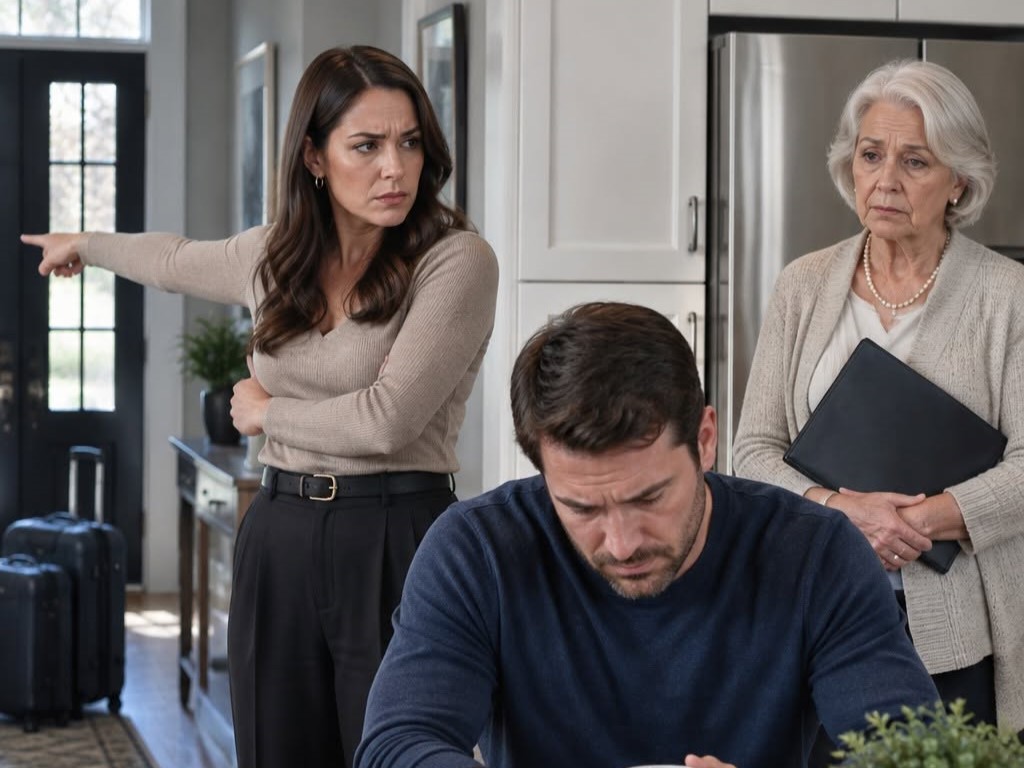
    Lauren was standing on my front porch, staring at the bank statement I had placed on the small table beside the door.

    For several seconds, neither of them moved.

    The porch light illuminated the paper between us.

    Somewhere down the street, a sprinkler clicked rhythmically.

    Behind me, I could hear the refrigerator humming inside the little house I had purchased with my own money.

    Three weeks earlier, Lauren had stood in her kitchen and told me I had two choices:

    Hand over my savings.

    Or move out.

    Now she stood outside my home holding a bank envelope, looking at evidence that the financial disaster she had blamed on me had actually started long before her ultimatum.

    “What is this?” she asked.

    I looked at my son.

    “You want to explain it?”

    Marcus dragged one hand across his face.

    Lauren turned toward him.

    “Marcus?”

    He said nothing.

    I knew that silence.

    It was the same silence he had used while his wife called me a freeloader.

    The same silence he had hidden behind when she demanded the retirement money my husband and I had spent forty-two years saving.

    Only this time, the silence was working against him.

    Lauren grabbed the statement.

    It showed a payment I had made for Marcus several months earlier.

    At the time, he had called me privately and said an unexpected truck repair had left him short.

    He told me everything else was fine.

    I believed him.

    So I transferred the money.

    But the date on the statement told a different story.

    It proved that their financial trouble had begun long before Lauren claimed the mortgage problems were recent.

    Lauren looked up.

    “You told me that money was for the truck.”

    Marcus stared at the floor.

    “Some of it was.”

    Her expression changed.

    “Some?”

    “We were behind on other bills too.”

    “How far behind?”

    I opened the front door wider.

    “You should probably come inside. The neighbors don’t need to hear this.”

    Oddly, that seemed to embarrass Lauren more than anything else.

    She stepped into my home for the first time.

    Her eyes moved around the living room.

    A blue sofa beneath the front window.

    Family photos on a shelf.

    My late husband’s reading chair angled toward the garden.

    A lamp I had owned for thirty years.

    Fresh flowers on the table.

    Nothing luxurious.

    Nothing borrowed.

    And nothing Lauren could threaten to take from me.

    Marcus noticed the chair.

    “Dad’s chair.”

    “Yes.”

    He swallowed.

    I led them to the dining table.

    Lauren placed the bank envelope beside the folder I had prepared.

    “We don’t have time for a lecture,” she said. “The mortgage company wants payment.”

    There it was again.

    That sharp tone.

    That belief that urgency gave her permission to command me.

    I stayed calm.

    “How much?”

    Marcus told me.

    The amount was much larger than I expected.

    It wasn’t one missed payment.

    There were several.

    Late fees had piled on too.

    “How many months?”

    He hesitated.

    Lauren answered.

    “Four.”

    “Five,” Marcus said quietly.

    She turned toward him so quickly the chair scraped the floor.

    “Five?”

    He nodded.

    For once, all the anger in the room was directed somewhere other than at me.

    Marcus started explaining.

    His work hours had been cut earlier in the year.

    Then an old credit-card balance became harder to manage.

    The truck needed repairs.

    They used one card to cover another bill.

    Then they started delaying payments from one week to the next.

    Each month, Marcus convinced himself the next month would be better.

    It never was.

    Lauren stared at him.

    “Why didn’t you tell me?”

    Marcus looked exhausted.

    “Every time I said we needed to cut back, you said we’d figure something out.”

    “So you lied to me?”

    “I was scared.”

    “And hiding bills was your solution?”

    Marcus glanced toward me.

    “I thought Mom could help until my hours went back up.”

    I sat very still.

    That sentence explained more than he understood.

    “So when Lauren demanded my savings,” I said, “you already knew how serious the situation was.”

    His face tightened.

    “Yes.”

    “And when she said I had been living in your house for free, you knew that wasn’t true.”

    He closed his eyes.

    “Yes.”

    That word hurt.

    But not the way it would have hurt three weeks earlier.

    Here, sitting in my own house, I could finally hear it clearly.

    It was a confession.

    Not proof that I was worthless.

    Lauren pushed the folder toward me.

    “Fine. Marcus handled things badly. I handled things badly too. But that doesn’t change what happens now. If we can’t pay this, we might lose the house.”

    “What exactly do you want from me?”

    She looked at me as if the answer were obvious.

    “Come back. Help us get things under control.”

    “With my savings.”

    She didn’t answer.

    Marcus did.

    “We need money, Mom.”

    I nodded.

    “That is not the same thing as needing me to move back in.”

    Silence.

    Marcus looked down.

    And that distinction mattered more than anything.

    They had not come because they missed me.

    They had not come because the house felt empty.

    They had not come because they had suddenly realized how cruelly they had treated me.

    They came because their money had run out.

    Lauren tried another tactic.

    “You obviously have enough to help. You bought this place with cash.”

    I almost smiled.

    “Three weeks ago, you told me what I owned should belong to you because I was sleeping in your guest room.”

    “I was angry.”

    “No.”

    I looked directly at her.

    “You were confident.”

    Her jaw tightened.

    I opened the folder.

    Then I started laying documents across the table.

    Electric bills.

    Grocery receipts.

    Money transferred to Marcus.

    The insurance payment that had kept his truck covered.

    A veterinarian bill I paid when one of their dogs became ill while they were traveling.

    I had never saved those things because I intended to demand repayment.

    Most of them existed automatically in online statements and receipts.

    But after Lauren called me a freeloader, I needed to make sure grief hadn’t distorted my memory.

    It hadn’t.

    Even I was surprised by the total.

    During the months I lived with them, I had contributed thousands of dollars.

    That didn’t include the cooking.

    Errands.

    Dog care.

    Cleaning.

    Or the countless daily things that never appeared on a bank statement.

    Lauren stared at the figures.

    “I didn’t know about all this.”

    “You knew about the groceries.”

    She said nothing.

    “You knew I paid the electricity.”

    “I didn’t know about the other payments.”

    I looked at Marcus.

    He remained silent.

    Lauren understood immediately.

    “You’ve been giving him money behind my back.”

    “When your husband asked me for help, I helped him.”

    She shoved her chair backward.

    “So both of you were lying to me.”

    “Don’t do that.”

    My voice wasn’t loud.

    But she stopped.

    “Do what?”

    “Turn your marriage problems into something I caused.”

    I pointed toward the papers.

    “I didn’t create your debt. I didn’t hide your mortgage notices. And I certainly didn’t stand in your kitchen and demand another woman’s retirement savings.”

    Lauren’s eyes flashed.

    “We’re talking about losing our home.”

    “I know exactly what losing a home feels like.”

    That stopped her.

    After my husband died, selling our old townhouse had felt like dismantling our marriage room by room.

    Marcus had been the one who convinced me I shouldn’t live alone.

    For a while, I believed moving in with him meant I still had a family home.

    Lauren destroyed that illusion in less than a minute when she told me to surrender my savings or leave.

    Now, strangely, I was almost grateful.

    At least I knew the truth.

    Marcus leaned forward.

    “Mom, I failed you.”

    Lauren glanced at him.

    He kept going.

    “I should have stopped her the second she told you to leave.”

    I waited.

    “Why didn’t you?”

    His answer came slowly.

    “Because part of me was hoping you’d give us the money.”

    There it was.

    No excuse.

    No polished version.

    Just the truth.

    My son had watched his mother be humiliated because desperation had made my bank account seem more important than my dignity.

    My throat tightened.

    “Thank you for finally admitting that.”

    Lauren stared at him.

    “You’re making it sound like I did everything.”

    “You said the words,” Marcus replied. “I stood there and let you. That isn’t much better.”

    Lauren got up and paced toward the window.

    “So what happens now? We lose the house while everyone sits around having some emotional revelation?”

    I closed the folder.

    “No.”

    She turned.

    “Then what?”

    “You deal with the actual problem.”

    “What problem?”

    “You cannot afford your house.”

    She reacted as if I had insulted her.

    But the numbers didn’t care about pride.

    I asked them what the property was worth.

    What they still owed.

    Whether foreclosure had formally begun.

    This time, Marcus answered honestly.

    The situation was serious, but it wasn’t beyond repair yet.

    The lender had sent multiple notices.

    They owed several missed payments.

    But they still had equity.

    If they sold voluntarily, they could probably walk away with something.

    If they waited until everything collapsed, they might lose far more.

    Lauren shook her head.

    “We are not selling.”

    “What is your alternative?”

    “Catch up.”

    “With whose money?”

    Her eyes moved toward me.

    That answered the question.

    I leaned back.

    “My savings are not your financial plan.”

    Her face hardened.

    “So you’re just going to watch your own son lose his house?”

    Marcus whispered her name.

    I raised one hand.

    “My husband worked through illness, holidays, and years when we barely took vacations because we wanted security when we got older.”

    I looked at Marcus.

    “I worked too.”

    Then at Lauren.

    “We saved so that if one of us died, the other would never become financially dependent on our child.”

    I tapped the folder.

    “That money has a purpose. It is not a reward for whoever applies the most pressure.”

    Lauren looked away.

    Marcus’s eyes were wet.

    “I understand,” he said.

    For once, I believed he might.

    I did offer to help.

    But not with a bailout.

    The next morning, I would sit beside Marcus while he called the mortgage lender.

    We would ask about hardship options.

    Payment plans.

    Possible restructuring.

    I would help them make a complete list of their debts.

    And if keeping the house was unrealistic, I would help them find an agent and sell it before the situation became worse.

    But I would not pay the overdue mortgage.

    I would not move back.

    And I would not hand over my savings.

    Lauren stared at me.

    “You’ll make phone calls with us, but you won’t give us the money?”

    “Correct.”

    “That is unbelievable.”

    Marcus surprised us both.

    “No, Lauren.”

    She turned toward him.

    “What?”

    “What’s unbelievable is that we threw Mom out and then showed up here expecting her to write a check.”

    Lauren’s face changed.

    She grabbed the bank envelope from the table.

    “Fine. You two can figure it out.”

    She headed toward the door.

    Before leaving, she looked around my living room again.

    I couldn’t tell whether she was angry.

    Embarrassed.

    Afraid.

    Probably all three.

    Marcus stayed.

    For several minutes, we sat without speaking.

    Then he looked toward his father’s chair.

    “Dad would’ve been disgusted with me.”

    “Don’t use your father to punish yourself.”

    He looked at me.

    “You are responsible for what you do next. Not for imagining what a dead man might say.”

    Marcus nodded.

    It was the first honest conversation we had had in months.

    The next morning, he returned alone.

    We called the lender.

    There was no miracle.

    The missed payments still existed.

    His reduced income still existed.

    But the situation wasn’t quite as hopeless as panic had made it feel.

    Over the following week, Marcus and Lauren finally went through every expense.

    The truth was brutal.

    The house had always been too expensive for them.

    When Marcus’s income dropped, they continued spending as though nothing had changed.

    Credit cards covered the difference.

    Until they couldn’t.

    Eventually Marcus called me.

    “We’re listing the house.”

    Lauren hated the decision.

    But she agreed.

    Several weeks later, the house sold.

    They cleared the mortgage and a large portion of the other debt.

    Then they moved into a smaller rental across town.

    Marcus sold the pickup truck too.

    When he told me, he gave an embarrassed laugh.

    “Turns out I didn’t need a giant truck payment to prove I was doing well.”

    “That was an expensive lesson.”

    “You’re telling me.”

    Things between Lauren and me didn’t suddenly become perfect.

    Life rarely works that neatly.

    For months, our conversations remained short and polite.

    Then one Sunday afternoon, she appeared at my front door.

    Alone.

    It was the same porch where she had once arrived carrying a bank envelope and expecting money.

    This time, her hands were empty.

    “Can I come in?”

    I stepped aside.

    She sat at the kitchen table and looked through the window toward the garden.

    “I keep thinking about what I said to you,” she began.

    I waited.

    “About you living with us for free.”

    I didn’t interrupt.

    “It was cruel.”

    She swallowed.

    “And it wasn’t true.”

    That mattered more to me than some dramatic speech.

    Lauren admitted she had been terrified about the mortgage.

    She was furious that Marcus had hidden the truth.

    But instead of facing the fact that they couldn’t afford their lifestyle, she looked at my savings and convinced herself I should solve everything.

    “I turned your money into the answer because that was easier than admitting we couldn’t afford our own life.”

    I nodded.

    “Yes.”

    Her eyes filled with tears.

    “I’m sorry.”

    I accepted the apology.

    But accepting it didn’t mean pretending nothing had happened.

    Lauren would never again have access to my financial information.

    And I would never again live under their roof.

    Those weren’t punishments.

    They were boundaries built from experience.

    Marcus and I repaired our relationship slowly too.

    He started calling without asking for anything.

    Sometimes he came over to fix a cabinet hinge.

    Sometimes he helped move something in the garden.

    Sometimes we just sat with coffee.

    Months later, on what would have been my husband’s birthday, Marcus showed up carrying his father’s favorite pie.

    We sat near the old reading chair and talked about him until the sun went down.

    Before Marcus left, he stopped by the front door.

    “Mom?”

    “Yes?”

    “I’m glad you bought this place.”

    I looked around.

    So was I.

    The day Lauren told me to hand over my savings or move out felt, at the time, like one of the worst humiliations of my life.

    But it forced me to understand something grief had blurred.

    A home isn’t simply a place where someone gives you permission to sleep.

    It isn’t a room you earn by being useful.

    Quiet.

    Helpful.

    Or financially convenient.

    A real home is somewhere your dignity isn’t being held as collateral.

    My husband and I had spent decades saving so that neither of us would ever have to sacrifice that dignity for security.

    In the end, the most important thing those savings bought me wasn’t the small house.

    It wasn’t the garden.

    Or the blue sofa.

    Or even the front door that opened with my own key.

    It bought me something far more valuable.

    The ability to say no.

    And still have somewhere safe to go.

  • The Goth Woman Across the Hall Never Spoke to Anyone – Then One Night She Knocked on My Door Holding My Two-Year-Old Daughter and Said, ‘Your Husband Doesn’t Know I Saw Him’  

    The Goth Woman Across the Hall Never Spoke to Anyone – Then One Night She Knocked on My Door Holding My Two-Year-Old Daughter and Said, ‘Your Husband Doesn’t Know I Saw Him’  

    My husband secretly left our daughter with another woman. I went to her apartment expecting a confrontation—but her first question changed what I thought I was looking for.

    Oliver and I had been married seven years, and until then, I would’ve said we were happy.

    We had a two-year-old daughter, Daisy, a comfortable home, and a marriage where I believed we shared everything.

    The only person who made me uneasy lived across from us.

    Charlotte was twenty-nine, always dressed in black, with heavy eyeliner, silver piercings, and tattooed arms. She rarely spoke to anyone.

    I’ll admit it—I found her a little intimidating.

    Oliver disliked her even more.

    “She gives me the creeps,” he once said.

    “You’ve spoken to her?”

    “No. That’s the point. Normal people say hello.”

    “That is a weird standard.”

    “I’m serious, Claire. Don’t get friendly with her.”

    “Why would I?”

    He shrugged. “I’ve seen her staring at Daisy.”

    “Maybe she just likes kids.”

    “You always give people the benefit of the doubt.” He smiled. “Sometimes too much.”

    After that, I watched Charlotte more carefully.

    Still, I hated feeling suspicious because of how I grew up. My parents could spend weeks after arguments speaking through me.

    “Tell your father dinner’s ready.”

    “Tell your mother I’m not hungry.”

    By twelve, I had one rule: say the ugly thing out loud.

    Oliver knew it.

    Early in our relationship, I’d told him, “You can tell me any truth. Just don’t make me hear it from somebody else.”

    He’d said, “Deal.”

    For seven years, I believed him.

    —

    One Friday night, Daisy refused to sleep.

    Around nine, Oliver grabbed his keys. “I’ll take her for a short drive. She’ll be asleep in five minutes.”

    “Bring her blanket.”

    “I’ve got it.”

    I kissed Daisy, watched them leave, and went inside.

    Nearly an hour passed.

    Then someone pounded on the door.

    I opened it and froze.

    Charlotte stood there holding Daisy.

    My daughter was awake, clutching her jacket.

    “Where’s Oliver?”

    Charlotte stepped inside. “Your husband doesn’t know I saw him.”

    “Saw him doing what?”

    She glanced at Daisy, then me. “He left her with another woman.”

    That was when my marriage stopped feeling like a marriage and became a question I couldn’t ignore.

    “Another woman where?”

    “Three blocks over.”

    “I was coming from the store. I saw him carry Daisy into a building. Ten minutes later he came out alone.”

    My heart hammered. “And you thought, what? Kidnapping?”

    “I thought it was weird.”

    “So you went inside?”

    “Yes.”

    “With no idea who was there?”

    “Yes.”

    “I knocked. Daisy was inside. I said I was your neighbor and that you were looking for her.”

    “I wasn’t.”

    “I know. I lied.”

    “Great.”

    “She gave Daisy to me because Daisy recognized me.”

    “She did?”

    “She said, ‘black lady.’”

    “That tracks.”

    “The woman looked scared when I mentioned you.”

    “Scared how?”

    “Like she didn’t know you knew.”

    My stomach dropped.

    I took Daisy from her. “Did they kiss?”

    “No.”

    “Did he know her?”

    “Definitely.”

    I grabbed Daisy’s coat. “Why?”

    “Because if I wait, I’ll get Oliver’s version first.”

    “You really don’t do suspense, do you?”

    “I’d rather hear something awful tonight than imagine ten worse things by morning.”

    “Apartment 3B.”

    I paused at the door. “Why are you helping me?”

    Charlotte almost smiled. “Ask me after you meet her.”

    That answer followed me downstairs.

    The worst part was that I still expected an affair. The truth waiting in 3B had never crossed my mind.-

    The woman who opened 3B looked about thirty-five.

    She had Oliver’s brown eyes and narrow nose.

    She stared at Daisy, then me. “Can I help you?”

    “I’m Claire. Oliver’s wife.”

    Her expression changed instantly. “Oh.”

    Not the reaction you want from a stranger.

    She swallowed. “Come in.”

    I stayed put. “Who are you?”

    She glanced behind me. “Did Oliver send you?”

    “No. Charlotte brought Daisy home.”

    “Charlotte?”

    “You know her?”

    “How?”

    She rubbed her forehead. “This is not how this was supposed to happen.”

    “Then improve it quickly.”

    She studied me for two seconds. “I’m Emma.”

    “Okay.”

    “Oliver’s sister.”

    That was only the first lie to crack—and what followed completely changed how I saw my husband.

    I laughed because my brain rejected it. “No.”

    Emma’s eyes widened. “No?”

    “My husband is an only child.”

    She stared.

    Then slowly shook her head. “He told you that?”

    “For seven years.”

    Emma sat down.

    I remained standing. “Show me proof.”

    She blinked. “Excuse me?”

    “You just told me my husband invented his entire family structure. So yes. Proof.”

    She handed me her phone.

    A childhood photo showed two children beside a cake.

    One was unmistakably Oliver. The other was Emma.

    Then came more: Christmas, the beach, graduation.

    My hands went cold. “Why doesn’t he speak to you?”

    Emma looked away. “We had a bad fight after Dad died.”

    “About what?”

    “Property. Money. Family things.”

    “That’s vague.”

    “You met me thirty seconds ago.”

    Fair. I hated that.

    “Why now?”

    Emma hesitated. “Because Oliver contacted me.”

    “After years?”

    “Yes.”

    “What changed?”

    “You need to ask him.”

    “That sentence is ruining my evening.”

    “I know. But whatever Oliver told you about me, I’m not going to defend myself by telling you his secrets.”

    “You’re protecting him?”

    “No.” Her jaw tightened. “I’m making him explain his own lies.”

    “Then give me one thing. Was the fight about money?”

    “Property. After Dad died.”

    “And?”

    “That’s all I’m saying tonight.”

    I picked up Daisy. That hurt.

    By the time I got home, I had an explanation—but nothing explaining why my husband had erased an entire person from his life.

    Oliver returned twenty minutes later.

    He saw Daisy asleep against my chest and froze. “Why is she here?”

    “I was going to ask you that. Who is Emma?”

    Silence.

    “Say it.”

    “My sister.”

    “You told me you were an only child.”

    “Emma hasn’t been my sister in any meaningful sense for years.”

    “Why?”

    “After Dad died, we fought over property. She disappeared whenever he needed help, then came back wanting half of everything.”

    “Did she steal from you?”

    “No.”

    “Then what did she do?”

    “She refused to be reasonable.”

    I stared at him. “That usually means someone refused to give you what you wanted.”

    “You met her once.”

    “And you hid her for seven years. So why are you suddenly taking our daughter to her?”

    He looked away. “Emma asked to meet Daisy.”

    “At nine at night?”

    “She works with kids, Claire. She’s always been good with them.”

    “So?”

    “The first time I took Daisy over, she wouldn’t settle down. Emma fell asleep in fifteen minutes.”

    I stared at him. “The first time?”

    He realized his mistake too late.

    “How many times have you taken our daughter there?”

    “A few.”

    “While telling me you were driving her around?”

    He looked away again.

    “And you didn’t tell me because?”

    “I knew you’d react like this.”

    “You mean ask questions?”

    “Claire, please leave it alone.”

    “No. You know my rule.”

    His expression shifted.

    For the first time, I wondered if Oliver had lied because Emma was dangerous—or because the truth was.

    The next morning, I found Charlotte by the mailboxes.

    She took one look at me. “You found her.”

    “Emma. His sister.”

    Charlotte went still. “What did Oliver say?”

    “That she was irresponsible. That their father spent years rescuing her. That she came back for money after he died.”

    “He said that about Emma?”

    “You know her?”

    “We were friends in college.”

    My pulse quickened. “What happened between them?”

    “I don’t know everything. But Emma wasn’t some reckless parasite. Their father left property to both of them. Oliver wanted control. Emma wanted her share protected.”

    “Protected from what?”

    “I don’t know.”

    She leaned closer. “But if Oliver is suddenly taking Daisy to Emma, he wants something. He hasn’t tried to reconcile in years.”

    Then it clicked. “Oliver told me not to speak to you.”

    Charlotte’s mouth tightened. “I figured.”

    “He spent a year making me think you were dangerous.”

    “Because I knew Emma.”

    That was when I stopped wondering what Oliver was hiding and started asking what he wanted from Emma.

    I didn’t confront him again.

    Every nerve wanted answers immediately, but I finally understood: Oliver would reveal only enough truth to stop the next question.

    So I got Emma’s number from Charlotte and called.

    “I need to see you.”

    “Did you talk to Oliver?”

    “Yes. He says you’re irresponsible and greedy.”

    Emma laughed. “Of course he does.”

    “I want your version.”

    “Come tomorrow.”

    “No. Today.”

    She sighed.

    “Fine. Six.”

    —

    At six, I left Daisy with my friend Megan and drove to Emma’s.

    Oliver’s car was parked outside.

    He had told me he was working late.

    Whatever he wanted from Emma apparently couldn’t be handled over the phone.

    For once, I didn’t panic. Everything felt clear.

    I went inside.

    Emma opened the door and immediately glanced over her shoulder.

    Oliver stood in the dining room.

    Papers covered the table.

    He looked caught. “What are you doing here?”

    I closed the door. “No. I’m done answering first.”

    “Claire, go home.”

    “No.”

    “This has nothing to do with you.” I looked at the papers. “If it has to do with why you used our daughter as leverage, it has everything to do with me.”

    Emma’s expression changed.

    Oliver snapped, “That is not what happened.”

    “Good. Explain it.”

    He reached for the papers.

    Emma covered them with her hand. “Don’t.”

    He looked at her. “Emma.”

    She shook her head. “No. She should know.”

    Finally, someone chose the truth.

    The papers finally explained what Oliver wanted from Emma.

    But they didn’t explain why he had involved our daughter.

    Emma slid one sheet toward me. “Our father left us a house.”

    “The one you told me was sold years ago?”

    Oliver closed his eyes. “Yes.”

    Emma continued. “It wasn’t sold.”

    “Why?”

    “Because we own it together.”

    “Then sell.”

    “I won’t sign.”

    Oliver cut in. “It’s been empty for years.”

    Emma ignored him. “He wants to sell now.”

    “Why now?”

    Emma looked at Oliver. “Because three months ago, a developer offered us more than the house has ever been worth.”

    I turned to him. “Three months ago?”

    Emma nodded. “That’s when he contacted me. He said we were getting older. Said he was tired of fighting.”

    I laughed without humor. “And Daisy?”

    Emma looked embarrassed. “At first he came alone. Then he brought photos. Then he said I should meet her.”

    Oliver cut in. “Emma works with kids. Daisy liked her. She was good at calming her down. That’s all it was.”

    I looked at him. “Then why did I think you were driving her around until she fell asleep?”

    “Claire, I…”

    “Keep going, Emma.”

    She swallowed. “He started leaving us alone together. I thought he wanted me to know my niece.” She looked at Oliver. “Now I think he wanted me attached to her.”

    Oliver stepped forward. “That was sincere.”

    Emma looked at him. “Was it? Then why did every visit end with the house?”

    He fell silent.

    Emma continued. “He kept saying, ‘She’s your niece. Don’t you want us to be a family again?’”

    I looked at Oliver. “You used Daisy.”

    “No, you..”

    “You brought our two-year-old to the sister you told me didn’t exist because you wanted her signature.”

    “I was going to tell you after the sale.”

    “After you have the money.”

    Emma pushed the papers aside. “I’m not signing.”

    Oliver turned. “Don’t be ridiculous.”

    “I almost did.”

    “I thought maybe you actually missed me.”

    “I do.”

    “No. You missed my signature.”

    “Claire, tell her this is stupid.”

    I stood. “You still think I’m here to help you close the deal?”

    He said nothing.

    That silence was enough.

    Oliver thought his worst mistake was hiding a house. He still didn’t understand what he had actually destroyed.

    I went home, picked up Daisy, and packed Oliver a bag.

    He stared at it. “You’re kicking me out over property?”

    “No. Over seven years of making me believe honesty was our rule while you edited your life around me.”

    “That’s dramatic.”

    “You deleted a sister until you needed something from her.”

    He looked away.

    “You used Daisy to soften Emma, lied about where you were, and made me suspicious of Charlotte because she knew the truth.”

    “That’s not why.”

    “Then why warn me away from her?”

    He didn’t answer.

    “Exactly.”

    “So you’re throwing away seven years?”

    “I won’t spend another seven wondering what else you hid.”

    “Claire, I love you.”

    “I believe you. I also believe you love getting your way more than being honest when honesty costs you.”

    “What do you want?”

    “For tonight? Leave.”

    “And tomorrow?”

    “Tell me the truth before I have to drag it out of you.”

    “About everything?”

    “That question isn’t comforting.”

    The next morning, Charlotte knocked with a paper bag. “I brought pastries.”

    “Goth pastries?”

    “Croissants. Emotionally, yes.”

    I laughed. “For a year, I thought you were the person in this hallway I should be afraid of.”

    “Piercings are powerful.”

    “Oliver made me suspicious of you because you knew Emma. One conversation could’ve ruined his version of the past.”

    Her smile faded. “So what happens now?”

    I glanced at Daisy in her dinosaur pajamas. “Oliver’s staying with a friend. I haven’t decided what happens to us.”

    “And Emma?”

    “She’s keeping her half of the house.”

    “That’ll annoy him.”

    “Deeply, I hope.”

    We laughed.

    For years, I thought asking for the truth was enough. Now I understood promises meant nothing when someone only told the truth when it suited them.

    I didn’t need another promise.

    I needed to see what Oliver did next.

  • “If you want to be my daughter-in-law, you’ll spend three hours outside,” my mother-in-law told me, while my husband remained silent and the guests watched. I didn’t cry or beg anyone: I called off the wedding  

    “If you want to be my daughter-in-law, you’ll spend three hours outside,” my mother-in-law told me, while my husband remained silent and the guests watched. I didn’t cry or beg anyone: I called off the wedding  

    The first words I heard from my future mother-in-law on my wedding day were not “Welcome” or “Congratulations.”

    They were an order to stay outside.

    I stood in front of Brandon’s family home in Grand Rapids, Michigan, wearing my wedding dress and holding a bouquet while nearly fifty relatives and friends waited behind me.

    We had driven in from Detroit that morning expecting a celebration.

    Instead, the front gate was wrapped in a heavy chain.

    Behind it stood Brandon’s mother, Mrs. Gertrude, dressed in bright red and looking completely serious.

    “A spiritual adviser warned me about Savannah,” she announced loudly enough for half the street to hear. “She carries too much dominant energy. If she enters immediately, she could bring bad luck into this family.”

    I stared at her.

    Then she added the part that made everyone go silent.

    “She must remain outside for three hours. She needs time to cleanse herself and learn humility before becoming part of this household.”

    For a moment, I honestly thought she was joking.

    My uncle Raymond reacted first.

    “Are you serious?” he demanded. “You think humiliating a bride on her wedding day is some kind of tradition?”

    Mrs. Gertrude folded her arms.

    “This is my home. My rules will be respected.”

    I tightened my grip on the roses until the thorns pressed into my palm.

    What made her words especially unbelievable was that I had personally paid to renovate most of the house behind her.

    I was twenty-nine and worked as a senior financial director for an international corporation.

    Brandon worked an entry-level administrative job for the local government.

    During our relationship, he had repeatedly told me that his mother was struggling financially and that the family home was falling apart.

    I loved him.

    And because I thought we were building a future together, I helped.

    I paid for waterproofing the roof.

    New hardwood floors.

    Modern windows.

    Renovated bathrooms.

    A custom kitchen.

    Painting.

    Carpentry.

    I bought the refrigerator, washing machine, television, dining set, bedroom furniture, and an expensive leather living-room set Mrs. Gertrude had personally chosen.

    Altogether, I had put more than $70,000 of my savings into that property.

    And now I wasn’t even allowed through the gate.

    I searched for Brandon.

    Surely this was the moment he would finally stand beside me.

    He pulled me a few steps away from everyone.

    “Savannah, please don’t turn this into something bigger than it needs to be.”

    I stared at him.

    “Bigger? Your mother locked me outside on our wedding day.”

    “Just wait a little while.”

    He lowered his voice.

    “You know how she is.”

    “And you’re going to allow this?”

    Brandon glanced nervously at the neighbors gathering along the street.

    “I work for the city. I can’t afford a public scene.”

    Then he added,

    “My mother has high blood pressure. What if she gets upset and something happens?”

    I couldn’t believe what I was hearing.

    Then he said the sentence that ended everything for me.

    “A good wife has to learn how to adjust to her husband’s family.”

    He walked away.

    No discussion.

    No apology.

    Nothing.

    A few minutes later, he was standing with his groomsmen, smoking as though his bride weren’t being publicly humiliated outside his mother’s gate.

    My father approached and rested a hand on my shoulder.

    “You don’t have to prove anything to these people,” he said softly. “If you want to leave, we’ll leave with you.”

    Before I could answer, Brandon came back looking irritated.

    “Stop looking like that,” he said. “You’re ruining the wedding.”

    I stared at him for several seconds.

    Then I let the bouquet fall.

    I removed my veil.

    Under the heavy bridal skirt, I had worn a simpler reception dress, so I unhooked the outer layer and handed it to my cousin.

    Then I asked for her coat.

    Brandon’s face lost its color.

    “What are you doing?”

    “What I should have done the second your mother locked that gate.”

    I turned toward everyone.

    “The wedding is cancelled.”

    Mrs. Gertrude rushed forward, shouting.

    Brandon reached toward my arm, but I stepped away before he could touch me.

    “I’m not leaving because your family has less money than mine,” I told him.

    “I’m leaving because your mother can humiliate someone and call it tradition—and you can stand there watching it happen and call that patience.”

    I took my mother’s hand.

    “We’re going back to Detroit.”

    One by one, engines started along the street.

    When I got into the car, Brandon ran after me and hit the window with his palm.

    “You’ll regret this for the rest of your life!”

    I looked through the glass at the house one last time.

    He thought he had simply lost a bride.

    What he didn’t understand yet was that his family had also just lost the use of nearly everything inside that house that I had paid for.

    The next morning, they found out.

    At nine o’clock, I returned to Grand Rapids.

    No wedding dress this time.

    I wore jeans and a plain white shirt.

    In one hand was a thick binder containing receipts, bank statements, warranty cards, and contracts.

    Behind me were two commercial moving trucks.

    Brandon was outside watering plants when we arrived.

    When he saw me, he actually smiled.

    “I knew you’d come back.”

    I didn’t answer.

    Mrs. Gertrude appeared in the doorway behind him.

    “If you want to come inside this house after yesterday,” she said, “you will apologize first.”

    She lifted her chin.

    “And if you truly want forgiveness, you can kneel right here on the porch.”

    I ignored her and turned to the moving crew.

    “You can begin.”

    Six movers entered.

    The television came out first.

    Then the refrigerator.

    Then the washing machine.

    When they began dismantling the bedroom furniture, Mrs. Gertrude finally understood what was happening.

    “That belongs to me!”

    I opened my binder.

    “Italian leather living-room set. Purchased by Savannah Miller.”

    Another receipt.

    “Sixty-five-inch smart television. Purchased by Savannah Miller.”

    Another.

    “Stainless-steel refrigerator. Paid in full by Savannah Miller.”

    Neighbors were already gathering.

    Brandon hurried to close the gate.

    I spread my receipts and bank records across an outdoor table.

    “I’m not taking anything your family purchased.”

    Mrs. Gertrude grabbed the washing machine.

    “It came into my house! It belongs to this household now!”

    I stayed calm.

    “Then we can call the authorities and let them review the ownership documents.”

    The moment I mentioned that, Brandon panicked.

    “Mom, let her take the appliances.”

    She spun toward him.

    “Brandon!”

    “Just let her take them!”

    For the first time, I saw what he was truly afraid of.

    Not losing me.

    Losing his public image.

    Within two hours, almost everything I had personally purchased was gone.

    But the furniture was only part of the issue.

    I opened a second folder.

    “The removable items are worth roughly $20,000.”

    Brandon went still.

    “Now we need to discuss the renovations.”

    I showed him the contracts.

    Electrical work.

    Masonry.

    Windows.

    Flooring.

    Bathrooms.

    Kitchen cabinets.

    Waterproofing.

    Interior finishes.

    More than $50,000.

    “I invested that money because I believed this would become my home after we married.”

    I looked straight at him.

    “Since your family denied me entry and the wedding ended, my attorneys will determine what portion can legally be recovered.”

    Mrs. Gertrude laughed.

    “What are you going to do? Tear the floors out and carry away the walls?”

    “No.”

    I handed Brandon a formal demand letter.

    “I don’t need to dismantle the house.”

    He stared at the document.

    “You have three days to respond.”

    That evening, Brandon’s older sister Pamela arrived at my apartment in Detroit carrying a fruit basket and a carefully rehearsed smile.

    First came the apology.

    Then tears.

    Then a story about Mrs. Gertrude becoming ill from stress.

    Eventually, she reached the real reason she had come.

    “Please drop the claim.”

    “No.”

    “We could pay you $200 a month.”

    I almost smiled.

    “At that rate, it would take decades.”

    Her expression changed immediately.

    She struck the table with her hand.

    “Then we’ll tell everyone online that you left Brandon because he was poor.”

    I stood and opened my apartment door.

    “Go ahead.”

    She stared at me.

    “What?”

    “Post whatever you want.”

    Then I listed what I had.

    Videos.

    Messages.

    Contracts.

    Invoices.

    Bank statements.

    And multiple witnesses who had watched what happened outside that gate.

    Pamela left furious.

    Two days later, Mrs. Gertrude came to my workplace.

    The receptionist called my office.

    “There’s an older woman downstairs saying she’s your mother-in-law. She’s accusing you of cheating her family.”

    I took a breath and went down.

    Mrs. Gertrude sat in the middle of the marble lobby surrounded by employees and security staff.

    The moment she saw me, she began crying loudly.

    “This woman took advantage of my son! She took everything from our home!”

    Dozens of people looked toward me.

    Through the tears, Mrs. Gertrude gave me the smallest triumphant smile.

    She thought she had finally cornered me.

    So I took out my phone.

    And my folder.

    PART 3

    “Mrs. Gertrude,” I said, activating my phone camera, “please repeat your claim.”

    The lobby became quiet.

    “Tell everyone here that you paid for the remodeling.”

    Her mouth opened.

    Nothing came out.

    “Tell them you personally paid for the kitchen, the windows, the furniture, and the structural work.”

    “I… my son…”

    I opened the folder.

    “These are my bank statements showing every transfer came directly from my personal account.”

    I held up more documents.

    “Signed construction agreements.”

    “Original invoices.”

    “And messages in which you personally thanked me for paying for your kitchen, windows, and furniture.”

    The whispers started immediately.

    Mrs. Gertrude tried to interrupt.

    “But you were going to become family!”

    “Exactly.”

    I looked at her.

    “I was going to.”

    Then I calmly explained what had happened on the wedding day.

    The chained gate.

    The demand that I wait outside three hours.

    The supposed spiritual cleansing.

    And Brandon standing by while it happened.

    I didn’t exaggerate.

    I didn’t need to.

    The truth already sounded unbelievable.

    One of my coworkers shook her head.

    “They actually did that?”

    Our head of security stepped forward.

    “Ma’am, you need to leave the property. If you believe a crime occurred, you can make an official report, but you cannot continue disrupting this workplace.”

    Mrs. Gertrude left with her face covered.

    I thought that would finally end things.

    It didn’t.

    That evening, I left work during heavy rain.

    Mrs. Gertrude was waiting near the entrance.

    This time, there were no fake tears.

    “Because of you, my son is going to lose everything!”

    “No.”

    I opened my umbrella.

    “He’s dealing with the consequences of his own decisions.”

    “You brought bad luck into our family!”

    I looked at her.

    “You still believe that?”

    Then she started insulting my parents.

    That was where I drew the line.

    “Do not talk about my parents.”

    “Your mother raised a heartless woman.”

    I stared directly at her.

    “If you want to talk about character, then perhaps we should discuss what Brandon has been hiding.”

    For the first time, she looked confused.

    During the last months of our engagement, I had discovered that Brandon’s financial situation was far worse than he had admitted.

    He had large personal debts.

    He had borrowed money from coworkers.

    He had taken financial advances he never told his mother about.

    And there had been irregularities involving funds in his municipal department serious enough to trigger an internal review.

    When he became frightened about the consequences, he came to me for help.

    I paid a significant portion of his debts because he told me it had all resulted from an accounting error.

    He promised he wanted to begin our marriage with a clean slate.

    Later, I discovered messages proving he had not told me the truth.

    I had stayed quiet because I still believed I could help him rebuild his life after we married.

    “I still have the messages and financial records,” I told Mrs. Gertrude.

    “I don’t want to use them against anyone.”

    I paused.

    “But if your family continues making false accusations about me, those documents will go to my attorneys and the proper authorities.”

    For once, Mrs. Gertrude had nothing to say.

    She walked away into the rain.

    Three days later, Brandon called.

    “We want to settle.”

    From that point on, I let the lawyers handle everything.

    No shouting.

    No scenes.

    Just paperwork.

    His family owned a small parcel of land outside Grand Rapids.

    They sold it to cover a significant portion of the claim and signed an agreement to repay the remainder over time.

    When the first settlement payment reached my account, I didn’t feel victorious.

    I felt relieved.

    Later, my father asked me,

    “Was all of this worth it?”

    I thought about it.

    “Yes.”

    “Not because I wanted to punish them.”

    I looked at him.

    “Because I refused to let them convince me that defending myself made me a bad person.”

    Weeks later, Brandon called about the furniture.

    “The house is almost empty.”

    “You already received a settlement. Can’t you at least return some of it?”

    For a moment, I considered it.

    Then I chose something else.

    I sold the furniture.

    I used part of the proceeds to cover moving and storage costs.

    The rest, along with several unused household items, went to a regional shelter helping women rebuild their lives after leaving unsafe homes.

    When Brandon found out, he called furious.

    “My mother personally chose that living-room set!”

    “Yes.”

    I answered calmly.

    “But I paid for it.”

    “You’re cruel, Savannah.”

    “No.”

    I took a breath.

    “I finally learned that giving more and more to people who don’t respect you does not make them respect you.”

    Then I blocked his number.

    For weeks, people around Grand Rapids talked.

    Some said I had gone too far.

    Others said I had done exactly what I should have done.

    Eventually, I stopped caring.

    Trying to control strangers’ opinions only gives strangers control over you.

    Six months later, my company offered me a major promotion.

    A new corporate division was opening in Minneapolis.

    They wanted me to lead financial operations.

    The salary was nearly double what I had been earning.

    I accepted immediately.

    My mother had only one request.

    “Promise me you won’t shut yourself off from love forever.”

    I smiled.

    “I’m not shutting my heart.”

    “I’m just becoming more careful about who I let into it.”

    Minneapolis became a fresh start.

    I rented a modern apartment overlooking the city.

    I made new friends.

    I traveled.

    I worked hard.

    But for the first time, all that effort was building a future that belonged entirely to me.

    Eventually, I realized entire weeks passed without Brandon entering my thoughts.

    Nearly a year later, my friend Chloe called from Grand Rapids.

    “You’ll never guess what your ex is dealing with.”

    “What now?”

    “His mother is still trying to find him a wife.”

    I laughed.

    “That sounds like her problem.”

    “Wait.”

    Chloe told me the story of the locked gate had spread throughout the local community.

    Every time Brandon was introduced to someone new, people asked the same question.

    “Isn’t that the family who locked the bride outside on her wedding day?”

    One woman cancelled a date after her mother learned who Mrs. Gertrude was.

    Another dated Brandon briefly, until he said during an argument,

    “My mother gets the final say in this house.”

    That relationship ended quickly.

    Chloe thought it was funny.

    I didn’t.

    Mostly, I felt sad for him.

    Because Brandon had been given countless opportunities to grow.

    On our wedding day, he could have simply opened the gate.

    He could have told his mother,

    “Enough.”

    He could have stood beside me.

    Instead, he chose silence.

    Sometimes a life doesn’t change because of one enormous catastrophe.

    Sometimes it changes because of one small moment that reveals exactly who someone is.

    Three years passed.

    My career moved faster than I ever expected.

    Eventually, I became national vice president of finance.

    That year, I traveled to Chicago for our company’s annual gala.

    The event took place in a luxury hotel downtown.

    Late in the evening, while I was speaking with several executives, the hotel manager approached.

    “Ms. Miller, I’m sorry to interrupt. There’s an elderly woman at the service entrance asking for you.”

    “Who?”

    He hesitated.

    “She says she is your former mother-in-law.”

    For a moment, it felt as if the previous three years vanished.

    I went downstairs.

    Mrs. Gertrude stood in the hallway.

    I barely recognized her.

    Her hair had turned completely silver.

    Her clothes were plain and worn.

    Nothing about her resembled the proud woman who had once stood behind a locked gate ordering me to prove my humility.

    When she saw me, she began crying quietly.

    “Savannah…”

    I waited.

    “Brandon moved away.”

    She wiped her face.

    “He took a job in another state. He barely calls. He rarely visits.”

    Her voice shook.

    “We had to sell the family house.”

    She looked down.

    “And now I’m alone.”

    Then she stepped toward me.

    “I’m sorry.”

    Three years.

    That was how long it took for those words to arrive.

    “I should have opened the gate that morning.”

    She continued.

    “I thought if I forced you to obey me immediately, you would become a daughter-in-law who respected me.”

    “That wasn’t respect.”

    I looked at her.

    “That was control.”

    She lowered her head.

    “I understand that now.”

    “My son lost so much.”

    “Brandon lost things because of his own choices.”

    She nodded.

    Then she said something I never expected.

    “You were a good woman, Savannah.”

    I looked at her.

    For years, I had imagined this moment.

    In some versions, I yelled.

    In others, I listed everything she had done.

    Standing there in reality, I didn’t want either.

    “I hope you find peace, Mrs. Gertrude.”

    She took my hand.

    “Is there really no chance you could speak to Brandon again?”

    I shook my head.

    “No.”

    “He says he has changed.”

    “I hope he has.”

    I gently pulled my hand away.

    “But changing does not automatically give someone the right to return to the person they hurt.”

    Her eyes filled again.

    “I forgave both of you years ago.”

    I paused.

    “But forgiveness is not the same as going back.”

    She whispered,

    “That gate…”

    I stopped her.

    “That gate may have been the best thing that ever happened to me.”

    She stared at me.

    “If you had opened it, I probably would have walked inside.”

    “I would have married Brandon.”

    “And I might have spent years trying to earn respect from people who believed I needed to beg for it.”

    Mrs. Gertrude said nothing.

    Before returning to the gala, I asked the hotel staff to call her a taxi.

    I paid the fare so she could get home safely.

    Not because I wanted her back in my life.

    Because I no longer needed to prove anything.

    Later that night, I stood by the window of my hotel suite looking over Chicago.

    I thought about the twenty-nine-year-old woman in the white dress.

    Bouquet in hand.

    Standing in front of a chained gate.

    At the time, she believed she had just lost the happiest day of her life.

    She hadn’t.

    She had reclaimed the rest of it.

    Women are often taught that being good means enduring everything.

    That wives must adapt.

    That silence keeps peace.

    That sacrifice proves love.

    I learned something very different.

    Love that requires your dignity as payment is not love.

    A family that humiliates you before accepting you is not offering you a home.

    And a partner who watches while others tear you down is still making a choice.

    I spent more than $70,000 renovating that house because I believed I was building a future.

    But a home is not made from new windows, expensive floors, or beautiful furniture.

    It is built from mutual respect.

    Standing outside that gate in Grand Rapids, I finally understood there would never be a real home for me behind it.

    I still remember my father placing his hand on my shoulder.

    “If you want to leave, we’ll leave with you.”

    Those simple words changed everything.

    Sometimes the person whose permission you need to leave a bad situation is yourself.

    I walked away from the house.

    I lost a wedding.

    I temporarily lost a great deal of money.

    And I lost a man I genuinely loved.

    But I got back something more valuable than all of it.

    My self-respect.

    If I ever find myself standing before another closed door where someone expects me to prove I deserve to enter, I already know what I’ll do.

    I won’t wait outside asking for permission.

    I’ll turn around.

    And walk away.

    Because sometimes a closed door isn’t stopping you from reaching your future.

    Sometimes it is showing you where your future was never meant to be.

  • At my sister’s engagement dinner, she moved my seat beside the kitchen and told her military fiancé I was nothing more than a records clerk. Then she knocked my hand away and sneered, “Don’t touch him with your civilian hands.” I stayed silent—until a major general entered, walked straight past her, and addressed me as Colonel. The moment he revealed my callsign, every officer in the ballroom stopped laughing.  

    At my sister’s engagement dinner, she moved my seat beside the kitchen and told her military fiancé I was nothing more than a records clerk. Then she knocked my hand away and sneered, “Don’t touch him with your civilian hands.” I stayed silent—until a major general entered, walked straight past her, and addressed me as Colonel. The moment he revealed my callsign, every officer in the ballroom stopped laughing.  

    Part 1: The Seat Beside the Kitchen

    The first thing my sister Lauren did at her engagement dinner was move my place card beside the kitchen doors. She had not even greeted me before relocating NATALIE REED away from our mother and between two distant relatives.

    “This is better,” she said, smoothing my charcoal blazer. “Ethan’s family is military royalty. Tonight isn’t the time for stories about forms, files, or whatever you do in Washington.”

    Lauren had invited me only because our mother, Patricia, insisted. Patricia soon appeared in navy silk, criticized my practical clothes, and tugged at my lapel, briefly exposing the edge of a dull brass pin beneath it.

    As far as my family knew, I managed military records. Years earlier, I had described my federal work as “mostly administrative,” and neither of them had cared enough to ask again.

    The truth was harder to explain. I spent my career in secure rooms coordinating personnel, aircraft, routes, intelligence, and emergency plans across multiple time zones. None of that belonged at an engagement party, so I remained silent.

    Ethan’s father, retired Colonel Richard Lawson, greeted me politely. “Government records, correct? Dependable work. Every organization needs people behind the scenes.”

    Lauren smiled. “Natalie likes her quiet little job. I’m the ambitious sister.”

    Captain Ethan Lawson studied me more carefully. His gaze paused on my jacket before he asked whether I had worked near Fort Liberty.

    “Occasionally.”

    “What unit?”

    Lauren answered for me. “She doesn’t have one. She files things.”

    During dinner, I sat beside the swinging kitchen doors while Lauren enjoyed the head table. Then Richard rose to speak about duty and leadership.

    “Real leaders stand where consequences are real,” he declared. “They carry responsibility instead of hiding behind paperwork while others take risks.”

    Lauren turned toward me. “Natalie has always preferred the paperwork side.”

    Laughter spread across the nearest tables. I quietly lowered my water glass.

    But Ethan was not laughing.

    He was staring at the thin strip of brass visible beneath my lapel—and the color was slowly leaving his face.

    Part 2: The Insignia Beneath My Lapel

    By the main course, Ethan could barely look at Lauren. His attention kept returning to the hidden pin, while she continued using me as the ordinary sister who made her new life seem more impressive.

    Before dessert, I retrieved the mahogany box I had brought for Ethan. Inside was an old field compass once given to me by an officer who believed leaders should know their direction before asking others to follow.

    Lauren blocked my path. “Leave it on the gift table. Ethan is discussing his promotion with senior officers, and you have nothing to contribute.”

    When I stepped around her, she knocked my hand away from Ethan’s sleeve.

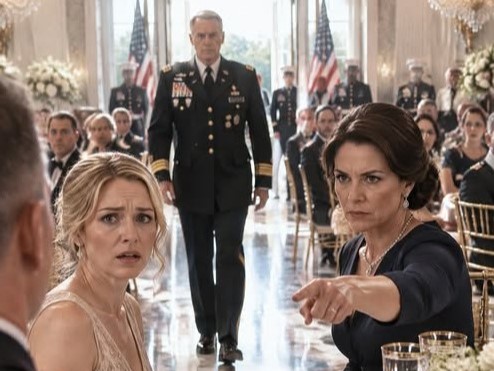
    “Don’t touch him with your civilian hands.”

    The room fell silent. As I straightened my blazer, the brass pin became fully visible.

    Ethan shot to his feet. “Where did you get that insignia?”

    Lauren frowned. “What insignia?”

    I closed my jacket. “Captain Lawson, sit down.”

    He remained standing. Then the ballroom doors opened, and two uniformed aides entered with Major General Gabriel Stone.

    Lauren hurried forward, introduced herself, and offered her hand. General Stone walked past her without slowing.

    He stopped before me and held out a sealed leather folder. “Reed.”

    “Sir. You’re early.”

    “Transport changed.”

    Richard stepped closer. “General, I believe there’s been some confusion. Miss Reed is a civilian records employee.”

    General Stone studied him. “Then why is Colonel Reed being discussed as a records clerk?”

    Nobody moved. Patricia’s champagne glass tilted in her hand, and Lauren stared at me as if I had become a stranger.

    General Stone glanced around the room, then added, “Captain Lawson knows her by another designation.”

    Ethan swallowed. “Yes, sir.”

    Lauren’s voice thinned. “What designation?”

    General Stone met my eyes with a silent apology.

    “Callsign Phantom.”

    The name meant little to most civilians, but several officers recognized it immediately. Their expressions changed—and no one laughed again.

    Part 3: The Truth Behind Phantom

    General Stone kept his explanation brief. I served in a joint operational planning command, and my exact duties were not appropriate dinner conversation.

    “Colonel?” Lauren repeated. “You mean an honorary title?”

    “No,” Ethan said quietly. “People in her position aren’t introduced to captains like me at parties.”

    That answer wounded Lauren more than the revelation itself. Her world depended on knowing who mattered, and she had spent years placing me beneath her.

    General Stone handed me the reassignment folder and said my departure window had moved. When Lauren demanded to know where I was going, I told her I could not discuss it.

    “You let us believe you were nobody,” she snapped.

    I thought about the tuition I had quietly helped pay and the nights I had comforted her after her first engagement failed.

    “I allowed you to believe I had an ordinary job. That is not the same thing.”

    Then Ethan revealed something worse. Lauren had told him I was jealous of military officers because I had failed a federal selection program after college.

    The claim was entirely invented.

    “Why?” I asked.

    Lauren said my unexplained absences and secrecy made her uncomfortable.

    “You could have told people you didn’t know.”

    “I didn’t know the truth.”

    “You knew you didn’t know.”

    Ethan explained that an instructor had once shown him an insignia like mine. Anyone authorized to wear it carried operational authority that junior officers did not question in the field.

    He apologized for remaining silent during Lauren’s insults.

    “You should have stopped her because she was cruel,” I said, “not because you discovered my rank.”

    His face reddened. “Yes, ma’am.”

    Richard apologized as well, admitting that my identity should never have determined whether I deserved respect. Then he led Ethan away to discuss his judgment.

    Patricia immediately approached me.

    “Fix this. Tell them Lauren didn’t know.”

    Across the ballroom, Ethan removed Lauren’s hand from his arm.

    For ten years, my family had never asked what my silence cost me. Now they wanted that same silence to rescue them.


    Part 4: The Consequence I Would Not Prevent

    I signed the reassignment papers in the club’s library. General Stone assured me that Ethan’s promotion board was outside my authority, though Richard clearly feared otherwise.

    “I have no intention of interfering with his career,” I said.

    When I returned, Lauren blamed me for ruining the evening. Richard offered a formal apology, then announced that his family was leaving and all joint wedding planning would stop until Ethan decided what he wanted.

    Ethan removed the engagement-photo pin Lauren had attached to his lapel and placed it on the table.

    “I need time.”

    “You can’t do this tonight,” Lauren protested.

    “I’m trying to understand why humiliating your sister was part of celebrating our future.”

    I placed the mahogany box beside him.

    “This was for you.”

    “I don’t deserve it.”

    “It’s a compass, Captain, not absolution. Figure out where you’re going.”

    Outside, Patricia caught me beneath the stone awning. She begged me to call Richard and explain that Lauren had been under pressure.

    “Her entire future is at risk,” she said.

    “Was her future secure only while everyone believed I was beneath her?”

    Patricia had no answer. She insisted I could repair everything with one phone call.

    For the first time in my life, I refused to stand between my family and the consequences they had created.

    By morning, I had twenty-seven missed calls from Patricia and Lauren. One message came from Ethan.

    I think you need to know what she did.

    Part 5: The Lies in Writing

    Ethan met me at a riverside coffee shop and handed me a folder of messages dating back nearly a year. Lauren had told him I hated military officers, had failed federal selection, and invented classified stories to seem mysterious.

    When Ethan once suggested inviting me to a military charity dinner, Lauren compared bringing me to inviting the DMV to a state dinner. She had also warned him to seat me away from senior guests because I became competitive around successful people.

    Lauren had not simply insulted me. She had spent months preparing Ethan to distrust me.

    “Why show me this now?” I asked.

    “My father wanted to know whether the engagement dinner was one terrible moment or part of a pattern.”

    “And?”

    “I ended the engagement this morning.”

    Ethan tried to return the compass, but I refused. I reminded him that he had watched Lauren mistreat me before learning my rank.

    “You looked uncomfortable, but you stayed silent. Rank didn’t create that failure. It only made you notice it.”

    He accepted the truth.

    Before I left, he mentioned a movement overseas the previous November. His unit’s route had been changed less than an hour before departure because the original corridor was compromised. General Stone had told Richard that I helped coordinate the adjustment.

    Ethan asked whether I knew he was among those officers.

    “No. I knew the movement, not every name.”

    My mother called as I reached my car and immediately suggested that meeting Ethan alone looked suspicious. Even after everything, she had found another way to make me the problem.

    I stopped her.

    “Lauren lied about me, humiliated me, and demanded that I remain small. I’m not spending my final day here repairing her life.”

    That evening, Lauren appeared at my apartment holding the returned engagement ring.

    “I lost everything because of you.”

    I stepped aside. “Then come inside and tell me exactly what you think I took.”

    Part 6: What Jealousy Had Cost

    Lauren entered my nearly empty apartment and accused me of giving the family nothing but secrecy. I reminded her that she could have simply said her sister worked for the government and could not discuss it.

    “And let everyone think you were secretly important?” she snapped.

    The honesty of that answer stopped us both.

    Lauren finally admitted that my silence had made people curious. Our mother understood Lauren’s visible achievements, while my unexplained absences created a blank space.

    “So you filled that space with failure,” I said.

    Then she revealed the source of her resentment. Before our father died four years earlier, he had told her she needed to become more like me because I understood responsibility.

    Lauren had just earned a promotion and purchased a condo. She could not understand why Dad still viewed me—the daughter who was rarely home—as the responsible one.

    “I hated you for that,” she whispered.

    She asked me to call Ethan and explain that insecurity had driven her behavior. I refused.

    “My wedding is gone,” she cried.

    “A wedding is not a life.”

    “Do you forgive me?”

    “Not tonight. Maybe someday—but forgiveness will not mean returning to what we were.”

    Lauren asked whether Dad had known the truth about my career. He had not.

    “Was he proud of you?”

    “He was proud anyway.”

    She left without saying goodbye.

    The next morning, General Stone’s aide collected me before dawn. As the car crossed Washington, Patricia sent two messages.

    Lauren told me what your father said. I never knew.

    Then:

    I think I owe you an apology.

    I locked my phone without responding. A late apology could still matter, but it did not automatically deserve immediate access to me.

    Part 7: Apologies Without Demands

    Eight months passed before I returned. My assignment took me through Germany, Poland, and other places I could never discuss at family dinners.

    Lauren sent four emails. The first was angry, the second defensive, the third said she was trying to understand, and the fourth was an apology. I read them all but answered none.

    Patricia eventually admitted that she had confused visible achievement with worth. Repeating Lauren’s version of my life had been easier than acknowledging how little she knew about her own daughter.

    I replied, “Thank you for saying that. I need time.”

    Two days after returning, I attended General Stone’s retirement reception at the same officers’ club. Ethan approached wearing a major’s insignia.

    His promotion had proceeded normally. The compass remained on his desk.

    “I owe you another apology,” he said. “I believed the version of you that required the least effort from me.”

    “Accepted.”

    Then Patricia entered. General Stone had invited her without warning me.

    She offered to leave, but I asked her to stay. For once, she did not question my assignments or ask whom I knew.

    “I’m sorry I made you earn respect I should have given freely,” she said.

    Patricia also told me Lauren had wanted to attend.

    “I told her your apology isn’t a stage she gets to schedule.”

    That boundary mattered more than another speech.

    Later, a package waited outside my apartment. Inside were my father’s pocket watch and a letter from Lauren.

    She made no excuses, requested nothing, and described her actions without adding the word but. At the bottom, she had written the same sentence twice:

    I wanted you to be small because I was afraid I was.

    I was not ready to forgive her. But for the first time, I believed she understood what she had done.

    Part 8: Something Quieter and More Honest

    A year after the engagement dinner, Lauren and I met at our father’s grave. She carried grocery-store sunflowers, his favorite, and offered to leave when she saw me.

    I asked her to stay.

    Lauren had left her status-driven job and begun managing events for a nonprofit. She seemed calmer and no longer demanded reassurance.

    “I used to think an apology was a transaction,” she said. “I thought saying sorry meant the other person had to stop being angry. Now I understand it only admits the debt. It doesn’t force anyone to erase it.”

    I told her I had read her letter.

    “Do you hate me?”

    “No. But we are not going back.”

    She nodded through tears.

    I explained that I no longer wanted to be the sister who fixed every crisis, paid bills, covered mistakes, and confused love with keeping everyone comfortable.

    “Maybe we can build something different someday.”

    “Maybe?”

    “Maybe.”

    It was all I could honestly offer, and it was enough.

    Months later, another reassignment arrived. The night before leaving, I called Lauren.

    She did not ask where I was going. She only told me to stay safe, then said she was proud of me.

    Once, those words would have meant everything. Now they simply felt kind.

    “I hope you’re proud of who you’re becoming too,” I replied.

    The following morning, I entered a secure terminal with my brass pin hidden beneath my lapel. A young officer noticed it, widened his eyes, and greeted me respectfully. I returned the greeting and continued toward my gate.

    My family had confused visibility with worth, status with dignity, and peacekeeping with love. I eventually forgave Lauren enough to release my anger, but I did not erase what happened or restore the closeness we had lost.

    We became something quieter, more distant, and more honest.

    My family finally learned the difference between being unseen and being insignificant.

    By then, I no longer needed them to.

  • I had barely finished holding my son’s newborn baby when a nurse pulled me aside and whispered, “That isn’t the child he left with.” My grandson’s birth was supposed to become one of the happiest memories of my life.  

    I had barely finished holding my son’s newborn baby when a nurse pulled me aside and whispered, “That isn’t the child he left with.” My grandson’s birth was supposed to become one of the happiest memories of my life.  

    PART 1

    My grandson’s birth was supposed to become one of the happiest memories of my life.

    A few years earlier, my son Julian and his wife, Chloe, had moved several states away. So when they called to announce that they were expecting their first child, I could hardly contain my excitement.

    Throughout the pregnancy, I repeatedly offered to visit and help them prepare.

    But every time, Julian gently turned me down.

    “Mom, wait until the baby arrives,” he would say. “Then we’ll all have more time together.”

    Now, when I look back, I wish I had trusted my instincts instead of his words.

    The morning my grandson was born, Julian called me.

    “Mom,” he said, his voice trembling, “he’s here.”

    I began crying before the call ended. Within minutes, I was on my way to the hospital.

    When I finally entered the room, Julian stood beside the bed with tears shining in his eyes. Chloe looked completely exhausted, yet happier than I had ever seen her.

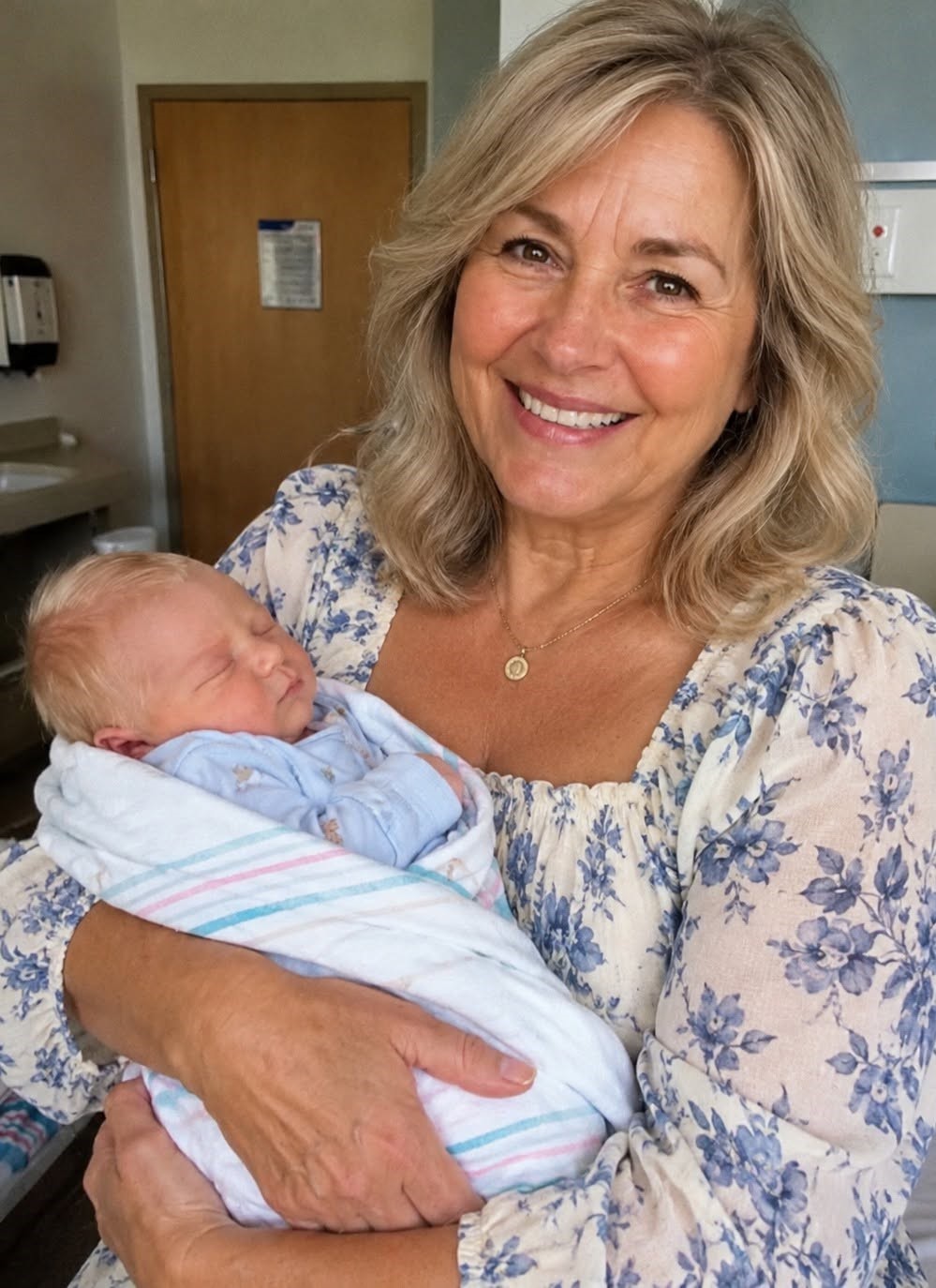
    Then Julian gently placed the newborn in my arms.

    He was beautiful.

    Tiny fingers curled against the blanket. Soft dark hair covered his head, and his little face looked impossibly peaceful.

    I stared down at him and whispered, “Hello, sweetheart. Grandma finally made it.”

    I cried so much that everyone in the room began laughing.

    A few moments later, Julian wrapped his arm around my shoulders.

    “Thank you for driving all this way, Mom,” he said with a smile. “I know you’ve been waiting for this day.”

    I kissed his cheek.

    “I’ve never felt happier.”

    After spending some time with them, I stepped into the hallway to give the new parents a little privacy. I saw one of the nurses nearby and decided to thank her for caring for my family.

    She smiled warmly when I mentioned Julian.

    “Oh, Julian? Yes, I remember him.”

    I nodded proudly.

    “Thank you for everything you’ve done today.”

    Then her expression suddenly changed.

    Her smile vanished.

    She glanced toward Julian’s room before slowly turning back to me.

    Lowering her voice until it was barely more than a whisper, she said, “That isn’t the baby your son left with.”

    For a moment, I honestly thought I had misunderstood her.

    I gave a nervous laugh.

    “I’m sorry… what did you say?”

    The nurse’s face turned pale.

    She stared at me as though she had just revealed something she was never supposed to mention.

    Then she quietly asked, “You… don’t know?”

    Before I could demand an explanation, another nurse called her name from farther down the hallway.

    She quickly apologized and hurried away without saying another word.

    I remained there, completely frozen.

    At first, I convinced myself that she had mistaken Julian for another patient. It was a busy maternity ward. The staff were exhausted. Surely, it was nothing more than a misunderstanding. There could not be any other explanation.

    But no matter how hard I tried, I couldn’t forget her words.

    That isn’t the baby your son left with.

    Every time I looked at the newborn, the sentence echoed through my mind.

    During the next couple of days, small details I had ignored began returning to me.

    The baby shower had been unusually small. Julian had never sent me a single photograph of Chloe during the pregnancy. He had shown me pictures of the nursery, the crib, folded baby clothes, and tiny shoes—but never one photograph of her growing stomach.

    All the family pictures had been taken only after the baby arrived.

    When I finally questioned Julian about the nurse’s strange comment, he immediately dismissed it.

    “She must have confused me with someone else,” he said.

    But I noticed the hesitation in his voice. I saw the fear in his eyes.

    Julian was my only son. I had known him his entire life.

    And I knew he was lying.

    I needed answers.

    One afternoon, while Julian and Chloe were away at an outpatient pediatric checkup, I searched through the folder in their guest room where they had placed their important documents.

    Hospital forms. Insurance records. Birth paperwork.

    Everything appeared completely ordinary.

    Then I found a page hidden near the bottom—a certified legal discharge order from a private surrogate and adoption agency three counties over, tucked inside a specialized hospital billing envelope.

    The moment I read the heading, my hands began trembling.

    I read the same sentence once. Then twice. Then a third time.

    And when I finally understood what it meant, every strange detail from the past nine months suddenly made sense.

    Part 2

    The document in my hands was a legal surro-adoption consent form signed four months prior, detailing a devastating twin pregnancy tragedy.

    Chloe had indeed been pregnant—with twins. But six months into the pregnancy, severe preeclampsia forced an emergency premature delivery. One twin, a tiny girl named Lily, had survived for only forty-eight hours. The second baby, a boy born under extreme medical distress, had suffered severe organ failure.

    The nurse in the hallway hadn’t mistaken my son for someone else.

    Four days ago, Julian had walked out of a specialized neo-natal hospice room holding his dying newborn son in his arms, saying his final goodbyes as the baby passed away in a quiet room at the end of the hall.

    The document in my hands revealed what happened next: six months earlier, knowing Chloe’s pregnancy was high-risk and facing a low chance of survival, Julian and Chloe had quietly registered with a private, expedited surrogacy agency. A surrogate mother had been carrying a healthy genetic embryo created by Julian and Chloe before her health deteriorated.

    That second baby boy had been delivered in the exact same hospital network, on the exact same morning, just two floors down.

    Julian had left one room carrying a son who didn’t survive, and three hours later, walked into another room to take home his healthy biological child born to their surrogate mother.

    My knees buckled. I sank onto the edge of the guest bed, holding the paper to my chest as tears blinded my vision.

    The silence wasn’t a deception born of deceit or malice; it was a wall built of overwhelming, crushing grief. They had kept their pain hidden from me because they were terrified I would judge their choices or look at their surviving child as a replacement rather than a blessing.

    Outside, I heard the garage door rumble open. Julian and Chloe were back from the clinic.

    I folded the paper carefully, slid it back into the folder, and wiped my eyes.

    When Julian walked into the living room carrying the baby carrier, he saw me sitting on the sofa. He froze, his eyes instantly darting to the open drawer in the corner.

    He knew.

    “Mom…” Julian whispered, setting the carrier down. His voice cracked completely. “I’m sorry. I’m so sorry.”

    Chloe burst into tears, sinking onto the floor beside the baby carrier, hiding her face in her hands.

    I didn’t yell. I didn’t scold them.

    I stood up, walked across the room, and knelt down on the floor right beside them, wrapping my arms tightly around both my son and my daughter-in-law.

    “Oh, my sweet children,” I sobbed into Julian’s shoulder. “Why didn’t you tell me? You didn’t have to carry this grief all by yourselves.”

    Julian buried his face in my neck, crying with the raw, uncontrollable pain of a father who had been holding back an ocean for months.

    “We were so scared, Mom,” Julian whispered through his tears. “We lost Lily… and then we lost little Leo… and we were so terrified that if we told you about the surrogate, you wouldn’t see this baby as real. We just wanted one moment where everyone smiled instead of cried.”

    I pulled back, took my son’s face in my hands, and looked him straight in the eyes.

    “He is your son,” I said with fierce, absolute conviction. “He is my grandson. He is flesh of your flesh, heart of your heart, and I love him with every piece of my soul.”

    Part 3

    The weeks that followed were a quiet, healing storm.

    Instead of returning home after my scheduled visit, I stayed with Julian and Chloe for a full month.

    Together, we didn’t pretend the tragedy hadn’t happened. We talked about Lily and little Leo. We cried together over afternoon tea. We planted two white rose bushes in the quiet garden behind their house, holding a small, private family memorial where we finally said the names of the two little angels we had lost.

    Naming the grief gave my son his life back.

    The tense, terrified look in Chloe’s eyes faded, replaced by genuine peace. The hospital nurse’s whisper—once a haunting mystery that threatened to tear our family apart—became the catalyst that brought the truth into the light where it could finally heal.

    A year later, the white rose bushes in the backyard were blooming with heavy, beautiful clusters of fragrant petals.

    The afternoon sun fell across the green grass as my grandson, now a healthy, chubby-cheeked one-year-old named Oliver, took his very first steps across the lawn.

    He wobbled on his tiny feet, arms outstretched, his dark hair catching the golden light, giggling with pure delight as he toddled straight toward me.

    Julian and Chloe sat on the porch bench, holding hands, watching him with bright, joyful eyes.

    Oliver took three steps, four steps, and tumbled safely right into my open arms, letting out a loud, happy screech.

    I pulled my grandson tight against my chest, kissing his warm cheek, listening to his heart beat strong and steady against mine.

    I looked over at Julian, who smiled at me with a profound, quiet gratitude that needed no words.

    I realized then that family isn’t defined by avoiding heartbreak or keeping painful secrets. It’s built on the willingness to stand together in the dark, hold each other through the grief, and welcome the light when it finally comes back home.

    Epilogue: The Light on the Horizon

    Three years after the white roses first took root in the backyard, the autumn air carried a crisp, sweet scent of pine and dry oak leaves.

    The small suburban house, once a fortress built of silent grief and hidden tears, had transformed into a place overflowing with life. Crayons cluttered the low coffee table in the living room, framed family photos lined the hallway, and the quiet garden out back had become a sanctuary where three generations met to remember, to grow, and to love without fear.

    Four-year-old Oliver stood at the edge of the patio, wearing a bright yellow raincoat and little green rain boots, his dark curls bouncing as he pointed enthusiastically toward the fence.

    “Grandma! Look! The birds are taking the seeds!” he shouted, his little voice echoing across the lawn.

    I set my teacup down on the wooden patio table, wrapping my cardigan tighter against the morning chill as I walked over to join him. I knelt beside my grandson, pulling his hood up over his soft hair.

    “They certainly are, Ollie,” I said softly, kissing his cheek. “They’re getting ready for winter.”

    In the doorway behind us, Julian stepped out onto the porch holding two mugs of steaming coffee. He looked completely different from the exhausted, terrified young man who had handed me a newborn three years ago. The dark circles beneath his eyes were gone, replaced by a calm, steady warmth. His posture was confident, his smile genuine and frequent.

    He walked over, handing a mug to Chloe, who joined him on the porch wrapped in a warm wool scarf.

    Chloe’s cheeks were flushed with health, her eyes bright as she watched Oliver chase a stray leaf across the grass. The shadow of preeclampsia and the crushing weight of the twin loss no longer consumed her identity. She had spent two years in grief counseling, working through the trauma of her emergency delivery, and together with Julian, had slowly rebuilt her spirit piece by piece.

    “Mom,” Julian said, resting a hand on my shoulder as I stood back up. “Did you pack the photo album for the drive back?”

    “It’s already in my bag,” I smiled. “I was just looking through the pages from Oliver’s birthday last week.”

    “He still talks about the dinosaur cake you brought,” Chloe laughed, leaning her head against Julian’s arm. “I think he ate half the frosting before we even sang.”

    We shared a soft laugh—a simple, comfortable sound that would have felt impossible during those first agonizing weeks after Oliver was born.

    As Oliver trotted toward the garden bed, his little boots squelching softly in the damp soil, he paused right beside the two white rose bushes. Even in late October, a few resilient white blossoms lingered on the stems, standing brave against the cool autumn wind.

    Oliver stopped, knelt down, and carefully touched a soft white petal with his tiny index finger.

    “Hello, Lily. Hello, Leo,” he whispered quietly to the flowers.

    My heart swelled with a sweet, profound ache.

    When Oliver had turned three, Julian and Chloe had made the brave, beautiful decision never to make his lost brother and sister a secret. They had bought age-appropriate storybooks about angel siblings, and whenever we visited the garden, we spoke their names with tenderness rather than sorrow.

    Oliver grew up knowing that he was deeply, fiercely loved—not as a replacement for two lost souls, but as a miraculous continuation of a family that had survived the storm. He knew that two little angels watched over his playground adventures, and that his family’s love was big enough to hold both grief and joy in the exact same breath.

    Julian walked down the wooden steps, kneeling beside his son in the garden soil. He pulled Oliver gently into his lap, resting his chin on the boy’s shoulder as they looked at the white roses together.

    “They’re watching you run today, Ollie,” Julian whispered into his hair.

    “Did they see me jump over the big puddle?” Oliver asked, turning his wide, dark eyes toward his father.

    “They sure did,” Julian smiled, his eyes shimmering with quiet emotion. “They thought it was the highest jump ever.”

    I watched them from the patio, wiping a stray tear from my cheek.

    For a long time, I had questioned why the universe had led me down that hospital hallway, why a exhausted nurse had whispered those six terrifying words into my ear, and why I had been forced to discover the truth through hidden legal documents.

    Now, looking at my son cradling his healthy, happy boy amidst the blooming roses, I understood.

    Secrets were heavy, suffocating things. Left in the dark, they festered into fear, isolation, and shame. But when brought into the light—surrounded by unconditional love, patience, and understanding—even the most devastating truths could be transformed into the foundation of a deeper, unbreakable bond.

    The nurse’s whisper had not been a curse meant to destroy our family; it had been the key that unlocked the door to our healing. It had allowed me to step out of the role of a distant grandmother and into the role of a shelter where my son and his wife could finally lay down their heavy burden.

    Chloe stepped up beside me, slipping her arm through mine as we watched Julian tickle Oliver until the boy’s wild, ringing laughter filled the entire backyard.

    “Thank you for staying, Evelyn,” Chloe said softly, using my name with a quiet, sacred respect. “Three years ago… if you hadn’t stayed, if you hadn’t held us through that nightmare… I don’t know if we ever would have found our way out of the dark.”

    I squeezed her arm gently, pulling her close.

    “You didn’t need a miracle, Chloe,” I whispered, watching my grandson sprint toward us across the green lawn, his arms open wide. “You just needed to know you weren’t alone.”

    Oliver slammed into my knees, wrapping his little arms tightly around my legs, giggling up at me with those big, dark eyes that carried the strength of his mother and the soul of his father.

    I leaned down, lifted my grandson into my arms, and held him tight against my chest. His little heart beat strong, steady, and full of life—a sweet, perfect rhythm that echoed out into the autumn morning, reminding us all that even after the darkest night, the light always, inevitably, finds its way back home.

  • I Showed Up at My Millionaire Ex-Husband’s Wedding With My 5-Year-Old Triplets… The Second His Family Saw the Three Children, Everyone Inside the Mansion Went Completely Silent.  

    I Showed Up at My Millionaire Ex-Husband’s Wedding With My 5-Year-Old Triplets… The Second His Family Saw the Three Children, Everyone Inside the Mansion Went Completely Silent.  

    PART 1

    They expected me to show up shattered.

    That was the real reason the Vance family invited me to the wedding.

    The Vances were Chicago old-money elites—wealthy, ruthless, obsessed with status, and convinced anyone outside their bloodline didn’t belong. Especially me.

    The invitation wasn’t kindness. It was humiliation carefully wrapped in gold paper.

    They wanted me hidden in the back row while my ex-husband, Jonathan Vance, married a younger woman from a “respectable” political family. They wanted their rich friends whispering about how easily I had been erased.

    And Eleanor Vance—Jonathan’s icy, manipulative mother—made sure every detail of my embarrassment was perfectly arranged.

    Including where I would sit.

    Table 27. Right beside the kitchen entrance of their massive Lake Geneva estate. Close enough to hear the staff yelling orders. Far enough to remind me I was no longer part of their world.

    But Eleanor made one fatal mistake. She had no idea I wouldn’t be arriving alone.

    The invitation smelled of luxury perfume and imported paper as I stood in my penthouse overlooking downtown Chicago, slowly turning the envelope in my hands. Gold lettering announced the marriage of Jonathan Vance and Victoria Cross, daughter of a powerful U.S. senator.

    I smiled coldly.

    Jonathan. The man who signed our divorce papers five years earlier without even lifting his eyes to look at me. The same man who stood there silently while his mother tore my life apart piece by piece.

    “Mama… who’s getting married?”

    I looked down to see Liam tugging at my sleeve. Across the room, Noah and Caleb were building a giant pillow fort while loudly arguing over dinosaurs.

    My triplets. Five years old.

    All three boys carried Jonathan’s sharp gray eyes and dark wavy hair. But their strength? Their fire? That came from me.

    I ran from the Vance mansion while pregnant, terrified Eleanor would discover the babies and destroy me in court. She would have taken my sons and raised them inside her cold empire as perfect little heirs.

    So I disappeared. And I survived.

    I worked eighteen-hour days while pregnant. I built a digital marketing company from nothing inside a tiny apartment while my babies slept beside my desk. Now my company was one of the fastest-growing agencies in America.

    And quietly… my fortune had grown to nearly triple what remained of the collapsing Vance empire.

    “Clear my Saturday schedule,” I told my assistant.

    “For what?”

    “I need three custom tuxedos made for my sons.”

    I glanced once more at the invitation. “If Eleanor Vance wants a family reunion… then it’s time she finally meets her grandsons.”

    Saturday arrived cold, bright, and perfect.

    The Vance estate looked like a billionaire’s fantasy. Thousands of white roses lined the gardens while a string quartet played beside enormous fountains. Politicians, CEOs, and old-money elites filled the grounds sipping champagne beneath crystal chandeliers.

    From an upstairs balcony, Eleanor Vance waited confidently for my arrival. She expected heartbreak.

    Instead, a convoy of black armored SUVs rolled slowly through the front gates. The first vehicle stopped directly beside the wedding aisle.

    The entire estate went silent. Hundreds of wealthy guests turned to stare.

    Then the back door opened, and I stepped out. I wore an emerald couture gown sparkling beneath the afternoon sun. Gasps swept instantly through the crowd.

    But the real shock came seconds later. I turned back toward the SUV and reached out my hand.

    One by one… Liam, Noah, and Caleb stepped out beside me wearing custom velvet tuxedos.

    The silence became unbearable. Because every single boy looked exactly like Jonathan Vance.

    Above us, Eleanor’s champagne glass slipped from her hand and exploded against the marble balcony floor. Slowly, I lifted my eyes toward her—and smiled.

    That was the exact moment everyone inside the estate realized the wedding of the year had just become the scandal of the decade.

    Part 2

    The sound of breaking crystal echoed across the estate like a gunshot.

    Jonathan stepped onto the balcony behind his mother just as the glass shattered. The second he saw my sons, the color drained from his face completely. His hands gripped the railing so tightly his knuckles turned white.

    He looked at the boys. Then at me. Then back at them again.

    Five years. The math hit him instantly.

    I didn’t react. I simply adjusted Caleb’s bow tie and took my sons’ hands before walking forward calmly through the crowd. Chicago’s elite parted around us like water.

    “Mama,” Noah asked loudly, pointing toward the altar, “is that the man getting married?”

    A few guests choked on their champagne. I smiled softly.

    “We’re only here to observe, sweetheart. Keep walking.”

    I completely ignored Table 27 near the kitchen entrance. Instead, I walked directly to the front row—the section reserved exclusively for immediate family.

    A trembling wedding coordinator rushed toward me. “Ma’am, I’m sorry, this area is reserved for close relatives only.”

    I glanced down at my sons, then back at her. “I promise you,” I said coldly, “you won’t find anyone here more closely related to the groom than his biological children.”

    And with that, I sat down gracefully between my boys while the wedding began collapsing before the music even started.

    Eleanor stormed downstairs moments later. Her face looked stretched tight with fury and panic.

    “What is the meaning of this?” she hissed at me. “Leave immediately before I have security drag you out!”

    “Try it,” I replied calmly. I nodded toward the guests. “The senator is watching. Reporters are filming. If one security guard touches my children, I’ll sue you publicly. And unlike five years ago, Eleanor… I now have far more money than you do.”

    Her expression cracked slightly. Then her eyes drifted helplessly toward the boys. The resemblance was undeniable.

    At that moment, Jonathan slowly approached us from the altar. He looked like a man walking toward his own execution.

    Caleb tilted his head at him in the exact same way Jonathan always used to when he was confused. Several guests gasped aloud.

    “Clara…” Jonathan whispered weakly. “What is this?”

    I looked him directly in the eyes. “These are the sons you never knew existed. The children you missed because you were too busy sleeping with your mistress before our divorce papers were even dry.”

    Whispers exploded everywhere. Because according to the Vance family’s public story, Jonathan met Victoria long after our marriage ended.

    “I didn’t know!” Jonathan said desperately. “You disappeared!”

    “I disappeared because your mother threatened me!” I snapped, my voice cutting across the estate like a blade. “She promised to destroy me. She told me I was trash. I knew if Eleanor discovered my pregnancy, she’d bury me in court and steal my children just to raise them into miniature versions of herself.”

    “That’s a lie!” Eleanor shouted frantically. “She hired child actors!”

    “No,” another voice interrupted firmly.

    Everyone turned. Dr. Richard Vance—Jonathan’s estranged uncle and one of the country’s leading geneticists—slowly stepped forward from the crowd. He studied my sons carefully, then nodded once.

    “The gold fleck in the left iris,” he said quietly. “The Vance genetic marker. Jonathan has it. His grandfather had it. All three boys inherited it.”

    Silence swallowed the entire estate.

    And then the wedding doors opened.

    Victoria Cross entered wearing a breathtaking designer gown, holding her senator father’s arm proudly. But instead of admiration… she found hundreds of guests staring at me and my children.

    Her smile vanished instantly. She looked at Jonathan. Then at the boys. Then back at Jonathan again.

    “You have children?” she whispered shakily.

    Her father exploded. “You humiliated my daughter!” the senator roared, grabbing Jonathan violently by the tuxedo collar. “You hid an entire family?!”

    “They are not illegitimate,” I interrupted sharply as I stood. “My sons were conceived during a legal marriage. They are Jonathan Vance’s lawful heirs.”

    Eleanor nearly collapsed into a chair clutching her chest. Nobody moved to help her.

    Victoria dropped her bouquet, turned, and fled the estate in tears while cameras flashed wildly around her. The wedding of the year was officially dead.

    I checked my diamond watch calmly. “Well,” I said lightly, “that ended faster than expected.” I turned toward my boys. “Say goodbye, kids.”

    I began walking toward the exit. Behind me, Jonathan suddenly ran after us.

    “Clara, wait!” he shouted desperately. “Please don’t take them away from me!”

    I helped the boys into the SUV before finally turning toward the man I once loved.

    “They’re my sons, Jonathan,” I said quietly. “I carried them. I raised them. I stayed awake through fevers and nightmares and every hard moment while you were gone. You were only the donor.”

    Days later, Eleanor filed for custody immediately. Fraud. Parental alienation. Full custody demands. She hired the most vicious attorneys in Chicago.

    But by then, I already knew something she didn’t. The Vance empire was drowning in debt.

    At a legal meeting downtown, Eleanor slid a check across the conference table. “Take ten million dollars,” she said coldly. “Sign over custody and disappear.”

    I stared at the check, then laughed—actually laughed.

    “Oh, Eleanor,” I whispered. “You still think I’m poor.”

    Her jaw tightened. “Don’t test me.”

    I stood slowly and walked around the table until I stood directly beside her chair. “My company made thirty million dollars last quarter alone,” I said softly. “And this morning?” I leaned closer. “I bought your bank debt.”

    Her face went white. “What?”

    “The estate mortgage belongs to me now,” I continued calmly. “Technically, Eleanor… you’re living in my property.”

    Silence filled the room. Jonathan looked physically sick.

    “You’re bankrupt?” he asked his mother quietly.

    Eleanor couldn’t answer. Her hands shook violently.

    I stepped back. “Drop the lawsuit today,” I said. “Or I remove your family from that mansion by tomorrow morning.”

    Then I looked at Jonathan. “You can see the boys. But under my rules. You’ll earn the right to be their father.”

    Jonathan nodded immediately, crying openly from humiliation and relief while Eleanor signed the withdrawal papers with trembling hands.

    Months later, rain poured softly across Chicago while Jonathan sat on the floor of my penthouse covered in paint and glitter beside our sons, learning how to become a real father.

    And as I watched them from my office while reviewing million-dollar contracts, I realized something important.

    The greatest revenge isn’t destruction. It’s building a life so successful, peaceful, and beautiful… that the people who tried to ruin you become nothing more than a forgotten footnote in your victory story.

    Part 3

    The months following the withdrawal of the lawsuit brought a strange, heavy quiet over the city.

    The social pages, which had spent weeks feasting on the ruins of the Vance-Cross scandal, gradually shifted their attention to new targets. But inside the high-rise offices of Chicago’s financial district, the seismic shift was permanent. The Vance empire hadn’t just faltered; it had been quietly, systematically absorbed.

    I sat behind the wide glass desk in my corporate headquarters on Wacker Drive, reviewing the quarterly earnings of my agency alongside the restructuring terms for the Lake Geneva estate.

    My phone buzzed. It was a message from Jonathan: We’re almost done with the dinosaur puzzle. Are you still taking them to the museum at four?

    I typed a quick reply: Yes. Have them washed up by three-thirty.

    Giving Jonathan supervised access to Liam, Noah, and Caleb hadn’t been an act of forgiveness. It was an act of clarity. I refused to let my sons grow up with an phantom father, feeding on bitter mysteries. If Jonathan wanted to be in their lives, he was going to do it on my terms, in my home, stripped of his family’s grand illusions.

    An hour later, my assistant knocked on the door. “Clara… Eleanor Vance is in the lobby. She doesn’t have an appointment, but she refuses to leave.”

    I didn’t look up from my tablet. “Send her in.”

    When Eleanor walked into my office, she looked nothing like the icy matriarch who had spent decades commanding Chicago’s elite. Her immaculate hair was slightly undone, her tailored designer suit seemed a size too large for her shrinking frame, and the imperious glare that used to make junior partners tremble was gone.

    She stood near the doorway, holding a small, faded velvet jewelry box in her trembling hands.

    “I didn’t come to argue, Clara,” she said, her voice raspy and devoid of its usual sharp edge.

    “Sit down, Eleanor,” I said, gesturing to the leather chair across from my desk.

    She didn’t sit. Instead, she walked forward with slow, hesitant steps and placed the velvet box on the corner of my desk.

    “What is this?” I asked.

    “It belonged to Jonathan’s grandmother,” Eleanor whispered, her eyes fixed on the desk. “The Vance family heirloom ring. It was meant to be passed down to the mother of the firstborn son.”

    I looked at the box, then back at her. “You kept this hidden five years ago when Jonathan and I got married. You told him it was lost.”

    “Because I thought you were unworthy,” she said, her chest heaving as a bitter tear escaped down her wrinkled cheek. “I thought if I protected the bloodline from… from people like you, I was saving our legacy. I thought money and pedigree were the only things keeping us from falling apart.”

    She looked up at me, her eyes filled with a hollow, crushing defeat.

    “I lost the estate, Clara. I lost our standing. Victoria’s father destroyed our remaining commercial contracts, and Jonathan barely speaks to me unless it’s about the boys. You took everything.”

    “I took nothing, Eleanor,” I corrected her softly, keeping my voice cold and steady. “You gambled your family’s future on arrogance and bad debt. I simply bought the chips when you ran out. And as for this ring…”

    I pushed the velvet box back across the polished wood toward her.

    “My sons don’t need a ring to know who they are. They have my name on their business trusts, and they have a mother who built an empire while you were busy hiding behind gold leaf.”

    Eleanor stared at the box, her fingers shaking as she slowly pulled it back. “What happens to me now?”

    “You keep your private apartment in Gold Coast,” I said. “I won’t enforce the eviction on your personal residence. But you will never set foot near my children without my explicit permission, and you will never again speak a word about status in their presence.”

    She closed her eyes, swallowed her remaining pride, and nodded once. “Thank you.”

    She turned and walked out of the office, her heels clicking softly against the marble, a broken woman leaving behind the wreckage of her own making.

    Final Part

    Spring arrived in Chicago with a crisp, clear sunshine that melted the last traces of winter ice along the lakefront.

    On a bright Saturday afternoon, the park beside my Lincoln Park penthouse was filled with the sound of laughing children and rustling oak leaves.

    I sat on a wooden park bench wearing a simple cashmere sweater and sunglasses, holding a warm cup of coffee. A few yards away on the grass, Jonathan was kneeling in the dirt, completely unbothered by the grass stains on his tailored trousers, helping Noah and Caleb build a makeshift launching pad for a toy rocket.

    A few feet beside them, Liam was standing tall, holding a clipboard and loudly counting down from ten with all the solemn authority of a NASA flight director.

    “Three… two… one… LAUNCH!” Liam yelled.

    Jonathan hit the foam launcher, and the rocket soared twenty feet into the air. All three boys erupted into wild, triumphant screams, chasing the toy as it drifted toward the trees.

    Jonathan stayed on his knees for a moment, catching his breath, watching them run. He looked up, met my gaze, and offered a small, quiet smile—a look of profound, humbled gratitude. He knew he was living on borrowed grace, earning his way into his sons’ hearts one Saturday at a time, completely free of the toxic expectations his mother had placed on him his entire life.

    My phone buzzed in my coat pocket. It was a notification from my Chief Financial Officer: Acquisition of Vance Logistics assets fully completed. Integration begins Monday.

    I closed the screen and slipped the phone away.

    Five years ago, I had walked out of the Vance estate in the dark, pregnant, terrified, and penniless, with nothing but three tiny heartbeats inside me and a refusal to be broken. They had treated me like an inconvenience to be erased, a footnote in their grand family story.

    Now, as I watched my three healthy, fearless sons laughing in the bright afternoon sun, I took a deep breath of the fresh spring air.

    I hadn’t just survived their cruelty. I had outgrown it, outspent it, and rewritten the narrative entirely. The Vance name was no longer a symbol of arrogant Chicago old-money; it was a chapter my sons would read about in financial records when they were old enough to understand how their mother built their kingdom.

    Liam ran over to the bench, breathless, his dark wavy hair stuck to his forehead with sweat, holding up a shiny yellow dandelion he had plucked from the lawn.

    “For you, Mama!” he said proudly, shoving the little flower into my hand.

    I smiled, pulling him into a tight hug and kissing the top of his head. “Thank you, sweetie. It’s beautiful.”

    Noah and Caleb came tackling into my side a second later, giggling wildly, while Jonathan walked over, wiping the dirt off his hands, standing at a respectful distance.

    The sky above Chicago was wide, blue, and endless.

    Standing there surrounded by my boys, supported by the unyielding life I had built with my own hands, I realized the ultimate truth of my journey:

    The ultimate victory wasn’t breaking the people who tried to destroy you. It was building a life so radiant, strong, and peaceful that their entire existence became nothing more than a faint shadow beneath your feet.

  • I came home from Qatar and found my mother locked in a room like a prisoner—starving, weak, and completely forgotten while my husband’s family spent every dollar i sent for her care.  

    I came home from Qatar and found my mother locked in a room like a prisoner—starving, weak, and completely forgotten while my husband’s family spent every dollar i sent for her care.  

    My husband looked me in the eyes and said, “Don’t turn this into a tragedy from 3,000 miles away.” I didn’t scream or argue. I secretly recorded everything and called the police. Then we lifted my mother’s mattress… and found an insurance policy in my name dated TWO DAYS IN THE FUTURE.

    PART 1

    When I pushed open the bedroom door at the far end of the hallway, my breath caught in my throat.

    My seventy-one-year-old mother, Rose, was lying on a stained mattress, her waist bound to the bedframe with makeshift cloth restraints. Her lips were cracked and bleeding, and two cockroaches crawled past a plastic plate of stale food left on a dusty nightstand.

    “Mom…” My voice was barely a whisper.

    Rose opened her eyes. Instead of smiling with relief at the sight of me, she shrank back against her thin pillow, her frame trembling.

    “Don’t untie me yet,” she rasped out, her voice raw. “Look under the mattress first.”

    I had landed in Miami just two hours earlier after spending nearly three years working double shifts as a housekeeping supervisor at a luxury hotel in Doha, Qatar. Nobody knew I was coming back. Not my husband, Mark. Not my mother-in-law, Brenda. Not my sister-in-law, Heather.

    I had taken the contract in Qatar after Mom suffered a complex hip surgery. Mark had sworn on his life that his family would care for her at their spacious family home in Fort Myers, Florida.

    “Don’t put her in a nursing home, Elena,” Mark had pleaded three years ago. “My mom and Heather will look after her. She’ll be treated like family.”

    I had wanted so desperately to believe him.

    For thirty-four months, I had wired increasingly large sums of money back to Florida every single payday: funds for specialized physical therapy, prescriptions, adult care supplies, a motorized hospital bed, and a private home health aide.

    In return, Mark sent periodic photos. Mom smiling weakly beside a window. Mom in a gray sweater beside that same window. Mom wrapped in a blue blanket, still sitting in that exact same spot.

    Whenever I asked for a live video call, an excuse conveniently popped up. Mom was sleeping. Mom was too tired. The Wi-Fi was down. Her phone battery was dead.

    Until eight days ago, when a three-second voice note arrived from Mom’s phone.

    In the audio, a loud thud echoed in the background, followed by a trembling, terrified whisper: “Don’t sign anything…”

    The message was deleted almost instantly.

    Mark called me at 3:00 AM Qatar time that very night. “Your mother’s getting confused and paranoid, Elena. Don’t make a tragedy out of this from 5,000 miles away.”

    I nodded into the phone, pretending to accept his explanation.

    The moment I hung up, I called Clara Benitez, a family law attorney in Miami recommended by a coworker, and booked the first flight back to the States.

    When I let myself into the Fort Myers house unannounced that morning, I found a renovated living room: a massive OLED TV, plush leather sofas, an expensive espresso machine, and a glass display cabinet filled with high-end decor. Around her neck, Brenda wore a solid gold pendant that had once belonged to my mother.

    Mark turned ghost-white the second he walked out of the kitchen and saw me standing in the foyer.

    “What… what are you doing here?” he stammered.

    “I came to get my mother.”

    Silence fell over the room.

    Then I heard a soft, scraping sound from the second floor. I didn’t wait. I bolted up the stairs.

    At the very end of the hall, a heavy wooden dresser had been pushed directly in front of a closed door.

    “Elena, wait!” Mark shouted, scrambling up the stairs behind me.

    I shoved the heavy dresser aside with all my strength, threw open the door, and found Mom.

    Without taking my eyes off her, I pulled out my phone, started a video recording, and dialed 911.

    “Mom, I’m here,” I sobbed, kneeling beside the bed.

    Mom weakly pointed a shaky finger toward the mattress.

    I lifted the corner. Tucked inside a sealed plastic bag was a folder containing bank receipts of all my wire transfers from Doha, photocopies of my driver’s license, forged medical releases, and a power-of-attorney authorization bearing a signature that looked almost identical to my own.

    Except I knew I had never signed it.

    Beneath those papers lay an official insurance policy folder. My eyes scanned the top line:

    Insured: Elena Morales

    Primary Beneficiary: Mark Vance

    Effective Date: In exactly two days.

    I slowly stood up and turned around. Mark was standing in the doorway, his hands trembling.

    “Elena, listen to me, I can explain—”

    From the bed, Mom shook her head weakly. “Elena… don’t drink anything they give you.”

    Downstairs, the sound of my luggage being unzipped echoed loudly up the stairwell. Heather’s voice shrieked from the foyer:

    “Mark! The money isn’t in her bag!”

    I didn’t move an inch. Because the money I had saved was safely tucked away in an offshore account Mark couldn’t touch.

    And none of them realized that, hidden in the front pocket of my carry-on, a tiny wireless camera had been recording every single word since I walked through the front door.

    Part 2

    Downstairs, Heather reached deep into the front pocket of my suitcase and pulled out the small, blinking recording device.

    “What the hell is this?!” she yelled.

    Mark backed down two steps on the staircase, paralyzed.

    I walked out to the top of the landing, holding the plastic-wrapped folder against my chest. “Put it back where you found it.”

    “You have no legal right to record us in our own house!” Heather spat, her face red with rage.

    “We’ll let the police decide that,” I replied, my voice eerily calm.

    My absolute composure terrified Mark far more than if I had started screaming.

    From the bedroom, Mom called out feebly, “The paperwork… he brought it to my room weeks ago…”

    I walked back to my mother’s bedside. “Mark made you sign something?”

    Mom nodded slowly. “He told me I had to sign to prove you authorized my care. When I refused… they took my phone away and moved the dresser.”

    I felt a cold, sharp rage ignite inside my chest. “Is that why you sent that voice note?”

    “It was the only chance I had. He left his phone on my nightstand for thirty seconds.”

    Downstairs, Brenda began weeping loudly. “Mark, you said you had everything under control! You said she wouldn’t come back until next year!”

    I stepped back out into the hallway, glaring down at my mother-in-law. “And leaving my mother tied to a bed like an animal seemed under control to you, Brenda?”

    Brenda looked away, unable to meet my eyes.

    Mark tried to take a step up the stairs, holding his hands out in a pleading gesture. “Elena, please. We’re family. We can figure this out without making a scene.”

    I held up the insurance policy document. “Does ‘family’ take out a multi-million-dollar life insurance policy on someone behind their back?”

    Before Mark could answer, the front doorbell rang sharply.

    It wasn’t the police yet.

    Standing at the front door was a man wearing a suit, carrying a blue leather notary folder, asking for Mark Vance. When he looked past Heather and saw me standing at the top of the stairs holding a phone, he paused.

    “Mr. Vance?” the man asked hesitantly. “I’m here for the final signature verification on Mrs. Morales’s policy documents.”

    Mark’s face lost every bit of color. He made a sudden, desperate dart toward the back kitchen exit.

    Part 3

    He didn’t make it three steps.

    I didn’t even have to touch him; I simply moved to the top of the stairs and called out the front door to the officers who were just pulling into the driveway with their sirens flashing.

    Two Fort Myers police officers and an emergency medical crew pushed through the front entrance, immediately taking control of the house.

    The man with the notary folder, identifying himself as an independent insurance broker, immediately raised his hands. “I’m just an agent! Mr. Vance submitted these authorization forms digitally. I came to get the physical signature verified!”

    “I never met this man, and I never authorized a policy,” I told the officers, handing over my passport, my Qatar work visa, and the folder recovered from under the mattress.

    The paramedics rushed upstairs to attend to Mom. When they carefully cut away the cloth bindings from her waist, they found deep, inflamed pressure marks on her skin. She was severely dehydrated, malnourished, and hadn’t received physical therapy or her prescribed heart medication in months.

    “Who was managing her daily care?” the paramedic asked sternly.

    Mom pointed a frail finger toward the doorway where Mark was being restrained by an officer. “He took my money. He took my phone. He locked me in.”

    Police officers searched the home, discovering boxes of expired medications, unopened medical supplies that I had paid for, and dozens of fraudulent receipts Mark had created to justify the thousands of dollars I had been wiring every month.

    While Mom was being placed on a stretcher, my attorney, Clara Benitez, arrived at the scene. Clara reviewed the forged power-of-attorney documents, the insurance policy, and the hidden camera footage from my bag.

    “This isn’t just elder abuse and fraud,” Clara informed the lead detective calmly. “This is a premeditated financial conspiracy, forged documentation, and attempted corporate fraud. The policy effective date was timed specifically around her scheduled return.”

    The police arrested Mark, Heather, and Brenda on the spot.

    As Mark was led out in handcuffs, he looked at me with hollow, desperate eyes. “Elena, please… I did it for us. The business was failing—”

    “Don’t ever say my name again,” I said, my voice steady and razor-sharp.

    Mom was transported to the hospital, where she spent two weeks receiving intensive care, hydration, and proper medical evaluation. The doctors confirmed that despite her physical weakness, her cognitive functions were completely intact; she knew exactly what had been done to her, and she gave a full, detailed statement to state investigators.

    I immediately filed for emergency divorce, revoked all shared account accesses, and secured a full protective order.

    Four weeks later, I moved my mother into a sunlit, fully accessible two-bedroom apartment in Tampa, far away from Fort Myers.

    On our first evening in the new apartment, I was putting away fresh linens when I heard Mom call me from the living room.

    “Elena?”

    I rushed into the room, terrified something was wrong.

    Mom was standing beside the front door, leaning comfortably on her walker.

    “Can you unlock the door for a second, sweetie?” she asked gently.

    I unlocked it and pulled the door open to the quiet, brightly lit hallway. Mom stood there for a long moment, looking out into the open space, breathing in the clean air.

    “Okay,” Mom smiled, looking up at me. “You can close it now.”

    I closed the door and locked it.

    “I just wanted to make sure I could ask to open it whenever I wanted,” Mom whispered, her eyes shining with tears.

    I sank down onto the couch beside my mother and finally wept—not out of sorrow or betrayal, but out of the overwhelming, beautiful relief that my mother was finally free.

    Mark, Brenda, and Heather faced extensive criminal indictments for elder abuse, grand theft, and insurance fraud. The house bought with my stolen money was liquidated under court order to pay full restitution to Mom.

    A year later, on a bright Florida afternoon, Mom sat on our new balcony, sipping tea beside a pot of blooming yellow hibiscus.

    She looked at me while I worked comfortably from my laptop on a freelance consulting project, and smiled.

    “You know, Elena,” Mom said softly, watching the sunlight bounce off the leaves. “For thirty-four months, I thought I was trapped in that room forever.”

    I walked over, kneeling beside her chair and taking her warm hand. “You were never trapped, Mom. You were just waiting for me to come home.”

    Mom squeezed my hand tightly. “And today, we’re right where we belong.”

  •   Melania Trump Showed a Rare Side of Herself at the State Dinner — Her Body Language Said It All — Photo  

      Melania Trump Showed a Rare Side of Herself at the State Dinner — Her Body Language Said It All — Photo  

    Melania Trump has never needed to say much for a photograph to start a conversation, and on September 24, the cameras caught something people were not used to seeing. At first, the change was easy to miss — until a moment outside the White House made it impossible to ignore.

    The timing made it even more curious. After months of carefully chosen appearances, Melania had suddenly spent several days moving from major event to major event. The woman who appeared at the end of that unusually busy stretch seemed noticeably different from the one Americans had been seeing earlier in the year.

    Melania’s public schedule has been unusually selective in 2026. An NBC News analysis found that she had made roughly half as many public appearances as she had by the same point in Donald Trump’s first term. | Source: Getty Images

    Melania’s public schedule has been unusually selective in 2026. An NBC News analysis found that she had made roughly half as many public appearances as she had by the same point in Donald Trump’s first term. | Source: Getty Images

    She Had Been Keeping a Low Profile

    Only a month earlier, Melania’s absence itself had become part of the story. When she returned to the White House Rose Garden following a 32-day stretch without a photographed public appearance, she walked to the podium and immediately joked, “Good afternoon. I heard you missed me?” before adding, “Here I am.”

    It was a playful line from someone who had been giving cameras relatively little to work with. Melania was not disappearing from her responsibilities entirely — she was simply choosing when much of that work became visible.

    Melania is also preparing to reveal more of her private life on camera. She said an upcoming 2-part docuseries will feature one-on-one conversations and answers to “private questions” she has never addressed publicly before. | Source: Getty Images

    Melania is also preparing to reveal more of her private life on camera. She said an upcoming 2-part docuseries will feature one-on-one conversations and answers to “private questions” she has never addressed publicly before. | Source: Getty Images

    That quieter public pattern made the week of September 22 particularly noticeable. Melania reconvened her Fostering the Future Together coalition during the U.N. General Assembly, where the initiative had grown to 57 participating countries and new partnerships involving Adobe, Amazon, Intel, Starlink, Google, and Zoom.

    Her message that day was strikingly simple: “The future of our world will be determined by what we do for our children today.” By then, the work had already expanded considerably from the summit she held earlier in the year with representatives from more than 40 countries.

    That earlier gathering brought first spouses together with technology-sector leaders to discuss children, education, digital literacy, and the rapidly changing online world. | Source: Getty Images

    That earlier gathering brought first spouses together with technology-sector leaders to discuss children, education, digital literacy, and the rapidly changing online world. | Source: Getty Images

    The next day, Melania rang the opening bell at the New York Stock Exchange while launching Imperia, her network for women in business. Then came September 24 — and instead of another podium or business appearance, the cameras were waiting for her at the White House.

    Then Came a Question She Rarely Answers

    Just as Melania was becoming unusually visible in public, she gave a rare glimpse at what that schedule looks like once the cameras are gone. During a recent television conversation that included her son Barron, she was asked whether the family still tries to come together for something as ordinary as Sunday dinner.

    Her answer probably sounded familiar to any mother whose children are grown and whose family calendar seems harder to coordinate every year. Melania said family time has to be scheduled because everyone is busy, adding that Donald can remain in the Oval Office as late as 9:30 p.m. and reminding the hosts, “I am busy too.”

    Melania has repeatedly made children and young people central to her public work, from education and technology initiatives to online-safety legislation. | Source: Getty Images

    Melania has repeatedly made children and young people central to her public work, from education and technology initiatives to online-safety legislation. | Source: Getty Images

    “We try to find time,” Melania said during her appearance on The Big Money Show. She also acknowledged that there is “less and less” family time now, a simple admission from a mother whose only son is 20 and building an adult life of his own.

    Those comments added a personal note to a week already filled with speeches, meetings, and public events. But by Thursday evening, the focus was about to move somewhere completely different — because another side of Melania was waiting at the White House.

    Xi Jinping and Peng Liyuan’s Washington visit placed Melania back in one of the most traditional first-lady roles: helping host an official state occasion at the White House. | Source: Getty Images

    Xi Jinping and Peng Liyuan’s Washington visit placed Melania back in one of the most traditional first-lady roles: helping host an official state occasion at the White House. | Source: Getty Images

    By Thursday Night, Everything Looked Different

    Donald and Melania Trump were waiting outside the White House to receive Chinese President Xi Jinping and First Lady Peng Liyuan. This time, Melania was not simply attending: the first lady had led preparations for the state dinner, from a menu built around American ingredients with subtle Chinese influences to the formal East Room setting.

    Then came the visual surprise. Instead of the sweeping evening gown many might expect for such an occasion, Melania stepped out in a sharp black-and-white, tuxedo-inspired look, with a crisp white blouse, an oversized bow at the neck, dark trousers, and black heels. Next to the Peng’s floor-length red look, the contrast was immediate.

    Melania’s role in the evening went beyond simply posing beside the president. Her office had been directly involved in shaping the dinner, giving her an unusually visible role in how the night came together. | Source: Getty Images

    Melania’s role in the evening went beyond simply posing beside the president. Her office had been directly involved in shaping the dinner, giving her an unusually visible role in how the night came together. | Source: Getty Images

    But according to body-language expert Dr. Lillian Glass, the clothes were not actually the biggest change in the photographs. Looking at Melania as she greeted the guests, Glass immediately focused on something happening above that dramatic white bow: her expression.

    “Look at that smile! We have rarely seen Melania smile this broadly in public, with her teeth fully showing and her entire face appearing animated,” Glass said. It was not the restrained, closed-mouth expression viewers have often seen in carefully posed photographs — this time, Melania appeared caught right in the middle of the moment.

    he White House setting had been carefully planned around the visit, with details chosen to blend traditional American state-dinner elements with references to the Chinese delegation. | Source: Getty images

    he White House setting had been carefully planned around the visit, with details chosen to blend traditional American state-dinner elements with references to the Chinese delegation. | Source: Getty images

    But One Detail Stole the Attention

    Glass also pointed to something beyond a single smile. “There appears to be a new confidence in Melania’s public presentation,” she said, connecting the dinner photographs with the first lady’s much more visible run of appearances during the same week.

    Only days earlier, Glass noted, Melania had flashed another unusually bright smile after her husband publicly acknowledged her work at the United Nations. At the state dinner, however, it was happening again and again: she smiled broadly during the greetings, appeared animated around the visiting couple, and looked notably relaxed in the formal setting.

    Donald Trump later presented Xi with a bald-eagle sculpture that he said had been designed “in personal collaboration with Melania and myself,” another detail pointing to her involvement in the visit. | Source: Getty Images

    Donald Trump later presented Xi with a bald-eagle sculpture that he said had been designed “in personal collaboration with Melania and myself,” another detail pointing to her involvement in the visit. | Source: Getty Images

    That contrast had become especially noticeable because the week had begun with a very different image of Melania. At the U.N., she had appeared serious and focused while speaking about children, leadership, and technology; by Thursday night, the cameras were catching her laughing and smiling through one of the White House’s biggest formal occasions.

    The interpretation remains just that — an expert’s reading of photographs cannot tell viewers exactly what another person is feeling. Still, the visual contrast was clear enough to become the central talking point of the night.

    The East Room featured red linens, dahlias, and ranunculus, with Melania’s office saying the color was chosen in part for red’s cultural significance in China. | Source: Getty Images

    The East Room featured red linens, dahlias, and ranunculus, with Melania’s office saying the color was chosen in part for red’s cultural significance in China. | Source: Getty Images

    Her Own Words Added Another Layer

    What made Glass’s observation even more timely was that Melania had already addressed the idea that her relatively low public profile meant she had been doing less. Asked about how rarely she was seen, she replied, “You don’t see me everywhere, but behind the scenes I’m working nonstop.”

    That week made some of that work much more visible than usual. The U.N. gathering, the NYSE appearance, and finally the state dinner all landed within days of each other, turning what had largely happened out of sight into an unusually concentrated stretch of public appearances.

    The September schedule also showed Melania stepping beyond her longtime focus on children. With Imperia, she began publicly speaking more about women, business leadership, and economic ownership. | Source: Getty Images

    The September schedule also showed Melania stepping beyond her longtime focus on children. With Imperia, she began publicly speaking more about women, business leadership, and economic ownership. | Source: Getty Images

    There was another clue in the way Melania spoke that week. Asked whether Donald Trump seeks her opinion after speeches and public appearances, she said she tells him what she thinks even when “he doesn’t want to hear it,” adding that she always tells him the truth.

    It was a rare public comment about conversations between the couple, and it sat neatly beside Glass’s description of a first lady showing a stronger public voice. Melania herself had also described that side of her personality years earlier, saying during Donald Trump’s first presidential campaign, “I’m not a yes person.”

    During that earlier campaign, Melania said she followed events “from A to Z” and told Donald Trump when she disagreed with him — a glimpse of the direct role she says she has long played privately. | Source: Getty Images

    During that earlier campaign, Melania said she followed events “from A to Z” and told Donald Trump when she disagreed with him — a glimpse of the direct role she says she has long played privately. | Source: Getty Images

    The Mother Behind the Public Role

    Melania’s comments about Barron gave the week another dimension that was easy to lose among the fashion, speeches, and formal photographs. While her public role appeared to be expanding, she was also admitting that the ordinary family moments she values are becoming harder to arrange.

    That concern is also closely connected to the work she has chosen to make public. Children, education, digital safety, and helping young people build independent lives have repeatedly appeared across her initiatives, even as the size and international reach of those projects have grown.

    Melania’s work on online safety also took her to Capitol Hill, where she personally advocated for legislation targeting nonconsensual intimate images and AI-generated deepfakes. | Source: Getty Images

    Melania’s work on online safety also took her to Capitol Hill, where she personally advocated for legislation targeting nonconsensual intimate images and AI-generated deepfakes. | Source: Getty Images

    One of those efforts became the Take It Down Act, which was signed into law in May 2025. Donald Trump even invited Melania to add her own symbolic signature after she had personally lobbied lawmakers for the measure.

    But the state-dinner photographs told a much simpler story than any policy announcement could. After months of appearing selectively, Melania had suddenly spent several days at the center of events she had helped shape — and the difference cameras picked up was written most clearly across her face.

    The state dinner capped several consecutive days in which Melania moved between international diplomacy, business, family conversations, and her own initiatives — an unusually concentrated stretch of public visibility. | Source: Getty Images

    The state dinner capped several consecutive days in which Melania moved between international diplomacy, business, family conversations, and her own initiatives — an unusually concentrated stretch of public visibility. | Source: Getty Images

    The Real Shift Had Been Building for Months

    The outfit attracted attention immediately, but Glass kept coming back to Melania’s expression. The unusually broad smile, she argued, looked different from the more controlled public image audiences had grown accustomed to seeing.

    And after a week in which Melania had repeatedly stepped forward on her own projects, spoken more openly about life at home, and taken a central role in the state dinner, Glass summed up the change in just a few words: “Now we are seeing another side of that woman. She is beaming.”

  • After my divorce, I bought a house and told no one. While I was out of state, my cameras showed a moving truck in my driveway. Then I saw my ex-husband and his new wife carrying their furniture inside. I didn’t call him. I called the police.  

    After my divorce, I bought a house and told no one. While I was out of state, my cameras showed a moving truck in my driveway. Then I saw my ex-husband and his new wife carrying their furniture inside. I didn’t call him. I called the police.  

    At 10:14 on a bright Saturday morning, I looked down at my phone and saw my ex-husband carrying a flat-screen television into a house he had absolutely no right to enter.

    Behind him was his new wife.

    She was carrying a brass floor lamp.

    My brass floor lamp.

    I was four hours away, standing barefoot in my sister Rachel’s kitchen in Louisville with a mug of coffee halfway to my mouth.

    For several seconds, my brain refused to understand what I was seeing.

    Maybe I had opened the wrong camera.

    Maybe the feed was delayed.

    Maybe I was somehow looking at someone else’s property.

    But I wasn’t.

    The house was mine.

    I had owned it for exactly eleven days.

    It was a modest three-bedroom brick home in Worthington, just north of Columbus.

    Nothing extravagant.

    An old maple tree in front.

    Oak cabinets straight out of the 1980s.

    Floors that needed refinishing.

    I had paid $327,500 for it.

    But the price wasn’t the important part.

    The important part was that I had bought it alone.

    After twenty-seven years of marriage, signing my own name on that deed had felt like learning to breathe again.

    Mark and I had finalized our divorce in January.

    By August, I was tired of the tiny apartment I had rented during our separation.

    So I bought the house.

    I didn’t tell Mark.

    I barely told anyone.

    Rachel knew.

    My twenty-eight-year-old daughter, Emily, knew I was house hunting but didn’t yet know I had closed.

    My realtor knew.

    The flooring crew knew.

    That was about it.

    I wasn’t trying to hide anything scandalous.

    I simply wanted one major decision in my adult life that didn’t immediately become family property.

    Then my phone buzzed.

    PERSON DETECTED IN DRIVEWAY.

    I opened the security-camera feed.

    A yellow moving truck was backing into my driveway.

    The driver’s door opened.

    Mark stepped out.

    Rachel leaned over the kitchen island.

    “You expecting the flooring guys?”

    “Maybe.”

    Then I saw him clearly.

    Rachel came around the counter.

    “Is that Mark?”

    “Yes.”

    “What is he doing at your house?”

    “I was hoping you knew.”

    Then the passenger door opened.

    Vanessa climbed out.

    Mark had married her five months after our divorce became official.

    I had met her twice.

    I had stopped asking questions about when their relationship had actually started.

    He was no longer my problem.

    At least, that was what I had been telling myself.

    Then Mark handed Vanessa a tall brass lamp.

    A lamp I recognized from his old apartment.

    He pulled a huge television from the back of the truck.

    More boxes followed.

    KITCHEN.

    BOOKS.

    Then one enormous carton labeled:

    MASTER BEDROOM.

    Rachel stared at the screen.

    “They’re moving in.”

    “I can see that.”

    The house wasn’t even ready for me to move into yet.

    The floors had just been sanded.

    Painters were coming Tuesday.

    Most of my possessions were still in storage.

    Apparently, Mark had decided to beat me to my own moving day.

    Then he walked toward the side entrance.

    I leaned closer to the screen.

    That door had a keypad lock so contractors could come and go.

    Mark didn’t knock.

    He didn’t search for a hidden key.

    He simply walked straight to the keypad.

    Pressed four numbers.

    The light flashed green.

    Click.

    Rachel turned toward me.

    “He knows your code.”

    I felt cold.

    I had never given it to him.

    Never.

    Mark opened the door and held it for Vanessa.

    She walked inside carrying the lamp as though she belonged there.

    That was the first moment I stopped feeling merely angry.

    I felt invaded.

    I had found that house myself.

    Signed for it myself.

    Stood alone in the empty kitchen after closing and eaten a sandwich over the sink because I didn’t own a chair yet.

    And now my ex-husband was walking through it like he owned the deed.

    Another clip loaded.

    Vanessa stood on my porch and said,

    “Once the sectional is in, I want to measure the windows for drapes.”

    Rachel looked at me.

    “Call him.”

    My thumb hovered over Mark’s name.

    For twenty-seven years, this had been my habit.

    Mark did something unreasonable.

    I called him.

    He explained.

    And somehow, by the end of the conversation, I would be questioning my own reaction.

    Mark wasn’t a screamer.

    He was much harder to fight than that.

    He was an explainer.

    He could turn broken promises, missing money, and obvious lies into misunderstandings with enough words.

    I closed his contact.

    Instead, I opened the digital copy of my deed.

    There it was.

    Clare Bennett.

    Sole owner.

    Then I called the police.

    “My ex-husband and his new wife are moving furniture into a house I legally own,” I told the dispatcher. “I’m four hours away. Neither of them has permission to be there.”

    She asked whether Mark lived at the address.

    “No.”

    Had he ever lived there?

    “No.”

    Was I the sole legal owner?

    “Yes.”

    Then she asked something that made my stomach tighten.

    “Do you know how he gained entry?”

    I looked again at the image of his hand pressing the keypad.

    “No,” I said.

    And suddenly the moving truck wasn’t the most disturbing part anymore.

    Police arrived within twenty minutes.

    I watched everything remotely.

    Mark and Vanessa were attempting to force a huge gray sectional through my front door when the first cruiser pulled up.

    An officer asked who owned the house.

    “My ex-wife,” Mark said immediately.

    At least we had established reality.

    Then he added,

    “She knows we’re staying here temporarily.”

    Vanessa turned toward him.

    “You told me she bought it as an investment property.”

    That was the first moment I realized she might not know the truth.

    Mark quickly insisted it was.

    The officer asked whether Mark had any ownership interest.

    “It’s complicated.”

    Whenever Mark said something was complicated, it usually meant the simple truth made him look bad.

    He launched into a long explanation.

    He claimed I bought the property using money from our former marital home.

    He said we had an understanding.

    He claimed he and Vanessa only needed temporary housing between leases.

    Then the officer called me.

    I emailed him the deed.

    Closing documents.

    The divorce decree.

    Everything.

    He asked if Mark had contributed money to the purchase.

    “No.”

    Did he have a lease?

    “No.”

    Had he ever entered the house before?

    “Not with my permission.”

    The officer put me on speaker.

    Mark immediately said,

    “Clare, stop turning this into something it isn’t.”

    I looked at the video feed.

    There was a moving truck in my driveway.

    “You are unloading bedroom furniture into my house, Mark. I know exactly what this is.”

    “We just need somewhere temporary.”

    “We never discussed that.”

    Vanessa suddenly interrupted.

    “Mark, you told me she agreed!”

    He snapped at her.

    “She did.”

    “No,” I said. “I did not.”

    The police couldn’t instantly sort out every legal claim while standing in the driveway.

    Mark had used a working entry code and was claiming some imaginary verbal agreement.

    But one thing was clear.

    I was the owner.

    I told the police he had no permission to remain.

    The move stopped.

    Mark tried to call it a private family dispute.

    The officer looked at him.

    “She is your ex-wife.”

    Rachel nearly spit out her coffee.

    Then Mark attempted another strategy.

    He told everyone I was bitter.

    Unstable.

    Overreacting.

    Vanessa stood several feet away.

    Finally she said,

    “Just stop. You told me she knew.”

    Mark looked at her and said something I had heard in different forms for years.

    “I warned you she gets like this.”

    That hurt more than I expected.

    He had already prepared Vanessa to distrust me.

    Any boundary I enforced would become proof that I was the hysterical ex-wife he had described.

    The police stayed until Mark and Vanessa loaded everything back into the truck.

    The lamp.

    The television.

    The boxes.

    The sectional.

    Then I drove home.

    When I reached Worthington that afternoon, the driveway was empty.

    For a moment, the house looked peaceful again.

    Then my neighbor Tom walked over.

    He was a retired engineer who spent most of his free time caring for his plants.

    “Quite a morning,” he said.

    “That’s one way to describe it.”

    Then he hesitated.

    “I assumed you knew he’d been here earlier this week.”

    My stomach dropped.

    “When?”

    “Wednesday.”

    “Was he alone?”

    Tom shook his head.

    “No. He had a locksmith.”

    I ran to the side door.

    Entered the contractor code.

    Red light.

    I tried again.

    Red.

    That was when I understood.

    Mark hadn’t accidentally learned an old password.

    He had brought someone to my house days earlier and changed the lock.

    This had been planned.

    I hired another locksmith immediately.

    When he removed the lock, he confirmed it was almost brand new.

    Inside, I found muddy footprints.

    A deep gouge across my newly refinished floor.

    A dent in the drywall.

    Then I reached the kitchen.

    There was a little wooden sign sitting on my counter.

    Home Sweet Home.

    Vanessa had already started decorating.

    I took pictures of everything.

    Then I paid to replace every lock and erase every code from the smart system.

    That evening, sitting alone on the floor of my empty living room, I started doing something I had done throughout my marriage.

    I searched for ways this could somehow be my fault.

    Had I accidentally told Emily?

    Had Mark misunderstood some passing conversation?

    Had I reused an old code?

    Living with him for twenty-seven years had trained me to examine my own behavior before questioning his intentions.

    The next morning, I started tracing exactly how he had found the house.

    The flooring contractor gave me the first answer.

    He mentioned the code was posted on the shared Google calendar.

    I froze.

    For years, Mark, Emily, and I had shared a family calendar.

    After the divorce, I thought I had removed Mark.

    I checked.

    He couldn’t edit anything.

    But his old Gmail account still had permission to view events.

    And there it was.

    Worthington Floor Crew — Side Door: 0427.

    That explained the code.

    But not the address.

    Then I remembered a photo.

    Eleven days earlier, Rachel had convinced me to take a picture on the front steps after closing.

    I had uploaded it to an old shared family photo album without thinking.

    I zoomed in.

    The closing folder in my hands had my new address clearly printed on the tab.

    No private investigator.

    No hacker.

    Just two pieces of old digital access I had forgotten to remove.

    I spent the next two hours changing passwords everywhere.

    Bank accounts.

    Cloud storage.

    Streaming accounts.

    Everything.

    I even removed Mark from our old grocery-rewards profile.

    If he was going to try to take my house, he certainly wasn’t keeping my fuel points.

    Then my former mother-in-law called.

    Diane and I had remained polite after the divorce.

    She sounded uncomfortable.

    “Clare, I need to ask you something awful.”

    “Go ahead.”

    “Did you hide money from Mark during the divorce?”

    I nearly dropped my phone.

    “No.”

    She sighed.

    Apparently, Mark had been telling the family that I bought my “secret house” using assets I had hidden from him.

    His commissions had dropped.

    He and Vanessa were struggling financially.

    Their lease was ending.

    And Mark had convinced himself that because I was doing well after the divorce, some of that success must rightfully belong to him.

    Then Diane sent me screenshots.

    The first message was from Mark to his sister.

    It said:

    Once we get inside, Clare won’t make a scene. She hates conflict. She’ll let us stay until we figure something out.

    I read it three times.

    That hurt worse than the scratched floor.

    He hadn’t simply gambled on getting into my house.

    He had gambled on me.

    On twenty-seven years of knowing exactly how much I hated conflict.

    He expected the woman I used to be to save him from the consequences.

    Then Diane sent another screenshot.

    If Clare gets difficult, I’ll threaten to reopen the divorce and make her explain where the money for the house came from.

    That was when my anger disappeared.

    Something colder replaced it.

    Focus.

    I called my divorce attorney.

    Susan Keller looked like someone’s elegant grandmother.

    She also happened to be terrifying.

    I brought her everything.

    The deed.

    Bank records.

    Screenshots.

    Closing documents.

    She checked every date.

    Every transfer.

    Then she leaned back.

    “Mark has no legitimate claim to the house.”

    I finally breathed.

    “But,” she added, “he can still file nonsense and force you to spend money responding to it.”

    I hated that sentence.

    So Susan sent him a formal cease-and-desist letter.

    We also documented every dollar of damage and expense.

    Locksmith.

    Floor repair.

    Drywall.

    Security changes.

    Total:

    $2,740.

    That evening, Vanessa called me.

    She sounded completely different.

    Quiet.

    Uncertain.

    “Did you really buy the house after the divorce?”

    “Yes.”

    “Mark told me the money was still jointly disputed.”

    “It wasn’t.”

    “He said you agreed we could stay there.”

    “I didn’t.”

    She became quiet.

    Then she admitted Mark had also been lying to her about his finances.

    For the first time, I felt sorry for her.

    Not enough to excuse carrying furniture into my house.

    But enough to recognize the situation.

    I had once been the woman trying to explain Mark’s behavior too.

    A few days later, my daughter Emily came over.

    “Dad shouldn’t have done it,” she said. “But why does everything have to become a war?”

    That hurt.

    “It became a war when he hired a locksmith to enter my house.”

    She looked exhausted.

    Then she said,

    “Sometimes I feel like I have to choose between having a relationship with Dad and knowing the truth.”

    I didn’t know how to answer that.

    Then she called two days later.

    Mark was planning to use Diane’s Labor Day cookout to tell the entire family that I had stolen money from him.

    My first instinct was not to go.

    Then I reread his message.

    Clare hates conflict.

    She’ll let us stay.

    He was still counting on the old version of me.

    So I baked a cherry pie.

    And went to the cookout.

    When I arrived, everyone was there.

    Mark.

    Vanessa.

    Emily.

    Diane.

    His sister.

    His brother-in-law.

    Family friends.

    A jury.

    Emily looked terrified when she saw me.

    Diane stared at the pie.

    “You brought dessert?”

    “I wasn’t raised by wolves.”

    Mark was less amused.

    “What are you doing here?”

    “Enjoying a cookout.”

    For twenty minutes, everyone pretended things were normal.

    Then someone finally asked Mark about the Worthington house.

    Mark began his speech.

    He said we had built everything together.

    That I left the marriage with a large amount of cash.

    That I secretly bought a house.

    That he and Vanessa only needed somewhere temporary.

    Then I interrupted.

    “What date was our divorce finalized?”

    He said nothing.

    Emily answered.

    “January seventeenth.”

    “And when did I close on the house?”

    Again, Mark said nothing.

    I pulled one document from my purse.

    My closing statement.

    “August third. Seven months later.”

    I explained that the down payment came from my legally awarded half of our former home equity plus my own income.

    Mark became angry.

    “But that money came from what we built together!”

    “Yes.”

    I looked at him.

    “My court-awarded half of what we built together.”

    Then Vanessa stepped forward.

    “You told me she offered the house to us.”

    Mark turned toward her.

    “I said she knew.”

    “No. You said she offered it.”

    That was new even to me.

    I told everyone about the locksmith.

    His sister gasped.

    Mark insisted it wasn’t a break-in because I was away.

    I answered,

    “That is not how home ownership works.”

    Then I played another piece of evidence.

    My neighbor Tom’s doorbell camera had captured Mark speaking to the locksmith.

    On the recording, his voice was perfectly clear.

    “Once we’re inside, she’ll complain, but she’ll let it go. She always does.”

    When the audio stopped, nobody spoke.

    Mark stared at my phone.

    Then Vanessa looked at him.

    “You knew she hadn’t agreed.”

    “We were desperate!”

    “You knew.”

    She reached into her purse.

    Removed the key to their apartment.

    Set it beside his beer.

    “I’m staying with my sister.”

    Mark looked horrified.

    “What are you doing?”

    “I need time.”

    Then, naturally, he pointed at me.

    “This is what she wanted!”

    Even then, it had to be my fault.

    Vanessa looked at me.

    Then back at him.

    “No, Mark. This is just what you didn’t think would happen.”

    And she left.

    Three weeks later, my attorney called.

    Mark had backed down.

    He reimbursed the $2,740.

    He dropped his threat to challenge the divorce settlement.

    No courtroom drama.

    No judge.

    Just paperwork.

    Dates had defeated the lies.

    Six weeks later, I finally moved into my house.

    I hired movers with a plain white truck because I had developed a completely irrational dislike of yellow moving vans.

    Rachel helped unpack.

    At one point, she heard me say,

    “My house.”

    Then she stopped.

    “Say that again.”

    I looked around.

    The floors were repaired.

    The walls were painted.

    The locks belonged only to me.

    Every shared digital account was gone.

    “My house.”

    And for the first time, it truly felt like it.

    The anxiety didn’t disappear immediately.

    Every camera notification made my heart jump.

    Every unfamiliar car slowed me down.

    Once, a yellow moving truck drove down my street and I stood at the window until it disappeared.

    That is one thing nobody tells you about finally standing up for yourself.

    Having boundaries doesn’t erase what happened before you created them.

    You can be stronger and still check the locks twice.

    Both can be true.

    Later, Emily came over to help paint.

    Eventually, she apologized for saying I had turned everything into a war.

    “I was overwhelmed,” she said.

    “I know.”

    Then I realized something.

    “You were asking me to be the reasonable one.”

    She looked at me.

    “Because you knew Dad wouldn’t be.”

    Silence.

    Then Emily said something I will never forget.

    “I think sometimes I was asking you to lose quietly so I wouldn’t have to deal with his anger.”

    That hurt.

    But it was honest.

    “And maybe,” I said, “I taught you that was normal by doing it for twenty-seven years.”

    We kept painting.

    Then she smiled.

    “Are you mad at me?”

    “I’ll put it on the calendar for Thursday.”

    She pointed her paint roller at me.

    “Not the shared calendar.”

    We both laughed.

    Weeks later, I found an envelope in the mailbox.

    From Vanessa.

    Inside was a short handwritten letter.

    She apologized for entering my house.

    She did not blame Mark for everything.

    She admitted she had personally carried furniture inside.

    She said that even if Mark lied to her, she still had responsibility for what she had done.

    There was also a cashier’s check.

    $350.

    Exactly the estimated drywall repair.

    I never became her friend.

    I didn’t call to comfort her.

    But I respected the apology.

    And eventually, I stopped wondering whether she stayed married to Mark.

    His marriage was no longer my responsibility.

    By Thanksgiving, the house finally felt lived in.

    Rachel came from Kentucky.

    Emily decorated the refrigerator with an awful glitter-covered turkey magnet.

    Diane came for dessert.

    Mark was not invited.

    Nobody debated it.

    Nobody whispered about him.

    We ate too much.

    Argued about the thermostat.

    Lost Diane’s glasses for fifteen minutes before discovering them on top of her head.

    It was wonderfully ordinary.

    Then Diane gave me a hostess gift.

    I opened it.

    A little wooden sign.

    Home Sweet Home.

    I stared at her.

    She whispered,

    “Too soon?”

    Then she started laughing.

    So did I.

    I hung it in the laundry room.

    Not because I suddenly loved decorative signs.

    Because the first time those words appeared in my house, somebody else had put them there without permission.

    This time, I chose where the nail went.

    That difference meant everything.

    For most of my life, I thought a boundary only worked if the other person understood it.

    If they agreed.

    If they acknowledged I was being reasonable.

    I know better now.

    They don’t have to understand your boundary.

    They don’t have to like it.

    They don’t have to approve of it.

    They simply have to stop crossing it.

    And if I’m completely honest, Mark wasn’t entirely wrong about who I used to be.

    There was once a version of me who would have seen that moving truck, called him in a panic, listened to his explanation, worried about where he and Vanessa would sleep, and somehow apologized for making their lives difficult.

    He built his entire plan around finding that woman.

    He was just eight months too late.

    I still believe in forgiveness.

    I still believe people can change.

    And I still prefer peace when the peace is worth preserving.

    But I no longer believe being a good person means leaving the door unlocked.

    And if I ever give someone another chance?

    They definitely won’t be getting the code to my house.

  • My Mother Told Me to Keep Quiet at Dinner. Then the Federal Judge Asked Who I Really Was.  

    My Mother Told Me to Keep Quiet at Dinner. Then the Federal Judge Asked Who I Really Was.  

    My father called me at 1:30 in the morning and told me not to tell the truth.

    For one terrifying second, seeing his name glowing on my nightstand, I thought someone had died.

    I sat upright in my Chicago apartment, heart pounding.

    “Dad?”

    His voice came softly through the darkness.

    “Emily, your brother and Megan are having her parents over Friday. Your mother says you can come.”

    I stared at the wall.

    That was a strange way to put it.

    Not we want you there.

    Not Ryan wants his sister at dinner.

    Your mother says you can come.

    Before I could respond, Dad added, “Megan’s father is a federal judge. It’s important to your brother.”

    Then Mom’s voice came from behind him.

    “Did you tell her?”

    Dad hesitated.

    The phone changed hands.

    “Emily,” my mother said, “you can come Friday, but I need you to do something for me.”

    I knew that tone instantly.

    “What?”

    “Keep your mouth shut about your job.”

    I nearly laughed.

    “Why?”

    “Because this dinner is about Ryan. Her father is a very important man, and I don’t want you getting started on police shootings and corruption and all those depressing things you write about.”

    “I wasn’t planning to.”

    “Good. If anyone asks, just say you work in an office.”

    I let the silence linger.

    Mom grew impatient.

    “Emily?”

    “Yeah?”

    “Please don’t embarrass us.”

    There it was.

    The same message I had heard in different forms my entire life.

    Don’t embarrass us.

    I was thirty-three, an investigative reporter at one of the Midwest’s largest newspapers, and eight months earlier I had led a team whose reporting triggered three internal investigations and a federal civil-rights review.

    But to my mother, I remained the child who somehow entered every room already guilty of ruining it.

    I looked across my dark bedroom.

    “You want me to tell a federal judge that I do office work?”

    “Yes.”

    I smiled.

    “Okay.”

    Relief entered her voice.

    “Thank you.”

    She had no idea the judge she was so desperate to impress already knew exactly who I was.

    When I was seven, I figured out where I ranked in my family without anyone saying it directly.

    Our fireplace mantel displayed framed photographs.

    Five were of Ryan.

    Ryan at preschool graduation.

    Ryan holding a baseball bat.

    Ryan without his two front teeth.

    Ryan in a tiny suit at our cousin’s wedding.

    Ryan riding on Dad’s shoulders at the state fair.

    There was one picture of me.

    It sat wedged behind a ceramic angel and plastic ivy.

    From the right angle, you could see half my forehead.

    One afternoon, I dragged a dining chair over, climbed up, and moved my picture into the center.

    I stepped back and smiled.

    For once, all three of us looked like a family.

    By the next morning, my photograph had been hidden again.

    I never asked why.

    Instead, I created what I secretly called the mantel test.

    Maybe straight A’s would move the picture.

    They didn’t.

    Maybe winning the eighth-grade writing competition.

    Nothing.

    Maybe becoming valedictorian.

    Still nothing.

    Maybe Northwestern.

    Maybe the scholarship.

    Maybe graduating near the top of my class.

    Maybe my first newspaper job.

    Maybe the first front-page investigation under my name.

    Maybe the journalism award.

    Maybe the national award after that.

    Surely someday I would achieve something impressive enough for my mother to look at me and say, Emily, I’m proud of you.

    That day never came.

    Ryan was four years younger, funny and effortlessly charming, the kind of person who made strangers feel like longtime friends.

    He sold cars outside Indianapolis.

    And he was good at it.

    I want to be clear about something.

    I never resented Ryan for being loved.

    I resented the idea that loving him somehow required erasing me.

    And Mom could never simply celebrate what Ryan actually did.

    Reality wasn’t impressive enough.

    To neighbors, he was a “regional executive.”

    To church friends, he “managed a major sales division.”

    To her book club, Ryan personally negotiated multimillion-dollar commercial deals.

    Once, I heard her claim he routinely flew across the country for corporate meetings.

    Ryan had flown twice as an adult.

    Both times on vacation.

    My accomplishments moved in the opposite direction.

    According to Mom, I had “struggled academically.”

    I had “never really found my path.”

    I had “some little writing job.”

    One Thanksgiving, I entered the kitchen and overheard our neighbor Carol quietly ask, “Is Emily still dealing with that depression problem?”

    I froze.

    I had never been diagnosed with depression.

    Mom lowered her voice.

    “She’s very private. We try not to talk about it.”

    I stood at the sink pretending to scrub away a coffee stain.

    My hands shook.

    For a moment, I considered turning around and confronting her.

    But I already knew the script.

    She would gasp.

    Claim I misunderstood.

    I would get angry.

    Then she would become wounded.

    And by dessert everyone would be whispering:

    See? Emily really is unstable.

    So I said nothing.

    I learned young that when someone controls the story, defending yourself can be turned into evidence against you.

    That lesson eventually made me an excellent reporter.

    Eight months before Ryan’s dinner, I began investigating a series of police shootings across three Indiana counties.

    Initially, the story focused on use-of-force policies.

    Then I found missing body-camera footage.

    Then altered evidence logs.

    Then procurement contracts awarded to companies that seemed to exist only on paper.

    Every document pointed toward another.

    I survived on vending-machine coffee and four hours of sleep.

    One shell company sold vehicle equipment to sheriff’s departments.

    Another handled “emergency fleet maintenance.”

    A third collected payments for equipment departments couldn’t prove they had received.

    Money moved through them in oddly precise amounts.

    My editors gave me more time.

    I kept digging.

    Then anonymous documents began appearing.

    No return address.

    No explanation.

    Only records.

    Invoices.

    Internal emails.

    Copies of checks.

    In my encrypted notes, I called the source R.

    R never requested money.

    Never asked for protection.

    Never told me to target anyone.

    The messages always repeated some version of the same instruction:

    Follow the invoices.

    So I did.

    Eventually, the reporting became a six-part investigation.

    It uncovered kickbacks, falsified contracts, and evidence suppression involving public officials, police administrators, private vendors, and politically connected businesses.

    One federal civil case involving those departments came before Judge William Harrison.

    Months before Ryan’s dinner, Judge Harrison spoke at a criminal-justice panel in Chicago.

    Afterward, he stopped me in a courthouse hallway.

    “Ms. Carter?”

    I turned.

    He extended his hand.

    “Your reporting was extraordinary.”

    I actually glanced behind me.

    He smiled faintly.

    “I’m speaking to you.”

    “Thank you, Your Honor.”

    “Your series was some of the most thorough work I’ve seen on this issue. You asked questions institutions should have asked years ago.”

    For one ridiculous second, I wanted to call Mom.

    I wanted to tell her:

    A federal judge just praised my work.

    Then I imagined the answer.

    That’s nice, Emily. Did I tell you Ryan might get a company car?

    I put my phone away.

    Friday evening, I drove three hours to Maple Grove.

    I left my press badge behind.

    But I wore my navy blazer.

    The one I had worn when I accepted my national journalism award.

    Maybe some childish part of me still needed proof that I existed outside my mother’s version of me.

    Their house hadn’t changed.

    White siding.

    Blue shutters.

    Porch light glowing.

    Through the window, I could see the chandelier over the dining table.

    Mom opened the door.

    Her eyes immediately traveled over me.

    “You look very… professional.”

    “Thanks.”

    “You’re not planning to talk about work, right?”

    “Hello to you too.”

    “Emily.”

    “I remember.”

    She relaxed slightly.

    Inside, the dining table looked magazine-ready.

    Crystal.

    Candles.

    Fresh flowers.

    The expensive china Mom reserved for people she considered important.

    There were handwritten place cards.

    Ryan sat near the center.

    Megan beside him.

    Her parents directly opposite.

    My seat was at the far end.

    I nearly laughed.

    The mantel test had become a seating chart.

    Ryan came in from the kitchen.

    “Em!”

    He hugged me.

    A genuine hug.

    “I’m glad you came.”

    That surprised me.

    “Mom made it sound like I’d won an appeals process.”

    His smile vanished for half a second.

    Then Megan appeared.

    She was warm, intelligent, and far less pretentious than Mom clearly wanted her to be.

    “You made it!” she said.

    She hugged me.

    “I’ve been asking Ryan about you.”

    Mom appeared immediately.

    “Emily drove down from Chicago.”

    Megan smiled.

    “Ryan said. What do you do there?”

    I opened my mouth.

    Mom answered first.

    “Administrative work. Little office downtown. Nothing exciting.”

    Megan blinked.

    Ryan looked at Mom.

    I looked at Ryan.

    Something crossed his face.

    Not embarrassment.

    Closer to anger.

    Then the doorbell rang.

    Judge Harrison had arrived.

    Mom practically rushed to the foyer.

    “Judge Harrison! Eleanor! Welcome!”

    I heard introductions.

    Then footsteps.

    Judge Harrison entered beside his wife.

    He saw me.

    Stopped.

    His eyes narrowed slightly.

    “Ms. Carter?”

    Mom laughed too quickly.

    “Oh, you don’t have to call her that. This is just Emily.”

    The judge looked at her.

    Then back at me.

    “We’ve met.”

    Mom’s smile froze.

    “Really?”

    “Yes.”

    I offered my hand.

    “Good to see you again, Judge.”

    He shook it.

    His wife, Eleanor, studied me with sudden interest.

    “You’re Emily Carter?”

    Mom stepped between us with impressive efficiency.

    “Dinner’s getting cold.”

    For the next hour, my mother worked harder than I had ever seen.

    Not at preparing food.

    At managing reality.

    Ryan sold cars.

    Mom turned him into the architect of a regional transportation empire.

    Ryan had trained two new salespeople.

    Mom said he “oversaw a growing team.”

    Ryan once sold six trucks to a landscaping company.

    Mom called it a “major commercial fleet acquisition.”

    Eventually Ryan interrupted.

    “Mom, I sell cars.”

    She laughed.

    “He’s modest.”

    Judge Harrison didn’t.

    Neither did Eleanor.

    Then Megan asked, “How long have you been in Chicago?”

    “Almost eleven—”

    “Emily, sweetheart, would you get more ice?”

    I got the ice.

    Later, Eleanor asked, “Do you enjoy journalism?”

    Mom dropped her fork.

    “Oh, Emily doesn’t—”

    Judge Harrison looked directly at her.

    “I believe Mrs. Harrison asked Emily.”

    Silence.

    Mom gave a tight smile.

    I answered.

    “Yes. Very much.”

    “What kind?”

    “Investigative.”

    Mom jumped in.

    “But nothing glamorous.”

    Judge Harrison slowly set down his wineglass.

    “I’m not sure anyone would describe investigative reporting as glamorous.”

    “No,” I said.

    “Dangerous sometimes,” Eleanor added.

    Mom laughed.

    “Oh, Emily exaggerates.”

    Something changed in that moment.

    Ryan’s hand tightened around his napkin.

    Judge Harrison noticed.

    So did Megan.

    Dad had barely spoken all evening.

    He sat hunched slightly forward, staring down at his plate.

    Then I realized he hadn’t looked directly at me once.

    After dessert, Judge Harrison stood and raised his glass.

    “To Ryan and Megan.”

    Everyone smiled.

    He spoke about marriage.

    Patience.

    Honesty.

    Choosing a person whose character you trust even when nobody is watching.

    Then he said:

    “A family is strongest when its members are allowed to be seen as they truly are.”

    Mom beamed.

    She thought he was complimenting her.

    Judge Harrison began moving slowly around the table.

    He stopped beside me.

    His expression stayed calm.

    But his voice changed.

    “I have to say, Ms. Carter, I’m surprised to see you here.”

    Mom’s smile flickered.

    I looked up.

    “Why?”

    He glanced around the table.

    Then at my mother.

    “Because I’ve spent the last hour listening to people describe you as if you were a stranger.”

    Nobody moved.

    He looked straight at me.

    “Who are you to them exactly?”

    The room went completely silent.

    Mom laughed.

    “What an odd question.”

    Judge Harrison kept his eyes on me.

    Before I could answer, Ryan did.

    “She’s my sister.”

    The judge turned.

    Ryan swallowed.

    “And she’s one of the best investigative reporters in the country.”

    My mother went pale.

    “Ryan.”

    “No.”

    He stood.

    For the first time in my life, my little brother looked at our mother without shrinking.

    “No, Mom. I’m done.”

    Megan reached for his hand.

    Judge Harrison stepped back.

    Mom stared at Ryan.

    “What are you doing?”

    “Something I should’ve done years ago.”

    Then he looked at me.

    His eyes were wet.

    “I’m sorry.”

    I felt suddenly cold.

    “For what?”

    “For letting her do this to you.”

    Mom shot to her feet.

    “That is enough.”

    Judge Harrison remained quiet.

    “Mrs. Carter, sit down.”

    Something in his tone froze everyone.

    She didn’t sit.

    But she stopped moving.

    He turned toward me.

    “Emily, your reporting was entered into evidence in a federal proceeding last month.”

    “I know.”

    “There’s something else.”

    Dad closed his eyes.

    And suddenly I knew whatever was happening had nothing to do with Ryan’s engagement.

    Dad whispered, “Don’t.”

    Ryan looked at him.

    “You’ve had thirty years to say something.”

    My pulse began pounding.

    “Say what?”

    Ryan reached inside his jacket.

    He pulled out a small flash drive.

    Placed it on the table.

    Mom stared at it as though it were a loaded weapon.

    Then she whispered:

    “You promised me.”

    Ryan’s expression broke.

    “No, Mom.”

    He looked at me.

    “I promised Emily.”

    I had no idea what he meant.

    He rolled the flash drive between his fingers.

    “Eight months ago, you started getting anonymous records.”

    The room seemed to shift.

    No.

    His eyes met mine.

    “I was R.”

    I stopped breathing.

    Every invoice.

    Every internal email.

    Every anonymous package.

    Every encrypted message.

    Follow the invoices.

    They had all come from Ryan.

    “You?”

    He nodded.

    “I found boxes in Dad’s workshop.”

    Dad spoke quietly.

    “Ryan…”

    “Bank statements. Vendor contracts. Copies of checks. I thought it was old dealership paperwork.”

    He looked at me.

    “It wasn’t.”

    Mom sank into her chair.

    Ryan kept going.

    “There were companies I’d never heard of. Payments routed through businesses connected to county contracts. And one company registered to an address I recognized.”

    He paused.

    “Our old house.”

    My hands went numb.

    “I started searching public records.”

    Mom whispered, “Please stop.”

    Ryan ignored her.

    “I found shell companies. Dozens of them.”

    Judge Harrison remained silent.

    So did Eleanor.

    Clearly, they already knew some of what was coming.

    Ryan turned toward Mom.

    “And then I found Emily’s name.”

    I stared.

    “My name?”

    He nodded.

    “One of the companies was registered using your Social Security number.”

    I laughed once because screaming felt like the only alternative.

    “That’s impossible.”

    “It was created when you were nineteen.”

    I looked at my parents.

    “I was at Northwestern.”

    Dad covered his face.

    Mom answered quickly.

    “It was for tax purposes.”

    Judge Harrison’s head snapped toward her.

    Eleanor whispered, “Oh my God.”

    Ryan’s voice hardened.

    “Mom opened companies in Emily’s name.”

    The room blurred around me.

    “She used her identity to move money.”

    My stomach twisted.

    “How much?”

    Nobody answered.

    “HOW MUCH?”

    Dad whispered:

    “More than two million.”

    I stood so abruptly that my chair fell over.

    Megan gasped.

    Mom reached for me.

    “Emily, listen—”

    “Don’t touch me.”

    She pulled back.

    Suddenly my whole childhood began rearranging itself.

    The lies.

    The whispers.

    The depression stories.

    The insistence that I was irresponsible.

    Unstable.

    Barely employed.

    A failure.

    Judge Harrison looked at my mother with something close to disgust.

    Then Ryan said the words that broke apart whatever remained of my old reality.

    “She wasn’t just trying to make you look smaller, Em. She was building a story about you in case anyone ever found the money.”

    I stared at Mom.

    She shook her head.

    No.

    Ryan continued.

    “If investigators traced those companies to Emily, Mom needed everyone to believe Emily was irresponsible. Emotional. Bad with money. Confused.”

    My mouth dried out.

    “You were preparing to blame me.”

    Mom began crying.

    “You don’t understand.”

    “Then explain.”

    “I did it for this family.”

    I laughed.

    “For this family?”

    “You had opportunities!”

    Her voice rose.

    “You got scholarships. You left. You built your own life.”

    “And that gave you the right to steal my identity?”

    “You didn’t need what Ryan needed.”

    Ryan flinched.

    “What does that mean?”

    She turned to him.

    “You were supposed to have the business. The house. Security.”

    Ryan stared.

    “I sell Hondas, Mom.”

    “You could have been more!”

    “And Emily had to disappear so I could be more?”

    “No!”

    But every person at the table heard the truth inside it.

    Then Dad finally spoke.

    “Linda.”

    Mom turned.

    He looked twenty years older than he had that morning.

    “Tell her everything.”

    Fear replaced the anger on her face.

    “I have.”

    Dad shook his head.

    No.

    My heartbeat slowed.

    There was more.

    Of course there was.

    Dad looked at me.

    “Emily, the money didn’t start when you were nineteen.”

    Mom whispered:

    “Tom.”

    He ignored her.

    “It started before Ryan was born.”

    Silence settled again.

    I stared.

    “What are you talking about?”

    He stood shakily.

    “When your grandfather died, he left you an inheritance.”

    I blinked.

    “My grandfather died when I was six.”

    Dad nodded.

    “He left money in trust for you.”

    “How much?”

    His eyes filled.

    “Originally?”

    “Yes.”

    “Seven hundred fifty thousand.”

    I couldn’t speak.

    Mom immediately interrupted.

    “It wasn’t like that much in cash—”

    “Stop.”

    My own voice frightened me.

    Dad continued.

    “Your grandfather believed you had… exceptional academic potential. He created a trust for education and adulthood.”

    I looked toward the fireplace.

    The mantel.

    The exact place where my photograph had spent years hidden behind a ceramic angel.

    Suddenly the cruelty seemed almost designed.

    “How much is left?”

    Dad lowered his eyes.

    “Nothing.”

    I closed mine.

    The Northwestern scholarship.

    The cheap apartment.

    Second jobs.

    Nights without dinner.

    Student loans.

    All while money had existed for me.

    Money my parents stole.

    Ryan looked sick.

    “I didn’t know.”

    I believed him immediately.

    Maybe it was his expression.

    Maybe because I finally understood that he had been used too.

    Mom had turned him into a weapon without ever telling him.

    Judge Harrison stepped toward the table.

    “Emily.”

    I looked at him.

    “There is something you should understand. The federal investigation that grew partly from your reporting did not initially identify you as a suspect.”

    Mom looked startled.

    He continued.

    “It identified you as a victim.”

    My mother became completely still.

    “The financial records made no sense,” he said. “Companies in your name were receiving money while your tax filings, employment records, address history, and banking activity showed no connection to those companies.”

    Even through the shock, my reporter brain activated.

    “So investigators realized someone was using my identity.”

    “Yes.”

    “Who?”

    He didn’t answer.

    He didn’t need to.

    I looked at my mother.

    She began sobbing.

    Not elegant tears.

    Not wounded tears.

    Panicked ones.

    Then Ryan spoke again.

    “There’s one last thing.”

    Mom screamed.

    “RYAN!”

    Everyone jumped.

    He looked at her.

    “You don’t get to stop this anymore.”

    Ryan inserted the flash drive into Megan’s laptop.

    Opened a folder.

    Dozens of files appeared.

    Scanned checks.

    Contracts.

    Bank statements.

    And audio recordings.

    I looked at him.

    “You recorded them?”

    “For six months.”

    Dad closed his eyes.

    Ryan opened one file.

    Mom’s voice filled the room.

    Clear.

    Cold.

    Nothing like the crying woman sitting beside us.

    “If Emily ever asks questions, you remind people she’s always been unstable.”

    Another voice followed.

    Dad.

    “I don’t like this.”

    Mom again.

    “You don’t have to like it. You just have to remember what happens if this comes out.”

    Ryan stopped the recording.

    I looked at Dad.

    “What happens?”

    He started crying.

    Mom snapped her gaze toward him.

    “Tom.”

    He turned to me.

    And then came the truth nobody had expected.

    Not Ryan.

    Not Megan.

    Not even Judge Harrison.

    Dad whispered:

    “The money wasn’t the reason your mother was afraid of your reporting.”

    The hairs on my arms rose.

    “What was?”

    He looked at Linda.

    She stared back with pure hatred.

    Then he said:

    “One of the police shootings in your series wasn’t the first death connected to those companies.”

    My chest tightened.

    “What death?”

    He looked directly at me.

    “Your grandfather’s.”

    For several seconds, no one seemed to understand.

    Then Mom stood.

    “This is insane.”

    Dad’s voice shook.

    “Your grandfather discovered the first contracts.”

    I couldn’t move.

    “He found out Linda was helping route payments through fake vendors. Not millions then. Thousands. But he confronted her.”

    Mom screamed, “HE WAS CONFUSED!”

    Dad kept going.

    “He threatened to report everything.”

    Judge Harrison moved closer.

    “What happened?”

    Dad swallowed.

    “He died three weeks later.”

    I knew that story.

    Heart attack.

    Alone in his garage.

    Sixty-two years old.

    No autopsy because everyone believed it was natural.

    Dad whispered:

    “I found his medication afterward.”

    Mom became motionless.

    “What medication?” I asked.

    “His heart pills.”

    Dad’s lips trembled.

    “They were in Linda’s dresser.”

    Silence.

    Mom looked around the table.

    “You cannot be serious.”

    Dad reached into his pocket.

    He pulled out an old envelope.

    “I kept this.”

    Inside was a folded, yellowed note.

    He handed it to me.

    My grandfather’s handwriting.

    I recognized it from old birthday cards.

    Tom — if anything happens to me, look at the county vehicle contracts. Linda knows more than she says. Protect Emily’s trust.

    My knees weakened.

    Mom lunged toward the letter.

    Judge Harrison caught her wrist.

    “Don’t.”

    She froze.

    His voice was completely different now.

    He was no longer a guest at dinner.

    No longer Megan’s father.

    He was a federal judge who knew exactly what evidence looked like.

    Mom stared at him.

    Then Ryan.

    Then me.

    Something in her finally collapsed.

    “You think you’re so smart,” she whispered.

    I felt nothing.

    No anger.

    No satisfaction.

    Only a huge, strange emptiness.

    She looked at me.

    “You always did.”

    I shook my head.

    “No, Mom.”

    My voice was soft.

    “I spent thirty-three years thinking I wasn’t enough.”

    Her face twitched.

    “I kept believing if I achieved one more thing, you’d finally love me.”

    Tears blurred the room.

    “I thought the problem was me.”

    She looked away.

    “And the entire time…”

    I raised my grandfather’s note.

    “You weren’t hiding my picture because I disappointed you.”

    She said nothing.

    “You were hiding me because you were afraid of me.”

    For the first time in my life, Linda Carter had no story prepared.

    Blue lights appeared outside twenty minutes later.

    Judge Harrison hadn’t called anyone.

    Ryan already had.

    He had coordinated with federal investigators before dinner.

    Megan knew.

    Her mother knew.

    Judge Harrison knew Ryan was cooperating, though he intentionally avoided details that might create ethical issues involving cases before his court.

    The dinner had never truly been about impressing Megan’s father.

    That was Mom’s assumption.

    Ryan had asked me there because investigators were preparing warrants, and he wanted me away from Chicago and surrounded by witnesses when they were executed.

    For months, he had been protecting me without being able to explain.

    Agents searched the house.

    They removed boxes.

    Computers.

    Files.

    A locked metal case from Dad’s workshop.

    Mom was taken away shortly before midnight.

    Dad went voluntarily for questioning.

    Before leaving, he stopped beside me.

    “I’m sorry.”

    I looked at him.

    Part of me wanted to hug him.

    Another part never wanted to see him again.

    “You knew.”

    He cried.

    “Yes.”

    “You let her tell people I was crazy.”

    “Yes.”

    “You let her steal from me.”

    His shoulders collapsed.

    “Yes.”

    I nodded.

    “Then being sorry doesn’t make you innocent.”

    He shut his eyes.

    “I know.”

    It was the first completely honest thing he said all night.

    Six months later, Linda Carter was indicted on federal charges involving wire fraud, identity theft, money laundering, conspiracy, obstruction, and misuse of public funds.

    The investigation into my grandfather’s death was reopened.

    The evidence was decades old.

    There was no miracle.

    No dramatic forensic discovery.

    But prosecutors found something almost as powerful.

    A former pharmacist remembered an unusual prescription request.

    Old banking records revealed payments.

    A retired county employee produced letters my grandfather had sent shortly before dying.

    And Ryan’s recordings captured Mom saying one sentence prosecutors replayed repeatedly:

    “Your grandfather should have known when to stop digging.”

    She eventually accepted a plea agreement on the financial charges while the death investigation remained open.

    Dad pleaded guilty to conspiracy and obstruction.

    He received a reduced sentence for cooperating.

    The stolen trust could never be fully recovered.

    Most of the money was gone.

    But investigators found assets.

    Property.

    Accounts.

    Investments.

    I received enough to eliminate my remaining student loans.

    The irony almost made me laugh.

    My grandfather had tried to pay for my education twice.

    First through the trust.

    Then, decades later, through the truth.

    Ryan and Megan postponed their wedding.

    Not because they doubted each other.

    Ryan said he needed to discover who he was when he wasn’t living inside the role Mom had written for him.

    He stopped telling everyone he was “fine.”

    He began therapy.

    Six months later, he called me.

    “I owe you something.”

    “You don’t owe me money.”

    “I know.”

    A week later, a package arrived.

    Inside was the old ceramic angel from our mantel.

    And my childhood photograph.

    The one that had spent years hidden behind it.

    There was a note.

    I’m sorry I never moved it.

    I cried harder over that note than I had during the indictments.

    I called him.

    “You were a kid too.”

    “I still saw it.”

    “So did Dad.”

    “So did everyone.”

    I looked down at the photograph.

    A seven-year-old girl smiling into the camera like she still believed love could be earned.

    “Ryan?”

    “Yeah?”

    “You didn’t put me back there.”

    He went quiet.

    Then whispered, “I love you, Em.”

    “I love you too.”

    A year after that dinner, Ryan married Megan in a small ceremony outside Bloomington.

    No grand ballroom.

    No status-driven guest list.

    No exaggerated introductions.

    During his toast, Judge Harrison said only:

    “Tell the truth about the people you love. Especially when the truth makes them shine brighter than you do.”

    Ryan looked at me.

    I smiled.

    Later, Judge Harrison found me near the garden.

    “There’s something I’ve wondered,” he said.

    “What?”

    “The first time we met in Chicago. Why didn’t you mention that we might soon be connected through family?”

    I laughed.

    “Because I had no idea Ryan was dating your daughter seriously.”

    “Fair.”

    He smiled.

    “Also, I was too busy trying not to faint because a federal judge knew my name.”

    He laughed.

    Then his expression softened.

    “You know your work did something extraordinary.”

    “The investigation?”

    “No.”

    He nodded toward Ryan across the lawn.

    “You gave someone the courage to tell the truth.”

    I watched my brother dance badly with his wife.

    “He gave me the evidence.”

    “Exactly.”

    I continued reporting.

    For a while, editors kept expecting me to write about my own family.

    I refused.

    Some truths belong in newspapers.

    Others belong in court.

    And some belong to the people who survived them.

    But I did write one thing.

    Not an article.

    A note.

    I framed it above the fireplace in my apartment.

    It reads:

    You do not have to earn your place in the picture.

    For years, I treated my life like the mantel test.

    Get better grades.

    Work harder.

    Win more awards.

    Become undeniable.

    I believed that if I became accomplished enough, impressive enough, useful enough, my mother would finally move my photograph into the center.

    What I eventually learned was much simpler.

    And much harder.

    Some people don’t make you small because you’re failing.

    They make you small because your existence threatens the story they need everyone else to believe.

    The night Judge Harrison stood beside me and asked, “Who are you to them exactly?” I thought he was asking about my family.

    He wasn’t.

    Not really.

    He was asking the question I had avoided my entire life.

    Who was I without my mother defining me?

    Without the lies?

    Without the comparisons?

    Without the hidden photograph?

    I was a reporter.

    A sister.

    A granddaughter whose grandfather had tried to protect her.

    A woman who unknowingly followed a corruption trail straight back into her own childhood.

    And most unexpectedly, I was the person who had finished the investigation my grandfather began before I was even old enough to understand what an investigation was.

    That became the final twist investigators uncovered months after the wedding.

    The county contracts he had examined before his death?

    They were connected to the same procurement network I exposed thirty years later.

    Different company names.

    Different officials.

    Different sums.

    But the same original structure.

    The same families.

    The same money trail.

    Inside my grandfather’s old notes was a sentence written in red ink:

    Follow the invoices.

    When the federal agent showed it to me, I stopped breathing.

    They were exactly the words Ryan had used in his anonymous messages.

    I called him immediately.

    “Did you know?”

    “Know what?”

    “Grandpa wrote it too.”

    Silence.

    Then Ryan said something that sent a chill through me.

    “Em… I never came up with that phrase.”

    “What?”

    “I found it written on the inside cover of one of the ledgers.”

    I closed my eyes.

    For thirty years, one sentence had survived.

    From my grandfather.

    Into a hidden box.

    To Ryan.

    To me.

    Follow the invoices.

    My mother had spent my entire life trying to erase my identity.

    She hid my photograph.

    Rewrote my accomplishments.

    Invented illnesses.

    Stole my name.

    Stole my inheritance.

    She built a future where, if the truth ever surfaced, nobody would trust me.

    And somehow, the thing she feared most still happened.

    I became someone who asked questions for a living.

    Someone who checked documents.

    Someone who followed the money.

    Someone she could never safely allow other people to see clearly.

    Not because I embarrassed her.

    Not because I was unstable.

    Not because I had failed some invisible family test.

    But because long before I knew there was a secret, I had grown into the one person capable of uncovering it.

    And in the end, the photograph my mother worked hardest to hide belonged to the woman who finally brought everything into the light.