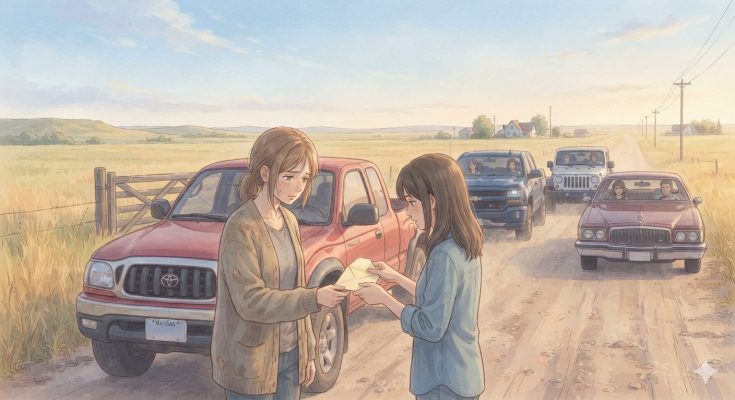
She reached for the paper, but I instinctively pulled it closer to my chest.
Not because I wanted to keep it from her.
Because Aunt Carol’s Buick had stopped three feet behind us, and both rear doors were already opening.
“Tell me the number,” June whispered.
I looked at the balance again.
“$3,217,408.61.”
June stared at me as if I had spoken in another language.
Then she laughed once.
It was not a happy laugh.
It was the sound people make when the truth is too large to fit inside their heads.
“Grandpa didn’t have three million dollars.”
“Apparently, he did.”
Mark slammed his truck door.
Dale came around the Jeep before the dust had even settled. Tommy and his wife climbed out behind him, while Aunt Carol marched toward us with one hand extended.
“What was in the envelope?”
June took the statement from me and folded it against her chest.
“Something Grandpa wanted me to read privately.”
Carol’s face tightened.
“We are standing on family property. Nothing involving this family is private.”
June looked past her toward the empty farmhouse.
For two years, she had entered that house carrying food, clean laundry, and medicine while the same people now surrounding her always had excuses for staying away.
“It’s funny,” June said quietly. “Nobody called it family property when the gutters needed cleaning.”
Dale stepped closer.
“Don’t start acting like you own the place.”
June glanced at the statement.
“I haven’t started acting like anything.”
Aunt Carol moved suddenly.
She grabbed the corner of the paper, but June held on.
For one ugly second, the two women stood tugging on Grandpa’s final instructions like children fighting over wrapping paper.
“Let go,” June said.
“I have a right to see it.”
“No, you have a dollar.”
Carol released the page as though it had burned her.
Her eyes changed.
The laughter from the attorney’s office disappeared, and something colder took its place.
“You think feeding an old man meatloaf makes you special?”
“No,” June answered. “I thought it made him less hungry.”
Nobody spoke after that.
I reached into the envelope and removed the remaining papers.
There was a letter, a small brass key taped to an index card, a copy of a recorded deed, and the business card Mr. Albright had mentioned.
Miriam Hayes.
Senior Vice President, Trust Services.
Kansas Prairie Bank, Salina.
On the back of the card, Grandpa had written four words:
CALL BEFORE ENTERING THE HOUSE.
I showed June.
She frowned. “Why would he write that?”
Dale tried to look over my shoulder.
“What else is in there?”
I unfolded the letter.
Grandpa’s handwriting shook across the page, but every word was readable.
June,
If you are reading this, then Carol has probably laughed, Dale has probably demanded an explanation, and Mark is pretending he does not care while standing close enough to hear every word.
Mark took two steps backward.
Tommy’s wife covered her mouth, trying not to smile.
I continued reading.
Do not be angry with them for following you. Money makes people curious. A large amount of money makes them forget their manners. The statement shows the balance of the Parker Agricultural Trust. Upon my death, you become its sole successor trustee and beneficiary.
Carol’s breath caught.
Dale muttered, “That’s impossible.”
June gripped my arm.
“Keep reading.”
The money came from the sale of the western acreage and the wind-energy agreement I signed eight years ago. I invested most of it. I told no one because I wanted to see who visited an old man when they believed there was nothing waiting at the end.
The silence around us became so complete that I could hear the metal cattle gate ticking in the afternoon heat.
Mark looked at the ground.
Tommy turned away.
I felt ashamed, too.
I remembered the Sundays I had chosen football over calling Grandpa.
I remembered the birthday card I had mailed three days late because I had forgotten until my mother reminded me.
June had not known about the money.
That was obvious from the way her knees seemed to weaken beneath her.
I kept reading.
Each grandchild received one dollar because each of you has already received something from me during my lifetime. The red ledger in the machine shed contains every loan, every check, and every debt I forgave. June asked for nothing. She gave me what none of you believed was valuable until today.
Time.
Aunt Carol snatched the letter from my hands.
“This is emotional nonsense.”
She scanned the next paragraph, and the color drained from her face.
Dale noticed.
“What does it say?”
Carol folded the letter quickly.
June reached for it.
Carol pulled it away.
“Your father wrote that for her,” I said. “Give it back.”
“My father was confused. He could barely remember what day it was.”
“He remembered Wednesdays,” June said.
Carol stared at her.
“He remembered because I came every Wednesday.”
“Or because you coached him to remember.”
June flinched as though Carol had slapped her.
I stepped between them.
“Give her the letter.”
Carol shoved it into my chest.
“Read the rest. Let everyone hear how cleverly she manipulated him.”
My hands were shaking now.
I found the place where I had stopped.
June, they will say I was confused. Enclosed are statements from two doctors confirming that I was competent when I signed the trust and deed. They will say you pressured me. Mr. Albright has recordings of four private meetings you did not know occurred. They will say this is unfair. When they do, show them the ledger.
The brass key opens the steel cabinet inside the machine shed.
Do not open the farmhouse until you speak with Miriam Hayes at the bank.
There is something else you need to know.
The next sentence had been heavily underlined.
Someone in this family has been taking money from me.
My eyes rose from the page.
Nobody moved.
Even Aunt Carol seemed to stop breathing.
June took the letter and read the sentence herself.
“Taking money how?” Mark asked.
Dale shoved both hands into his pockets.
“This is ridiculous. If someone stole from him, why didn’t he call the police?”
“Maybe he didn’t know who it was,” Tommy said.
The letter answered him.
I know who did it. I also know that person will try one last time after my death. Miriam has been instructed to wait, watch, and preserve everything.
June immediately pulled out her phone.
She dialed the number on Miriam Hayes’s card and put the call on speaker.
A woman answered on the second ring.
“Kansas Prairie Bank. Miriam Hayes speaking.”
“My name is June Parker.”
The woman went silent.
Then we heard papers moving.
“Ms. Parker, are you alone?”
June looked at the six relatives surrounding her.
“No.”
“Are you at your grandfather’s property?”
“At the cattle gate.”
“Do not enter the farmhouse.”
Dale scoffed. “Ask her why.”
Miriam heard him.
“Who is speaking?”
“Dale Parker. Walter Parker’s grandson.”
There was another pause.
“Mr. Parker, I need you to step away from Ms. Parker’s phone.”
He stared at the screen.
“What?”
“This call concerns an active fraud investigation.”
Aunt Carol folded her arms.
“Fraud committed by whom?”
“I cannot discuss that with you.”
Carol stepped toward June.
“You see? I told you something was wrong. Three million dollars doesn’t appear out of nowhere.”
“It didn’t,” I said. “He sold land.”
“And who convinced him to hide it?”
June’s face hardened.
“Stop.”
It was the first time she had raised her voice.
Everyone did stop.
June spoke into the phone.
“Ms. Hayes, my grandfather’s letter says someone was taking money from him.”
“That is correct.”
“Did you find out who?”
“We found seventeen unauthorized withdrawals made during the last fourteen months of his life. They totaled $286,000.”
Mark swore under his breath.
Tommy’s wife asked, “How could nobody notice that?”
“Most were disguised as payments for medical care, property repairs, and farm expenses,” Miriam explained. “Your grandfather noticed when he received an invoice for a new irrigation pump. The farm has not used that irrigation system since 2009.”
June glanced toward the machine shed.
“Did Grandpa report it?”
“He asked us not to stop the transfers immediately. He wanted to trace where the money was going.”
“And did you?”
“Yes.”
Aunt Carol’s fingers began tapping against her arm.
Dale would not look at anyone.
For the first time, I wondered whether Grandpa’s letter had predicted their reactions because he knew their personalities—or because he already knew which one of them had betrayed him.
June asked the question all of us were afraid to ask.
“Whose account received the money?”
Miriam hesitated.
“I cannot disclose that over speakerphone. I need you to come to the bank with Mr. Albright tomorrow morning.”
“Then why did Grandpa tell me to call before entering the house?”
“Because someone entered it at 8:12 this morning.”
June’s eyes moved toward the porch.
The front door appeared closed, but from where we stood, I could see something I had missed before.
A narrow black gap ran between the door and its frame.
It was not completely latched.
“Who entered?” I asked.
“Our security company received an alert from the private safe installed in your grandfather’s study. The person used the correct door code but entered the wrong safe combination three times.”
Dale turned toward his Jeep.
“I’ve heard enough.”
“Don’t leave,” June said.
He stopped.
It was not the order that stopped him.
It was the distant wail of sirens approaching along County Road 18.
Aunt Carol’s face twisted with fury.
“You called the police?”
“No,” June said.
“I did,” Miriam answered through the phone. “Your grandfather instructed me to dispatch them if anyone opened that door before Ms. Parker contacted me.”
Mark backed away from the farmhouse.
Tommy’s wife hurried to their truck.
Dale looked as though he might run, but a sheriff’s cruiser appeared at the end of the road before he could move.
June stared at the brass key taped to the index card.
“What is in the safe?”
“We don’t know,” Miriam said. “Your grandfather never told us. But we know what the intruder was searching for.”
“What?”
“The original trust documents.”
Carol pointed at June.
“Search her truck. She got here first.”
“We arrived less than ten minutes ago,” I said.
“That doesn’t mean she wasn’t here earlier.”
June looked wounded, but not surprised.
She had spent her whole life being the easiest person in the family to blame.
The sheriff’s cruiser stopped beside us.
Deputy Harris stepped out, followed by a second officer. I had known Harris since high school. His expression told me this was not a friendly visit.
“Nobody leaves,” he announced.
He asked for our names, photographed the vehicles, and sent the second officer toward the house.
Then he looked at June.
“Ma’am, would you open the back of your truck?”
Aunt Carol smiled.
June handed him her keys.
The tailgate came down.
There was nothing inside except the blue cooler, a bag of groceries, jumper cables, and a cardboard box filled with Grandpa’s old clothes.
Deputy Harris lifted the cooler lid.
Three empty Cool Whip tubs sat inside it.
Each one had a strip of masking tape across the top.
WEDNESDAY—MEATLOAF.
WEDNESDAY—POTATO SOUP.
WEDNESDAY—CHICKEN AND RICE.
Grandpa had washed and saved every container she brought him.
June covered her mouth.
“He kept them?”
Before anyone could answer, the second officer shouted from the porch.
“Harris, you need to see this.”
We all turned.
The officer was holding a torn piece of blue fabric.
June looked down at her work shirt.
The same blue fabric.
The sleeve near her elbow was ripped.
Aunt Carol pointed at it triumphantly.
“There! She broke into the house!”
June stared at the tear.
“I caught it on Grandpa’s fence last Wednesday.”
Deputy Harris took the fabric and placed it in an evidence bag.
Then June’s phone rang.
Miriam Hayes was calling back.
June answered, but this time she did not use the speaker.
She listened for several seconds.
Her face slowly went white.
“What do you mean, another account?”
She looked at me.
Not at Carol.
Not at Dale.
At me.
June lowered the phone.
“What did she say?” I asked.
Her lips trembled.
“The stolen money wasn’t sent to Carol, Dale, or Mark.”
“Then who received it?”
June’s eyes filled with tears.
“The bank traced every transfer to an account opened fourteen months ago.”
She turned the screen toward me.
There, beneath seventeen deposits totaling $286,000, was the name of the account holder.
My name.
Rachel Elaine Mercer.
Before I could speak, Deputy Harris reached for his handcuffs.
And from inside Grandpa’s farmhouse, the other officer shouted, “We found the missing trust—and Rachel’s fingerprints are all over it.”…
PART3: My grandfather left $1 to each grandchild except June, the cousin who drove 29 miles every Wednesday to shave him and bring meatloaf in a Cool Whip tub.
PART 3: THE VOICE IN THE MACHINE SHED
I stared at Deputy Harris’s handcuffs.
For a second, nobody moved.
Then June stepped directly between us.
“You are not arresting her.”
Harris kept his voice calm.
“June, step aside.”
“No.”
“Those documents were found inside a locked house, and the bank says nearly three hundred thousand dollars was transferred into an account bearing Rachel’s name.”
“I don’t care what the bank says. Rachel didn’t steal from Grandpa.”
Aunt Carol gave a bitter laugh.
“You’ve defended her for thirty seconds, but you have known me your entire life.”
June turned toward her.
“That is exactly why I’m defending her.”
Carol’s mouth fell open.
Deputy Harris reached for my wrist.
I raised both hands.
“Wait. How could your officer possibly recognize my fingerprints just by looking at them?”
Harris glanced toward the porch.
“He didn’t. The fingerprints on the trust are in purple ink. They were deliberately pressed beside your printed name on every page.”
My stomach dropped.
“Someone put my name on Grandpa’s trust?”
“Not the original trust,” the second officer said as he came down the steps carrying a clear evidence bag. “This appears to be a replacement document dated fourteen months ago.”
That was the same month the first stolen payment entered the account with my name on it.
Aunt Carol stared at me.
“What did Walter promise you?”
“Nothing.”
“Then why is your name on those papers?”
“I have never seen them before.”
Dale pointed at the evidence bag.
“Her fingerprints are right there.”
“They aren’t my fingerprints.”
Harris looked at me carefully.
“Are you willing to provide a comparison?”
“Right now.”
I held out my hands.
Carol shook her head.
“Of course she is. She probably wore gloves when she forged them.”
“Then they wouldn’t be her fingerprints,” June said.
Carol ignored her.
Deputy Harris had me press each finger onto a small scanning device from his cruiser. He sent the results to the county office, but told us a proper comparison could take hours.
While we waited, Miriam called June again.
This time, June placed the phone on speaker without asking anyone.
“Ms. Parker,” Miriam said, “I have reviewed the complete account-opening file.”
June glanced at me.
“What did you find?”
“The account was opened using Rachel Elaine Mercer’s driver’s license, Social Security number, and birth certificate.”
I stopped breathing.
My birth certificate had been kept in a yellow envelope inside my bedroom desk for years.
“That is impossible.”
“Ms. Mercer, when did you last see those documents?”
“My birth certificate is at home. My driver’s license is in my wallet.”
“And your Social Security card?”
I opened my wallet.
The slot behind my insurance card was empty.
Then I remembered.
Fourteen months earlier, the family had gathered at Grandpa’s farm for Memorial Day.
I had recently started a new job and brought my Social Security card because I needed to complete employment paperwork the next morning.
During lunch, my purse disappeared.
We searched the kitchen, the porch, and the trucks.
Forty minutes later, Aunt Carol walked out of Grandpa’s pantry holding it by the strap.
“You left it beside the canned peaches,” she had said.
I had thanked her.
I had never checked whether every card was still there.
I slowly looked at Carol.
Her arms remained folded, but the tapping of her fingers had stopped.
“You found my purse at the Memorial Day picnic.”
“So?”
“My Social Security card was inside it.”
“Are you accusing me?”
“I am asking if anyone else touched it.”
Carol stepped closer.
“You should be very careful what you say next.”
June placed herself between us again.
“That sounded like a threat.”
“It was advice.”
Miriam’s voice came through the phone.
“Ms. Mercer, the bank retained a photocopy of the identification used to open the account. Your driver’s license photograph and information appear on it, but there is something unusual.”
“What?”
“The license number is correct, but the expiration date was altered.”
“Why would anyone change it?”
“Because your real license expired two months before the account was opened. Whoever created the copy updated the date so the clerk would accept it.”
Deputy Harris took out a notebook.
“Was the account opened in person?”
“Yes. Unfortunately, the regular branch manager was away. A temporary employee handled the application.”
“Do you have security footage?”
“We are searching the archives now.”
Aunt Carol walked toward her Buick.
Harris blocked her path.
“Nobody leaves.”
“I need my heart medication.”
“Tell me where it is. My officer will retrieve it.”
For the first time, Carol looked frightened.
Not angry.
Frightened.
Dale noticed it, too.
“Mom,” he said slowly, “what did you do?”
Carol spun toward him.
“Nothing. Do not turn on me because some bank woman found a photocopy.”
June picked up the brass key.
“The letter says the red ledger is in the machine shed.”
Deputy Harris looked at the old building across the pasture.
“We will go together.”
The seven of us followed him through the cattle gate.
June walked beside me.
She did not say anything until we were far enough ahead that the others could not hear.
“Did you take the money?”
Her question hurt more than I expected.
“No.”
“Did Grandpa ever ask to use your name on an account?”
“No.”
“Did you ever sign anything for him?”
“No.”
June watched my face.
I could see the battle happening behind her eyes.
Three million dollars had appeared in her life less than an hour ago, and already every person she knew had become a possible enemy.
“If you don’t believe me,” I whispered, “I understand.”
June looked back at the relatives following us.
Then she looked at my empty hands.
“You sat beside me when everyone else acted like I was dirt.”
“That doesn’t prove anything.”
“No,” she said. “But you tried to stop me from opening the envelope because you saw them coming. If you already knew what was inside, you would have wanted me to open it immediately.”
I felt tears sting my eyes.
“So you believe me?”
“I believe someone wants us to stop believing each other.”
We reached the machine shed.
The padlock was rusty, but June’s brass key slid into it perfectly.
Inside, the air smelled of motor oil, dry soil, and mouse droppings. Grandpa’s workbench stood along the back wall beneath a row of coffee cans filled with nails.
Deputy Harris switched on his flashlight.
“Where is the steel cabinet?”
June pointed toward a faded green cabinet behind the tractor tires.
The key opened that lock, too.
Inside sat a thick red ledger, three sealed envelopes, a digital voice recorder, and a handwritten note taped to the shelf.
Harris read the note aloud.
DEPUTY HARRIS,
IF YOU ARE READING THIS, THE PERSON STEALING FROM ME HAS MADE A MISTAKE.
DO NOT ARREST RACHEL MERCER.
SHE DID NOT TAKE MY MONEY.
Everyone turned toward me.
My legs nearly gave out.
June grabbed my hand.
“I told you.”
Harris removed his hand from his cuffs.
Aunt Carol pushed forward.
“That note proves nothing. Rachel could have written it.”
Deputy Harris held the note beside Grandpa’s letter.
“The handwriting appears identical.”
“Appears,” Carol repeated. “That is not proof.”
Harris opened the red ledger.
Every page contained Grandpa’s careful handwriting.
Dates.
Names.
Amounts.
Reasons.
Mark had received $91,800 after his bait shop failed.
Dale had received $73,400 for legal fees and unpaid taxes.
Tommy had received $55,000 toward his house.
Aunt Carol had received $186,000 across twelve years, most of it marked NEVER REPAID.
Then Harris reached my name.
Rachel Mercer—$24,000 for college.
Beside it, Grandpa had written:
SHE TRIED TO PAY ME BACK. I REFUSED.
My face burned.
I had forgotten how much he had helped me.
The next page contained only one name.
June Marie Parker.
Underneath it, Grandpa had recorded every Wednesday she visited him.
One hundred and four trips.
Six hundred and twelve hours.
Two hundred and nine meals.
Thirty-eight medical appointments.
Beside the total, he had written:
SHE NEVER ASKED WHAT SHE WOULD GET.
SHE ONLY ASKED WHAT I NEEDED.
June pressed her fingers to her lips.
Mark stared at the floor.
Tommy’s wife began to cry.
Even Dale seemed unable to look at June.
Carol remained unmoved.
“Sentimental bookkeeping does not explain the account in Rachel’s name.”
Harris turned to the final ledger page.
Written in red ink were three sentences.
THE ACCOUNT IS BAIT.
THE MONEY HAS NEVER LEFT MY CONTROL.
THE THIEF BELIEVES RACHEL WILL TAKE THE BLAME.
PLAY THE RECORDER WITH THE POLICE PRESENT.
Harris lifted the small digital recorder.
A strip of masking tape covered the back.
On it, Grandpa had written:
RECORDED THREE WEEKS BEFORE MY DEATH.
Deputy Harris pressed PLAY.
For several seconds, we heard only static.
Then Grandpa’s voice filled the shed.
He sounded weak but completely alert.
“I know about the invoices.”
A woman’s voice answered.
“You are confused again.”
Carol’s head snapped toward the recorder.
The voice was muffled, but it was familiar.
Grandpa coughed.
“I know where the money went.”
“You signed the payments.”
“I signed blank checks because I trusted you.”
“You should have left everything alone.”
There was a scraping sound, as though a chair had moved.
Then a man’s voice spoke.
“Arguing will not help us. Walter, sign the replacement trust, and this problem disappears.”
I looked at June.
The color had vanished from her face.
Grandpa answered, “You put Rachel’s name on that account.”
“Rachel is useful,” the man said. “She is close enough to June to gain her trust and distant enough from the rest of the family that everyone will believe she stole from you.”
June tightened her grip on my hand.
The woman on the recording whispered, “What happens when June receives the envelope?”
“She will lead us to the ledger,” the man replied. “Then we destroy it, report Rachel, and challenge June’s inheritance. By the time the court learns the truth, the three million dollars will belong to us.”
Mark stepped toward Carol.
“Mom, that sounds like you.”
“It is not me.”
“Then why are you shaking?”
“I am not.”
But she was.
The recording continued.
Grandpa spoke one final time.
“You have forgotten one thing.”
“What is that?” the man asked.
“Old men are easy to ignore. That makes it easy for us to listen.”
A door slammed on the recording.
Then we heard Grandpa breathing heavily.
Before the file ended, he whispered into the hidden recorder.
“June, if you hear this, trust Rachel. And do not trust the man who read my will.”
Every person in the shed froze.
I pictured the dusty plastic fern.
The brown carpet.
The cream envelope.
The lawyer who had told us Grandpa’s final wishes with a perfectly calm face.
June whispered the name first.
“Mr. Albright.”
At that exact moment, her phone rang.
The screen displayed:
MR. ALBRIGHT—ATTORNEY.
June slowly answered.
“Hello?”
His voice was pleasant.
Too pleasant.
“June, I understand you reached the farm.”
Nobody made a sound.
Mr. Albright continued.
“Whatever you found inside that machine shed, do not let Rachel or the police hear it.”
June stared at Deputy Harris.
“Why?”
There was a long silence.
Then Mr. Albright’s voice dropped to a whisper.
“Because your grandfather is not the only person in this family who is about to die.”
And somewhere directly behind the steel cabinet, we heard the unmistakable click of a gun being loaded….
Leave a Reply