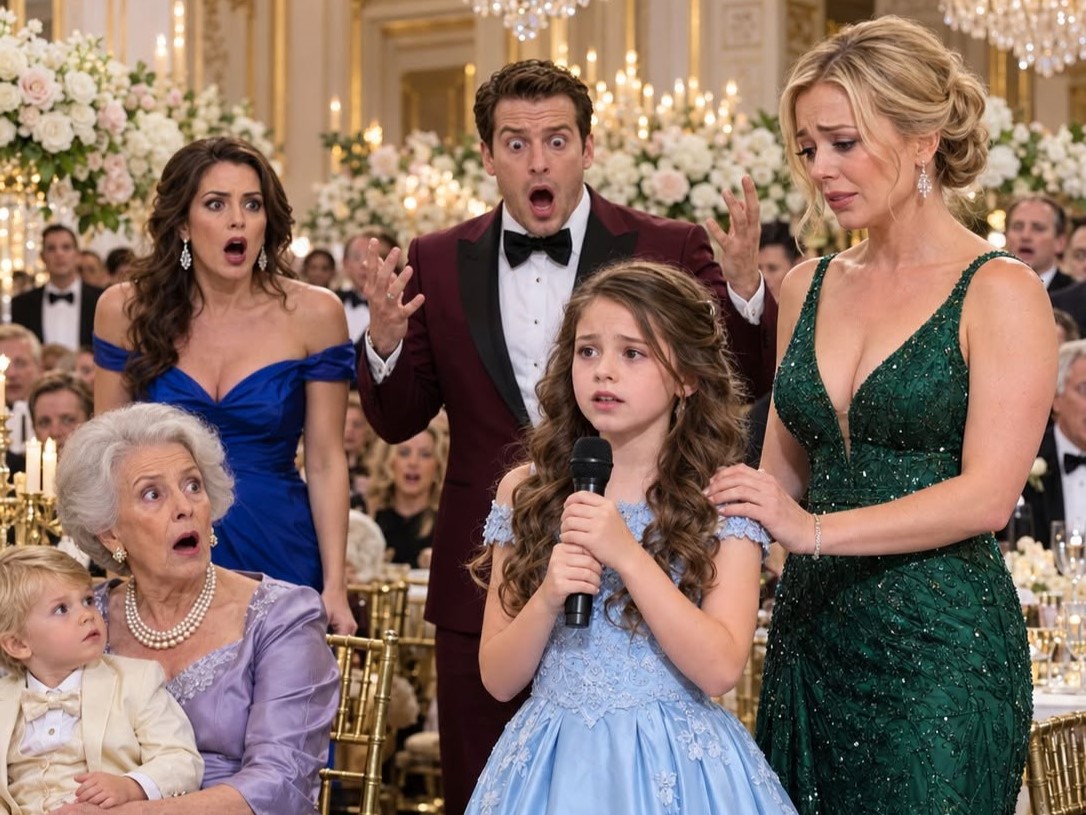
Before I could say a word, my 10-year-old daughter stepped forward, took the microphone, and pulled out a USB drive. Within seconds, my husband realized that the trap he had planned for me was about to destroy him instead.
“Today you are going to stop being my wife, and I want everyone here to be a witness.”
Mark Callahan declared those words at his mother’s seventy-fifth birthday party, right in front of more than a hundred guests gathered at an exclusive country club in Greenwich, Connecticut.
I was standing right beside his mother, Margaret, adjusting the soft cardigan over her shoulders while the catering staff poured champagne. Mark had been missing for almost an hour. I already knew why.
Three days ago, I had found a second, burner phone hidden in the back drawer of his study desk.
There were photos, messages, bank transfer records, and a video of a three-year-old boy running toward him, squealing:
“Daddy!”
Ten years of marriage reduced to a few inches of glass.
Even so, I had said nothing at the time. I wanted to consult a top divorce attorney first and, above all, protect our ten-year-old daughter, Emma. Emma had been born with severe respiratory issues and had spent most of her early years in specialty clinics rather than on playing fields. To Mark and his mother, that had always been viewed as a flaw.
Margaret routinely remarked that the Callahan family needed “strong sons.”
Then the heavy double doors of the ballroom swung open.
Mark walked in accompanied by a young woman in a sharp red dress named Vanessa. Walking between them was the three-year-old boy from the video.
The entire room went dead silent.
“Mom,” Mark said, a triumphant smile on his face. “I brought you the gift you’ve always wanted.”
He placed his hand firmly on the little boy’s shoulder.
“This is Oliver. My son.”
Margaret went pale. I waited for her outrage. I waited for her to remember that I had been called her “daughter” for a decade, that I had accompanied her to every medical appointment, organized every holiday gala, protected the family’s public image, and swallowed her cold remarks without complaint.
Instead, she opened her arms.
“My grandson… my precious boy.”
She looked at Oliver with a warmth she had never once shown Emma.
Mark turned to face me.
“Claire, there’s no point in pretending anymore. Vanessa and I are going to be together. You couldn’t give me another child, and my mother deserves a proper grandson to carry on the family name. Be reasonable. Sign the divorce papers, pack your things, and don’t make a mess over the house or the company stock.”
I felt dozens of eyes locking onto me.
An aunt whispered that “a man like Mark needed an heir.” A cousin murmured that I should just accept reality with dignity.
I opened my mouth to respond.
Before I could speak, Emma stood up.
She walked straight up to the stage, picked up the microphone from the podium, and looked directly at Vanessa.
“I want to thank you for taking my dad off our hands,” Emma said, her voice echoing clearly over the sound system. “As of today, you’re officially responsible for this walking corpse.”
Gasps erupted, followed by nervous chuckles and a furious “Emma!” from Mark.
My daughter didn’t lower the microphone. She reached into her blazer pocket and pulled out a small black USB flash drive.
“And my mom isn’t walking away empty-handed,” Emma added. “Because I copied everything off my dad’s secret phone.”
For the first time that night, Mark’s smug smile completely vanished.
And then Emma said there was something on that drive that even I didn’t know about.
Part 2
Mark lunged toward the stage, but I stepped squarely between him and Emma.
“Control your daughter!” Mark spat, his jaw tight.
“When she wins academic awards, she’s ‘your daughter,’” I said, keeping my voice dead level. “When she embarrasses you, she’s ‘my daughter.’ I’m not shutting her up to save you tonight.”
Emma was shaking, though she tried her best to hide it.
“Dad said Mom doesn’t have a right to anything,” Emma continued into the microphone. “But Grandpa left company shares in Mom’s name. And there are emails here showing Dad trying to trick her into signing them over.”
The quiet murmurs turned into an uproar.
My late father-in-law, who had passed away four years ago, had willed me a minority stake in Callahan Global because I had spent a decade managing public relations, client crisis control, and corporate partnerships that Mark didn’t even understand. Mark had hated my independent shareholding from day one.
“Cut her mic!” Mark barked to the AV booth.
The technician hesitated.
Just then, my father walked briskly into the hall, leaning on his cane, having just arrived from out of state with my mother.
“Leave the microphone on,” my father commanded.
Mark froze.
Emma looked over at me, her young voice cracking. “Mom… you’re always standing alone.”
That sentence cut deeper than Mark’s betrayal ever could.
I gently took the microphone from her hand. “Not tonight, sweetie.”
I turned to face Mark. “You want a divorce? You’ll get one. But I’m not moving out of our home, I’m not surrendering my shares, and I will not let you use Emma as collateral damage.”
Vanessa stepped forward. “Mark told me you two had been separated for years!”
“And that’s why you came to his mother’s birthday party to watch me get thrown out in public?” I replied.
She had no answer.
Margaret tried to intervene. “Vanessa, don’t destroy this family over a mistake!”
“Oliver is three years old, Margaret,” I said cleanly. “This wasn’t a one-night mistake.”
My mother-in-law fell silent.
Mark took a step closer to me and whispered, “You’re going to regret this.”
I smiled softly. “The microphone is still on, Mark.”
A few guests let out sharp laughs. He backed away, his face turning beet red.
I took Emma’s hand, and we walked out with my parents. In the backseat of the car, Emma began to tremble, finally bursting into tears.
“I didn’t want them to kick you out,” she sobbed. “I’ve heard Grandma say so many times that I wasn’t enough for the Callahan name.”
I pulled her into a hug so tight my arms ached.
“Did Dad go look for another kid because I came out defective?” she asked softly.
My heart shattered inside my chest. I cupped her face and made her promise to listen: no child is ever responsible for the void inside an adult, and she would never have to earn her right to be loved.
The next morning, two forensic family attorneys reviewed the contents of the USB drive.
There were clear records of the affair, wire transfers to Vanessa, unauthorized corporate fund shifts, and text threads where Mark explicitly planned to humiliate me publicly to pressure me into signing over my shares.
But one file stood out.
It was an audio recording of Mark talking to his mother a few weeks prior to the party.
Hearing Margaret’s voice on the recording made my hands go cold:
“If Claire won’t sign over those shares willingly, use the girl. After a public scene, no one on the board will take her side.”
And my husband’s response was even worse:
“We make her look unstable. If she loses her temper in front of the entire family, it’ll be easy to claim she’s unfit to hold board votes or retain custody.”
Part 3
The room was silent for a long moment after the recording stopped.
I had endured neglect, cold comments, and infidelity, but this was different. This wasn’t just a man wanting to leave for another woman. He had deliberately constructed my humiliation as legal leverage against me.
My mother set her tea down with a sharp click. “That’s why they chose a party packed with guests.”
Our attorney nodded grimly. He didn’t promise instant miracles; he explained that a high-net-worth divorce would be lengthy, every financial record would be audited, and custody would focus on Emma’s best interests. But for the first time, I felt zero fear.
I felt absolute, crystalline clarity.
Mark called twenty times that day. Then came the texts:
This has gotten out of hand.
My mother’s blood pressure is spiking.
Vanessa is hysterical.
Emma had no right to act like that.
We can settle this without lawyers.
And finally:
If you keep pushing this, you’re going to destroy this family.
My mother read the last text and let out a dry laugh. “Isn’t that funny? The family is always ‘destroyed’ the second the woman stops sweeping up the broken glass.”
Three days later, Mark showed up at my parents’ house. My father met him at the front gate.
“I want to see Emma,” Mark demanded.
“Emma doesn’t want to see you,” my father replied calmly.
“She’s ten years old! She doesn’t know what she wants!”
My father looked at him steadily. “After your mother’s party, she seems to have a far better grasp on reality than most adults.”
I walked out to the porch. When Mark started ranting that I “hadn’t left him a choice,” I stepped down the walk.
“What choice did I take from you, Mark? You could have asked for a divorce. You could have told me the truth. You could have protected Emma. You didn’t have to use a three-year-old boy as a trophy to humiliate me. You chose that route because you thought it would break me into giving up my shares.”
He pointed back toward his car. “Vanessa isn’t to blame for this!”
I looked at him. “She’s the very first person you’ve stood up to defend all week.”
He had no response.
I told him all future communication regarding Emma would go through our attorneys while Emma began therapy. Mark stormed off, but he no longer had a room full of socialites backing his narrative.
The following months were grueling.
His legal team tried to paint me as an embittered, vindictive spouse who had manipulated our daughter. They claimed I had never held a real corporate position, lived off the Callahan name, and that my shares should be placed in a family trust.
The phrase “never held a real job” burned, but I channeled it into proof. For ten years, I had organized investor summits, managed corporate crisis control, taken care of Margaret through two surgeries, managed a home, and shielded Mark’s public reputation more times than I could count.
My mother reminded me: “In court, only what we can prove matters. In your new life, what you refuse to give away for free matters.”
Emma began seeing a child psychologist named Dr. Rachel Thompson. At first, she barely spoke. She drew a picture of a house with two separate front doors: me standing at one, Mark at the other, and her standing in the middle yard.
Seeing that drawing brought me to my knees. I was fighting for property and corporate shares; my daughter was fighting not to be pulled apart.
One evening, I sat beside her on her bed. “Emma, you don’t have to hate your dad to prove you love me.”
“Right now I do hate him,” she mumbled.
“It’s okay to feel that way.”
“What if one day I don’t?”
“That’ll be okay, too.”
She looked up, surprised. “You won’t be mad at me?”
“No, sweetie. What he did to me as a husband is one thing. What you feel as his daughter is yours to navigate. I will never use your pain as a weapon in my war.”
She stayed quiet, then softly recalled how Mark had taught her to ride a bike when she was six. “How can someone do nice things and then do something terrible?”
“Because people aren’t just one thing, Emma. And sometimes that’s harder to accept than thinking someone is entirely bad.”
Months later, Emma agreed to a court-monitored visitation. Mark arrived carrying expensive handheld gaming systems. Emma didn’t even unwrap them.
“Hey, kiddo,” Mark said softly.
“Do you want to know how I’m actually doing, or do you just want an answer you can show your lawyer?” Emma asked directly.
Behind the glass observation window, my throat tightened.
The counselor encouraged Mark to just listen.
Emma looked at her father. “Why did you bring Oliver to Grandma’s party?”
“I wanted the family to meet him,” Mark mumbled.
“No. You wanted everyone to see that he was the ‘better’ grandchild.”
Mark shook his head, but Emma didn’t back down. “Grandma looked at him like he was finally the right kid. I don’t hate Oliver. He didn’t do anything wrong. But you did. If you cared about me, you wouldn’t have used me to hurt Mom.”
Mark lowered his head. “I’m sorry, Emma.”
Emma watched him for several seconds. “Are you sorry because you did it, or because everyone saw you do it?”
Mark’s silence was answer enough.
Emma requested to end the session early. In the car on the way home, she told me she wasn’t ready to forgive her father.
“You don’t have to be,” I told her. “Just don’t let that hurt turn you into someone cruel.”
The divorce took nearly a year.
After forensic audits, depositions, and negotiations, I retained my corporate shares, my independent assets, and primary physical custody of Emma, with Mark granted structured visitation accompanied by family counseling.
It wasn’t a grand act of revenge. It was simply room to breathe.
The day we signed the final decree, Mark waited for me in the courthouse hallway. He looked thinner, worn down.
“Vanessa left,” he said flatly.
I didn’t reply.
Leave a Reply