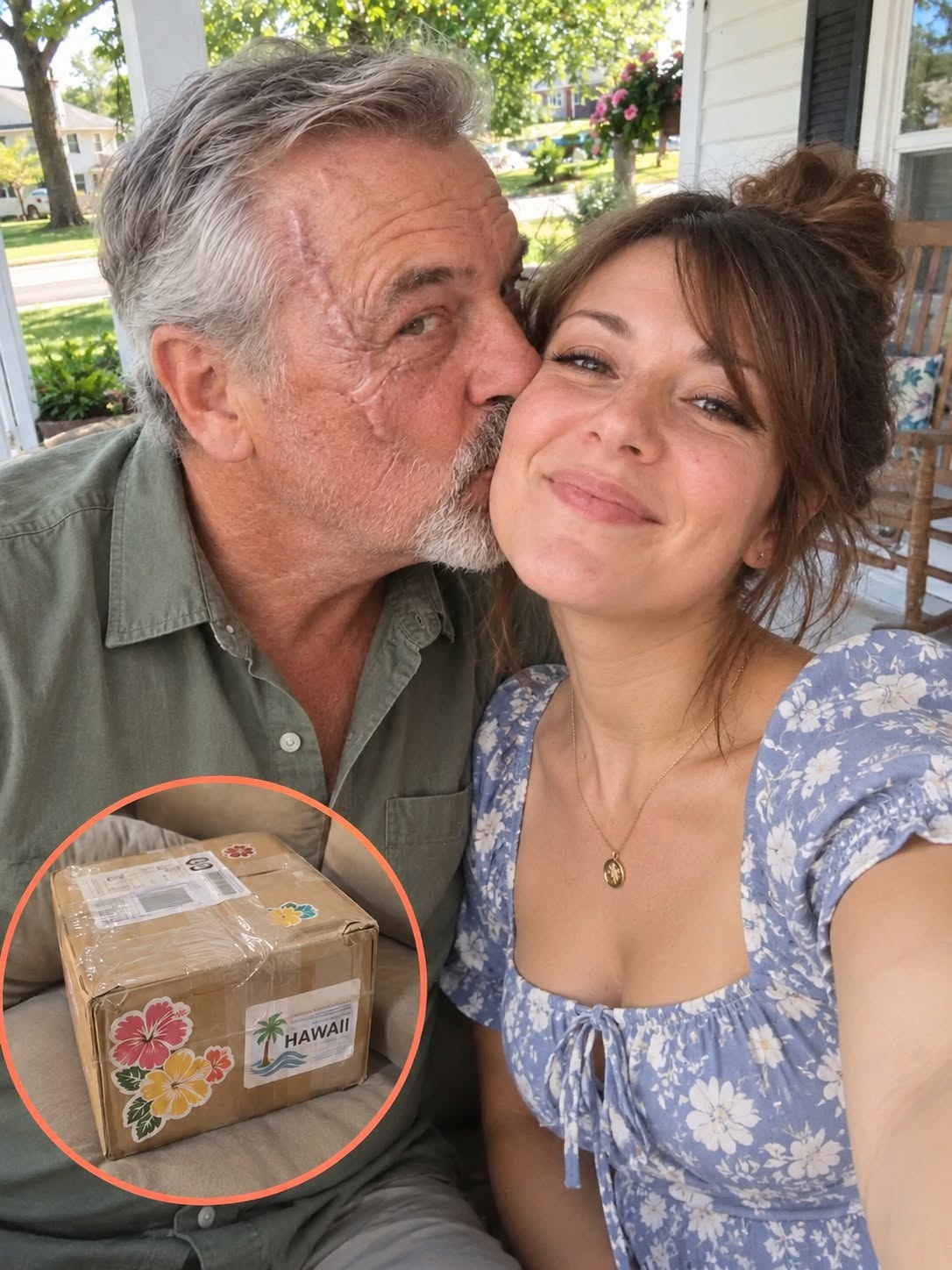
I was always Daddy’s girl. I could tell him any secret.
But he never told me his.
Sometimes I’d find him at the kitchen table, turning a faded photograph of a beach over in his hands.
“What’s it like there?” I asked once.
“The rain is warm,” he said. “You can smell the ocean before you see it.”
Dad was born in Hawaii. He left at twenty, moved to Oregon, and met my mother. He missed home terribly, but Hawaii eventually became a word we didn’t say at the dinner table.
Whenever Dad brought it up, Mom got upset. She couldn’t stand hearing how much he missed it, as though his longing meant he wasn’t happy with us.
I never understood why she took it so personally.
Dad would only say, “Try to understand your mother, Chloe. If you knew the whole story, you wouldn’t be angry with her.”
I wish I had asked what he meant.
Two weeks ago, Dad was in a car accident.
He never made it home.
We were still trying to grasp that he was gone when the mail carrier brought a huge box to our door.
It was addressed to Dad. The Honolulu postmark was dated three days before the accident.
There was no return address.
I carried it into the kitchen. I wanted to find out who had sent it so I could tell them what had happened.
Mom took one look at the box and went deathly pale.
“Leave it, Chloe.”
“Mom?”
“Please.” Her fingers closed around my wrist. “Throw it away. Let’s pretend it never came.”
I pulled free.
I couldn’t bear to throw away something that had been meant for Dad. And somewhere in Hawaii, someone might be waiting for an answer he could no longer give.
So I peeled back the tape.
The moment I saw what was inside, I covered my mouth with my hand.
“Oh God,” I whispered, staring into the box, “what are we supposed to do with this?”
Inside the box, cushioned between thick layers of bubble wrap, was an ornate wooden urn carved with intricate Hawaiian ocean waves and hibiscus flowers. Beside it lay a sealed manila envelope and a carved koa wood box wrapped in a hand-woven lei.
My hands shook as I reached in and pulled out the letter from inside the envelope.
The letterhead belonged to a probate law firm in Honolulu.
I read the opening lines aloud, my voice breaking:
“Dear Mr. James Miller,
We are writing to inform you of the passing of your elder brother, Keanu Miller, who passed away peacefully at his home in Oahu on the 12th of this month. Per his last wishes and testament, his earthly remains are being delivered to you, along with the title deed to the Miller family estate in Waimea Bay and the original family trust documents…”
I stopped reading. I looked up at my mother.
“Dad had a brother?” I whispered. “He told me he was an only child. He told me his entire family died before he moved to Oregon!”
Mom sat down heavily in a kitchen chair, burying her face in her hands. The quiet, dignified strength she had maintained since Dad’s accident shattered completely.
“He lied to protect you, Chloe,” Mom sobbed. “He lied to protect all of us.”
“Protect us from what?!” I demanded, holding the letter. “Mom, there is an urn sitting on our kitchen counter containing my uncle’s ashes! Why did Dad leave Hawaii at twenty and never go back? Why did you get angry every time he mentioned it?”
Mom wiped her eyes, her hand trembling as she reached into the box and lifted the lid of the smaller koa wood container. Inside were decades of un-opened letters, all stamped from Honolulu, all addressed to James, and all returned or marked Unread.
“Your father didn’t leave Hawaii because he wanted to start a new life, Chloe,” Mom whispered, her eyes dark with painful memories. “He was forced out.”
PART 2
Mom took a slow, shuddering breath and touched the smooth wood of the urn.
“When your father was nineteen,” Mom began, “he and his brother Keanu were co-owners of a generational stretch of coastal land in Waimea Bay that had belonged to their family for over a century. A powerful commercial development group wanted that land to build a luxury resort. They offered millions, but your father refused to sell.”
“And Keanu?” I asked, setting the letter on the table.
“Keanu was young, reckless, and deep in debt,” Mom said softly. “The developers targeted Keanu. They paid off his debts, fed his vices, and convinced him that James was holding him back from real wealth. One night, a fire destroyed the resort construction equipment nearby. The developers bribed local authorities and blamed your father, threatening him with twenty years in prison for arson—unless he signed over his half of the land and left the island forever.”
I gasped. “Keanu set the fire?”
“Keanu didn’t set it, but he stood by and let them frame your father,” Mom revealed, tears spilling down her cheeks. “Keanu chose the money over his own brother. Your father was given twenty-four hours to pack a single bag and leave Hawaii, under threat of immediate arrest if he ever returned or tried to claim his heritage.”
The weight of Dad’s entire life suddenly clicked into place like missing puzzle pieces.
The quiet sadness in his eyes whenever he looked at that faded beach photograph. The longing in his voice when he talked about the warm rain. The reason he never took us on family vacations to the islands. He hadn’t abandoned his home—he had been banished from it by the people he trusted most.
“When I met your father in Oregon,” Mom continued, “he was broke, traumatized, and completely alone. He built a new life with me, but his heart remained broken. Every year, Keanu tried to send him letters, money, and land deeds—trying to buy forgiveness for what he had done. But every time a letter arrived, it reopened your father’s deepest wound.”
“That’s why you got upset when he talked about Hawaii,” I realized, the anger I had held toward my mother dissolving into deep empathy. “You weren’t mad at him for missing it. You were hurting because you knew how much he had suffered.”
“I hated what that place did to him,” Mom whispered, resting her hand over mine. “He carried that exile on his shoulders every single day of his life, Chloe. He never told you because he wanted your memories of him to be about love, not bitterness.”
I looked down at the letter again. Beneath the legal jargon at the bottom of the second page was a handwritten note from my uncle Keanu, penned just days before he died:
‘James, I sold my soul for land that brought me no peace. I spent forty years rich in money and bankrupt in spirit. The developers are gone, the land is restored to our family name, and I am leaving everything back to you and your children. Please… come home. Lay me to rest where the waves meet the sand, and forgive a foolish brother who lost his way.’
I wiped a tear from my cheek and looked at my mother.
“Dad never got to go home,” I said quietly. “He spent twenty years in Hawaii and forty years in exile, carrying a love for his home that never faded. We can’t leave Uncle Keanu in a box on a kitchen table, Mom. And we can’t leave Dad’s story unfinished.”
Mom looked at me, her eyes reflecting the same fierce determination that Dad had always possessed. “What are you saying, Chloe?”
“We are going to Hawaii,” I said softly. “We are going to take them both back.”
Two weeks later, the warm, tropical ocean breeze swept across my face as I stepped off the plane in Honolulu.
Just as Dad had said, the air smelled of salt, plumeria, and damp earth. The rain was soft, warm, and gentle against my skin.
Mom and I drove north to Waimea Bay, where the green mountains met the turquoise waters of the Pacific. We pulled up to a breathtaking stretch of undeveloped coastal land—pristine, peaceful, and untouched by resort concrete.
We walked down to the water’s edge, where the golden sand met the rolling tide.
Together, Mom and I carried two urns: my uncle Keanu’s, and the small wooden box containing my father’s remains, which we had brought with us from Oregon.
We stood knee-deep in the warm, clear water as the sun began to set, painting the sky in brilliant shades of amber, violet, and gold.
“You’re home now, James,” Mom whispered into the wind, her voice filled with a peace she hadn’t known in decades. “You can finally rest.”
We gently scattered their ashes into the outgoing tide, watching the white dust catch the sunlight before dissolving into the vast, endless Pacific Ocean. For the first time in forty years, the two brothers were reconciled, reunited with the land that had raised them.
I stood on the shore, watching the gentle waves lap against my feet, feeling a warmth settle deep in my chest.
My father’s exile was finally over. He had brought us love, he had taught me strength, and now, at long last, he was home.
EPILOGUE
Six months after the tide carried my father and uncle home, the morning sun rose over Waimea Bay, turning the rolling Pacific waves into liquid gold.
I stood on the wide wooden porch of the newly restored Miller homestead, a mug of hot Kona coffee warming my hands. The scent of sweet frangipani and salt spray filled the morning air, carried by the soft, warm trade winds Dad had described to me so many years ago.
From inside the house, the quiet hum of life drifted through the open screen doors. Mom was in the kitchen, humming a soft tune as she sliced fresh papaya and pineapple. She had decided to stay on the island for the winter, finding a profound sense of healing in the very place she had feared for decades. Without the shadow of Dad’s pain looming over her, she had finally fallen in love with his home.
Down near the water’s edge, a small wooden plaque was mounted on a smooth basalt rock beneath the shade of an ancient ironwood tree. It read:
THE MILLER FAMILY LAND Restored in Memory of James & Keanu Miller “The rain is warm, and the ocean leads us home.”
Rather than letting the vast coastal property sit idle or selling it off to developers, Mom and I had worked with local community leaders to convert the acreage into a protected cultural land trust. The beach remained open to local families, the native flora was being carefully restored, and the story of resilience that had defined my father’s life was now woven into the history of the bay.
My phone buzzed in my pocket. I pulled it out to see a notification from my attorney in Oregon—the final tax transfers and land trust documents had officially cleared. Everything Dad had been forced to give up at twenty was now permanently protected for future generations.
I walked down the porch steps, the cool, soft sand giving way beneath my bare feet as I made my way to the shoreline. The warm tide surged gently over my ankles, receding with a soft, rhythmic hiss.
I looked out toward the endless blue horizon where the sky met the sea.
For years, I had thought my father was a man who lived with a quiet, hollow regret. But standing here on the shores of his youth, listening to the roar of the ocean he had cherished, I finally understood the truth. He hadn’t lived his life in defeat; he had lived it with immense grace. He had sacrificed his home to protect his honor, built a beautiful family in Oregon, and passed down a love so fierce that it had eventually brought us all back to where we belonged.
I lifted my mug toward the horizon, letting a soft smile touch my lips.
“We did it, Dad,” I whispered into the morning breeze. “You’re home.”
And as a sudden, gentle sun-shower began to fall from the clear blue sky—warm, light, and sweet against my skin—I knew he was listening.
Leave a Reply