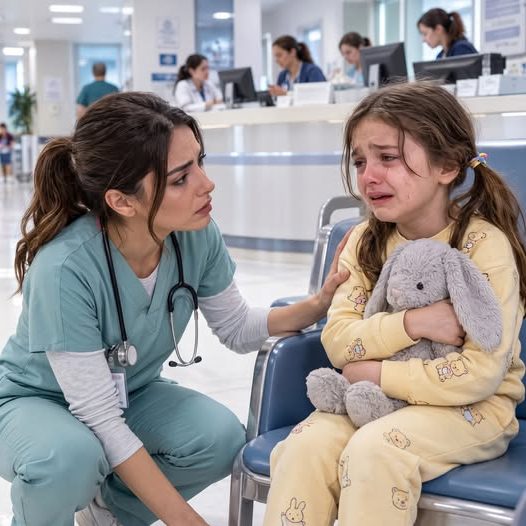
I didn’t waste time arguing. I got the girl medical help and checked her phone. The last message from her aunt made my blood run cold.
PART 1
“If I die here, will somebody tell my dad?”
The question came from an 8-year-old girl who had been sitting in front of the reception desk at Harbor Naval Medical Center in Norfolk, Virginia, for almost 2 hours. Nobody answered. A clerk kept typing, and a few feet away, 2 doctors argued about where to order lunch.
I had just come down from pediatrics when I heard her. My name is Marianne Hargrove, I’m 39, and I’ve been a nurse for 11 years. I’ve heard grown men scream over a bandage, but I had never heard a little girl ask so calmly whether she was going to die.
I walked over. She wore a red sweater plastered to her body with sweat and a pair of patched-up sandals, and she held a stuffed rabbit with half an ear missing. Her breathing whistled. She clutched the toy as if it could hold her upright.
“What’s your name, sweetheart?”
“Lucy Brennan.”
“Who came with you?”
“Nobody. My dad said they take care of Navy families here.”
I knelt so I’d be at her level. Her forehead was burning. On the wall behind us, a sign read: Our mission is to care. I was ashamed to look at it.
At the desk, I asked why she hadn’t been sent for evaluation.
“She didn’t have an ID card or a responsible adult with her,” the clerk said. “We asked her to wait while we tried to locate someone.”
“Did anyone take her vitals?”
She didn’t answer. She checked her screen and looked away.
“Then she wasn’t waiting for care,” I said. “She was waiting for somebody to decide to see her.”
I asked for a wheelchair and called the pediatric emergency department. I didn’t need a relative’s permission to have a possible emergency evaluated. While the orderly came, Lucy tugged at my sleeve.
“Please don’t be mad at them. Maybe they’re too busy.”
That was what hurt the most. She was apologizing for being sick.
On the way down, I learned that she’d been coughing for 9 days, that the fever had gotten worse over the last 3 nights, and that she had barely eaten. Her mother had died a year and a half ago. Her father, Chief Petty Officer Owen Brennan, was deployed on a maritime patrol. They couldn’t always talk; communications depended on service and signal.
“And who do you stay with when he’s gone?”
“Mrs. Pruitt. She makes me soup and checks my homework.”
“Where is Mrs. Pruitt?”
Lucy looked down at the rabbit.
“They took her away in an ambulance. She said my Aunt Bernie was coming.”
“How long ago?”
She counted on her fingers. Ten days.
My stomach dropped. Ten days was far too long for any child, but she had learned not to make noise. She ate crackers, drank tap water, and locked the door when it got dark. She had come on 2 buses, following the address her father had written on the back of a photograph. She told me she’d counted the stops with a little pebble in her fist so she wouldn’t forget them when the fever got worse. One driver asked where her mother was, but she pretended to be asleep, afraid he’d call the police before she got there. When she got off, she walked 6 blocks holding on to the walls. She had picked this hospital because the people who worked here would understand why her father wasn’t home.
In the ER, the pulse oximeter read 88. The attending physician ordered oxygen, tests, and immediate monitoring. She didn’t argue about paperwork: first we had to get Lucy breathing better. While we fitted the mask, Lucy asked whether her rabbit could stay.
“Captain Floppy is scared of hospitals,” she explained.
“Then he stays with you,” I promised.
My daughter was 8 when she died, 8 years ago. I had avoided getting attached to patients ever since. Before working here, I’d served as a Navy corpsman and gotten used to handling emergencies without shaking. That afternoon, my hands trembled as I tucked the blanket around her. I remembered the nights when Ellie, my little girl, said all she needed was to see me sitting beside her bed to feel safe. Lucy didn’t even know whom to ask to sit with her. I looked at the chart, still blank, and understood that the problem hadn’t begun with the cough. Someone had turned a little girl into a piece of paperwork that could wait.
To find a relative, I asked Lucy’s permission to look through the contacts on an old cell phone in her backpack. The screen was cracked. There were messages from her, sent over several days to “Aunt Bernie”: I can’t find any food. Mrs. Pruitt isn’t coming back. I’m really hot and it hurts to breathe.
Every one of them showed as read.
The last message received was from that morning. I read it twice, certain I had misunderstood:
Don’t tell anyone you’re alone. I already told your dad you’re fine. If you make a scene, they’ll take you away from him.
PART 2
I looked at the screen again. Lucy was watching me over the oxygen mask, waiting for me to scold her too.
“Did your aunt know you’d been alone for days?”
She nodded.
“She said I was big enough to take care of myself. And that if I told, Dad would get in trouble.”
I didn’t ask her to tell me more. I put the phone in a bag with her belongings, wrote down what I’d seen, and called social work. A sick child with no caregiver needed protection, not an improvised promise that everything would be fine.
After the X-ray and lab work, the doctor confirmed pneumonia in both lungs. She would have to stay in the hospital on oxygen and treatment. Dehydration worried us too. When we explained she’d be here for several days, she asked whether she’d have to pay with the coins she kept in a sock.
“You just focus on getting better,” I told her. “The grown-ups will take care of the rest.”
But this time I wanted my words to mean something.
The front desk log showed that Lucy had arrived at 9:17. Her first medical evaluation began at 11:46. I asked that both times be recorded in an incident report; I wasn’t going to let anyone replace that wait with the phrase patient admitted without complications.
With a social worker, we tried to reach Bernadette Brennan, Owen’s sister and the alternate contact listed on a form Lucy had brought from school. She answered on the fourth try.
“I can’t walk out of work over every little tantrum,” she said, before asking about the girl.
“She has pneumonia and she’s been admitted. Did you know Mrs. Pruitt was in the hospital?”
There was a silence.
“Dorothy exaggerates everything. My niece had food. Besides, her father knows I’m keeping an eye on things.”
“Have you seen her in person in the last 10 days?”
“I don’t have to explain myself to a nurse.”
She hung up.
I asked the school to confirm, through social work channels, who was listed for emergencies. Bernadette appeared as the secondary contact. The principal reported that Lucy had been absent for 6 days and that when the school asked, the aunt had answered by text that Lucy had the flu and was being looked after at home. That reply was saved in the school’s records.
By afternoon we learned where Mrs. Pruitt was: admitted to the county hospital after a fall. A social worker there agreed to pass along our request. The next day she was able to speak by phone with ours, with her permission and without pressure.
“I called Bernadette from the ambulance,” she said, her voice breaking. “She swore she’d pick up Lucy that very night. I sent the girl to sleep at my house because I thought her aunt was coming. I didn’t know she was still alone.”
She was 74 years old. She had looked after Lucy since her mother died and knew her favorite meals, her school schedule, and the rabbit’s name. She wasn’t a stranger hired at random. Owen trusted her; Bernadette was meant to be the backup if anything happened.
I asked the Navy’s command liaison to verify the father’s information and send an urgent notice through the appropriate channels. They couldn’t promise an immediate call. Meanwhile, social work notified Child Protective Services so they could assess protective measures. Nobody talked about taking custody away from Owen for working at sea.
That night Lucy told me she had saved a slice of bread for when Mrs. Pruitt came back. She’d left it on a plate under a napkin, because she didn’t know whether anyone was feeding her at the other hospital.
When she said it, I stepped away for a moment to cry where she couldn’t see me.
The next morning Bernadette showed up. She carried a designer purse, perfect nails, and a plastic folder. She demanded to take her niece home as soon as the oxygen came off. She produced a letter signed by Owen authorizing her to pick Lucy up in an emergency.
“My brother put her in my care,” she said. “You people are creating a family problem where there isn’t one.”
I explained that the letter didn’t cancel medical treatment or a child-protection assessment. Nor did it prove she’d taken care of her.
“If my brother is paying the expenses, why do you care how we organize things?” she shot back.
She went still when she realized what she’d said.
I knew nothing about any payments. Lucy had never mentioned money. Before I could ask, my extension rang. It was the Navy liaison: they had managed to connect the father with social work.
Owen spoke from an installation ashore, his voice choked.
“Bernie assured me yesterday that Lucy was staying with her,” he said. “I even sent money for a doctor’s visit. Why is my daughter in the hospital, and why didn’t anyone tell me sooner?”
At that moment, Bernadette reached for the phone on the desk.
“Don’t say those things to my brother. Give it to me.”
And Lucy, who had heard her voice from the half-open door, hid behind my scrubs.
PART 3
I put my body between Lucy and the door without pushing anyone. Bernadette stopped when she saw the social worker and the doctor approaching. Her expression changed: she no longer looked like a woman worried about getting her niece back, but like someone afraid of being left without a convincing explanation.
“You’re not talking to her right now,” I said. “She’s sick, she got scared, and she needs rest. You can wait in the family lounge while we review your paperwork.”
“You have no authority to decide anything about my family.”
“About your family, no. About her care and her safety in this hospital, I have responsibilities. And I’m not going to ignore them.”
The social worker walked Bernadette to an office. I went back to Lucy. I adjusted her mask and asked if she wanted me to lower the blinds. She shook her head.
“Is my dad mad at me?”
“He’s worried because he loves you. You didn’t do anything wrong by asking for help.”
“My aunt said if I told, they wouldn’t let me live with him anymore.”
My throat tightened, but I didn’t make promises I couldn’t keep.
“There are people looking into what happened. Your dad already knows where you are, and we’re trying to get the two of you on the phone.”
Owen couldn’t leave his post right away. They informed him of the situation over an authorized line; he requested emergency leave for a family crisis and had to wait for a relief. While that was worked out, he kept in touch with social work and the medical team by phone. Three days later he was able to talk to his daughter directly by video call, when she could tolerate longer stretches without the mask.
Lucy asked me to stay.
“I’m sorry, kiddo,” Owen said the moment he appeared on the screen.
She pressed Captain Floppy against her cheek.
“I did go to the hospital, like you told me.”
“You did exactly the right thing. I’m the one who believed you were being looked after without checking.”
Owen didn’t blame her for staying quiet. He asked what she’d eaten and who had taken care of her. When he heard she hadn’t wanted to get him in trouble, he had to step away from the camera to cry.
Afterward he asked to speak with social work. I turned over my notes on the wait, the messages, and the school record, so the facts would be available during the review.
The head of the ER questioned my report.
“Marianne, filing an internal report is going to involve colleagues who were dealing with other things.”
“I know. But two and a half hours without an evaluation is not a misunderstanding. The next child might not be able to sit there until someone looks at her.”
In the end, she agreed to refer the incident to the quality and patient safety office. The review didn’t mean automatically firing anyone; it meant finding out who received the notice, why triage wasn’t triggered, and how to keep it from happening again.
Owen arrived 4 days after the first call. When he saw her from the doorway, he stood frozen, as if he needed to confirm she was really there.
“Daddy!”
Lucy tried to sit up too fast. He crossed to the bed and knelt to hug her without tugging the tubes she still had. They both cried. I stepped out into the hallway and left them alone.
An hour later Owen showed me his bank records.
“My sister told me Dorothy couldn’t take care of her anymore and that she’d handle it. I was depositing $450 a month for food, school, and whatever was needed. I thought it was better not to move Lucy out of her hometown.”
Leave a Reply