Part 1: The Dinner That Became an Interrogation
When Ethan Brooks first took me home to meet his family, he warned me that dinner with his father could feel like a military briefing. Retired Admiral William Brooks welcomed me politely, but his gaze lingered when Ethan mentioned my engineering degree and I casually referred to Pensacola. I suspected he recognized something. Still, he asked no questions, and I was grateful.
I was thirty-six, quiet by nature, and accustomed to people making assumptions. When I said I worked for the Navy, they imagined an office. If I mentioned aviation, they assumed logistics or contracting. Almost no one pictured me flying military aircraft, and years earlier I had stopped correcting them.
Ethan knew I was a pilot, but even he knew only the ordinary parts of my career. Certain missions remained classified; others were memories I refused to turn into dinner-table entertainment. His sister Natalie seemed to understand. Over coffee a few weeks later, she asked what I really did.
“I fly.”
“Military aircraft?”
“Yes.”
“What kind?”
“The kind I don’t discuss over coffee.”
She accepted the answer, then quietly said, “Dad knows something about you.”
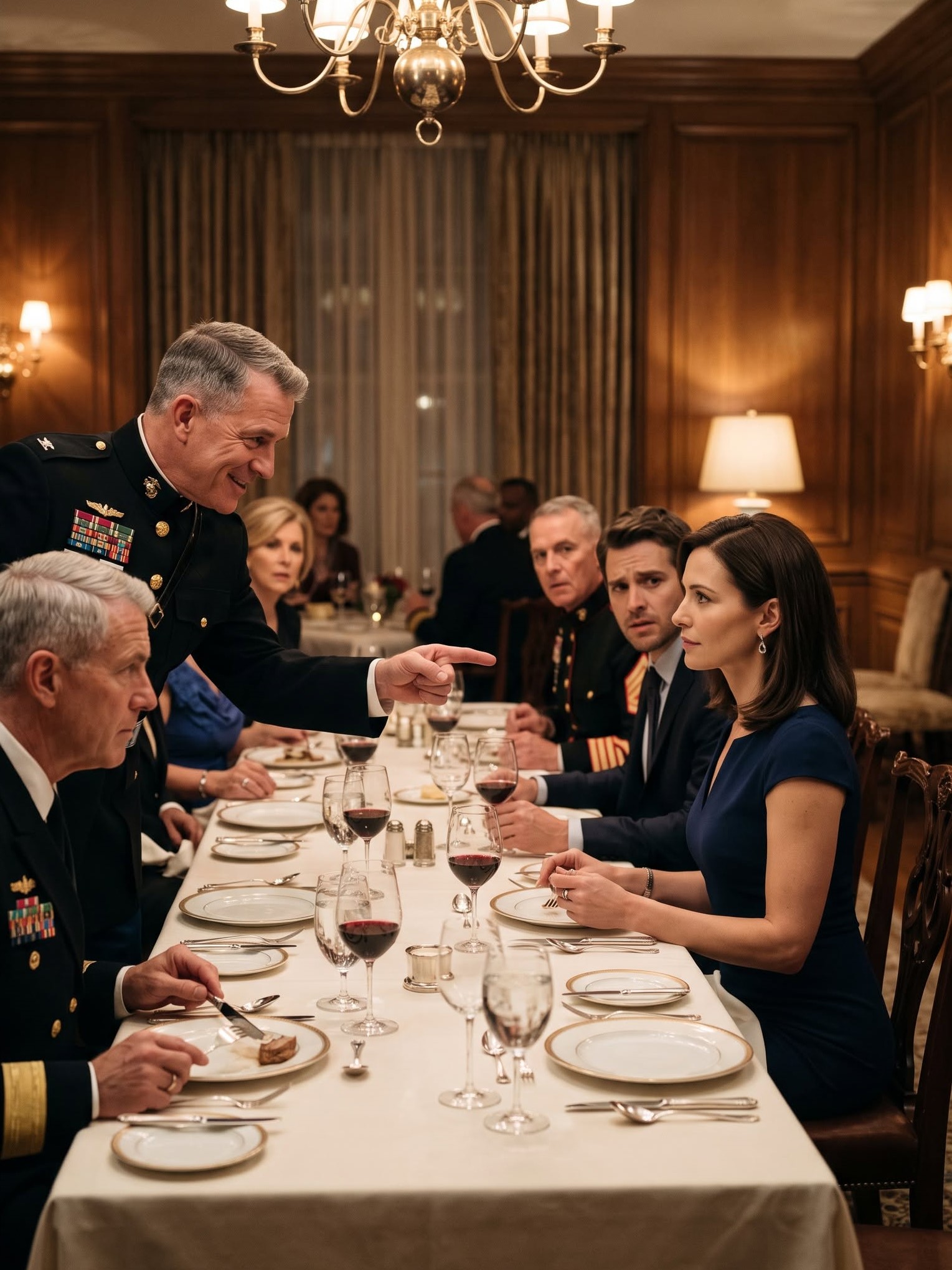
For the next three months, Admiral Brooks continued watching without exposing me. I began to relax—until Ethan invited me to his father’s seventieth-birthday dinner in Washington. The private room was crowded with retired officers, commanders, and their spouses. Shortly after we arrived, a broad-shouldered guest with a glass of bourbon approached us.
“Claire, meet Colonel Richard Coleman,” Ethan said. “He’s an old friend of Dad’s.”
Coleman looked me over as if assigning me a category.
“What do you do, Claire?”
“I fly for the Navy.”
His eyebrows rose, followed by a knowing smile. I recognized it immediately: the expression of a man who had already decided my answer could not be true.
Across the table, Admiral Brooks silently watched us. Coleman had no idea that the quiet woman he was preparing to challenge had once made a decision over black water that had reached the admiral’s desk years earlier.
And before Coleman asked his next question, I knew dinner was about to become an interrogation.

Part 2: Prove It
Coleman began politely, asking whether I flew helicopters, fixed-wing aircraft, or carrier missions. I answered only what I wished to share, and every restrained response made him more certain I was hiding inexperience rather than protecting private information.
When retired Captain Thomas Reed mentioned a dangerous rescue during severe weather, Coleman interrupted him. “Weather only frightens pilots who don’t trust their training.”
The remark pulled me back to black water, violent rain, failing visibility, and two voices fading through static. I kept my expression neutral.
Coleman asked about my flight hours, deployments, and operational history. Then he announced that I did not carry myself like the combat aviators he knew. Natalie challenged him, while Ethan’s patience visibly thinned.
Finally, Coleman addressed the table instead of me. “Maybe she flies support. Maybe she’s a reservist. I’m only saying the person doesn’t match the story.”
Then he smiled sympathetically. “Sweetheart, nobody expects you to impress us.”
Ethan started to rise, but I touched his knee. Coleman wanted me angry because anger would make his behavior seem justified. I refused to give him that advantage.
After another round of questions, I set down my fork. “You’ve asked me eleven things and listened to none of my answers. You compared each one to what you wanted to hear, then treated the difference as evidence.”
His expression hardened.
“You say you aren’t accusing me of lying,” I continued. “Yet that is exactly what you’ve done. If you intend to accuse me, Colonel, have the discipline to say it clearly.”
Coleman leaned forward. “Fine. Name one aircraft, one unit, or one deployment. Prove you are what you claim.”
I resumed eating.
“You won’t answer?”
“No.”
“Why?”
“Because you’re not entitled to an answer. I’m accountable to my chain of command, and you are not part of it.”
He demanded my call sign next. Ethan stood and ordered him to stop, but I gently pulled him back down.
Then Admiral Brooks placed his fork beside his plate. The quiet metallic sound silenced the room.
He looked directly at me.
“Claire,” he asked calmly, “what is your call sign?”

Part 3: Lantern
Admiral Brooks had not exposed me or ordered me to answer. He had given me a choice after months of protecting my privacy.
That earned the truth.
“Lantern.”
Recognition immediately crossed his face.
“Meridian,” he said.
Coleman’s smile vanished. He had helped brief part of the after-action review and knew exactly what that name meant.
Admiral Brooks briefly explained that two naval officers had gone into the Atlantic during a failed extraction. A brutal storm had reduced visibility to almost nothing, and several aircraft had been redirected because reaching the recovery point was considered too dangerous.
“One crew continued,” he said.
Coleman stared at me. “That was you?”
“I was the aircraft commander.”
“And the pilot who made the final approach,” Admiral Brooks added.
Coleman remembered that our crew had been told to hold position. I corrected him. We had been advised to hold, not ordered. The weather was closing, fuel was running low, and the officers in the water were weakening. We had one shrinking opportunity.
I took it.
Both officers came home alive.
Coleman lowered his eyes. “I didn’t know.”
Admiral Brooks regarded him evenly. “You didn’t ask. You decided.”
He reminded Coleman that thirty-one years of service should have taught him the difference between verification and assumption. Coleman had judged me by appearance, then demanded that I perform my record for his approval.
When Coleman attempted to apologize, I raised a hand. “Not tonight.”
I did not want remorse offered only because the audience had changed.
Admiral Brooks nodded and calmly told him to finish his dinner. Conversation gradually returned, but nothing felt ordinary again. Ethan held my hand beneath the table, though uncertainty had replaced anger in his expression.
Outside the restaurant, he finally asked the question I had expected.
“Why didn’t you tell me about Meridian?”
The hurt in his voice made me realize that revealing my identity had ended Coleman’s interrogation—but opened a far more difficult conversation between Ethan and me.

Part 4: The Story I Never Wanted to Tell
Under the restaurant awning, I explained that every time people heard about Meridian, they rearranged their understanding of me. I stopped being the woman who misplaced her keys, left coffee cups in the car, and enjoyed terrible movies. I became the pilot from a famous rescue.
“I didn’t want a heroic version of myself with you,” I said. “I wanted an ordinary life.”
Ethan understood, but understanding did not erase his pain. He quietly asked why I had never allowed him the chance to respond differently.
He was right.
Two days later, Admiral Brooks invited me to a diner. He admitted that the Meridian report had crossed his desk while he was still serving because one of the rescued officers, Commander David Hayes, had once served under him. Hayes had recovered, retired, and now lived in Maine surrounded by grandchildren.
The admiral also explained why I had been given the call sign Lantern. During the rescue, I had repeatedly identified faint lights and landmarks through weather no one else could penetrate. After landing, someone joked that I could find a porch light from space.
Admiral Brooks had recognized my name and background the first night we met. He also recognized a habit described in the report.
“You become quieter when everyone else becomes louder,” he said.
He had chosen not to reveal me because my history belonged to me. He regretted not stopping Coleman sooner, but I admitted that he had been waiting to see whether I wanted help.
When he mentioned that Coleman wished to apologize, I declined. I did not need Coleman to improve for my benefit. I only needed him to stop treating me as inferior.
Outside the diner, Ethan was waiting. He told me something his father had left unsaid: years before Meridian, Commander Hayes had saved Admiral Brooks during a shipboard fire.
That was why Meridian affected him so deeply.
The admiral had considered contacting me after the rescue but decided I did not need another stranger turning the worst night of my life into something he needed from me.
Until then, I had respected William Brooks.
After learning that, I trusted him.
Part 5: What Came After the Storm
That evening, I told Ethan more about Meridian—not classified details, but the human ones. I described the smell of hydraulic fluid, the coffee spilled before launch, my freezing hands after landing, and the crew member who became sick behind a hangar once the adrenaline faded.
I explained why the commendation ceremony had felt wrong. Everyone called us courageous while I remembered the decisions that could have killed us.
Ethan did not interrupt or praise me. When I finished, he simply said, “Thank you for telling me.”
Our relationship did not instantly become perfect, but it became more honest. He learned that “I can’t discuss that” was not rejection, and I learned that privacy could sometimes be fear disguised as independence.
News of the birthday dinner spread through the military community. At first, people introduced me as “the Meridian pilot” and sought my opinion on every aviation story. I hated being reduced to one mission again, but eventually the attention faded.
Months later, Coleman sent me a direct apology. He admitted that pride had turned his curiosity into disrespect and that he had humiliated me publicly.
I replied: “Thank you for acknowledging what happened. I accept that you regret it. I have nothing further to discuss, but I hope you treat the next person differently.”
That was enough. I did not forgive him sentimentally or pretend the experience had been a gift. I simply stopped carrying the burden of his judgment.
That spring, Captain Monica Reyes called me into her office and handed me two documents. The first confirmed my promotion. The second assigned me to advanced aviation training.
“You’ve spent years making difficult decisions,” she said. “Now teach others how to make them.”
For the first time, I saw a future in which Meridian would not define my career.
Then I read the roster for my incoming class.
One name made every muscle in my shoulders tighten:
Lieutenant Grace Coleman.
Richard Coleman’s daughter.
Part 6: The Colonel’s Daughter
For five seconds, I considered refusing the assignment. Then Captain Reyes asked whether the family connection would affect my judgment.
“No.”
Grace arrived three weeks later. She resembled her father enough that I recognized her immediately, and her expression confirmed that she knew who I was. Neither of us mentioned it.
She was talented, disciplined, and harder on herself than any instructor needed to be. During one simulator exercise, she missed a change on final approach because she was still thinking about an earlier error.
“You were flying backward,” I told her. “The aircraft doesn’t care what happened thirty seconds ago. It cares about what you do now.”
As she prepared to leave, Grace stopped.
“My father told me what happened. I’m sorry.”
“You didn’t do anything.”
“He was wrong.”
“Yes.”
She seemed surprised by my bluntness, but the truth required neither cruelty nor pretending.
“In this building, you are Lieutenant Coleman, I am Commander Bennett, and your father does not appear on my training schedule.”
Relief softened her expression.
Over the following months, Grace became one of the class’s strongest pilots—not because she stopped making mistakes, but because she learned to admit them before they became dangerous. She absorbed the lesson her father had missed at dinner: confidence and competence were not the same.
Meanwhile, Ethan and I became better at asking questions and respecting boundaries. Our problems did not vanish; we simply stopped hiding them beneath politeness.
One morning, while I stood barefoot in my kitchen drinking terrible coffee, Ethan placed a ring box beside my mug.
“I don’t need every version of your past,” he said. “I only want the future you’re willing to build with me.”
I said yes before he finished.
For once, letting someone fully into my life did not feel like surrender.
It felt like partnership.
Part 7: The Lesson That Arrived Late
Two weeks before our wedding, Grace completed the advanced course. Her family attended the graduation, and for the first time since Admiral Brooks’s birthday, I saw Richard Coleman in person.
He approached while Ethan and Admiral Brooks stood nearby.
“Commander Bennett.”
“Colonel.”
“Retired,” he corrected quietly.
He thanked me for teaching Grace. I reminded him that it was my job, but he continued.
“She says you taught her not to confuse certainty with competence.”
“She talks too much.”
A faint smile crossed his face. Then he admitted that he wished someone had taught him that lesson thirty years earlier.
I could have punished him with silence or reminded him how late the realization had come. Instead, I said, “Better late than never.”
He offered his hand. After a brief pause, I shook it.
It was not friendship, reconciliation, or complete forgiveness. It was an acknowledgment between two people standing beyond an ugly moment and agreeing not to repeat it.
After Coleman left, Admiral Brooks looked toward the flight line.
“Lantern,” he said.
It was the first time he had used my call sign since the dinner.
“Do you ever miss being only that?”
I looked at Ethan, Natalie, my students, and the life that had grown beyond one night over the Atlantic.
“No.”
For the first time, I meant it.
Part 8: An Ordinary Life
Ethan and I married beneath the trees at a restored farmhouse outside Charlottesville. During his vows, he promised never to make me prove what I had already shown him. I promised not to call privacy strength when it was really fear.
Later, Admiral Brooks found me near the orchard and handed me a letter from Commander Hayes. He had not read it and left the decision entirely to me.
Hayes did not write a heroic tribute. He told me about Maine, his wife, his grandchildren, a badly built deck, neighborhood arguments, an Alaska trip, and his failed attempts at baking bread.
Then I reached the sentence that finally broke through six years of distance:
“I hope your life became ordinary in all the ways mine did.”
I cried because I had always believed Meridian either had to define me or mean nothing. His letter offered another possibility: it could matter without owning me.
Years later, as a full-time instructor, I began every class by writing two sentences on the board:
Competence does not need an audience.
But it does require accountability.
Coleman and I never became friends, though Grace later told me he had become slower to dismiss junior officers and more careful with people whose experience did not match his expectations. His growth belonged to him; I did not need to reward it by pretending his disrespect had never happened.
The lesson I carried was simpler. Silence could be confidence, strategy, or merely a way to avoid making others uncomfortable. Strength meant knowing the difference.
Whenever new pilots asked about my call sign, I usually gave them the joke about spotting porch lights from space. If they pressed, I told them the longer story was unnecessary. The best ones respected that answer.
For years, I thought the victory at Admiral Brooks’s dinner came when Coleman finally learned who I was.
It did not.
The victory came earlier, when I knew exactly who I was and refused to treat his disbelief as an emergency. The call sign only made the truth visible.
Because truth does not become weaker when someone fails to recognize it.
And I did not become smaller simply because Richard Coleman lacked the imagination to see my full size.
Leave a Reply