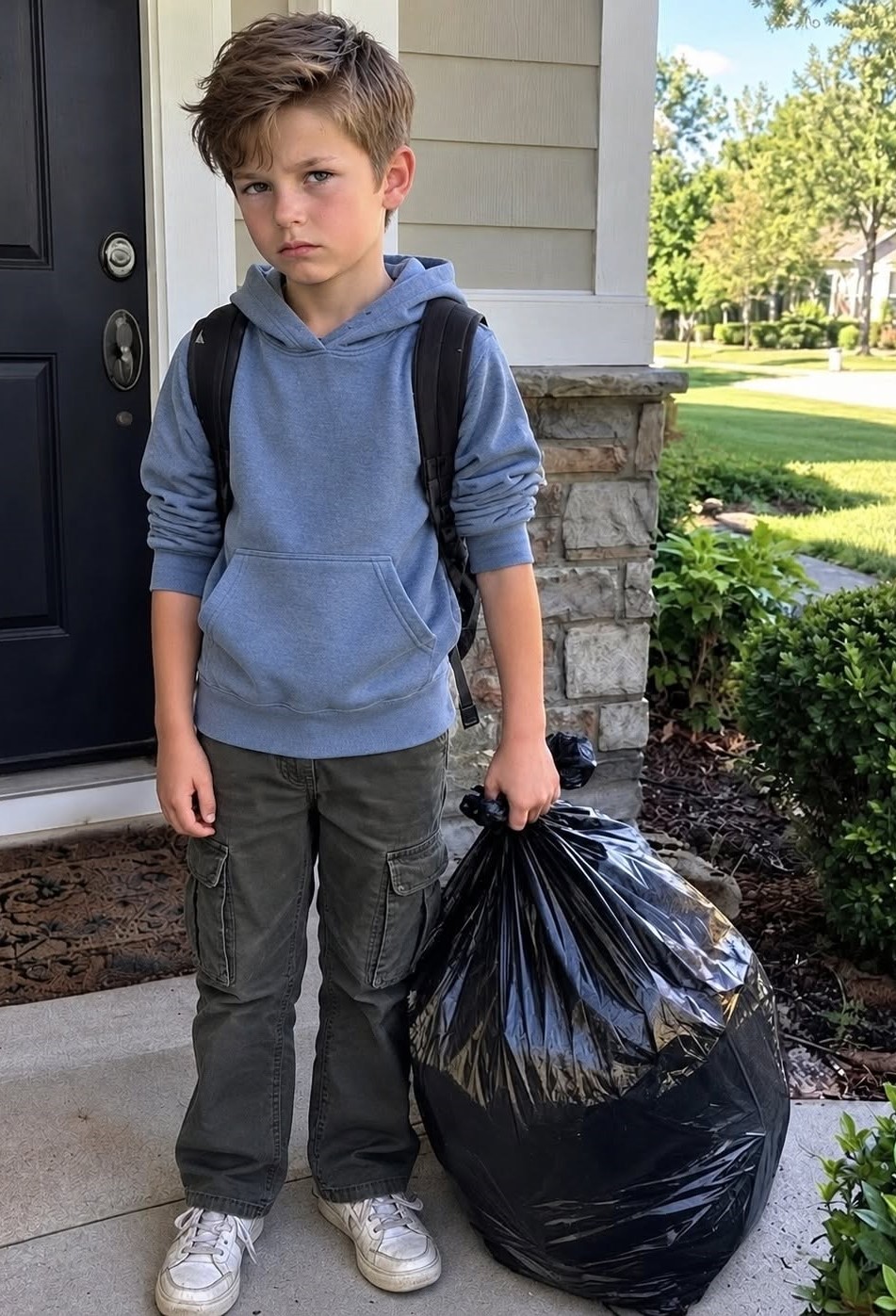
After nearly three years of applications, home inspections, interviews, paperwork, and endless waiting, eight-year-old Oliver was finally standing inside our house.
His social worker looked exhausted. She placed a tied black trash bag in my hands and explained that it contained all of Oliver’s belongings.
That was it. Eight years of a child’s life packed into one plastic bag.
She checked something on her phone, gave us a few final instructions, and left.
Oliver stayed near the entrance, staring at his worn sneakers. My husband, Julian, knelt so they were at eye level.
“We’ve been waiting a long time for you, buddy,” he said gently. “This is your home now.”
Oliver looked up. There was no excitement on his face, but there wasn’t exactly fear either. He simply had the guarded expression of someone much older than eight.
“For how long?” he asked.
My heart tightened. “For good,” Julian answered.
Oliver studied his face. “Forever?”
I stepped closer. “Forever,” I promised.
Something in his expression changed. Not quite a smile, but some of the tension seemed to leave his shoulders. Then he glanced at the garbage bag in my hands.
“Okay,” he murmured. “I guess I can unpack now.”
Those words stayed with me. Julian took Oliver into the kitchen to make him something to eat while I carried his belongings upstairs.
We had spent weeks preparing his bedroom: fresh sheets, a new comforter, books on the shelf, a small desk near the window, empty dresser drawers waiting for clothes that belonged to him. I wanted everything put away before Oliver came upstairs. Maybe opening a drawer and seeing his clothes neatly folded inside would help him understand that he wasn’t simply visiting—he belonged here.
I placed the black bag on the center of his new bed, untied the knot, and carefully tipped it over. Two faded pairs of jeans fell out first, followed by a handful of oversized T-shirts, several mismatched socks, an old sweatshirt, and a worn stuffed bear whose fur had been rubbed almost flat.
I picked up the bear gently, setting it beside Oliver’s pillow. Then I reached for the remaining clothes. I thought the bag was empty, but when I lifted the final shirt, something heavy slid from underneath it.
Thud.
The object landed directly in the middle of the mattress. I froze.
Whatever it was, it definitely wasn’t a toy. I slowly moved the shirt aside, and all the warmth seemed to leave my body. My hands began trembling.
“No…” I whispered.
I knew that object. I had seen it before—years earlier, long before Oliver’s name had ever appeared in our adoption paperwork. I reached toward it, then stopped myself. There was no possibility I was mistaken. A tiny detail along one side confirmed it: the same hand-carved initials, the same silver compass inlay, the exact same leather casing.
It was my brother David’s pocket watch—the one he was wearing the night he disappeared twelve years ago.
Suddenly, I could hear Oliver and Julian laughing softly downstairs. I stared toward the bedroom doorway, then back at the object lying among Oliver’s few belongings.
How did an eight-year-old boy in foster care come to possess a timepiece that belonged to a man who vanished over a decade ago?
Footsteps sounded on the stairs, and Oliver appeared in the doorway holding a glass of juice. The moment he saw what I was holding, his small smile disappeared.
“Where did you get this?” I asked softly, my voice barely audible.
Oliver didn’t answer right away. He looked down at the floor, clutching his glass with both hands.
“My real dad gave it to me before he died,” Oliver whispered. “He told me if I ever felt lost, to find the woman whose name was etched on the inside of the latch.”
My breath hitched. With shaking fingers, I pressed the small release button on the side of the watch. The brass lid sprang open, revealing the delicate cursive engraving hidden beneath the cover:
To Evelyn — Always keep finding your way home. Love, David.
I dropped to my knees on the hardwood floor, tears spilling down my cheeks as the truth crashed over me. Oliver wasn’t just a child assigned to us through an anonymous system; he was my nephew. David had spent his final months making sure his son would eventually find his way to me.
Oliver walked slowly across the room, setting his juice down on the nightstand, and wrapped his small arms around my neck.
“Are you Evelyn?” he asked softly.
“Yes, Oliver,” I sobbed, pulling him into a tight, desperate embrace. “I’m your Aunt Evelyn. And you’re finally home.”
Part 2
Julian ran upstairs after hearing me sob, stopping dead in the doorway as he saw us on the floor.
“Evelyn? What happened? What’s wrong?”
Through my tears, I held up the watch. Julian’s eyes widened in instant recognition. He knew the story of David’s disappearance—how my older brother had walked out of his apartment twelve years ago and vanished without a trace, leaving a cold case file that the police had eventually shelved.
“David…” Julian breathed, dropping to his knees beside us. “How… how is this possible?”
Oliver looked between the two of us, his young face solemn. He reached into the pocket of his faded jeans and pulled out a folded, yellowed envelope.
“My dad left this in the watch case,” Oliver said softly. “He told the social worker to put it in my bag, but he said I could only read it when I met the person with the watch.”
My hands shook as I unfolded the paper. The handwriting was unmistakably David’s—messy, fast, but filled with absolute clarity.
Evelyn,
If you’re reading this, it means I’m gone, but Oliver found his way to you. I knew I couldn’t trust the family courts or the state to bring him to you directly—there were people from my past who wanted to make sure my child was erased.
After I left, I lived under a new name in rural Oregon, trying to start over. I met a wonderful woman, and we had Oliver. But when sickness caught up with us both, I spent my last months making sure my son’s legal profile would quietly trigger your adoption agency preferences. I planted the watch in his bag as my final proof.
I never stopped loving you, Evie. Protect my boy. Give him the life we always talked about.
Your brother, David.
I pressed the letter to my heart, weeping openly as years of grief, confusion, and unresolved pain gave way to an overwhelming sense of closure and purpose. David hadn’t abandoned me. He had spent his final days orchestrating a miracle to save his son.
Julian wrapped his arms around both of us, resting his forehead against mine. “We have him now, Evelyn. We’re going to protect him.”
Part 3
The following months were a quiet, powerful journey of healing and discovery.
Through our adoption attorney, we petitioned the state to officially amend Oliver’s records, connecting him to his true family heritage. When the judge reviewed David’s letter, the watch, and the DNA verification results, she wept openly from the bench before granting full, permanent legal adoption and restoring Oliver’s birth surname.
We told Oliver everything about his father—how brave David was, how much he loved music, how he used to build wooden treehouses in our backyard when we were kids, and how fiercely he had fought to make sure his son would land in safe hands.
Oliver’s guarded, quiet demeanor slowly began to melt away.
The bedroom we had prepared for him became a sanctuary filled with laughter, art supplies, and framed photographs of David alongside new memories of our daily life. The small stuffed bear with the uneven stitching remained on his pillow every night, sitting beside the brass pocket watch resting safely on his nightstand.
One evening, as autumn settled over our neighborhood, Julian and I sat on the back patio watching Oliver kick a soccer ball across the grass. He was laughing—a bright, ringing sound that filled every corner of our yard.
Julian turned to me, wrapping his arm around my shoulders. “Do you ever think about the odds? Three years of waiting, hundreds of agency files… and he ended up right here.”
I smiled, looking up at the clear twilight sky. “David always said that no matter how far someone strays, love always acts like a compass. He built the map; Oliver just followed it.”
Oliver ran over to the patio, out of breath, his cheeks flushed red from the cool evening air. He collapsed onto the wooden bench between us and rested his head against my arm.
“Aunt Evelyn?” he asked softly.
“Yes, Oliver?”
“Do you think my dad can see us right now?”
I smoothed back his dark curls, looking into eyes that were the exact replica of my brother’s.
“I know he can, Oliver,” I whispered, kissing his forehead. “And I know he’s finally resting, knowing his boy is safe.”
Oliver smiled, closing his eyes as he held my hand tightly.
We had spent three long years waiting for a child to complete our family, completely unaware that the boy we were waiting for was the piece of my heart I thought I had lost forever twelve years ago.
The black trash bag that had carried his belongings into our home was long gone, replaced by closets full of clothes, shelves full of books, and a future filled with unconditional love.
Oliver wasn’t a guest in our home. He was the living promise of a brother’s eternal love—and he was finally, permanently home.
Epilogue: The Compass Pointing Home
Ten years after a tied black garbage bag was set onto a fresh comforter, the morning sun rose over the Puget Sound, flooding our living room with warm amber light.
At eighteen, Oliver stood in the center of the room wearing a crisp dark suit, adjusting his tie in the reflection of the glass patio doors. He had grown so tall—taller than Julian, taller than David had been—with the broad shoulders and steady, thoughtful posture of a young man who knew exactly who he was and where he belonged.
On the dining table behind him sat two leather suitcases, neatly packed and tagged for his afternoon flight to Boston. He had received a full academic scholarship to study architecture at MIT, fulfilling a dream he had quietly nurtured since he was a young boy sketching floor plans at his bedroom desk.
Julian walked out of the kitchen carrying three mugs of hot coffee, setting them on the table before wrapping an arm around Oliver’s shoulders.
“You look sharp, son,” Julian said, his voice thick with pride.
“Thanks, Dad,” Oliver smiled, his voice deep and grounded. “I still can’t believe we’re loading the car today.”
I stepped forward, smoothing the lapel of his jacket. Tears welled in my eyes, but they were tears of pure, unadulterated joy.
Ten years ago, Oliver had walked into our home carrying the heavy, guarded silence of a child who believed every safety net was temporary. He had asked if he was staying for good, expecting the answer to be a lie.
Now, standing before us as a confident, brilliant young man, the phantom shadows of foster care and uncertainty were long gone, replaced by a decade of unconditional love, stability, and belonging.
“Before we head to the airport,” I said softly, taking his hand, “there’s something I want to give you.”
I walked over to the wooden display cabinet near the fireplace. Resting on a velvet cushion was David’s brass pocket watch. Over the past decade, it had stayed on Oliver’s nightstand as he grew up, serving as a quiet anchor through middle school achievements, high school graduations, and late-night heart-to-heart conversations about the father he had lost too soon.
Alongside the watch sat a small, leather-bound journal—a collection of letters, photos, and stories about David that Julian and I had compiled over the years so Oliver would always know the man whose blood ran in his veins.
I picked up the watch and set it gently into Oliver’s open palm.
The brass surface was polished smooth, gleam catching the morning light.
Oliver ran his thumb over the hand-carved initials and the silver compass inlay along the casing. With a soft click, he pressed the release button, opening the lid to read the familiar inscription engraved inside:
To Evelyn — Always keep finding your way home. Love, David.
Oliver looked up at me, his dark eyes brimming with emotion. “Aunt Evelyn… are you sure?”
“Your dad left that watch so you would find your way to us,” I whispered, pressing my hand over his fist. “Now it’s meant to guide you wherever you go next. No matter how far away Boston is, Oliver, this home—and our hearts—will always be your anchor.”
Oliver swallowed hard, pulling me into a tight, fierce embrace. “I’m going to miss you both so much.”
“We’re only a phone call and a plane ride away, buddy,” Julian said, joining the hug, his arm wrapping around both of us. “And we expect full architectural tours of the campus every time we visit.”
Later that afternoon, after we loaded his bags into the trunk, we drove down the coastal highway toward Seattle-Tacoma International Airport.
The autumn trees lined the road in brilliant arches of red, gold, and deep orange. Oliver sat in the passenger seat, gazing out at the familiar pine ridges and water that had framed his childhood. In his coat pocket, his hand rested over the weight of his father’s watch.
At the departure terminal, as crowds of travelers bustled around us, Oliver pulled a small, folded envelope from his inner jacket pocket and handed it to me.
“I wrote this last night,” he said with a shy, gentle smile. “Don’t open it until you get back home.”
We held him tightly one last time, watching as he walked through the security line. Just before stepping out of sight, Oliver turned back, gave us a crisp wave, and flashed that bright, effortless smile that looked so much like my brother’s.
When Julian and I returned to our quiet house that evening, the living room felt strangely still. The sun had dipped below the horizon, painting the sky in deep purples and soft twilight pinks.
We sat together on the sofa, and I carefully unfolded the letter Oliver had left behind.
His handwriting was neat, confident, and filled with deep warmth:
Dear Mom and Dad,
(I know I’ve called you Aunt Evelyn and Uncle Julian for years, but in every way that truly matters, you have been my Mom and my Dad.)
When I stood on your porch ten years ago holding a black garbage bag, I was terrified that I was just another stop on a long, lonely road. I didn’t know if anyone would ever truly want me, or if I would ever belong anywhere.
You didn’t just open your door that day; you opened your lives. You gave me a home, a family, and my father’s memory back. You showed me that I was never unwanted, never forgotten, and never alone.
Dad left me a watch with a compass on it, but you were the ones who taught me how to navigate the world. Everything I am today, everything I achieve at MIT and beyond, belongs to the love you gave me.
Thank you for keeping your promise. Thank you for making it forever.
Love always,
Oliver
I pressed the letter to my chest, tears falling freely onto the paper as Julian wrapped his arms tightly around me, resting his chin on my shoulder.
The black trash bag that had once contained an eight-year-old boy’s whole world had faded into a distant memory. In its place remained a legacy of courage, healing, and unbreakable family ties.
David had carved a compass on a brass watch to save his son. And ten years later, that compass had led us all to the greatest gift of our lives: a young man soaring into a brilliant future, knowing he would always know the way back home.
My mother called in tears, begging me to cover my younger brother’s $46,000 debt, so I promised to send the money by noon. Then she forgot to hang up, and I heard my father say, “I told you she’d cave,” while my brother joked that I needed to feel necessary. When Mom called my million-dollar house a “consolation prize,” I finally answered from the other end of the line—and everything changed…
My mother forgot to disconnect the call, and within a minute, I heard how my family described me when they thought I wasn’t listening.
It began with yet another emergency involving my younger brother, Darius.
Mom had called crying, saying he was terrified and might lose everything. Dad apparently hadn’t slept properly in days. Then came the line I’d heard my entire life whenever Darius created another disaster: “I don’t know what this family would do if we didn’t have you.”
For years, I mistook that for love.
So I agreed.
Forty-six thousand dollars.
I told Mom I’d authorize the transfer before noon the next day. Darius didn’t need to call because I understood. Everything would be fine.
“You’re a blessing, sweetheart,” she whispered.
I thought the conversation had ended.
I carried my coffee toward the sink when Mom’s voice came through the speaker beneath my kitchen cabinets again.
Except the crying had vanished.
“So,” she said.
Dad answered, “I told you she’d cave.”
Then Darius laughed.
Not nervously or guiltily.
He laughed like someone watching his prediction come true.
“Camille can’t help herself,” he said. “She needs to be the hero.”
My grip tightened around the mug.
Mom said I acted independent but was actually desperate to feel necessary.
Then Dad added, “At least all that loneliness finally serves a purpose.”
The mug struck the sink hard enough to chip its handle.
I stared at my reflection in the dark patio doors while they continued talking.
Darius said I lived alone in my “giant house” anyway and suggested someone should get something useful from all that money.
Then Mom said the words that permanently changed something in me.
“That million-and-a-half-dollar house is basically her consolation prize.”
She said I’d built a beautiful life because I couldn’t build a real one.
For several seconds, I couldn’t breathe.
This was the same woman who posted pictures of my garden and told everyone how proud she was of her successful daughter. The same woman who kept dresses in my guest room because she liked staying over. The same woman who hosted nearly every holiday under my roof while I paid the bills and made room for everyone.
Suddenly, every room felt different.
The six bedrooms.
The dining table Mom insisted had to fit the entire family.
Dad’s favorite chair in the theater room.
Darius’s boxes filling my garage.
The family photographs along the hallway.
The house hadn’t felt like home in years. I’d simply been too busy proving my generosity to admit it.
Then Mom said she would call the next morning and tell me Darius had broken down crying when he learned the $46,000 was coming.
That would keep me from changing my mind.
Something inside me became completely still.
I walked to the counter, picked up the phone, and said, “You don’t need to call tomorrow.”
Every voice disappeared.
Mom whispered my name.
“Camille… how long have you been listening?”
“Long enough.”
She immediately tried explaining. She said I’d misunderstood. Darius told me not to turn it into something huge.
I nearly laughed.
Even after being caught, he still expected to control what everyone else was allowed to feel.
“Darius,” I said, “you’re not getting the money.”
“What?”
“The $46,000. It’s not happening.”
Mom gasped and said I couldn’t punish my brother because I’d overheard a private conversation.
“A private conversation?” I asked.
Dad finally stepped in, telling everyone to calm down.
“I’ve been calm for most of my life, Dad,” I said. “That’s how we got here.”
Mom began crying again.
But for the first time, I heard the mechanics behind it. The timing. The pressure. How the tears always appeared right before she asked me to abandon myself.
“You called my life a consolation prize,” I said.
“I was upset,” she whispered.
“No. You were relaxed. You thought I couldn’t hear you.”
Dad tried redirecting the conversation toward my own flaws, saying everyone sometimes says unkind things.
Maybe that was true.
But there’s a difference between an imperfect sentence and a pattern.
“You’re right,” I told him. “I’m not perfect. I’m also not financing Darius anymore.”
My brother snapped that I thought I was better than everyone because I’d bought a mansion.
That was when I finally explained why I’d bought it.
“I bought it because I hoped all of you would finally look at me and see something worth celebrating.”
Silence.
“Tonight, I learned you only saw an address and a bank balance.”
I ended the call.
Standing alone in that enormous kitchen, surrounded by everything I’d spent years building, I realized I didn’t feel successful.
I felt awake.
The next morning, I called my closest friend, Tasha.
She listened silently while I told her everything.
When I finished, there was a long pause.
Then she said four words I never expected to hear.
“Then build an exit.”
IF FACEBOOK BROUGHT YOU HERE, HERE’S THE CONTINUATION YOU’VE BEEN WAITING FOR. ENJOY!
Tasha arrived about 50 minutes later with two coffees, a legal pad, and the expression she usually wore before a difficult business negotiation.
She hugged me first.
So tightly my knees nearly gave out.
Then she stepped back and studied me. “Okay,” she said. “Now tell me what you actually want.”
I looked toward the dining room.
“I want to leave this house.”
She waited.
“I didn’t buy it because I loved having six bedrooms. I bought it because I thought if I built something impressive enough, they would finally respect me.”
Tasha nodded.
“They don’t,” I said.
“No.”
“They see the money. The space. The access. The place where everyone can gather. They don’t see me.”
Tasha slowly sipped her coffee. “Then sell it.”
The suggestion hit harder than expected.
Sell the house.
Darius had casually suggested the same thing, except he wanted the difference turned into something useful for the family.
I wanted my life returned to me.
At 9 that morning, I called my attorney, Celeste Rowan. She’d repeatedly warned that the way I handled family money and property left me vulnerable. After hearing about the call, she went silent for several seconds.
Finally she said, “I would like the record to show that I have been waiting for this day.”
We made a list.
Stop the $46,000 transfer.
Change every exterior access code.
Disable relatives’ garage remotes.
Inventory belongings.
Suspend automatic payments.
Review past transfers.
Move important family communication into writing.
And most importantly, stop making spontaneous loans.
Celeste called it basic asset and boundary management.
Tasha called it removing squatters from my nervous system.
That afternoon, I also contacted a realtor, Marisol Vega.
She toured the house two days later.
We walked through the kitchen, study, dining room, and sunroom. Marisol said little until we reached the windows overlooking the garden.
“This is a gorgeous property,” she said.
Then she looked at me.
“You don’t like living here.”
I blinked. “What makes you say that?”
“People who love their homes touch them,” she said. “They stop to look at a favorite window. They straighten something without thinking. You’ve walked through every room like we’re inspecting evidence.”
I swallowed.
“That might be the most accurate thing anyone has said to me all week.”
We agreed to market the house privately at first.
No family announcement.
No dramatic explanation.
Verified buyers only.
That evening, I sent Mom one message.
I heard the conversation after you thought the call ended.
I will not be sending Darius any money.
I am not discussing this tonight.
Her replies arrived almost instantly.
First an explanation.
Then a claim that she’d been emotional.
Then she said I’d misunderstood.
Then she asked Dad to speak with me.
Finally came the familiar plea not to destroy my brother over something she’d said.
Not one message began with, “I’m sorry.”
Dad called twice.
I ignored him.
Darius kept calling until I blocked his number.
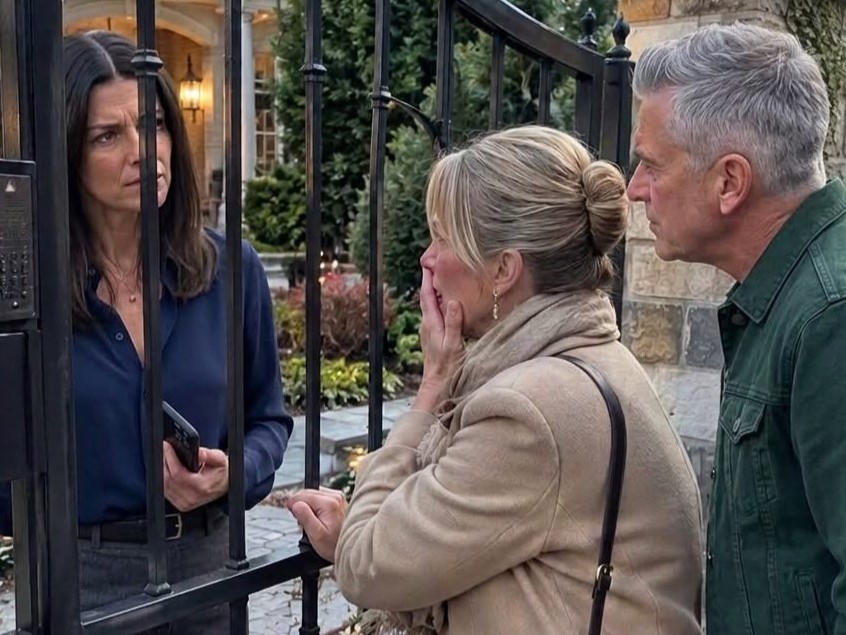
Around seven that evening, the gate intercom buzzed.
Mom stood outside.
She tried the old code twice before calling.
“Camille, the gate isn’t opening.”
“I changed the code.”
She stared into the camera.
“Why?”
“Because I changed it.”
“Sweetheart, I’m standing outside my daughter’s house.”
“Exactly,” I said. “My house.”
Dad stepped into view.
“Open the gate,” he said. “We need to discuss this like adults.”
“No.”
Mom started crying.
“Can we please just come inside?”
“No.”
They had their own home thirty minutes away.
When Mom asked, “Then where are we supposed to go?” I realized how completely everyone had come to believe my house belonged to the family.
“Go home,” I said.
Then I ended the intercom.
They remained outside nearly half an hour before leaving.
Once their car disappeared, I sat beside the sofa and cried.
Not because I regretted changing the code.
Because I finally understood how long I’d waited for permission to have boundaries.
Tasha stayed that night.
The next week brought calls from relatives.
My aunt Relle called first.
She said Mom was barely eating and there had been some misunderstanding.
After Celeste explained that the communication system had automatically archived the call and verified the relevant metadata, I sent Aunt Relle a short recording.
She went quiet.
Then she said, “Baby, I’m sorry. Thank you.”
She’d heard enough.
The family divided.
Some said I was being emotional.
Some called Mom’s words a single mistake.
Others admitted they’d always been uncomfortable with how often I was expected to fix Darius’s problems.
Then someone discovered I planned to sell the house.
Mom called in a panic.
“You’re selling?”
“Yes.”
“Why would you do that?”
“Because I don’t want it anymore.”
She cried and said I was destroying everything over one conversation.
“This is where the family gathers,” she said.
I looked around my kitchen.
“No,” I told her. “This is where everyone gathers while I disappear into whatever role makes the gathering possible.”
She fell silent.
Then she whispered, “Don’t sell your home just to hurt us.”
“I’m not selling it to hurt you,” I said. “I’m selling it so it stops hurting me.”
Dad later emailed, accusing me of choosing ego over blood and behaving emotionally.
Celeste helped me respond with facts.
I wasn’t responsible for Darius’s business obligations.
I wasn’t responsible for maintaining property other adults had grown dependent on.
Personal belongings could be collected by appointment.
Future financial requests had to be made in writing and could not be assumed approved.
Dad replied, “This is not the daughter we raised.”
I stared at the sentence for nearly a minute.
Then I answered:
“You’re right.”
And muted the thread.
Three weeks later, Marisol called.
A couple relocating from Colorado had made a full-price cash offer.
Since changing the codes, the house had become strangely peaceful.
No jackets thrown over chairs.
No relatives opening the refrigerator without asking.
No mother rearranging decorations.
No father claiming the biggest chair.
Only quiet.
“Accept it,” I told her.
“Are you sure you don’t want until tomorrow?”
“I’ve been thinking about this house for years,” I said. “I just didn’t know that’s what I was doing.”
We accepted.
Closing was set for 32 days later.
Ten days after that, Darius arrived with a rental truck.
He wasn’t there for his storage boxes.
He wanted my furniture.
Security called from the gate.
Through the camera, I saw him beside the truck with his arms crossed.
He called from an unfamiliar number.
“Camille, stop acting ridiculous.”
“Why are you here?”
“Mom said some things in the house should stay with family.”
“Which things?”
“The dining table. The theater seats. One of the guest bedroom sets. The entry mirror. Dad wants the smoker.”
I almost laughed.
“You came with a truck to take furniture from my house.”
“You’re selling everything anyway.”
“I’m selling my property. That doesn’t make it yours.”
He called me selfish, then irrational.
Finally he said, “You think selling this place makes you powerful? You’re still alone.”
Once, that sentence would have destroyed me.
It didn’t.
“Maybe I am alone sometimes,” I said. “But I’d rather eat dinner alone than feed people who laugh at me afterward.”
I hung up.
Security escorted him away.
That evening, he posted online about selfish successful people leaving others behind.
Tasha sent me a screenshot.
I replied with one word.
“Predictable.”
The final confrontation with my parents came eight days before closing.
Mom had asked three times to meet.
I finally agreed on three conditions: Celeste would attend, Tasha would be there, and Darius wouldn’t be invited.
My parents arrived looking older than they had five weeks earlier.
Mom’s eyes were swollen.
Dad’s anger had faded into something heavier.
They sat opposite me at Celeste’s conference table.
Mom spoke first.
“I’m sorry.”
Then she continued.
She apologized for calling me a failure.
For mocking my life because I wasn’t married.
For saying I needed to feel necessary.
For laughing after accepting everything I’d given them.
For using the thing she knew hurt me most as entertainment.
It was her first apology without the word “but.”
I told her I appreciated hearing it.
Then she surprised me.
“I was jealous,” she said.
I hadn’t expected that.
“Of your house. Your career. The way people listened when you spoke. How independent you became. I love benefiting from what you built, but privately I resented that you created a life bigger than anything I ever imagined for myself.”
She lowered her eyes.
“So I reduced it. I told myself you were lonely. I told myself the house was your consolation prize. I made what you built smaller because otherwise I had to face how much of my own life I had spent believing women shouldn’t want too much.”
The honesty was brutal.
But genuine.
Dad closed his eyes.
Then spoke.
“I’m sorry too. For sitting there while Darius mocked you. For treating your house like it belonged to the whole family. For expecting more from you because Darius could handle less.”
That hit harder than anything else.
“Why?” I asked.
He looked at me.
“Every time I rescued him, I could pretend I hadn’t failed him as a father. Every time I asked you to carry some of it, it felt safe because you always survived.”
I slowly leaned back.
“My ability to survive wasn’t permission,” I said.
“No,” he answered. “I know that now.”
Mom reached toward my hand, then stopped halfway.
“Can I?”
I shook my head.
“Not today.”
She immediately withdrew her hand.
That mattered.
Then came the question I expected.
“Are you still selling the house?”
“Yes.”
“Where will you live?”
“I already bought another place.”
It had three bedrooms, a garden, a studio, and one guest room.
Mom noticed immediately.
“Only one?”
“Only one.”
Neither of them tried negotiating after that.
Closing day arrived on a gray Friday morning.
I walked through the house alone.
Most furniture had been sold, donated, or moved to storage. The family photos were gone. Mom’s dresses were gone. Darius’s boxes were gone. Dad’s blanket was gone.
The dining room no longer had a seat of honor.
Only open floor remained, with pale rectangles where pictures once hung.
I stood in the kitchen where the forgotten call had changed everything.
Then whispered, “Thank you.”
Not to the house.
To the accident.
To the open line.
To the truth arriving without permission.
When I signed the final documents, strangers officially owned the house.
I expected grief.
Instead, I felt light.
My new home was comfortable, but completely different.
Three bedrooms.
A garden behind the kitchen.
A small dining area.
A studio I actually used.
No theater room.
No enormous guest wing.
No six-car driveway.
No rooms designed for people who confused hospitality with permanent access.
I withheld my address from my family for seven months.
Eventually, Mom stopped seeing that as punishment and understood it as protection.
Darius’s company failed about ten weeks after I refused the rescue money.
Initially, he blamed me.
Then creditors finished what denial had delayed.
The business closed.
Equipment was sold.
Contracts ended.
Without my money cushioning every impact, the company finally had to survive on its own numbers.
My parents didn’t rescue him.
They couldn’t.
Eventually, Darius took a regional sales job with a building supply company.
He hated it at first.
Then he discovered his paycheck appeared only when he worked.
Slowly, necessity accomplished what family indulgence never had.
It made him less theatrical.
A year after the phone call, he asked to meet.
I declined.
Another year passed.
Then another message arrived.
“I’m not asking for money. I want to apologize for what I said when I thought you weren’t listening.”
I agreed to meet at Celeste’s office.
He looked different.
The expensive watch was gone. His clothes were simpler. He seemed tired, but somehow more real.
He sat down.
“I’m sorry.”
I waited.
“For laughing about your loneliness. For taking your help while acting like your generosity made you weak. For talking about your house like it belonged to everybody. For bringing that truck to your gate.”
Then he admitted something else.
“I was jealous of you.”
“Not the house?”
“Not really. I told myself it was the house. But you built something real. You could stand without Mom and Dad protecting you. Almost everything I tried to build depended on somebody covering the holes.”
I listened.
“Losing the company was humiliating,” he said. “But eventually I had to admit you didn’t make me fail.”
“No,” I said. “I helped you postpone failing.”
He winced.
Then nodded.
“I think I needed to fail earlier.”
“I think so too.”
He asked whether we could ever be a family again.
“We never stopped being related,” I told him. “The question is whether being around each other can become safe.”
He nodded.
So I gave him the rules.
No more money.
No comments about my marriage, loneliness, wealth, or house.
No sending Mom to negotiate.
No treating invitations like access rights.
“Okay,” he said.
That meeting wasn’t reconciliation.
It was a doorway with rules beside it.
My parents changed more slowly.
Mom eventually started therapy. Months later, she asked me to meet at a café and deliberately said, “I’m not asking where you live.”
That detail showed me she was learning.
We ordered tea.
After several minutes, she said, “I’m learning something embarrassing.”
“What?”
“I used crying to escape accountability.”
I nearly dropped my cup.
She gave me a sad smile.
“My therapist is extremely expensive.”
This time, she cried without turning the tears into leverage.
Then she said something that hurt more than the original insult yet somehow healed more too.
“I don’t think I ever learned how to love you without needing something from you.”
I looked at her.
“Then practice today,” I said.
So we discussed soup, weather, television, gardening, and ordinary things.
Nothing about money.
Nothing about Darius’s latest crisis.
Nothing about my address.
When we got up to leave, she thanked me for spending time with her.
I said, “Now you understand why being seen matters.”
Dad changed mostly through actions.
He stopped automatically taking the most important chair at family dinners.
When someone once said I’d become too sensitive about money, he corrected them.
“No,” he said. “We became too comfortable expecting things from her.”
I cried in my car after hearing that.
Months later, he asked whether he might someday visit my home.
“Not yet,” I told him.
“I understand.”
And he didn’t ask again.
Nearly three years after the forgotten call, I invited my parents to dinner.
Not Christmas.
Not Thanksgiving.
Not a birthday.
Just an ordinary Saturday.
Mom arrived holding flowers.
Before entering, she asked, “May we come in?”
That question nearly broke me.
“Yes.”
They stepped inside slowly.
They didn’t open doors.
They didn’t wander upstairs.
They didn’t ask what anything cost.
My dining table was round now, so nobody sat at the head.
We ate chicken stew, herb rice, roasted carrots, and bread from a neighborhood bakery.
After dinner, Dad collected the plates.
Mom washed the cups.
For once, I didn’t stop her by insisting she was a guest.
I allowed care to move both ways.
Later, Mom stood at the kitchen window overlooking the garden.
“I think I finally understand why you sold the other house,” she said.
“Do you?”
She nodded.
“It was crowded even when you were there alone. Too much of us lived there. Our expectations. Our things. Our entitlement.”
I started crying.
So did she.
But neither of us made those tears responsible for repairing everything.
We simply stood there.
For once, nothing needed pretending.
The proceeds from the large house went several directions.
I invested a significant portion.
Some went into my company.
Some went to nonprofits I’d quietly supported.
And some funded something I named the Deep Well Initiative, inspired by Grandma Evelyn’s warning that a well eventually runs dry when people only take from it.
The project supported women who had become their families’ invisible financial infrastructure.
Women paying debts.
Housing relatives.
Financing siblings.
Covering emergencies.
Hosting everyone.
And still being called selfish when they finally said no.
Tasha helped develop the financial tools.
Celeste volunteered legal clinics.
Eventually, Mom asked if she could help.
My first answer was no.
Months later, after she completed the required training, I reconsidered.
Her first job was simply arranging chairs and preparing information folders.
She did it quietly.
That mattered.
Years later, when I finally spoke publicly about the forgotten call, I changed identifying details and kept my family private.
I told an audience that one night Mom forgot to end a call, and I heard my family describe me as lonely, desperate, and useful while discussing money I’d just promised them.
Then I explained that I sold the house I once bought hoping it would finally make them proud.
People assumed selling it meant I’d lost something.
It didn’t.
It was the first property transaction of my life that gave something back to me.
Afterward, women approached me with their own versions of that house.
A car everyone borrowed.
An apartment treated like a free hotel.
A monthly payment to a parent who criticized their career.
A brother’s rent.
A sister’s credit card.
A holiday table where they paid for everything yet still felt like staff.
I told them what I had finally learned.
You can love people without financing every consequence of their choices.
You can have a generous heart without leaving the door unlocked.
And you can be lonely without allowing loneliness to become the price of belonging.
Mom no longer has a code to my house.
She receives invitations.
Dad no longer assumes the most important chair belongs to him.
Darius no longer gets emergency transfers.
He gets birthday messages, occasional dinners, and conversations that end when disrespect begins.
Tasha remains the person I call whenever I’m tempted to confuse guilt with obligation.
Celeste remains the attorney whose rules helped stop our family from destroying itself.
And me?
I no longer live inside architecture built to impress people whose approval always came with an invoice.
My mother forgot to disconnect a call.
I heard her describe me as a woman who had everything except what supposedly mattered.
So yes, I sold the house.
But the most important things I sold were invisible.
I sold the belief that achievement could buy tenderness from people who measured my worth by what I provided.
I sold the stage where my family performed pride publicly while practicing contempt privately.
I sold the idea that being necessary meant being loved.
And with what remained, I bought quiet.
I bought locked doors.
I bought a round table.
I bought mornings when my phone can ring without tightening my stomach.
I bought a home where every room belongs first to the person who lives there.
Today, my house has fewer bedrooms.
Less furniture.
Fewer people coming and going.
But every room feels larger because I’m finally allowed to exist inside my own life.
My name is Camille Hail.
I once owned an enormous home filled with people who needed things from me.
Today I live in a quieter house where people knock before entering.
And I finally learned that peace does not need six bedrooms to feel abundant.
Marcus and I had been married for eleven years. I had spent every one of them sharing him with that hospital.
He was a gifted surgeon, and I was proud that my husband saved so many lives. But over the past year, I had started wrapping up his dinner before I even sat down to eat mine.
He missed Thanksgiving, our anniversary, and our daughter’s eighth birthday.
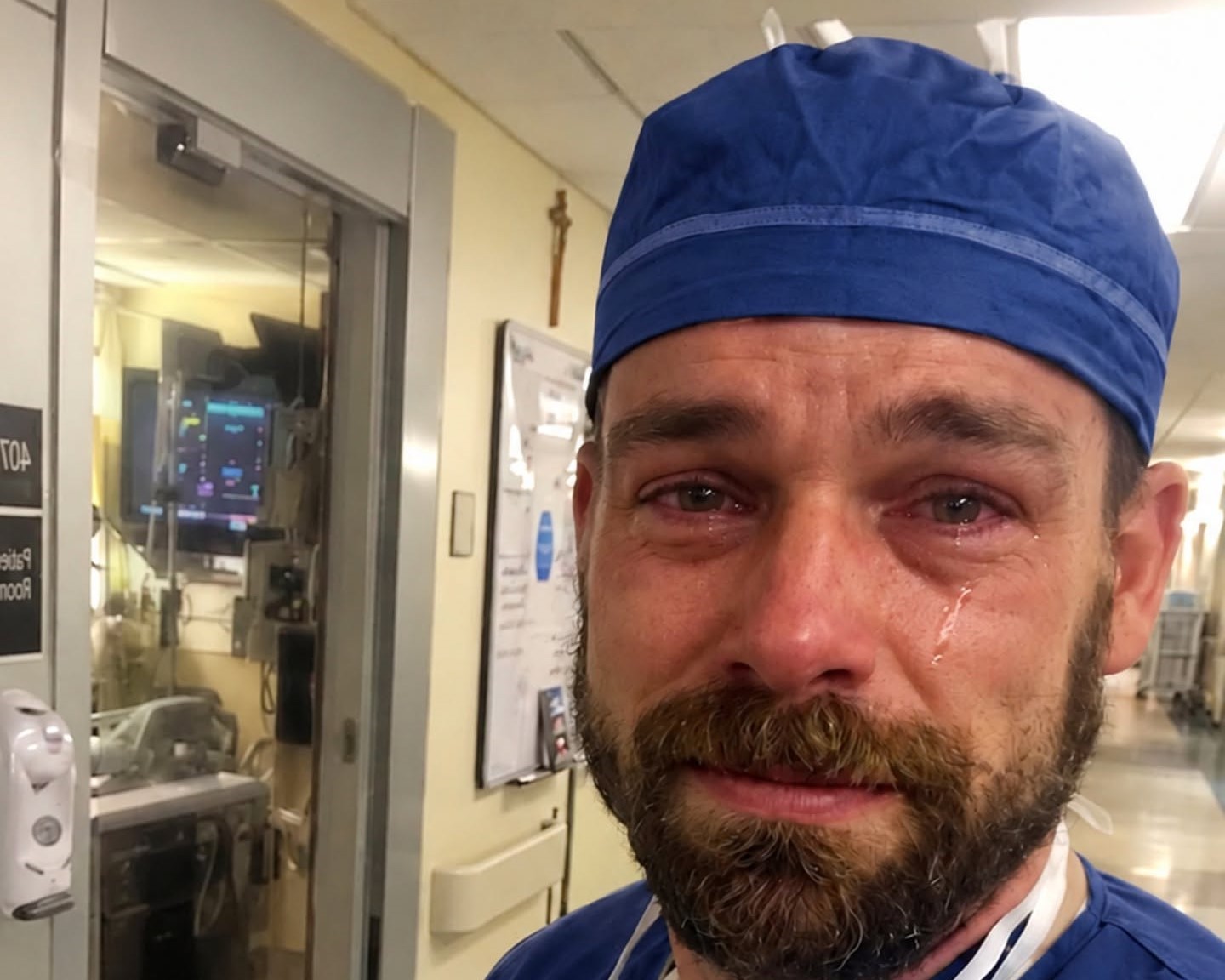
Whenever he finally crawled into bed, he looked so exhausted that I swallowed every complaint. Once, I woke to find him sitting on the edge of the mattress, his shoulders shaking.
“Marcus?”
He wiped his face before turning around.
“Rough night. Go back to sleep.”
So that Tuesday, after watching him leave with his hospital badge clipped to his pocket, I decided to surprise him.
I packed his favorite lunch, added a slice of apple pie, and tucked a note under the fork:
You don’t have to take care of everyone. Let me have a turn.
I drove to the hospital, imagining how happy Marcus would be to see me.
But the moment I arrived, something felt wrong.
At the nurses’ station, a woman I had known for years stopped smiling the moment she saw me.
“Is Marcus around?” I asked. “And please don’t warn him. He’ll tell me I shouldn’t have bothered.”
She glanced at the nurse beside her.
My smile faded.
“Did something happen to him? Where’s Marcus?”
Neither of them answered.
I was starting to get angry at how strangely they were behaving when I spotted Marcus’s colleague, David, approaching me.
His face was as white as a sheet.
He stopped in front of me.
“I’m so glad you’re here!” I said brightly. “Can you tell me where Marcus is?”
David searched my face.
Then, without warning, his eyes filled with tears.
“He hasn’t told you anything, has he?”
Part 2
My blood ran cold. The lunchbox in my hand suddenly felt heavy, pulling at my shoulder as I stared at David’s trembling lips.
“Told me what?” my voice rose, sharp and breathless. “David, what is going on? Is Marcus hurt? Did he collapse?”
David placed a firm, trembling hand on my arm and guided me away from the busy corridor into a private consultation room. He closed the door behind us, shutting out the rhythmic hum of hospital monitors and hurrying footsteps.
“Clara… Marcus isn’t working today,” David said softly, his voice thick with uncontained emotion. “He hasn’t been performing surgeries for six months.”
I stared at him, letting out a hollow, incredulous laugh. “That’s impossible. He leaves every morning with his scrubs. He stays overnight for emergency calls. He was crying on the edge of our bed last week because of a bad shift!”
“He was crying because he couldn’t bring himself to break your heart,” David whispered, pulling a thick medical file from a drawer on the side desk and sliding it toward me. “Six months ago, during a routine tremor assessment, Marcus was diagnosed with early-onset ALS. His fine motor skills in his hands began degrading rapidly.”
The room seemed to spin violently around me. The air vanished from my lungs.
I looked down at the folder. Inside were neurological scans, progression charts, and Marcus’s voluntary surrender of his surgical license.
“He stepped down from the OR immediately,” David continued, tears spilling down his cheeks. “He knew he could never risk a patient’s life. But he couldn’t bear the thought of going home, looking at you and your daughter, and admitting that the man who saved everyone else was losing control of his own body.”
“Where is he?” I choked out, tears blinding my vision as I clutched the lunchbox to my chest. “David, where is my husband right now?”
David wiped his eyes. “He’s down in the pediatric oncology garden. He’s spent every single day of these past six months volunteering there—reading to the children, sitting with families, doing whatever he can to help without a scalpel in his hand.”
Part 3
I practically ran through the lower level glass doors, my heels clicking frantically against the concrete until I reached the secluded courtyard garden.
There, sitting on a wooden bench beneath a blossoming dogwood tree, was Marcus.
He was wearing a simple jacket over his worn blue scrubs. In his lap was a children’s storybook, and sitting beside him on the bench was a little boy with a soft knit beanie, giggling as Marcus tried to do funny cartoon voices.
As I watched him, I saw it—the faint, involuntary twitch in his right hand as he tried to turn the thin page of the book. He paused, swallowed hard, and used his left hand to gently force the page over, keeping his warm smile fixed on the boy’s face so the child wouldn’t notice.
He hadn’t been avoiding our family out of coldness or workaholism. He had been grieving the death of his lifelong passion in absolute solitude, spending his remaining strength bringing comfort to sick children while hiding his failing body from the people he loved most.
“Marcus,” I sobbed out, unable to hold it in any longer.
Marcus froze. He slowly lifted his head, his dark eyes widening in utter shock as he saw me standing at the garden entrance, holding the packed lunchbox and crying.
“Clara…” he whispered, his voice trembling as he stood up awkwardly.
He apologized to the little boy, set the book down, and took three hesitant steps toward me before stopping, looking at the ground like a child caught doing something wrong.
“You weren’t supposed to find out like this,” he choked out, tears welling up in his eyes. “I wanted to give you and Lily one more normal year. I wanted you to remember me as strong, as the man who provided for you, not… not as someone who needed to be taken care of.”
I didn’t wait for him to finish. I dropped the lunchbox onto the grass, rushed forward, and threw my arms around his neck, burying my face into his shoulder.
He hesitated for a second, then wrapped his arms around me, holding me so tightly I could feel the desperate, ragged rise and fall of his chest as he finally let go of the burden he had carried alone for six long months.
“You stupid, brave, wonderful man,” I sobbed into his collar. “Did you really think I only loved you because of what your hands could do in an operating room?”
Marcus pressed his face against my hair, weeping silently. “I was terrified, Clara. I’m so scared.”
“You don’t have to take care of everyone anymore, Marcus,” I whispered, pulling back just enough to look into his tear-stained eyes, taking his trembling right hand into both of mine and pressing it against my cheek. “Let me have a turn.”
Final Part
We walked out of the hospital together that afternoon, hand in hand.
Marcus didn’t return to the hospital as a surgeon again, nor did he hide in the shadows of his own grief. That night, we sat down with our eight-year-old daughter, Lily, and explained that Daddy’s body was going to get tired a little faster now, but that our family was going to fight every single step of the journey together.
Over the next two years, the disease took its physical toll, but it never touched the heart of our home.
Marcus spent every single morning making breakfast for Lily, walking her to the bus stop, and being present for every recital, every anniversary, and every ordinary Tuesday evening that he had missed during his years in the OR.
With the support of David and the hospital board, Marcus established the Hayes Patient Support Fund—a foundation that provided emotional and financial counseling to families dealing with terminal diagnoses. The surgeon who had once saved lives with a scalpel spent his remaining time saving spirits with his wisdom, empathy, and boundless love.
One quiet autumn afternoon, as Marcus sat in his favorite armchair by the living room window wrapped in a warm blanket, watching Lily play in the falling leaves outside, he reached out his left hand and squeezed mine.
“Thank you, Clara,” he whispered softly, his voice faint but steady.
“For what, sweetheart?” I asked, leaning down to kiss his forehead.
“For coming to the hospital that Tuesday,” Marcus smiled, his dark eyes filled with a profound, peaceful warmth. “You saved my life long before I ever needed saving.”
Marcus passed away peacefully a year later, surrounded by a home filled with warmth, laughter, and an abundance of sweet memories.
And every time I look at our daughter—now a bright, compassionate young girl who wants to study medicine—I don’t remember Marcus as the distant, exhausted surgeon who missed birthdays. I remember him as the man who held my hand, who let us love him through the dark, and who taught us that the greatest healing in the world doesn’t happen in an operating room—it happens right at home.
Epilogue: The Garden Beneath the Dogwood
Five years after Marcus’s passing, the early autumn sun streamed through the glass atrium of the hospital’s pediatric wing, casting long, golden geometric patterns across the freshly polished floors.
The hospital had expanded over the years, but the quiet courtyard garden on the lower level remained untouched. The dogwood tree beneath which Marcus had sat with a children’s storybook five years ago was now tall and wide, its branches stretching proudly toward the afternoon sky.
Beside the tree stood a simple, elegant bronze plaque, permanently mounted onto a slate pedestal:
Dr. Marcus Vance (1981–2022)
Surgeon, Humanitarian, Father.
“The greatest healing in the world doesn’t happen in an operating room—it happens right at home.”
I sat on the wooden bench beside the pedestal, holding a warm paper cup of black coffee. The cool breeze carried the familiar scent of ozone, clean cotton, and fallen leaves.
In my lap rested a leather-bound folder detailing the annual report of the Marcus Vance Patient Support Fund.
What had started as a small, quiet initiative in our living room during Marcus’s final months had grown into a nationwide network. The fund now supported over twelve hundred families each year—providing grants for home healthcare, covering lost wages for caregiving spouses, and placing grief counselors directly into pediatric and oncology wards across three states.
David, now the Chief of Surgery, walked through the glass doors of the courtyard, wearing his signature navy scrubs with a lab coat thrown loosely over his shoulders. His silvering hair at the temples was the only hint that five years had swept past us.
“I knew I’d find you down here, Clara,” David said softly, stepping onto the stone path.
“I always stop by before the annual lecture,” I smiled, looking up as he sat beside me on the bench. “How are things upstairs?”
“Chaotic, as usual,” David chuckled, taking a slow breath as he looked at the dogwood tree. “We had three emergency surgeries last night. I was in the OR until 4:00 AM. But every time my hands get tired, I step over to the window, look down at this garden, and remember what Marcus used to say.”
“What was that?”
“‘A scalpel can fix a heart, David, but only presence can comfort one,’” David quoted, his eyes shining with quiet nostalgia. “He was a better teacher in his final two years than most of us are in a lifetime.”
“He loved this place,” I whispered, resting my hand against the cold bronze of the plaque. “He loved the kids here.”
“Speaking of which,” David said, nodding toward the glass entrance. “Your star student is waiting in the auditorium.”
I smiled, closing the folder and standing up.
We walked together up the wide marble staircase to the hospital’s main auditorium. The hall was packed to capacity with first-year medical residents, nursing staff, attending physicians, and pediatric specialists.
Sitting in the front row, wearing a crisp white coat that looked remarkably like the one Marcus used to wear, was thirteen-year-old Lily.
She had grown so tall. Her dark, expressive eyes and steady, thoughtful smile were the spitting image of her father. For her eighth-grade honors project, she had chosen to shadow the hospital’s pediatric palliative care team, and today she was seated as the guest of honor for the annual Marcus Vance Memorial Lecture.
When I stepped up to the podium, the room fell into a respectful, attentive silence.
“Thank you, everyone, for being here,” I began, my voice echoing clearly through the microphone. “Five years ago, my husband, Dr. Marcus Vance, surrendered his surgical license. For a long time, he believed that without his hands, without his scalpel, and without his title as a surgeon, he had lost his purpose.”
I looked out at the sea of white coats, meeting Lily’s bright, proud eyes in the front row.
“Marcus spent his entire career saving lives behind closed doors in the OR,” I continued. “But it wasn’t until he stepped out of those doors—until he allowed himself to be vulnerable, to be seen, and to be cared for by the people who loved him—that he discovered his true legacy. Healing isn’t just about preserving life; it’s about honoring the time we are given with one another.”
I held up the leather report. “Today, because of his courage to speak the truth, thousands of families no longer have to carry their darkest burdens alone in the dark.”
The auditorium erupted into warm, sustained applause.
After the lecture, as physicians and residents gathered around the stage to share stories of how Marcus had impacted their training, Lily walked up the steps and wrapped her arms tightly around my waist.
“You were amazing, Mom,” she whispered into my shoulder.
“Your dad would be so proud of you, sweetie,” I said, kissing the top of her head. “Look at you in that coat.”
“I’m going to be a pediatric neurologist, Mom,” Lily said with absolute, quiet conviction, looking up at me. “I want to be the doctor who helps families find hope when things get scary.”
“I know you will, Lily,” I smiled, holding her close. “I know you will.”
Later that evening, long after the auditorium had cleared and the hospital had settled into its quiet nighttime rhythm, Lily and I walked out through the front entrance together.
The crisp evening air hit our faces, carrying the sweet scent of autumn leaves across the quiet driveway.
I took my daughter’s hand in mine, feeling the warmth of her grip—steady, vibrant, and full of the future.
We didn’t look back at the hospital with sadness or regret. We looked forward, stepping into the starlight, knowing that the man who had loved us so deeply had left behind a light bright enough to guide us for the rest of our lives.
When a couple walked out of the restaurant without paying their $400 bill, I cried because I knew that money would have to come out of my pocket.
At the time, it felt like the worst thing that could happen.
Instead, it became the luckiest $400 I ever lost.
Four hundred dollars was not a small amount of money to me.
It was nearly two weeks of groceries.
It could cover the electric bill and still leave enough to put something toward next semester’s tuition.
For people like the couple sitting in my section that Friday night, $400 might have been the price of a nice dinner.
For me, it was survival.
I was attending college in a neighboring state, close enough to visit home when I had money for the trip but far enough away that every family emergency felt impossible to manage.
I had been working as a waitress at a restaurant near campus for almost a year.
Most evenings were a balancing act between classes, assignments, late shifts, and sending whatever money I could spare back home.
And lately, “whatever I could spare” had become almost everything.
Because four months earlier, my mother had disappeared.
Her name was Evelyn.
Mom and I had always been close, even though she wasn’t exactly the warm-and-fuzzy type.
She was organized almost to a fault.
Appointments were scheduled weeks ahead.
Receipts were stored in labeled folders.
She called me every Sunday evening at exactly eight.
Even the kitchen towels had designated places.
That was why her disappearance made absolutely no sense.
She vanished without packing anything.
Her purse was still at home.
So was her phone.
Her medication.
Most of her clothes.
There was no note.
No message.
No explanation.
Anyone who knew my mother agreed on one thing:
Evelyn Mercer would never simply walk away without telling somebody.
I went home immediately.
I spoke to the police repeatedly.
They asked questions, filed reports, and told us they were looking into it.
But there was no obvious evidence of a crime.
Mom was an adult.
And every possible lead seemed to disappear almost as soon as it appeared.
We considered hiring a private investigator.
We couldn’t afford one.
So I did the only thing I knew how to do.
I made posters.
Hundreds of them.
I taped my mother’s photograph everywhere I could think of.
Supermarkets.
Bus stations.
Coffee shops.
Laundromats.
Restaurants.
All over campus.
I carried extra copies inside my bag in case I met someone who might recognize her.
Before every shift, I checked my phone hoping someone had finally called.
Nobody did.
For four months, there was nothing.
Then came that Friday night.
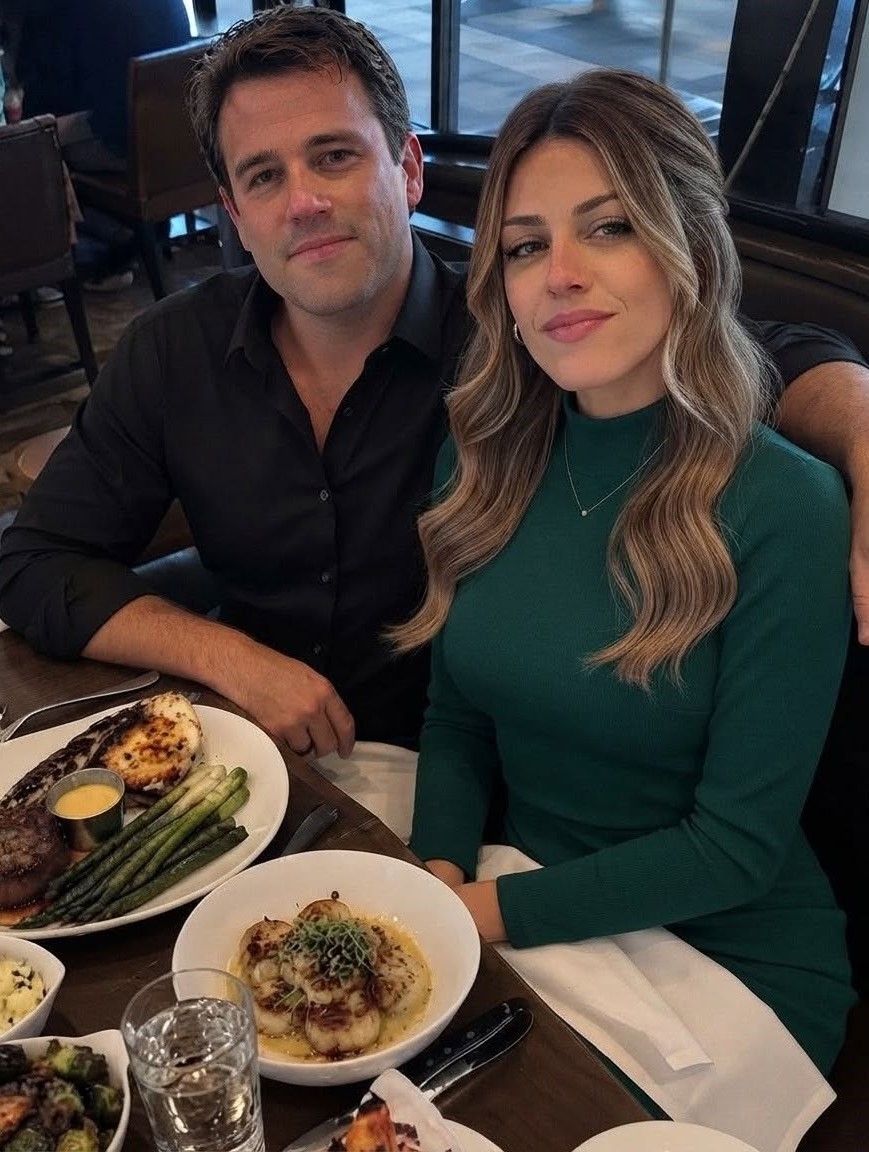
A couple was seated in my section shortly after seven.
They looked wealthy.
Not flashy exactly, but comfortable in the effortless way some people are.
They told me they were celebrating their anniversary.
The woman was polite.
So was her husband.
Actually, they were kinder than many customers I dealt with.
But something about them seemed distracted.
The man kept checking his phone beneath the table.
Every time he looked at it, his wife stopped speaking and watched his expression.
Still, they ordered as though they were determined to enjoy the evening.
Oysters.
Filet mignon.
Lobster.
Several cocktails.
And a bottle of Bordeaux we kept in the locked wine cabinet.
By the time they turned down dessert, their total came to $407.63.
“Could we have the check?” the man asked.
He looked at his phone again.
I placed the leather folder beside him and walked away to deliver drinks to another table.
I was gone maybe three minutes.
When I came back, the booth was empty.
So was the payment tray.
At first, I assumed they had stepped outside.
Then I checked the restrooms.
Nothing.
I hurried toward the front entrance.
They were gone.
My stomach dropped.
I went straight to my manager’s office.
Jett barely looked up when I rushed inside.
“Table twelve left,” I said. “They didn’t pay.”
He sighed.
“Maybe they stepped outside for a cigarette.”
“They’re gone.”
“You sure?”
“Check the cameras.”
He shook his head.
“I don’t have time to go through footage during dinner service.”
Then he said the words I had been dreading.
“You know the policy. Walkouts come out of the server’s pocket.”
I stared at him.
“That’s over four hundred dollars.”
“Then consider it a lesson.”
A lesson.
As though I had personally invited two strangers to steal from me.
At the end of my shift, I paid the bill.
My hands were shaking when I signed the paperwork.
By the time I stepped outside, I had already cried once in the employee bathroom.
Four hundred dollars was gone.
My mother was still missing.
And I had no idea how I was going to explain any of it to my family.
I barely slept that night.
At eight the next morning, Jett called.
“Can you come in?”
“My shift doesn’t start until five.”
“I know.”
His voice sounded strange.
“Just come as soon as you can.”
Twenty minutes later, I walked back into Bellamy’s wearing yesterday’s jeans.
I expected another lecture.
Instead, I found Jett standing beside table twelve.
He looked pale.
“What happened?” I asked.
“The cleaning crew found something.”
He held up a small plastic bag.
“It was wedged behind the booth. They almost missed it.”
He hesitated before handing it to me.
“I’m sorry about last night,” he said. “I should have checked the cameras.”
Then he looked at the bag.
“And after seeing this, I think you need to know what happened.”
Inside was a gold ring.
The second I saw it, I stopped breathing.
Thin band.
Three tiny diamonds.
A pale blue center stone.
One bent prong near the setting.
I knew every scratch.
Every flaw.
Every detail.
Because I had spent four months staring at photographs of that ring.
It belonged to my mother.
She had worn it every day for twenty-three years.
She wore it while cooking.
While sleeping.
While showering.
When Mom disappeared, almost everything valuable had been left at home.
Her jewelry.
Her purse.
Her belongings.
But that ring was missing.
Jett looked at my face.
“You recognize it.”
I nodded.
Of course he knew about it.
I had shown photographs of my mother and that ring to almost everyone I worked with.
I grabbed the bag.
The couple from the night before had somehow possessed the one object Mom was wearing when she vanished.
My mind immediately went somewhere terrible.
If they had the ring, they knew something about her.
Maybe they knew exactly where she was.
Jett opened his office and pulled up the restaurant security footage.
We watched table twelve.
At first, everything looked ordinary.
Then the woman opened her purse.
She searched around inside and pulled something out.
As she withdrew her hand, a tiny object caught against the purse clasp.
The ring.
It slipped from her fingers.
Neither of them noticed.
It landed on the seat, rolled toward the wall, and disappeared into the narrow gap behind the booth.
“That’s how it got there,” Jett whispered.
Then something else happened.
The husband’s phone lit up.
He answered.
Whatever the person on the other end said made him go completely still.
He turned the phone toward his wife.
Her hand flew to her mouth.
They stood so quickly that she knocked the chair sideways.
He grabbed her purse and coat.
Then they rushed out.
The bill was still sitting on the table.
That was when I understood.
“They weren’t running away from the check.”
Jett looked at me.
“No.”
I was already heading toward the employee lounge.
The valet working that morning hadn’t been on duty the night before, but Jett found the man who had been.
“Do you remember that couple from table twelve?” I asked.
He nodded.
“They were in a hurry.”
“Did they say where they were going?”
He thought for a moment.
“The husband told me to get their car immediately.”
Then he frowned.
“He was on the phone. I heard him say something like, ‘Call the hospital. Tell them we’re coming.’”
Hospital.
My heart started racing.
Jett grabbed his keys.
“I’m coming with you.”
“No.”
“Laura, you have no idea who these people are.”
“That’s exactly why I have to go.”
For four months, I had waited.
Waited for police.
Waited for phone calls.
Waited for someone to recognize my mother.
Waited for another person to find the clue I couldn’t find myself.
Waiting had done nothing.
I slipped the ring into my pocket.
This time, I was going.
I reached the hospital in about twelve minutes.
I ran from the parking lot toward reception with the plastic bag clenched in my hand.
A receptionist in blue scrubs looked up.
“I’m trying to find my mother.”
I pulled one of the missing-person flyers from my bag.
Her photograph was worn from being folded and unfolded so many times.
“Her name is Evelyn Mercer. She disappeared four months ago.”
The receptionist looked at the photograph.
“I’m sorry, but I can’t provide patient information.”
“Please.”
I held up the ring.
“She was wearing this when she disappeared. Last night, two people had it at the restaurant where I work. They left suddenly and came here.”
Her expression changed.
She looked at the poster again.
Then she started typing.
“What did they look like?”
I described the couple.
Seconds passed.
They felt like hours.
Finally, she shook her head.
“There’s nobody registered under Evelyn Mercer.”
My hope collapsed.
Then she stopped.
“Wait.”
She typed again.
Her expression became more serious.
“There is an unidentified woman.”
I stepped closer.
“What?”
“She was admitted several weeks ago. She was confused when she arrived and couldn’t tell anyone her name. She was later transferred to neurological care.”
My heart began pounding.
“Does she look like this?”
The receptionist studied Mom’s picture.
“I can’t confirm that from here.”
Then she softened.
“But the age and general description are similar.”
“That’s her.”
I knew it.
I don’t know how.
I just knew.
Then the receptionist said something that made the situation even more urgent.
“The patient suffered a seizure yesterday. She’s stable now, but she isn’t really supposed to have visitors.”
“I’m her daughter.”
She hesitated.
“She already has two people with her.”
The couple.
My mind filled with every nightmare I had been trying not to imagine.
They had my mother’s ring.
They knew where she was.
And now they were sitting beside her hospital bed.
“You don’t understand,” I said. “Those people may have done something to her.”
The receptionist looked toward security.
I lowered my voice.
“Please. Let me see her. If I’m wrong, I’ll leave immediately. But if that woman is my mother…”
I couldn’t finish.
After a moment, she picked up the phone.
She spoke quietly to someone upstairs.
Then she printed a visitor badge.
“Third floor. Room 318. A nurse will meet you.”
I grabbed it.
“And miss?”
I turned.
“Prepare yourself. She may not recognize you.”
The elevator took forever.
A nurse met me on the third floor and led me down a quiet corridor.
Then we stopped outside room 318.
Through the narrow window, I saw them.
The couple from Bellamy’s.
The woman was still wearing the same green dress, although now it was wrinkled.
Her husband’s silver hair was messy.
They no longer looked polished or wealthy.
They looked exhausted.
I pushed the door open.
The woman turned around.
Her eyes immediately dropped to the plastic bag in my hand.
“That ring,” she whispered.
I stepped closer.
“Where did you get it?”
Her husband raised both hands.
“Please. The patient needs quiet.”
“You had my mother’s ring.”
The woman stared at me.
“Your mother?”
I looked toward the bed.
And the rest of the room disappeared.
There she was.
My mother.
Evelyn.
She looked smaller than I remembered.
Pale.
Thin.
An IV taped to the back of her hand.
For four months, I had pictured finding her a thousand different ways.
But I had never imagined this.
“Mom?”
Her eyelids moved.
She didn’t wake.
My knees almost gave out.
I grabbed the bedrail.
Then I turned toward the couple.
“Who are you?”
Neither answered immediately.
“What did you do to her?”
The woman’s eyes filled with tears.
“Nothing.”
Her voice shook.
“We found her.”
Her name was Margaret.
Her husband was Thomas.
Several weeks earlier, they had been driving outside town when they saw a woman walking beside the road.
It was my mother.
She was barefoot.
Disoriented.
She couldn’t say where she lived.
She couldn’t tell them her name.
She had no purse.
No phone.
No identification.
They stopped.
They called an ambulance.
Then they followed it to the hospital.
Margaret looked toward my mother.
“She wouldn’t let go of my hand.”
I said nothing.
“Whenever I tried to leave, she became frightened.”
Doctors believed Mom had experienced some kind of injury that affected her memory.
The hospital had registered her as unidentified.
But because she had been found in another jurisdiction, nobody connected her to the missing-person report back home.
Then Thomas explained the ring.
During Mom’s examination, nurses had removed it.
She kept trying to put it back on, but she had lost so much weight that it no longer fit properly.
Margaret volunteered to keep it safe.
“I was worried it might disappear,” she said. “There are so many people coming in and out of hospital rooms.”
So she placed the ring inside her purse.
For weeks, Margaret and Thomas visited my mother almost every day.
She had no family that anyone could identify.
No name.
No memories.
And they couldn’t bring themselves to abandon her.
The previous night was their anniversary.
After spending weeks going back and forth between home and the hospital, they decided to have one dinner together.
That explained everything.
Thomas had kept looking at his phone because they were waiting for updates about the unidentified woman in room 318.
Then the hospital called.
Mom had suffered a seizure.
“We didn’t even think about the restaurant bill,” Thomas said. “We barely thought about anything. We just came straight here.”
The anger I had been carrying disappeared.
In its place came embarrassment.
“You stayed with her this whole time?”
Margaret looked toward the hospital bed.
“We kept hoping someone would eventually come looking for her.”
My eyes filled with tears.
“I did.”
My voice broke.
“I never stopped.”
Then I heard movement.
Mom’s fingers twitched against the blanket.
Her eyelids slowly opened.
At first, her gaze wandered around the room without recognition.
Then her eyes found me.
I stopped breathing.
Her forehead creased.
She stared as though trying to pull my face from somewhere deep inside a fog.
Then she whispered one word.
“Laura?”
Everything inside me broke.
I bent over the bed, laughing and crying at the same time.
“Yes.”
I wrapped my arms around her carefully.
“Yes, Mom. It’s me.”
Her weak hand lifted toward my face.
She touched my cheek.
“I knew you were somewhere,” she whispered. “I just couldn’t remember how to get back.”
I pulled the ring from the plastic bag.
Then I carefully slid it onto her finger.
It was loose now.
Too loose.
So she curled her fingers around my hand to keep it from slipping off.
Then she looked at me.
“Take me home, Laura.”
I squeezed her hand.
“I will.”
Behind me, Margaret began crying.
Thomas wrapped an arm around her shoulders.
And only then did I fully understand what had happened.
They hadn’t stolen my mother’s ring.
They hadn’t taken her away from me.
They were the reason she had survived long enough for me to find her.
The couple who left me with a $407 dinner bill had spent weeks caring for a nameless woman simply because they couldn’t bear to leave her alone.
And if they hadn’t forgotten to pay that bill…
If Margaret hadn’t dropped the ring…
If the cleaning crew hadn’t found it behind that booth…
I might never have known where my mother was.
That night had cost me $400.
At the time, I thought I had lost money I couldn’t afford to lose.
Instead, it led me to something I had spent four months desperately trying to find.
My father was never a man who expressed himself easily.
He didn’t give emotional speeches or write long, sentimental letters. I can’t remember him ever saying “I love you” in the direct way people often expect parents to say it.
He was a civil engineer, and he approached almost everything—including emotion—the way he approached a bridge: use only what was necessary, but make sure whatever you built could carry the weight.
His language was action.
He showed up.
He attended every school performance I ever had, even when my only role was standing silently in the background. He sat through Eric’s baseball games in pouring rain, including seasons when my brother’s team barely won anything.
And when our mother left us when I was eleven and Eric was eight, Dad rearranged his entire life around raising us.
He didn’t make a speech about sacrifice.
He simply stayed.
For thirty-two years of my life, that was the most important thing I knew about my father.
He was there.
Then suddenly, he wasn’t.
Dad was diagnosed with pancreatic cancer in March. By September, we understood how little time remained. For six months, Eric and I reversed the roles Dad had played our entire lives. We drove him to appointments, stayed beside him during difficult nights, and slowly learned what it meant to watch someone run out of time.
He died on a Tuesday morning in October.
He was sixty-eight.
He left behind his house, the lingering smell of his coffee and aftershave, two children who had been shaped by him more deeply than either of us understood—and one final secret.
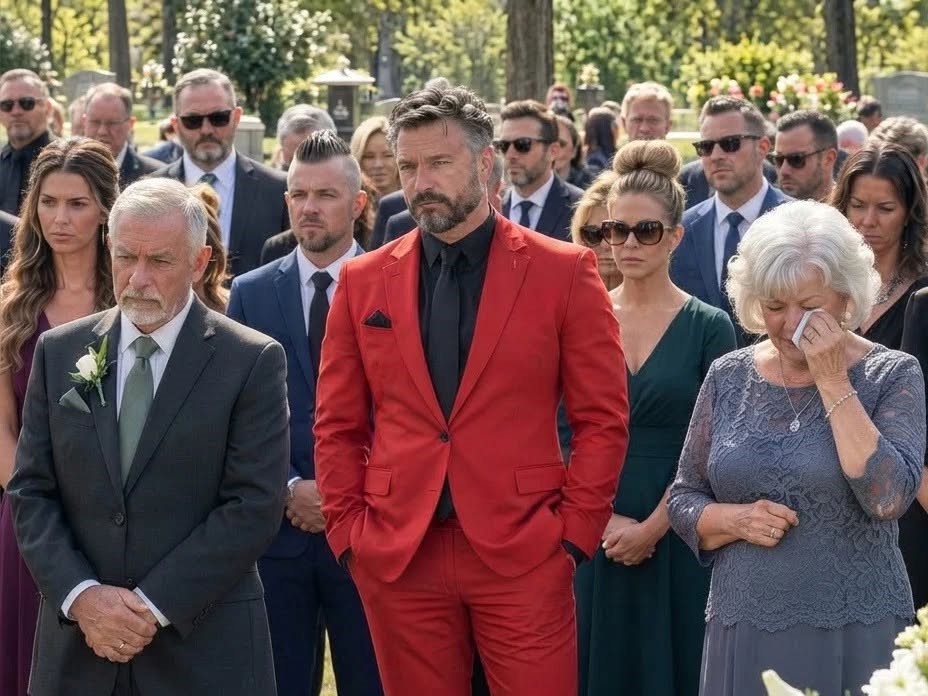
That secret walked into his funeral wearing a bright red suit. :chatgpt-content-reference{index=”0″}
—
My younger brother Eric had always been complicated.
He was four years younger than me and had an extraordinary talent for doing the wrong thing for the right reasons.
He was late constantly, but if you called him and said you were struggling, he would drive four hours through a snowstorm without thinking twice.
He was blunt.
Stubborn.
Loyal.
And for most of his adult life, he and Dad could barely spend an hour together without irritating each other.
The problem was simple.
They were almost identical.
Same stubbornness.
Same pride.
Same laugh.
And, unfortunately, the same habit of becoming silent whenever they were hurt.
Five years before Dad died, Eric went through a painful divorce. Somewhere during that period, he and Dad had an argument.
Technically, everyone knew what the argument had been about.
But families understand that some arguments are never really about the thing that started them.
This one carried twenty years of misunderstandings underneath it.
Afterward, Eric and Dad remained polite.
They called on birthdays.
They saw each other at Christmas.
But something between them had closed.
I knew Dad regretted it.
Naturally, he never said so.
But during those final six months, I noticed how his expression changed whenever Eric’s name came up.
I noticed the phone calls that ended sooner than Dad wanted.
And one evening, I saw him sitting alone at the kitchen table, carefully writing something on a sheet of paper.
He would write.
Stop.
Think.
Then begin again.
I never asked what it was.
After his funeral, I wished I had.
The morning we buried Dad was cold and clear.
I arrived early wearing the black dress I had bought specifically for the funeral and a pair of shoes Dad had given me two birthdays earlier.
People slowly filled the chapel.
Then, after nearly everyone had taken their seats, the doors opened.
Eric walked in.
Every head seemed to turn.
Because my brother was wearing red.
Not burgundy.
Not dark crimson.
Bright red.
A perfectly fitted, impossible-to-ignore red suit.
He walked to Dad’s casket, stood there silently for several seconds, then came and sat beside me.
I leaned toward him.
“What on earth are you wearing?”
“Not now, Sarah.”
“Dad would have hated this.”
That made Eric finally look at me.
His expression wasn’t angry.
It was strangely certain.
“No,” he whispered. “He wouldn’t.”
Then the service started.
I didn’t ask again.
But throughout the eulogies, I kept watching my brother.
The minister talked about Dad’s reliability, his steadiness, and his habit of making people feel that someone had remembered them.
Eric stared forward, his jaw tightening exactly the way Dad’s used to whenever he was trying to contain emotion.
For a moment, I remembered what years of arguments had made me forget.
Those two men had always been almost exactly alike.
Everything changed at the cemetery.
Dad’s longtime attorney, Herbert Lawson, approached us after the burial.
Mr. Lawson had handled Dad’s legal affairs for decades. He was seventy-three, meticulous, composed, and rarely surprised by anything.
Then he saw Eric.
More specifically, he saw the red suit.
He stopped walking.
His face lost its color.
“Where did you get that?”
Eric frowned.
“Why?”
“Just tell me.”
Eric hesitated.
“It was in Dad’s closet.”
I immediately looked at him.
“What closet?”
I had already gone through Dad’s main closet and the spare bedroom.
There had been no red suit.
“The downstairs one,” Eric said.
Dad’s study was downstairs.
And as far as I knew, Dad’s study didn’t have a closet.
Eric explained that while searching for Dad’s military papers for the funeral arrangements, he had run his hand along one of the bookshelves.
That was when he noticed something unusual.
A narrow section of the bookcase moved.
The entire shelf was mounted on hidden hinges.
Behind it was a small concealed closet.
Inside hung three garment bags.
Two contained black suits.
The third contained the red one.
Pinned to it was a note bearing Eric’s name.
Mr. Lawson stared at him.
Then he asked one strange question.
“Did you check the pockets?”
Eric shook his head.
Mr. Lawson pulled us away from the other mourners and began examining the jacket.
The pockets were empty.
Then his fingers stopped over Eric’s chest.
He pressed the lining.
Something crackled underneath.
Mr. Lawson looked at us.
“Your father told me I would know when the time came.”
He opened his briefcase and removed a tiny pair of scissors.
I stared at him.
“Time for what?”
He didn’t answer.
He carefully cut several stitches in the jacket lining.
Inside was a folded piece of heavy paper.
Eric took it.
His hands started shaking before he even finished unfolding it.
Then he read.
I watched his face change.
I had known my brother my entire life, but I had never seen that expression before.
It looked like someone had just returned something to him that he had stopped believing he would ever receive.
Later, Eric let me read part of the letter.
Some of it belonged only to him, and I will always respect that.
But I can tell you what Dad was trying to say.
He wrote about Eric’s divorce.
About their argument.
About all those silent years afterward.
And then Dad admitted something.
He had failed to show up.
Not physically.
Dad had always been there physically.
But during the worst period of Eric’s divorce, my brother hadn’t needed advice or solutions.
He had needed his father to say:
I see what this is costing you.
I know you’re hurting.
I’m here.
Dad had felt those things.
He simply hadn’t said them.
Eric interpreted his silence as judgment.
Dad eventually realized that two men who both hid pain behind silence had spent years misunderstanding each other.
In the letter, Dad apologized for assuming Eric somehow knew what he had never spoken aloud.
He admitted he had spent his life being better at showing love than explaining it.
And because he no longer had enough time to say those things face-to-face, he had found another way.
That was Dad.
He built things.
Bridges.
Structures.
Hidden compartments.
Solutions.
And now, with his time disappearing, he had built one last structure capable of carrying the words he had failed to say while he was alive. :chatgpt-content-reference{index=”1″}
A hidden closet.
A red suit.
A letter sewn into its lining.
All of it designed for Eric.
I turned to Mr. Lawson.
“You knew?”
“Not exactly.”
He explained that Dad had visited him in August.
Dad told him he had arranged something but refused to explain exactly what.
He simply said that when the moment arrived, there would be an unmistakable sign.
Mr. Lawson looked at Eric’s brilliant red jacket.
Apparently, Dad had been right.
“And what were you supposed to do?” I asked.
“Make sure Eric found what he was supposed to find.”
If Eric discovered the suit, Mr. Lawson was supposed to check that the plan had worked.
If Eric came to the funeral without it, Mr. Lawson had instructions to guide him toward Dad’s study afterward.
I almost laughed.
“He planned a backup plan?”
Mr. Lawson gave me a knowing look.
“Your father planned contingencies for everything.”
Of course he did.
Dad had spent his career calculating loads, stresses, weaknesses, and redundancies.
He had apparently approached reconciliation exactly the same way.
Later, I found Eric sitting alone on a cemetery bench.
The letter was still in his hands.
I sat beside him.
For several minutes, neither of us spoke.
Finally, Eric shook his head.
“He planned all of this.”
“Yes.”
“The hidden bookcase alone must have taken forever.”
“Probably.”
Then I asked the question that had been bothering me.
“Why red?”
Eric looked down at the jacket.
“That’s in the letter.”
Dad had ordered the suit specifically for him.
Why?
Because Dad had spent years watching Eric make himself smaller whenever he entered rooms where he feared he wasn’t wanted.
Dad didn’t want that happening at his funeral.
He wanted his son visible.
Impossible to overlook.
The note attached to the suit essentially told Eric to put it on and enter as though he belonged there.
Because he did.
Dad had ordered it in July using Eric’s measurements.
He never lived long enough to see Eric wearing it.
But Eric had followed the instruction anyway.
He had walked into a room filled with black and gray dressed in brilliant red without understanding why.
He simply trusted that Dad had a reason.
And Dad did.
Mr. Lawson eventually joined us carrying another folder.
“There’s more.”
Dad had called certain things in his estate his **non-monetary assets**.
He had left one for each of us.
Mr. Lawson handed us two envelopes and said Dad specifically wanted us to open them at the cemetery together.
Mine contained an old photograph.
Dad was young, wearing his military uniform.
But instead of standing stiffly for the camera, he was laughing.
Really laughing.
His head was thrown backward, his eyes closed.
I had rarely seen him look that carefree.
On the back, he had written a short message thanking me for teaching him that sometimes simply being present was enough.
Under the photograph was an engineering specification for the bridge he had been proudest of designing.
It was a pedestrian bridge from early in his career.
Dad had written another message in the margin.
He wanted me to walk across it someday.
Preferably with someone I loved.
Then I looked at Eric.
His envelope contained only one object.
A key.
And a card.
The message directed him to Dad’s garage.
Far-left cabinet.
Behind the paint cans.
Something was waiting there that Dad believed Eric should have received years earlier.
We went back to the house still dressed for the funeral.
Mr. Lawson followed us.
Eric found the tall cabinet.
The old key fit perfectly.
Behind several paint cans was a large flat package wrapped in brown paper.
Eric carried it to Dad’s workbench.
Then he opened it.
Inside was an oil painting.
Two boys stood in the backyard of our childhood home.
I recognized the tire swing.
The old fence.
The oak tree.
And the boys.
Eric and me.
They were facing away, looking toward something outside the frame. The younger boy—Eric—had one hand resting against the older child.
On the back, Dad had written that he started the painting after our mother left.
He could never get it right.
So he kept working on it.
The hardest part, he explained, had been capturing the light the way he remembered it.
Apparently, after all those years, he finally believed he had succeeded.
Then came the final message:
We had always belonged to each other.
We shouldn’t forget it. :chatgpt-content-reference{index=”3″}
Eric sat down on the garage floor.
Still wearing that ridiculous, beautiful red suit.
He covered his face.
I sat beside him.
Neither of us cared that our funeral clothes were touching the cold concrete.
Dad’s garage still smelled like sawdust, motor oil, and him.
After a while, Eric whispered:
“He knew.”
“He knew.”
“He knew I’d find everything.”
And gradually, we understood how carefully Dad had designed the entire thing.
There had even been another note inside the hidden closet.
Dad reminded Eric that when he was sixteen, he had once noticed the edge of the hidden bookcase hinge.
Eric had forgotten.
Dad hadn’t.
He had built the entire plan around the son he actually had.
Not the son he wished Eric had been.
Not some idealized version of him.
The real Eric.
The boy who noticed details.
The man who preferred finding answers himself rather than asking for help.
Dad had designed the message specifically for the person receiving it.
—
Then Mr. Lawson appeared in the garage doorway.
“There’s one last thing.”
This time, Dad hadn’t wanted it hidden in a jacket or written on a card.
He wanted someone to say it aloud.
Mr. Lawson cleared his throat.
Dad wanted us to know that he understood his difficulty with words had hurt the people he loved.
He regretted making us work so hard to understand what he felt.
Building things had always been his language, he explained.
But he wished he had translated that language more often.
Then came the sentence that finally broke through both Eric and me:
We were the best thing he had ever built.
Mr. Lawson paused.
Then he added something that made Eric almost laugh.
Dad had made him practice delivering the message.
Three times.
Apparently, even from the edge of death, Dad had opinions about pacing.
Eric and I stayed at Dad’s house that night.
We ate cereal for dinner at the kitchen table because neither of us wanted to cook.
It was strangely appropriate.
When we were children and Dad was exhausted, cereal had been his emergency dinner solution.
We spent hours talking about him.
Not the polished funeral version.
Our father.
The stubborn one.
The funny one.
The man who quietly repaired something Eric had broken as a child without ever lecturing him because, in Dad’s mind, Eric already knew he had made a mistake.
Eventually, we looked at the painting leaning against the wall.
Dad had started it when our mother left.
We had been eleven and eight.
He had worked on it, on and off, for twenty-five years.
Twenty-five years trying to get the light right.
Neither of us knew what to say after realizing that.
Then Eric looked at the red jacket hanging over a chair.
“He told me I belonged there,” he said.
He explained that when he first found the suit, he didn’t know about the letter sewn inside.
The visible note simply told him the suit was for him and that when the time came, he should wear it.
That meant Dad had deliberately created a test of trust.
Eric had to choose whether to follow one strange final instruction without knowing why.
Wear a bright red suit.
Walk into your father’s funeral.
Let everyone stare.
Trust me.
And Eric had.
That was what Dad had needed from him.
One final act of trust.
And once Eric gave it, Dad gave something back.
All the words that should have been spoken years earlier.
The next morning, Eric left.
Before getting into his car, we hugged.
We weren’t usually people who hugged.
We were Dad’s children.
We tended to show up instead.
But that morning, we did both.
Eric took the letter, the old key, and the painting.
The red suit went into a garment bag.
I asked what he planned to do with it.
He thought for a moment.
“Wear it again.”
“When?”
“Something important. Somewhere I need to remember that I’m allowed to walk in like I belong.”
I smiled.
“Dad would like that.”
Eric nodded.
“I know.”
A week later, I discovered eight small sketchbooks on a high shelf in Dad’s bedroom.
They were filled with decades of drawings.
Some were engineering sketches.
But most were us.
Eric laughing at eight.
Me sitting on the steps at eleven, trying not to cry after Mom left.
Eric at sixteen, studying something outside the frame.
Both of us at Christmas.
Dozens and dozens of moments from our childhood and adulthood.
Dad had been watching.
Remembering.
Keeping us.
Inside the first sketchbook, he had written one sentence:
**The things I couldn’t say, I drew.** :chatgpt-content-reference{index=”5″}
I sat on his bedroom floor surrounded by thirty years of things my father had never managed to say aloud.
And suddenly I understood him more clearly than I ever had while he was alive.
Dad had spent his entire life constructing things strong enough to carry weight.
Bridges.
Homes.
Hidden closets.
Paintings.
Letters.
A bright red suit.
And in the final months of his life, he had built one last structure—one designed to carry all the love, regret, forgiveness, and reassurance he had never known how to put into conversation.
It worked.
The bridge Dad designed all those years ago is still standing.
MY SIXTEEN-YEAR-OLD DAUGHTER DISAPPEARED FROM A CROWDED BEACH WITHOUT HER PHONE, HER SANDALS, OR A SINGLE EXPLANATION.
EIGHT YEARS LATER, THE FIRST REAL CLUE I FOUND WASN’T A POLICE CALL OR A MESSAGE.
IT WAS A FADED TURQUOISE COVER-UP WORN BY A STRANGER.
And the moment I saw the crooked yellow sun stitched into the hem, I knew exactly who it had once belonged to.
My daughter Nora disappeared when she was sixteen.
We had been spending the day at a crowded beach.
She told me she was walking down to the ice cream stand at the far end.
I watched her leave.
I still remember thinking how much taller she had gotten that year.
Twenty minutes passed.
Her towel was still beside mine.
Her sandals were sitting neatly on top of it.
And her phone was still inside her bag.
At first, I was irritated.
Then confused.
Then terrified.
Lifeguards searched the water.
Police checked the bathrooms, parking lots, nearby hotels, and the roads leading away from the beach.
They found the ice cream stand.
But nobody working there remembered seeing Nora.
There was no useful camera footage.
No witness who could explain where she had gone.
Nothing.
The last thing Nora had been wearing was a turquoise beach cover-up my mother had sewn for her that spring.
It was made of lightweight cotton and loose enough to wear over a swimsuit.
Inside the bottom hem, my mother had embroidered Nora’s initials.
N. V.
On the first day of that vacation, Nora caught one corner of the fabric on a piece of driftwood and tore it.
My mother repaired the damage herself.
But instead of trying to hide the patch, she stitched a tiny yellow sun over it.
The sun was slightly crooked.
Nora laughed when she saw it.
“It looks weird now.”
My mother smiled.
“It looks one of a kind.”
Nora rubbed the stitching between her fingers.
“I think I like it better this way.”
For eight years, I remembered those words.
I had taken one photograph of Nora wearing that cover-up about forty minutes before she vanished.
She was standing barefoot in the sand, squinting into the sun and holding up one hand because she was telling me to stop taking pictures.
That photograph became the image everyone knew.
Police enlarged it.
News stations used it.
Volunteers printed it on flyers.
For years, I studied every detail.
Her face.
Her hair.
The turquoise fabric.
That crooked yellow sun.
None of it brought her home.
Eventually, the organized searches stopped.
Then the phone calls became less frequent.
People who had once asked what they could do slowly stopped asking.
Life kept moving for everyone else.
For Michael and me, time simply reorganized itself around Nora’s absence.
My husband became quieter.
I became obsessed with details.
Every report about an unidentified young woman caught my attention.
Every supposed sighting.
Every message from a stranger claiming they had seen Nora in a grocery store, a train station, or a bus terminal.
Most of them led nowhere.
Some were cruel.
Eventually, I stopped going near beaches.
I couldn’t hear waves without being pulled back to that afternoon.
So when Michael suggested we spend a weekend in a coastal town nearly six hundred miles from home, I immediately said no.
He asked again.
“It doesn’t have to be about the beach.”
“It is literally a beach town.”
“We can eat. Walk around. Sit somewhere. If you hate it, we leave.”
I looked at him.
He looked exhausted.
We were both in our forties by then.
And we had spent eight years building our lives around someone who wasn’t there.
So I agreed.
The first day was difficult.
I refused to go near the water.
We stayed on the boardwalk.
Michael bought coffee.
I pretended not to notice families walking past us carrying towels and beach toys.
Then we passed a café with outdoor seating.
A woman was standing near the railing talking to a server.
She looked around fifty.
Maybe older.
She was wearing a faded turquoise cover-up.
My body reacted before my mind did.
I stopped walking.
There had to be thousands of turquoise beach cover-ups in the world.
I knew that.
Then the wind lifted one corner of the fabric.
And I saw it.
A tiny yellow sun.
Crooked.
Hand-stitched.
Exactly where my mother had sewn it.
I crossed the terrace without realizing I had started moving.
“Excuse me.”
The woman turned.
“Where did you get that?”
She glanced down.
“This?”
“Yes.”
Her expression shifted.
“I’ve had it for years.”
“Where did you get it?”
My hands were already shaking.
Michael called my name behind me.
I barely heard him.
I pulled out my phone.
It took me several tries to find the photograph because my fingers wouldn’t cooperate.
Then I held it in front of her.
Nora.
Sixteen years old.
Standing on the beach in that exact turquoise cover-up.
The yellow sun clearly visible near the hem.
The woman stared at the picture.
Then at me.
Then past my shoulder.
Suddenly, she grabbed my wrist.
“Put that away.”
Her voice was low.
“She can’t know you’re here.”
The entire world seemed to shift beneath me.
“Who?”
The woman looked frightened.
Or maybe sad.
Then she whispered one word.
“Nora.”
I turned.
At first, I couldn’t find her.
There were too many people.
Then I looked through the café window.
A young woman wearing a black apron was carrying two plates toward a table.
Her hair was dark and pulled into a low ponytail.
She was thinner than the girl I remembered.
Older, obviously.
Her face had changed.
But not enough.
I knew her.
A mother knows.
My knees nearly gave out.
Michael caught my arm.
“What is it?”
I couldn’t speak.
The woman grabbed my other hand.
“Please don’t go in there.”
“That’s my daughter.”
“I know.”
“She’s alive.”
“Yes.”
Michael followed my gaze.
His entire body went rigid.
“Oh, my God.”
He started toward the café.
The woman quickly stepped in front of him.
“No.”
Michael stared at her.
“Move.”
“Please.”
“That is our daughter.”
“I know exactly who she is.”
“Then move.”
I said his name.
Michael looked at me.
I don’t know why I stopped him.
Maybe it was the expression on the woman’s face.
She didn’t look like someone trying to keep Nora from us.
She looked terrified of what Nora might do if we surprised her.
“Who are you?” I asked.
“My name is Elaine.”
“How do you know my daughter?”
Elaine looked through the café window.
Nora was laughing at something a customer had said.
I hadn’t heard my daughter laugh in eight years.
Elaine lowered her voice.
“I used to run a small women’s shelter about forty minutes from here.”
Michael and I stared at her.
“Nora came to us four years ago.”
I felt the air disappear from my lungs.
“Four years ago?”
“She was twenty.”
“Where was she before that?”
Elaine closed her eyes briefly.
“With a man she couldn’t easily leave.”
My stomach turned.
“What man?”
Elaine looked at both of us.
“I think you should sit down.”
We moved to a small patio around the side of the café where Nora wouldn’t easily see us.
Every part of me hated it.
My daughter was alive only yards away.
I wanted to run inside.
Touch her face.
Hear her call me Mom.
But Elaine repeated the same warning.
“If you surprise her, she may panic and leave.”
That stopped me every time.
Elaine told us Nora had arrived at the shelter late one night.
She had almost nothing with her.
No phone.
Very little money.
No bag.
She was exhausted and frightened.
At first, she gave them a different name.
Weeks passed before she admitted she had family elsewhere.
Months passed before she admitted that she had disappeared when she was a teenager.
“She told you about us?” I asked.
“Eventually.”
“Then why didn’t you call the police?”
Elaine met my eyes.
“Because Nora was already an adult by the time she came to me. And she begged me not to contact anyone.”
Michael’s expression hardened.
“You knew she was a missing person.”
“Not when she first arrived.”
“But you eventually knew.”
“Yes.”
“And you did nothing?”
Elaine remained calm.
“I encouraged her to contact you. Many times.”
“That’s not the same thing.”
“No,” she admitted. “It isn’t.”
I understood Michael’s anger.
Part of me felt it too.
But another part couldn’t stop thinking about one thing.
Nora had survived long enough to reach Elaine.
“What happened to her?” I asked.
Elaine looked toward the café again.
Then she began.
“When Nora was sixteen, she had secretly been seeing a nineteen-year-old named Caleb.”
The name meant nothing to me.
That made it worse.
Elaine explained that Nora had met him online after lying about her age.
They had been communicating for several months.
Nora knew Michael and I would never approve of her seeing someone older.
So she kept him hidden.
On the day she disappeared, Caleb convinced her to leave the beach with him.
Only for the weekend.
That was how he presented it.
Two days away.
A small adventure.
Something exciting.
Something that would supposedly prove she trusted him.
He told her to leave her phone behind so we couldn’t track her.
She left her sandals because she had been walking barefoot.
She climbed into his car wearing her swimsuit and the turquoise cover-up.
I pressed both hands over my mouth.
Michael looked physically ill.
“What happened?” he asked. “Why didn’t she come back?”
Elaine was silent for a moment.
“Because Caleb didn’t bring her back.”
At first, Nora believed they were simply staying away a little longer.
Then things changed.
Caleb began deciding where she could go.
He kept control of most of their money.
He told her the police were looking for him too and that if she returned home, they would both get into trouble.
Then came the lies about us.
He told Nora we hated her.
That we would never forgive her for leaving.
That everyone would call her foolish.
That there was no point going back.
They moved repeatedly.
Cheap motels.
Friends’ apartments.
Eventually another state.
Caleb took irregular jobs.
Nora worked too.
But he controlled most of what she earned.
Whenever she talked about leaving, he frightened her into staying.
Sometimes with threats.
Sometimes by insisting he could make sure she never saw us again.
“He told her he knew where you lived,” Elaine said. “He made her believe contacting you could put you in danger.”
I stared at her.
“How long?”
“Almost four years.”
Four years.
My sixteen-year-old daughter had made one reckless choice.
Then she spent years believing she could never undo it.
“How did she finally get away?”
Elaine explained that Caleb was arrested after an unrelated incident.
It had nothing to do with Nora.
But while he was gone, she realized it might be her only chance.
She took some hidden cash.
Left the apartment.
Got on a bus.
At the bus station, another woman told her about the shelter.
That was how Nora eventually found Elaine.
“She was terrified Caleb might come looking for her,” Elaine said.
“Did he?”
“Not that we know of.”
“Where is he now?”
“I don’t know. Nora hasn’t seen him in years, and she doesn’t want to know.”
Michael stared at the table.
Then he asked the question I had been afraid to hear.
“Why didn’t she call us once she was safe?”
Elaine looked at me.
I already knew the answer would hurt.
“She was ashamed.”
I started crying before she finished.
Nora believed we would blame her because she had left willingly.
She thought we would ask why she hadn’t escaped earlier.
Why she had trusted Caleb.
Why she had stayed.
Why she hadn’t called.
Then too much time passed.
A year.
Then another.
Elaine helped her replace her identification.
Find counseling.
Get a job.
Eventually, Elaine left the shelter and opened the café.
She offered Nora work.
Nora had been there ever since.
I looked at the turquoise cover-up Elaine was wearing.
“What about this?”
Elaine glanced down.
“Nora gave it to me.”
“Why?”
“About two years ago, she was clearing out old things.”
Elaine touched the fabric.
“She said she hated seeing it.”
My eyes went to the yellow sun.
My mother’s stitches.
Elaine’s voice softened.
“Nora said it was what she had been wearing on the day she ruined her life.”
Something inside me cracked.
“She did not ruin her life.”
Elaine nodded.
“I know.”
“She was sixteen.”
“Yes.”
“She made one bad decision.”
“Yes.”
“That didn’t mean she deserved everything that came afterward.”
“No.”
I wiped my face.
“Does she know we looked for her?”
“Yes.”
“Then why…”
I couldn’t finish.
Elaine did.
“Because knowing people love you and believing you still deserve that love are two different things.”
I looked through the café window again.
My daughter was wiping down a table.
She was twenty-four years old now.
I had missed eight birthdays.
Eight Christmases.
Jobs.
Apartments.
Bad days.
Good days.
Entire pieces of her life I could never get back.
“I need to see her.”
“You will.”
Elaine paused.
“But let me speak with her first.”
Michael leaned forward.
“What if she says no?”
Elaine didn’t lie to us.
“Then you let her say no today.”
I hated that answer.
But I understood.
We gave Elaine our hotel information.
Then we walked away.
Leaving that café while knowing Nora was alive inside it was one of the hardest things I had ever done.
Back at the hotel, Michael cried.
I had seen my husband cry before.
Never like that.
“What if she disappears again?”
“She won’t.”
“You don’t know that.”
“No.”
So we waited.
At seven that evening, my phone rang.
Elaine.
“She wants to see you.”
Twenty minutes later, Michael and I were sitting in a quiet room behind the café.
Then the door opened.
Nora walked in.
For several seconds, none of us moved.
She looked at me.
Then at Michael.
Her face crumpled.
“I’m sorry.”
I crossed the room before I even realized I had moved.
I wrapped my arms around her.
For half a second, she went stiff.
Then she collapsed against me.
She was crying so hard I could barely understand the words.
“I’m sorry. I’m sorry. I’m sorry.”
I held her face.
“Stop.”
“I left.”
“You were sixteen.”
“I went with him.”
“You were a child trying to make a decision you didn’t understand.”
“I should have come home.”
“You’re safe now.”
She stared at me as if she didn’t know what to do with those words.
Michael wrapped both arms around us.
“We believe you,” he said.
Nora looked at him.
“All of it?”
“All of it.”
“You don’t think I was stupid?”
Michael’s voice broke.
“I think you were sixteen.”
That was when she completely fell apart.
We talked for hours.
Not enough to cover eight years.
Not even close.
But it was a beginning.
At one point, we asked Nora if she wanted to come home with us.
She shook her head.
At first, that hurt.
Then she explained.
She already had an apartment.
A job.
Friends.
A therapist.
Savings.
She was planning to take classes at a community college.
After years of having someone else control her choices, she had worked incredibly hard to build a life where she could decide things for herself.
Returning immediately to her childhood bedroom felt like going backward.
“I want you in my life,” she said. “I just don’t know what that looks like yet.”
I took her hand.
“We don’t know either.”
She looked nervous.
I squeezed her fingers.
“But we can figure it out.”
Michael and I stayed in town three extra days.
Nora had breakfast with us the next morning.
Then dinner.
Then she walked with us along the boardwalk.
She didn’t step onto the sand.
Neither did I.
Before we left, Elaine gave Nora the turquoise cover-up.
Nora stared at it for a long time.
Then she handed it to me.
“You keep it.”
“Are you sure?”
She nodded.
“I don’t want it right now. But I think it should stay with the family.”
I folded it carefully.
The yellow sun was faded.
Still crooked.
Still there.
Six months have passed since that day.
Nora calls twice a week.
Sometimes more.
Michael visits once a month.
I probably send too many messages, but she hasn’t complained yet.
She enrolled in two classes.
She still works at the café.
She still sees Elaine.
And she still has difficult days.
So do we.
There is no version of this story where eight missing years disappear because we hugged and cried together.
We missed too much.
Nora survived too much.
Healing doesn’t erase any of that.
But last week, she called me after class.
She was laughing.
“Mom, I think I completely failed this quiz.”
I laughed too.
“Then congratulations. You’re experiencing normal student life.”
She went quiet for a second.
Then she said,
“I like normal.”
So do I.
For eight years, I thought finding Nora would mean bringing her home.
Now I understand I was wrong.
She already has a home.
What we are building is something different.
A path back to each other.
And for the first time in eight years, I no longer have to wonder whether my daughter is alive.
I know where she is.
I know she’s safe.
And most importantly, she is finally beginning to understand that one mistake she made at sixteen never meant she deserved everything that happened afterward.
I was thirty-eight weeks pregnant with twin boys when everything collapsed.
My pregnancy had been smooth. Then, one afternoon, a sharp, blinding pain tore through my stomach and dropped me to my knees. Minutes later, I was in an ambulance.
The next thing I remember was waking up in a hospital room three days later. Every part of my body ached. Even breathing felt like too much.
My husband, Mark, was sitting beside me, holding my hand. The moment he saw my eyes open, he broke down.
“I’m so sorry,” he said quietly. “They couldn’t save one of the babies.”
I stared at him. “What…?”
His grip tightened around my fingers. “They did everything they could. We have to focus on the son we still have.”
Then he buried his face in my shoulder, and I cried with him. I thought we were grieving together.
For the next two days, Mark barely left the hospital. He brought me flowers. He helped me sit up. Everyone kept telling me what an amazing husband and father he was. I believed them.
Then, on the morning the NICU finally cleared our baby to stay in my room, a nurse named Judy wheeled him in. She smiled at Mark. “Congratulations,” she said.
Then she leaned over my son, adjusting his blanket. Without looking at me, she whispered under her breath, “Don’t react. Just smile. I sent something to your phone.”
My heart skipped. She gently placed my son into my arms, then leaned closer.
“Watch it after your husband leaves,” Judy’s voice dropped even further. “You have no idea WHAT HE REALLY DID TO YOUR OTHER BABY.”
Half an hour later, Mark kissed my forehead and stepped out to get coffee.
The second the door closed, I grabbed my phone. There was one new video from an unlisted number. It was just twenty-seven seconds long.
I pressed play.
Five seconds later, my phone slipped from my hands onto the bed.
“No…” I breathed. “Oh my God…”
I looked toward the door, realizing the man I’d been mourning with had been lying to me from the moment I woke up.
PART 2
The video was recorded from a high-corner security feed inside the delivery anteroom.
It showed Mark standing near a sterile transport incubator holding a sleeping newborn. Standing beside him was his wealthy, overbearing mother, Wendy Vance.
In the video, Wendy handed Mark a pen and a set of private adoption surrender documents.
“The doctors said Hailey nearly died on the table, Mark,” Wendy’s recorded voice echoed softly from my phone speaker. “She’s too weak to care for two boys. The private agency in Chicago has already wired the initial balance. Tell her the second twin was stillborn.”
Mark didn’t hesitate. He took the pen, signed the document, and handed the sleeping baby directly to a private medical courier waiting by the door.
My second son hadn’t died in labor. Mark and his mother had sold my baby to a private agency while I was unconscious in ICU, fabricating a tragic stillbirth to cover their tracks.
My hands trembled violently as I pulled little Martin closer to my chest.
Before I could even process the horror, the door pushed open. Mark walked back in holding two coffee cups, a warm, tragic smile plastered across his face.
“How’s my strong girl doing?” he asked softly, setting the cups on the bedside tray.
I tucked my phone beneath my pillow, keeping my face completely still. “Mark… can you check with the nurse about Martin’s birth certificate forms? I want to make sure the legal names are spelled right.”
“Of course, sweetie,” Mark said, kissing my temple. “I’ll be right back.”
The moment Mark walked out down the corridor, Nurse Judy slipped into the room, locking the door behind her.
“Did you watch it?” Judy whispered, her eyes fierce and determined.
“Where is my other baby, Judy?” I choked out, tears finally spilling over my lashes. “Where did they take him?”
“The courier hasn’t left the hospital grounds yet,” Judy said rapidly, pulling out her personal cell phone. “My sister is an investigator with the State Police. I showed her the feed ten minutes ago. They’re locking down the exits right now.”
PART 3
Ten minutes later, the quiet atmosphere of the maternity wing shattered.
Mark came running back toward my room, his face pale, screaming for the head nurse. Behind him, four State Police officers and a detective strode down the hall, escorting a trembling private courier who was carrying a transport bassinet.
Inside the bassinet was my second son.
“Hailey!” Mark burst into my room, his eyes wild with terror as he saw the police surrounding my bed. “Hailey, what is going on?! These officers are saying crazy things!”
Detective Rachel Vance stepped into the doorway, raising a tablet playing the twenty-seven-second security video.
“Mark Vance,” Detective Vance stated coldly. “You are under arrest for federal human trafficking, custodial interference, and filing false medical records.”
In the hallway outside, Wendy Vance was already in handcuffs, shrieking at her attorneys over her cell phone as officers led her away.
Mark lunged toward my bed, his face collapsing into pathetic, sobbing desperation. “Hailey, please! My mother forced me into it! We were broke, and she said you couldn’t handle twins! I did it for us!”
I looked at the man I had trusted with my life—a coward who had traded his own child for his mother’s approval and a wire transfer.
“Get him out of my sight,” I said, my voice dropping into a razor-sharp register.
The officers grabbed Mark by the arms, forcing him to his knees before hauling him out into the corridor in front of the entire hospital staff.
Six months later.
The morning sun cast a warm, golden light across the nursery in my new home. The scent of fresh ocean air drifted through the open window from the coast.
I sat in a wide wooden rocking chair, holding my twin boys—Martin and Leo—in my arms. Both were chubby, healthy, and fast asleep against my chest.
Nurse Judy walked in carrying two bottles, offering a bright, warm smile. After the trial, Judy had left the hospital system to work as my private night nurse, becoming one of my closest friends.
“How are our little champions doing today, Hailey?” Judy asked softly.
“Perfect,” I smiled, kissing Leo’s soft forehead.
The legal fallout for Mark and Wendy Vance had been absolute.
Faced with unassailable security footage, financial wire records, and Judy’s witness testimony, Mark and his mother were convicted on multiple federal felony counts. Mark received a twelve-year sentence in a federal penitentiary, while Wendy’s private assets were seized to pay full legal restitution into a private trust for my sons.
My legal team secured an emergency annulment and sole legal custody of both boys, permanently stripping Mark of any parental rights.
My phone chimed on the nightstand with an update from my attorney: “All asset transfers from the Vance estate have cleared into the boys’ educational trust.”
I set the phone down and looked down at my two precious sons.
Mark had tried to break my family before it even began, believing he could hide his dark greed behind my grief. He had forgotten that a mother’s love, backed by the courage of those who speak the truth, will tear down any lie.
I rocked gently in the quiet room, holding my twins safe against my heart, knowing that we were finally home.
EPILOGUE: THE SUNLIGHT THROUGH THE NSERY BLINDS
The late afternoon light slanted through the white wooden blinds of the nursery, painting warm, golden stripes across the light blue rug. Down the street, the gentle murmur of coastal traffic mixed with the rustle of maple leaves in the autumn breeze. Inside the room, the only sound was the soft, rhythmic breathing of two four-month-old babies asleep in their cribs.
I sat at the small writing desk near the window, reviewing a stack of finalized legal documents bearing the official gold seal of the Connecticut Family Court.
My attorney, Rachel Vance, set a thick, leather-bound folder flat on the desk.
“That’s the final decree, Hailey,” Rachel said softly, her voice carrying a quiet, unshakeable finality. “The federal court has formally concluded the asset forfeiture proceedings against Wendy Vance’s estate. The liquid capital from the sale of her Greenwich property—just over three point two million dollars—has been transferred directly into an irrevocable educational trust for Martin and Leo.”
I traced my fingers over the embossed letters at the top of the page: Sterling v. Vance — Final Custody and Absolute Annulment.
“And Mark?” I asked, keeping my tone deadpan and steady.
“Mark’s appeal was flatly rejected by the second circuit bench this morning,” Rachel replied, closing her portfolio. “His twelve-year sentence at the federal correctional facility in Pennsylvania stands without parole eligibility for the first eight years. His parental rights have been permanently terminated by judicial order. Legally, biologically, and financially, he no longer exists in your sons’ lives.”
I took a deep, clear breath of the crisp autumn air drifting through the window. Six months ago, I had woken up in an ICU bed, cold, terrified, and grieving a child I was told had died on the delivery table. I had wept on the shoulder of the very man who had signed away my son’s life for a wire transfer.
Now, sitting in a home filled with sunlight, warmth, and the gentle breathing of my two healthy boys, that dark hospital room felt like a distant, vanishing nightmare.
A soft knock sounded at the nursery door, and Judy walked in carrying a tray with two mugs of fresh coffee.
“Legal business finished?” Judy asked, setting a mug down on the edge of the desk.
“Signed, sealed, and filed,” Rachel smiled, standing up and picking up her trench coat. “I’ll leave you ladies to your afternoon. Call me if you need anything, Hailey, but as far as the law is concerned, you are completely free.”
After Rachel left, Judy sat in the armchair near the cribs, sipping her coffee and watching Martin roll onto his side in his sleep, his tiny fist tucked beneath his chin.
“He looks more like you every day, Hailey,” Judy murmured gently. “Both of them do.”
“They have my father’s nose,” I smiled, walking over to stand beside the cribs. I reached down, softly smoothing a stray lock of dark hair from Leo’s forehead. “I still find myself standing here sometimes, just watching them breathe, making sure it’s all real.”
“It’s real, Hailey,” Judy said, her voice filled with deep, unshakeable warmth. “You fought through the dark to bring both of your boys home. Nobody can ever take them from you again.”
I looked over at Judy—the nurse who had risked her own career, her job, and her safety to whisper three words into my ear on the worst morning of my life: Don’t react. Smile.
“I never properly asked you, Judy,” I said, turning to face her. “Why did you do it? In a hospital full of staff who just wanted to follow protocol and keep quiet, why did you pull that security feed?”
Judy set her coffee mug down, her expression turning serious as she looked at the sleeping twins.
“Because six years ago, before I transferred to the maternity wing in Hartford, I worked in a county clinic in Rhode Island,” Judy said softly. “I saw what happens when wealthy, powerful families use private adoption agencies and illegal couriers to move children quietly behind closed doors. I saw young mothers left broken because nobody believed their word against a multi-million-dollar estate.”
She looked up, meeting my eyes directly.
“The night you were brought in, I saw Wendy Vance standing in the corridor outside the ICU, talking on a encrypted phone about ‘clearing the wire balance’ before you woke up. I knew something was wrong. When I checked the anteroom security logs and saw Mark sign those surrender papers while you were intubated in the next room, I knew I couldn’t just hand you one baby and let you spend the rest of your life grieving a lie.”
Tears welled in my eyes, but they weren’t tears of grief—they were tears of pure, overwhelming gratitude.
“You saved my family, Judy,” I whispered.
“You saved your family, Hailey,” Judy corrected her gently, standing up and wrapping her arm around my shoulders. “I just handed you the truth. You were the one who had the courage to stand up and use it.”
A few minutes later, little Leo let out a soft, bubbling gurgle, his tiny arms stretching wide as he woke up from his nap. Beside him, Martin stirred, blinking his wide, clear brown eyes open to the sunlit room.
I reached into the crib, scooping Leo into my left arm, then carefully lifted Martin into my right, holding both of my sons against my chest. They cooed happily, their small hands reaching up to clutch at my shirt, completely warm, safe, and protected.
Mark and his mother had believed that money, influence, and a tragic lie could buy my silence. They had believed that a mother’s grief could be manipulated, managed, and buried under a false stillbirth certificate.
They had forgotten that a mother’s love, backed by the unshakeable truth, will break through any wall of deception.
I walked over to the bay window, holding my twin boys in the warm afternoon light, looking out over the quiet ocean horizon.
There were no more secrets, no more hidden wire transfers, no more silent tears in the dark.
I woke up the morning after my wedding feeling happier and more certain about my future than I ever had before. For the first time in my life, everything seemed to have fallen perfectly into place.
Then, within minutes, that certainty was replaced by a rush of fear. The things between my fingers were small, cold, and definitely not a hotel key card.
I stood frozen beside the armchair in our honeymoon suite, wearing a hotel robe tied loosely around my waist. My heart was pounding so loudly that I could almost hear it echoed in the silent room.
Callum was still asleep three feet away, buried beneath the white duvet, one bare arm stretched across the pillow where I had slept. I didn’t dare look down at my hand again, so I looked at him instead.
Twenty-four hours earlier, I had been standing across from this man in a garden filled with fairy lights, promising him everything. Now I was standing over his dark tuxedo as if it were evidence in a serious crime.
I need to go back and explain how I got here. My name is Valerie, and I am twenty-seven years old. Until that morning, I would have told you that I had the least dramatic love story of anyone in my group of friends. Considering my dating history, that would have been something of a miracle.
Before Callum, I dated a guy named Darren who kept a second phone hidden in his glove box. Before him, there was a man named Mitchell whose so-called cousin eventually turned out to be his hidden fiancée.
My early twenties had been, to put it politely, a masterclass in recognizing red flags. Then Callum walked into my life four years ago and somehow refused to be a mess.
From the very beginning, our relationship felt completely different from anything I had known before. On our third date, he slid his phone across the table toward me while we were waiting for dinner.
“I don’t do secrets,” he said back then, his passcode already entered on the screen. “It is far too exhausting, so let us just not have any.”
I stared at him in utter disbelief. “Are you joking with me right now?”
“I am really not,” he replied with a quiet smile.
And he certainly wasn’t. For four years, we shared all our passwords, digital calendars, bank account alerts, and group chats without a single argument.
If a woman from his office texted him after nine at night, he would show me before I even had a chance to ask about it. If I had a strange dream about an ex-boyfriend, I would tell him over morning coffee.
There were no mind games, no unexplained disappearances, and no mysterious passwords. There were no little pieces of his life that seemed to exist outside our relationship.
Callum was the most grounded, fiercely loyal, and transparent person I had ever known. We built our entire relationship around absolute honesty, and that complete, unwavering trust was exactly why I fell so deeply in love with him.
It might sound unromantic when I say it out loud, but it wasn’t. It was the softest, safest thing I had ever experienced in my life.
Which is why what I found inside his tuxedo pocket felt so utterly impossible.
Callum and I had gotten married the day before in a beautiful ceremony. Our wedding had been everything we had dreamed it would be, perfect in every single way.
Felicia, my best friend and maid of honor, cried through her entire toast. My cousins started a conga line that somehow lasted far longer than anyone expected.
Callum stepped on my dress twice and apologized each time as though he had committed some terrible crime. By the time we finally stumbled into our suite at two in the morning, we were exhausted, laughing, and still covered in traces of glitter from the celebration.
Callum shrugged out of his custom black tuxedo and tossed it over the armchair with all the reverence of a man throwing away a napkin. He was asleep before I had even finished brushing my teeth in the bathroom.
The next morning, our suitcases were already packed and waiting by the front door. We were scheduled to leave for San Jose, Costa Rica, that afternoon.
I had woken up feeling exhausted but unbelievably happy. Quietly, I slipped out of bed and started organizing our bags while Callum continued sleeping peacefully.
I decided to fold his tuxedo into its garment bag so it could be taken to the dry cleaner before we headed to the airport. That was my entire plan, but because I had once lost a rental car key at a friend’s wedding, I had developed a strict habit of checking every pocket before sending formal clothes away.
“Pockets first,” I muttered to myself under my breath.
The outer breast pocket was completely empty. The trouser pockets contained only a mint and a crumpled drink ticket from the bar.
Then I checked the inner breast pocket where formal items were usually kept. I expected to touch our handwritten vow books or maybe a plastic hotel key card.
Instead, my fingers closed around something cold and small. It was something that absolutely did not belong against my husband’s heart on our wedding night.
I slowly pulled the items out into the morning light and looked down. My heart started racing instantly, and I glanced back toward Callum, who was still sleeping peacefully.
I grabbed my phone from the wooden dresser, tightened the belt of my robe, and quietly slipped out of the suite. The heavy door clicked shut behind me as I stepped into the carpeted hallway.
PART 2
The hallway carpet felt cool beneath my bare feet as I stood there alone. I leaned against the wall beside our door and finally opened my palm to see what I had taken.
It was a folded store receipt and a tiny brass key attached to a soft red ribbon. Tucked inside the fold of the paper was a small square of cream-colored stationery covered in loopy handwriting that was definitely not mine.
I unfolded the note with trembling fingers and read the words written on it. “Thank you for keeping this between us, and she can never know until the right moment, signed R.”
I read the short message once, then again, and then a third time. My mouth went completely dry as the reality of the words settled into my mind.
Callum and I did not do things like this. We did not exchange secret notes with strangers, we did not keep tiny keys from one another, and we certainly did not use the word ‘she’ to describe me while I was sleeping a few feet away.
My fingers trembled as I unfolded the store receipt to see where it came from. It was from a place called Sterling & Sons Jewelers, located at an address on the other side of town.
The date was printed as three weeks before our wedding day. The final amount listed was so large that it could have easily bought a reliable used car.
My stomach dropped as I stared at the numbers printed on the paper. I pulled out my phone and called Felicia immediately, and she answered on the second ring while sounding half asleep.
“Valerie, it is eight in the morning, so please tell me you are calling to brag about marital sex,” she said into the phone.
“I found something disturbing in Callum’s tuxedo pocket,” I whispered into the receiver.
Her grogginess disappeared instantly as she sat up. “Define something right now.”
“I found a key, a note that I think is from another woman signed with the letter R, and a jeweler’s receipt from three weeks ago for an amount that could buy a car,” I told her.
There was a long pause on the line before she spoke carefully. “Okay, breathe deep, my friend, and tell me what exactly the note says.”
I read the message to her in a low whisper so no one in the hall would hear me. “It says thank you for keeping this between us, and she can never know until the right moment, signed R.”
“Okay, I hear you,” Felicia said softly.
“Felicia, he had this tucked in his pocket on our wedding night while he was standing there saying vows to me,” I said, feeling my voice break.
“Stop right there and stop spiraling,” she instructed me firmly.
“I am not spiraling,” I argued back.
“You are absolutely spiraling,” she corrected me without hesitation.
“I have a pretty good guess about what this means,” I insisted.
“You have a bad guess,” she corrected me gently. “You have a scared guess, and there is a huge difference between the two.”
I pressed the tiny brass key against my lips as I listened to her. The red ribbon attached to it was soft and worn, as though someone had handled it many times before.
“Who do we know whose name starts with the letter R?” Felicia asked me thoughtfully.
“Nobody,” I replied, running through every name I knew. “Not in his family and not in mine, because his mother is Beth and his sister is Kayla, so I do not know a single R.”
“Could it be an ex-girlfriend?” she suggested cautiously.
“He has not spoken to an ex in years, and you know that as well as I do,” I said.
“Okay, then what about the receipt, and what did he actually buy?” she asked.
“I do not know because it does not list the item,” I explained. “It just shows the large amount and the store name, Sterling & Sons.”
“I have never heard of that store,” Felicia admitted.
“Neither have I, and that is the whole point,” I said, feeling the panic rising again. “Callum has never mentioned that place, and we usually tell each other when we buy socks.”
I heard the bedsheets rustling on her end as she apparently sat upright in her bed. “Valerie, listen to me carefully because I know how your brain works when you get overwhelmed.”
“I am completely fine,” I claimed, trying to sound composed.
“Do not go back into that room and shake him awake in a panic,” she warned me.
“I was not going to do that,” I lied.
“You were absolutely going to do that,” she countered.
I laughed, but the sound came out forced and tight in my throat. “Okay, I admit that I was going to do that.”
“Ask him calmly after you have some coffee,” Felicia advised me patiently. “Do not accuse him of anything, just watch his face because Callum is a terrible liar, and you know he could not even keep our surprise party a secret.”
“Which is exactly why this is so weird,” I pointed out. “He cannot keep secrets, yet here we are dealing with one.”
“It means either it is something big and awful, or it is something big and not awful at all,” she said. “Both outcomes are completely possible right now.”
I stared down at the small key lying in my hand. It was far too small for a normal house door and seemed designed for a tiny lock, like a jewelry box or a small cash drawer.
“Felicia, what if I just married a man that I do not actually know?” I asked softly.
“You dated him for four long years, so you know who he is,” she insisted firmly.
“People manage to hide huge things for years all the time,” I argued.
“You know Callum,” she repeated with conviction.
“Maybe not this version of Callum,” I whispered back.
“Valerie, come on, you know it is not like him,” she said, trying to reassure me.
I wanted to believe her with all my heart. I wanted to walk back into that suite, slide beneath the warm covers, and pretend I had never checked the pockets of that tuxedo.
PART 3
“I cannot wait until we reach Costa Rica to ask him,” I said into the phone. “I cannot sit on a long flight with this sitting in my bag.”
“Then do not wait,” Felicia urged me gently. “But remember to ask him, not declare things.”
“Ask, do not declare,” I repeated to myself as a reminder.
“Exactly,” she confirmed through the receiver.
I nodded my head even though she could not see me through the phone line. “And Felicia?”
“Yeah, what is it?” she asked.
“Whatever the truth is, I will call you right after we talk,” I promised her.
“I do not care if you are crying or laughing, I just need to know you are okay,” she said.
“I promise I will call,” I said before hanging up the phone.
For a long moment, I remained standing in the empty hallway, holding the warm key in one hand and the receipt in the other while my new wedding ring caught the light overhead. Then I stood up straight and decided it was time to face my husband.
I slipped back into the quiet suite, easing the door shut with extreme care. Callum was already sitting up in the middle of the large bed, looking around the room.
His hair was sticking out in every direction, and he blinked at me sleepily before offering the lopsided smile that had won me over years ago. “There you are, because I woke up and found the bed cold, so where did you vanish to?”
“I went down to the ice machine,” I said, the lie slipping out of my mouth before I could stop it.
He raised one eyebrow in confusion as he looked at my hands. “You went to the ice machine wearing a robe with no ice bucket in sight?”
“I simply forgot to grab the bucket on my way out,” I claimed quickly.
“Uh-huh, if you say so,” he replied with a slight grin.
I tried to laugh, but the sound came out far too high and strained. My hand remained buried deep inside my robe pocket, holding the key and note tightly.
Just then, a knock sounded at the door as room service arrived with breakfast. I had ordered coffee earlier, and I was deeply grateful for the interruption because it gave me a moment to breathe.
We sat across from each other at the small table with hot coffee between us. I tried to act like a normal person who was not silently falling apart inside.
Callum buttered a warm croissant as if nothing in the world was wrong. “So,” I began casually, “did you remember to empty your tuxedo pockets last night, since it needs to go to the cleaner?”
“Yeah, I took care of it last night, so everything is all good,” he answered smoothly.
“Are you completely sure about that?” I pressed further.
He looked up from his plate with a puzzled expression. “Valerie, I checked them myself, so the vow book and hotel key are taken care of.”
My chest tightened as I listened to his confident answer. “That is weird, because I found something else in there this morning.”
Callum stopped chewing his food instantly, and I watched his face carefully for any reaction. “I found a receipt from a place called Sterling & Sons,” I added.
The change in his expression was subtle, just a quick blink and a slight tightening around his jawline. It was not exactly guilt, but he definitely looked guarded.
I placed the tiny key, the handwritten note, and the receipt on the table between our coffee cups. Callum became completely still as his eyes fell upon the items.
He did not reach out to touch them. He simply looked at them for a long moment, then raised his eyes to meet mine with a serious look.
I watched him do that familiar thing where he chose his words with extreme care, as if every syllable mattered. “Okay,” he said very quietly.
“Okay?” I repeated, feeling my frustration rise.
“Valerie, I need you to trust me for just six more hours until we reach the airport,” he requested softly.
“Six hours?” I asked, unable to hide my disbelief.
“Yes, just six hours,” he repeated calmly.
“Callum, we have been married for less than half a day,” I pointed out.
“I know how long we have been married,” he said softly.
“We share phone passwords and bank accounts, and now you want me to sit on a secret for six hours?” I demanded.
“Yes, please, sweetheart,” he asked, looking directly into my eyes.
I stared at him across the table, feeling a wave of confusion. He did not look like a man who had been caught doing something terrible, but rather like someone who was hurt that I doubted him.
“Who is R?” I asked directly.
“Valerie, please,” he groaned softly.
“Who is she?” I insisted, leaning forward.
“I am not cheating on you,” he stated firmly, his voice cracking slightly on the word as if the accusation itself was painful to hear. “I swear on my mother, I swear on us, but if I tell you right now, I ruin something I have been working on for a full year.”
“A full year?” I repeated, stunned.
“Yes, a full year,” he confirmed.
“Wait, on our wedding morning, you are telling me you have kept a secret from me for a year?” I asked.
“It was only one secret,” he explained gently.
“Only one secret?” I echoed.
“And it is not at all what you are thinking right now,” he assured me.
“You have no idea what I am thinking,” I shot back.
“I have a pretty good guess,” he said, allowing the smallest hint of a smile to touch his lips before he quickly stopped himself.
“This is not funny, Callum,” I said, standing up so quickly that my coffee sloshed over the rim of the cup onto the table. “No, that is not how this works, and that is not how we operate.”
“Sharon,” he called out as I turned away.
“Don’t,” I said coldly, walking straight into the bathroom and shutting the door firmly behind me.
PART 4
I locked the bathroom door with a sharp turn of the mechanism, which felt like a declaration of war. I sat down on the edge of the large porcelain bathtub, still wrapped in the white hotel robe, and remembered something my grandmother used to say.
She was the one who always told me to watch what a man does rather than what he promises with his words. My hands were shaking uncontrollably as I pulled out my phone to text my friend.
“I think I made a massive mistake and married the wrong man,” I typed quickly to Felicia. “I think our entire relationship was built on a lie.”
The three little typing dots appeared almost instantly on the screen as she began to reply. On the other side of the bathroom door, I heard Callum’s footsteps approaching slowly and carefully.
He did not try to turn the door handle or force his way in. He simply stood on the other side of the thin wood.
“Valerie,” he said softly through the door, his voice so gentle that it somehow made me feel even angrier than before. “I am not going to lose you now after everything we have accomplished and built together.”
I pressed my forehead against the cool bathroom tile and closed my eyes tightly, trying to stop the tears. A moment later, there was a soft knock on the lower panel of the door.
I did not answer him, keeping my eyes shut tight. Then I heard the faint rustle of paper sliding across the smooth floor tiles beneath the door gap.
I opened my eyes and looked down to see a glossy photo lying on the floor. I picked it up with trembling hands and turned it over to see what it was.
Inside the frame of the picture was a photograph of a beautiful vintage ring. I recognized the unique design immediately, and my heart stopped in my chest.
It was my grandmother’s original engagement ring, the precious family heirloom that my aunt had been forced to sell nearly a decade ago during a terrible financial crisis. It was the ring I had cried about losing during my second date with Callum, a painful memory I had never mentioned to him again.
My breath caught in my throat as I stared at the image in my hands.
“Valerie?” Callum’s gentle voice came through the door again. “Please open the door so I can talk to you.”
I unlocked the door slowly and pulled it open to reveal my husband standing there. He was still wearing his hotel robe with his messy hair sticking up, looking less like a guilty man and more like a sad puppy who knew he was in trouble.
“Rosalie,” he said with a long, heavy sigh.
“Who is Rosalie?” I asked, my voice barely above a whisper.
“She is one of your grandmother’s old friends from the historical society,” he explained carefully.
I stared at him, trying to process his words. “She helped me track down the jeweler who bought the ring years ago,” he continued, taking a step closer to me. “Her cousin happens to work at that jewelry shop, and it took almost a full year of layaway payments to buy it back.”
I looked down at the photograph in my hands again, feeling tears prickling the backs of my eyes.
“I was planning to surprise you with it on the beach when we reached Costa Rica,” he said quietly.
I blinked away the tears, trying to focus. “And the key?”
“It is for a safe deposit box at the local bank,” he explained, rubbing the back of his neck nervously. “I did not want to keep the real ring sitting in our apartment where you might accidentally find it while cleaning.”
A sudden laugh escaped my lips, sounding like a mix of extreme relief and total disbelief. “Callum, I almost searched for divorce lawyers over a piece of dry cleaning!”
“I realized that when you locked the door,” he admitted with a sheepish grin.
“I am completely serious,” I said, wiping a tear from my cheek.
“I know you are,” he replied softly.
“Callum, you really scared me,” I whispered.
“I was just trying to give you a moment you would never forget,” he said. “Rosalie slipped me the final receipt and the key at our rehearsal dinner, and she wrote that note thanking me for letting her help with the surprise.”
“And you managed to leave the evidence right in your tuxedo pocket,” I noted, shaking my head.
He winced slightly at his own mistake. “I completely forgot to remove the evidence before going to sleep.”
I stared at him for a long moment, and then I started laughing out loud as the terrible fear that had been crushing my chest finally vanished. I reached out and took his hand in mine.
“I am so sorry I doubted you, sweetheart,” I said softly.
“It is okay, you had every reason to be confused,” he replied gently.
“No, I broke our absolute rule about trusting each other,” I insisted.
“So did I, by keeping a massive secret from you,” he pointed out.
“You only did it to surprise me with something wonderful,” I said.
“I know, but it still caused a mess,” he admitted, squeezing my hand tightly. “No more secrets from now on, okay?”
“Not even good ones?” I teased him gently.
“Not even good ones,” he promised firmly.
“It is a deal,” I agreed, smiling up at him.
He leaned forward and pressed a warm kiss onto my forehead, and for the first time all morning, I allowed myself to breathe normally again.
Later that week, after we landed in Costa Rica, Callum took me down to a quiet stretch of beach near our resort just as the sun was beginning to set. The ocean stretched out endlessly before us, glowing under the golden evening light.
Callum took the small velvet box from his pocket and opened it to reveal the real ring, polished and shining in the sunlight. He took my hand gently and slid my grandmother’s ring onto my finger, right beside the new wedding band I had received days before.
It fit perfectly, as if it had been waiting for my hand all those years. I looked down at the two rings sparkling together, and then I looked up at my husband as tears filled my eyes.
For one terrifying morning, I had believed that the man I trusted most in the world was living a double life. Instead, he had spent an entire year secretly working to bring a lost piece of my family’s history back to where it belonged.
I took his hand firmly in mine as the waves crashed softly against the shore. Standing there on the warm sand, I realized something important that I had not understood when I woke up that morning.
Sometimes a secret can look exactly like a betrayal until you finally learn the truth behind why it was kept. Callum had only broken his own rule because he loved me enough to restore something I thought was lost forever, and looking at him through my happy tears, I knew I would never doubt his heart again.
The first thing I saw when I walked into the ICU was my daughter’s hand, lying still beneath a tangle of tubes. The second thing I saw was the empty chair beside her bed.
The chair where her father should have been sitting.
“Mrs. Ashford?”
I turned. A doctor in blue scrubs was reading my face the way doctors do when they’ve delivered this kind of news too many times.
“Emma had a severe allergic reaction,” he said. “She’s stable now. But the first few hours were critical.”
Critical. I made him say the word twice before it landed.
“Who brought her in?”
“Your housekeeper.”
I stared at him.
“Where is my husband?”
He hesitated, and that hesitation told me more than his answer did.
“We haven’t been able to reach him.”
Three days earlier, none of this had seemed possible. I’d been in Chicago, closing an acquisition I’d spent five months building — the kind of deal that makes the difference between a good year and a defining one for Sinclair Capital, the firm I founded eleven years before I ever met my husband, Derek. I flew home two days early, told no one, and let myself imagine something soft for once: breakfast with twelve-year-old Emma before school, maybe a joke about Derek forgetting to water my orchids again.
Instead, the house was empty. The kitchen was empty. My phone showed three missed calls from Saint Agnes Medical Center, and by the time I understood what those calls meant, my hands were already shaking too hard to unlock my phone screen.
By the time I reached the ICU, my knees were shaking too.
I sat beside Emma and wrapped my fingers around hers. They were cold. I didn’t let go.
Then my phone buzzed.
A text from Naomi, my assistant.
*You need to see this.*
Under it, a photo pulled from someone’s public social media account. My husband, barefoot on the deck of our sixty-foot yacht, champagne flute in one hand, his other arm looped around a blonde woman in a red bikini. Behind them, six people laughing, a case of Dom Pérignon sweating on ice, the whole scene lit gold by a Miami sunset.
The caption read: *Best surprise weekend ever. Thank you, D.*
My daughter was fighting to breathe in a hospital bed while her father was toasting a weekend getaway two states away.
I called him. No answer.
I called again. Voicemail.
Then I called Marisol, our housekeeper, and her voice cracked before she’d said three words.
“Mrs. Ashford, I’m so sorry. Mr. Derek told me he was taking Miss Emma to lunch. But he left before noon. She called me herself when she couldn’t breathe.”
Something in me went very, very still.
Derek had lied. Not to me — to everyone. And for years, he’d called me *obsessive* for reviewing our finances line by line, for wanting to know exactly where every dollar in our life came from and where it went.
“You make enough money,” he liked to say. “Why do you care?”
I cared because I built Sinclair Capital out of a one-room office and a single client. I cared because the yacht was mine. The waterfront house was mine. Despite the stories Derek told at dinner parties about “our fortune,” almost everything of real value in our life sat inside trusts and holding companies that answered to me and no one else.
I opened my banking app with my thumb still trembling.
Derek’s card had charged $18,740 that afternoon. Another charge, $9,200, ten minutes later.
I froze both cards before I’d finished reading the second number.
Then I opened his private expense account. Then the yacht’s discretionary account.
I called the marina last.
“This is Vivian Sinclair,” I said, my voice steadier than I felt. “Effective immediately, no fuel, provisioning, docking extensions, or services are to be charged to any account under my name without my written authorization.”
“Understood, Mrs. Ashford.”
I went back to Emma’s bedside and did not move again for hours.
At 7:14 p.m., my phone began vibrating against the tray table.
Derek.
I declined the call.
It rang again. I declined it again.
By 8:06, the screen showed ninety-nine missed calls, and I sat looking at my unconscious daughter and whispered the only thing I had left in me.
“Now you remember you have a family.”
PART 2
I didn’t cry. That surprised me more than anything else that night.
I’d expected, if this moment ever came — and some small, guarded part of me had always suspected it might — that I would fall apart. Instead I sat very straight in a plastic hospital chair with my daughter’s hand in mine, and I felt something colder and more useful settle into place. Not grief. Arithmetic.
I thought about the eleven years before I married Derek Ashford, back when Sinclair Capital was three of us in a sublet with folding tables, and how I’d built it dollar by dollar into a firm that managed nine figures for people who trusted me with their children’s futures. I thought about how, when I met Derek, he owned a small marketing consultancy that was two payrolls from insolvency. I refinanced the business myself. I made introductions that turned into contracts. Eventually I placed him on the advisory board of one of my own portfolio companies, a courtesy, a kindness, a way to give him something to be proud of that didn’t require me to hand him equity in something I’d built alone.
He’d started telling people he was a *partner* not long after that.
He wasn’t. He never had been. I’d let the exaggeration slide for years because correcting him in public felt smaller than the marriage I wanted to protect.
I looked at that now the way I looked at a bad position in a portfolio — not with anger, but with the specific, focused attention you give to something that is actively losing value and will keep losing it until you act.
A nurse came and adjusted Emma’s monitor. I watched the numbers steady, watched my daughter’s chest rise and fall in that shallow, mechanical rhythm that machines make look calmer than it is.
“Dad said he’d be back before lunch,” she would tell me later, when she woke. I didn’t know that sentence yet, sitting there at nine o’clock. I only knew the shape it was going to take.
Derek’s texts arrived in bursts.
“What did you do to my cards?”
“The marina won’t authorize fuel.”
“Stop acting insane.”
Then, finally, the one that burned away whatever guilt I still carried for freezing his accounts from a hospital chair:
“You’re embarrassing me in front of important people.”
Not once — not once — did he ask about Emma.
Somewhere in the space between that message and the next, I stopped thinking like a betrayed wife. I started thinking like the corporate attorney I’d been for six years before I ever founded Sinclair Capital, back when my job was finding exactly where a company’s numbers stopped telling the truth.
I texted Naomi. *Bring my laptop to the hospital. And pull everything — yacht expenses, hotel charges, gifts, reimbursements, transfers. Three years back.*
Her reply came fast. *You think he’s been using company funds?*
I looked through the glass at my daughter’s small, still shape under a white blanket, and I typed the only sentence that felt true.
“I think Derek confused access with ownership. It wouldn’t be the first time.”
I set the phone face-down on my knee and waited, because I already knew, somewhere underneath the calm, that whatever Naomi found by morning was not going to be small.
For illustrative purposes only
PART 3
Naomi arrived a little after midnight with my laptop, two bottles of water, and the particular look on her face of someone who has decided not to ask the obvious questions yet.
I didn’t open the laptop right away. Instead I called Walter Graham, the attorney who’d handled Sinclair Capital’s structure since the year I incorporated it.
“I need you at the hospital by ten,” I told him. “Bring the prenuptial file. And I want every trust and holding entity reviewed before you walk in the door.”
“Is Emma—”
“She’s stable. This isn’t about Emma. Not directly.”
There was a pause on the line, the kind lawyers give you when they already suspect where a call is headed.
“Understood,” Walter said. “Ten o’clock.”
I hung up and finally opened the laptop. While Naomi dug through three years of statements, I did what I’d once been trained to do and had almost forgotten I still knew how: I built a timeline. Every large, unexplained withdrawal. Every account Derek had access to that he hadn’t opened himself. Every place his signature appeared on a document he technically had no authority to sign.
By one in the morning, the marina had already confirmed, in a clipped and slightly nervous email, that Derek had tried three more times that evening to authorize services on accounts now locked to my signature alone. Each attempt failed. Each failure was logged with a timestamp, which meant that somewhere on the water, my husband was learning in real time exactly how far his reach did not extend.
At 1:40, Emma stirred.
Her eyelids fluttered before they opened.
“Mom?”
I was out of the chair before I’d finished hearing the word.
“I’m here.”
She squeezed my fingers, weak but unmistakable. “Dad said he’d be back before lunch.”
I had braced myself for a lot of things that night. I hadn’t braced for that sentence, delivered so plainly, without accusation, as if she were only reporting a fact she hadn’t yet understood the weight of.
It hurt more than anything Derek himself could have said to me.
I stayed with her until she drifted back under, then returned to the laptop, where Naomi had highlighted the first irregular entry in yellow.
A wire transfer. Eleven thousand dollars. Routed to an entity I didn’t recognize: Meridian Advisory Solutions LLC.
“Do we have any vendor by that name?” I asked.
Naomi shook her head slowly. “I checked. It’s not in our system. Not anywhere.”
I stared at the name until the letters stopped meaning anything, then looked back at my sleeping daughter, and understood — with the specific, sinking clarity of someone who has just watched the floor of a familiar room reveal a trapdoor — that the affair was very likely not the largest thing my husband had been keeping from me.
It was only the one that had been easiest to photograph.
PART 4
By seven the next morning, I had stopped counting Derek’s missed calls and started reading his messages purely for information, the way you’d read a competitor’s earnings call.
*You froze my accounts over a misunderstanding?*
I typed back three words. *My money, Derek.*
His reply came almost instantly, a voice memo this time, his tone practiced into something that might have sounded charming if I hadn’t already heard it a hundred times before.
“Vivian, don’t be ridiculous. We’re married. What’s mine is yours and what’s yours is mine.”
“And Emma,” I said aloud to no one, “is in the ICU.”
I called him back instead of texting, and when he answered, I heard a woman’s voice laughing somewhere behind him before it cut off.
“What the hell are you doing?” he said.
“How was your weekend?”
Silence. Then, quieter: “You froze my money over a misunderstanding?”
“There’s no misunderstanding here that I can find. Only a photograph.”
“I—I didn’t know she’d have a reaction. She was fine when I left.”
“She’d already told you her throat felt strange. Marisol told me everything.”
“That doesn’t mean—”
“Marisol saved her life, Derek. You were on a yacht.”
For the first time since I’d answered, he went quiet in a way that wasn’t performance.
“Baby, listen,” he said finally, his voice dropping into the register he used when he wanted something. “I can explain Brooke.”
“I’m sure you can.”
“You don’t end a marriage over one mistake.”
I looked at the spreadsheet still glowing on my screen, at the wire transfer to Meridian Advisory Solutions LLC that no one in my company could explain.
“One?” I said.
He didn’t answer that. The silence stretched two full seconds, and in that silence I heard everything I needed to.
I hung up before he could fill it with anything else.
At 9:50, Walter arrived at the hospital carrying a leather folder and the calm, unhurried energy of a man who had done this kind of morning before, just never for me. Naomi met him in the hallway with a second folder, thicker, and the three of us found a small consultation room down the corridor from Emma’s, close enough that I could see the door to her room from where I sat.
“Before we talk settlement,” Walter said, “you should see what Naomi found overnight.”
He slid the folder across the table.
The first page was a spending summary. The number at the bottom, circled twice, read $430,000 — three years of yacht fuel, hotel suites, private dinners, and, on one particularly bold line item, a Cartier bracelet, all submitted through Derek’s consultancy as “client development expenses” against an account he had never been authorized to use in his own name.
“He billed the bracelet as executive recruitment,” Naomi said, and for a moment I nearly laughed, the sound catching somewhere between my throat and something sharper.
“Whose recruitment?”
Naomi raised an eyebrow. “Apparently his own.”
I turned the page and found the second entry Naomi had flagged the night before — the Meridian wire, now cross-referenced against two more transfers, smaller, but recurring on a schedule too regular to be a coincidence.
“We haven’t traced this entity yet,” Walter said, tapping the page. “But I’d advise finding out exactly what it is before you file anything. In my experience, Mrs. Ashford, a name like this rarely turns out to be nothing.”
I looked through the glass at Emma’s room one more time, at the shape of her under the white blanket, breathing on her own now, and I understood that whatever came next in that folder was going to cost me more than a marriage.
For illustrative purposes only
PART 5
Naomi traced Meridian Advisory Solutions LLC to a filing address two towns over, registered eight months earlier, its sole listed officer a name I didn’t recognize at first: B. Ellery.
Brooke Ellery. The woman from the yacht.
“She’s not just a lifestyle consultant,” Naomi said, sliding her laptop toward me. “She co-founded a boutique wealth advisory in Miami two years ago. It folded. This filing went up four months after it did.”
I read the registration twice before the shape of it became clear enough to sit with.
Meridian wasn’t a shell for laundering gift purchases or padding an affair. It was a business. A real one, on paper — capitalized, licensed to operate as a financial advisory entity, currently dormant, waiting.
Waiting for what, I didn’t yet know. But Naomi had found three more threads by noon that told me the direction, even without the full picture.
The first: an IT flag from six weeks earlier, dismissed at the time as routine vendor testing, showing a login to Sinclair Capital’s secure client portal from a device that had never accessed our systems before. The access window lasted eleven minutes. Someone had opened four client files during that window — three of them among our largest accounts.
The second: a calendar entry, buried in Derek’s synced work calendar, six months out, titled only *Launch — soft date*, with no further detail, no attendees, no location.
The third, the one that turned my stomach the most: a folder of client-facing materials — pitch decks, performance summaries, fee structures — that had been exported from our internal drive to an external email address eleven days earlier. The recipient field had been scrubbed from the audit log, but the export itself hadn’t been.
I sat with that for a long moment, my hand resting flat on the folder as if I could keep the information contained by pressure alone.
“He wasn’t just spending my money on her,” I said finally.
Naomi didn’t answer right away. When she did, her voice was careful. “It looks like he might have been building something. With her. Using what he could reach from inside your company.”
I thought of every time Derek had introduced himself at a dinner party as a partner at Sinclair Capital. I thought of every time I’d let it pass because correcting him publicly felt like a small cruelty I didn’t want to inflict on a marriage I still believed in. I thought of the advisory seat I’d given him out of kindness, the seat that came with a badge, a login, and — I understood now — four years of quiet, incremental access to exactly the kind of information a man would need if he ever intended to walk away from a marriage and take a piece of the business with him.
The affair had been the visible wound. This — the exports, the shell company, the calendar entry counting down to a date I hadn’t been told about — was the one bleeding underneath it, the one I hadn’t known to look for until Naomi had gone looking anyway.
“Don’t send anything to the board yet,” I told her. “Not until I know exactly how far this goes.”
But even as I said it, I already knew the answer wasn’t going to be small enough to stop with a lawyer’s letter and a locked bank account. Something had been built behind my back for months, quietly, patiently, the way you build a boat in a bottle — invisible until the moment someone finally turns the bottle to the light.
PART 6
Derek arrived at the hospital the next morning wearing yesterday’s linen shirt and the expression of a man just beginning to understand that charm stops working once the money behind it disappears.
He came down the hallway fast, and I stepped in front of Emma’s door before he reached it.
“You’re not going in.”
“She’s my daughter.”
“And you left her mid-emergency to fly to Miami.”
His jaw tightened. “I made a mistake.”
“You made reservations.”
“Keep your voice down, Vivian.”
I almost admired it — the reflex, even now, to manage the optics of a hallway instead of the wreckage of everything else. Brooke stood twenty feet back near the elevators, arms crossed, watching him the way someone watches a plan they’ve invested in start to wobble.
“Turn my cards back on,” Derek said, lowering his voice the way he did when he wanted to sound reasonable. “Release the yacht. Then we can talk about this privately, like adults.”
“We can talk about it through Walter.”
His eyes flicked past me and found Walter coming around the corner, folder in hand, and something in Derek’s face shifted from anger into something closer to alarm.
Walter held out an envelope without preamble. “Mr. Ashford. Divorce petition. Also a formal notice of your removal from the Solace Advisory board, effective immediately, pending a fraud review.”
“What fraud review?”
“The one built around four hundred thirty thousand dollars in improperly documented reimbursements,” Walter said. “And a filing under the name Meridian Advisory Solutions that I believe you’re familiar with.”
Derek’s face didn’t just pale. It went still, the particular stillness of a man doing math he doesn’t like the answer to.
“You can’t do this,” he said, quieter now.
“I already have.”
“Half of everything you own is mine. You know that.”
Walter answered before I needed to. “Actually, Mr. Ashford, the majority of Mrs. Ashford’s holdings predate the marriage and sit inside separate trusts. Your prenuptial agreement is, if I may say, unusually specific on this point.”
I remembered the night Derek signed it. He’d barely read three pages before pushing it back across the table, kissed my forehead, and said, laughing, “I’m marrying you, not your balance sheet.”
He should have read both more carefully.
Behind him, Brooke had gone very quiet. When Derek turned to check on her, something in her posture had changed — arms still crossed, but her weight shifted back on her heels, the stance of someone recalculating whether the man in front of her was still worth defending.
“Derek told me the yacht was his,” she said suddenly.
I looked at her directly for the first time. “He tells people a lot of things.”
Her eyes narrowed at Derek. “You told me you were a partner at Sinclair Capital.”
“Brooke—”
“You told me we’d be running Meridian together by fall. You said the accounts would be ready.”
“Shut up,” Derek snapped, and the second the words left him, I watched the last piece of Brooke’s loyalty go out like a pilot light.
“I have every message you ever sent me,” she said, voice rising now, no longer performing for anyone. “Every file you forwarded. Every screenshot of those client accounts you said you had ‘access to build from.’”
Walter’s hand went instantly for his phone. “Please — don’t delete anything. Any of it.”
Derek lunged toward her, not violently, just fast and desperate, reaching for the phone in her hand, and a hospital security guard stepped between them before I had to say a word.
For the first time in twenty-four hours, I didn’t need to raise my voice at all.
“Derek. Leave.”
For illustrative purposes only
PART 7
He didn’t leave immediately. He stood there a moment longer, looking at me the way you look for someone who used to be in a room and has since stepped out — as if the version of me who forgave things automatically might still be standing behind the one currently in front of him.
She wasn’t.
“You’re going to regret this,” he said, low enough that only I could hear it.
I glanced through the glass at Emma, who was sitting up now, sipping water through a straw, watching all of us with the wary attention of a child who understands more of an adult conversation than the adults would like.
“No,” I said. “I regret trusting you. That regret is already paid in full.”
Security walked him toward the elevators. Brooke didn’t follow immediately. She stayed behind, arms wrapped around herself now instead of crossed, and when Walter asked, gently, whether she’d be willing to speak with the firm’s outside counsel about what she knew, she didn’t hesitate the way I expected her to.
“He told me the divorce was already basically done,” she said. “Months ago. He said you two had been living separate lives for years and staying married for tax reasons. He said the prenup didn’t matter because most of what you had was really *ours* — his, through the company.”
“None of that is true,” I said.
“I’m starting to understand that.” Her voice cracked slightly. “He showed me screenshots. Client names, account values, performance numbers. He said once Meridian was licensed, he could bring half your book of business with him. He said clients follow relationships, not firms.”
I thought of every client dinner Derek had sat through over the years, charming, attentive, memorizing names and children’s ages and anniversary dates the way other men memorize sports statistics. I’d always thought it was generosity. I understood now it had been reconnaissance.
“When did the exports start?” Walter asked her.
“I don’t know exactly. Before this year. He said the calendar was already set — fall, he kept saying. He wanted the timing right so it looked less obvious. He said if he waited until after some liquidity event closed, no one would trace it back cleanly.”
I felt something in my chest go cold in a new way — not the sharp cold of betrayal, but the slower, heavier cold of understanding that the man I’d built a life with had been quietly, patiently constructing an exit built on the exact thing I’d spent eleven years protecting.
“He never planned to build something of his own,” I said, mostly to myself. “He planned to take mine and put his name on it.”
Brooke didn’t argue.
Walter turned to me. “This changes the calculus considerably. We’re no longer talking about a personal indiscretion with sloppy expense reporting. Depending on what the export logs show, we may be looking at misappropriation of trade secrets, breach of fiduciary duty, and potentially a criminal referral.”
“Criminal?”
“That would be the board’s call, and ultimately yours, once we have the full picture.”
I looked at Emma again through the glass. Twelve years old. Already asking the nurse when she could go home. Already, in the space of two days, learning more about her father than I’d wanted her to learn in a decade.
“I’m not interested in destroying him for the sake of it,” I said slowly. “I’m interested in making sure he can never do this to anyone again — to me, to my clients, to another family he decides is a resource instead of people.”
Walter nodded, already writing. “Then let’s talk about exactly what that costs, and what it buys you.”
PART 8
We didn’t talk numbers at the hospital. I wouldn’t let money enter a room where my daughter could hear it discussed like a casualty count. Instead, three days later, once Emma was home and sleeping in her own bed under a nightlight she’d outgrown years ago but still wanted, Walter and I sat at my kitchen table with the folder between us and made the decision that would define the next six months.
“You have two paths,” Walter said. “We pursue the full criminal referral — trade secret misappropriation, potential wire fraud through the reimbursement scheme. It’s strong. It’s provable. It would very likely end with restitution and possibly a custodial sentence.”
“And the cost?”
“A public trial. Discovery that puts Emma’s name, your clients’ names, and every detail of this marriage into a courtroom record, potentially into the press. It could take eighteen months, minimum. Sinclair Capital’s name would be attached to a fraud case for the duration, regardless of the outcome.”
I already knew what that would cost, in a currency more important to me than restitution. Clients don’t stay for a firm defending its founder’s marriage in open court. Emma didn’t need her twelve-year-old year defined by testimony.
“The second path,” Walter continued, “is a settlement structured around the prenup, plus a separate civil resolution on the reimbursements and the Meridian filing — full disgorgement of the misappropriated funds, dissolution of Meridian, a permanent bar from any advisory role connected to Sinclair Capital or its portfolio companies, and a non-disparagement and non-solicitation agreement covering every client he had access to during the marriage. No admission of criminal conduct filed publicly. It resolves in weeks, not years.”
“And if he violates the non-solicitation?”
“Then the criminal referral is no longer off the table. We keep that leverage in reserve.”
I sat with it for a long moment, turning the choice over the way I’d once turned over acquisition terms at two in the morning, weighing what a number actually meant versus what it merely represented.
“He keeps almost nothing,” I said finally. “But Emma doesn’t spend a year of her childhood in a courtroom, and my clients don’t spend eighteen months reading about this firm in the business press instead of trusting it with their money.”
“That’s the trade,” Walter said. “I won’t pretend it isn’t a real cost. He’ll walk away with less than he deserves, legally speaking. Some people would call that letting him off easy.”
“He’ll walk away with nothing he built himself,” I said. “And nothing with my name on it, ever again. That’s not easy. That’s just quiet.”
Walter nodded and began drafting.
Two nights later, I signed the settlement authorization at that same kitchen table, Emma asleep upstairs, the folder closed in front of me for what I hoped was close to the last time. It didn’t feel like victory. It felt like the specific, unglamorous relief of finally setting down something heavy you’ve been carrying without realizing how much it weighed.
For illustrative purposes only
PART 9
The board investigation moved faster than any of us expected, mostly because Brooke, true to her word, handed over every message, every screenshot, every calendar invitation Derek had ever sent her regarding Meridian. Combined with the export logs and the reimbursement records, it took Solace Advisory’s outside auditors nine days to confirm what Walter had already suspected — that Derek’s “advisory” role had, for at least the last year, functioned largely as a pipeline for information he had no right to remove.
He was removed from every position I had any legal standing to strip from him within a week. Three of his former business associates, on learning the scope of the reimbursement scheme, filed their own claims over expenses he’d pushed through their accounts using the same “client development” language he’d used on mine. He sold his sports car within the month, Naomi told me, to cover retainer fees for the lawyer he’d hired to fight a fight he no longer had the resources to win.
Brooke cooperated fully with the auditors and, separately, dissolved Meridian herself before Walter’s team ever had to file the paperwork. She and Derek did not survive the six days that followed the hospital hallway. I heard about it secondhand, from Naomi, who heard it from someone at the marina, the way news like that always seems to travel through people who technically have no reason to know it.
Emma came home from the hospital after eight days, thinner than she’d gone in, quieter for the first week, and then, slowly, herself again. That was the only outcome in those months that actually mattered to me. Everything else — the settlement, the board findings, the calls from reporters that Walter fielded and I never returned — was accounting. Emma sleeping in her own bed, asking for pancakes on a Saturday morning, laughing at something on her phone loud enough that I could hear it through the wall — that was the only ledger I was still checking.
The final settlement closed three months after the night in the ICU. Derek received exactly what the prenuptial agreement entitled him to, and not one dollar more. He signed without a fight, Walter told me, which surprised no one. There was nothing left to fight for that a lawyer could win back.
I didn’t attend the signing. I was at Emma’s school play that afternoon, watching my daughter forget every line of a part she’d rehearsed for weeks, laughing so hard at herself on stage that the whole auditorium laughed with her. I remember thinking, watching her, that I hadn’t heard that particular laugh — easy, unguarded — in almost a year, long before the yacht, long before any of it. I hadn’t noticed it was missing until I heard it come back.
PART 10
Six months later, Emma and I stood on the deck of the yacht at sunrise.
I’d considered selling it. There was a version of that spring where I nearly did, where the boat felt like nothing but the frame around a photograph I never wanted to see again. But Emma asked me not to, in the quiet, direct way she’d started asking for things since the hospital, as if she’d learned that some conversations only work if you have them plainly.
“Can we keep it?” she’d said. “Just — different. Not his.”
So I kept it, and I renamed it.
*Second Wind* was painted fresh across the stern by the time we took it out that morning, the letters still faintly smelling of new paint when Emma ran her fingers over them.
She leaned against the railing, hair whipping across her face, healthy in a way that still occasionally caught in my throat when I let myself remember the alternative.
“Mom?”
“Yes?”
“Are you happy?”
I thought about the ninety-nine missed calls. About the yellow highlighter on a bank statement at one in the morning. About Walter’s folder, and Brooke’s voice cracking in a hospital hallway, and the specific, cold arithmetic that had gotten us from that night to this one.
Then I looked at my daughter, sunlit, twelve years old and entirely present, and I found that the answer required no arithmetic at all.
“I am now.”
My phone buzzed on the table beside me. A message from a number I still hadn’t deleted, mostly out of habit.
*Can we talk? I’ve lost everything.*
I read it once.
Then I blocked the number, set the phone face-down, and didn’t think about it again for the rest of the morning.
Emma smiled at me and turned back toward the water. Behind us, the shoreline shrank as the boat pushed out toward open water, the city smaller with every minute, the wake behind us smoothing flat and even, like something closing.
Some people mistake steadiness for something they can spend without ever running out.
By the time dessert arrived, I already realized I had made a mistake inviting Daniel’s family to dinner.
I had reserved a private room at a steakhouse in Columbus, Ohio, for my daughter Lily’s eighth birthday.
I paid the deposit, ordered the cake, and covered the entire bill because Daniel had been without work for two months.
I did not mind paying.
What bothered me was watching my mother-in-law, Carol, treat my wallet like a shared family resource.
The server had barely cleared the plates when Carol began stacking untouched rolls, sliced steak, roasted vegetables, and half the birthday cake into takeout boxes.
“Leave some for us,” I said. “Lily asked to have cake tomorrow.”
Carol did not even glance at me. “You have enough food at home.”
“I paid for this dinner.”
That made her turn.
“So now you’re keeping score?”
Daniel stared at his phone. His sister, Megan, smirked.
I reached toward the cake box. “I said leave it.”
Carol pressed her palm against the table and lifted her hand toward me, fingers spread, in a gesture that immediately made me uncomfortable. Her expression changed completely.
“Don’t you dare embarrass me in front of my family.”
The room became silent.
Lily froze beside me.
That was the moment I stopped arguing.
I took the box from Carol, walked toward the trash can near the service station, and emptied the remaining cake and food into it. Gasps followed me.
“There,” I said. “Now nobody takes it.”
Daniel finally stood. “Rachel, what the hell is wrong with you?”
I picked up Lily’s coat.
“What’s wrong is that your mother just made a thre:atening gesture toward me, and you watched.”
Carol shouted that I was dramatic. Megan called me selfish. Daniel told me to sit down.
I did not.
I took Lily, drove home, packed two overnight bags, and stayed with my friend Jenna.
At 8:17 the next morning, while Lily was eating cereal at Jenna’s kitchen counter, my phone rang.
It was First Federal Bank.
The loan officer said he was calling to verify whether I was still willing to serve as a personal guarantor on a $48,000 small-business loan for Megan.
I nearly dropped the phone.
“I never agreed to guarantee anything.”
There was a pause.
Then he said, carefully, “Ma’am, your name, income information, and partial Social Security number were submitted on the application yesterday.”
Yesterday.
While I was paying for dinner.
My stomach tightened as I remembered Daniel asking me three nights earlier to text him a photo of my latest pay stub because he claimed our apartment complex needed updated income verification. I had sent it without thinking.
“Please freeze the application,” I told the loan officer. “And email me everything you’re legally allowed to send.”
Then I called Daniel.
He answered on the second ring.
Daniel did not say hello.
“Where are you?”
“Did you put my information on Megan’s loan application?”
Silence.
Not confusion.
Not surprise.
Silence.
Then he sighed. “It wasn’t supposed to be a big deal.”
I stood inside Jenna’s laundry room so Lily could not hear me.
“You used my pay stub.”
“I gave Megan the numbers. The bank still has to approve everything.”
“That is not an answer.”
Daniel lowered his voice. “She needs the money to open the salon. Mom already put in fifteen thousand. Megan’s credit isn’t strong enough by itself, and I’m not working right now. You’re the only one with steady income.”
I actually laughed, but there was nothing amusing about it.
“So you volunteered me.”
“We’re married, Rachel.”
“That does not make my signature yours.”
He became defensive immediately. He said nobody had signed my name. He said the loan officer was only calling to confirm. He said I could have simply agreed and spared everyone the embarrassment.
Then he made the mistake of adding, “After what you pulled last night, you owe my family some goodwill.”
I ended the call.
The bank emailed me within an hour. The application listed me as a proposed guarantor and included my employer, annual salary, home address, and the last four digits of my Social Security number. My signature line was blank, which mattered legally, but the rest of it still made my hands tremble.
Jenna read the pages twice.
“You need to lock your credit.”
I did. I froze all three credit files, changed the passwords on my banking and payroll accounts, and called my employer’s HR department to ask what employment information could be released without my consent.
Then I checked our joint checking account.
That was when the dinner stopped being the biggest concern.
Four days earlier, Daniel had transferred $6,500 from our joint savings into his personal account. The memo line said “family investment.”
That savings account held the money I had been building for Lily’s summer care, emergencies, and the security deposit on a better apartment. Daniel had contributed some of it when he was working, but most had come from my paychecks over the previous year.
I called him again.
This time he sounded irritated before I even spoke.
“Did you send Megan sixty-five hundred dollars?”
“Mom said she was short.”
“You didn’t ask me.”
“I knew what you’d say.”
The sentence landed harder than an argument would have.
“You knew I would say no, so you took it anyway.”
“It’s our money.”
“Then why did you move it to your private account first?”
He had no clear answer.
By noon, Carol began texting me.
Her first message said I had embarrassed her.
Her second said Megan’s future was being ru!ned because I was “vindictive.”
Her third said Daniel had every right to use marital resources to help his sister.
Then came the message that changed the tone completely:
If you call the bank again and cause trouble, don’t expect this family to forgive you.
I took screenshots.
At two that afternoon, I met with a family-law attorney named Melissa Grant. I was not ready to say I wanted a divorce. I was ready to understand what could happen if Daniel kept moving money or using my personal information.
Melissa asked one question that made me feel foolish for not asking it myself.
“Do you know whether he has opened anything else in your name?”
I did not.
We pulled my credit reports.
There were no new loans, but there was one hard inquiry from First Federal and another inquiry from an online lender two weeks earlier.
I stared at the date.
That was the same week Daniel had told me he was “looking into refinancing options” for our car.
He had never mentioned an online lender.
That evening, I opened a separate checking account and redirected my paycheck. I left enough in the joint account to cover rent, utilities, and Lily’s expenses.
Then I received a voicemail from Megan.
She was crying.
Not because she was apologizing.
Because the bank had suspended her application.
“You ruined this for me,” she said. “Do you understand that? I already signed a lease.”
That was the first time anyone had mentioned a lease.
And suddenly I understood why Carol had been packing every scrap of food from a birthday dinner she did not pay for.
This family was not lacking in entitlement.
They were running short on cash.
The lease changed everything because it explained the urgency.
Megan had signed a three-year commercial lease for a salon suite in a strip mall outside Columbus. She had put down a deposit using Carol’s money and ordered equipment on credit. The $48,000 loan was supposed to pay for renovations, chairs, sinks, inventory, insurance, and several months of operating expenses.
She had committed first and arranged financing second.
According to the paperwork she later sent Daniel, the first month’s rent was due in less than two weeks.
That did not make her crisis mine.
Melissa advised me to keep every conversation documented and to stop discussing the loan over the phone. She also told me not to empty the joint account or move money secretly. The goal, she said, was to protect myself without causing a new problem that Daniel might use against me later.
I followed her guidance.
I sent Daniel one email.
I wrote that I had never authorized Megan, Carol, or him to provide my personal or financial information for any loan. I told him I had disputed the bank inquiry, frozen my credit, and requested records regarding the second lender. I also demanded that the $6,500 transferred from our joint savings be returned.
Daniel replied twenty-three minutes later.
He did not dispute any of it.
Instead, he wrote that he had been trying to support his sister and that marriage required “supporting each other’s families.”
I answered with one sentence:
Supporting your family does not mean giving them access to me without my consent.
That evening he arrived at Jenna’s house.
I saw him through the front window before he knocked. He looked exhausted, still wearing the same gray jacket he had worn to Lily’s birthday dinner.
Jenna asked whether I wanted her to turn him away.
“No,” I said. “But stay nearby.”
I stepped onto the porch and shut the door behind me.
Daniel immediately started talking about Megan.
He said she would lose the lease. He said Carol could lose the fifteen thousand dollars she had invested. He said Megan had already told people she was opening the salon and would be em.bar.ras.sed if it collapsed.
I listened until he finished talking.
Then I asked, “When were you going to tell me about the sixty-five hundred?”
He rubbed his forehead. “I was going to put it back.”
“With what money?”
“I’m interviewing.”
“That is not money.”
He looked toward the street.
Then I asked about the online lender.
His expression shifted.
That gave me my answer before he spoke.
He admitted he had started another application using my income because he wanted to see what amount we might qualify for. He insisted he had stopped it before submitting the final paperwork.
“You used my information twice?”
“I didn’t sign your name.”
“You keep saying that like it makes this normal.”
“I was trying to fix things.”
“For Megan?”
“For all of us.”
I stared at him.
“How does putting forty-eight thousand dollars of her business debt on me fix anything for Lily and me?”
He had no response.
Then he said something I would remember for years.
“Mom said you’d say no if we asked first.”
There it was.
Not a misunderstanding. Not hurried paperwork. Not a confused conversation where everyone believed I had agreed.
They had anticipated my refusal and decided to move ahead before I could give it.
I opened the door.
“You need to leave.”
“Rachel, come on.”
“You need to leave.”
He stepped closer, not threatening me, but trying to lower his voice into that calm, private tone he used whenever he wanted me to question whether I was being unreasonable.
“We can solve this. Tell the bank you’re willing to reconsider. Megan can refinance you off later.”
“No.”
“You don’t even know the business plan.”
“No.”
“Can you stop saying no for five seconds?”
“No.”
Jenna opened the door behind me.
Daniel looked at her, then back toward me.
He left.
The next morning, First Federal’s fraud and compliance department called. They had spoken with Megan. The representative would not tell me everything she had said, but he confirmed that the bank had closed the application and would not move forward with me as guarantor. He also gave me instructions for disputing the credit inquiry.
Later that day, Megan sent me a lengthy email.
She said Daniel had told her I was “basically on board” but wanted to avoid discussing money during the birthday dinner. She claimed she believed the bank call was simply a formality.
That explanation might have helped her if she had ended there.
She did not.
In the next paragraph, she wrote that she knew I was careful with money and that Daniel thought it would be easier for me to accept the loan once the application was already moving.
I forwarded the email to Melissa.
Then I saved three copies.
Carol called from a number I did not recognize because I had blocked hers.
The moment I answered, she began speaking angrily.
She said I had turned her children against each other. She said Megan had done nothing wrong. She said Daniel had only tried to be a supportive brother. Then she returned to the dinner and accused me of wasting food “out of spite.”
For the first time, I understood that arguing about the cake benefited her.
If the story was about cake, she could call me petty.
If the story was about food, she could call me wasteful.
If the story was about disrespect, she could present herself as the victim.
So I rejected that framing.
“This is not about leftovers,” I said.
“It absolutely is. You behaved completely irrationally.”
“You raised your hand toward me in front of my daughter.”
“I never touched you.”
“And the next morning a bank called because my information had been put on Megan’s loan.”
Silence.
Only for a moment.
Then Carol said, “Families help each other.”
“That answer tells me everything I need to know.”
I hung up.
Two days later, Daniel returned the $6,500.
Not because he suddenly agreed with me.
Carol had given him the money.
I knew because the transfer into our joint account came from Daniel’s personal account less than an hour after Megan sent him an angry text accusing me of “forcing Mom to cover your share.”
Daniel forwarded that text to me accidentally while trying to send it to someone else.
I saved that too.
For the next week, he tried every variation of the same argument.
Megan would repay the loan.
Megan’s salon would succeed.
I would never actually lose money.
The guarantee was only backup.
Carol had guaranteed things for relatives before.
A husband and wife were supposed to make sacrifices.
Every argument ignored the same fact: I had never agreed.
When I finally met Daniel at Melissa’s office, he looked smaller than he had on Jenna’s porch.
He had brought his own attorney.
That was when our separation became real.
We worked out temporary arrangements for Lily. Daniel could see her on a regular schedule, and neither of us would discuss the disagreement with her. I moved back into the apartment with Lily after Daniel agreed to stay with Carol while we worked through the separation.
The apartment felt unfamiliar without him.
His shoes were gone from the entryway. His coffee mug was gone from the drying rack. Half the closet was empty.
Lily noticed everything.
“Is Dad mad at you?” she asked on our first night back.
“No,” I said carefully. “Dad and I are having grown-up problems, and we’re working on them.”
“Because Grandma got angry?”
I sat down beside her on the couch.
“That was part of a difficult night.”
“She was going to hit you.”
My throat tightened.
“She lifted her hand. I saw it.”
I had been so focused on what Carol had done toward me that I had nearly forgotten Lily had been watching.
I told her she had done nothing wrong and did not need to fix anything between adults. Then we watched a movie and ate microwave popcorn for dinner.
The salon never opened.
I found that out three months later.
Megan could not obtain enough financing without another guarantor. The landlord kept part of her deposit under the lease terms, and Carol lost money on some equipment Megan had ordered too soon. Megan eventually accepted a booth-rental position at an established salon.
Nobody became homeless. Nobody’s life was ruined.
The c@tastrophe I had supposedly caused turned out to be a costly business mistake that the people who made it had to absorb.
The second credit inquiry was removed after I challenged it. The lender confirmed that no loan had been funded in my name. First Federal also corrected its inquiry after reviewing my complaint.
Daniel and I attended counseling twice.
The first session was mostly him explaining why he had always felt responsible for Megan.
His father had d!ed when Daniel was nineteen. Carol had depended heavily on him after that, and he had spent years acting as the person who solved emergencies. When Megan needed rent, he helped. When Carol needed a repair, he helped. When a cousin needed a car, he found one.
I could understand the background.
Understanding it did not make the choice acceptable.
In the second session, the counselor asked Daniel a straightforward question.
“If Rachel had said no before the application was started, what would you have done?”
Daniel stared down at the carpet for a long time.
Finally, he said, “I probably would have tried to change her mind.”
“And if she still said no?”
Another pause.
“I don’t know.”
I did.
That was the issue.
He had already shown me what he did when he expected my answer would be no.
He worked around it.
I filed for divorce the following month.
There was no dramatic courtroom battle. No secret fortune appeared. No one was taken away in handcuffs.
There were forms, financial disclosures, parenting schedules, attorney invoices, and difficult conversations inside plain conference rooms.
Daniel did not dispute that the $6,500 belonged back in the marital account. Since it had already been returned, that issue disappeared quickly. The bank records and emails mattered mostly because they explained why I insisted on clear financial separation during the case.
Carol stopped contacting me directly after Melissa sent a written request that communication regarding Lily go through Daniel.
Megan blocked me everywhere.
For a while, Daniel blamed me for the salon.
Then, several months into the divorce, something changed.
He called one evening after dropping Lily off.
“I found out Megan had another investor,” he said.
I waited.
“She never told me.”
The investor had promised ten thousand dollars, then backed out before the lease was signed. Megan signed anyway because she assumed Daniel would cover the difference.
Just as Daniel had assumed I would cover his.
Just as Carol had assumed she could take most of the birthday dinner because I had paid for it.
Different amounts. Same pattern.
Take first.
Explain later.
Call resistance selfish.
Daniel sounded surprised by the realization, but I was no longer waiting for him to understand before trusting my own judgment.
“I’m sorry,” he said.
It was the first apology he had offered me without attaching the word “but.”
I believed he meant it.
I also knew an apology could not rebuild what had been broken.
Our divorce was finalized eleven months after Lily’s birthday.
We shared custody. Daniel found another job. He became more responsible about money and, as far as I could tell, much more careful about keeping Carol and Megan outside decisions involving Lily.
I did not become friends with his family again.
At Lily’s next birthday, we chose something smaller.
Six children, bowling, pizza, a grocery-store cake with purple frosting.
Daniel came.
Carol did not. Megan did not.
At the end of the party, there were four pieces of cake left.
I packed two for Daniel and put two in my refrigerator.
No argument. No raised hand. No one telling me what I owed them simply because I had enough.
Later that night, after Lily went to bed, I found the old steakhouse receipt inside a folder with the divorce paperwork.
I had kept it because Melissa once advised me to keep anything connected to the timeline.
The total was $612.47.
For months, that number had bothered me. I had paid more than six hundred dollars for a birthday dinner that ended with my daughter upset, my marriage unraveling, and most of the food in a trash can.
But the receipt eventually came to represent something different.
It marked the final night I let peace at the table matter more than what was actually happening around the table.
People still had opinions about what I did.
Even Jenna admitted she would not have thrown the food away.
She said she would have taken the boxes herself and left.
Maybe that would have been calmer.
Maybe throwing everything away was impulsive.
I can acknowledge that.
But the food was never the choice that changed my life.
Leaving was.
Answering the bank truthfully was.
Checking the account was.
Freezing my credit was.
Refusing to guarantee a debt I had never agreed to carry was.
The hardest part was not discovering that Daniel had used my information.
It was realizing that he viewed my consent as an obstacle to work around rather than a boundary to respect.
Once I understood that, everything else became paperwork.