Author: Ordinary

  • I woke up alone in our hotel room in Bangkok. My husband, his mother, my phone, passport, and flight home had all disappeared. On the pillow, Ethan had left one note: “Figure it out yourself.”  

    I woke up alone in our hotel room in Bangkok. My husband, his mother, my phone, passport, and flight home had all disappeared. On the pillow, Ethan had left one note: “Figure it out yourself.”  

    I woke up alone in our Bangkok hotel room. My husband, his mother, my phone, passport, and flight home were all gone. On the pillow, Ethan had left a note: “Figure it out yourself.” His mother added, “Let’s see who comes looking for you now.” I didn’t cry. I went to the hotel phone, dialed a number they never knew I had, and said, “Blue Lantern.” That was when their real trouble started.

    I woke in our Bangkok hotel room to a silence so complete it felt deliberate. My husband, his mother, and his sister were gone—along with my phone, passport, wallet, and flight home.

    A folded note sat on Ethan’s pillow.

    Figure it out yourself.

    Beneath it, in Susan’s sharp handwriting: Let’s see who comes looking for you now.

    For several seconds, I couldn’t breathe.

    The previous night, we’d had dinner overlooking the river. Susan spent half the meal calling me “too independent,” while Ethan complained that I embarrassed him by keeping my finances separate.

    “You’re married,” he had said. “There shouldn’t be secrets.”

    There weren’t. There were boundaries. Apparently, they found that distinction offensive.

    I searched the room. My suitcase was still there, but the document pouch was empty. The hotel confirmed Ethan had checked out at 5:40 a.m. with two women. My return reservation had been canceled online shortly afterward.

    The front-desk manager, Mali, noticed my expression and quietly asked, “Are you safe?”

    “I don’t know yet.”

    Her expression immediately changed. She moved me behind the desk, contacted hotel security, and offered me a landline.

    Ethan expected me to panic. He expected tears, begging, maybe even a humiliating call to his mother asking for my passport.

    Instead, I dialed a number I’d memorized six years earlier.

    A calm voice answered. “Sterling Private Client Security.”

    “My name is Claire Morgan.”

    “Verification phrase?”

    I looked through the glass doors at Bangkok traffic moving beneath the morning sun.

    “Blue Lantern.”

    The operator paused.

    “Emergency protocol active. Are you under coercion?”

    “Yes.”

    “Are your identity documents compromised?”

    “Yes.”

    “Do you authorize full containment?”

    “Yes.”

    “Confirmed.”

    What Ethan didn’t know was that Blue Lantern wasn’t simply a lost-card code. It froze my private accounts against outside transfers, suspended every secondary card, blocked trusted-device access, alerted my attorney, and triggered an enhanced review of any business exposed to my assets or guarantees.

    That last part mattered.

    Two years earlier, I had quietly guaranteed a $1.4 million credit facility that saved Ethan’s family import company from collapse.

    Susan called it “their bank relationship.”

    Ethan called it proof he was a brilliant businessman.

    Neither knew I was the guarantor.

    Mali returned with hotel security.

    “Tourist police are coming.”

    I nodded.

    The fear hadn’t disappeared. But something colder had taken its place.

    Ethan thought he had stranded me in Thailand.

    Instead, he had stranded himself inside a financial system that had just begun asking questions.

    By noon, the hotel had preserved hallway footage showing Ethan leaving with my handbag and document case. Tourist police took my statement, while the U.S. consular section explained how to replace my passport. Sterling arranged temporary funds, secure transportation, and a new phone after confirming my identity through backup records.

    At 1:18 p.m., Ethan finally called.

    “Having fun?”

    I could hear the smirk in his voice.

    “Where is my passport?”

    “Safe.”

    “That wasn’t the question.”

    Susan grabbed the phone. “Maybe now you’ll learn gratitude. Ethan has carried you for years.”

    I nearly laughed.

    “Where are you?”

    “None of your business.”

    The call ended.

    They were already at the airport.

    I knew because my security team could see attempted transactions on Ethan’s supplemental card.

    Duty-free purchase.

    Declined.

    Airport lounge.

    Declined.

    Restaurant.

    Declined.

    At 2:03 p.m., Ethan called again.

    “What did you do to the cards?”

    “I protected my accounts.”

    “Your accounts? Those are household cards.”

    “They’re supplemental cards on my credit line.”

    Silence.

    He had never bothered reading the paperwork.

    “Claire, unlock them.”

    “No.”

    “We need to get home.”

    “So did I.”

    He swore. Susan yelled in the background, “Tell her to stop being childish!”

    I ended the call.

    That should have been enough.

    It wasn’t.

    At 3:40 p.m., my attorney, Rachel Kim, called.

    “Blue Lantern triggered a linked-exposure review.”

    “And?”

    “Ethan’s family company breached two covenants last quarter. They moved funds to an affiliated company and failed to disclose it.”

    I closed my eyes.

    The loan wasn’t mine, but my guarantee had helped the bank extend favorable credit. The agreement also gave me notice rights when serious borrower violations occurred.

    Rachel continued.

    “There’s more. Someone attempted to reset access to your investment portal this morning from a device registered to Ethan.”

    My stomach went cold.

    “What did he try to access?”

    “Your portfolio.”

    That turned cruelty into evidence.

    I authorized Sterling to preserve every login record and instructed Rachel to tell the bank my guarantee was under review because of suspected unauthorized access and borrower misconduct.

    I didn’t demand repayment.

    Not yet.

    I wanted facts.

    By evening, Ethan and his family had reached Singapore on tickets purchased by Susan.

    They thought they’d escaped.

    Then Ethan messaged me from a new number.

    Stop overreacting. We’ll discuss this when you get home.

    I forwarded it to Rachel.

    Underneath, I typed:

    Schedule the borrower review for Monday.

    Five minutes later, she replied.

    Done.

    Ethan believed he had abandoned a helpless wife thousands of miles from home.

    Instead, he had handed a compliance attorney, a bank, and a fraud team a perfectly documented timeline.

    They had targeted the wrong woman.

    And Monday morning, they were going to meet her professionally.

    I returned home three days later with an emergency passport, police report, preserved hotel footage, and a new phone.

    Ethan was waiting in our kitchen.

    Susan sat beside him.

    Neither apologized.

    Ethan pointed toward a chair. “Sit down.”

    I stayed standing.

    “You’ve caused a financial disaster over a family disagreement,” he said.

    “A family disagreement?”

    Susan rolled her eyes. “We taught you a lesson.”

    “You stole my passport.”

    “We were going to return it.”

    “You canceled my flight.”

    “You’re capable,” she said. “You always say that.”

    I placed the police report on the counter.

    Then Rachel walked through the front door.

    Ethan’s expression shifted.

    “Why is she here?”

    “Because this stopped being a marriage conversation when you tried accessing my investments.”

    Rachel placed three folders on the island.

    The first revoked Ethan’s supplemental cards and removed him from every account I controlled.

    The second documented the attempted account reset.

    The third contained the bank’s covenant-review notice for Morgan-Pierce Imports.

    Susan grabbed it.

    “What is this?”

    Rachel answered calmly.

    “The company’s credit facility is supported by Claire’s personal guarantee.”

    Susan stared at me.

    “No.”

    “Yes.”

    Ethan found the number.

    “One point four million?”

    “You told everyone the bank believed in you,” I said. “The bank believed in my balance sheet.”

    His expression twisted.

    “You deceived us.”

    “I saved your company anonymously because you told me two hundred employees would lose their jobs.”

    Rachel opened another page.

    “The bank is requiring disclosure of related-party transfers and replacement collateral. Claire is also withdrawing her guarantee at the earliest contractual date.”

    Ethan stepped toward me.

    “You can’t do that.”

    “I already did.”

    His arrogance finally broke.

    “If they reduce the facility, we’ll have to sell assets.”

    “Then sell them.”

    The later investigation uncovered improper transfers to a side company controlled by Ethan and his cousin. The bank tightened its terms and required additional collateral. To stabilize cash flow, the family sold a vacation property and part of its investment portfolio.

    Ethan lost his executive position after the other shareholders discovered why the financing had come under review.

    Then I filed for divorce.

    The hotel footage, police report, attempted unauthorized account access, and Ethan’s messages didn’t automatically decide everything. But together, they made his actions impossible to dismiss as a misunderstanding.

    Eight months later, I lived in a bright apartment with enormous windows and no one monitoring my money.

    Morgan-Pierce survived under professional management.

    Susan sold the lake house she once used as proof of her superiority.

    Ethan took a sales job elsewhere.

    One evening, Rachel asked if I regretted activating Blue Lantern.

    I looked at my new passport beside a ticket to Chiang Mai.

    “No.”

    They had abandoned me in Thailand to prove nobody would come looking for me.

    They were right about one thing.

    Nobody needed to.

    I knew exactly how to find myself.

  • For twelve years, my husband told everyone I was an unemployed housewife while he built a multimillion-dollar transportation empire. During our divorce, he arrived with three attorneys and a prenup he believed would leave me with nothing. Then I opened the envelope I’d carried for years and revealed two things he’d never bothered to learn about his wife.  

    For twelve years, my husband told everyone I was an unemployed housewife while he built a multimillion-dollar transportation empire. During our divorce, he arrived with three attorneys and a prenup he believed would leave me with nothing. Then I opened the envelope I’d carried for years and revealed two things he’d never bothered to learn about his wife.  

    Part 1 – My Husband Told the Court I Was a Penniless Housewife, Until I Opened the Envelope That Proved Who Really Owned His Empire

    The rain had been falling over Fairfax County since dawn when I arrived at the courthouse for the hearing that was supposed to end my marriage. By the time I reached Courtroom Four, reporters had already filled the back row, local business leaders occupied several seats in the gallery, and my husband Adrian’s three attorneys were arranged beside him as though they were preparing for a corporate takeover instead of a divorce.

    Adrian Hollis looked exactly as he always did when he believed everything was under control. He checked his watch, adjusted his cuff, and occasionally leaned toward Paige Ellison, the glamorous woman who had replaced me in his private life long before our marriage officially collapsed.

    Paige sat beside him as though the seat had always belonged to her. She whispered something into Adrian’s ear that made him smile, and neither of them seemed particularly concerned that the woman they intended to defeat hadn’t yet entered the courtroom.

    I understood their confidence.

    Adrian was the celebrated CEO of Hollis Transit Systems, one of the most successful transportation companies in Northern Virginia. He had an ironclad prenuptial agreement, a team of expensive attorneys, and twelve years of carefully constructed assumptions about the woman he married.

    According to the story Adrian had spent years telling everyone, I was Evelyn Lane, the quiet wife who had abandoned any meaningful ambition after marriage. I had no visible career, no impressive public income, and no professional identity that appeared beside Adrian’s in magazine profiles or photographs from business events.

    He never asked why.

    He never wondered why I avoided photographers whenever local magazines interviewed him. He never questioned the unexplained trips I occasionally took, the phone calls I answered behind closed doors, or the leather handbag I carried almost everywhere.

    That bag contained things Adrian had never bothered to look for.

    He didn’t investigate because he didn’t think I was interesting enough to have secrets.

    Judge Henry Calder entered the courtroom shortly after nine.

    Everyone stood.

    When the room settled again, his eyes moved toward the empty chair at my table.

    “Where is Mrs. Lane?”

    Adrian leaned back slightly.

    “My wife has never respected anyone else’s time.”

    A few people in the gallery laughed.

    Then the courtroom doors opened.

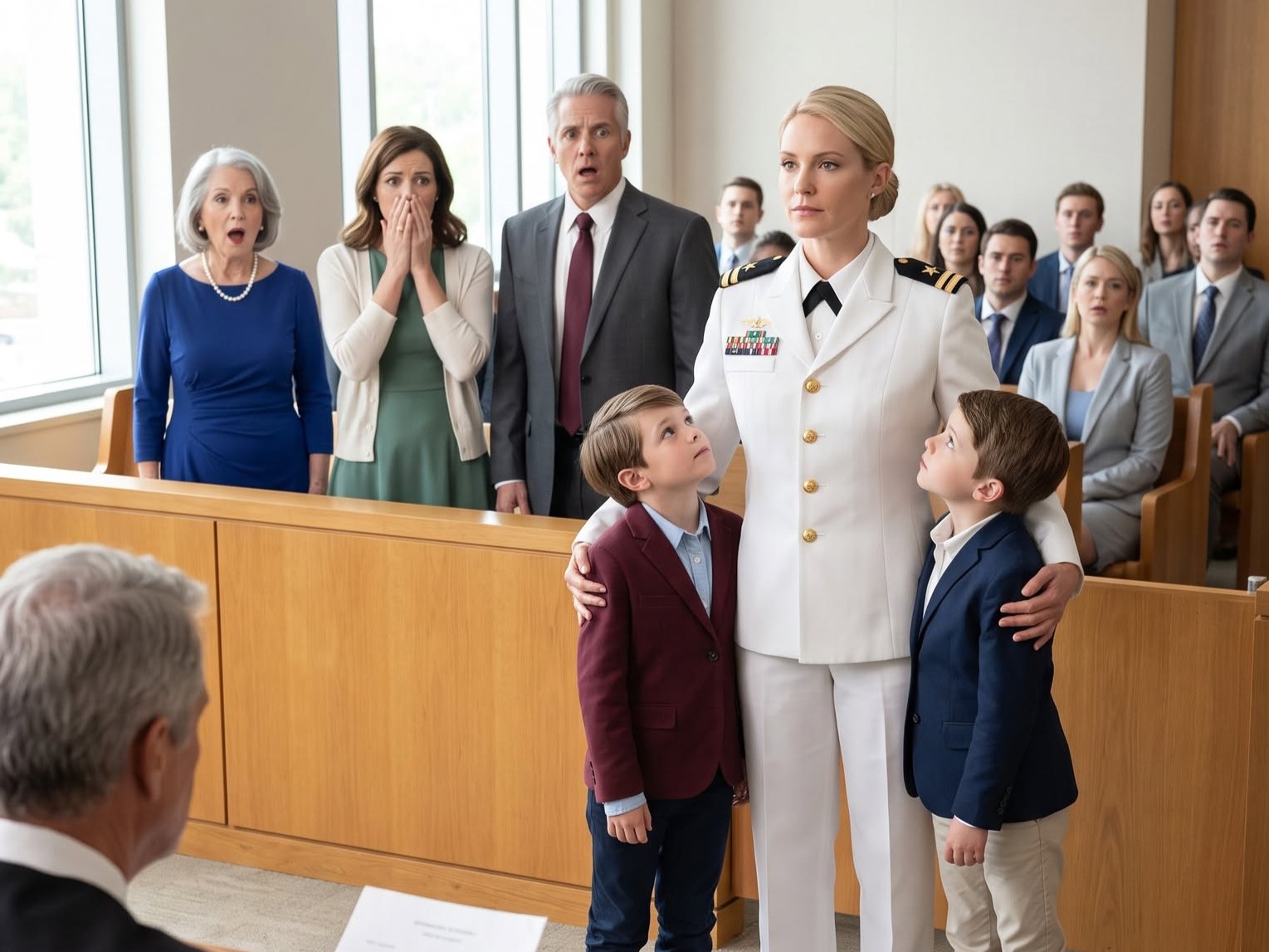
    I walked inside holding the hands of my eight-year-old sons, Samuel and Owen.

    The laughter stopped.

    Both boys wore their best clothes, but I could feel how frightened they were from the way their fingers tightened around mine. I hadn’t originally wanted them anywhere near a divorce hearing, yet Adrian had already involved them so deeply in our conflict that keeping them away from the courtroom would no longer protect them from what he had been saying.

    Paige looked toward us.

    “She actually brought the children?”

    Judge Calder immediately turned toward her.

    “One more interruption, Ms. Ellison, and you’ll be removed from my courtroom.”

    Paige went silent.

    I faced the judge.

    “I apologize, Your Honor.”

    His expression softened only slightly.

    “The boys shouldn’t be here.”

    “I agree.”

    I looked down at Samuel and Owen.

    “But their father has already told them that I abandoned them, that I have no job, and that they’ll soon be living permanently with him and Ms. Ellison.”

    Adrian shifted in his seat.

    I continued.

    “They deserve to hear the truth instead of another version created for them.”

    The judge studied me for several seconds before instructing us to proceed.

    Adrian’s attorneys wasted no time.

    They began presenting the financial picture their client had spent years preparing.

    Bank accounts carrying Adrian’s name.

    Property deeds controlled through his companies.

    Investment statements showing assets he claimed as separate property.

    Then came the prenuptial agreement.

    It was thick, detailed, and drafted by attorneys who had anticipated almost every ordinary way a spouse might challenge Adrian’s wealth.

    His lead attorney placed it before the judge with obvious confidence.

    “Mrs. Lane entered this marriage with no meaningful career or independent income comparable to Mr. Hollis’s current financial position.”

    I listened quietly.

    “She has not participated publicly in the management of Hollis Transit Systems and has no documented executive position within the company.”

    Also true.

    “Under the terms of the prenuptial agreement, she waived any claim to the substantial business assets accumulated by Mr. Hollis during the marriage.”

    That was where the argument became interesting.

    Adrian looked at me.

    His expression said he was waiting for panic.

    I gave him none.

    His attorneys continued building the portrait they believed would destroy me.

    I was financially dependent.

    Professionally insignificant.

    A woman who had enjoyed the lifestyle created by a successful husband and now wanted a share of something she hadn’t built.

    Eventually, Judge Calder turned toward me.

    “Mrs. Lane, who is representing you today?”

    “I am, Your Honor.”

    Adrian smiled.

    One of his attorneys actually looked surprised.

    Judge Calder studied me.

    “You understand that Mr. Hollis is represented by three attorneys experienced in family and corporate law?”

    “Yes.”

    “And you still intend to represent yourself?”

    “Yes, Your Honor.”

    Adrian leaned toward Paige.

    She smiled.

    They thought the decision proved exactly what they had always believed about me.

    I was outmatched.

    Unprepared.

    And too naive to understand what was about to happen.

    I placed my leather handbag on the table.

    For eleven years, Adrian had seen that bag sitting in our kitchen, our bedroom, our cars, restaurants, airports, school events, and family vacations. He had never once asked why I guarded it so carefully.

    I opened it.

    My fingers found the sealed envelope inside.

    There were no stacks of legal binders.

    No team of attorneys waiting outside.

    Just one envelope.

    I placed it on the table.

    “Your Honor, I’d like to submit an original document.”

    Judge Calder looked toward Adrian’s attorneys.

    They objected immediately.

    The judge examined the envelope first and then allowed the document to be presented subject to authentication.

    He broke the seal.

    Adrian’s smile remained in place.

    For approximately ten seconds.

    Judge Calder unfolded the papers.

    His eyes moved down the first page.

    Then the second.

    He returned to the first.

    The room became increasingly quiet.

    Finally, he looked toward Adrian.

    “Mr. Hollis.”

    Adrian straightened.

    “Yes, Your Honor?”

    Judge Calder held up the document.

    “Can you explain why these original incorporation records identify someone other than you as the founding owner of Hollis Transit Systems?”

    Adrian stopped moving.

    One of his attorneys immediately reached for another file.

    The second attorney whispered something to the first.

    Paige looked between them.

    “What does that mean?”

    Nobody answered her.

    Adrian finally spoke.

    “There must be some mistake.”

    I looked at him.

    There wasn’t.

    The papers in Judge Calder’s hands were the original incorporation records for the company Adrian had spent years presenting to the world as his empire.

    Hollis Transit Systems existed because of money that didn’t come from Adrian.

    The original capital came from the Lane Family Trust.

    My grandfather’s estate.

    My inheritance.

    And my authorization.

    Adrian had built the public image.

    I had built the foundation beneath it.

    Judge Calder examined the ownership information again.

    Then he looked toward me.

    “Mrs. Lane, is there anything else this court should know before we continue?”

    “Yes, Your Honor.”

    Adrian stared at me.

    His attorneys were no longer smiling.

    Neither was Paige.

    I reached into my handbag again.

    This time, my fingers found a slim black portfolio concealed inside a false flap in the lining.

    That portfolio had traveled with me through school pickups, grocery runs, birthday parties, dinners, vacations, and eleven years of marriage.

    Adrian had never found it.

    More importantly, he had never thought to look.

    I placed it on the table.

    “I believe it’s finally time everyone learns who I really am.”

    The judge motioned for the bailiff to bring the portfolio forward.

    When Judge Calder opened it, the first item he removed wasn’t another business document.

    It was an identification card.

    He studied it.

    His expression changed.

    Then he read it again.

    I stood.

    “Colonel Evelyn Margaret Lane.”

    A murmur spread through the gallery.

    “United States Army.”

    Paige’s mouth fell open.

    Adrian laughed.

    It was a short, disbelieving sound.

    “You’re not in the Army.”

    I turned toward him.

    “I’ve been in the Army for twenty years, Adrian.”

    His laugh disappeared.

    “Longer than I’ve known you.”

    Judge Calder examined the accompanying verification letter.

    It confirmed my active service status and rank, and according to the records I submitted, my assignments had involved sensitive operations that required significant protection of my professional identity.

    The judge looked toward me.

    “How long has your service status been concealed from your husband?”

    “Eleven years, Your Honor.”

    “Since before the marriage?”

    “Yes.”

    “Did Mr. Hollis know about the nature of your assignment or your rank?”

    “No.”

    The judge turned toward Adrian.

    “Mr. Hollis, your filings repeatedly describe your wife as unemployed and financially dependent. Did you know she was a military officer?”

    Adrian’s jaw tightened.

    “I knew she had a past.”

    “A past?”

    “I knew there were things she didn’t discuss.”

    “But you didn’t know she was serving?”

    “No.”

    Judge Calder looked back toward me.

    I could feel every person in the courtroom watching.

    For years, Adrian had mistaken secrecy for emptiness.

    Because I didn’t advertise my work, he assumed I had none.

    Because I didn’t compete with his public success, he assumed I couldn’t.

    And because I allowed him to occupy the spotlight, he eventually convinced himself he had created everything around us alone.

    His lead attorney recovered first.

    “Your Honor, while Colonel Lane’s service record is certainly unexpected, it doesn’t change the central issue before the court.”

    He stood.

    “The prenuptial agreement remains valid.”

    I didn’t disagree.

    In fact, I had been waiting for him to say exactly that.

    “The agreement governs the division of marital assets,” he continued. “Colonel Lane willingly executed that agreement before the marriage.”

    Judge Calder turned toward me.

    “How do you respond?”

    I opened the black portfolio again.

    “The prenup governs marital assets.”

    I removed another set of documents.

    “But it cannot give Mr. Hollis ownership of something that was never his.”

    I placed the papers before the court.

    “These records establish that Hollis Transit Systems was originally capitalized through the Lane Family Trust, which I controlled before I ever met Adrian.”

    His attorney began reading.

    The confidence disappeared from his expression.

    “These appear authentic.”

    “They are.”

    I looked toward Adrian.

    “Every signature was notarized, and the relevant filings were submitted through the proper corporate channels.”

    Adrian finally stood.

    “I built that company.”

    His voice carried through the courtroom.

    “I worked eighteen-hour days to build Hollis Transit from nothing.”

    “You did work hard.”

    I didn’t need to deny that.

    “But you didn’t start from nothing.”

    His eyes locked onto mine.

    “You started with my money.”

    The room became silent.

    “My contracts.”

    I took another document from the portfolio.

    “My connections.”

    Adrian shook his head.

    “You inherited money. That doesn’t mean you built my company.”

    “Ten years ago, when Hollis Transit couldn’t pay its first major insurance premium, who wrote the check?”

    He said nothing.

    “When the operating license stalled, who made the call that got the application reviewed?”

    Still nothing.

    “When the bank threatened to repossess the first fleet, who provided the guarantee that stopped it?”

    Adrian’s jaw tightened.

    “You told me those were investors.”

    “They were.”

    I paused.

    “Me.”

    Paige stared at him.

    “You told me the company was yours.”

    “It is.”

    His answer came too quickly.

    I turned toward Judge Calder.

    “I have a certified ownership agreement identifying the Lane Family Trust as the controlling shareholder of Hollis Transit Systems.”

    Adrian’s lead attorney closed his eyes briefly.

    He understood what his client hadn’t yet accepted.

    The prenup might protect Adrian’s legitimate separate assets.

    But it couldn’t transform my preexisting ownership interest into his property simply because he had spent years behaving as though the company belonged exclusively to him.

    I placed the certified agreement beside the incorporation documents.

    “Mr. Hollis has no unilateral authority to sell, transfer, or encumber company assets without trustee approval.”

    Adrian slammed his palm against the table.

    “You can’t do this.”

    Judge Calder immediately warned him to control himself.

    I looked at the man I had married.

    Twenty years earlier, my grandfather had taught me something I eventually forgot during my marriage.

    Never let someone else convince you that what you brought to the table disappeared simply because they became louder than you.

    For years, I had allowed Adrian to stand in front of the company.

    He attended the interviews.

    He appeared in the photographs.

    He accepted the awards.

    And slowly, the public story became his private belief.

    He stopped seeing himself as the man I had helped build something with.

    He began seeing himself as the man who built everything while his useless wife watched.

    Paige leaned toward him.

    “Adrian.”

    He ignored her.

    “Adrian, is what she’s saying true?”

    “The company is mine.”

    “According to those papers, it isn’t.”

    He turned on her.

    “Shut your mouth.”

    Paige flinched.

    For the first time that morning, she looked genuinely frightened by him.

    I recognized the expression.

    I had worn versions of it myself.

    Judge Calder called the courtroom back to order.

    “Given the significant dispute concerning corporate ownership, this court will not permit either party to alter the status of these assets until the records can be independently reviewed.”

    Adrian’s attorneys said nothing.

    “I am ordering a full audit of Hollis Transit Systems.”

    The judge looked directly at Adrian.

    “Until that audit is complete, Mr. Hollis is prohibited from selling, transferring, pledging, or otherwise encumbering company assets.”

    Adrian sat down.

    His face had gone pale.

    But I wasn’t finished.

    The company mattered.

    The money mattered.

    The lies mattered.

    None of them mattered as much as Samuel and Owen.

    “Your Honor.”

    Judge Calder looked toward me.

    “I need the court to address temporary custody.”

    His expression became more serious.

    “Do you have evidence relevant to the children’s welfare?”

    “Yes.”

    I reached into my handbag again.

    This time, I removed my phone.

    Three weeks earlier, Owen had received a tablet for his birthday. He loved recording everything—songs, jokes, conversations, and random noises he thought were funny.

    The previous week, he had accidentally left it recording in our living room.

    What it captured wasn’t funny.

    I pressed play.

    Adrian’s voice filled the courtroom.

    He was telling Owen that he needed to tell the judge he wanted to live with his father.

    Then came Owen’s small voice.

    “But Mom said—”

    Adrian interrupted him.

    “Mom’s leaving, Owen. She’s going to move far away, and you’re going to live with me and Paige.”

    I watched Adrian.

    He no longer looked angry.

    He looked alarmed.

    Samuel’s voice came through the recording next.

    “Is Mom leaving because of us?”

    Then Adrian answered.

    “No. Mom’s leaving because she has secrets. She doesn’t love us the way we deserve.”

    I heard one of my sons begin crying.

    Then Adrian told him to stop being a baby.

    I stopped the recording.

    Nobody moved.

    Judge Calder stared at my husband.

    “Mr. Hollis, do you have anything to say?”

    Adrian straightened his tie.

    “Every parent says things they regret during a divorce.”

    The judge’s expression hardened.

    I looked toward Adrian.

    “You weren’t preparing them for a divorce.”

    His eyes met mine.

    “You were preparing them to choose you.”

    “You’re using our children against me.”

    “No.”

    I held up the phone.

    “I’m using your own words to protect them from being manipulated.”

    Adrian looked toward the back of the courtroom.

    It was a tiny movement.

    Most people probably wouldn’t have noticed.

    I did.

    A man in a gray suit sat near the door.

    He wasn’t watching me.

    He was watching Adrian.

    Their eyes met.

    Something passed between them.

    Recognition.

    Fear.

    Maybe both.

    The stranger stood.

    The bailiff immediately moved toward him.

    “Sir, remain seated.”

    The man ignored the instruction and reached inside his jacket.

    Several people gasped.

    The bailiff accelerated toward him.

    But the stranger didn’t pull out a weapon.

    He pulled out a folder.

    He threw it onto the courtroom floor and walked through the doors.

    The bailiff went after him.

    Judge Calder called for order while people in the gallery whispered and reporters scrambled to understand what had just happened.

    Eventually, the folder was retrieved and brought to the bench.

    Judge Calder opened it.

    He read the first page.

    Then he looked directly at Adrian.

    The expression on his face changed so completely that even Adrian seemed to understand something far worse than our divorce had just entered the room.

    “Mr. Hollis.”

    Adrian swallowed.

    “You have forty-eight hours to produce all records related to your accounts at Meridian Offshore Bank in the Cayman Islands.”

    Adrian’s face drained of color.

    Paige turned toward him.

    “What is he talking about?”

    Judge Calder held up the document.

    “Based on the information provided here, approximately fourteen million dollars in company assets may have been systematically transferred into offshore accounts over a period of nine years.”

    Paige stared at Adrian.

    “Fourteen million?”

    He didn’t answer.

    I felt my own pulse accelerate.

    I knew the offshore accounts existed.

    I had traced pieces of them through records I kept on a laptop hidden at home.

    What I had never been able to prove was who actually controlled them.

    Now someone had walked into a courtroom and dropped that missing evidence at the judge’s feet.

    The divorce had already exposed more than Adrian ever expected.

    But as I looked toward the empty doorway where the stranger had disappeared, I understood something else.

    The fourteen million dollars weren’t the end of the secret.

    They were the beginning of a much larger one.

    And whoever had just handed us the evidence clearly wanted Adrian—and me—to know that he was watching.

    Part 2 – Forty-Eight Hours After I Won Temporary Custody, Someone Sent Me a Photograph of My Sons at School

    Judge Calder looked down at the documents the stranger had thrown into the courtroom, then announced that the court would reconvene for a full asset hearing in thirty days. Until then, Adrian would be required to produce every record connected to the fourteen million dollars held through Meridian Offshore Bank in the Cayman Islands.

    Then the judge turned to the matter I cared about most.

    “Pending review of these records, I am granting temporary sole custody of Samuel and Owen Hollis to Colonel Lane, with supervised visitation for their father.”

    Adrian immediately stood.

    “Your Honor—”

    Judge Calder stopped him.

    “Until I have reviewed those offshore accounts, you are to have no unsupervised contact with your children. That is my final order.”

    The gavel came down.

    Reporters surged toward the front while Adrian’s attorneys surrounded him, speaking urgently enough that even he seemed to understand the situation had moved beyond an ordinary divorce. Paige remained beside the table staring at him as though the man she intended to build a future with had suddenly become a stranger.

    I gathered my documents.

    My hands were shaking.

    I had taken only a few steps when Adrian called my name.

    “Evelyn.”

    I stopped but didn’t immediately turn.

    “You think you’ve won something.”

    His voice was low.

    “You’ve destroyed everything I built.”

    I looked back at him.

    “What I built.”

    His expression tightened.

    “And I would have shared it with you, Adrian, if you had ever loved me the way you claimed.”

    “I did love you.”

    I studied him.

    “Whatever you felt wasn’t love.”

    I tightened my grip on the portfolio.

    “You can’t love someone you spend twelve years lying to.”

    Outside the courtroom, Samuel and Owen were waiting with my sister.

    The moment they saw me, both boys ran toward me.

    “Mom, what happened?”

    I knelt and wrapped my arms around them.

    “The judge said you’re coming home with me.”

    Owen pulled back.

    “Forever?”

    The question hurt because I couldn’t promise what another judge might decide months from now.

    But I smiled.

    “For as long as you want.”

    At the time, I thought Adrian was the greatest threat to our stability.

    Forty-eight hours later, I learned how wrong I was.

    My phone buzzed shortly after I dropped Samuel and Owen at school.

    The number was unfamiliar.

    There was no greeting.

    No name.

    Only a photograph.

    Samuel and Owen stood near the school gate wearing their backpacks. Owen’s hair was messy from running, while Samuel was looking over his shoulder as though some instinct had warned him they were being watched.

    The timestamp read 8:47.

    I had left them at 8:42.

    Someone had been close enough to photograph my children five minutes after I drove away.

    Beneath the image was one sentence.

    He’s not the only one who’s been keeping secrets.

    My hands began shaking.

    I immediately called the school.

    “This is Evelyn Lane. Samuel and Owen Hollis. I need someone to bring them to the front office right now and keep them inside until I arrive.”

    The secretary heard something in my voice.

    “Is everything okay, Mrs. Lane?”

    “No.”

    I grabbed my keys.

    “Please just keep them inside.”

    Then I called Mara Vance.

    “I received a photograph of the boys.”

    Silence.

    “It was taken this morning at school.”

    “Where are you?”

    “Route 50. I’m heading there now.”

    “Don’t panic.”

    Her voice became professional immediately.

    “I’m contacting the provost marshal’s office. I’ll arrange for someone to meet you.”

    The fourteen-minute drive felt endless.

    Every car behind me seemed suspicious.

    Every vehicle parked near the school made me wonder whether someone was watching.

    When I reached the front office, Samuel and Owen were standing together near the window.

    Owen was holding his brother’s hand.

    The moment he saw me, he ran.

    I caught him against my chest.

    “Why did they take us out of class?”

    “I thought we’d have lunch together.”

    Samuel didn’t smile.

    He was staring past me.

    “Who was that guy?”

    My stomach tightened.

    “What guy?”

    “The man by the fence this morning.”

    Samuel pointed toward the school entrance.

    “He was watching us.”

    “What did he look like?”

    “He had a gray coat.”

    Owen nodded.

    “He had a camera.”

    I crouched in front of them.

    “Did he speak to either of you?”

    Samuel shook his head.

    “No.”

    Owen added, “He waved.”

    “Did you wave back?”

    Both boys shook their heads.

    I pulled them closer.

    “You did exactly the right thing.”

    I told them we were going somewhere safe.

    I didn’t take them home.

    And I didn’t take them for pizza.

    I drove directly to Fort Belvoir.

    At the security checkpoint, I showed my military identification and was waved through. Samuel stared through the window at the base as we passed military vehicles, administrative buildings, and personnel moving between facilities.

    “Is this where you work?”

    “Sometimes.”

    “You’ve never brought us here.”

    “I know.”

    Owen leaned forward between the seats.

    “Are you really a soldier?”

    “Yes.”

    “Like with a gun?”

    Despite everything, I smiled.

    “Mostly with a desk and far too much paperwork.”

    Samuel remained serious.

    “Dad said you were just a housewife.”

    The words hurt differently now.

    Not because Adrian had underestimated me.

    Because he had taught our children to underestimate me too.

    “I know.”

    Samuel looked at me.

    “Is Dad a liar?”

    There are questions children ask that adults desperately want to answer with simple words.

    That wasn’t one of them.

    I parked.

    “Your father loves you.”

    Samuel waited.

    “But he has told you things about me that aren’t true.”

    “Did he lie about everything?”

    “No.”

    I turned toward both boys.

    “He lied about me. But I believe he told the truth when he said he loves you.”

    Samuel nodded slowly.

    It wasn’t enough.

    But it was the most honest answer I could give.

    Mara met us inside the headquarters building.

    She had arranged a private family room where the boys could stay with Sergeant Davis while we spoke.

    Owen immediately became nervous.

    “Are you coming back?”

    I knelt.

    “Always.”

    “Promise?”

    “Promise.”

    I kept smiling until the door closed behind them.

    Then I turned toward Mara.

    “Tell me everything.”

    She led me into a windowless conference room.

    A map of Northern Virginia covered one wall.

    “We pulled metadata from the photograph.”

    “And?”

    “The number is a prepaid device. The message went through a tower near the school.”

    “A burner.”

    “Yes.”

    Mara opened a laptop.

    “We also reviewed courthouse security footage.”

    A grainy photograph appeared.

    The man in the gray suit was walking through a parking garage.

    Short dark hair.

    Clean-shaven.

    White shirt.

    No tie.

    Something about him bothered me.

    “I know that face.”

    Mara switched images.

    The second frame was sharper.

    This time, the man was looking almost directly toward the camera.

    A memory surfaced.

    “Daniel Shaw.”

    “Who?”

    “He was a captain in military intelligence fifteen years ago.”

    I leaned closer to the screen.

    “He was assigned to my unit early in my career.”

    “What happened to him?”

    “He disappeared.”

    Mara frowned.

    “Disappeared?”

    “One day he was there. Then he wasn’t.”

    The official explanation had been a special assignment.

    I had never seen him again.

    There was something else I didn’t tell Mara immediately.

    Daniel had once been my mentor.

    He was the person who encouraged me to take the transportation command path that eventually shaped my career.

    Years later, when I first suspected Adrian was hiding something from me, Daniel’s name had crossed my mind.

    But I had nowhere to find him.

    Mara closed the laptop.

    “There’s more.”

    She lifted an evidence bag.

    Inside was another copy of the photograph.

    “This arrived at the provost marshal’s office fifteen minutes ago.”

    I read the message beneath it.

    THE CHILDREN ARE SAFE NOW. THEY WON’T BE ONCE THE MEDIA LEARNS WHO THEIR MOTHER REALLY IS.

    My stomach tightened.

    “They’re using my service record.”

    “Possibly.”

    “They think the classified aspects of my career give them leverage.”

    Mara studied me.

    “Does it?”

    “I’ll protect my children.”

    I looked back at the photograph.

    “But I’m not giving someone control over me because they know my name.”

    There was one person who might know who the man was.

    I called Adrian.

    He answered almost immediately.

    “Evelyn, we need to discuss the offshore—”

    “Did your attorney send someone to photograph our children?”

    Silence.

    “What?”

    “The man from the courtroom.”

    I forced myself to remain calm.

    “He photographed Samuel and Owen at school this morning.”

    “I didn’t send anyone.”

    “You recognized him.”

    Another pause.

    “I saw you looking at him.”

    Adrian said nothing.

    “Who is he?”

    “I don’t know.”

    “Don’t lie to me again.”

    His breathing changed.

    Then he finally spoke.

    “I’ve seen him before.”

    “Where?”

    “He works for someone named Viktor Soren.”

    The name meant nothing to me.

    Adrian’s tone told me it should.

    “Who is Viktor Soren?”

    “A logistics broker.”

    “What kind?”

    “International.”

    He hesitated.

    “He helped me secure contracts when Hollis Transit was still growing.”

    “And the man in gray?”

    “You called him Daniel Shaw?”

    “Yes.”

    “That’s not his name.”

    I felt my grip tighten around the phone.

    “Then what is it?”

    “Daniel Krev.”

    The room suddenly felt smaller.

    “He’s a former Czech intelligence officer.”

    Adrian lowered his voice.

    “He introduced me to Soren.”

    Mara was listening now.

    “Why was Krev in court?”

    Another silence.

    Then Adrian gave me the answer he had apparently been terrified to say.

    “Because I owe them money.”

    “How much?”

    “Fourteen million.”

    Everything connected at once.

    “The offshore account.”

    “Yes.”

    I closed my eyes.

    “That money wasn’t hidden for you.”

    “No.”

    “It was for Soren.”

    Adrian exhaled.

    “I was moving company assets into an account they controlled.”

    “You stole money from my company to repay them.”

    “I was trying to keep things under control.”

    “You transferred fourteen million dollars.”

    “I didn’t have another option.”

    “There is always another option besides stealing.”

    His voice sharpened.

    “You don’t understand these people.”

    “Then explain them.”

    The anger disappeared again.

    What replaced it was fear.

    “The court froze the assets.”

    “I know.”

    “If I can’t access that money, Soren doesn’t get paid.”

    “And Krev photographed our children.”

    “Yes.”

    My blood went cold.

    “He wants you to drop the case.”

    “Why me?”

    “Because you control the company.”

    Adrian finally sounded like he understood the ownership documents from court.

    “If you back away, I can regain access to the accounts and finish the transfer.”

    “And Samuel and Owen stay safe?”

    “That’s what they’re telling me.”

    I looked toward the wall separating us from the room where my children waited.

    “Men who photograph children aren’t offering safety.”

    Adrian didn’t answer.

    Then I remembered the second courthouse image.

    Daniel Krev.

    A face I knew.

    Not from fifteen years ago.

    From somewhere else.

    Military intelligence reports.

    My memory finally connected the details.

    “Adrian.”

    “What?”

    “Daniel Krev wasn’t simply Czech intelligence.”

    Silence.

    “He appeared in military files connected to trafficking stolen military technology.”

    Adrian stopped breathing for a moment.

    “He’s not just your creditor.”

    I looked at Mara.

    “He’s a national-security threat.”

    “I didn’t know.”

    “You knew enough to hide fourteen million dollars for him.”

    “I was trying to protect our family.”

    “No.”

    I lowered my voice.

    “You were protecting yourself.”

    Then I ended the call.

    Mara stared at me.

    “We take this upstairs immediately.”

    “I know.”

    “This isn’t just divorce fraud anymore.”

    “I know.”

    “The boys need protection.”

    “Yes.”

    “They may need to stay out of school.”

    I looked toward the door.

    “They’ll think they’re getting a vacation.”

    Mara studied me.

    “What are you planning?”

    I already knew the answer.

    “I need Krev to talk to me.”

    “No.”

    “He reached me through my sons.”

    “That doesn’t mean you meet him.”

    “If I ignore him, he escalates.”

    Mara shook her head.

    “You don’t know that.”

    “I know men like him.”

    “Then you know meeting him alone is reckless.”

    I looked at her.

    “I’m a soldier.”

    “That doesn’t make you bulletproof.”

    She was right.

    I knew she was right.

    But an hour later, I was standing in the parking lot of a closed gas station on Route 1.

    The pavement was still wet from the rain.

    My phone rang.

    Unknown number.

    I answered.

    “Colonel Lane.”

    The voice carried a faint Eastern European accent.

    “I’ve been expecting you.”

    “Daniel Krev.”

    “You know of me.”

    “I know enough.”

    He laughed softly.

    “Then you know I’m not interested in exposing your military career.”

    “What do you want?”

    “My money.”

    “It’s frozen.”

    “Temporarily.”

    He sounded almost amused.

    “And you have influence.”

    “Not over a court order.”

    “You own Hollis Transit.”

    “I don’t control the courts.”

    “No.”

    His voice changed slightly.

    “But you’re a mother.”

    I tightened my grip on the phone.

    “That photograph was a mistake.”

    “It was a demonstration.”

    “Stay away from my children.”

    “I haven’t harmed them.”

    “You watched them at school.”

    “To make a point.”

    “What point?”

    “That Adrian’s problems are no longer Adrian’s alone.”

    I forced myself to breathe slowly.

    “What aren’t you telling me?”

    Krev paused.

    Then he said something I wasn’t expecting.

    “Ask your husband about the private shipment contract he signed last year.”

    “What contract?”

    “The one that never went through Hollis Transit.”

    I felt a chill move through me.

    “What was being shipped?”

    “Adrian didn’t ask enough questions.”

    “That isn’t an answer.”

    “He saw money.”

    Krev sounded almost contemptuous.

    “He signed papers.”

    “And?”

    “The shipment was a cover.”

    “For what?”

    “Smuggling.”

    I said nothing.

    “Our mutual friends at the FBI have been following it for some time.”

    “You expect me to believe that?”

    “I don’t care what you believe.”

    His voice remained calm.

    “But they’re watching Adrian.”

    A pause.

    “And they’re watching you.”

    The call ended.

    I stood alone with the phone against my ear.

    Then I heard an engine behind me.

    A black sedan sat at the edge of the parking lot.

    Its rear window lowered.

    The face from the courthouse surveillance image appeared inside.

    Daniel Krev looked directly at me.

    “Get in, Colonel.”

    His expression was completely calm.

    “We have a lot to discuss.”

    I stared at the open window and understood that the fourteen million dollars had never been the real center of Adrian’s secret.

    The money was connected to something larger.

    Something that had reached into my company, my military past, and now my children’s lives.

    And for the first time since walking into divorce court, I wasn’t trying to discover how badly my husband had betrayed me.

    I was trying to understand exactly who he had brought into our family.

    Part 3 – The Man Watching My Sons Wasn’t After My Divorce. He Was After a Secret Adrian Had Buried Inside My Company

    I stood in the rain-darkened parking lot staring at the black sedan while Daniel Krev waited behind the half-open rear window. Every instinct told me not to get inside, but another part of me understood that he had already proven how easily he could reach the places that mattered most to me.

    “I’m not getting in your car.”

    Krev smiled faintly.

    “Smart.”

    The rear door remained closed.

    “You came alone anyway.”

    “I came to talk.”

    “Then talk.”

    For several seconds, neither of us moved.

    Krev studied me with the calm expression of someone who had spent years watching frightened people decide how much they were willing to sacrifice. He didn’t look like the man I remembered from military files, but the eyes were the same—alert, calculating, and constantly measuring distance.

    “You want fourteen million dollars.”

    “I want what Adrian owes.”

    “That money came from Hollis Transit.”

    “Your company.”

    “My company.”

    He nodded.

    “That is why you are useful.”

    I kept my distance from the sedan.

    “You sent a photograph of my children.”

    “I sent proof that I could reach them.”

    “That makes you my enemy.”

    “No.”

    His voice remained almost conversational.

    “It makes me someone you should take seriously.”

    I wanted to believe he was simply another criminal using fear to recover money. The problem was that nothing about his appearance at the courthouse, his knowledge of my military past, or the private shipment contract sounded like an ordinary debt dispute.

    “What was in the shipment?”

    Krev looked toward the empty road.

    “Components.”

    “What kind?”

    “Navigation assemblies.”

    My stomach tightened.

    “For civilian use?”

    He smiled.

    “That depends on how imaginative the buyer is.”

    There it was.

    The answer I had feared.

    “Who bought them?”

    “You are asking the wrong question.”

    “What is the right one?”

    “Who authorized them to move.”

    I thought immediately of Adrian.

    Krev noticed.

    “Your husband signed the transportation documents.”

    “He didn’t know what was inside.”

    “Perhaps.”

    His expression became colder.

    “Or perhaps Adrian spent years learning that ignorance becomes profitable when you stop asking questions.”

    That sounded like him.

    Adrian had always believed details were obstacles for people beneath him. If a contract generated enough money and someone else accepted responsibility for the paperwork, he rarely cared how the machinery underneath actually worked.

    “Why tell me?”

    “Because the court froze my money.”

    “You could have gone after Adrian.”

    “I did.”

    Krev looked toward me.

    “He no longer controls anything useful.”

    That sentence summarized Adrian’s fall more brutally than any courtroom ruling.

    “He controlled the company publicly.”

    “But you controlled it legally.”

    Krev leaned back.

    “And now everyone knows.”

    The irony wasn’t lost on me.

    For eleven years, secrecy had protected my work, my military obligations, and the structure surrounding Hollis Transit.

    Now the very truth that defeated Adrian had also made me visible to people I never wanted looking in my direction.

    “You said the FBI is watching us.”

    “They are.”

    “How do you know?”

    “Because some of them have been watching me longer than they’ve been watching your husband.”

    I studied his face.

    “Then why are you standing here?”

    “Because being watched is not the same as being arrested.”

    He said it with enough confidence that I believed him.

    “For now.”

    Krev smiled.

    “Exactly.”

    I needed more than hints.

    “If Adrian’s shipment was connected to stolen military technology, what exactly did he sign?”

    “A private logistics contract routed through a shell company in Delaware.”

    “What company?”

    “Redhaven Global.”

    The name meant nothing to me.

    I would remember it.

    Krev continued.

    “Hollis Transit never appeared in the final documents. Adrian used vehicles controlled by one of your subcontractors.”

    I felt my anger rising.

    “He used my infrastructure off-book.”

    “Yes.”

    “Who was supposed to receive the shipment?”

    “A buyer operating through Rotterdam.”

    “That’s not a name.”

    “No.”

    He looked at me.

    “It’s enough for your people to start asking the right questions.”

    My people.

    Military investigators.

    Federal authorities.

    That was what he wanted.

    Not just his money.

    Leverage.

    If I moved aggressively against the shipment network, he could use the resulting chaos against someone else.

    If I did nothing, my company and my children remained exposed.

    “You’re trying to recruit me.”

    “I’m trying to survive.”

    “And you think using my sons helps?”

    His expression changed only slightly.

    “I think mothers become efficient when the threat is close enough.”

    I took one step toward the car.

    “If you photograph Samuel or Owen again, whatever protection you think you have disappears.”

    Krev’s eyes narrowed.

    “Is that a military threat?”

    “No.”

    My voice remained calm.

    “It’s a promise that I stop treating this as a financial negotiation.”

    For the first time, his expression lost some of its amusement.

    Good.

    Then the rear window began rising.

    “Ask Adrian about Redhaven.”

    “Krev.”

    The glass stopped.

    “Why did you drop the offshore records in court?”

    He looked at me through the narrowing gap.

    “Because Adrian had stopped paying.”

    “That’s all?”

    “No.”

    The window paused again.

    “He also became disposable.”

    Then the glass closed.

    The sedan pulled away.

    I memorized the license plate even though I assumed it was false.

    By the time I reached Fort Belvoir again, Mara already had two officers waiting.

    I gave them everything.

    Krev’s statements.

    Redhaven Global.

    The navigation assemblies.

    The private shipment contract.

    His admission that Adrian had signed the transportation documents.

    Nothing was held back.

    That decision mattered because my first instinct throughout the divorce had been to control information carefully.

    This was different.

    My children were involved.

    My company infrastructure might have been used to move restricted technology.

    And whatever Adrian had done now intersected with responsibilities far larger than our marriage.

    Mara listened without interrupting.

    When I finished, she folded her arms.

    “You met him alone.”

    “Yes.”

    “That was reckless.”

    “Yes.”

    She seemed surprised I didn’t argue.

    “Are you going to do it again?”

    “No.”

    That answer was easier than I expected.

    Krev wanted me to believe the only way to protect my sons was to deal directly with him.

    I knew better now.

    Isolation was Adrian’s strategy.

    Secrecy was Krev’s advantage.

    I wasn’t giving either man more of it.

    Within hours, the information moved through military and federal channels.

    The boys remained on base overnight under protective arrangements while investigators examined the school photograph, the courier delivery, the courthouse footage, and the burner phone.

    I sat with Samuel and Owen in a small family room that evening.

    They were building a tower from plastic blocks.

    Owen looked up.

    “Are we sleeping here?”

    “Tonight.”

    “Why?”

    I considered lying.

    Then I remembered what the divorce had already done to them.

    No more lies.

    “Because someone took your picture without permission and I want to make sure you’re safe.”

    Samuel stopped building.

    “Was it Dad?”

    “No.”

    “Was it because of Dad?”

    I hesitated.

    “Partly.”

    He looked down.

    “Everything bad is because of Dad now.”

    “No.”

    I moved closer.

    “Your father made serious mistakes.”

    I paused.

    “But adults are responsible for their own choices.”

    Samuel looked at me.

    “You mean the camera guy?”

    “Yes.”

    “He chose that.”

    “Yes.”

    That distinction mattered.

    I didn’t want my sons growing up believing Adrian was some supernatural source of every problem around them.

    He was a man.

    A flawed one.

    A dishonest one.

    But the other adults involved had chosen their own actions too.

    Owen placed another block on the tower.

    “Are you scared?”

    I almost said no.

    Instead, I told the truth.

    “Yes.”

    Both boys looked at me.

    “But being scared doesn’t mean we don’t know what to do.”

    Samuel nodded slowly.

    That answer seemed to help him.

    It helped me too.

    The next morning, Adrian requested an emergency call through his attorney.

    I agreed only after federal investigators confirmed the conversation could proceed.

    His voice sounded exhausted.

    “You met Krev.”

    I didn’t answer immediately.

    “How do you know?”

    “He called me.”

    “What did he say?”

    “That you’re making this worse.”

    I almost laughed.

    “I’m not the one who signed private shipment contracts.”

    Silence.

    Then Adrian said, “You talked to him about Redhaven.”

    “Yes.”

    Another pause.

    “He told you.”

    “He told me enough.”

    Adrian exhaled.

    “You don’t understand what happened.”

    “Then explain it.”

    He began with the same excuse he had used for everything else.

    The company was under pressure.

    A major contract had collapsed.

    He needed liquidity.

    Viktor Soren offered him a private shipping arrangement that appeared legitimate and paid unusually well.

    “Did you know what was being transported?”

    “No.”

    “Did you ask?”

    Silence.

    That answer was enough.

    “You signed off without knowing.”

    “It was sealed freight.”

    “Under a shell company.”

    “I didn’t know that at first.”

    “When did you know?”

    Adrian hesitated.

    “After the second shipment.”

    My stomach turned.

    “And you kept doing it.”

    “I was already in.”

    “No.”

    I closed my eyes.

    “You chose to stay in.”

    His voice sharpened.

    “They threatened me.”

    “Before or after you started moving company money offshore?”

    Silence.

    “Adrian.”

    “After.”

    There it was.

    He had begun with greed.

    Fear came later.

    The distinction mattered because he would eventually try to rewrite the entire story as coercion.

    “You weren’t protecting us.”

    I spoke quietly.

    “You were hiding what you did.”

    “I was trying to fix it.”

    “With fourteen million dollars that belonged to the company.”

    “I needed Soren gone.”

    “And instead you brought him closer.”

    Adrian’s breathing became uneven.

    “What are you going to do?”

    “Tell the truth.”

    “You can’t.”

    “I already have.”

    His voice turned desperate.

    “Evelyn, if federal investigators open everything, Hollis Transit is finished.”

    “No.”

    I looked through the glass toward Samuel and Owen.

    “You may be finished.”

    “The company is not the same thing as you anymore.”

    That sentence silenced him.

    For twelve years, Adrian had treated Hollis Transit as an extension of his identity.

    Now he had to confront the reality that the company could survive without him.

    “I can testify.”

    He said it suddenly.

    “Against Soren?”

    “Yes.”

    “And Krev?”

    A pause.

    “Yes.”

    “Why now?”

    “Because I don’t want them near the boys.”

    For the first time in weeks, I believed him.

    Not completely.

    But enough to recognize something genuine beneath the fear.

    Adrian had lied to me.

    Manipulated our sons.

    Stolen from the company.

    Hidden offshore accounts.

    Yet the terror in his voice when he spoke about Samuel and Owen sounded real.

    “That doesn’t erase what you did.”

    “I know.”

    It was the first time I had ever heard him say those words without immediately defending himself.

    Federal investigators took over from there.

    Adrian entered into formal cooperation discussions.

    He provided records identifying Redhaven Global, shell entities connected to Viktor Soren, and shipping routes that had bypassed Hollis Transit’s normal compliance systems.

    The investigation widened quickly.

    Some details were never shared with me because they intersected with classified matters.

    I didn’t ask for everything.

    I had spent years living inside a world where knowing only what you were authorized to know was normal.

    What mattered was that Krev’s network began collapsing.

    Accounts were frozen.

    Several shipments were intercepted.

    Soren disappeared before authorities could reach him, but multiple intermediaries were arrested.

    Daniel Krev was detained weeks later while attempting to cross into Canada under another identity.

    When Mara told me, I felt no triumph.

    Only relief.

    The photographs stopped.

    The boys returned to school with additional security precautions that gradually became less visible.

    And for the first time since the courtroom hearing, I slept through an entire night.

    The divorce continued.

    So did the corporate audit.

    The offshore accounts were fully documented.

    Adrian’s financial misconduct became impossible to separate from the broader investigation, and his cooperation reduced some consequences without erasing them.

    The custody case changed too.

    Judge Calder reviewed the recordings involving Samuel and Owen, Adrian’s manipulation of them during the divorce, and the instability created by the offshore financial investigation.

    Temporary sole custody remained with me.

    Eventually, it became permanent primary custody with structured visitation.

    I never asked the court to erase Adrian from their lives.

    He was still their father.

    But access came with boundaries.

    Truth came first.

    Months later, Adrian met the boys under supervised conditions.

    I waited outside.

    When Samuel returned, he was quiet.

    Owen held a folded piece of paper.

    “What’s that?”

    “Dad wrote us a letter.”

    I didn’t ask to read it.

    “Do you want me to?”

    Owen thought about it.

    “Later.”

    That was fine.

    Their relationship with Adrian belonged to them too.

    I would protect it from manipulation.

    I wouldn’t control it.

    Hollis Transit survived the audit.

    That surprised some people.

    It didn’t surprise me.

    The company had never been weak.

    Its governance had been.

    We replaced several executives, strengthened internal compliance, created independent approval requirements for high-risk shipments, and removed the structures Adrian had exploited.

    Employees who had spent years believing their jobs depended entirely on Adrian discovered something healthier.

    Companies survive when systems are stronger than personalities.

    A year after the divorce hearing, I stood in the headquarters lobby beneath the original Hollis Transit incorporation certificate.

    My name was now displayed beside it.

    Not because I wanted public recognition.

    Because secrecy had stopped serving the company.

    Samuel and Owen visited that afternoon.

    Owen stared at the framed document.

    “So you really started this?”

    “With help.”

    “Dad said he did.”

    “I know.”

    Samuel looked toward me.

    “Was anything he said true?”

    I smiled sadly.

    “He worked very hard.”

    “That’s not the same as owning it.”

    “No.”

    Samuel nodded.

    He understood more now.

    Maybe too much for his age.

    But at least what he understood was real.

    Later, while the boys raced each other through the lobby, I thought about the leather handbag I had carried for eleven years.

    The incorporation papers.

    My military identification.

    The documents hidden behind a false lining.

    I once believed protecting those secrets made me safer.

    In some ways, it did.

    But secrecy also gave Adrian space to create his own version of me.

    The unemployed wife.

    The woman without ambition.

    The mother who would eventually disappear.

    The spouse too powerless to challenge him.

    He built that story because I never corrected it.

    Daniel Krev tried using another secret against me.

    My military identity.

    My classified past.

    My fear for my children.

    But by then, I had learned something Adrian never understood.

    A secret only becomes leverage when you’re willing to sacrifice the truth to keep it hidden.

    I wasn’t anymore.

    Adrian lost the company he believed belonged entirely to him.

    He lost control over the offshore money.

    He lost the ability to tell Samuel and Owen whatever version of our family served him best.

    But I didn’t consider any of that victory.

    My victory was smaller.

    Samuel stopped asking whether I was going to leave.

    Owen stopped sleeping with his tablet beside him because he was afraid he might miss something important.

    And when I told them I was going to work, they finally knew where I meant.

    Months after the last court hearing, Samuel asked me one evening whether I regretted marrying Adrian.

    I thought about it carefully.

    “No.”

    He looked surprised.

    “Why not?”

    “Because then I wouldn’t have you and Owen.”

    He accepted that immediately.

    Children sometimes understand complicated truths better than adults.

    I didn’t regret the sons who came from my marriage.

    I regretted the years I spent allowing their father to define who I was because correcting him seemed more exhausting than staying quiet.

    Adrian thought I had no career.

    No money.

    No power.

    No fight.

    He was wrong about all four.

    But the most important thing he misunderstood wasn’t hidden in the envelope, the military portfolio, or the ownership agreement.

    He believed my silence meant I had surrendered.

    It never did.

    I had simply waited too long to speak.

    Once I finally did, the company, the court, my sons, and even Adrian were forced to confront the truth.

    He had spent twelve years building an empire on secrets.

    In the end, the secrets didn’t destroy me.

    They destroyed the story he had built around himself.

     

  • Engaging Writing Challenges

    Engaging Writing Challenges

    Writing is a journey, a path that often takes unexpected turns.

    For many, it can feel like a solitary endeavor, but there are ways to invite joy and creativity into the process.

    Engaging writing challenges can spark inspiration, foster community, and enhance your skills, whether you’re a seasoned author or someone just beginning to explore the written word.

    Finding your voice in writing can sometimes feel elusive, much like trying to catch a breeze. It’s not uncommon to hit a wall, where the words seem to stick in your throat or drift away like clouds. Engaging in writing challenges can serve as a gentle nudge toward unlocking those thoughts and emotions that yearn to be expressed.

    A small shift toward balance

    Taking part in a writing challenge can create a sense of balance in your creative life. It encourages you to set aside time for your craft, turning writing into a regular habit rather than an occasional indulgence. Whether it’s a month-long challenge or a shorter, focused exercise, committing to a specific goal can provide structure to your writing practice.

    Consider the idea of daily prompts, where you receive a word, phrase, or theme to inspire your writing for the day. This simple exercise can help you break free from the confines of self-doubt and perfectionism. Each prompt is an invitation to explore new ideas, characters, or settings. It’s a chance to stretch your imagination and see where it leads.

    The beauty of these challenges lies in their diversity. Some may focus on poetry, while others encourage short stories or even essays. You might find yourself drawn to a genre you’ve never explored before, perhaps dabbling in speculative fiction or memoir writing. This exploration can be refreshing, allowing you to rediscover the joy of storytelling without the pressure of producing a polished piece.

    Building a community of support

    Engaging writing challenges often come with a built-in community. When you participate in a challenge, you may find fellow writers who are just as eager to share their experiences. This sense of camaraderie can be incredibly uplifting. Sharing your work, even in its rough draft form, can help you connect with others and gain valuable feedback.

    In an age where digital connections can sometimes feel superficial, finding a group of like-minded individuals can be a breath of fresh air. Whether it’s through social media, local writing groups, or online forums, these communities can provide a supportive space for sharing ideas and encouraging one another.

    The act of sharing your work can be daunting, yet it can also be liberating. You may discover that your words resonate with others in ways you hadn’t anticipated. This validation can bolster your confidence and inspire you to keep writing, even when the going gets tough.

    Nurturing creativity through exploration

    Engaging in writing challenges encourages you to step outside your comfort zone and explore new themes and styles. This exploration can be a powerful catalyst for creativity. When you allow yourself to write without the fear of judgment, you create a safe space for your imagination to flourish.

    Consider setting aside a weekend to immerse yourself in a specific challenge. You might choose to write a story based on a photograph, or perhaps you’ll focus on capturing the essence of a place you love. This type of creative exploration can enrich your writing and deepen your understanding of the world around you.

    As you explore new subjects, you may find that your writing takes on a life of its own. Characters can surprise you, plots can twist unexpectedly, and the themes you once thought you understood may reveal new layers of meaning. Embracing this fluidity can lead to unexpected discoveries and a more profound connection to your craft.

    The joy of reflection

    After completing a writing challenge, take a moment to reflect on your experience. What did you learn about yourself as a writer? How did the challenge stretch your creativity? Reflection can be an essential part of the writing process, helping you to internalize what you’ve accomplished and where you want to go next.

    Consider keeping a journal of your reflections. This practice can help you track your growth over time, offering insights into your evolving style and interests. You might find that certain themes resonate with you more than others, guiding your future writing endeavors.

    In this space of reflection, it’s also helpful to celebrate your achievements, no matter how small. Each word you write contributes to your journey, and acknowledging these milestones can foster a sense of accomplishment.

    Finding inspiration in the everyday

    Writing challenges can also encourage you to seek inspiration in the everyday moments of life. Sometimes, the most remarkable stories come from the simplest experiences. A walk in the park, a conversation with a friend, or even the quiet moments spent in solitude can spark an idea or a character that lingers in your mind.

    Engaging in writing challenges can help you cultivate a habit of observation. When you approach your surroundings with a writer’s eye, you may begin to notice details that previously went unnoticed. The way sunlight filters through leaves, the sound of laughter echoing in a café, or the fleeting expression on a stranger’s face can all serve as rich sources of inspiration.

    As you learn to embrace these moments, your writing may become more vibrant and authentic. You’ll find that the world around you is brimming with stories waiting to be told.

    The journey continues

    Ultimately, engaging in writing challenges is not just about producing finished pieces; it’s about nurturing your passion for writing and allowing your creativity to flourish. Each challenge is a stepping stone on your journey, guiding you toward deeper self-expression and connection with others.

    Whether you’re writing for yourself or sharing your work with the world, remember that the process is just as important as the product. Embrace the challenges, celebrate the small victories, and allow your writing to be a reflection of your unique voice. The journey of writing is a beautiful adventure, one that is meant to be savored at every turn.

  • My husband threw me and our two children out of the house for his mistress, convinced that after 18 years of marriage, i had nothing left.  

    My husband threw me and our two children out of the house for his mistress, convinced that after 18 years of marriage, i had nothing left.  

    That first night, with nowhere else to go, I stood at a stranger’s door and said, “Please let me stay here with my two children. I’ll take care of the entire house for free.”

    I lowered my head and stepped inside quietly.

    But the man who opened the door had done business with my husband—and he remembered a certain amount of money my husband had desperately wanted me to forget.

    PART 1

    “If you let me stay here with my kids, I’ll work for free. I’ll cook, I’ll clean, I’ll do whatever you need. I just need a place for them to sleep tonight.”

    Evelyn Vance never imagined she would ever say those words standing on the porch of an unfamiliar home in the wealthy suburbs of Greenwich, Connecticut.

    It was nearly eight o’clock at night. Seven-year-old Leo carried a dinosaur backpack, holding a plastic grocery bag filled with the few clothes they’d managed to grab. Four-year-old Nora was asleep on her mother’s shoulder, exhausted after three days of bouncing between temporary couches.

    First, they had stayed with a friend of Evelyn’s. Then, at a cousin’s cramped apartment. But Evelyn knew those uncomfortable looks all too well—the silent tension that creeps in when a visitor stays past their welcome.

    Her husband, Julian Vance, had made his terms crystal clear.

    “I want a divorce. I’m seeing someone else. And don’t waste your time trying to fight me for money. The house is registered under my mother’s name, the cars belong to the company, and every single bank account is protected. You have nothing.”

    Eighteen years of marriage, reduced to four cold sentences.

    Evelyn had given up her career when Leo was born. Before that, she had managed a medical clinic. But then came the children, the house, Julian’s corporate commitments, formal dinners with clients, and an entire life organized around building his career.

    Now, at forty-two, she had no home, no income, and not enough savings to rent an apartment on her own.

    That was why she had chosen this quiet, leafy street.

    She didn’t know anyone in the neighborhood. She had simply decided to knock on doors until she found one that didn’t shut in her face.

    The intercom remained silent for several long seconds. Evelyn thought she was going to be ignored.

    Then, the heavy wrought-iron gate began to click open automatically.

    “Mommy,” Leo whispered softly, “if they have a dog, tell them I know how to take care of it.”

    Evelyn fought back tears. “I will, sweetie.”

    They walked up a gently illuminated stone pathway to a massive, elegant estate. Before they even reached the entrance, the heavy oak front door swung open.

    The man standing on the threshold made Evelyn freeze in her tracks.

    Arthur Vance.

    Julian’s long-time business partner.

    The very same man who had been a groomsman at her wedding nearly twenty years ago.

    Arthur recognized her instantly. “Evelyn?”

    She couldn’t bring herself to speak.

    Leo, trying to break the heavy silence, pointed to his little sister. “That’s Nora. She’s sleeping. I’m Leo. Do you have a dog?”

    Arthur looked down at the boy. “No.”

    Leo looked down at his sneakers.

    “But maybe I’ll get one someday,” Arthur added softly. “Come inside.”

    Half an hour later, Nora was fast asleep on a plush sofa, and Leo was devouring a turkey sandwich, trying to eat slowly so no one would notice how hungry he actually was.

    Arthur sat across from Evelyn in the quiet study. “What did Julian do?”

    Evelyn told him everything. The affair. The sudden divorce demand. Being thrown out of their home. Julian’s threats that she would never see a single dime.

    Arthur listened in total silence.

    Finally, he asked, “What about the townhouse you inherited from your parents?”

    Evelyn looked up, her expression hollow. “It’s gone.”

    “What do you mean it’s gone?”

    “I sold it seventeen years ago.”

    “Why?”

    It took Evelyn a moment to find her voice. “To give Julian the capital to start Vance Global.”

    Arthur went completely still. “What did you say?”

    “When Julian started the firm, he didn’t have any money. I had inherited a small townhouse in Boston from my parents. I sold it and handed him almost every single dollar.”

    Arthur slowly stood up from his chair. “Julian told me that money was a personal loan from a rich uncle.”

    Evelyn frowned. “Julian didn’t have a rich uncle. His family was struggling just to make mortgage payments back then.”

    The color drained from Arthur’s face. For the first time that night, he looked genuinely rattled.

    “Evelyn… I founded that company with him.”

    She stared at him, confused.

    Arthur sat back down, leaning forward. “And for seventeen years, I believed I knew exactly where our initial startup capital came from.”

    That night, Arthur set them up in two guest bedrooms. But before going upstairs, Evelyn made one thing absolute:

    “I don’t want charity. I will work for my keep here. I’ll cook, clean, and manage the house. If you don’t accept that, we leave tomorrow morning.”

    Arthur met her gaze with deep respect. “Deal.”

    The following morning, while Evelyn was preparing breakfast in the kitchen, Arthur received a phone call. He didn’t reveal who was on the line. He simply listened, asked two brief questions, and hung up.

    He looked at Evelyn with an intensity that made her uneasy. “I’m going to review some old corporate archives at the office today.”

    “Why?”

    Arthur grabbed his car keys off the counter. “Because if Julian lied to me about the money that built this company… I want to know what else he’s been lying about.”

    Evelyn didn’t know it yet, but that single question was about to destroy far more than just her marriage. And what Arthur uncovered that very week was so severe that neither of them could foresee the storm coming.

    PART 2

    Over the next two weeks, Evelyn transformed Arthur’s quiet, sterile estate into a warm, living home.

    Not because she planned on staying forever, but because having work to do gave her back something she had lost: control. She organized the pantry, prepped meals, revived rooms that hadn’t been used in years, and helped her children slowly feel like normal kids again.

    Arthur usually arrived home after eight in the evening. He never pried into where Julian was, nor did he treat Evelyn like a helpless victim. Evelyn was more grateful for that dignity than for any luxury he offered.

    One evening, Arthur walked into the kitchen carrying a thick leather-bound binder. “I need you to look at this.”

    He spread several financial printouts across the island. “These are wire transfers from seventeen years ago.”

    Evelyn leaned in. There, printed on the page, was a number she had never forgotten—the exact closing amount from the sale of her parents’ townhouse.

    “That was my money.”

    “I know,” Arthur said.

    “How can you prove it?”

    Arthur pointed to the date. “It hit Vance Global’s master account three days after your real estate closing.”

    A knot tightened in Evelyn’s stomach. “So there’s a clear paper trail.”

    “Yes. We can trace every cent. I’ve already spoken with a senior forensic accountant and a top family law attorney.”

    Evelyn looked at him, startled. “Without telling me?”

    “I only asked them to be on standby,” Arthur said calmly. “The decision to meet them is entirely yours.”

    Evelyn was silent for a moment. “I want to meet them.”

    Arthur nodded, but he didn’t close the binder. “There’s more.”

    He pulled out four independent vendor contracts—consulting firms, interior remodeling companies, technical audit groups.

    “These four companies have received over three million dollars from Vance Global over the last three years.”

    “And?”

    “Two of them don’t have physical office addresses. One was set up under a straw owner, and another dissolved legally before one of these contracts was even signed.”

    Evelyn went cold. “Are you saying Julian has been embezzling money?”

    “I’m saying there are millions of dollars in corporate payouts I cannot account for,” Arthur said directly. “And I only started digging because I realized he lied to me about our foundation capital from day one.”

    The attorney, Patricia Salgado, was even more direct during their meeting. Since Evelyn had inherited the townhouse prior to her marriage, the money was her separate asset. The sale could be verified, the wire transfer traced, and the funding of Julian’s firm proven. Furthermore, Evelyn had spent eighteen years performing uncompensated domestic and childcare labor while Julian built his net worth.

    It didn’t automatically mean she owned half of Vance Global. But it meant Julian was dead wrong when he told her she had no rights.

    “He’s going to fight dirty,” Patricia warned.

    Evelyn remembered the cold look on her husband’s face when he kicked her out onto the street. “Let him try.”

    Three days later, Julian realized someone was auditing the firm’s historical accounts.

    On Saturday morning, his luxury SUV pulled up Arthur’s driveway. Evelyn recognized the car from the window.

    “The kids are upstairs,” Arthur said quietly.

    “I’m not hiding,” Evelyn replied.

    They walked out onto the front porch together. Julian looked at Evelyn first, then glared at his business partner.

    “So this is where you’ve been hiding,” Julian sneered.

    “Say what you came to say, Julian,” Evelyn said flatly.

    Julian tried to adopt a calm, reasonable tone. “Look, I want to handle our separation like adults. We have children.”

    “You remembered them a little late,” she replied.

    Julian’s jaw tightened. He turned to Arthur. “You have no business getting involved in my marriage, Arthur.”

    “I’m not getting involved in your marriage,” Arthur said, stepping forward. “I’m auditing four shell companies that siphoned three million dollars out of our firm.”

    Julian’s face drained of color. “That’s an entirely separate corporate matter.”

    “Exactly,” Arthur countered. “And I also found the original wire records showing whose money actually built Vance Global seventeen years ago.”

    Julian whirled toward Evelyn. That was all it took. He didn’t ask what Arthur meant. He knew.

    “So you ran to a lawyer,” Julian muttered, his voice dropping into a dark threat.

    “Yes.”

    Julian let out a bitter, dry laugh. “Are you really going to turn eighteen years of marriage into a legal war?”

    Evelyn met his gaze without flinching. “The war started the night you threw me out of my home with two children and told me to good luck proving I owned anything.”

    Julian had no response. He demanded to see the kids.

    “No,” Evelyn said firmly. “You will see them through a court-approved visitation schedule. You are not stepping foot into this house, and you are not using them as leverage against me.”

    Julian stared at her as if she were a total stranger. “You’ve changed.”

    Evelyn shook her head slowly. “No, Julian. You just never bothered to look at me.”

    He drove away in a fury. But three days later, the real blow landed.

    Patricia Salgado located the verified bank archives for the townhouse sale. The closing document, the cashier’s check, and the company deposit lined up down to the penny. The paper trail was airtight.

    At the same time, Arthur’s independent auditor discovered a recent wire transfer from one of the fake vendor accounts directly into a personal account belonging to Julian’s new mistress, Chloe.

    When Arthur laid that document on the kitchen counter, Evelyn knew her husband’s problems went far beyond a divorce court.

    “We have the full board audit tomorrow morning,” Arthur said quietly. “If the board confirms what these papers show…”

    He didn’t need to finish the sentence.

    The next day, Julian would be forced to sit across from his business partner, a panel of corporate attorneys, and a mountain of evidence capable of destroying the empire he had built on the back of the woman he thought he could discard.

    PART 3

    Evelyn didn’t sleep that night.

    Not because she felt pity for Julian. Nor because she wanted to see him ruined. What kept her awake was a realization far harder to swallow: her entire eighteen-year marriage had been built on a foundation of lies.

    She remembered her parents’ small townhouse in Boston. It was modest, old, with a small iron balcony where her mother grew potted hydrangeas. After both of her parents passed away, that house had been the only tangible piece of them she had left.

    When Julian had begged her for help to start his business, she hadn’t hesitated. “It’s for our future, Evelyn,” he had told her.

    She sold it without a second thought.

    For years, whenever times were tough, Evelyn reminded herself that it had all been worth it. The company grew. Julian traveled. They got the sprawling estate, the sports cars, the private schools, and the high-society lifestyle he loved to brag about in front of clients.

    Evelyn had always thought, We built this together.

    Now she discovered Julian had told everyone a completely different story.

    He told Arthur the startup capital was a family loan. He told investors he built the firm from scratch with his bare hands. In magazine interviews, he spoke endlessly about his “years of personal sacrifice.”

    Evelyn was relegated to a side note: “My supportive wife who stayed at home.”

    Never the woman whose inheritance funded the entire operation.

    The corporate audit shattered whatever was left of his image. Three vendor companies were linked directly to Julian. They had billed Vance Global for inflated or non-existent services, with millions funneled into private accounts. Among those accounts was one belonging to Chloe—the woman Julian had left Evelyn for.

    Arthur called an emergency board meeting. Julian arrived with two criminal defense attorneys.

    “What is the meaning of this ambush?” Julian demanded, looking at the files spread across the conference table.

    “It’s your chance to explain these line items,” Arthur said calmly.

    Julian tried to talk his way out of it, blabbering about trade secrets, market research, and confidential consulting fees.

    The lead auditor interrupted him. “Mr. Vance, why did a market research firm transfer forty percent of its retainers into an account owned by a Ms. Chloe Bennett?”

    Julian went dead silent. His attorneys immediately requested a recess.

    Arthur denied it. “I also want an official explanation as to why you falsified the corporate registry regarding our initial capital source seventeen years ago.”

    “That was two decades ago!” Julian shouted.

    “I didn’t ask when it was,” Arthur replied coldly. “I asked why.”

    The emergency meeting ended with the board immediately voting to strip Julian of his executive authority pending a full forensic investigation.

    Evelyn heard the news from her attorney. She didn’t celebrate. She simply cooked dinner for her children, helped Leo with his math homework, bathed Nora, and then locked herself in her room and cried for the first time since being thrown out.

    She cried for her parents. For the memory of their Boston home. For the years she had defended Julian whenever people said he worked too much. And most of all, she cried because she realized she had spent eighteen years confusing endurance with love.

    When she stepped out into the hallway, she found Arthur standing by the kitchen island. He didn’t ask why her eyes were red. He simply handed her a warm cup of tea.

    That quiet respect almost brought her to tears again.

    A few weeks passed. Evelyn landed a job as an administrative coordinator at a medical group in downtown Stamford. The salary wasn’t extravagant, but it was hers.

    When she told Arthur, he smiled. “I knew you’d land on your feet.”

    “I also found a place to live,” she added.

    Arthur’s smile faded. “Where?”

    It was a small two-bedroom apartment near Leo’s new school. The space was tight—one bedroom for the kids, one for her, and a shared kitchen. But Evelyn could afford the rent on her own.

    “We move in two weeks,” she said.

    Arthur remained silent for a long moment.

    “I’m not running away from your help, Arthur,” she explained gently. “I just need to prove to myself that I can support my children without relying on any man.”

    “I understand,” Arthur said softly.

    “I don’t want to trade a husband who controlled everything for a good man who solves everything for me—even if your intentions are wonderful.”

    Arthur nodded. “You’re right.”

    Evelyn hadn’t expected him to agree so easily. “That’s it?”

    “Did you want me to try and convince you to stay?”

    “No.”

    “Then that’s it,” Arthur smiled. Then he added, “But as long as you’re here, this is your home.”

    Leo was the hardest to convince on moving day. Before getting into the moving van, he walked up to Arthur and held out his hand. “Thank you, Mr. Arthur.”

    Arthur shook the boy’s hand. “For what, buddy?”

    “For not acting like we were in the way.”

    Arthur looked at the boy seriously. “You were never in the way, Leo.”

    Little Nora didn’t say anything. She simply wrapped her arms around Arthur’s leg for a long moment before running to the car.

    When Evelyn walked over, Arthur spoke in a quiet voice. “If anything goes wrong with the apartment, you call me.”

    “We’ll be fine.”

    “I don’t doubt it.”

    They stood looking at each other. Over those weeks, something quiet and unspoken had grown between them. Evelyn knew it. But she also knew she wasn’t ready yet.

    “You’re a good man, Arthur,” she said.

    Arthur offered a faint smile. “Take care of yourself, Evelyn.”

    Life began again in the small apartment.

    Every morning, Evelyn dropped Leo off at school, took Nora to a local daycare, and caught the train into Stamford. Her job involved taking calls, scheduling patient procedures, managing billing issues, and handling stressed clients.

    Curiously, she was exceptionally good at it. After eighteen years of managing Julian’s volatile moods, handling corporate social events, and navigating family chaos, a busy medical front desk felt surprisingly manageable.

    A month later, the clinic director called her into her office. “Evelyn, I want to offer you the permanent Office Manager position.”

    Evelyn stared at her. “Really?”

    “I don’t know what you were doing for the last eighteen years, but you know how to run an office.”

    Evelyn offered a soft smile. “I was doing the exact same thing. I just wasn’t getting paid for it.”

    While she rebuilt her life, the divorce moved forward.

    Julian offered a settlement: he would pay her an amount roughly equal to the original sale price of her Boston townhouse seventeen years ago, adjusted for basic inflation, if she dropped all claims to Vance Global and his personal assets.

    Patricia Salgado was blunt. “If you take this, it ends today. But it’s a fraction of what a court will award you based on the forensic audit.”

    Evelyn looked at the document. Years ago, she would have signed it just to avoid conflict.

    This time, she slid it back across the desk. “No.”

    “We can counter,” Patricia said.

    “Then let’s counter. But we aren’t using his fake math.”

    Julian rejected her counter-offer. They went to trial.

    The legal battle lasted months. Evelyn worked by day, took care of her children by afternoon, and reviewed legal motions late into the night. There were days she felt like giving up—days she fell asleep sitting upright at her kitchen table.

    One night, Leo found her sitting in front of a mountain of financial files. “Mom?”

    “Yes, sweetie?”

    The boy set a glass of water on the table. “You can keep going tomorrow.”

    Evelyn felt a lump in her throat. “Who taught you to say that?”

    “You did,” he said, turning back toward his bedroom.

    The crucial evidence in court came down to the bank archives: the original closing on her Boston townhouse, the immediate wire transfer, and the deposit into Vance Global’s startup account. Furthermore, Patricia presented old emails from Julian thanking Evelyn for “sacrificing everything to back my dream.”

    Julian’s defense team tried to frame the investment as a “gift between spouses.”

    Patricia countered by presenting the full picture: Evelyn had provided the foundational capital while taking on one hundred percent of the domestic and childcare burden for nearly two decades, allowing Julian to accumulate an empire from which he now sought to exclude her entirely.

    The judge ruled decisively.

    The court awarded Evelyn a substantial multi-million-dollar financial settlement reflecting her original capital contribution, her marital share of assets, and alimony.

    When Patricia called with the news, Evelyn was standing at her office desk. “We won the major motions, Evelyn.”

    Evelyn closed her eyes, letting out a long breath. “How much?”

    Patricia laid out the figures. It was more than enough for Evelyn to buy a lovely home, establish a college trust for Leo and Nora, and secure her financial independence forever.

    “He might appeal,” Patricia noted.

    “Let him,” Evelyn said, her voice steady and completely unshakeable.

    After hanging up, Evelyn sent a brief text to Arthur: We won.

    He replied seconds later: Patricia told me. I couldn’t be happier for you.

    Then another message popped up: Leo still owes me a look at his baseball card collection.

    Evelyn smiled.

    The following Sunday, Arthur arrived at her apartment at noon sharp. Leo had been waiting by the front door for twenty minutes.

    They spent an hour going over old sports cards Leo had inherited from his grandfather. Arthur inspected each card with total interest. Nora sat right beside Arthur on the rug, resting her head against his arm while he read her a story.

    Evelyn watched them from the kitchen doorway while brewing coffee.

    She realized something profound. She didn’t have to wonder if Arthur was perfect. Julian had seemed perfect once, too.

    What mattered was something far different: Arthur respected her boundaries. He respected her choices. He didn’t turn a kindness into a debt, nor did he need to make her feel small to make himself feel powerful.

    When the kids went to play in their room, Arthur and Evelyn sat together at the small dining table.

    “I haven’t hired a housekeeper for the estate,” Arthur said quietly.

    “Why not?”

    Arthur looked at his coffee mug. “Because I never needed a housekeeper, Evelyn.”

    Evelyn offered a faint, warm smile. “I know.”

    A quiet fell over the room.

    “Arthur,” she said softly.

    “Yes?”

    “When I left your house, I told you I didn’t trust my own judgment about people anymore.”

    “I remember.”

    “I’m still afraid of making mistakes.”

    Arthur nodded. “That’s completely natural.”

    “But I also realized that living in constant fear would mean letting Julian control my life even though he’s gone.”

    Evelyn took a deep breath. “I don’t want to thank you anymore for what you did. I’ve already done that.”

    Arthur smiled gently. “I appreciate it.”

    “I want something else.”

    “What?”

    “I want you to keep coming over. Without saving anyone. Without owing anyone. Just us.”

    Arthur looked at her, his eyes warm and sincere. “Are you sure?”

    Evelyn smiled. “No. But I want to try.”

    Arthur set his mug down. “Then let me make one thing clear so there’s never any confusion. I didn’t open my door to you that rainy night out of pity. And I didn’t help you because of what Julian did.”

    Evelyn met his gaze.

    “I come here,” Arthur said softly, “because from the night you walked into my home carrying a sleeping little girl while your son asked about a dog… my house felt empty the moment you left.”

    Evelyn felt her eyes fill with tears.

    “I don’t want to be your savior, Evelyn,” Arthur continued. “You’ve proven beyond a shadow of a doubt that you don’t need one. But I would love to be part of your life, whenever you’re ready.”

    Julian ended up losing far more than he ever anticipated.

    The divorce cost him millions, but the corporate forensic audit cost him his career. Arthur and the board pursued legal action regarding the shell companies, forcing Julian to sell off major assets to cover his financial restitution to Vance Global. Chloe, the woman he had abandoned his family for, vanished the moment his bank accounts were frozen.

    Over time, Julian was granted structured court-ordered visitation with his children. Evelyn never tried to alienate Leo and Nora from their father, but she stopped covering for his shortcomings. If Julian missed a weekend visit, he had to explain it to Leo himself.

    Six months later, Evelyn purchased a beautiful sunlit home for herself and the kids. She didn’t rush to move into Arthur’s estate, and he never pressured her to. They dated slowly. They took the kids to the park, cooked dinners together, and built a foundation of mutual trust.

    When Evelyn finally decided to move into Arthur’s home a year later, she didn’t walk through the door carrying borrowed suitcases or offering to work for a roof over her head.

    She walked in holding her children’s hands, with a career of her own, financial security in her bank account, a legal judgment that had restored what was stolen from her, and the absolute certainty that she could walk away if she ever ceased to be happy.

    That was the ultimate transformation.

    She hadn’t found a man to save her. She had learned how to save herself.

    And only then was she truly ready to share a life with someone who didn’t need to own her in order to love her.

    Because sometimes, losing the home where you thought you had everything is the only way to discover where your real home actually begins.

  • My husband of forty years d:ie:d while visiting his daughter overseas. When I opened his urn to scatter his ashes, something slipped out and exposed a sh0cking secret.  

    My husband of forty years d:ie:d while visiting his daughter overseas. When I opened his urn to scatter his ashes, something slipped out and exposed a sh0cking secret.  

    PART 1: THE UNEXPECTED CALL

    After forty years of marriage, I believed there was very little left for me to discover about my husband. I knew Patrick’s habits, his moods, his favorite songs, and the little things that made him laugh so easily.

    I knew he hated being late, checked the front door twice before going to bed, and deliberately sang the wrong lyrics whenever one of his favorite tracks played on the radio. I knew the stories from his childhood, the names of the people he had lost, the mistakes he regretted, and the proud moments that defined his life.

    Most importantly, I believed I knew the man himself inside and out. After four decades together, I truly thought there were no secrets left between us.

    I was wrong.

    The hardest goodbye I had ever imagined was supposed to happen with Patrick’s hand held tightly in mine. Instead, it came through a phone call from thousands of miles away in the city of Nashville.

    Patrick had traveled down to Tennessee to visit Samantha, his daughter from his first marriage. Their relationship had been complicated for years, marked by long periods when they barely spoke, followed by brief and awkward attempts to reconnect.

    Recently, something had changed between them for the better. They were calling each other almost every week, and Patrick was happier about it than he wanted to admit to anyone.

    Whenever Samantha called, I could see the immediate change in his face. He would disappear into another room with his phone and return twenty minutes later pretending the conversation had been entirely ordinary.

    It was not ordinary at all. He had spent years wishing they could become close again, so when he told me he wanted to spend three weeks with her, I did not try to stop him.

    “You should go and spend that time with her,” I told him as we stood near the entryway. “You have spent enough years missing each other.”

    Patrick kissed my forehead gently. “Forty years together and you are still trying to get rid of me.”

    “It is only three weeks, Patrick,” I laughed softly.

    “Three weeks,” he repeated with a warm smile.

    He picked up his suitcase and walked toward the door, turning around one last time to wave. I watched him leave, thinking to myself that three weeks was practically nothing after four decades together.

    I had no idea that I had just watched my husband walk out our front door for the very last time.

    Six days later, Samantha called me crying uncontrollably. The moment I heard her voice, something inside my stomach tightened into a painful knot.

    “Loretta, Dad collapsed,” she sobbed into the receiver.

    I sat down immediately on the nearest kitchen chair. Something in her voice had already told me that there was far more to the story.

    “Is he in the hospital right now?” I asked, trying to keep my voice steady.

    There was a long pause, so quiet that I could hear her heavy breathing over the line.

    “No,” she finally whispered. “He is gone.”

    I do not remember much of what happened immediately after that sentence. Samantha said the ambulance had arrived quickly, that the doctors had tried everything, and that there was nothing anyone could do to save him.

    None of those sentences made any sense to me. Patrick had left our house six days earlier and was supposed to come home in another two weeks.

    He was supposed to complain about the long flight back home to Minneapolis. He was supposed to tell me that Samantha had finally learned how to make coffee the way he liked it.

    He was supposed to walk through our front door with his heavy suitcase and tell me how glad he was to be home. Instead, I was standing alone in my kitchen listening to his daughter tell me he was dead.

    I immediately started looking for flights online. “I am coming down to Nashville right now,” I told her.

    “No, please do not come,” she said quickly, her response coming so fast that I froze.

    “What do you mean by that?” I asked, completely stunned.

    “There is nothing you can do here because the hospital paperwork is awful, and you will be sitting alone while I handle it,” she explained. “Please let me take care of Dad.”

    “I should be there with him,” I insisted, gripping the phone tightly.

    “I know,” her voice broke down completely. “Please just let me do this for him.”

    Every part of me wanted to argue and get on the first plane south. Patrick was my husband, and for forty years we had faced every single challenge together.

    Now he was dead in another state, and I was not even there to say goodbye to him. But Samantha kept insisting, promising that she would handle everything and bring him home to me.

    Eventually, I agreed to stay put in Minnesota. Maybe grief makes a person easier to direct, or maybe I was simply too devastated to think clearly.

    Samantha arranged the cremation, promising that Patrick would come back to me soon.

    PART 2: THE ASHES AND THE RING

    Two weeks later, a heavy package arrived on my front porch. I knew what it was before I even opened the box, my hands shaking violently as I lifted the lid.

    Inside rested a soft-blue ceramic urn. Blue had always been Patrick’s favorite color, and he used to joke that if he ever had to choose the color of his coffin, I was not allowed to pick anything else.

    Now I was holding his urn in my hands. I sat on the living room floor and held it against my chest, crying until my throat felt completely raw.

    When someone dies, you expect the pain to come in one enormous wave, but it comes in tiny daily moments instead. You see their empty armchair, hear a noise outside, or reach for a second cup of coffee without thinking.

    Patrick and I had made one promise to each other many years ago. Whoever died first would be scattered beneath the old willow tree beside Lake Minnetonka where we had first met as teenagers.

    It took me another month to find the courage to go there. I chose an early morning when nobody else would be around, carrying the heavy urn across the damp grass.

    I sat beneath the sweeping branches with Patrick’s urn in my lap. For several minutes, I simply could not bring myself to open the lid.

    “I hate you for doing this first,” I whispered to the quiet water, and the absurdity of my words made me laugh softly through my tears.

    I began talking to him about everything he had missed over the past weeks. I told him about the leaking kitchen faucet, our neighbor’s new dog, and the mail that kept arriving in his name.

    “You always were selfish,” I whispered, smiling as I imagined him telling me I was being overly dramatic.

    Eventually, I took a deep breath and removed the lid. I expected to see nothing except the ashes, but something hard rattled loudly against the ceramic bottom.

    Inside the urn was a sealed plastic bag containing his ashes, but beside it lay a small metallic object. I reached down and picked it up with trembling fingers.

    It was Patrick’s wedding ring. I knew every tiny scratch on that band because he had worn it faithfully for forty years.

    Samantha had specifically told me that Patrick had been cremated wearing his ring, swearing that she had seen it on his finger right before the service. Patrick used to joke that only I had the right to take it off him.

    Now it was sitting directly in the palm of my hand. I turned it over, and as the morning sunlight caught the inside of the band, I saw an engraving.

    My breath caught in my throat. Patrick’s ring had never been engraved in all our forty years together.

    I turned the metal toward my eyes. Three distinct words were freshly carved into the polished surface.

    DON’T BELIEVE HER.

    I read the words three times while my hands trembled uncontrollably. Who was “her”?

    There was only one woman who had been with Patrick during those final six days of his life. Samantha.

    Why would Patrick leave me a cryptic message like that? What had actually happened during those six days in Nashville?

    I did not call her, I did not confront her over the phone, and I did not tell a single soul what I had uncovered inside the urn. Two days later, I boarded a plane bound for Tennessee.

    PART 3: THE SECRET IN NASHVILLE

    When the taxi finally pulled up outside Samantha’s suburban house, I almost told the driver to keep going. For a few long seconds, I simply sat in the backseat looking through the window.

    Something moved inside the house near the front room. It was a young boy who looked to be around twelve years old, wearing Patrick’s old navy baseball cap.

    I recognized that cap instantly because Patrick had owned it for thirty years. The boy was kneeling beside Patrick’s open leather suitcase on the floor, carefully taking things out.

    My stomach dropped into a cold pit. Why was a child going through my husband’s personal belongings, and why was Patrick’s luggage still sitting in her living room?

    I paid the driver and stepped out onto the driveway. The front door of the house was wide open, with cardboard boxes stacked throughout the main hallway.

    Two movers were carrying heavy wooden furniture toward a large white van parked outside. Several boxes had PATRICK written across the top in thick marker.

    His leather shoes were resting beside the stairs, his travel bag sat on a hall chair, and his walking cane leaned against the wall. Samantha had sent me almost none of these things, claiming the hospital had misplaced his belongings.

    I stepped inside the open doorway. “Samantha?” I called out into the busy hallway.

    She walked out from the kitchen carrying a small box, and when her eyes landed on me, she nearly dropped it onto the floor.

    “You were not supposed to come here,” she said, her voice tight with panic.

    “That is a very interesting thing to say to me,” I replied, staring directly into her eyes.

    “I meant that I would have picked you up from the airport,” she stammered, trying to correct herself.

    “No, you did not mean that at all,” I said firmly. “Why is Patrick’s stuff still sitting here in your house?”

    She opened her mouth to answer, but no sound came out. That was the exact moment I noticed Patrick’s cell phone resting right on the kitchen counter.

    I walked straight over and picked up the phone. Samantha moved immediately to stop me, extending her hand.

    “Give me that phone, Loretta,” she demanded.

    “You told me this was lost at the medical center too,” I said, pulling the device against my chest.

    Before she could respond, the young boy appeared at the top of the stairs, still wearing Patrick’s vintage baseball cap. He looked down at me with natural curiosity.

    “Mom?” the boy asked softly.

    Samantha closed her eyes in deep frustration. “Go back upstairs right now, Toby.”

    The boy did not move immediately, looking between the two of us.

    “Who is that child, Samantha?” I asked, turning toward her with a sinking feeling.

    “Upstairs, Toby, please,” she repeated, and the boy finally disappeared back down the hall.

    “Who is he?” I insisted, my voice rising.

    “He is my son,” she admitted in a low whisper.

    “Your son?” I gasped. “Are you telling me that Patrick had a grandson this whole time?”

    Samantha began to cry, but I stood completely still. “How old is he?”

    “He is twelve years old,” she confessed.

    I sat down heavily on a nearby packing crate. Twelve years meant twelve Christmases, twelve birthdays, and twelve years of complete silence.

    Every single December, I had sent Samantha holiday cards and asked Patrick if we should send extra money or gifts. Every time, Patrick had told me that Samantha preferred to keep her life simple.

    “Did Patrick know about him?” I asked, though her painful silence gave me the answer before she even spoke.

    “Yes,” she whispered. “Since Toby was three years old.”

    Nine years of secrets. Nine years of quiet phone calls and shared knowledge between my husband and his daughter while I remained entirely in the dark.

    I pulled Patrick’s ring out of my purse and placed his phone on the table beside it. “He left me a warning inside his ring that says DON’T BELIEVE HER, but it seems he was lying to me too.”

    PART 4: THE UNCOVERED TRUTH

    Samantha covered her face with both hands, sobbing against the quiet hum of the movers outside.

    “Tell me everything right now,” I demanded, leaning forward.

    “Toby’s father walked out before he was born,” Samantha explained, wiping her tear-stained cheeks. “Dad and I were not speaking back then, but when we finally reconnected, Toby was already three years old.”

    “Why on earth did you not tell me?” I asked, feeling a mixture of profound anger and sadness.

    “I was deeply ashamed of how I had handled my life,” she admitted softly. “You had spent years trying to make me feel part of your family, and I kept pushing you away, so revealing a whole child felt impossible.”

    “So you just chose to keep hiding him from me,” I said bitterly.

    “At first I truly intended to tell you,” she replied. “Then Dad started visiting us here, and every passing year made the truth harder to speak out loud.”

    “That is usually how lies work,” I told her plainly. “Is that why Patrick came down to Tennessee this time?”

    Samantha nodded slowly. “Partly, yes. Toby and I are moving up to Minnesota next month, and Dad came down to convince me to stop hiding him before we arrived.”

    “So he finally grew a conscience after nine years?” I asked.

    “He had been begging me to come clean for a long time,” she insisted. “He said we could not just walk into your life pretending the last twelve years had never happened.”

    “When did he get this ring engraved?” I asked, pointing to the silver band on the counter.

    Samantha looked confused for a moment. “Two days before he died, Dad went to a local jeweler in town because he was having it engraved for your upcoming anniversary.”

    “What was it supposed to say?” I asked quietly.

    “FORTY YEARS. STILL YOU,” Samantha answered, her voice trembling. “The next morning, he and I got into a terrible argument about Toby.”

    “What happened during the argument?”

    “I told him he had no right to judge me after helping me hide Toby for nine years,” she confessed. “He got furious and said that if I would not tell you the truth, he was going to call you right then and tell you himself.”

    “And then he went back to the jeweler,” I realized.

    “Yes,” Samantha nodded. “When Dad collapsed the following morning, the ring was not on his finger because it was still at the shop. I found the jeweler’s receipt in his jacket pocket and collected the ring later.”

    “You saw his new message inside the band and still shipped it to me inside his urn?” I asked, staring at her in disbelief.

    “I panicked,” she admitted, looking down at her hands. “You had asked me about his ring while I was arranging the cremation, and I knew if I told you it was at a jeweler, you would ask why. The lie just came out before I could stop it.”

    Before I could reply, a small voice echoed from the hallway stairs.

    “Is Grandpa mad at Mom?” Toby asked, holding onto the banister.

    Samantha wiped her face quickly. “No, sweetheart, everything is fine.”

    Toby looked down at the shiny ring resting on the table, then pushed his round glasses up his nose with one finger. It was the exact, distinct physical habit Patrick had done every single day of his life.

    My chest tightened as I looked at the boy properly, noticing his thick eyebrows and subtle movements. For the very first time, I was not looking at a hidden secret, but at Patrick’s flesh and blood.

    “Did you really know Grandpa for forty whole years?” Toby asked, taking a small step into the room.

    “Yes, I certainly did,” I replied softly, pulling out the wooden chair beside me. “Come sit down over here.”

    He walked over and sat beside me while Samantha watched us intently from across the table.

    “What was he like when he was young?” Toby asked, his eyes wide with genuine curiosity.

    “He could never make pancakes without burning the very first batch,” I told him with a small smile. “And he sang the wrong lyrics to every song.”

    Toby burst into a bright laugh. “He did that exact same thing when he made pancakes here last week!”

    For the first time since Patrick had passed away, I found myself laughing without feeling an immediate wave of crushing guilt. We sat together for nearly an hour talking about Patrick’s funny habits, until Toby finally went back upstairs to finish packing his room.

    Samantha looked across the table at me, her eyes filled with nervous anticipation. “Can we still move up to Minnesota?”

    I thought about Patrick, the two conflicting messages engraved inside his ring, the nine years of hidden truth, and the innocent twelve-year-old boy upstairs who had no part in any of it.

    “Yes, you can come home,” I said firmly. “But there will be no more secrets between us ever again.”

    “No more secrets,” she agreed, nodding repeatedly.

    PART 5: BENEATH THE WILLOW

    Three weeks later, Samantha and Toby stood directly beside me beneath the large willow tree near Lake Minnetonka. The cool autumn wind moved gently through the long branches above us.

    This time, I was not standing alone in my grief. Toby helped me lift the top of the soft-blue ceramic urn while Samantha stood quietly by my right side.

    Standing there near the quiet water, I realized that grief was never going to give me a clean or simple answer. Patrick had loved me unconditionally for forty years, yet he had also kept an enormous secret from me for nine of those years, and both of those statements were completely true.

    We scattered his ashes together over the grass where Patrick had kissed me for the very first time forty-two years earlier. No one made a formal speech because the quiet rustle of the leaves said everything that needed to be said.

    I kept Patrick’s wedding ring safely in my coat pocket, but before we walked away from the lake, I reached out and handed Toby the old navy baseball cap.

    His young face lit up instantly. “Can I really keep it?”

    “It belongs to you now,” I smiled, watching him pull it snugly over his hair.

    As he adjusted the brim, I could almost see Patrick standing there right beside him in the autumn breeze. I touched the ring in my pocket, thinking about the three harsh words carved inside the band alongside the memory of the original anniversary message he had planned.

    Patrick loved me for forty years, and Patrick kept a secret for nine years. I did not need to decide which truth defined him more.

    As we walked back toward my car, Toby reached out to grab Samantha’s hand, then turned around to look back at me with a warm smile.

    “Are you coming with us, Loretta?” he asked gently.

    I looked at my grandson, feeling the cold weight of the past finally lift from my shoulders.

    “Yes, Toby,” I replied smoothly as we walked together. “I am coming home.”

    THE END.

  • I Was Giving $2.5K To My Family Every Month. But Then, My Brother’s Family Told Me To Leave, Calling Me A “Joy Thief,” And My Mom Called Me A “Freeloader.” I Thought To Myself, “They’ll See…” And Then, Moving Day Came, He Learned Who Had Really Been Keeping Our Family Afloat  

    I Was Giving $2.5K To My Family Every Month. But Then, My Brother’s Family Told Me To Leave, Calling Me A “Joy Thief,” And My Mom Called Me A “Freeloader.” I Thought To Myself, “They’ll See…” And Then, Moving Day Came, He Learned Who Had Really Been Keeping Our Family Afloat  

    The morning my brother called me a “joy thief,” I was standing in the kitchen holding the receipt for the $2,500 I had transferred to our family account just hours earlier.

    By sunset, my mother was calling me a freeloader and telling me I had thirty days to move out.

    What none of them seemed to remember was that I had been quietly holding that entire household together for four years.

    After my father died, our family finances fell apart.

    My mother’s pension barely covered her medication and car payment.

    My brother Ethan’s construction business was unpredictable.

    His wife, Melissa, worked part-time but spent as though money would somehow keep appearing.

    So I stepped in.

    Every month, I transferred $2,500 into an account Ethan managed.

    He called it “shared household money.”

    I never corrected him.

    That money helped cover the mortgage.

    Utilities.

    Property taxes.

    Groceries.

    My mother’s supplemental insurance.

    And more than once, Ethan’s overdue business expenses.

    I worked remotely as a financial analyst and earned far more than my family realized.

    I dressed simply.

    Drove a six-year-old Honda.

    Never discussed my salary.

    Apparently, that made me look broke.

    The argument started because Melissa decided she wanted my upstairs bedroom.

    “I want to turn it into a wellness room,” she said over breakfast.

    I stared at her.

    “My bedroom?”

    “You’re always working. You bring this depressing energy into the house.”

    Ethan laughed.

    “You are kind of a joy thief. Everything has to be practical with you.”

    Then Mom walked in.

    Melissa sighed.

    “We just want our home to finally feel like ours.”

    Our home.

    I looked at Ethan.

    “And where exactly am I supposed to live?”

    He shrugged.

    “You’re thirty-four. Get an apartment.”

    Then my mother said the sentence I never forgot.

    “You’ve stayed here long enough without building a life. At some point, you stop being family helping out and start being a freeloader.”

    For several seconds, I couldn’t speak.

    Then I smiled.

    “Okay.”

    Melissa blinked.

    “Okay?”

    “I’ll move.”

    Ethan almost looked disappointed that I wasn’t arguing.

    “Good. Maybe this will motivate you.”

    I walked upstairs.

    Closed my bedroom door.

    Opened my laptop.

    And canceled the automatic $2,500 transfer scheduled for the following month.

    Then I opened a folder labeled:

    **HOUSE**

    Inside were years of bank statements.

    Tax receipts.

    Mortgage records.

    Insurance invoices.

    And one document Ethan had apparently forgotten existed.

    The deed.

    Because three years earlier, when the bank had threatened foreclosure, I hadn’t simply made a few late mortgage payments.

    I had negotiated with the lender.

    Paid the arrears.

    Settled a lien connected to Ethan’s failed business expenses.

    Refinanced the property.

    And under the ownership agreement drafted by a real-estate attorney, I became the majority owner.

    Seventy percent.

    My mother retained a protected life interest in the property.

    They thought they were throwing me out.

    I decided not to correct them yet.

    For the next three weeks, my family treated my departure like a celebration.

    Melissa ordered paint samples for my bedroom.

    Ethan bought a television he couldn’t afford.

    Mom told relatives I was “finally learning independence.”

    I packed quietly.

    Whenever Ethan saw my boxes, he smirked.

    “Found somewhere cheap?”

    “Something like that.”

    “Try not to come crawling back.”

    Meanwhile, the bills started arriving.

    First, the mortgage account was short.

    Ethan cornered me in the hallway.

    “Did you mess with the payment?”

    “No.”

    “The automatic payment didn’t go through.”

    “I stopped funding the household account.”

    He stared at me.

    “That money was for family expenses.”

    “Exactly.”

    “You still live here.”

    “For another nine days.”

    His expression hardened.

    “You can’t just stop paying your share.”

    I almost laughed.

    “My share?”

    “Twenty-five hundred dollars.”

    Melissa appeared behind him.

    “You have money. Don’t be petty just because we asked you to grow up.”

    “I’m not being petty.”

    I looked at the boxes.

    “I’m moving.”

    A few days later, more consequences appeared.

    Ethan’s commercial vehicle insurance was no longer being quietly covered.

    Two utility bills arrived at once.

    The family phone plan needed payment.

    Then came the property-tax notice.

    Ethan stormed into my room with the envelope.

    “What is happening?”

    “I’m leaving.”

    “You keep saying that like it explains everything.”

    “It does.”

    He dropped the notice on my desk.

    “Pay this.”

    I looked at it.

    “No.”

    His face reddened.

    “This is Mom’s house.”

    That was when I opened the filing cabinet.

    I pulled out the thick folder.

    “Read this.”

    He frowned.

    “What is it?”

    “Something you should understand before moving day.”

    He opened it.

    The confidence slowly left his face.

    Three years earlier, Mom had been months behind on the mortgage.

    The bank was preparing foreclosure proceedings.

    Ethan’s business problems had made things worse.

    I had stepped in.

    I paid the overdue balance.

    Settled the lien.

    Refinanced the property.

    And signed a new ownership agreement.

    Mom had a protected right to remain in the home.

    I owned seventy percent.

    Ethan read the paperwork twice.

    “No.”

    “Yes.”

    “You tricked us.”

    “I saved the house.”

    Mom appeared in the doorway.

    “What is he talking about?”

    Ethan looked at her.

    “He owns it.”

    Her eyes widened.

    I stood.

    “You both signed the refinancing documents.”

    Mom looked confused.

    “You said they were refinancing papers.”

    “They were.”

    Melissa grabbed the folder.

    “You can’t just throw us out.”

    “I’m not throwing Mom out.”

    Relief flashed across Ethan’s face.

    Then I continued.

    “But the attorney handling the property will be here Saturday.”

    “Why?”

    I zipped my suitcase.

    “Because Saturday isn’t only my moving day.”

    I looked around the bedroom Melissa had already started measuring for yoga equipment.

    “It’s yours too.”

    Saturday morning, my attorney arrived.

    Ethan tried to stop her at the door.

    “This is a family matter.”

    She smiled politely.

    “Actually, it’s a property matter.”

    Melissa rushed downstairs.

    “You can’t make us leave without notice.”

    “You received formal notice eighteen days ago,” my attorney said.

    Ethan froze.

    “What notice?”

    She showed them the certified letters.

    Melissa had signed for them herself.

    “I thought those were advertisements.”

    “They came from a law firm and were addressed to you personally.”

    Mom sat down heavily at the dining table.

    “Daniel,” she whispered, “you wouldn’t put your mother out.”

    I looked at her.

    “No.”

    Her shoulders relaxed.

    “Your life-interest agreement protects your right to remain here.”

    Then I looked at Ethan.

    “He doesn’t have that protection.”

    Ethan stepped toward me.

    “I’m your brother.”

    “You were my brother when you called me a joy thief.”

    “That was a joke.”

    “You were my brother when Mom called me a freeloader.”

    Mom lowered her eyes.

    Ethan’s tone changed.

    “Fine. I’m sorry.”

    I looked at him.

    “That doesn’t change the finances.”

    Melissa became emotional.

    “We have children.”

    “And you had four years to build savings while someone else covered much of your living expenses.”

    Nobody answered.

    Then my attorney opened another folder.

    Over four years, I had contributed more than $120,000 toward household expenses, emergency mortgage payments, taxes, repairs, Ethan’s insurance, and Mom’s medical costs.

    Ethan stared at the total.

    “One hundred twenty thousand?”

    “Approximately.”

    “But you only sent twenty-five hundred a month.”

    “Usually.”

    “The emergency payments were separate,” my attorney added.

    Mom covered her mouth.

    For the first time, she seemed to understand.

    The man she had called a freeloader had been keeping the house running.

    Ethan sank into a chair.

    “My business can’t handle rent right now.”

    “That’s unfortunate.”

    “What am I supposed to do?”

    I remembered standing in the same kitchen while he told me to get an apartment.

    So I gave him the same advice.

    “Maybe this will motivate you.”

    He looked stunned.

    I wasn’t interested in putting children on the street.

    So through my attorney, I arranged thirty days of temporary housing for Ethan’s family.

    After that, they would be responsible for themselves.

    Mom remained in the house under the agreement.

    Before I left, she stood on the porch beside me.

    “I was wrong,” she said quietly.

    I stopped.

    “Yes.”

    “I didn’t know how much you were doing.”

    “You never asked.”

    Her eyes filled.

    “Can you forgive me?”

    “Eventually.”

    Then I drove away.

    Six months later, I was living in a condo fifteen minutes from downtown.

    I had been promoted.

    I finally bought the car I had wanted for years.

    Ethan sold his oversized truck, moved into a smaller rental, and started taking steady contract work.

    Melissa returned to full-time employment.

    Mom stayed in the house, but she began paying her own utilities and living on a real budget.

    And every month, on the same date I used to transfer $2,500 into the family account, I transferred it into my own investment portfolio instead.

    Sometimes I still thought about the word “freeloader.”

    It didn’t hurt anymore.

    It reminded me of the most expensive lesson my family ever learned:

    **Never mistake the person carrying you for the person standing in your way.**

  • MY MOM WALKED BOTH MY SISTERS DOWN THE AISLE. TWICE. BUT AT MY WEDDING, SHE SAID: “I REFUSE TO WALK MY GREATEST REGRET TO THE ALTAR.” SO MY 81-YEAR-OLD GRANDPA TOOK HER PLACE.  

    MY MOM WALKED BOTH MY SISTERS DOWN THE AISLE. TWICE. BUT AT MY WEDDING, SHE SAID: “I REFUSE TO WALK MY GREATEST REGRET TO THE ALTAR.” SO MY 81-YEAR-OLD GRANDPA TOOK HER PLACE.  

    My mother had walked both my sisters down the aisle as if they were miracles in lace. But on my wedding morning, she looked at me in my white dress and said, “I refuse to walk my greatest regret to the altar.”

    The bridal room fell silent.

    My veil shook between my fingers. Behind Mom, my sisters, Paige and Lauren, traded satisfied smiles. They had always enjoyed watching me shrink. Paige adjusted the diamond bracelet Mom proudly helped pay for. Lauren tilted her head and whispered, “Don’t cry, Emma. You’ll ruin the cheap mascara.”

    I studied my reflection. Twenty-nine. Calm face. Steady mouth. Still the unwanted child in their eyes—the girl who slept in the attic while her sisters got bedroom suites and birthday trips to Paris.

    My father stood by the door in his gray tuxedo, smiling as if this amused him. “Your mother has a right to her feelings,” he said. “You’ve always been difficult.”

    Difficult meant asking where my college fund went.

    Difficult meant wondering why Grandpa’s letters stopped coming.

    Difficult meant becoming a forensic accountant instead of marrying rich and staying grateful.

    My fiancé, Daniel, stepped forward, fury beneath his calm expression, but I touched his sleeve.

    “Don’t,” I whispered. “Not yet.”

    Mom laughed softly. “Still dramatic. Even today.”

    Then the door opened.

    My grandfather entered slowly, leaning on his black cane, white hair neatly combed, his navy suit older than my sisters’ marriages but cleaner than my parents’ consciences. At eighty-one, Grandpa Arthur still had eyes that could silence a room.

    He looked at my mother. “Margaret, you said what?”

    Mom’s expression tightened. “This is family business.”

    “I am family,” he said.

    Dad stepped forward. “Arthur, don’t make a scene.”

    Grandpa ignored him and turned to me, reaching for my hand.

    “I’ll walk you,” he said.

    My throat tightened. “Grandpa…”

    “You were never a regret, Emma.” His thumb pressed into my palm. “You were the only one who came back for the truth.”

    Mom’s smile flickered.

    Only for a second.

    But Grandpa and I both saw it.

    The organ began playing in the hallway. The church was packed with relatives, business partners, old neighbors, and donors from my parents’ charity foundation—everyone who believed the perfect Stone family had nothing to hide.

    Mom lifted her chin, convinced she had won.

    She had no idea I’d spent eighteen months tracing every stolen dollar…

    The church doors opened, and every head turned.

    Grandpa and I stepped onto the white runner. My sisters stood near the front in champagne dresses, smirking like bridesmaids at an execution. Mom sat perfectly upright in the front pew, pearls gleaming at her throat. Dad sat beside her, one arm stretched along the pew, smiling proudly at a room he still believed belonged to him.

    Halfway down the aisle, Grandpa stopped.

    The music faltered.

    His grip tightened around mine.

    Then he slowly turned toward my mother.

    His voice wasn’t loud, but it sliced through the church like breaking glass.

    “Tell them whose blood paid for your house.”

    Eight words.

    The entire church gasped.

    My father’s smile disappeared instantly.

    My mother whispered in panic, “Arthur, please.”

    Grandpa lifted his cane and pointed toward the front pew. “No. She called my granddaughter a regret in the house of God. Now God can hear the rest.”

    Mom jumped to her feet. “This is not the time.”

    “It became the time when you humiliated her,” Daniel said from the altar, his voice cold.

    Paige hissed, “Emma, stop this.”

    I turned slightly. “I haven’t started.”

    Murmurs spread through the pews.

    Dad stood, his face red. “Sit down, everyone. Arthur is confused. He’s elderly.”

    Grandpa gave one laugh. “Elderly, yes. Confused, no.”

    He reached inside his jacket and pulled out a sealed envelope. His hands were steady. He wasn’t uncertain.

    He was prepared.

    My mother went pale.

    That was the room’s first clue that she knew exactly what was inside.

    Grandpa handed the envelope to Daniel’s best man, my attorney, Marcus Reed. Marcus stepped forward, opened it, and removed notarized bank records, trust documents, and a handwritten letter sealed in plastic.

    My sisters stopped smiling.

    Marcus spoke clearly. “These records show that Margaret and Thomas Stone diverted money from a wrongful death settlement and education trust belonging to Emma Stone. The funds were transferred through the Stone Family Foundation over a seventeen-year period.”

    Dad snapped, “That’s a lie.”

    “No,” I said quietly. “It’s arithmetic.”

    Camera phones rose throughout the church.

    Mom gripped the pew. “Emma, you don’t understand. We had expenses. Your sisters had needs.”

    “My sisters had destination weddings,” I said. “Paige had a condo. Lauren had a boutique Dad secretly funded. I had student loans for money Grandma left me before she died.”

    Paige’s mouth fell open. “You’re blaming us?”

    “I’m naming facts.”

    Grandpa faced the room. “Her grandmother died because Margaret delayed calling an ambulance after their fight over the trust. She was bleeding after a fall. Margaret called Thomas first. Not 911.”

    A woman gave a soft scream.

    Mom’s lips trembled. “It wasn’t like that.”

    For the first time, Grandpa’s voice cracked. “I heard the voicemail, Margaret. So did Emma.”

    My father stepped backward as if the floor had disappeared.

    Because that was the secret I’d never told them I discovered: Grandma’s final voicemail, misfiled in an old insurance archive, her weak voice saying, “Margaret took Emma’s papers. Arthur, help me. I’m hurt.”

    Mom hadn’t only stolen my future.

    She had buried the woman who tried to protect it.

    Mom rushed into the aisle. “Turn that off!” she shrieked at a cousin holding up a phone. “This is private!”

    “No,” I said. “Theft is private until prosecutors get involved.”

    Dad pointed at me, his voice shaking with anger. “You ungrateful little brat. After everything we gave you?”

    I looked around the church—the flowers I had paid for, the guests they wanted to impress, the altar where I was supposed to begin a life without them.

    “You gave me a childhood of leftovers,” I said. “Grandpa gave me evidence. Grandma gave me legal standing. And you gave me motive.”

    Marcus handed another folder to the pastor, then one to Dad. “Thomas Stone, you were served this morning at 9:12 a.m. The civil suit has been filed. A criminal complaint has also been submitted to the district attorney’s financial crimes unit.”

    Dad stared at the documents as his hands began trembling.

    Mom backed toward the pew. “Thomas, fix this.”

    For the first time in my life, my father didn’t look powerful.

    He looked trapped.

    “There’s more,” I said.

    Lauren snapped, “Of course there is. You always need attention.”

    I smiled, but not kindly.

    “The Stone Family Foundation board voted last night to remove Mom and Dad after my audit was reviewed. Every donor in this church will receive a copy of the findings. The gala next month is canceled. The house, the lake property, and both business accounts are under temporary restraining order pending recovery of stolen trust assets.”

    Paige whispered, “My condo…”

    “Purchased with traceable funds,” Marcus said. “Yes.”

    Her expression collapsed.

    Dad turned on Mom. “You said the transfers were clean.”

    Mom struck his chest with the envelope. “You signed them!”

    The church erupted.

    Grandpa squeezed my hand. “Walk, sweetheart.”

    So we continued.

    Past my mother’s panic.

    Past my father’s ruin.

    Past my sisters’ sudden poverty.

    At the altar, Daniel took my other hand. His eyes glistened, but his voice remained steady. “Still want to marry me after all that?”

    I laughed through the tears I had refused to give my mother. “Only if you promise our children never earn love like a paycheck.”

    “I promise.”

    Behind us, two uniformed officers entered the church. They didn’t interrupt the vows. They waited until after the kiss.

    It was the kindest thing anyone did for my mother that day.

    When the pastor pronounced us husband and wife, the church stood. Not everyone applauded. Some cried. Others whispered. But Grandpa Arthur clapped first, his cane tucked beneath his arm, his face lifted like a man finally putting down a coffin he’d carried for twenty years.

    Three months later, my parents sold the house built with my stolen inheritance and my grandmother’s silence. Dad took a plea deal for fraud. Mom fought longer, blamed everyone, then lost publicly when the voicemail played in court. Paige’s condo was seized. Lauren’s boutique closed before Christmas.

    Grandpa moved into our guesthouse that spring.

    Every Sunday, we planted roses for Grandma.

    One morning, he found me by the garden gate, watching Daniel paint the nursery pale yellow.

    “Regret anything?” Grandpa asked.

    I touched the small gold locket Grandma had left me, finally returned by court order.

    “No,” I said peacefully. “Not anymore.”

    And for the first time in my life, the word family finally felt clean.

  • After giving birth, I took my newborn daughter to meet the grandfather who had raised me. But the second he saw her face, tears filled his eyes. “This can’t be possible,” he whispered. “You have no idea what you’ve done.”  

    After giving birth, I took my newborn daughter to meet the grandfather who had raised me. But the second he saw her face, tears filled his eyes. “This can’t be possible,” he whispered. “You have no idea what you’ve done.”  

    PART 1

    My grandpa was the only father I ever had after my parents died in a car crash.

    So when I got pregnant at 27 and the man I loved disappeared the same night I told him, Grandpa was the one who kept me from falling apart.

    He had never met Caleb. I had repeatedly postponed introducing them, convinced there would be plenty of time once our relationship became more serious.

    But when Caleb vanished without even saying goodbye, part of me was relieved that their paths had never crossed.

    “Bring that little baby into the world, sweetheart,” Grandpa said, wrapping his hand around mine. “Whatever happens, we’ll face it together.”

    And he meant every word.

    He built Nora’s crib with his own hands, drove me to every appointment, and wept with joy when the doctor told us I was carrying a girl.

    Then the delivery went terribly wrong.

    What should have been two days in the hospital turned into almost two weeks as my tiny daughter fought to survive.

    But from the first moment I held Nora, I saw Caleb in every part of her face.

    His dark curls.

    The little cleft in his chin.

    Even his unusual eyes — one bright blue and the other such a deep brown that it looked almost black.

    When the doctors finally allowed me to take Nora home, I drove straight to Grandpa’s house.

    He was sitting on the porch when my car pulled into the driveway. The instant he saw us, he sprang to his feet so quickly that his coffee spilled across the steps.

    “There are my girls!” he cried.

    I carefully placed Nora in his arms.

    His smile vanished.

    Grandpa stared at one of her eyes, then the other. Within seconds, all the color drained from his face.

    “Grandpa? What’s wrong?”

    His hands began to tremble beneath Nora’s blanket.

    “Who is this baby’s father?”

    The question caught me off guard.

    “What do you mean?”

    “The man you were seeing,” he said urgently. “What was his name?”

    “Caleb. Why are you asking me this?”

    Grandpa looked at me with an expression I had never seen before — a mixture of horror, grief, and disbelief.

    “Oh God,” he whispered. “You don’t understand what you’ve done. Why didn’t you ever tell me who he was?”

    He pulled Nora closer and kept staring at her eyes as though he were holding a ghost.

    Terrifying possibilities raced through my mind.

    “Grandpa, you’re scaring me. What are you talking about?”

    He closed his eyes. When he opened them again, tears were streaming down his cheeks.

    “I was never supposed to tell you the truth,” he said. “Your mother made me promise I would take it to my grave.”

    My entire body went cold.

    “But after the mistake you made without even knowing it… I have no choice anymore.”

    PART 2

    The hospital disappeared in my rearview mirror as Nora slept beside me, finally coming home after thirteen days in the NICU. I thought the worst was behind us.

    My daughter had Caleb’s dark curls, his cleft chin, and his eyes – one bright blue, the other nearly black.

    “Someone in the family must have them, too,” the discharge nurse had said.

    “Her father,” I’d whispered. I hadn’t said his name out loud in months.

    Caleb had disappeared the same night I told him about the pregnancy. No note, no answered calls, nothing.

    The worst part was that nothing about that night had warned me.

    When I showed him the test, Caleb had stared at it for several seconds before looking at me. “Are you okay?”

    “I don’t know.”

    He took my hand. “Then we’ll figure it out.”

    “You’re not scared?”

    “Terrified.”

    I laughed through my tears. He kissed my forehead before he left and told me he’d call in the morning.

    He didn’t.

    By noon, my messages were unread. By evening, his phone went straight to voicemail. The next morning, I drove to his apartment. Half his closet was empty.

    I stopped waiting sometime around my fifth month, when Grandpa Walter finished sanding the crib in his garage and told me we would be fine, just the three of us.

    My parents died when I was ten, and Grandpa had raised me ever since. The few things I had left of my mother sat in a cedar box at the back of my closet – old photographs and letters I’d never dared to go through.

    Grandpa drove me to every prenatal appointment. He cried when the technician said “girl.”

    I turned onto his gravel drive just past four. He was already on the porch, the way he’d been every afternoon for two weeks, waiting. He saw the car and stood up so fast his coffee mug tipped off the arm of the rocking chair and shattered on the boards.

    “There are my girls!” he called, coming down the steps two at a time, quick for a man of seventy-three.

    I lifted Nora out, and he opened his arms like he’d been holding them open the whole time I was gone. “Say hi to your great-grandpa,” I said, easing her into the crook of his elbow.

    I expected him to cry. I didn’t expect him to look afraid.

    He looked down at her, and his whole face bloomed. Then he tilted her toward the light. His eyes moved from one mismatched eye to the other, then to the cleft in her chin.

    The color drained from his face.

    “Grandpa?”

    His hands began to shake around her. “Chloe. Who is her father?”

    I laughed once. “You know his name. Caleb.”

    Whatever Grandpa had been afraid of, that name confirmed it. The porch beneath us seemed to tilt.

    Grandpa sank into the wicker chair. “Caleb. And his father?”

    “William. Grandpa, you’re scaring me.”

    He pressed his lips to Nora’s forehead and closed his eyes. “No, sweetheart. God, no.”

    When he spoke again, his voice was thin. “I promised your mother I would never tell you. Sarah made me swear, years before the crash.”

    “Swear what?”

    “That you would grow up without that family in your life.” He looked away. “And after she died, I was glad to keep that promise. After what William did to her, I wanted nothing from that family anywhere near you.”

    I lowered myself onto the top step, gripping the railing. “Grandpa. Please. Are you telling me Caleb and I are…” I could not finish it.

    “No.” His head snapped up. “No, sweetheart. God, no. You are not related. Not by blood.”

    Relief hit me so hard I almost laughed. “Then what?”

    He looked at Nora’s small mismatched eyes and his own eyes filled with tears. “Your mother was his nanny.”

    “Whose?”

    “Caleb’s. When that boy was seven years old, your mother worked for Caleb’s family. She lived in that house. You lived in that house, Chloe. You were four, five years old.”

    Something stirred inside me. “A big house,” I whispered. “There was a garden. There was a red bicycle.”

    “Yes.”

    “And a boy. There was a boy who…” I swallowed. “He used to run with me.”

    “That was Caleb.”

    And suddenly, the strangest moments of our relationship didn’t feel strange anymore. Almost two years, I thought. Two years since the bookstore reading where he had turned in the aisle and said my name like he already knew it. Two years of coffee and long drives and a quiet apartment, and none of it, none of it, had been chance.

    “After Caleb’s mother died, William started pursuing your mother. Sarah refused him, so he fired her and made sure no decent family in the county would hire her again.”

    “I remember yelling,” I said. “A man yelling at Mom in a doorway.”

    “That was William. I confronted him once. Caleb was there, holding onto the banister and watching us.”

    Tears burned my eyes. “I forgot all of this,” I whispered. “I forgot everything.”

    “Your mother packed you into the car that week,” Grandpa said. “We never spoke about that family in this house again.”

    “But he… Caleb is not William.”

    “He is William’s son.” Grandpa’s voice went hard. “After what his father did to your mother, I didn’t care to find out whether Caleb was any different.”

    I looked down at Nora. I wanted to argue, but Caleb had made that almost impossible.

    Grandpa followed my gaze. “Then he disappeared the second you told him about the baby.” His voice softened. “Chloe, sweetheart, I thought that proved me right.”

    I stared at my daughter in my grandfather’s arms. “Grandpa. If he was just cruel… Why did he stay two years?”

    He did not answer.

    I stood up slowly. My knees ached from the hospital chairs, from the long weeks of leaning over an incubator. “I need to see for myself. Not through you. Not through what William did to Mom. I need to know what Caleb actually did to me.”

    Grandpa closed his eyes. I took Nora back into my arms and walked to my car, already knowing where I would look first.

    That night, after Nora was asleep, I pulled my mother’s cedar box from the closet. If Grandpa had hidden that family from me, I needed to know what else was inside.

    I was looking for proof that Grandpa was wrong about Caleb. What I found was proof that Caleb had been lying to me, too.

    Beneath the scarves was a photograph of me at four, sitting on a red bicycle. Beside me stood a dark-haired boy with mismatched eyes.

    Under it lay a bundle of letters. The earliest was written in a child’s careful print.

    ‘Dear Sarah, where did the little girl go? Did she take her bicycle? Please write back. Caleb.’

    He hadn’t forgotten me. Not even then.

    I opened another, then another. A teenage hand, folded bills tucked inside.

    ‘I saved this from my allowance. Please use it for her. Please tell me she is okay.’

    A later letter was written in an older, less careful hand.

    ‘Grandfather says he’s leaving something for me when I’m old enough. Dad says I’ll never touch any of it without him. Maybe someday I’ll finally be able to help you myself.’

    On the back of the last letter, in my mother’s slanted script, were five words:

    ‘He isn’t like his father.’

    My mother had trusted Caleb before I was old enough to remember him. Now I needed to know whether I’d been a fool to do the same.

    My mouth went dry. I remembered a night on Caleb’s couch, months before I knew I was pregnant, when he had asked me, almost too casually, if I ever had a red bicycle as a child. I had laughed and said yes; my mom bought it secondhand. He had smiled at the ceiling like a man who had just answered a question he had been carrying for twenty years.

    The bookstore event. He had walked in during the Q&A. He had known.

    I remembered complaining to him about the rich family my mother used to work for, how she came home with nothing, how she died still ashamed. He had listened, and he had said nothing.

    At sunrise I strapped Nora into the car seat and drove to the address on the oldest envelope.

    The house was smaller than my memory had made it. The garden was the same.

    An older man opened the door – thinner than I had imagined, but the eyes told me everything.

    “You look exactly like your mother,” William said.

    I held Nora tighter. “I need to speak with Caleb.”

    “Caleb isn’t available.”

    “Then tell me why he left.”

    William glanced at Nora. “Come inside. We can talk about this like adults.”

    “I want an answer.”

    His eyes dropped to Nora. For one brief second, something flickered across his face – recognition. Then it was gone. His jaw tightened, and when he looked at me again, his expression was perfectly controlled.

    “He knew about the pregnancy. He chose to leave.” His voice was calm now. “That is the answer you drove all this way for. Take your daughter and go home.”

    “I don’t believe you.”

    “That is not my concern. Please get off my porch.”

    I stepped back into the garden, and something folded open inside me.

    A woman crying at a door. My mother’s hand wrapped tightly around mine. A man’s voice following us down these same steps.

    “Don’t come back.”

    Then another image surfaced. A little boy running barefoot after us. Mismatched eyes. Caleb. He was crying, too.

    And suddenly I remembered something else: his hand gripping the back of my red bicycle while I screamed at him not to let go. “I won’t. Keep going.”

    I made it halfway to the car before I stopped. Nora shifted against my chest.

    William wanted me to believe that boy had grown into a man who could abandon his own daughter without looking back. Maybe he had. But I wasn’t going to take William’s word for it.

    I turned back. “William. I am not leaving until Caleb himself stands in front of me and tells me he does not want his daughter.”

    “You are being hysterical.”

    “I am being clear.”

    Behind him, a voice from somewhere deeper in the house said, “Dad, move.”

    Footsteps came down the hallway. William’s hand tightened on the frame, then fell. The door opened wider.

    And Caleb stepped out onto the porch, looking exhausted, like he hadn’t slept in days.

    For months, I’d imagined what I would say if I ever saw him again. None of it survived the sight of him standing in his father’s doorway.

    I faced Caleb on the gravel drive, Nora warm against my chest. “How long did you know?”

    He didn’t pretend to understand. “From the bookstore.”

    “So you found me on purpose.”

    “I recognized your name. Then I saw you and…”

    “The red bicycle,” I cut in. “All those questions about my childhood. You knew exactly who I was.”

    His eyes dropped. “I wanted to tell you.”

    “For two years?”

    “Chloe…”

    “You listened while I talked about the family my mother worked for. You knew exactly who I was talking about. You let me fall in love with you without telling me you were part of it.”

    “I was afraid you’d look at me and see him.”

    I glanced toward William. “And when I told you I was pregnant, you disappeared anyway.”

    Caleb took a step toward me. “Not because I didn’t want Nora.”

    “Then why?”

    His hesitation scared me more than any answer could have.

    Caleb’s voice broke. “The night you told me, I drove straight here. I made him tell me what he’d done to your mother. He confessed.”

    William gave a bitter laugh. “Don’t make it sound like I volunteered.”

    Caleb shot him a look. “Then he offered me a deal. Stay away from you until the baby was born, and he’d finally release the family trust – one-point-six million my grandfather left me, money he’s controlled since I was nineteen.”

    “And you agreed?”

    “I agreed. I told myself that once the baby was born and the trust was legally mine, he couldn’t control me with it anymore. Then I’d come back, tell you everything, and we’d build a life he couldn’t touch.”

    “And Nora was born almost two weeks ago,” I cut in. “So why are you still here?”

    “The transfer cleared three days ago,” Caleb added. “I was packing to leave when Dad told me Nora was still in the NICU. I didn’t even know which hospital you were in.”

    “So you disappeared and decided I’d understand later.”

    His eyes dropped to Nora. “I told myself losing those months with you was better than letting him control the rest of our lives.”

    “And you never thought I should get a say in that?”

    He went still. That was my answer.

    I looked at him, then past him at the house. Every man who had ever loved a woman in my family had decided what she was allowed to know.

    “William decided for my mother. Grandpa decided what pieces of my own childhood I could hold. You decided when I deserved the truth. You let him choose what I got to know, Caleb. That’s exactly what he did to her.”

    He looked down at Nora. His eyes filled with tears. “She has my eyes.”

    “She does.”

    “Can I know her?”

    Three months earlier, I would have answered for the woman who loved him. Now I had to answer as Nora’s mother.

    “Yes. You can be her father. But I’m not taking you back.”

    “I won’t disappear again. I promise.”

    “Don’t promise me. Show me.”

    Three months later, I watched Caleb struggle with Nora’s car seat in my driveway.

    “You can ask,” I said.

    “Give me one more.” He got it right, then looked at me. “Six?”

    “Six. And if anything changes, you call. You don’t decide for both of us.”

    “I know.”

    This time, I believed him. I handed him the diaper bag.

    There were no secrets left. He had moved out of his father’s house, and although the trust was finally his, decisions about Nora were ours.

    Later, I read Mom’s letters to Grandpa.

    “I thought keeping that family away was protecting you,” he said, wiping his eyes. “I never gave Caleb a chance to prove he wasn’t his father.”

    That night, Caleb brought Nora home exactly at six.

    As I rocked her to sleep, I realized there were no secrets left for someone else to decide I wasn’t ready to hear.

    I was the first woman in my family to hear the whole story – and decide for myself who got to stay.

  • My teenage son mowed our lonely neighbor’s lawn for free every Saturday for four years. At the old man’s funeral, an attorney walked over, handed him an envelope, and said, “He left very specific instructions for you.”  

    My teenage son mowed our lonely neighbor’s lawn for free every Saturday for four years. At the old man’s funeral, an attorney walked over, handed him an envelope, and said, “He left very specific instructions for you.”  

    Part 1: The Quiet Neighbor

    For four full years, my son Mason pushed our lawnmower across the pavement every single Saturday morning to cut the grass for our elderly neighbor, Mr. Callahan. He never asked for a single dime, and Mr. Callahan barely ever spoke to him. I used to stand by our kitchen window sipping my morning coffee and wondering why Mason kept going back week after week.

    There were no long conversations taking place between them, no birthday cards exchanged, and no obvious sign of friendship that I could see. Most Saturdays, Mason would spend a solid hour sweating under the sun, trim the edges, and then stand near the wooden porch steps for a few minutes before walking back to our house.

    Whenever I asked him what they talked about during those brief moments, Mason always gave me the exact same reply. He would just shrug his shoulders and say that they talked about nothing at all.

    I naturally assumed their quiet routine was simply Mason being a compassionate kid who wanted to help an old man who could no longer handle physical yard work. I had absolutely no idea that Mr. Callahan was actually paying attention to every single detail about my son all along.

    Two weeks ago, Mr. Callahan passed away peacefully in his sleep. At the funeral service, I expected Mason to sit quietly near the back row of the church. Instead, a lawyer in a dark gray suit walked directly down the aisle toward my teenager.

    He stopped right in front of Mason, held out a thick brown envelope, and asked if he was talking to Mason. My son looked at me for reassurance before answering, and when he nodded, the lawyer introduced himself as Thomas and explained that he managed Mr. Callahan’s estate.

    Mason stared at the paper envelope and asked what it was, to which Thomas replied that Mr. Callahan had left very specific instructions meant only for him.

    Raising Mason by myself had taught me early on that some life lessons can be explained to a child, while other values are learned simply by watching how you move through the world. His father had walked out on us long before Mason was born.

    There was no dramatic midnight argument in our driveway and no emotional final speech about how he was not ready for fatherhood. He simply stopped answering my phone calls one day and vanished completely.

    By the time Mason arrived, I had already accepted that every diaper change, every high fever, every parent teacher conference, and every late night panic would rest entirely on my shoulders.

    I used to worry endlessly about what growing up without a father figure might do to his emotional development. As the years went on, I realized I should not have worried so much because Mason grew into the kind of boy who truly noticed people. He picked up on small details that most folks walked right past without a second glance.

    If an elderly woman dropped her grocery bag in the parking lot, Mason was the first person to dash over and gather her belongings. If a neighbor struggled to drag a heavy recycling bin to the curb, he ran out to lend a hand. He never made a grand display out of his helpfulness because he simply paid attention to the world around him.

    When Mason turned fourteen years old, he began noticing Mr. Callahan sitting on the porch across the road. Mr. Callahan lived directly opposite our house, sitting in a faded wooden armchair with his hands folded loosely over his waist.

    His wife, Brenda, had passed away several years prior, and after her passing, he seemed to fold completely into himself. He became much quieter, spent almost all of his time alone, and rarely ventured far from his front yard.

    Mr. Callahan had two grown children named Zachary and Paige, but I almost never saw them visiting the house. I assumed they lived far away in different states or were simply too busy with their own hectic lives. Most neighbors would wave politely as they drove past his house, and sometimes Mr. Callahan waved back while other times he just stared straight ahead.

    One warm Saturday morning, Mason stood by our living room window while I made breakfast. He called out to me and pointed toward the driveway across the street, letting me know that Mr. Callahan was struggling to get his old lawnmower started.

    I glanced out the window and saw the elderly man leaning heavily against the handlebars while yanking the pull cord with all his strength. Nothing happened on the first pull, and when he tried a second time, he stopped immediately and pressed his hand firmly against his lower back.

    I told Mason that the old man would probably figure it out eventually, but Mason kept watching with a concerned look on his face. A second later, Mr. Callahan tried bending down to inspect the engine and nearly lost his balance entirely.

    Mason immediately set his cereal spoon down on the table and declared that Mr. Callahan would probably say no if he offered to help. I looked at my son and advised him to ask anyway, even if the answer turned out to be a refusal.

    Mason headed straight into our garage, and five minutes later, I saw him pushing our own lawnmower across the asphalt. I stood near the kitchen glass expecting Mr. Callahan to send him right back home with a wave of his hand. Instead, the old man watched Mason approach in complete silence for a few long seconds before slowly pointing toward his overgrown side yard.

    Mason gave him a firm nod, and without exchanging a single word or discussing any payment, my son started the engine and began cutting the grass.

    Part 2: The Four-Year Routine

    From that spring morning all the way through every autumn season, Mason mowed Mr. Callahan’s entire lawn every single Saturday without fail. He was never paid a single dollar for his labor during those four long years.

    I remember trying to convince Mason that he should let the neighbor give him at least twenty dollars for his hard work. Mason looked almost offended by my suggestion and asked why he should ever accept money for doing something so basic.

    When I explained that people normally get paid for performing physical labor, he simply shrugged his shoulders and reminded me that the old man was completely unable to cut the grass himself.

    Mr. Callahan was certainly not a talkative person by any standard. Sometimes I watched Mason finish mowing the vast yard, wipe the sweat from his forehead with his cotton shirt, and rest against the porch railing.

    Mr. Callahan might speak three short words, and Mason would reply with two. When Mason finally walked back home, I would naturally ask him what they had discussed while standing together on the porch.

    Mason would pause to think about it and tell me that Mr. Callahan commented on how hot the afternoon was getting. When I asked if anything else was said, Mason replied that he simply agreed with him. Apparently, that brief exchange counted as a complete conversation between the two of them.

    Despite the lack of chatter, Mason never missed a single Saturday unless our family was traveling out of state for a vacation. He pushed that mower through blistering summer heatwaves, crisp October mornings, and mild spring rainstorms.

    He went out to mow during the stressful week before his high school final examinations, and he even marched across the street the morning right after his senior prom when he had barely slept three hours.

    I once suggested that he could skip just one weekend to catch up on his rest, but he refused to listen because he insisted the lawn needed to be maintained regardless.

    Two weeks ago, the quiet routine came to a sudden end when Mr. Callahan passed away. His son, Zachary, walked across the street and knocked on our front door to give us the news in person. He looked exhausted, with dark circles under his eyes and a weary posture.

    When Mason came downstairs, Zachary swallowed hard and announced that his father had passed away peacefully the previous night.

    Mason stood quietly for a moment before asking if his father was alone when he died. Zachary shook his head and assured him that both he and his sister Paige were sitting right by his bedside. Mason gave a single nod of relief and asked when the funeral service would be held.

    Three days later, we dressed in dark clothes and drove down to the local church.

    The sanctuary was crowded with community members, far beyond what I had originally anticipated. Looking around at the packed pews, I realized that Mr. Callahan had known many more people in his lifetime than I ever gave him credit for.

    Zachary and Paige sat in the very front row, wiping away tears throughout the eulogy. Mason insisted that we take seats in the very last row of the church because he believed the front rows were reserved strictly for immediate family. I gently reminded him that he mattered to Mr. Callahan too, but Mason shook his head and said his connection was nothing like what his children shared with him.

    When the service concluded, people began moving slowly toward the altar to offer their condolences. Zachary hugged visiting relatives while Paige spoke softly with family friends near the aisle. That was when I noticed Thomas walking straight down the carpet toward the back row.

    He stepped right up to Mason, presented the thick brown envelope, and explained that Mr. Callahan had left very specific instructions that needed to be carried out starting that week.

    Mason carefully unsealed the main flap and pulled out four smaller white envelopes tucked neatly inside. On the front of each envelope, Mr. Callahan had written neat cursive handwriting that read Saturday One, Saturday Two, Saturday Three, and Saturday Four.

    Mason looked up at Thomas and asked what was hidden inside the paper, but Thomas admitted that he had no idea. He explained that his duty was simply to deliver the package and ensure Mason followed the strict order of opening one envelope every Saturday morning.

    Zachary and Paige noticed the interaction and walked over to see what was happening. Zachary admitted that he had never seen those envelopes before, and Paige looked at her brother with a puzzled expression.

    Mason let out a brief, breathless laugh, which was such an unusual sound during a solemn funeral that I gently nudged his elbow. Mason whispered an apology to me, explaining that the mysterious treasure hunt was just so typical of Mr. Callahan’s personality.

    Zachary studied my son’s face for a second, smiled softly, and agreed that it sounded exactly like his father.

    Part 3: Unfolding the Messages

    The following Saturday morning, Mason sat at our kitchen table and carefully sliced open the envelope marked Saturday One. Zachary and Paige had driven over to our house to join us for the opening. Inside the paper was a slip with a local address and a short instruction telling Mason to take Paige with him to that location.

    Paige stared at the written address, and her entire face changed as she recognized the spot immediately. It was a cozy morning diner located about twenty minutes down the main highway, a place she had not visited in many years.

    When we pulled into the parking lot and walked inside, an elderly woman standing behind the diner counter looked up from her duties. The moment her eyes landed on Paige, she froze in place and gasped out loud.

    She hurried around the counter, wrapped her arms tightly around Paige, and called her by her middle name while weeping softly. The woman explained that she had not seen Paige since Brenda passed away years ago.

    She disappeared into the back kitchen for a minute and returned holding a sturdy cardboard storage box. She set the box on the wooden table and explained that Mr. Callahan had brought it to her six months prior for safekeeping. Paige opened the lid and found dozens of handwritten recipe cards covered in her mother’s distinct handwriting.

    Paige picked up the very top card, gasped for air, and held the paper tight against her chest while tears spilled down her cheeks. She explained to Mason that it was her mother’s famous Christmas morning cinnamon roll recipe, which she assumed had been lost forever after her mother passed away.

    Later, standing near our cars, Paige admitted that she had completely stopped baking holiday breakfasts because the family house no longer smelled the same without her mother. Mason leaned against the car door and gently told her that her feelings made complete sense.

    Paige looked at him through her tears and realized that her father had known about her hidden pain all along.

    The second envelope proved to be much more emotionally difficult for everyone involved. On the following Saturday, Mason opened the second letter, which instructed him to take Zachary to Miller Park and make sure to bring the old leather baseball glove stored in the hallway closet.

    The moment Zachary saw the worn leather glove in Mason’s hands, his entire jaw tightened with sudden resentment. He shook his head firmly, declared that he would not participate in a sentimental scavenger hunt, and asked Mason if he understood why the entire situation was so frustrating.

    Zachary explained that his own young son, Tyler, had played Little League baseball at Miller Park for five straight seasons. He had invited his father to come watch the games constantly, but Mr. Callahan had always offered excuses about being too tired, finding the summer weather too hot, or dealing with aching knees.

    Zachary looked toward his father’s empty house and pointed out that while his father sat on the porch every weekend watching Mason mow the grass, he never bothered to show up for his own grandson’s ballgames. His voice broke as he admitted that he had spent years believing his father simply did not care about his family.

    Mason stood quietly before holding out the leather glove and suggesting that Zachary should come along to find out the truth. Zachary stared at the glove for a long moment before taking it, and we all drove down to Miller Park together.

    We searched around the dugouts for nearly half an hour until an old groundskeeper noticed us and waved us toward the main maintenance shed. He reached into a locker and handed over a sealed letter that Mr. Callahan had left with him months prior.

    Zachary sat down on a wooden bench and read the letter silently. In the letter, Mr. Callahan confessed that after Brenda died, he had tried to attend one of Tyler’s games but found himself completely overwhelmed by grief and anxiety when he reached the main entrance gate.

    Unable to sit in the crowded bleachers, he had instead parked his pickup truck along the distant outfield fence where no one could spot him. He wrote about watching Tyler hit a magnificent double into deep left field during one game, and watching him strike out twice in another game before tossing his helmet into the dugout in frustration.

    He joked that Tyler had clearly inherited the family temper.

    Mr. Callahan admitted in writing that he should have found the courage to walk closer to the field, but he simply did not know how to bridge the distance, and he begged for forgiveness. Zachary stopped reading as tears ran down his face, realizing that his father had actually been present for those precious childhood moments from afar.

    Mason sat down beside him on the park bench and softly offered that perhaps Mr. Callahan simply did not know how to express his love properly. Zachary nodded slowly and agreed that the hidden letter was his father’s way of finally admitting his mistakes.

    Part 4: The Notebook and the Garden

    The third Saturday belonged entirely to Mason himself, which took my son completely by surprise. The third envelope contained only four short words instructing Mason to go to Mr. Callahan’s house and check his wooden porch chair.

    Mason walked across the street, stepped onto the quiet porch, and sat down in the faded armchair where the old man had spent so many afternoons. He leaned forward and ran his fingers carefully along the underside of the wooden frame until his fingertips touched heavy duct tape.

    He carefully peeled the tape away and pulled out a small black leather notebook that had been hidden beneath the wooden seat. Mason flipped the notebook open and discovered that almost every single page was filled with short journal entries written on Saturdays over the past four years. He began reading the entries aloud to me as I stood on the porch steps beside him.

    One early entry noted that the neighborhood boy arrived at eight ten in the morning on a blistering hot day, and though Mr. Callahan told him to quit early, the stubborn kid completely ignored the advice.

    Mason laughed out loud at the memory and turned to another page, which recorded a rainy morning where Mr. Callahan assumed the boy would stay home, yet Mason showed up anyway with his rain jacket on.

    Another entry complained in mild frustration about Mason parking our lawnmower too close to his metal mailbox, prompting Mason to defend himself while I reminded him with a smile that he really did park too close.

    As Mason flipped through the pages, the entries grew deeper and more observant. Mr. Callahan had written notes noticing when Mason looked exhausted during his school exam weeks, expressing hope that the young man would achieve all his dreams after graduation.

    Another entry noted a Saturday where Mason seemed deeply upset about something, with Mr. Callahan writing that he wished he possessed the right words to ask what was wrong.

    Four years of Saturdays were recorded in that small journal, proving that Mr. Callahan had been silently watching, appreciating, and worrying about my son every single week. At the very bottom of the final written page, one sentence was underlined twice, stating that he needed to find a proper way to thank the boy before his time ran out.

    Mason slowly closed the black cover, his voice barely above a whisper as he realized how much the old man had actually cared about him. When Zachary and Paige read the entries later that afternoon, Zachary found a line where his father wrote that Mason reminded him of Zachary when he was young, stubborn and quiet but practical. The realization brought a peaceful smile to Zachary’s face.

    When Saturday Four arrived, Mason, Zachary, and Paige gathered on the front lawn to open the final envelope together. The instruction inside was simple, directing them to gather in the side yard at nine o’clock and bring something beautiful to plant in the soil.

    A commercial landscaping team hired by the real estate agent had already mowed the main lawn to prepare the property for sale, but they had left one small dirt bed right beside the porch completely untouched.

    Paige arrived carrying a vibrant potted hydrangea bush, explaining that it was her mother’s absolute favorite flower. Zachary picked up a metal shovel from the garage and joked that despite hating yard work his entire life, he was ready to dig the hole.

    Mason helped lower the root ball into the fresh soil, and I brought over a watering can from our house to thoroughly soak the newly planted bush.

    There were no more dramatic confessions, hidden letters, or surprising secrets waiting for us in that final envelope. There were just four people standing together in a sunny yard that used to belong to a lonely man who had finally managed to bring his family and my son together. Mr. Callahan had never been skilled at verbalizing his feelings during his life, so he used physical tasks and small assignments as his primary language.

    He instructed his daughter where to go to find her mother’s memory, guided his son where to go to heal his past resentment, and showed my son that his quiet labor had never gone unnoticed.

    Before we walked back across the street, Zachary placed his hand on the top of the wooden porch chair and asked Mason if he wanted to take the chair home for himself. Mason stared at the worn furniture for a moment before shaking his head, stating that the chair belonged right where it was on that porch. Zachary understood completely and did not press the matter any further.

    A few months later, a moving van backed into the driveway across the street as a young couple with a six-year-old boy began moving their belongings into the house. The energetic child spent most of the morning sprinting across the green grass while his parents carried heavy cardboard boxes through the front door.

    The hydrangea bush was blooming beautifully beside the porch, and the grass was just starting to grow a little long around the edges.

    Mason and I stood in our driveway watching the new family settle into the neighborhood. For four straight years, every Saturday morning had meant pushing our lawnmower across the asphalt to fulfill a silent duty for an elderly neighbor who rarely spoke.

    Mason watched the little boy run across the yard, turned to me with a calm smile, and pushed our lawnmower back into our garage, remarking softly that the new owners had everything under control now.

    THE END.

  • I Asked a Coworker to Pretend to Be My Boyfriend at My Ex-Husband’s Wedding, but He Teased Me and Said, ‘No One Would Date You’ – So My Fake Date Wiped the Smile off His Face  

    I Asked a Coworker to Pretend to Be My Boyfriend at My Ex-Husband’s Wedding, but He Teased Me and Said, ‘No One Would Date You’ – So My Fake Date Wiped the Smile off His Face  

    My ex-husband’s wedding invitation arrived by text.

    “Come to my wedding with Claire and bring the girls. Your invitation includes a +1, but we both know you don’t have anyone.”

    That was very Max.

    We had been married for almost thirteen years and had two daughters, ten and three, when he decided I no longer looked the way he wanted.

    “You don’t look like you used to,” he told me.

    Then I discovered Claire.

    His personal trainer.

    When I confronted him about the affair, Max didn’t apologize.

    “What did you expect? Men are visual. Claire is perfect.”

    I stood in our bedroom while he packed.

    “You cheated because I gained weight?”

    “You used to have a slim waist, Ronnie. When was the last time you even looked at yourself in the mirror?”

    After that, I looked constantly.

    At my stomach.

    My arms.

    My reflection from the side.

    I changed clothes because I could still hear Max telling me what I should hide.

    Then he announced he was marrying Claire.

    I could have skipped the wedding, but our daughters were going, and my oldest kept asking whether I would be there.

    So I said yes.

    Then I looked at the +1.

    I wanted Max to see that I was fine.

    More than fine.

    That was how I ended up standing beside my coworker Edward’s desk on Monday morning.

    “I need a favor.”

    He looked up.

    “That sounds expensive.”

    “Come to my ex-husband’s wedding with me.”

    “As emotional support?”

    “As my boyfriend.”

    He stared.

    “Pretend boyfriend,” I added.

    “Oh. Much healthier.”

    Edward had become one of my closest friends during the divorce. He listened without trying to fix everything, brought me coffee when the divorce became final, and once helped me rewrite an angry message to Max before I sent something I would regret.

    He was also tall, athletic, and annoyingly handsome.

    Exactly the kind of man Max would notice.

    “Why me?” Edward asked.

    I tried to joke.

    “Because you’re ridiculously presentable.”

    He kept watching me.

    “Veronica.”

    I sighed.

    “I want Max to see me with you and wonder if leaving me was a mistake.”

    Edward leaned back.

    For some reason, that answer seemed to bother him.

    Then he nodded.

    “Okay.”

    I should have wondered why he agreed so easily.

    Instead, I spent the week worrying about my dress.

    Max had trained me well.

    I rejected dress after dress because I could hear his old comments about my waist and arms.

    Eventually, I chose the one I had liked before imagining what he would think.

    Edward picked me up on Saturday.

    There was a large cardboard box in the back of his car.

    “What’s that?”

    “Donation stuff.”

    I didn’t ask again.

    The wedding was enormous.

    Flowers everywhere.

    White tablecloths.

    Champagne.

    More chandeliers than any room needed.

    Our daughters were thrilled.

    Then Max saw us.

    His eyes moved from me to Edward and back again.

    For one satisfying second, he had nothing to say.

    Claire stood beside him in a fitted white gown.

    She looked beautiful.

    I hated that noticing still hurt.

    Max approached.

    “So this is your plus-one?”

    “Max, this is Edward.”

    Edward offered his hand.

    “Congratulations.”

    Max looked him up and down.

    Then he laughed.

    Not politely.

    Actually laughed.

    Several nearby guests turned toward us.

    “What’s funny?” I asked.

    “Him?”

    Max looked around as though everyone should understand the joke.

    “Your boyfriend?”

    Claire touched his arm.

    “Max.”

    He ignored her.

    “I don’t believe it. No one would date you. Especially someone like him.”

    My face burned.

    Then he gave me the same grin he always used when he wanted cruelty to sound like humor.

    “What did you do, pay him to come?”

    For half a second, I was back in our bedroom watching him pack.

    I wanted to disappear.

    Edward didn’t raise his voice.

    Instead, he smiled.

    “Actually, Max, I brought you a wedding gift.”

    Max looked surprised.

    “For me?”

    “Especially for you.”

    Edward turned to me.

    “Give me five minutes.”

    Then he walked outside.

    Max watched him leave and smirked.

    “I knew it.”

    Five minutes later, Edward returned carrying the cardboard box from his car.

    He set it on an empty table.

    “For the groom.”

    Max laughed.

    “You were serious.”

    “Open it.”

    By then, several guests were watching.

    Max opened the box.

    His smile disappeared.

    Inside was an enormous pair of trousers.

    He pulled them out.

    “What is this?”

    “Mine,” Edward said.

    Max looked between Edward and the trousers.

    “You wore these?”

    “Yes.”

    Edward took them back.

    “I used to be much heavier.”

    Max frowned.

    “So?”

    Edward looked at me.

    “Veronica knows part of this story.”

    I stared at him.

    “I do?”

    “About three years ago, before we became friends, someone brought birthday cake into the office.”

    Then I remembered.

    Edward had been standing near the break room.

    Someone offered him cake.

    He refused.

    “People who look like me don’t need cake.”

    I had been having a terrible week with Max.

    Without thinking, I replied,

    “Funny. My husband talks about me like that.”

    Edward’s smile disappeared.

    Then I told him,

    “I hate hearing it from him. I don’t like hearing it from you either.”

    At the time, I took my cake and walked away.

    I had almost forgotten the conversation.

    Edward hadn’t.

    “That stayed with me,” he said.

    Max looked impatient.

    “What exactly is the point?”

    Edward folded the trousers over one arm.

    “The point is Veronica never told me what I should weigh. She never told me I would be more valuable if my body changed. She just made me realize I had started speaking to myself the same way someone else was speaking to her.”

    People were listening now.

    Edward continued.

    “I stopped postponing my life until I looked acceptable. Later, I changed some habits, and my body changed too.”

    Max smirked.

    “So Veronica inspired you to get in shape. Great.”

    “No.”

    Edward answered immediately.

    “That is exactly what you still don’t understand.”

    Max’s smile faded.

    “She didn’t fix me. There was nothing wrong with me that needed fixing before I deserved to enjoy my own life.”

    Claire glanced at Max.

    Then at me.

    Max gave an uncomfortable laugh.

    “What does any of that have to do with me?”

    Edward handed him the trousers.

    “Because you looked at me tonight and decided my appearance proved something about Veronica.”

    Max shrugged.

    “It does.”

    Edward held his gaze.

    “Then why are you still trying so hard to prove it?”

    Max stopped smiling.

    A few minutes later, Edward asked me to step into the hallway.

    His expression had changed.

    “Veronica, Max was wrong about you. But there’s something I should have said before we came.”

    “What?”

    “You asked me because you thought showing up with a man who looks like me would prove something to Max.”

    My face warmed.

    “I know.”

    “I agreed because I hoped you would realize it wouldn’t.”

    I stared at him.

    “You could have told me that before the wedding.”

    “Yes.”

    “Instead, you let me pretend you were my boyfriend so you could teach me a lesson.”

    “You’re right.”

    No excuse.

    No argument.

    Just that.

    I walked farther down the hallway because I refused to cry where Max could see me.

    Edward followed but kept his distance.

    Then I heard a small voice.

    “Mom?”

    My oldest daughter stood nearby.

    I quickly wiped beneath one eye.

    “Hey.”

    She looked toward the reception.

    “Why did Dad say nobody would date you?”

    I crouched beside her.

    “He was being unkind.”

    She thought for a moment.

    “Edward isn’t really your boyfriend?”

    “No.”

    “Then why did you say he was?”

    For a moment, lying would have been easier.

    Instead, I told her the truth.

    “Because I wanted your dad to think somebody wanted me.”

    She frowned.

    “But we wanted you here.”

    I had no answer.

    She hugged me.

    That one sentence did more for me than anything Edward or Max had said all evening.

    After she ran back to the reception, Edward was still waiting.

    “I’m sorry,” he said.

    “I’m still angry with you.”

    “You should be.”

    Then Max appeared.

    His confidence had returned, but it looked more fragile now.

    I stared at him.

    “You’re marrying Claire. You got what you wanted. Why do you still need me to be undesirable?”

    He didn’t answer.

    Claire had followed him into the hallway.

    Max glanced at her.

    “She’s twisting this.”

    Claire looked at me, then at him.

    “You told me she stopped trying.”

    “She did.”

    Claire’s expression changed.

    “That isn’t what I just heard.”

    For the first time since Max had packed those suitcases, I wasn’t waiting for him to explain what his opinion meant about me.

    Back inside, Edward began putting the old trousers into the box.

    “What are you doing with them?” I asked.

    “Taking them to the donation center.”

    “Good.”

    He raised an eyebrow.

    “I’m still mad at you.”

    “Fair.”

    “You owe me.”

    “Also fair.”

    “Start by getting those pants out of my ex-husband’s wedding.”

    He picked up the box.

    “Best fake date you’ve ever had.”

    “Only fake date I’ve ever had.”

    “Still undefeated.”

    I laughed despite myself.

    Soon afterward, I gathered the girls.

    As we reached the exit, Max called my name.

    “So what happens with you and Edward?”

    I turned.

    Even now, he needed to know.

    If Edward wanted me, Max could measure my value with that.

    If he didn’t, Max could measure that too.

    “You really need the answer, don’t you?”

    He opened his mouth.

    I walked away.

    Outside, my older daughter paused beside the car and smoothed her dress.

    “Mom?”

    “Yeah?”

    “Does this make me look weird?”

    The question sounded casual.

    That made it hurt more.

    I could have immediately told her she looked beautiful.

    Instead, I asked,

    “Do you like the dress?”

    She looked down, then spun once and watched the skirt move around her knees.

    “Yeah.”

    “Then that’s the answer that matters.”

    She smiled and climbed into the car.

    Her little sister followed, leaving frosting on the door.

    “I look sticky.”

    I laughed.

    “You definitely do.”

    After buckling her in, I walked around to the driver’s side.

    My reflection appeared in the dark car window.

    For a moment, Max’s old question returned.

    “When was the last time you even looked at yourself in the mirror?”

    So I looked.

    But this time, I didn’t inspect my waist.

    I didn’t turn sideways.

    I didn’t wonder what Max would criticize.

    I didn’t wonder whether Edward would approve.

    I simply looked at myself.

    Then my three-year-old yelled from inside the car,

    “Mom! Go!”

    I smiled, opened the door, and got in.