My mother and twin sister forced me out of our home when I was nineteen. After that, I spent years struggling to rebuild my life with almost nothing.
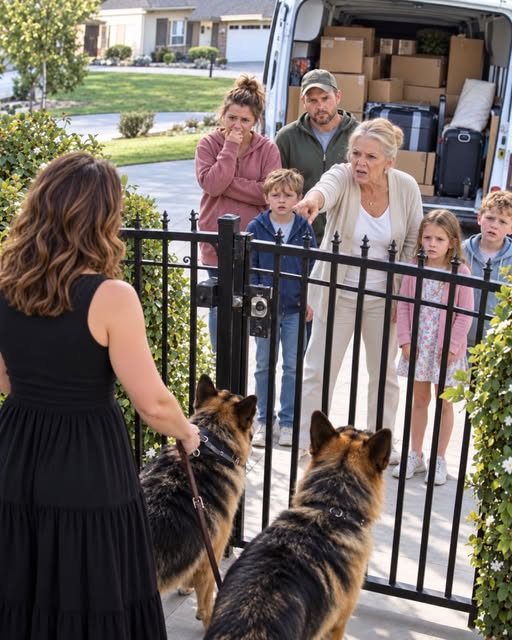
Twelve years later, they appeared outside the gates of the home and business I’d created, accompanied by three children, packed boxes, and a moving truck. They were already discussing which bedrooms they intended to occupy.
I watched them through the security camera, left the gate locked, and finally gave them an answer they’d never imagined hearing from me.
They still saw me as the obedient daughter who always surrendered whatever her sister wanted.
They had no understanding of what that locked gate meant to me, or how deliberately I’d protected everything behind it.
My mother’s first words weren’t a greeting.
“Open the gate, Paige. We’ve been driving for three hours, and the children are tired.”
Her voice emerged from the intercom beside my desk while I examined payroll records for my twelve employees.
On the security monitor, Diane Whitaker stood beneath the camera wearing a beige coat, her expression as impatient as I remembered from childhood.
My twin sister, Mallory, waited beside her husband and three children. A rented moving truck occupied half the gravel entrance.
Sealed cardboard boxes were stacked near the gate.
They’d packed everything without once checking whether I wanted them there.
Mallory approached the speaker.
“The downstairs suite will be perfect for us. The kids can use the rooms across the hall.”
Her husband, Grant, examined my separate workshop through the metal bars.
“Does that building have heat? I could set up a furniture business in there.”
I listened as they allocated my property among themselves, behaving as though I’d already consented.
Mom glanced toward the neighboring driveway.
“Don’t embarrass me by making everyone stand outside.”
For twelve years, I’d imagined what I might say if they ever returned needing my help.
In those fantasies, I always delivered a perfect speech.
But seeing them outside my locked gate, I realized I needed very few words.
Mallory and I were born seven minutes apart.
Our mother treated those seven minutes as evidence that my sister deserved to come first in nearly everything.
Mallory received the bedroom with a window, new winter coats, dance lessons, and birthday celebrations organized around her friends.
I inherited her worn clothing and constant reminders that I was easier to raise.
“You’re independent,” Mom would say whenever Mallory wanted something that belonged to me.
It sounded complimentary until I understood what she meant.
Being independent meant nobody felt obligated to support me.
Only our grandmother, Elaine, noticed the unfairness.
On Saturdays, she took me to estate sales and showed me how to evaluate damaged and repaired furniture.
“Never be ashamed of a crack,” she once told me. “Just pay attention to what caused it.”
At Grandma’s kitchen table, I could express an opinion without being accused of causing problems.
When she died during my final year of high school, the atmosphere at home deteriorated almost immediately.
Mallory stopped pretending to share.
Mom stopped pretending to treat us equally.
A few months after graduation, Mallory announced she was pregnant.
Her boyfriend, Grant, moved into our rented duplex carrying two laundry baskets, a huge television, and no dependable income.
Mom decided that my bedroom was the only space suitable for a crib.
I asked whether I could sleep on the couch until community college began.
“Grant has back trouble,” she said. “He may need the living room.”
“What about the basement?”
“We need it for baby supplies.”
Then she folded her arms and delivered the sentence that changed my life.
“You’re nineteen, Paige. At some point, you have to stop being my responsibility.”
Mallory stood behind her, one hand resting protectively against her stomach.
“You’ve always acted like you don’t need us,” she said. “This should be easy for you.”
I filled two trash bags with my belongings while they watched television in the next room.
Before I left, Mom gave me canned soup and crackers.
“Tell people you chose to move out,” she said. “It sounds more mature.”
For several weeks, I slept on friends’ floors.
When those temporary arrangements ended, I purchased an inexpensive tent and concealed it behind storage buildings at a roadside flea market outside Ridge Hollow.
Before work, I washed in gas-station restrooms. I stored my clean shirt inside a plastic grocery bag to protect it from the smell of wet grass.
One rainy afternoon, I was gathering shopping carts outside a supermarket when Mom drove past.
Our eyes met through her windshield.
Mallory sat in the passenger seat, laughing at something on her telephone.
My mother didn’t stop.
She drove away slowly enough that I knew she’d recognized me and deliberately chosen not to return.
That night, I held my prepaid phone for nearly an hour without dialing her number.
Instead, I made myself a promise.
## Part 2 — The Gate They Could Never Cross
One day, I would create a life secure enough that nobody could make me homeless again.
Not Mom.
Not Mallory.
Not anyone.
The following morning, I entered a small furniture-restoration business in Ridge Hollow and asked whether the owner needed help.
His name was Thomas Reed.
He was sixty-two, with silver hair, thick glasses, and hands permanently roughened by years of sanding wood.
He glanced at my worn shoes and the grocery bag containing my lunch.
“You ever restore furniture before?” he asked.
“My grandmother taught me.”
He pointed toward a damaged oak dresser in the corner.
“Show me.”
I worked on that dresser for six hours.
I replaced the broken drawer runners, repaired its cracks, smoothed the damaged edges, and uncovered the beautiful natural grain hidden beneath years of neglect.
When I finished, Thomas slowly ran his fingertips across the surface.
He remained quiet for a long moment.
Then he asked, “How much do you need to make to keep coming back tomorrow?”
I nearly burst into tears.
Not simply because he’d offered employment.
Because he’d asked what I needed rather than deciding what I deserved.
I began working for him the following Monday.
I cleaned the workshop, carried timber, restored chairs, and learned to calculate renovation costs. Every evening, I studied business management from secondhand textbooks purchased for a few dollars.
For months, my meals consisted mostly of instant noodles, and I slept wherever I could find temporary shelter.
Eventually, I saved enough to rent a tiny room above a laundromat.
Rainwater came through the ceiling, and its only window faced a brick wall.
But the room had a lock.
And I had its key.
On my first evening there, I locked the door three separate times.
Then I sat on the floor and cried until morning.
I wasn’t crying because my circumstances were difficult.
I cried because, for the first time since leaving home, nobody could force me out of my own room.
I didn’t call my mother.
I didn’t contact Mallory.
Neither made any effort to reach me.
Eventually, I heard that Mom was telling relatives I’d selfishly abandoned my pregnant sister.
Mallory claimed I’d always been jealous of her.
I allowed them to believe whichever version made them comfortable.
I had more important things to accomplish.
Three years later, Thomas retired.
Before leaving, he offered to sell me his business through an affordable payment agreement he’d carefully arranged.
The shop was far from impressive.
Its roof required repairs, two machines were older than I was, and the office at the back smelled of damp cardboard.
But it offered something I’d never truly possessed.
A future I could shape myself.
My hands shook when I signed the purchase documents.
Over the following seven years, I transformed the little shop into a restoration company specializing in historic properties, custom cabinets, and expensive furniture.
My first major contract involved restoring furnishings for a boutique hotel.
That allowed me to employ my first worker.
Then a second.
Then another.
I learned how to negotiate with suppliers, organize payroll, and distinguish worthwhile opportunities from costly mistakes.
I tracked every dollar.
Reviewed every agreement.
Documented every significant business decision.
Eventually, I purchased an industrial property outside Ridge Hollow and converted it into a larger workshop.
Later, I acquired the neighboring land.
Then I bought my house.
It stood in a peaceful area beyond the town’s old stone bridge, with a broad gravel driveway, a detached workshop, and enough surrounding property to provide the privacy I’d always wanted.
I wasn’t trying to impress anybody.
I wanted somewhere I could sleep without worrying about what another person might take away.
By then, my company employed twelve people.
I had a trustworthy accountant, a business attorney, and sufficient savings to survive a difficult year without losing everything.
I also installed security cameras throughout the property.
Thomas laughed when he saw them.
“Expecting trouble?”
“No,” I told him. “I’m making sure trouble doesn’t get to decide where I live.”
He stopped laughing.
Twelve years had passed without contact from Mom or Mallory.
Then, on an ordinary Tuesday afternoon, they arrived outside my gate with a moving truck.
Suddenly, I remembered standing in our old doorway at nineteen, clutching two trash bags while Mom explained why there was no room for me.
But this time, the doorway belonged to me.
And I controlled the keys.
“Paige!” Mom snapped through the intercom. “I know you’re in there.”
I pressed the microphone button.
“I am.”
Her expression changed.
“Good. Open the gate.”
“Why?”
She stared toward the speaker as though I’d answered in a foreign language.
“Because we’re moving in.”
I examined the stacked boxes.
“Who told you that you could move in?”
Mallory stepped closer, pushing her hair behind her ears.
“Oh, come on. Don’t make this complicated. We’re family.”
I almost smiled.
Twelve years.
No birthday telephone calls.
No Christmas cards.
Not even one message asking whether I was alive.
Yet now, standing outside my property, they had rediscovered the importance of family.
Mom lifted her chin.
“You have plenty of space. We need somewhere to stay while we get back on our feet.”
“Where are you staying now?”
“That’s not the point.”
“It seems relevant if you’re planning to move into my house.”
Grant approached the gate and inspected its lock.
“Look, Paige, we’ve had a rough few months. Mallory and I thought we could stay here temporarily. The kids need stability.”
I looked at the three children sitting near the open side door of the truck.
The eldest girl, perhaps eleven, watched me nervously.
The youngest boy clutched a stuffed dinosaur.
None of them was responsible for the adults’ behavior.
I understood that completely.
But caring about innocent children didn’t mean surrendering my property to their parents.
“How long is temporarily?” I asked.
Grant shrugged.
“A few months. Maybe six.”
Mallory interrupted.
“Mom thinks we should take the downstairs suite. The boys can share one room, and Sophie can have the other. Grant could use the workshop until we find a place.”
I stared at her.
She’d already selected bedrooms.
Allocated the workshop.
And decided that everything I’d worked for should become available whenever her family needed it.
“Did you bring a lease?” I asked.
Mallory frowned.
“What?”
“An agreement. Anything showing that I invited you to live here?”
Mom’s expression hardened.
“Don’t be ridiculous. I’m your mother.”
“And I’m the owner of this property.”
The silence that followed was almost satisfying.
Almost.
Because some small, foolish part of me still wanted Mom to say the words I’d waited twelve years to hear.
That she was sorry.
That she shouldn’t have forced me out.
That she should have protected me.
Instead, she said, “You owe me more respect than this.”
I released the intercom button.
Then an old memory returned.
Standing in the rain outside that supermarket, watching Mom drive away.
Remembering how desperately I’d wanted her to turn around.
She never had.
I pressed the button again.
“You need to leave.”
Mom blinked.
“Excuse me?”
“This is private property. You do not have permission to enter. Take your truck and go.”
Mallory laughed in disbelief.
“You cannot be serious.”
“I am.”
Her cheeks reddened.
“You have a huge house! You have a business! We have three children!”
“And I built this life without your help.”
Mom’s mouth dropped open.
Then she delivered what sounded like a rehearsed accusation.
“We are the reason you exist, Paige. The least you could do is help your own family.”
I looked directly toward the camera.
“No, Mom. You gave birth to me. You didn’t build my life.”
She began shouting.
I disconnected the intercom.
For several moments, I watched them argue among themselves on the monitor.
Then Grant approached the gate and pulled at it.
He tested the latch.
Shook the metal bars.
Finally, he turned toward Mallory and said something I couldn’t hear.
The security cameras recorded every movement.
I saved the footage.
I had no desire to use it unnecessarily.
But experience had taught me that people could dispute memories.
Written and recorded evidence was more difficult to change.
They refused to leave.
Instead, Mom sat on a moving box beside the gate and began making telephone calls.
Ten minutes later, my phone rang.
Aunt Patricia.
“Paige, sweetheart, your mother says you’re refusing to help her.”
“I am refusing to let her move into my house without permission.”
“But she says you’ve got so much room.”
“I do.”
“And your sister is struggling.”
“I understand.”
“Then why won’t you help?”
I looked through my office window.
In the workshop, my employees were completing custom cabinets for a local restaurant.
“Because helping someone doesn’t mean handing them control over everything you’ve worked for.”
Patricia sighed.
“Your mother says you became wealthy and forgot where you came from.”
Something inside me settled.
“No, Aunt Patricia. I remember exactly where I came from.”
I ended the conversation politely.
Then returned to my work.
For another hour, I ignored the continuing calls.
At 4:37 p.m., my office manager, Rebecca, knocked.
“Paige, there’s a woman at reception asking for you.”
“Who?”
“Your mother.”
I stared at her.
“How did she get inside the property?”
“She came around to the employee entrance while the delivery driver was leaving. Security stopped her before she reached the building.”
I stood.
“Please ask her to wait outside the office. I’ll speak with her there.”
Rebecca hesitated.
“Do you want me to call the police?”
“Not yet. Just keep the doors secured.”
When I reached reception, Mom stood beside the glass entrance holding a thick envelope.
Her expression had changed.
She no longer appeared furious.
She looked wounded.
It was the expression she’d perfected whenever she wanted someone else to feel responsible for her unhappiness.
“I knew you’d come to your senses,” she said.
I stopped several feet away.
“What do you want?”
She extended the envelope.
“Your sister needs money. They’ve fallen behind on their mortgage, and Grant’s business hasn’t been doing well. We thought you could help them get caught up.”
“How much?”
“Eighty thousand dollars.”
I stared.
Eighty thousand.
Not a few hundred for food or a small emergency payment.
Eighty thousand dollars.
“Did Mallory ask you to come here?”
“Of course.”
“Did she ask me herself?”
Mom hesitated.
“She knew I’d explain it better.”
I almost laughed.
“You drove three hours with a moving truck to claim my house, and now you’re asking me for eighty thousand dollars?”
“Don’t make it sound so ugly.”
“What would you call it?”
She tightened her fingers around the envelope.
“I raised you.”
“And then you put me out.”
Her eyes narrowed.
“That was twelve years ago. Are you going to punish us forever?”
“No. I’m going to live my life.”
She glanced toward the office corridor.
“Your grandmother would be ashamed of you.”
Those words still hurt.
Grandma Elaine was the only person who’d consistently made me feel valuable.
Mom knew that.
She knew precisely where to strike.
For an instant, I felt nineteen again, standing in our old kitchen and wondering why affection always came with demands I couldn’t satisfy.
Then I remembered Grandma’s hands smoothing the damaged oak dresser.
Never be ashamed of a crack.
Just pay attention to what caused it.
I looked at my mother.
“Don’t use Grandma to make me feel guilty.”
She became still.
“I loved her,” I continued. “She taught me how to work. She taught me how to stand on my own feet. She taught me that being family doesn’t give anyone permission to hurt you.”
Mom’s eyes flickered.
“And she would never have wanted you to become this cold.”
“Grandma would have asked why you never checked whether I had a place to sleep.”
For once, Mom had no immediate reply.
I continued before she could invent another accusation.
“I slept in a tent behind a flea market. I washed in gas-station bathrooms. I worked until my hands cracked because I couldn’t afford to stop. You saw me outside that grocery store, and you drove away.”
Mom lowered her eyes.
“I was upset.”
“So was I.”
“I didn’t know what to do.”
“You could have stopped the car.”
Tears filled her eyes.
For one dangerous moment, I thought she might finally apologize.
Instead, she whispered, “I had Mallory to think about.”
There it was.
Even now.
After twelve years.
Standing inside the company I’d built through my own efforts.
Mallory still came first.
I nodded slowly.
“Thank you for reminding me.”
I turned toward the entrance.
“Paige, wait.”
I stopped without facing her.
“You can’t just abandon your mother.”
I looked back.
“You taught me how to live without you. I’m simply very good at it now.”
Then I asked Rebecca to escort her outside.
By six that evening, the moving truck remained beside the gate.
Mallory paced impatiently.
Grant had started making calls.
The children were hungry and exhausted.
I watched the security footage before deciding what to do.
I contacted a local family-support organization and asked whether emergency accommodation was available for two adults with three children.
It was.
I gave Mallory the organization’s telephone number through the intercom.
I also arranged for a nearby restaurant to deliver dinner for the children, paying the restaurant directly.
I didn’t offer my house.
Grant couldn’t use my workshop.
And I wasn’t handing over eighty thousand dollars.
When Mallory learned about the arrangements, she stormed toward the gate.
“You’ll pay for this,” she shouted.
I responded through the speaker.
“The children aren’t responsible for our history. That’s why I arranged dinner and gave you a place to ask for help.”
“We don’t need charity!”
“Then you don’t have to accept it.”
She glared at the camera.
“You think you’re better than us because you have money?”
“No. I think I’m responsible for what I built.”
“Mom says you owe us!”
“Mom can say whatever she wants.”
Mallory moved closer.
“You were always the selfish one.”
I took a steady breath.
“Mallory, when we were children, I gave you my winter coat because Mom said you needed it more. When you wanted the bedroom with the window, I took the smaller room. When you became pregnant, I was the one who was told to leave.”
Her expression hardened.
“You offered to give up your room.”
“No. I asked if I could sleep on the couch.”
“You’re twisting everything!”
“I’m remembering it.”
She looked away briefly.
Then said something that revealed how she still viewed our childhood.
“You always made things difficult by acting like you were the victim.”
I stared at her through the monitor.
“I was homeless at nineteen, Mallory.”
“And I was pregnant!”
The words seemed to hang between us.
That was her justification.
For twelve years, she’d used the same reasoning.
Because she was pregnant, I had to leave.
Because she now had children, I should surrender my home.
Because she had financial problems, I owed her my savings.
There was never a point when my needs counted equally.
I pressed the intercom button for the final time.
“You have until seven o’clock to move the truck off my driveway. If you refuse, I’ll contact the authorities to have the trespass addressed.”
Mallory stared up toward the camera.
“You wouldn’t do that to your own sister.”
“I already gave you twelve years to remember you had one.”
I switched off the monitor.
At 6:52 p.m., the moving truck finally departed.
But their demands weren’t finished.
The following morning, my attorney called.
“Paige, I wanted to let you know that your mother contacted my office.”
I leaned back.
“What did she want?”
“She claims you promised to provide housing for Mallory and her family. She says you made a verbal agreement several months ago.”
I closed my eyes.
Of course.
When guilt failed, they changed tactics.
“Did she provide any evidence?”
“No. But I recommend that you preserve all communications and security footage. Given what happened yesterday, it’s worth documenting everything.”
“I already saved it.”
“Good. Also, I want you to know that your mother mentioned your grandmother’s estate.”
My attention sharpened.
“What about it?”
“She claims you received money from Elaine that your sister was entitled to share.”
I sat motionless.
Grandma Elaine had left me a modest inheritance when she died.
It hadn’t transformed my finances, but it helped pay for my earliest community college classes and the deposit on the room above the laundromat.
I’d never concealed receiving it.
What I hadn’t realized was that Mom had been circulating a different version of the inheritance among relatives.
“What exactly is she claiming?”
“That you received more than your fair share.”
I asked my attorney to send every available document.
An hour later, I was examining the old estate records.
Grandma’s will was unambiguous.
She had left me a small sum and a handwritten letter.
Mallory had received her own separate gift.
Everything had been properly recorded during the estate administration.
There was no hidden money.
No questionable transaction.
No outstanding obligation.
My attorney reviewed the papers and confirmed it.
“They have no apparent basis for this claim,” he said. “Keep everything. Don’t argue with them directly. If they make a formal demand, we’ll respond through the appropriate channels.”
I thanked him.
Then opened a drawer beneath my desk.
Inside rested a small wooden box I’d carried from one home to another for twelve years.
Grandma’s letter was still there.
Its edges had yellowed with age.
Although I’d read it hundreds of times, I unfolded it once more.
My dearest Paige,
You have a habit of believing that being easy to love means asking for less.
It doesn’t.
Never make yourself smaller to keep someone else comfortable.
You are allowed to have a home of your own. You are allowed to say no. And you are allowed to walk away from people who only remember your name when they need something.
If you ever feel lost, remember that good things can be repaired, including a life.
Love, Grandma Elaine.
I pressed the paper against my chest.
For years, I believed my greatest accomplishment was creating a successful business.
But that afternoon, I recognized something more important.
I’d endured hardship without becoming someone who deliberately hurt others simply because she had the power to do so.
I could defend my property without humiliating Mallory’s children.
I could refuse my mother without wishing suffering upon her.
I could acknowledge what they’d done without allowing those memories to control every future decision.
That was what separated us.
They believed power meant obtaining whatever they wanted.
I’d learned that genuine strength involved saying no and accepting that decision without seeking anyone’s approval.
Three days later, Mallory sent me a message.
It was the first personal message she’d sent in twelve years.
The kids keep asking why their aunt won’t let them stay with her.
I read it twice.
Another message followed.
I hope you’re happy. Mom has been crying all day.
I didn’t answer.
A minute later, she sent a photograph showing the children sitting on the floor of a modest temporary apartment.
Sophie held the same stuffed dinosaur I’d noticed inside the truck.
The boys were eating pizza from paper plates.
Their surroundings were simple, but the room looked warm and clean.
I examined the picture for a long time.
I felt sympathy for those children.
And sadness for the nineteen-year-old girl I’d once been.
But I didn’t feel guilty.
The children had safe shelter.
Their parents had access to resources that could help them secure permanent housing.
Mallory and Grant had options nobody had offered me twelve years earlier.
Eventually, I typed a reply.
I’m glad the children have somewhere safe to stay. I hope you use this time to make a stable plan for your family.
That was all.
No financial assistance.
No promises.
No invitation to move in.
Only a sincere hope that they’d find a way forward.
Mallory read the message without responding.
For several weeks, I heard nothing.
Eventually, Aunt Patricia mentioned that Mallory and Grant had found a smaller rental property.
Grant had accepted a position with a local furniture company while attempting to rebuild his business.
I was relieved that the children were doing better.
I didn’t request further details.
I didn’t send money.
And I didn’t reopen my gate.
Six months later, my workshop held a small celebration.
Our team had completed the restoration of a historic inn, and its owners invited all our employees to the reopening.
Thomas attended wearing the same old brown jacket he’d worn the day I first entered his shop seeking work.
He stood beside me as my employees gathered for a photograph.
“You built something good here,” he said.
I looked at the people who’d helped transform a struggling little workshop into a thriving company.
“I had help.”
“That’s true,” he replied. “But you had to be willing to keep going before anyone knew your name.”
After the celebration ended, I drove home.
Evening sunshine stretched across the gravel driveway.
Beyond the gate stood my house, peaceful and welcoming, while lights glowed inside the workshop in the distance.
For years, I’d believed success would mean proving Mom wrong.
I imagined that owning a beautiful home, employing twelve people, and having enough savings to feel secure would finally give me satisfaction.
But standing there, I understood I no longer needed my mother’s regret to validate my achievements.
I didn’t require Mallory to admit she’d been wrong.
I didn’t need an apology to prove the past had happened.
What I’d endured at nineteen mattered, whether they acknowledged it or not.
And what I’d created afterward mattered, whether they appreciated it or not.
I unlocked the gate and drove onto my property.
Then I closed it behind me.
Not because I feared the world.
Not because I was seeking revenge.
But because I’d finally understood something my younger self desperately needed to learn.
A locked gate isn’t necessarily a symbol of resentment.
Sometimes it marks the boundary between a life others expect you to sacrifice and the future you’ve struggled to create.
My mother once told me I was no longer her responsibility.
She intended those words as punishment.
I spent twelve years turning them into a personal promise.
I would take responsibility for my future.
I would protect my peace.
I would decide who entered my home.
And I would never again mistake being a loving daughter, sister, or decent person for allowing others to take everything I owned.
My name is Paige Whitaker.
At nineteen, I left home carrying two garbage bags.
At thirty-one, I stood behind a gate I owned, with a house I’d earned and a company I’d created.
Mom and Mallory had arrived expecting the quiet girl who always moved aside.
They departed having discovered that the daughter they’d pushed away had finally learned to defend herself.
For the first time in my life, I refused to step aside.
I didn’t shout.
I didn’t beg them to understand.
I simply kept the gate locked.
Leave a Reply