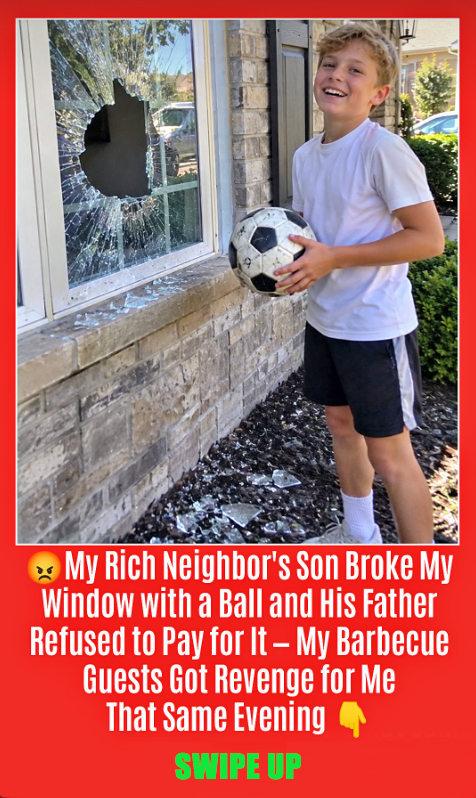
A baseball came through my kitchen window in the middle of my barbecue. My neighbor refused to pay for the damage, but by the end of the night, some of my guests clearly had plans of their own.
My name is Melissa, and last Saturday, I hosted our annual summer barbecue in the backyard, with twenty-some neighbors and friends packed in for burgers and lawn games under the string lights I’d spent all afternoon carefully hanging up myself.
Around six, a loud crack echoed suddenly from the side of my house.
For half a second, everyone seemed to freeze.
Then I heard someone yell my name.
I hurried through the back door and stopped in the kitchen.
My big window over the sink had a baseball-sized hole punched clean through it.
Glass covered the countertop, glittered across the floor, and had even landed in the dish rack beside the sink.
Through the broken window, I could see my neighbor’s 12-year-old son, Tyler, standing frozen in his backyard next door.
He still had the bat in his hand.
He looked genuinely terrified.
“Tyler?” I called.
His mouth opened, but nothing came out.
About a minute later, his father appeared.
Richard lived next door and made sure everyone knew he had money.
He drove a brand-new Range Rover and seemed incapable of having a conversation without eventually mentioning that he owned three separate car dealerships in town.
He walked across his yard, looked at Tyler, then glanced at my shattered window.
“Kids will be kids,” Richard said. “It’s just a window, relax.”
I actually thought I’d misheard him.
“It’s a $600 window, Richard, and it’s the second one this year alone,” I said, trying to stay calm in front of my guests. “I need you to cover the cost of the repair this time.”
Actually laughed out loud.
“I’m not paying for something that happens in every single backyard across America,” he said. “You’re overreacting a little, don’t you think?”
Behind me, I could feel people on the patio pretending not to listen.
Tyler still hadn’t moved.
Richard looked at his son.
Then he walked back inside without saying another word to me.
I stood there looking at the hole in my kitchen window, embarrassed and furious in equal measure.
The first broken window earlier that year had been smaller and cheaper to repair.
Tyler had accidentally sent a ball into another window on the side of the house, and Richard had brushed that one off too.
Now I had glass all over the room where I’d spent the morning preparing food for more than 20 people, and somehow I was the unreasonable one for expecting the parent of the child responsible to pay for it.
A few guests helped me clean up the worst of the mess.
We moved food away from the kitchen and made sure nobody walked barefoot inside.
Then I went back to my party.
I did my best not to let Richard ruin the whole evening.
Several people had clearly overheard the exchange, but I didn’t say another word about it.
Neither did any of my guests.
At least not directly to me.
Around nine, people began slowly heading home.
I was collecting paper plates when I noticed a small cluster near my fence line.
Five or six people were standing together, talking low.
Every few seconds, one of them glanced toward Richard’s dark driveway next door.
His Range Rover sat there under the driveway lights.
I watched Caleb, one of my friends from down the street, fold something and put it in his pocket.
Another neighbor whispered something to him.
One of the guests noticed me watching, gave me a small, knowing smile, and headed out through the gate into the night.
Caleb stayed behind with the others. He looked up when I approached.
I immediately crossed the yard.
“Okay,” I said quietly. “What are you doing?”
“That is not reassuring.”
Someone behind him snorted.
I looked toward Richard’s driveway again.
“If you’re planning to do something to his car, don’t.”
“Adults do stupid things too.”
He reached into his pocket and unfolded the paper.
At the top, he’d written an offer to purchase Richard’s Range Rover.
I looked at the number and frowned.
“Because it’s about six hundred bucks less than what he’d probably consider a reasonable offer.”
Then I saw the line at the bottom.
Another neighbor held up her own folded piece of paper.
Apparently, during the previous hour, they had been writing ridiculous mock purchase offers for Richard’s SUV. Every offer was slightly different, but each one was deliberately about $600 too low.
And every one ended with some version of Richard’s own words.
“You people are terrible,” I said.
“Do you want us to stop?”
I looked at the broken kitchen window.
Then at Richard’s perfect SUV.
“You’re not touching anything except the windshield wipers.”
“Then I didn’t see anything.”
Within 10 minutes, there were more than a dozen folded notes tucked under Richard’s windshield wipers.
I laughed harder than I had all evening.
But what happened next made the whole thing feel less funny.
While we stood near the fence, my older neighbor, Lisa, shook her head.
“He does this every time.”
“Tyler breaks something.”
“I thought I was the only one.”
Over the next few minutes, I learned that Tyler had knocked over part of Lisa’s flower bed the previous summer while chasing a ball.
Another neighbor had lost a decorative porch light during a backyard game.
Just normal kid mistakes.
But Richard’s reaction was apparently always the same.
Don’t make a big deal out of it.
I felt my amusement fade.
“Why has nobody ever said anything?”
“Because each thing seemed too small to start a neighborhood war over.”
“Exactly,” Caleb said. “That’s probably why he keeps doing it.”
Before I could respond, a light came on next door.
Richard’s front door opened.
We scattered back toward my patio with the maturity of teenagers caught sneaking out after curfew.
Richard walked toward his SUV.
He noticed the papers almost immediately.
He pulled one from under the windshield wiper.
His face changed as he realized what they all had in common.
“Oh. Just the windshield wiper.”
“You don’t touch somebody else’s vehicle.”
That was when I almost laughed again.
Richard pointed toward his SUV.
“People need to learn some respect for other people’s property.”
The entire patio went quiet.
I don’t think Richard heard himself until the silence hit him.
“This is childish, Melissa.”
“I didn’t write the notes.”
“But you’re allowing this.”
“You’re making a scene over $600.”
One of the neighbors called from behind me, “They’re just pieces of paper, Richard. Relax.”
Richard’s face turned red.
Then Tyler appeared at the front door.
He had changed out of the clothes he’d been wearing while playing baseball. He stood on the porch listening.
Richard held up one of the notes.
“This is what happens when adults can’t let an accident go.”
Then at my broken window.
“I still broke it,” he said quietly.
“Then stop acting like you committed some horrible offense.”
Something about Tyler’s expression bothered me.
“I still broke it,” he repeated.
Richard pressed his lips together.
Tyler went back into the house.
The rest of us stood there in an uncomfortable silence.
Richard pulled the remaining notes from his windshield, crushed them together, and went inside.
The revenge should have felt satisfying.
For a few minutes, it had.
But Tyler’s face stayed with me.
Most of the remaining guests left soon afterward.
As Lisa was saying goodnight, she paused at my gate.
“There’s something you should know.”
She looked toward Richard’s house.
“After Tyler wrecked my flower bed last summer, he came over the next morning.”
“That’s the thing. Richard didn’t know.”
She told me Tyler had shown up at her door and asked whether he could help fix the flower bed.
When Lisa told him some of the plants were ruined, he offered to do yard work to earn enough money to replace them.
“He was probably 11,” she said. “I wasn’t going to take money from him, obviously. I told him helping me replant would be enough.”
According to Lisa, Richard had walked over and demanded to know what Tyler was doing.
When Tyler explained, Richard had become annoyed.
“He told him not to let people guilt him into paying for normal childhood accidents,” Lisa said. “Then he took him home.”
Suddenly I remembered Tyler standing with the bat earlier.
I’d assumed he was afraid of getting punished.
Now I wondered whether I’d read that moment completely wrong.
Maybe Tyler hadn’t been afraid his father would get angry about another broken window.
Maybe he’d already known exactly what Richard would do.
Make me feel unreasonable.
And prevent Tyler from doing anything about it.
“Why didn’t you tell me before?”
Lisa gave me a tired smile.
“I didn’t think it mattered until tonight.”
After she left, I started cleaning the patio.
Most of the string lights were still glowing overhead.
The yard looked oddly peaceful after everything that had happened.
I was carrying a stack of cups toward the house when I heard a knock at my side door.
He was holding an envelope.
He looked toward my kitchen.
“Is there still glass everywhere?”
Then he held out the envelope.
“This is for the window.”
That made my heart ache more than any dramatic speech could have.
He extended the envelope again.
“I can give you the rest later.”
“No, because I’m not taking your savings.”
I leaned against the doorframe.
“And you’re going to help make it right. That’s different from emptying your savings account because your dad won’t take responsibility.”
He stared at the envelope.
I looked toward the kitchen.
“You can come by tomorrow and help me with the cleanup after I get the dangerous glass out. There’ll still be plenty to do.”
“You did the right thing coming over.”
“Don’t tell my dad about the money.”
Before I could answer, I heard footsteps behind him. Richard had apparently followed Tyler over from next door.
“About what money?” he asked.
“What are you doing here?”
Tyler held the envelope against his chest.
“I was paying for the window.”
“You took money from my son?”
“I didn’t take anything.”
“I told you this was handled.”
“No,” I said. “You told me it wasn’t your problem.”
Richard looked irritated.
He reached for Tyler’s envelope.
Richard’s expression hardened.
“We’ve been through this.”
Tyler’s voice shook, but he kept going.
“I broke her window. Why shouldn’t we fix it?”
The question none of Richard’s neighbors had been able to make him answer.
Richard glanced toward my kitchen window. Then toward his driveway, where those notes had been stuck beneath his windshield wipers less than an hour earlier.
I could see the anger leaving his face, replaced by something less comfortable.
“Your son has tried more than once to take responsibility for things he’s damaged. You’re the one stopping him.”
“I don’t want people taking advantage of him.”
Apparently that was enough for him to understand she’d told me.
“Nobody is saying Tyler is a bad kid because he broke a window. Kids make mistakes. Adults do too.”
“But if your answer every time is that nobody should care because you don’t care, what exactly are you teaching him?”
Tyler stared at the ground.
For once, Richard didn’t have a quick response.
Finally, he said, “Go home, Tyler.”
“Tomorrow morning,” I said. “You can help clean.”
The next morning, a little after ten, someone knocked on my front door.
Richard stood there holding a check.
He handed it to me without ceremony.
“I should’ve handled it differently,” he said.
It wasn’t a dramatic apology.
It wasn’t especially warm.
But considering the man I’d argued with the night before, it was something.
He nodded toward the kitchen.
Richard looked down at the driveway.
A few minutes later, Tyler arrived wearing work gloves that were much too big for him.
I’d already removed the dangerous shards, so I gave him a broom and showed him where the smaller pieces had scattered.
We worked quietly for a while.
At one point, he looked at the temporary covering over the window.
“But I’m not mad at you for making a mistake.”
He seemed to think about that.
“What are you mad about?”
“People pretending mistakes don’t matter just because fixing them is inconvenient.”
Then he went back to sweeping.
Later, after he left, I found his envelope sitting on the counter.
He must have slipped it there when I wasn’t looking.
I carried it straight back next door.
He looked at the envelope but didn’t take it immediately.
“He left it here anyway?”
For the first time since I’d known him, he didn’t have anything clever to say.
The window was replaced a few days later.
The Range Rover survived its devastating encounter with several pieces of paper.
And yes, Richard still drives it around like he’s personally responsible for inventing luxury vehicles.
But something changed after that barbecue.
Richard didn’t become a completely different person overnight.
But when Tyler’s ball rolled into my yard a couple of weeks later, he came over and asked before retrieving it.
“Thanks,” he said when I handed it back.
“Try aiming the other direction.”
I’d started that Saturday thinking the issue was simple.
A kid had broken my $600 window, and his rich father refused to pay for it.
By the end of the weekend, I understood that the broken glass wasn’t really what bothered me most.
Tyler had made a mistake and wanted to fix it.
Richard had turned that mistake into something worse by teaching his son that responsibility was weakness and that money only mattered when it belonged to you.
My guests got their revenge by making him experience his own argument from the other side.
But the thing that finally reached him wasn’t the notes.
It was his son standing in my yard with $143 he’d saved himself, asking one question his father couldn’t answer.
Would you accept money from a child who wanted to make amends for something they broke if you knew their parent should really be paying?